Shipbuilding Without Shipbuilders — and a Flag Without a Fleet

By Karl Garcia
We boast that we are the world’s “fourth-largest shipbuilder,” a line lifted from an OECD report that counted repair yards and workforce size. But UNCTAD’s actual tonnage data tells a harsher truth: we produce barely 1% of global output, far behind China, Korea, and Japan. “Fourth” is not strength; it is statistical luck.
The Philippines wants two big maritime dreams at once: to revive shipbuilding and to become a competitive ship registry — a “flag of convenience.” Both are ambitious. Both depend on something we keep forgetting: talent and industrial depth.
And we lack the one ingredient every real shipbuilding nation has: a deep bench of naval architects, marine engineers, and systems specialists. Our best graduates leave for Japan, Korea, or Europe. Without design talent and integration capability, even the best shipyard incentives will not build a real industry. At best, we remain a repair nation; at worst, a labor exporter with big slogans.
The government’s instinctive solution is scholarships. But look at agriculture: scholarships were created, but graduates walked away — because the jobs were outdated, the pay was poor, and the industry was stuck. If we repeat this mistake in shipbuilding, we will simply train people for export.
A real maritime industrial policy must link scholarships to actual industry demand:
– guaranteed jobs in modernized, competitive shipyards,
– specialization tracks from design to green retrofits to recycling,
– service agreements with pay that can compete internationally,
– and an ecosystem where they can actually practice: R&D incentives, supplier networks, and a transparent regulatory regime.
This matters not just for shipbuilding — but also for our push to become a flag of convenience through the Ship Registry bill. We will never match Singapore’s tight governance, credibility, or brand — they are a small but gifted maritime nation with world-class institutions. But we can compete on tax incentives, tonnage fees, and speed of service, if we do it with discipline and clear-cut cost–benefit accounting. A registry is a business: the economics must work.
But here’s the catch: no serious shipowner registers under a flag that cannot manage its own maritime competencies. A weak talent pipeline, fragmented agencies, and inconsistent enforcement undermine both shipbuilding and any registry ambition.
If the Philippines wants to matter in the maritime world — as builder, recycler, or flag — we need more than slogans. We need the people who build ships, inspect ships, and regulate ships — and we need to keep them.
Because the truth is simple and unavoidable:
You cannot be a shipbuilding nation — or a flag of convenience — if you cannot keep the people who make ships possible.


 The Society of Honor by Joe America
Yes, the Philippines faces a significant shortage of Naval Architects and Marine Engineers (NAMEs) due to very few universities offering the specialized course, leading to low numbers of licensed professionals, despite high demand from the growing shipbuilding, repair, and maritime sectors, creating a critical gap for national maritime development. This scarcity impacts the country’s ability to build advanced vessels, prompting government bodies like CHED, MARINA, and PRC to promote the profession and encourage more graduates.
Key Reasons for the Shortage
Impact on the Industry
Efforts to Address the Shortage
What are Naval Architects?: Job Opportunities in the Philippines
The term architect is often associated with a professional who is qualified to design, plan, advise and aid the construction of houses and buildings. Naval Architects are professionals who manage, supervise, lead, and perform professional architectural, engineering, and scientific work relating to the form, strength, stability, performance, and operational characteristics of marine structures and waterborne vessels; and all types of naval crafts and ships operating on the sea surface.
There are only a handful of colleges and universities that offer a degree in Naval Architecture and Marine Engineering and some of which are Asian Institute of Maritime Studies, , Mariners Polytechnic College Foundation – Baras, Namei Polytechnic Institute, University of Cebu, and University of Perpetual Help System DALTA – Las Pinas.
According to the Professional Regulation Commission, there are only approximately 400 Naval Architects and Marine Engineers in the Philippines. Given that there’s only a handful number of licensed professionals nationwide, the demand for Naval Architects and Marine Engineers may be high.
The Philippines itself is not considered a “flag of convenience” (FOC) country; rather, a substantial number of Filipino seafarers work on ships registered under FOC flags. This is a common phenomenon because the Philippines is a major global supplier of maritime labor, and FOC vessels make up a significant portion of the world’s merchant fleet.
The Philippines and the FOC System
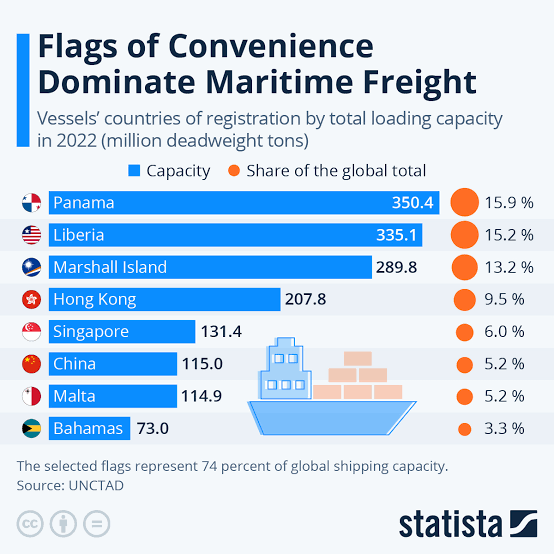
Shipowners use FOC registries—such as Panama, Liberia, the Marshall Islands, Malta, and the Bahamas—to reduce costs, sidestep stringent labor regulations, and benefit from low or non-existent taxes.
“Chances” for Filipino Seafarers
For Filipino seafarers, the “chances” related to FOCs generally refer to the high likelihood of being employed on such vessels. This presents a mixed picture:
In summary, the “chances” of a ship being a flag of convenience in the Philippines is irrelevant as the country does not offer that registry. However, the chances of a Filipino seafarer working on an FOC-flagged ship are very high.
Yes, the Philippines can act as a flag of convenience (FOC) by attracting foreign ships to register there for laxer rules and lower costs, but it’s also a major source of seafarers for FOCs, with calls from groups like the ITF to strengthen its own flag and combat FOC abuse for Filipino workers. While recent laws opened Philippine domestic shipping to more foreign investment, the country is seen by some as needing to become a more competitive open registry (like Panama or Liberia) to counter exploitation, though this involves balancing economic gains with protecting Filipino seafarers.
How the Philippines functions in the FOC system:
Challenges & Activism:
In essence, the Philippines is deeply involved in the FOC system, both as a victim (supplying labor) and potentially as a participant (attracting registration), with ongoing debates on how to leverage its maritime position for national benefit while ensuring seafarer welfare.
📌 Core Themes & Takeaways
Filipino seafarers are described as a distinct form of migrant workers — “sea-based” and without a fixed host country. Instead of settling in one nation, they traverse international waters throughout their contracts, forming a unique diaspora at sea.
The Philippines is a major supplier of seafarers globally:
Historically accounting for a substantial share of the world’s placed seafarers.
Data in the presentation cited figures like approximately 347,150 Filipino seafarers around 2010.
The Philippines also had a large number of maritime schools and crewing agencies supporting global deployment.
FOCs are merchant ships registered in countries other than the shipowner’s country to reduce costs and avoid stricter labor regulations.
Many Filipino seafarers work on FOC-registered ships, where:
Philippine labor laws generally do not apply while they are at sea.
This limits legal protections and enforcement of labor standards for Filipino workers aboard these ships.
Because seafarers work on international waters and vessels flagged in other countries:
Philippine domestic labor protections do not extend onboard.
International maritime labor standards exist, but enforcement for seafarers remains uneven.
This situation contributes to vulnerabilities in terms of wages, rights, insurance, and legal recourse.
Government agencies like the Philippine Overseas Employment Administration (POEA), Department of Foreign Affairs, and Maritime Industry Authority (MARINA) work to support seafarer welfare.
There are also NGO efforts focused on advocacy and assistance.
📌 Conceptual Points on Diaspora
Rather than just geographic dispersion, the presentation frames Filipino seafarers’ diaspora as:
✔ A transnational labor migration — mobility across oceans and flags.
✔ A social identity tied to maritime work, often distant from home for months.
✔ Distinct from land-based migrants because of the environment (sea) and legal complexities of maritime employment.
📌 Why This Matters
This study highlights:
The global role of Filipino seafarers as key players in international shipping.
How regulatory systems (like FOC) shape their working conditions.
Gaps between national labor protections and the realities of seafarers working under international flags.
The need for better governance, advocacy, and legal frameworks to protect this labor diaspora.
A Flag of Convenience is not just about registration—it is about regulatory behavior.
FOC states typically offer:
Low taxes and fees
Fast, cheap ship registration
Minimal inspections
Weak labor enforcement
Limited accountability when violations occur
Classic FOC examples:
Panama
Liberia
Marshall Islands
They dominate world tonnage—but not worker protection.
Under international law (UNCLOS, SOLAS, MLC 2006):
If the Philippines becomes an FOC:
PH authorities must inspect and police thousands of foreign-owned vessels
Any failure becomes our legal and moral responsibility
Seafarer abuse on PH-flagged ships becomes a Philippine failure
Given existing challenges in:
Port State Control capacity
Regulatory enforcement
Corruption risks
Maritime manpower shortages
This is a dangerous trade-off.
❌ Myth: “If ships are PH-flagged, Filipinos are protected”
Reality:
Flag ≠ protection
Enforcement quality matters more than nationality
Many FOC ships:
Delay wages
Ignore rest hours
Overwork crews
Skirt safety maintenance
Abandon seafarers during crises
If PH becomes lax to attract registrants, Filipino seafarers become cheaper—not safer.
The Philippines is:
🌍 #1 supplier of seafarers globally
💵 A major recipient of maritime remittances
🎓 A global maritime training hub
Yet:
We are not an FOC state
Filipino seafarers work across many flags
Their protection comes from:
MLC enforcement
Port State Control by strict countries (EU, Japan, Australia)
Union pressure and international scrutiny
Turning PH into an FOC adds risk without clear benefit.
Seafarer safety improves when a country focuses on:
✅ Strong labor enforcement (not cheap registration)
Zero tolerance for wage theft
Mandatory rest hour audits
Mental health and fatigue management
✅ Port State Control excellence
Aggressive inspections abroad
Blacklisting abusive operators
Detention powers used decisively
✅ Crew-first maritime diplomacy
Legal support for abandoned seafarers
Fast consular response
Flag-state prosecution of violators
✅ Selective, high-standard flagging (not FOC)
Small but premium registry
Only reputable shipowners
Higher fees → better enforcement
This is the “quality flag” model, not FOC.
If PH becomes an FOC:
We risk reputation downgrade
Filipino crews may be seen as part of a “cheap-flag ecosystem”
Abuse cases would damage our seafarer brand
Long-term wages and bargaining power decline
Once a country becomes known as a weak flag, it is very hard to recover.
Instead of FOC status, the Philippines should aim to be:
That means:
Labor-superpower, not flag-superpower
Enforcement credibility over ship count
Seafarer welfare as national strategy
High-standard niche registry (optional, not mass FOC)
Bottom line
Being a Flag of Convenience would not make Filipino seafarers safer.
It would:
Increase enforcement burdens
Invite regulatory shortcuts
Risk reputational damage
Potentially worsen labor abuse
Safety comes from strong institutions—not convenient flags.
Because the Philippine state is chasing short-term rent and prestige while underestimating long-term governance risk.
That sounds blunt—but it is the most accurate explanation. Let’s unpack it carefully and structurally.
💰 Registration rents
FOC promises:
Registration fees
Annual tonnage dues
Minimal capital outlay
No need to own ships
For a fiscally constrained state, this looks like:
But this is low-quality revenue—high liability, low multiplier.
🏛️ Bureaucratic prestige
A large registry:
Signals “maritime power” on paper
Boosts agency budgets
Expands regulatory turf (MARINA, DOTr, etc.)
It creates institutional incentives even if national outcomes worsen.
Many policymakers see:
Panama = big registry
Liberia = profitable registry
Marshall Islands = global tonnage leader
And conclude:
What’s missing:
These registries are outsourced to private professional managers
They operate under strict commercial logic
The states themselves bear reputational but limited operational load
The Philippines, by contrast:
Centralizes authority
Politicizes regulation
Has fragmented maritime enforcement
Copying the model without copying the institutions is fatal.
The Philippines’ true maritime strengths are:
Human capital (seafarers)
Training institutions
Language and cultural fit
Crew management expertise
But policymakers confuse:
These are completely different businesses.
Seafarer-export economies do best when:
They are labor advocates
Not labor regulators for foreign capital
There is real external pressure:
Shipowners want a crew-friendly flag
Manning agencies want vertical integration
Local elites see brokerage opportunities
A Philippine flag could offer:
Easier hiring of Filipino crews
Softer enforcement “because kababayan”
Regulatory familiarity
This is regulatory capture risk—not seafarer protection.
You will often hear:
This misunderstands the FOC logic.
FOC competitiveness depends on:
Speed
Leniency
Discretion
Flexibility
Once enforcement tightens:
Owners leave
Revenue collapses
Political pressure forces dilution
There is no stable middle ground.
Because:
Costs are diffuse and delayed (seafarer harm happens abroad)
Benefits are immediate and concentrated (fees, budgets, power)
Maritime labor lacks a unified political lobby
Seafarers vote—but don’t vote as a bloc
This is classic political economy failure.
One major scandal:
Abandoned Filipino crew on PH-flagged ship
Wage theft under PH jurisdiction
Death at sea traced to PH oversight
And suddenly:
EU port states target PH flag
ILO scrutiny intensifies
Filipino seafarers suffer collective stigma
The downside risk is nonlinear and severe.
Instead of FOC dominance, the Philippines should pursue:
🥇 Seafarer-First Maritime State
World leader in MLC enforcement
Aggressive protection of nationals at sea
Gold-standard certification and welfare systems
⚓ Selective, premium registry (optional)
Small registry
High fees
Strict compliance
Only reputable operators
🌏 Maritime labor diplomacy
Legal muscle abroad
Flag-neutral seafarer protection
Port-state influence via partnerships
This aligns with our real comparative advantage.
Bottom line
The Philippines aspires to be an FOC not because it is good for seafarers,
but because it is:
Easy to sell
Easy to imitate
Easy to monetize (at first)
It is policy driven by appearance, not capability
👉 If the Philippines builds and owns more ships, we do not need to be a Flag of Convenience—and seafarer safety improves.
Here’s the structured reasoning.
An FOC is about paper control (registries, flags, fees).
Shipbuilding is about real assets.
When a country:
Builds ships
Owns ships (state, private, or PPP)
Operates ships
It gains:
Economic leverage
Industrial depth
Labor bargaining power
Strategic autonomy
This is a qualitative leap, not an incremental policy tweak.
⚓ Employer ≠ anonymous foreign owner
If Filipino seafarers work on:
Philippine-owned ships
Philippine-operated fleets
Then:
Accountability is domestic
Political pressure works
Courts, unions, media have reach
Abuse becomes visible and punishable, not offshore and untouchable.
🧠 Safety culture is built at design stage
Shipbuilding allows:
Ergonomic design
Better crew quarters
Fatigue-aware layouts
Maintenance-first engineering
FOC flags inherit ships.
Shipbuilders shape ships.
Right now, the PH exports:
Labor (seafarers)
Training
Compliance
But captures:
Only wages + remittances
If we build ships, we also capture:
Construction value
Engineering jobs
Maintenance and refit
Insurance and finance
Fleet management
This turns seafarers from:
The Philippines does not need to build:
LNG mega-carriers
VLCCs
Ultra-large container ships
We can specialize in:
Coastal and inter-island vessels
Offshore support vessels (OSVs)
Ferries and ROROs
Small tankers and feeders
Green and hybrid vessels
Government and auxiliary ships
Japan, Norway, and the Netherlands dominate niches—not volume.
If done correctly, this creates a self-reinforcing system:
Shipyards need skilled crews
Seafarers feed back operational insights
Operators design safer, more efficient vessels
Training institutions adapt curricula
Regulators enforce domestic standards credibly
This ecosystem is impossible under pure FOC logic.
Building ships locally also:
Supports AFP and PCG modernization
Reduces dependence on foreign yards
Enables rapid repair during crises
Builds dual-use industrial capacity
Strengthens maritime sovereignty
FOCs add zero strategic depth.
Shipbuilding requires:
Long-term industrial policy
Patient capital
Skilled workforce development
Anti-corruption discipline
Infrastructure investment
FOC requires:
Legal tweaks
Marketing
Regulatory leniency
That’s why politicians prefer FOC.
But only one path builds a maritime nation, not a maritime illusion.
Phase 1: Domestic demand anchor
Inter-island ferries
Government vessels
Logistics support ships
Disaster-response vessels
Phase 2: Export niches
ASEAN short-sea shipping
Pacific island fleets
Green retrofits
Modular vessels
Phase 3: Ownership + operation
Philippine shipping lines
PPP fleets
State-backed leasing
Bareboat charters with PH crews
At this point, a small, high-standard PH flag makes sense—not an FOC.
If the Philippines builds ships:
Seafarer safety improves
Wages rise sustainably
Reputation strengthens
Strategic autonomy grows
If the Philippines becomes an FOC without ships:
Risk rises
Safety declines
Reputation erodes
Bottom line
Yes—building more ships of our own is the correct alternative to FOC ambitions.
It:
Aligns with our seafarer strength
Improves safety structurally
Creates real maritime power
Avoids the FOC trap
You’re pointing at a strategic truth the Philippines has been slow to confront:
You’re absolutely right: we should build more ships, reduce dependence on Flags of Convenience (FOCs), and stop exporting risk to Filipino seafarers.
And the missing keystone is exactly what you identified: naval architects and marine engineers.
FOCs (Panama, Liberia, Marshall Islands) exist to:
Lower taxes
Weaken labor protections
Dilute safety enforcement
Reduce liability for owners
Filipino seafarers carry the risk, but:
Do not control the ships
Do not set safety culture
Do not benefit from capital accumulation
So we end up as:
⚓ World’s top seafarer exporter
❌ Not a ship-owning nation
❌ Not a ship-designing nation
❌ Not a ship-financing nation
That is maritime colonialism by another name.
When a country builds ships, it gains:
Economic power
Capital stays domestic
Local supply chains (steel, electronics, coatings)
Long-term asset ownership
Strategic power
Easier naval and coast guard expansion
Dual-use civilian–defense shipbuilding
Maritime sovereignty (very relevant to WPS)
Labor power
Seafarers move up the value chain
From crew → superintendent → designer → owner
The Philippines has:
Tens of thousands of seafarers
Thousands of marine engineers
Very few naval architects relative to need
Why?
Naval architecture is math- and physics-heavy
Few universities offer strong programs
Little demand because we don’t build ships
Brain drain to Korea, Japan, Singapore
This creates a vicious cycle:
A. Treat naval architecture as a strategic profession
Just like:
Doctors
Pilots
Nuclear engineers
Policy tools:
Full scholarships with return-service
Defense + civilian ship design tracks
Fast-track licensure + international accreditation
B. Start with ships we actually need (not mega-projects)
Focus on:
Inter-island cargo vessels
Ro-Ro ferries
Fishing and research vessels
Coast Guard patrol ships
Hospital and disaster-response ships
These are:
Technically achievable
Economically viable
Immediately useful
C. Convert seafarers into designers and owners
Create bridges, not silos:
Seafarer → Marine Engineer → Naval Architect
Sea-time credited toward design programs
CAD, hydrodynamics, and systems training
This is how Japan and Korea did it after the war.
D. Align this with national security and ESG
This connects directly to:
AFP modernization
Disaster resilience
Green shipping (hybrid, LNG, electric ferries)
SDGs and ESG compliance
A Philippine-built ship:
Is safer for Filipinos
Has clearer accountability
Can be designed for our waters, not North Atlantic assumptions
We were once:
Shipbuilders of balangays
Navigators of Southeast Asia
Today:
We supply crews for ships we do not own
Designed by people who will never sail them
Flagged in countries with no sea
That is strategic absurdity.
The ocean covers 70% of our planet, yet remains one of humanity’s least protected spaces. On land, abuse sparks outrage; at sea, it too often disappears—literally—beneath the waves. Fishers forced into bonded labor, seafarers abandoned without pay, Filipino crew beaten in gray-zone encounters, migrants left drifting: these are not isolated tragedies but symptoms of a global governance vacuum.
Ships operate beyond easy scrutiny. Jurisdiction is murky, enforcement is weak, and economic incentives favor silence. When rights violations occur offshore, accountability evaporates in the fog of flags of convenience and corporate chains designed to avoid responsibility.
The Philippines, as one of the world’s largest suppliers of maritime labor, has a moral and strategic duty to push back. Protecting human rights at sea is not just advocacy—it is national interest. Stronger port state controls, mandatory transparency for recruitment agencies, a global registry of offenders, and full enforcement of the Maritime Labour Convention would significantly reduce abuses. Even bolder: champion the emerging call for a UN Convention on Human Rights at Sea, placing universal rights where they are most often ignored.
The ocean is our lifeline. It cannot remain a lawless frontier where people become invisible. Human rights should not stop at the shoreline.
Thanks for your informative posts on this subject, Karl. I suspect that ship building does not suit our “personality” so to speak, hence no meaningful pursuit of it by our local talent.
Thanks and thanks for dropping by CV. Yes, we do not not have the Architects and engineers for building ships yet we say we are numbe four the world in ship building.