When Doctors Leave, Quacks Arrive:
Free Healthcare Promises, System Failure, and the Rise of Informal Medicine in the Philippines
By Karl Garcia
Quack doctors, fake healers, religious cults, and indigenous ritual practitioners persist in the Philippines not because Filipinos are irrational or anti-science, but because the formal healthcare system is absent, episodic, unsafe, and unreliable. Where doctors are consistently present, trusted, and institutionally supported, these alternatives fade. Where doctors leave—or never arrive—authority vacuums are filled by whatever care is available, familiar, and persistent.
This is not a cultural problem. It is a governance problem.
Free Hospitalization Without Hospitals
The Philippine health debate is often framed around cost: free hospitalization, subsidized medicines, expanded PhilHealth coverage, and Universal Health Care (UHC). Yet the central failure of the system is not financial generosity, but delivery capacity.
Free hospitalization means little when:
- There are no doctors on duty
- No beds available
- No medicines in stock
- No diagnostics functioning
- No referral system that works under stress
A “free” hospital that cannot admit, treat, or refer safely is not healthcare—it is an illusion. People do not turn to quacks because they reject science; they turn to them because someone is actually there.
PhilHealth: Insurance Without a Health System
PhilHealth operates as insurance in a country where large parts of the healthcare system barely function. It reimburses after care is delivered—if care exists at all.
Delayed reimbursements, low case rates, and bureaucratic friction have driven hospitals and doctors away from poor, rural, and high-risk areas. The result is a cruel paradox: coverage expands on paper while actual providers disappear.
Insurance cannot substitute for:
- Doctors willing to stay
- Hospitals that can operate continuously
- Clinics that patients can physically reach
Fire insurance does not put out fires if there are no fire stations.
Universal Health Care Without Universal Access
Universal Health Care promises entitlement. It does not guarantee presence.
Geography, security risks, understaffing, and weak local governance mean that UHC expands expectations faster than the system can deliver. When care fails to materialize, trust erodes—not only in institutions, but in medicine itself.
People then fall back on:
- Faith healers
- Herbalists
- Cult leaders
- Indigenous ritual practitioners
Not because they are superior, but because they are consistent and embedded.
Absence, Insecurity, and Authority Vacuums
Doctors do not leave communities casually. They leave because postings are unsafe, housing is insecure, supplies are unreliable, political pressures are constant, and career paths are uncertain.
Armed conflict, criminality, and impunity make long-term deployment risky. When the state cannot protect healthcare workers, it cannot expect them to stay.
Quacks and cult healers face none of these risks. They do not require licenses, security clearances, or supply chains. They fill the vacuum left by a retreating state.
Doctors to the Barrios: Proof That Presence Works
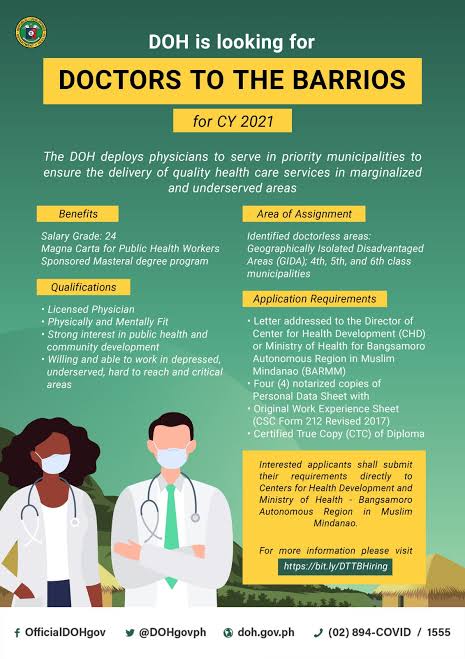
Programs like Doctors to the Barrios (DTTB) demonstrate a simple truth: consistent medical presence displaces quackery.
Where DTTB doctors are embedded:
- Vaccination rates rise
- Maternal and infant deaths fall
- Chronic diseases are detected earlier
- Reliance on miracle cures declines
But DTTB is temporary. When doctors rotate out, the system reverts. Informal healers return—not out of preference, but necessity.
Persistence, not heroism, is what defeats quack medicine.
Community Hospitals That Try to Be Everything—and Fail
Many community hospitals collapse because they attempt to mimic tertiary centers without the resources to do so. They lose credibility, hemorrhage staff, and become referral bottlenecks rather than care providers.
Without clear roles, reliable staffing, and security guarantees, these hospitals cannot anchor trust. When institutions fail visibly, belief systems rush in to explain suffering and offer certainty.
Private Hospital Networks: Necessary but Insufficient
Large private groups—Ayala’s AC Health and Pangilinan’s Metro Pacific Health—expand access through provincial hospitals, telemedicine, outreach clinics, and even floating hospitals. They modernize management and respond faster than the public system.
But private healthcare is episodic by design. Rotating specialists and medical missions cannot replace the weekly, mundane, trusted presence that builds credibility.
Markets can scale innovation. Only the state can guarantee permanence.
Culture Is Not the Cause—It Is the Adaptation
Indigenous rituals, faith healing, and informal medicine thrive where institutions fail. They provide continuity, explanation, and social trust in environments where the formal system is confusing, distant, or hostile.
Blaming culture for quackery is like blaming informal settlers for housing shortages. Culture adapts to state absence; it does not cause it.
The Core Failure
Philippine healthcare does not fail because it is underfunded, insufficiently generous, or culturally resisted. It fails because it cannot sustain trusted, safe, continuous medical presence, especially in the places that need it most.
Free care collapses when the people meant to deliver it cannot stay.
Bottom Line
Quacks, cult healers, and ritual practitioners are symptoms of system failure, not moral or cultural defects. They appear where doctors are absent, unsafe, undervalued, or unsupported—and they retreat when doctors stay.
The rule is simple and unforgiving:
When doctors leave, quacks arrive.
When doctors stay—protected, supported, and embedded—communities heal.


 The Society of Honor by Joe America
Some time ago, in this book “Serve,” I read about one of our heroes in the health care field in the Philippines Dr. Manuel Dayrit. I don’t remember the details but I recall he tried hard to improve the health care system in the Philippines. He spent a lot of time in the remote poor areas. I think he was Secretary of Health for a while.
He was Secretary in the early 2000s. Public Health is his specialty and he teaches PH in the Ateneo.
With health care insurance in the news again here in the US, I happened to look into the options for Americans who do not have employer sponsored health insurance and are too “wealthy” to qualify for government subsidies under the Affordable Care Act. What do you do if you are 60 years old, have a chronic illness where you have to see your doctor (whether primary care physician or specialist) and you take a bunch of prescription drugs? I’ve heard that premiums for high deductible plans can be as high as $2k/month to even $4K/month for a single person! Yikes!
One option that has been around is “medical tourism” to Mexico. Over there you can find English speaking doctors, AND even with training in the US. And facilities can be great. One can use that as an option until one reaches Medicare age which is 65. Medicare insurance is currently a little over $200/month and rises every year about 7%. It is inconvenient for sure…but sometimes it is the only viable choice.
We have talked about Mexico and Thailand but the PH is becoming the choice of Fil Ams if costs are skyhigh because it is mot covered.
What if you end up with a Quack? 🙂
Yikes some even dress and talks like a duck I mean a doc.
Non defeatist answer hehe: go to top hospitals still cheaper than US most of the time.
As to Mexico ….ask a friend or look for creds as KB mentioned
I do not know if it is cheaper travel to Thailand but some Americans do that.
https://www.bumrungrad.com/usa
Their come on is:
Over half of Americans delay or
don’t get health care
because they can’t afford it
Pay Up-To 80% Less for High Quality Medical Care and Rx Prescriptions with the Award Winning Bumrungrad Hospital’s New Medication Tourism Service
Bottom Line
✅ If your priority is practical, lower-cost treatment with minimal travel stress, especially for dental, cosmetic, and routine care, Mexico is usually the more practical choice for Americans. �
✅ If you’re focused on high-specialty surgery or combining care with extended wellness travel, Thailand’s healthcare infrastructure and global reputation might be worth the longer trip. �
magazine.medicaltourism.com
magazine.medicaltourism.com
🛡 Tips Before You Go
Check hospital accreditation (JCI or equivalent) and doctor credentials.
Use a medical tourism facilitator or patient coordinator (especially in Thailand).
Factor in aftercare and follow-up costs once you return home.
Consider travel insurance that covers complications abroad. �
I don’t think native medicine is bad in itself. Mostly native medicine is harmless, except when a person has a serious health condition where delay in treatment has negative consequences. During my trip there were plenty times when I had a headache and hosts insisted I try “Bisaya medicine” (In Cebuano, “panambal”), to which I gently declined.
The greater issue is as you highlighted the lack of access to modern medicine.
I’m sure even with access to modern medicine quite a few Filipinos would also visit their abularyo/mananambal, just to “make sure.” Curiously people seem to be willing to pay for an abularyo’s services, but hesitate to pay for modern medicine. Well that won’t matter much if a healthcare system provides more accessible (and affordable) care.
haha there used to be an albularyo travelling throughout Europe to offer his services to (older) Filipino migrants over here – in THIS century..
BTW the word mananambal is also the one used in Bikolano and Waray.
There used to be a “medical association” of traditional medicine run by Philippines-trained *MDs* here in the US (it is now defunct) that provided abularyo services to Fil-Ams. My old friend’s lola used to visit for services there. Amusingly they directed urgent medical cases to the emergency room of regular hospitals, which tells something.
And yes, mananambal or man-tambal is a proto-Visayan world so unsurprising that other Visayan languages share the same word. Man + tambal, meaning “one who treats with tambal.” The equivalent Tagalog prefix to the Visayan “man-” is “mag-.”
See here:
https://en.wiktionary.org/wiki/mananambal
P.S. Wiktionary is an excellent etymological source for Philippine languages. Most times I find Wiktionary to be better sourced than actual Philippine language dictionaries.
Well traveled and wise beyond your age, so is Irineo.
Irineo is older than me, but my guesstimate is you are younger based on your accounts.
I am in my early 40s. But yes, I am more traveled than most people.
I was correct, I am almost mid 50s.
Most of my friends are a bit older than you. Back then when small boutique dogs were too expensive for guys to buy to attract the attention of a girl, my kuya friends would bring me along as their cute mascot to ask the ate’s number lol.
Hahaha
Interesting. I see some thoughtful points but experience teaches me that doctors are not immune to being quacks, cult healers, and ritual practitioners. Second and sometimes third opinions are useful. Although I would rather employ an honest doctor rather than a dishonest faith healer, I do see the value in faith when it is allowed to expand into practical understanding. I think conventional medicine begins with faith as I define faith. It requires a strong faith, lots of money, and serious persistence to find a cure for cancer. I live in a country with many doctors and many people die of cancer rather than heal, including my dad. His faith in a comforting God brought conscious comfort when he wasn’t drugged into unconsciousness due to severe suffering from the disease. I think that communities heal under the rule of forgiveness and the protection of honesty. I explore this very important subject you discuss in my book Science and Spirituality: Celebrating the 150th anniversary of Mary Baker Eddy’s first edition of Science and Health. https://www.amazon.com/dp/B0DPF89WQQ The best doctors I have have faith. I wrote, “Prescriptions and platitudes cannot be mistaken for power, especially if we get our information from sources loyal to institutions that claim their drug or dogma is true and healing.”
Many thanks for your thoughts.