The Philippines at the Crossroads: From Identity to Excellence and Resilience
By Karl Garcia
I. Introduction: Between Pride and Self-Criticism
Among Filipinos, few questions ignite more debate than: “Bakit tayo ganito?” Some insist the country is hopeless, corrupt, and backward. Others argue Filipinos are resilient, talented, and adaptable. Both voices contain truth, but both are incomplete.
The tension between self-flagellation and defensive pride is a defining feature of the national psyche. It stems from colonial history, inequality, migration, politics, and the challenge of defining identity in a globalized world. The problem is not whether Filipinos think too low or too high of themselves; the problem is the lack of collective self-respect grounded in reality.
This essay argues that understanding Filipino identity, history, and structural constraints is essential for designing systems of excellence and resilience, capable of sustaining development, safeguarding citizens, and projecting national strength.
II. Poverty, Corruption, and Structural Incentives
“Mas mahirap maging korap kung walang mahirap.” Poverty is not merely economic; it is a structural enabler of corruption. When basic needs are uncertain, bending rules becomes survival, not moral failure. Small entrepreneurs, local officials, and workers often operate within systems of necessity.
Experiences from Vietnam, Thailand, and Indonesia illustrate that corruption is reduced less by virtue-signaling campaigns than by altering incentives through opportunity and accountability. Economic development flips the logic: when people have more to lose and more to gain from honesty, corruption diminishes naturally.
A robust middle class functions as the natural enforcer of accountability. Poverty reduction is the most effective anti-corruption policy, because it transforms citizens from passive participants into agents of systemic integrity. Metrics, audits, and performance measurement turn morality into pragmatic choice, not preaching.
III. Inequality, Mobility, and the Illusion of Progress
Extreme inequality rarely appears first in statistics. It manifests in motion: people uprooted, workers commuting farther, families migrating. John Steinbeck’s The Grapes of Wrath illustrates how concentrated land and capital in 1930s America forced millions to move—not toward opportunity, but survival.
In the Philippines, the wealthy enjoy comfort, opportunity, and access. The poor experience systemic neglect, long commutes, and fragile livelihoods. This inequality produces polarized perceptions of the nation: visible prosperity masks vulnerability. Growth without inclusion becomes an illusion, fragile under crises, natural disasters, or economic shocks.
Lessons from Vietnam and Indonesia highlight alternatives: inclusive urban planning, land reform, education, rural investment, and careful urbanization reduce the need for desperate mobility and create long-term stability. The Philippines, by contrast, often relocates informal settlers without access to livelihoods, reinforcing commuter poverty and social disconnection.
IV. Performative Governance: Signals vs. Systems
Philippine governance is marked by busy-busy han: visible activity, announcements, and campaigns that suggest order, while systems fail.
- Signals: clean offices, open windows, press releases, high-profile campaigns.
- Systems: trained personnel, functional processes, maintained infrastructure, coordinated agencies.
Too often, signals dominate. Public service looks efficient, yet backlogs, broken processes, and selective enforcement remain. Violence, private armies, and negotiated impunity become instruments of control where governance thins. Prestige projects substitute for capacity building, not complement it.
The lesson from Indonesia is clear: capacity must come before prestige. Governance should prioritize functioning systems over optics.
V. Towards Systems Thinking and Excellence
Recurring failures—delayed maintenance, shifting budgets, fragmented projects—reflect a structural problem, not individual incompetence. The Philippine development system is a fragmented network, where each actor behaves rationally in incentives, yet the whole fails.
The pwede na mindset is rational adaptation to instability. Engineers design for budgets, contractors build for approval, officials prioritize speed over integration. Countries that reduced this pattern—Singapore, South Korea, Vietnam, Thailand, Indonesia—did so by stabilizing systems, aligning long-term strategy with institutional continuity, and insulating national priorities from short-term politics.
Lessons from Asia
- Singapore: Technocracy, planning, and state investment preserve continuity beyond politics.
- South Korea: Industrialization linked to national defense; long-term planning reinforced through strategic policy.
- Vietnam: Focused on production, discipline, and incremental capability building.
- Thailand: Maintained consistent policies despite political instability.
- Indonesia: Maritime and archipelagic strategies integrated into national development.
Lessons from the New Deal
The U.S. Great Depression response shows that development, relief, and capacity-building can be integrated. Work programs built infrastructure while training citizens, aligning public effort with state capability.
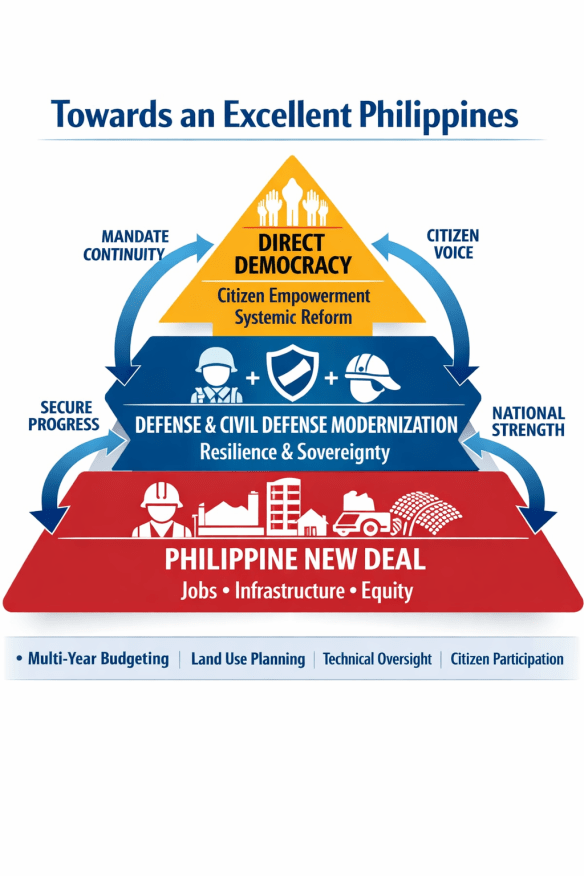
A Philippine New Deal would combine infrastructure, citizen training, and systemic continuity, transforming the state from financier of projects into builder of durable public goods.
VI. National Resilience and Civil Defense
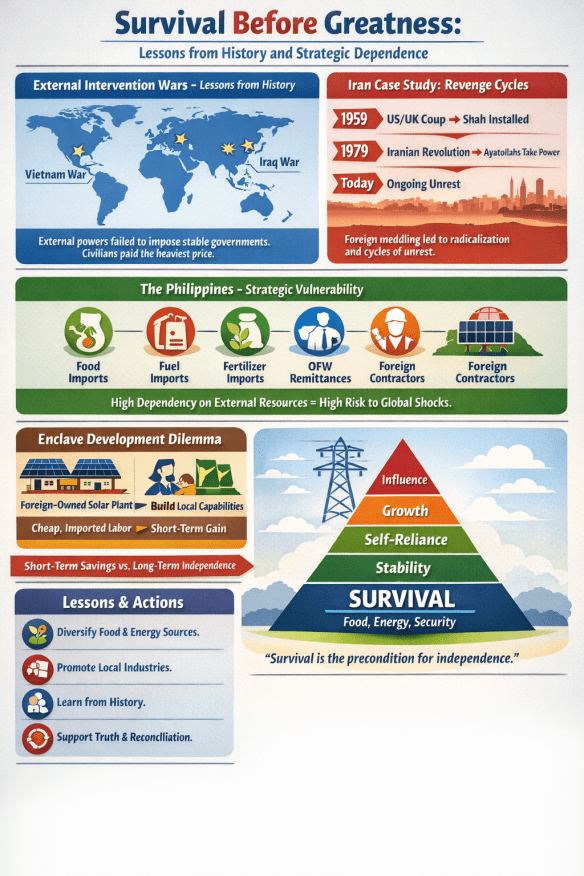
Geography ensures disaster is inevitable. The Philippines faces earthquakes, typhoons, sea-level rise, energy vulnerability, and global geopolitical shocks. Resilience requires civil defense, energy security, and societal capacity.
Key Components:
- Civil Defense: Proactive, whole-of-society preparation, not merely reactive disaster response.
- Repatriation: Permanent infrastructure and trained personnel to manage returning overseas Filipinos.
- Citizen Participation: ROTC, reserves, and volunteers trained in practical emergency skills.
- Technical Leadership: Warrant officers maintain institutional memory and technical continuity.
- Energy Security: Diversification, strategic reserves, and maritime protection reduce vulnerability to global shocks.
- National Absorption Capacity: Ability to receive, support, and stabilize populations during simultaneous crises.
Drills, documentation, and continuous practice ensure readiness. Preparedness must be normal, not exceptional.
VII. Governance, Direct Democracy, and Structural Reform
Legislative gridlock, entrenched dynasties, and incentive misalignment undermine long-term strategy. Structural reform must:
- Align incentives for long-term policy over short-term politics.
- Incorporate direct democracy mechanisms for citizens and experts to pre-vet laws.
- Strengthen institutions capable of sustaining strategy beyond individual leaders.
No leader alone can fix a fragmented system. Structural alignment protects the future from present weaknesses.
VIII. Conclusion: The Path to an Excellent and Resilient Philippines
The Philippines already possesses:
- Talent, creativity, and resilience.
- Democratic legitimacy and social capital.
- Strategic geography and abundant natural resources.
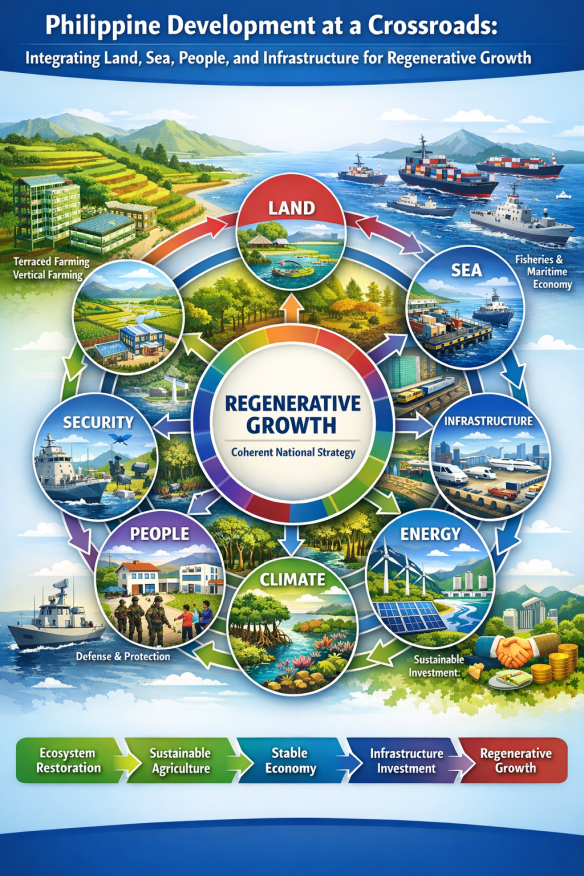
What it lacks is systemic alignment: a coherent integration of governance, development, social inclusion, civil defense, and national strategy.
Excellence is near but never automatic. Achieving it requires:
- Honest pride grounded in reality.
- Economic inclusion to reduce poverty and corruption.
- Infrastructure and institutions designed for continuity, not optics.
- Civil defense and energy security integrated into national planning.
- Citizen engagement and technical expertise cultivated across generations.
The Philippines need not imitate Singapore, Korea, or Vietnam. It must become a republic that is:
- Excellent in governance and strategic planning.
- Resilient to disasters, conflict, and global shocks.
- Inclusive in opportunity, accountable in leadership, and empowered in citizenship.
Somewhere in this integration of identity, systems, and resilience lies the real Filipino future: capable, confident, and prepared for both prosperity and survival.
Pinoy kasi, Pinoy nga naman—but we can still rise above being “just Pinoy” and become excellent.
Do you want me to do that next?


 The Society of Honor by Joe America
**Among Filipinos, few questions ignite more debate than: “Bakit tayo ganito?”**
Thanks, Karl. Your opening sentence reminded me of me! I did ask that question about 25 years ago while having lived here in the US about 10 years. There was already internet, but no AI…. In my research, I found Rizal to be my best resource to answer the question.
Your essay gives an excellent road map. Unfortunately, it requires a people that is ready to “pick itself up by the bootstraps” to use that Western expression. Rizal had that assumption too.
Filipinos do not seem to believe in that approach. We seem to think that we are entitled. I think you folk have referred to it as a “señorito” complex.
Remember when you told Joey thar we are theorizing and suggesting, that is very correct. If we can not drive change now, hope eventually we will. I know some one will think of ways to make things happen whether it is a charismatic leader or an action leader.
the only change I can see from higher up is that president bong marcos has lost weight! his trousers hang off him now, they used to be snug and fit him well. strange too that his sister imee is quite these days like she is suffering from a bad case of laryngitis.
anyhow, president marcos has declared state of emergency, so now, our govt can go in and put cap on fuel prices, maybe even ration fuel too, and may even consider putting cap on prices of commodities as well. my friends in australia told me that 500 gasoline stations in australia run out of gasoline and had closed up shop. kasi raw, the countries that promised to send oil or contracted to send oil to australia changed their minds and decided to keep the oil for their own use.
The fare hike might be too heavy for studdnts if ever
Drivers have chidren too who are students
https://www.philstar.com/lifestyle/2026/03/19/2515414/many-find-philippines-polite-filipinos-think-otherwise-study
dalawa ang mukha, the face we show to strangers, and those people who are high ranking by the look of their clothes and the way they carry themselves; them we give respect. but the filipinos like the consular official in the middle east who belittled ofws and bad mouthed them for apparently always asking for consular help, ay hindi polite and was given the marching order.
sometimes, we filipinos dont have the patience and have short fuses to our fellow filipinos na ka-level natin, and snapping at them too. but maybe, if our fellow filipinos approach nicely and with a smile instead of looking sourly and petulantly at us, we may show them politeness at hindi iinsultohin.
I input a bunch of academic papers and literature that I’ve read before into Claude to see what would happen and it came up with pretty much the same conclusions I’ve been writing about since I arrived here. Am I actually an AI? lol!
Topic:
Economic development strategy
Actor:
• Historian ->Sociologist -> Policy Advisor -> Senate staffer -> Presidential advisor
Focus:
• Diagnostic framing — mapping the structural and cultural constraints specific to your country’s situation
• Sequencing strategy — which interventions to prioritize given binding constraints (infrastructure, energy, human capital, institutional trust)
• The Middle Income Trap — how countries like South Korea, Botswana, Vietnam, Indonesia, and Mauritius navigated it, and what was culturally transferable versus idiosyncratic
• Social cohesion as economic infrastructure — how relational and communal trust networks can be leveraged rather than bypassed in early-stage development
• Energy and connectivity as preconditions — the sequencing logic behind infrastructure-first versus institution-first versus export-led approaches
Comparative analysis across 9 countries:
• Japan
• Taiwan
• South Korea
• Thailand
• Indonesia
• Malaysia
• Singapore
• Philippines
• Vietnam
I came up with the following results and artifacts (generated reports):
https://www.dropbox.com/scl/fo/ljtvfzre5nw9f60euviqb/AFZz4BuyWwTH-iuIwzlNv7I?rlkey=tknk7ck26h96zlyl8j0qp95gs&st=9yx61og1&dl=0
Highlights I found most interesting:
I guess my years in machine learning (which is basically what AI depends on) came in handy. Crafting prompts correctly with logic chains is incredibly important in getting a good result. Basically one needs to feed correct known information (from my observations in the Philippines), describe regions of the Philippines identify observed government services failures, and so on, then tell Claude how to sequence its thinking. It got some things wrong, mostly regarding unconstitutional stuff, but I told Claude to revise the proposed bill informed by the text of the Constitution as well as constitutional case law.
Added analysis document and draft of a Senate bill:
https://www.dropbox.com/scl/fo/ljtvfzre5nw9f60euviqb/AFZz4BuyWwTH-iuIwzlNv7I?rlkey=tknk7ck26h96zlyl8j0qp95gs&st=9yx61og1&dl=0
Many thanks for this. My wrong impression of you being AI averse is being recalibrated.
I’m adverse using AI as a mental crutch because I dislike lazy thinking. I do a lot of machine learning especially as it relates to cybersecurity though. That’s the basis of my consulting practice. I’ve got a machine learning setup right next to me right now with multiple nvidia cards and tons of memory. “AI” in its current marketed commercial form is just a type of chatbot that uses machine learning. Anthropic’s neural network architecture is actually quite sound compared to others like OpenAI. Claude is a more conservative model btw, which is better for analysis compared to ChatGPT which can be quite loose. Grok is the worst. Deepseek is good with small data sets but it’s a bit weird when the new Deepseek models use bigger language models.
I also have a custom “connector” that I built that enhances Claude’s abilities. My connector is sort of an academic library of research material.
If you want I can add in and analyze the industries in your current article, if they fit into the framework I built, and which linkages reinforce and enable different sectors.
Understood thanks.
from what I understood so far, Joey has his own server with an LLM on it which he gives very controlled inputs / source and training data.
And yes, my (own) experiments with prompts on Gemini and Claude in recent weeks have shown me how important they are.
My experiments have also shown me how AI can lead itself astray to the point na parang usapang lasing na ang chat mo with it.
Iyong tipong nagbobolahan na lang kayo and the AI sounds like an incredibly intelligent person not rooted in any reality.
Guess my experience in OCR (not the garden variety but the kind used to automate incoming document entry) of 25+ years also helped.
I believe that Joey’s critique of AI is that most people use it like people who don’t know how to use a chainsaw properly.
Most public AI has a lot of garbage in and certainly garbage out – Joey’s best AI ranking (Claude, Gemini, ChatGPT and forget the rest) I noted.
A lot of support platforms nowadays already autosuggest solutions using LLMs but they feed from their own, usually quite clean knowledge bases and FAQs.
https://www.manilatimes.net/2026/03/24/opinion/columns/will-ai-replace-historians-and-cultural-workers/2305592/ by Xiao:
the part I put in bold is what Joey has been telling us for quite a while (basically garbage in, garbage out) and the prompts I guess are the “boundaries” as the AI has no human context to give itself sensible boundaries. Interesting to see how it is already being used on digitized archives, which makes sense.
Claude, Gemini, and ChatGPT all support adding constraints (what information to discard) to the “thinking” process. In Claude this is done by telling the bot to do so with natural language (“don’t include xyz”) but it is more effectively done with XML tags (“”).
What annoys me the most about common AI usage is people seem to want to use AI chatbot outputs to win arguments despite putting little effort to actually learn the thing they are arguing about. Or they use AI chatbots as a substitute for actual thinking and didn’t even realize they are dumbing themselves down, like the following from a few days ago on X/Twitter:
https://cdn.bsky.app/img/feed_fullsize/plain/did:plc:n27pw7bbyk2lcapdazimiypf/bafkreieshzjwoehdhrmtfj6szt433dhoope5bocwjfuspqvzzd2vozjdfa
haha, that person might be used by some of your French relatives as confirmation bias if they already have the typical French cliche of “dumb Americans”..
..that reminds me of cashiers in grocery stores who no longer know how compute the right change if they made a mistake typing in the cash given. Getting dumbed down and getting too comfortable is something not just the cliche MAGAs are about we in Europe have our own version, just snootier.
Of course every tool has the potential to dumb us down. I grew up in a time when one often knew the most important phone numbers by heart as one had them written down and typed them in when needed, often at a phone booth, so one remembered.
We also had pretty old-fashioned teachers when it came to arithmetic, who told us “what will you do if you are in the jungle or there is a brownout”? Pretty realistic in the 1970s Philippines, where you always had candles and flashlights ready for brownouts, and water in pails in case the flowing water was interrupted, which was most of the time in UP then.
Stuff which I can tell as it is about process not about work content: I have developed some sense of how to work with inputs from different people (which helps in utilizing AI) because first of all I led a team of offshore people in my Cognizant days, of course you delegate because you don’t have the time to do it all, but if one is not to be a senyorito manager (yes I had a senior manager title then so I was a senyor, but that is because of the status-consciousness of the culture of the majority of those working at the company) one has to at least try to get the gist of the solutions they are proposing and understand them too to be able to test them properly. Second I have been utilizing consultants ever since I got into my present job, as even a specialist has stuff where it is economically more efficient to hire those even more specialized, hmm am I making sense yes I guess I am. Same banana, one has to delegate but has to engage to understand. Third I have had projects that were totally outside my special area, happens when you are internal IT and for instance software is passed due to people retiring or leaving so I have had to talk to software vendors or consultants who are from totally different areas. Asking questions to fully understand foreign domains becomes essential, not just taking stuff verbatim like many people do with AI nowadays.
In fact excellent AI output can be enough to blow one’s mind – I am thinking of the stuff you have uploaded now. Of course one can treat it like some Filipino politicians treat expert studies, not read them at all or skim them. Well the coming Easter weekend over here in Europe is long for that stuff.
The crazy thing is I *have* read through plenty of Philippines Congressional and Senate bills and the “bill” Claude created was much more of a matter-to-fact and ready-for-action plan than any Philippine bill that I ever read. Philippines bills tend to be too aspirational, filled with flowery language, probably much too head in the clouds, and chasing what elites envy about other countries but not spending much time on specifying what *effort* is needed to get there. The 10 industries Claude helped with connecting into industrial clusters are real industries that the Philippines can get going with *right now* that don’t explicitly require FDI (but with FDI would enable supercharged timelines). I identified the 10 industries specifically as areas that could lift up out of poverty large segments of the urban and rural poor that exist as an available workforce. One of my biggest worries for the Philippines is the large working age population will soon age out and the Philippines would become a country with shrinking population that cannot be replaced by massive immigration while at the same time not having built up prior infrastructure that can allow a smaller population to do well globally.
I just skimmed through the ten industries and they are indeed doable. Two (ship repair and aquaculture) were part of the Blue Industries aspect of VP Leni’s 2022 industrial program as the President she did not become. I will have a look at the stuff again in deeper detail during the Easter weekend.
Going for a “digital fast” now though, lot of stuff to do at work before Easter. And the usual “spring cleaning” stuff at home as well.
Btw I consider Prof. Virgilio Enriquez’s “Sikolohiyang Pilipino” to be nationalistic in nature. Prof. Enriquez’s study of Filipino relational dynamics can be understood from the viewpoint of someone (like me) with a more broad understanding of regional cultures as it relates to the Philippines to be “innovative” — framing Filipino cultural truths a bit differently as a means to serve more nationalistic ends as so many elite-driven discourse is in the Philippines. I still included that academic work though since it does inform the current cultural zeitgeist of how Filipinos (or at least the elites) view themselves and for the fact the work is loosely taught in Philippines schools. In that way Prof. Enriquez’s work as relates to “utang na loob” is not that much different from Meiji Japan’s transformation of “gimu” (a profound moral debt, e.g. from subject to emperor) from interpersonal and local into national service and sacrifice to the nation.
Most bills leave everything to the IRR or are declarations / pronouncements
I guess Bato would say “plans-plans lang iyan” and Ben&Ben would sing “trip-trip lang” to them.
Yes, this is how “major legislation” in the US works too. The US Congress, informed by the President, creates a legislative enabling framework. Then agency experts craft regulations to be able to execute on what Congress directed.
I guess a problem in the Philippines is that the laws (and indeed even the Constitution) is much too aspirational without sufficient institution building in order to unlock the aspirations. James Madison in Federalist No. 48 wrote of “parchment barriers” (in modern usage “parchment guarantees”) that are barely worth the paper it is written on. In other words, without actual guarantees enforced within strong institutions, a constitution (or law) is not self-executing.
For example if one were to look at the EVIDA law (RA 11697), HEVs, PHEVs, and BEVs are all granted a number of relief on taxation and registration, which is great for Filipino consumers. What is not great is in effect EVIDA allows zero-tariff imports on the aforementioned vehicle classes, which is why BYD and VinFast were able to enter the Philippines market. Due to AFTA’s (ASEAN FTA) zero-tariff provision which went into effect in 2015 the Philippines would only be able to impose tariffs on Chinese vehicles. No effort at all in EVIDA to create a domestic auto industry aside from passive provisions. CARS is an EO with annual budget provision so Congress can choose not to provide funds, which happened recently in the 2026 budget, causing existing relationships with Toyota (through TMP) to have less investment confidence. And so on. Even when laws are written, the laws are so nebulous that IRR crafters don’t even know where to start.
If you have time Irineo give the artifacts I created a read. Although most of it is what I’ve written about in comments since my time here (with some other stuff Claude suggested), the innovation Claude allowed is to be able to tie my line of reasoning together into a cohesive policy plan and accompanying Congressional bill.
Probably the most important part is the cross-analysis of cultural practices that contributed to success and failures in the 9 countries I analyzed. Like I’ve shared before Filipino elites act as if Philippine culture is static and in the past, but culture and society evolves. Relational dynamics are very important in driving organizational success. Specific to Asian cultures there’s also various ideas of relational debt (e.g. “utang na loob”). I cross-analyzed how other cultures in the analysis matrix were able to overcome the negative aspects of their own relational dynamics and translate that into success, and how those lessons might inform the Philippines.
On more effective prompting, Claude supports XML structured prompts. Yes, prompts in the natural language work most of the time, but just like Google-fu which requires knowing how to construct a search query that might not sound at all natural but is more effective XML structured prompts is a huge level up. With XML structured prompts you can also tell Claude to use whatever custom connectors and supported third party datasets.
https://platform.claude.com/docs/en/build-with-claude/prompt-engineering/claude-prompting-best-practices
For example my prompt in natural language:
Can be re-written in XML Markdown as:
I can see the machine saluting and jumping off the cliff into the rod section of a nuclear reactor. This is very very helpful, Joey. It provides boundaries while letting the machine loose. Thanks!
The focus of my analysis were policies that were able to complement or enable higher value policies. Even though a lot of the stuff Claude did was tying together my separate ramblings, it is useful to see it all sequenced and organized into a framework of a plan. If you have time to go through all the generated analysis, I certainly found it to be eye opening how many solutions are “within reach” for the Philippines, and only require political capital spent in order to get things moving.
Guys, I thank you for your ideas I am belately asking permission of using your brsin power hoping to have done you justice.