From Blueprint to Breakthrough: Building Systems That Transform the Philippines
By Karl Garcia
The Philippines has long produced plans, roadmaps, and reform agendas. Some were visionary. Some partially implemented. Yet the pattern repeats: plans are drafted, priorities shift, administrations change, and systems remain fragmented.
If the blueprint to transform the Philippines from a Transit Nation into a Transformation Nation is to succeed, the decisive phase begins not with drafting policy, but with building the machinery that can execute policy across political cycles, regions, and sectors. Transformation requires a shift from planning projects to governing systems.
This blueprint integrates three critical dimensions of transformation:
- Institutional Continuity – building structures that survive elections.
- Cluster-Based Development – demonstrating success before nationwide expansion.
- Systems Thinking – changing the culture of planning from isolated projects to interconnected national capability.
I. Accept That Fragmentation Is the Core Problem
The Philippines does not lack talent, ideas, or resources—it lacks alignment.
- Energy is planned separately from industry.
- Transport is built without land-use integration.
- Education produces graduates without regard to labor demand.
- Flood control is designed without watershed management.
- Digital infrastructure grows without energy planning.
- Local governments pursue projects without national coordination.
Each decision may be rational in isolation. Together, they produce inefficiency, high costs, and vulnerability.
The first step in transformation is conceptual: the country must accept that the main problem is disconnection. Once understood, the need for an integrated execution structure becomes obvious.
II. Build Institutions That Outlast Administrations
No transformation plan will survive if it depends entirely on one president, one cabinet, or one political coalition. Political cycles are shorter than development cycles:
- National leadership changes every six years.
- Local governments change every three.
Infrastructure takes years to build. Industrial policy may take decades to mature. Education reform may take a generation.
When political time is shorter than development time, continuity must come from institutions, not individuals.
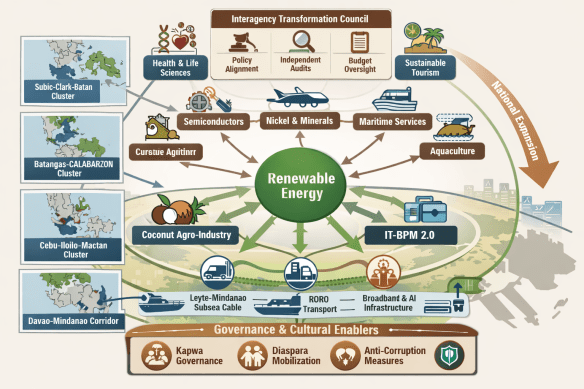
Interagency Transformation Council (ITC)
The ITC is the proposed permanent body to coordinate, align, and enforce policy across departments and regions. It is not a replacement for government, but the mechanism for policy continuity.
Key Features:
- Cabinet-Level Authority – the council can direct agencies toward shared goals.
- Budget Coordination Power – ensures investments reinforce each other.
- Regional Representation – accounts for diverse economic, geographic, and social conditions.
- Public Transparency – builds trust through reporting and scrutiny.
- Independent Audits – protect programs from political capture and corruption.
With alignment, projects become components of systems, enabling continuity across administrations.
III. Start With Clusters, Not the Entire Nation
The Philippines cannot transform everywhere at once. With 7,600+ islands and a population of over 115 million, attempting nationwide rollout risks delay, dilution, and failure.
Clusters are geographic areas where multiple systems—energy, transport, industry, water, education, and digital infrastructure—can be improved together. Clusters make transformation manageable, testable, and replicable.
Examples of Philippine Clusters:
- Subic – Clark – Bataan
- Batangas – CALABARZON
- Cebu – Iloilo – Mactan
- Davao – Mindanao Corridor
Clusters allow integrated planning: roads, ports, energy, education, and industry reinforce each other, creating momentum before national expansion.
IV. Deliver Early Wins to Build Confidence
Long-term reforms require patience, but patience depends on visible progress. Citizens and investors need proof that change is real.
Early wins should be chosen for both economic value and symbolic power, demonstrating:
- Agencies can coordinate effectively.
- Investments produce tangible benefits.
- Transformation is possible and credible.
V. Change the Culture of Planning: From Projects to Systems
Perhaps the most difficult step is cultural. For generations, development has been understood as a series of discrete projects, not as integrated systems.
- A road without industry carries little cargo.
- A port without logistics moves little trade.
- A school without jobs produces frustration.
- A power plant without transmission fails to deliver electricity.
Real transformation requires system thinking: understanding development as interdependent systems:
Energy + Transport + Industry + Education + Water + Agriculture + Governance + Finance + Digital Infrastructure + Environmental Management
Key Concept: When one system advances alone, progress slows. When multiple systems advance together, progress multiplies.
- Infrastructure supports industry.
- Industry creates jobs.
- Jobs strengthen education and institutions.
- Strong institutions improve governance, attracting investment.
- Investment builds infrastructure.
- Infrastructure expands opportunity.
- Environmental management sustains all systems.
VI. Align Education With Economic Reality
Human capital must match industry needs. Education policy cannot be isolated from energy, transport, and industrial strategy. Integrated planning ensures:
- Skills pipelines match Phase 1–3 industry needs.
- Employment opportunities retain talent locally.
- Industrial growth and education reinforce each other.
VII. Philippine Development Agency (PDA) Framework
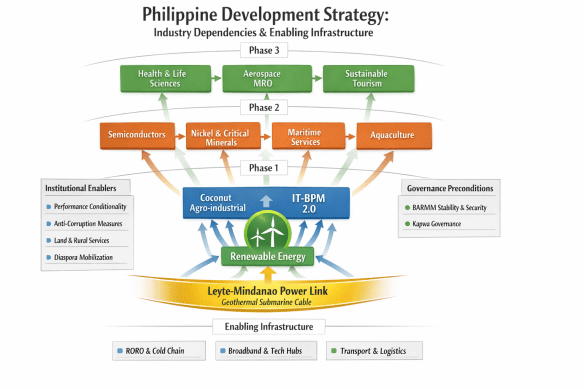
The PDA provides a dependency-driven architecture for industry and infrastructure sequencing:
Definitions:
- Dependency Graph: Industries (nodes) connected by enabling relationships (edges). Success of one sector depends on another.
- Enabling Infrastructure: Investments facilitating multiple industries—energy, transport, digital networks, regulatory frameworks.
- High-Leverage Investment: Interventions that impact multiple sectors simultaneously.
- Phase 1–3 Sequencing: Foundational industries (Phase 1) → value-chain expansion (Phase 2) → high-value knowledge sectors (Phase 3).
Phase 1 – Foundations:
- Renewable energy: powers all industries.
- Coconut agro-industrial complex: rural employment and social stabilization.
- IT-BPM 2.0: AI-resilient jobs and skill development.
Phase 2 – Value Chain Expansion:
- Semiconductors, nickel/critical mineral processing, maritime services, aquaculture/fisheries.
Phase 3 – Knowledge Economy:
- Health & life sciences, aerospace MRO, sustainable tourism.
Governance & Cultural Enablers:
- Performance conditionality, anti-corruption measures, secure land rights, diaspora mobilization, Kapwa governance (addressing cultural norms like utang na loob and hiya).
High-Leverage Infrastructure:
- Leyte-Mindanao submarine cable, RORO transport, broadband and AI infrastructure, provincial roads, BARMM governance & security investments.
The dependency graph ensures systemic alignment, with renewable energy at the core, Phase 1 stabilizing society, Phase 2 expanding industry, and Phase 3 delivering high-value knowledge services.
VIII. Protect Reform From Its Own Success
As sectors grow, risks multiply: land values rise, political interests expand, and corruption opportunities increase. Transparency and digital governance are structural safeguards, ensuring that early gains do not get captured by narrow interests.
IX. Balance Openness With Strategic Autonomy
Philippine development cannot occur in isolation. Trade, alliances, investment, and technology transfer are essential. But reliance on a single partner or market creates vulnerability.
Distributed infrastructure, diversified supply chains, and regional clusters increase resilience while maintaining openness.
X. The Moment of Choice
The Philippines stands at a familiar crossroads. History repeats itself: plans exist, priorities shift, systems fragment.
The blueprint for a Transformation Nation already exists:
- Build institutions that outlast administrations.
- Start with regional clusters.
- Deliver early wins.
- Align education and workforce with industrial needs.
- Protect reforms through transparency and governance.
- Integrate systems thinking across projects and policies.
- Sequence industries using high-leverage, dependency-aware infrastructure investments.
If these steps are implemented with discipline, the Philippines can move beyond a Transit Nation, where value passes through ports, labor, and resources, to a Transformation Nation, where value is created, refined, and sustained across the archipelago.
Not by chance. Not by slogans. But by design.


 The Society of Honor by Joe America