Streaming Didn’t Kill Physical Media
The Long History of Recorded Music—and Why Old Formats Keep Coming Back

By Karl M. Garcia
In every generation, people are told they are witnessing the end of an era.
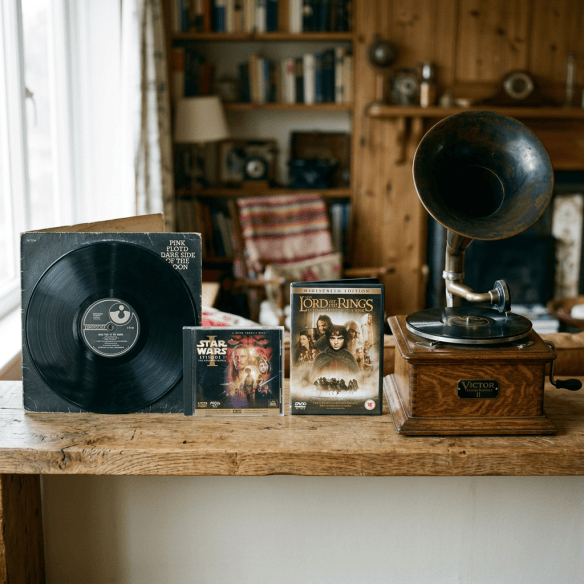
When the phonograph was invented in the nineteenth century, it promised to preserve voices forever. When radio spread across the world, many believed people would stop buying music altogether. Vinyl records were eventually displaced by cassette tapes. Compact discs were hailed as “perfect sound forever.” MP3 files shattered the dominance of CDs, and streaming services later transformed music into an invisible utility accessible almost anywhere with an internet connection.
Each innovation was greeted with the same prediction: the previous technology was finished.
History tells a different story.
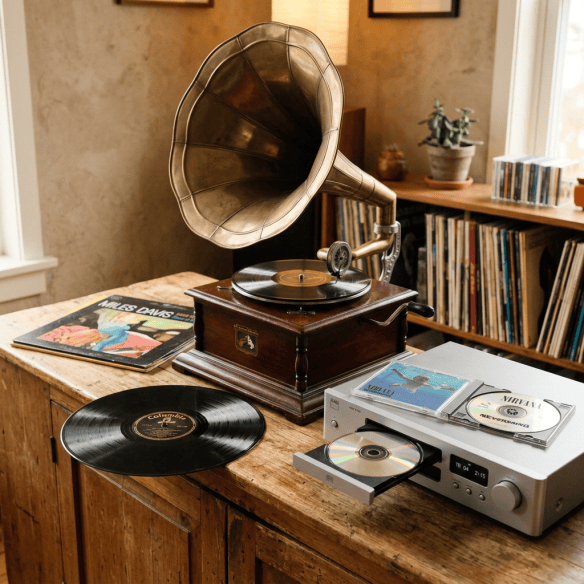
The story of recorded music is not one of extinction but of accumulation. Every major format solved the shortcomings of its predecessor, yet almost none disappeared completely. Instead, old and new technologies learned to coexist, each serving different audiences and different human needs.
The resurgence of vinyl records and the quiet revival of cassette tapes are not historical accidents. They are reminders that technology evolves in ways that are often far more complicated than simple replacement.
Capturing Sound for the First Time
For most of human history, music existed only in the moment.
A song could be remembered, taught, and performed again, but every performance was unique. Once the last note faded, only memory remained.
That changed in 1877 when inventor Thomas Edison introduced the phonograph. For the first time, human voices and music could be recorded and played back.
The achievement was astonishing.
People who had never imagined hearing the voices of the dead suddenly realized that sound itself could survive its creator.
Music was no longer confined to concert halls, churches, or family gatherings.
It could travel.
It could be preserved.
It could become an industry.
The Rise of Records
During the early twentieth century, improvements in recording technology produced shellac records, later replaced by vinyl.
Vinyl transformed the listening experience.
Long-playing (LP) records allowed artists to present complete albums instead of isolated songs. Album covers became works of art. Liner notes explained lyrics, production choices, and the stories behind recordings.
Listening became an event.
Families gathered around record players.
Teenagers saved money for albums.
Record stores became cultural landmarks where friendships formed over shared musical tastes.
Music became both entertainment and identity.
Radio Changes Everything
At first, the recording industry feared radio.
Why would anyone purchase music if they could hear it for free?
Instead of destroying recorded music, radio expanded its audience.
Listeners discovered new artists before buying records.
Local stations introduced regional musicians.
National broadcasts created shared cultural moments.
Radio democratized music.
It brought orchestras, jazz, rock, pop, news, and drama into millions of homes.
Even today, radio remains one of the world’s most resilient communication technologies.
In countries such as the Philippines, battery-powered radios continue serving communities during typhoons, earthquakes, volcanic eruptions, and extended power outages.
New technology did not eliminate radio.
It gave radio a new purpose.
The Cassette Revolution
The arrival of compact cassette tapes during the 1960s fundamentally changed music consumption.
Unlike vinyl, cassette tapes were portable.
People could record music from the radio.
Friends exchanged homemade mixtapes.
Families preserved personal memories on inexpensive blank tapes.
The invention of portable cassette players—and later devices like the Sony Walkman—made music intensely personal.
Instead of gathering around a living-room record player, individuals carried entire soundtracks in their pockets.
For the first time, music became a companion during walks, bus rides, and commutes.
Cassettes also democratized creativity.
Garage bands could distribute demos without expensive record-pressing facilities.
Independent music scenes flourished.
The cassette became the format of experimentation.
The Compact Disc Era
The 1980s introduced another revolution.
Compact discs promised crystal-clear digital sound without scratches, pops, or tape hiss.
Marketing campaigns proclaimed “perfect sound forever.”
Consumers eagerly replaced vinyl collections with CDs.
Record companies celebrated another wave of album sales as millions repurchased music they already owned.
Compact discs also encouraged longer albums and easier track selection.
Unlike cassette tapes, listeners no longer needed to rewind or fast-forward.
Everything appeared cleaner, simpler, and more modern.
For a time, it seemed physical media had reached perfection.
The Digital Disruption
The internet transformed everything.
MP3 compression made digital files small enough to share online.
Services such as Napster disrupted the music industry by enabling peer-to-peer file sharing.
For record companies, the impact was devastating.
Consumers suddenly expected music to be free.
The industry responded with lawsuits, digital stores, and eventually legal download services.
Apple’s iTunes Store fundamentally changed purchasing habits.
Instead of buying entire albums, listeners increasingly purchased individual songs.
The album—once the dominant artistic format—began losing influence.
Singles returned to prominence.
Streaming Changes the Business Model
Streaming represented an even greater transformation.
Ownership became optional.
Instead of purchasing music, consumers subscribed to platforms offering access to enormous catalogs.
The convenience was extraordinary.
Millions of songs became available instantly.
Recommendations improved through artificial intelligence and machine learning.
Playlists replaced personal collections.
Streaming democratized discovery.
Independent artists could theoretically reach global audiences without major record labels.
Listeners enjoyed unprecedented variety.
Yet convenience came with trade-offs.
Music increasingly became background activity.
Albums were fragmented into playlists.
Algorithms shaped listening habits.
Ownership gave way to access.
The Return of Vinyl
Few analysts predicted what happened next.
Vinyl records began growing again.
Year after year, sales increased.
Pressing plants reopened.
Artists once again released deluxe vinyl editions.
Young consumers embraced a format they had never experienced during childhood.
Why?
Because vinyl offered something technology had quietly removed.
Listening required intention.
The record had to be selected, cleaned, placed on the turntable, and played.
The listener often experienced the album exactly as the artist intended.
Album artwork returned to center stage.
Physical ownership regained emotional significance.
The ritual became part of the experience.
Ironically, what once appeared inconvenient became desirable.
The Quiet Return of Cassette Tapes
Vinyl’s revival attracted headlines.
Cassette tapes followed more quietly.
Independent musicians began releasing limited-edition cassettes.
Collectors appreciated their affordability.
Small labels embraced tapes because production costs remained relatively low.
More importantly, cassettes represented participation in a community.
Recent discussions of “streaming fatigue” suggest that many listeners feel overwhelmed by endless choice, algorithmic recommendations, and subscription-based access.
Physical formats offer an alternative.
They encourage slower, more deliberate listening.
Instead of infinite libraries, listeners focus on a single album.
Instead of passive consumption, they actively participate.
The cassette has become less a technical medium than a cultural statement.
Music as Memory
Physical media possesses qualities digital files struggle to reproduce.
Albums age.
Corners bend.
Sleeves fade.
Cassette cases become scratched.
These imperfections tell stories.
A record inherited from parents carries emotional weight impossible to download.
A handwritten note inside a cassette case becomes part of family history.
Objects accumulate memories.
Digital files remain permanently identical.
Ironically, perfection often feels less personal than imperfection.
The Album as Art
Streaming emphasizes individual songs.
Physical media emphasizes complete works.
Many artists carefully design albums with beginnings, climaxes, and endings.
Songs speak to one another.
Themes unfold gradually.
Vinyl especially encourages uninterrupted listening because skipping tracks is less convenient.
The listener experiences the narrative as intended.
This changes not merely how people hear music, but how they understand artistic expression.
The Philippine Experience
The history of recorded music in the Philippines mirrors global developments while reflecting unique local realities.
Radio remains deeply woven into everyday life.
Even as streaming grows, millions still rely on AM and FM stations for news, traffic reports, weather updates, religious programming, and community discussion.
During disasters, battery-powered radios often become the most reliable communication tools available.
Physical media also preserves Filipino musical heritage.
Many regional recordings, traditional performances, and independent releases never reached digital platforms.
Collectors, archives, broadcasters, and libraries play essential roles in preserving these cultural treasures.
Without them, portions of the nation’s musical memory could disappear.
Artificial Intelligence and the Future of Music
Artificial intelligence now composes melodies, generates lyrics, restores damaged recordings, and recommends personalized playlists.
Its influence will undoubtedly grow.
Yet history suggests caution before predicting another technological extinction.
AI may accelerate music production.
It may help independent artists.
It may improve discovery.
But it is unlikely to eliminate the human desire for authenticity, ownership, craftsmanship, and shared experience.
The future will almost certainly include AI-generated music.
It will also include orchestras performing live concerts, teenagers discovering vinyl, collectors buying cassette tapes, and families preserving old recordings.
Technology expands possibilities.
It rarely erases human preferences.
Beyond Music
The story of recorded music reflects a larger pattern visible across society.
Printed books survive alongside e-books.
Movie theaters coexist with streaming.
Mechanical watches flourish despite smartphones.
Film photography remains an artistic medium.
Board games thrive in an age of digital entertainment.
Each survives because people seek more than efficiency.
Humans value ritual, ownership, community, memory, and authenticity.
These needs do not disappear simply because technology advances.
An Ecosystem, Not a Battlefield
Perhaps the greatest misconception about technological progress is the belief that innovation is a zero-sum game.
History suggests otherwise.
The phonograph did not truly kill live music.
Radio did not destroy records.
Television did not eliminate radio.
Cassette tapes did not permanently erase vinyl.
Compact discs did not eliminate every earlier format.
Streaming did not make physical media irrelevant.
Instead, each technology found its place within a larger ecosystem.
Some became everyday utilities.
Others became premium experiences.
Still others survived because they excelled in situations newer technologies overlooked.
This lesson extends well beyond music.
Artificial intelligence will reshape industries, but not every profession will disappear.
Digital banking will continue expanding, yet cash remains valuable during emergencies.
Cloud computing dominates modern business, yet local backups remain essential.
Innovation often adds layers rather than replacing foundations.
The Enduring Soundtrack of Humanity
Recorded music has traveled an extraordinary journey—from wax cylinders to shellac records, vinyl LPs, cassette tapes, compact discs, MP3 files, downloads, streaming platforms, and now artificial intelligence.
Each stage reflected the aspirations of its era.
Each promised to define the future.
Yet none completely erased the past.
Instead, the history of music reminds us that progress is rarely about choosing between old and new.
It is about discovering which technologies best serve particular moments, communities, and human needs.
Streaming offers extraordinary convenience.
Vinyl offers ritual.
Cassette tapes offer intimacy.
Radio offers resilience.
Live concerts offer shared emotion.
Together they form not a hierarchy but a symphony of technologies.
The lesson reaches beyond music.
Innovation is at its best when it expands human choice rather than narrowing it.
Old technologies do not survive because people fear progress.
They survive because they continue offering something that progress alone cannot replace.
The future of music will undoubtedly include smarter algorithms, immersive audio, artificial intelligence, and experiences we have yet to imagine.
But somewhere, a teenager will still place a needle on a record.
Someone else will slide a cassette into a player.
A family will gather around a radio during a storm.
And millions will discover that the most enduring soundtrack of humanity is not defined by any single technology, but by our timeless desire to listen, remember, and connect.


 The Society of Honor by Joe America
Maybe check with the musicians about their experiences?
It can be quite different from country to country.
My brother, a classical musician in Europe basically gave up on recordings and to a lesser degree in international concerts. He even forbade his daughter to follow his (and his wife’s) footsteps in music and both have now reverted to teaching.
Apart from the (very) big ticket items (Styles, Swift, Eilish, Sheeran etc), music is struggling in Europe, America and other Western countries. Small and intimate concerts in established smaller venues are still happening, but for the individual musicians and small groups, it is almost impossible to fill a concert hall and also classical music has dropped in popularity gradually, so many orchestras have disappeared. You also see it in the yearly “top-2000” list where 1960-1970 music remains the main popular genre amongst the elderly and young generation and the newer music is in the minority. Multi-day music festivals are still very popular, but as the ticket costs have increased insanely, many have been cancelled and therefore the musicians have less chance to proliferate themselves and media sales therefore will suffer as well.
This is quite different in Philippines where live music is appreciated and various groups are popular. The problem here is that music is copied infinitely on phones and tapes and even CD’s and the musicians therefore have to rely on live performances as the income from records/CD/cassette is minimal. It must be a difficult life for these musicians when a big part of their income stream has disappeared over the past decennia and a “life on the road” is required to make a living. Also the radio here does not really help. When I scan the various stations, it is the same old stuff all the time and there is hardly any promotion of new styles, young musicians and therefore the younger musicians have a hard time promoting their work and they have to rely on Tiktok etc to promote themselves, a very shaky basis. A real pity because there is a very lively music scene out here and that deserves better coverage (and hence those musicians would see an increase in sales of their media).
We are lucky to be able to enjoy some great musicians downtown, a thing to cherish.
It does not matter HOW people consume music (Radio, TV, CD, LP, Spottify, festivals), as long as it is stimulating the musicians. And stimulating the musicians requires concerts and media to pay for their effort. Even musicians need to eat and enjoy the occasional drink…
Unless you like AI music (which is basically stolen music rehashed cleverly).