Sovereignty at Sea: Philippine Maritime Strategy, Governance, and Operational Integration
By Karl Garcia 🌊
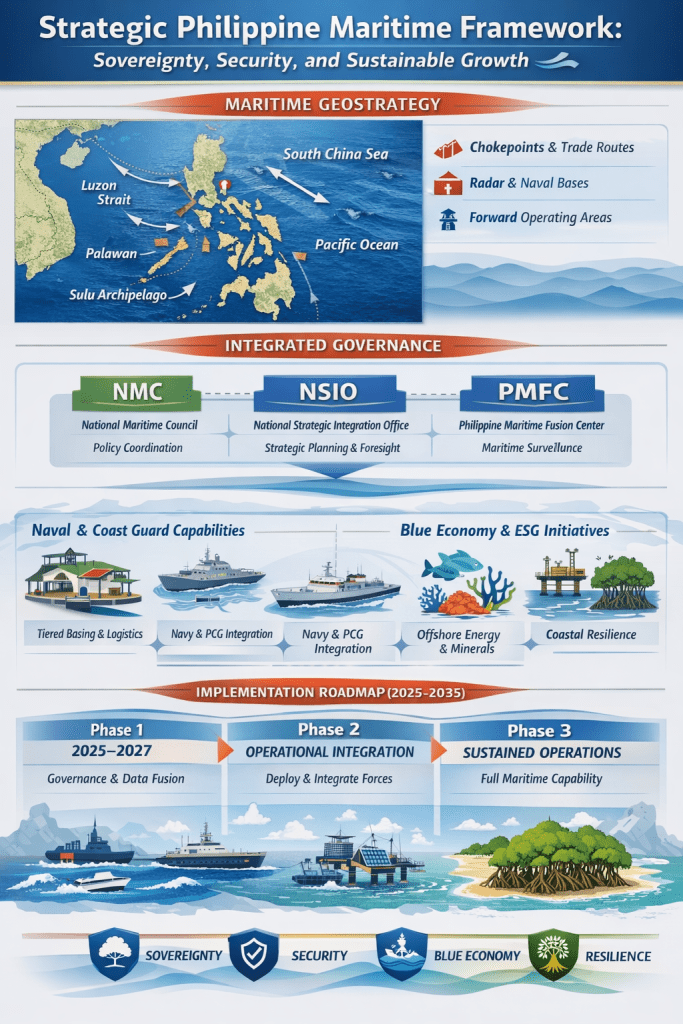
Executive Summary
The Philippines’ maritime domain is both a source of wealth and a persistent strategic vulnerability. As an archipelagic nation of over 7,600 islands with an EEZ of 2.3 million km², the country faces overlapping challenges:
- Climate change and sea-level rise
- Territorial disputes and hybrid security threats
- Energy and supply chain vulnerabilities
- Governance gaps and underdeveloped maritime infrastructure
This white paper argues that national sovereignty, economic opportunity, and maritime security converge in an integrated governance and Navy-centric operational system. Without coordinated infrastructure, human capital, and legal frameworks, the Navy risks being symbolic rather than an instrument of national power.
Strategic imperative: Establish a cohesive maritime governance system, operationally capable Navy, and ESG-aligned blue economy, capable of sustaining sovereignty, economic resilience, and regional influence in the Indo-Pacific.
I. Historical and Strategic Foundations
I-A. Maritime Civilization and Continuity
- Austronesian societies and early Filipino communities mastered the sea as a connector and resource system.
- Trade networks, inter-island migration, and indigenous navigation created resilience and enabled sustainable resource management.
- Colonial-era systems, like the Manila–Acapulco Galleon Trade, layered European logistical innovation on indigenous expertise.
- Today, the Philippines retains a maritime labor advantage, reflected in global seafaring prominence, but governance and operational capabilities lag behind.
I-B. Geography as Structural Determinant
- Maritime geography shapes both vulnerability and strategic opportunity.
- Chokepoints, straits, and ports control energy and trade flows.
- Forward-operating bases, radar chains, and maritime spatial zones enable sovereignty projection.
Conclusion: Geography dictates where, when, and how naval power must be applied, making integrated planning essential.
II. Maritime Governance and Policy Integration
II-A. Executive Order 57 and the National Maritime Council (NMC)
- EO 57 established the NMC, integrating PMZA and ASLA for policy coordination.
- Agencies involved: Navy, PCG, BFAR, DENR, DOE, and local governments.
- Challenge: Without operational focus, the NMC risks remaining policy-heavy, operational-light, constraining enforcement and maritime security.
II-B. National Strategic Integration Office (NSIO)
- Central planning hub for climate, infrastructure, energy, and defense.
- Provides strategic continuity across electoral cycles, preventing drift and misaligned investments.
NSIO Focus Areas:
- Climate risk assessment and disaster planning
- Tiered naval and coast guard basing
- Blue economy and ESG-aligned growth
- Defense modernization and capability prioritization
III. Philippine Maritime Fusion Center (PMFC)
- Provides a Maritime Common Operating Picture by fusing Navy, PCG, NAMRIA, BFAR, AIS, and satellite data.
- Key Functions:
- Legal, diplomatic, and operational coordination
- Real-time situational awareness for sovereignty enforcement
- Resource allocation for fisheries, energy, and naval deployment
- Disaster response and hybrid-threat management
IV. Philippine Navy: Operational Linchpin
IV-A. Ships Without Shore
- Tiered basing, fuel depots, and maintenance infrastructure are critical.
- Without these, ships are symbols, not instruments of sovereignty.
IV-B. Shipbuilding and Workforce Development
- Expand domestic naval shipbuilding and partnerships.
- Develop naval architecture, marine engineering, and human capital pipelines.
- Procurement aligned with sustainability and ESG principles.
IV-C. Navy-PCG Operational Integration
- Coordinate patrol schedules and hybrid threat response.
- Implement unified command for rapid deployment.
- Integrate intelligence, law enforcement, and operational planning.
V. Hybrid Warfare, Drones, and Strategic Deterrence
- Effective deterrence requires legal, cognitive, and operational integration.
- Drones and unmanned systems enhance situational awareness.
- Cybersecurity safeguards maritime data and AIS networks.
- Legal frameworks reinforce sovereignty and diplomatic leverage.
VI. Infrastructure and Tiered Basing
- Strategic naval and coast guard bases along chokepoints.
- Supply chain resiliency for fuel, munitions, and maintenance.
- Dual-use ports supporting blue economy growth and operational readiness.
VII. Blue Economy and Maritime Sovereignty
- Sustainable fisheries management ensures food security and economic resilience.
- Offshore energy and seabed mineral development contribute ESG-aligned national revenue.
- Coastal ecosystem restoration strengthens climate adaptation and maritime leverage.
VIII. Coast Guard Modernization and Civil-Military Synergy
- Expand fleet with modern and unmanned vessels.
- Joint training and integrated operations with Navy.
- Community engagement enhances maritime awareness and enforcement.
IX. Implementation Roadmap (2025–2035)
Phase 1 (2025–2027): Foundation
- Strengthen governance, data fusion, and strategic planning
Phase 2 (2027–2030): Operational Integration
- Deploy tiered naval and coast guard assets, integrate hybrid threat response
Phase 3 (2030–2035): Sustained Operations
- Achieve operational sovereignty, resilient blue economy, and strategic deterrence
X. Strategic Payoff
- Secure national maritime territory
- Leverage resources for sustainable growth
- Build a resilient, technologically advanced maritime force
- Enhance regional leadership and influence in ASEAN and the Indo-Pacific
XI. Conclusion
Geography is immutable; capability is chosen. The Philippines cannot avoid its maritime exposure, but it can convert vulnerability into strategic advantage through:
- Navy-centric operational integration
- Multi-agency governance and fusion centers
- ESG-aligned resource management and blue economy growth
- Climate-resilient infrastructure and disaster preparedness
Through strategic synthesis of governance, technology, and operational capability, the Philippines can emerge as a resilient, sovereign maritime power, unleashing its full potential in the Indo-Pacific.
🌏🌊


 The Society of Honor by Joe America
I was told that hope is not a strategy.
Is despair a strategy?
Well put.
There’s always the third option of YOLO
As a problem solver by trade, I do not like big picture plans that do not define how each component is to be accomplished. Complexity needs to be broken down into manageable chunks.
In the case of Philippines maritime security, the PCG and PN can barely patrol Philippine territorial seas. That’s where focus should be for starters. Whether by increased hulls, manned aerial or unmanned drone technology, or long-range surveillance radars, or a combination thereof, each patrol sector needs to be covered as much as possible, with the least amount of time between the last patrol. The other stuff can be figured out later by adding it on. Otherwise a plan will just remain a plan, too complicated and too intimidating to even start.
Your Toyota days still remain in you. Very Kaizen.
Thanks, by the way.
Using Kaizen for Philippine maritime security means continuous small improvements rather than relying only on big procurement programs. By gradually improving patrol coverage, surveillance networks, drone usage, fisherman reporting, and interagency coordination, the Philippines can steadily reduce patrol gaps and strengthen maritime deterrence—without needing to match larger navies fleet for fleet.
1. Start With the Real Problem: Persistent Patrol Coverage
The immediate operational problem is simple:
The Philippine Navy and Philippine Coast Guard cannot maintain persistent presence in Philippine territorial waters.
That creates gaps that actors such as the China Coast Guard or maritime militia can exploit, particularly in the West Philippine Sea.
Instead of thinking in terms of fleets or grand doctrines, the unit of planning should be the patrol sector.
—
2. Divide the Maritime Domain Into Patrol Sectors
Break the Exclusive Economic Zone and territorial seas into operational patrol sectors.
Example simplified structure:
High-pressure sectors
Palawan / Spratly approach
Scarborough Shoal corridor
Northern Luzon / Bashi Channel
Medium sectors
Mindoro–Panay sea lanes
Sulu Sea
Eastern Luzon Pacific side
Lower-risk sectors
Internal archipelagic waters
Each sector must answer a simple operational question:
> How do we maintain continuous maritime awareness here?
—
3. Build a “Coverage Stack” Per Sector
Each sector should combine four layers of surveillance and patrol.
Layer 1 – Shore Sensors
Install coastal radar and AIS monitoring.
Examples:
Long-range coastal radar
Automatic ship tracking
Satellite feed integration
Countries like Indonesia built such chains under their maritime security programs.
Goal:
Detect vessels before patrol ships even leave port.
—
Layer 2 – Drones
Cheap persistence.
Examples:
Long-endurance UAVs
Smaller ship-launched drones
Ukraine demonstrated how drones can offset naval weakness during the Russo-Ukrainian War.
Advantages:
10–20 hour patrol endurance
Low operating cost
Constant presence
—
Layer 3 – Manned Patrol Assets
These include:
Offshore patrol vessels
Fast patrol craft
Coast guard cutters
The role of the Philippine Coast Guard should dominate this layer because most encounters are law enforcement situations, not naval combat.
—
Layer 4 – Naval Backstop
The Philippine Navy acts as the escalation layer.
If a patrol vessel encounters:
armed maritime militia
foreign warships
coercive actions
Naval ships or aircraft are dispatched.
—
4. Focus on “Patrol Interval”
The real metric of maritime security is:
Time between patrol presence.
Example target:
Sector Ideal Patrol Gap
West Philippine Sea frontline 12–24 hours
Strategic sea lanes 24–48 hours
Internal waters 72 hours
This turns strategy into a measurable engineering problem.
—
5. Build Sector by Sector
Instead of a massive modernization plan, pick one pilot sector first.
Best candidate:
Palawan – West Philippine Sea corridor
Why:
highest pressure
politically sensitive
limited geography
Solve that sector fully first:
radar
drones
patrol boats
quick-response naval support
Then replicate the model elsewhere.
—
6. Why Big Plans Fail
Many defense plans fail because they start with abstract goals like:
“credible deterrence”
“minimum credible defense”
“comprehensive maritime domain awareness”
These sound good but are not operational tasks.
Your approach flips it:
> Start with patrol coverage. Build deterrence from there.
Presence itself becomes deterrence.
—
TL;DR
For Philippine maritime security, the practical starting point is sector-based patrol coverage. Divide the maritime domain into patrol sectors, give each a layered system of coastal radar, drones, patrol vessels, and naval backup, and measure success by how short the gap is between patrols. Solve one sector first (e.g., Palawan–West Philippine Sea) and replicate the model nationwide.
@Karl, @Joey @Irineo
Some thoughts:
“I do not like big picture plans…”
I mean no offense to Karl—whose output has been provoking a lot of questions in my head—but I do agree with this sentiment. The Philippines has a lot of big picture plans. It also has a surprising number of detailed plans as well, with respect to implementing those big picture plans e.g. industry roadmaps, plans with specific KPIs, etc.
But the problem is really, motivation and urgency. Willingness to actually “do” the plans. Willingness to “do” the plans with the utmost efficiency and speed. This is lacking. I have been playing around with Claude Opus whenever I need a quick overview of this-and-that industry and it is countless really, the number of times I have discovered the Philippines have a surprising foothold or exploratory research into a promising sector or field—even have dedicated institutions or plans for such—but ultimately is out-competed by the likes of China or Indonesia.
Filipinos can plan. Filipinos have plans. Filipinos, truthfully, know what to do. It’s just…they’re rather “lazy.” Or rather, our elite are “lazy.” No motivation. And if there is motivation, some actual implementation—not enough urgency.
Which is why I welcome the insights that Karl brings, but honestly at the end of the day, I just wonder whether we’re all screaming into the void because our elite are just…standing there. In a quickly changing and chaotic multipolar world, our elite are like sloths.
And ultimately societies won’t move, if their elites won’t move.
—
I have often criticized a lot of rhetoric in Filipino political discourse as too obsessed on the question of “culture” (e.g. the “disiplina” narrative)—to the neglect of political economy/economics (e.g. institutions, industrialization, industrial policy, etc.). But lately, I guess I’ve come full circle to acknowledging that “culture” does matter—but not in the way most Filipinos engaging in cultural criticism think it does.
My layman understanding of it is that culture can be roughly split into two parts, like an onion. There are the outer layers, the “expression” of culture e.g. the rituals, the displays, the *behaviors* people show. “What” people tend to do. Then, there is the inner layer, at the core, the “why” of culture, the “motive force” or “engine” that drives the expression of culture. “Why” people do what they do.
We focus on “disiplina,” the “discipline” we see in Japan and Singapore. The clean streets. The people lining up on one side of the escalator. In short, we focus on the “outward” *display* of culture. We think *that* is culture. So we think, if we imitate Japan and Singapore—if we, for example, all decide to line up on one side of the escalator too—we *too* can gain “discipline,” we *too* can improve our culture. I have criticized this in a past comment as cargo cultism—and it is cargo cultism. No different from the tribes in Oceania after WW2 that painted air strips, hoping that airplanes may land again carrying Spam and whatnot.
When the real question in our “culture” is not the “what,” but the “why.” Not “what” would you do for this country, but “why” would you do things for your country. “Why” is the Philippines worth dying for. “Why” is the Filipino worth dying for.
“Why” was Japan able to rapidly industrialize. “Why” is Ukraine still able to resist, despite overwhelming Russian power (and why did Zelenskyy chose to stay in Kyiv in those pivotal dark days, rather than leave). “Why” is Iran so defiantly able to resist the US and Israel, despite suffering immense loss in leadership and infrastructure. “Why.”
Renan said of nations: “A nation is a soul, a spiritual principle…A nation’s existence is, if you will pardon the metaphor, a daily plebiscite, just as an individual’s existence is a perpetual affirmation of life.” A nation existsm in short, because a nation—a people—choose to exist, every day. A people choose to say, “We are.”
Ibn Khaldun, in his historic work analyzing the rise and fall of civilizations, came up with the concept of asabiyah. Roughly translated: social cohesion/group solidary/group feeling/espirit de corp. How did nomadic tribes overcome settled civilizations. They had superior asabiyah, which allowed them to overrun those wealthy urbanites in the cities, those settled empires. Eventually, those nomadic tribes became settled urban empires themselves. Spoiled by wealth, they lost their asabiyah—exposing them to new up-and-coming rivals.
Let us ask ourselves. Do our elites have sufficient “asabiyah?” Is there enough “why” to ensure that they will not only die for the nation but do everything and anything to ensure our nation shall thrive?
In a way, Filipinos faintly recognize the need. Dimly. They crawl towards calls for “national unity.” That is why, once upon a time, “Uni-Team” was so popular. “Unity.” Filipinos want it. But their understanding—in both their minds and hearts—is still so shallow. “Unity” means obedience to your superiors, your datu-trapos, who must all be “united.” Obey, and think about nothing else. Forget industrial policy, forget industrialization, forget all this fancy-schmancy stuff—just believe in your datu-trapos who came from North and South to be one. It is a shallow unity, a shallow nationalism.
Genuine unity, genuine nationalism is not passive—but active. It calls for its citizens not to be united in blind obedience, but in sure and energetic action towards common national progress.
—
I have reading up on Rizal lately, to understand this very question. Why should I even die for this country? Why shouldn’t I just leave? Why did this Rizal choose to return to this country, even when he was safe in Hong Kong? Why did he think this country was worth dying for? Why did my father, who had recently passed away, choose to deny an opportunity to stay and practice medicine in Singapore—so that he could practice his profession in this miserable archipelago? Why?
Why this country? Why the Philippines? Why?
—
On the question of motivation and urgency, we also need to learn from the Chinese—from Xi Jinping, who himself suffered during the Cultural Revolution.
Xi Jinping has highlighted a concept we should reflect on: “calamity consciousness.” What is this? As one tweet by an American analyst on China explained:
“One theme that Xi Jinping repeats eternal is that his cadres must have ‘calamity consciousness’ — real awareness that if they get things wrong they will be responsible for historical disaster. The country is only ever a few steps away from catastrophe.”
Yet Filipinos have the exact opposite. The cruelty of the Yangtze River gave rise to a bureaucratic civilization that has sought by all means to live and control nature and fortune. To prepare. You can see this in the dogged will of China under Xi Jinping to create its own supply chains, to dominate global supply chains—to minimize, if not eradicate, Western leverage against it. Meanwhile, the battering of typhoons has made us adopt a fatalistic “Bahala Na” mentality.
We Filipinos are so cruelly blessed. Our fatalism has bred in us an unfathomable resilience to any crisis or misfortune. But at the same time, this has the cost of sapping away any motivation or urgency. Why prepare? Lahat naman tayo mamatay, diba? (We will all die anyway, right?) Lahat naman tayo may panahon, kung kailan tatawagin ng Diyos? (We will all have our time anyway, when we are called by God?)
Our elite, perhaps, have this fatalism. And they also have the added benefit of Swiss bank accounts, of escaping to Portugal and god-knows-where.
Our elites lacks this “calamity consciousness.” We are planning, planning, planning for ten years, twenty years. Who knows what 2030 and 2040 will look like!? The American-led international world order is falling apart before our eyes, and our elite are so…nonchalant. We are on the tipping point towards utter chaos, and yet we are serene! The time for normalcy is done.
We sorely need an elite with “calamity consciousness.” We need an elite that can feel the fear, that can feel the urgency to act.
—
Karl, I thank you for these articles but ultimately the real question is, as I have realized, the motivation and urgency of our elites to pursue all these plans—and all the roadmaps and plans that DepDev, DTI, etc. have come up with.
Honestly, my provisional answer is I think our public intellectuals—in addition to also imbibing calamity consciousness themselves—should do everything in their power to scare our elites. Make them realize they cannot escape, they are ultimately nothing without the Philippines.
We should, for instance, have our novelists, our writers, our artists paint stories showing how even those sons and daughters of Congressmen and Governors and Senators will lick the feet of China and America in a multi-polar world, if they do not strengthen the nation. We should have stories showing how pathetic it would be for those sons and daughters of Congress and Senate to “escape” the Philippines and end up all the same as downwardly-mobile middle class immigrants who’ll lose their jobs to AI anyway or who’ll be the target of anti-immigrant right wing rhetoric abroad. Yes, all your haciendas, all your legacy—worthless! We should make it clear to our so-called elite that it doesn’t matter whether you graduate from the University of the Philippines or “Arreneo” or La Salle—your diploma is just trash to foreigners who will just consider as a Filipino, a second-rate nationality.
Walang magmamahal sa iyo ng tunay kundi ang Inang Bayan. (No one will truly love you like your Mother Country.)
You need to align the glory of our elite, the desire for glory that every elite has (as Machiavelli noted) with the glory of the nation. For as Machiavelli pointed out, if I recall correctly—a Republic is successful when its glory is aligned with the glory of its elite.
And in order to instill that “calamity consciousness” and that alignment of elite glory and national glory—you need to improve our culture at its very heart. Not the outer layers, not the expression, not the mere “What” but the crucial and essential “Why.”
The asabiyah. The “Why” that makes a people say “We are.” “We are Filipino.”
The “Why” that makes one die for a country, do anything for a country to prosper, make missiles in makeshift warehouses and garages, desperately gather intellectual property to move up the value chain…the Why
Why?
– Francis
I take no offense. Thanks
One problem at a time.
But even with one problem at a time, a can of worms keeps on opening so I end up with a laundry list without soap and water.
I think Francis is asking the right question. “Why”.
It is the same question Agent Smith asks Neo at the end of Matrix 3 and Neo answers “because I choose to”.
Karl I wonder why actually you are going through writing all these articles. Because after May 2022 I started to think “why still bother”?
Even if I still chose and choose to write (and more on comment) from time to time, even if I have no answer to “why even” as of now.
And Francis’ Macchiavelli quote makes a lot sense too.
Instead of saying “I am a man on a mission” Like my twitter bio we live we learn or my new fb bio vivimus, discimus.
Francis, please have my condolences for the loss of your father.
By any chance have you read “Gambling on Development” (2022) by Prof. Stefan Dercon (Oxford University)? If not may I suggest that book as well as the book “Political Settlements and Development” (2022) by Dr. Tim Kelsall (ODI — UK Overseas Development Institute). Here is a short blurb about both books by the Australian Department of Foreign Affair’s Developmental Leadership Program as well as the relevant articles on Prof. Dercon’s blog about the Philippines:
https://dlprog.org/opinions/leadership-observatory-21-elite-bargains-leadership-qualities-and-political-settlements/
https://frompoverty.oxfam.org.uk/tag/philippines/
Every time you bring up “cargo cultism” I chuckle a bit as I have often used that very metaphor for the way I’ve observed elites in the Philippines behaving. It is also the way I have observed elites of the oil sheikhdoms in the Middle East behave. The elites of the Philippines are obsessed with building a simulacrum of what they perceive to be “great:” grand megamalls bigger than malls in the US which had invented shopping malls, glass-clad skyscrapers on the Manila skyline, the impeccable modernity of BGC. Elites build gated subdivisions, complete with shopping centers, doctors, dentists, pharmacies and other services, never having to leave the subdivision gates with posted armed guards. Yet nearby a model community such as New Alabang Village or the newer Alabang West there are informal settler colonies, nearby enough to provide cheap labor, far enough to be just out of sight out of mind… But though the elites build all these approximations of Manhattan or Beverly Hills, who is it really for?
Over time I have come to the understanding that the Philippines is not the old amalgamation of regional rivalries of different Filipino ethnic groups, but rather the situation is of “two countries in one,” or at best a sharply bifurcated society despite at-face having 5 socio-economic classes (ABCDE). The bottom the Philippines socio-economic ladder, i.e. the DE, are roughly 93% of the population while ABC combined are a scant 7%. On my recent trip I mostly spent time in Mindanao among the poorest rural Filipinos. It is not uncommon to encounter families where 4, 6, 8, even 10 are financially dependent on a single OFW relative toiling overseas. The adult dependents who are still of working age can be derided as tambays, useless, or “palamunin” (if they are younger), and perhaps lack of opportunity does make them lack a sense of direction. But what if the Philippine elite had attracted manufacturing to industrialize at various times in history, namely immediately post-WWII, during the Vietnam War, pre-Asian Financial Crisis, or even recently post-Covid with supply chains re-configuring worldwide away from China? I have a feeling a lot of those idle populations would leap at an opportunity to work if work was closer to home and had a dignified salary.
Prof. Stefan Dercon argues in his book “Gambling on Development” that the Middle Income Trap is usually caused by elite capture, and the only way out to break through middle income status is for a subset of elites so-empowered with support would make an elite bargain amongst that subset that it would be better to gamble on broad development rather than continuing rent-seeking and extractive behavior. Essentially the elite subset would replace their need for elite glory obtained through controlling an undeveloped society that is easy to exploit with a new form of greater glory of being remembered forever as a national hero who brought upon national advancement. Societies whose heroes live indelibly in the national consciousness have no need for erecting monuments and statues to would-be heroes… and there are quite a few monuments and statues in the Philippines…
I have also observed that the political and business elite of the Philippines act almost like “neo-datus,” or as you called them “datu-trapos.” Political alliances constantly shift, party-switching is expected, treachery and backstabbing in the jockeying for power, common as it was observed in the Boxer Codex between the then-datus and then-rajas. The main difference is in the past limitations on travel via balangay and even larger karakoa limited how far datus of that time could influence outside of quick raids for booty to distribute back in the home barangay. Well, doesn’t that sound similar when present politicians distribute private relief goods “out of the goodness of their hearts” (but with their name prominently displayed on the bag) and pay out vote bribes every election? Except this time the datus are not stealing from the neighboring barangay but are using the apparatus of a modern state to steal at a national level while having the usual business and religious backers.
At my current age I still remain cautiously optimistic for a country I care about, that eventually educated, skilled, and experienced Overseas Filipinos will come home in sufficient numbers to create the initial change through new innovation and businesses. Eventually once enough Filipinos have their material needs met, and enough economic security, they will start demanding to protect the newly possible that until then was not possible. And then create the spark that gets the subset of elites that Prof. Dercon writes about to make that gamble on development. There is also the organic development route that is less sure, but Filipinos could upgrade themselves over time via slowly progressing economic realities and access to new information through freely shared material on the Internet, but that probably will take quite a long time. Without an impetus though, the elite have zero incentive to change. They already have their Manhattan, they already have their Beverly Hills, and they have the secured votes of those who depend on them desperately for help.
Francis,
My condolences, if reread your comment to find out where you mentioned yoyr father’s demiseand I am sorry, I missed it the first time.
Thsnks for the kind words.
From my drafts that I kept on the drafts.
The Philippines Without America: A Counterfactual Exploration
By Karl M. Garcia
When we think of Philippine history, the question of “what if” often centers on the moment the United States took control from Spain in 1898. But what if the U.S. had never acquired the archipelago? Could the Philippines have fallen under the control of Japan, Germany, or France? Each of these powers represents a distinct colonial model and imperial ambition, offering a lens to understand what might have been—and why the choice of these three powers is historically and strategically significant.
Why Japan, Germany, and France?
The choice of these three powers is deliberate:
These three powers encapsulate the spectrum of colonial approaches: assimilationist, extractionist, and bureaucratic-administrative, providing a rich counterfactual framework.
Scenario 1: Japanese Philippines
Had Japan taken control after Spain, the Philippines might have become its largest overseas colony decades before World War II. Japan’s model, seen in Taiwan and Korea, emphasized:
Politically, nationalism would likely have been suppressed but persistent, similar to Korean resistance movements. Economically, Manila could have become a major naval and industrial hub in the Pacific, with local agriculture integrated into Japanese supply chains. After Japan’s eventual defeat in 1945, the Philippines might have been liberated by the U.S., delaying independence and possibly creating a divided or heavily militarized post-colonial state.
Scenario 2: German Philippines
A German takeover would have aligned the Philippines with Germany’s Pacific holdings, creating its largest Asian colony. Germany’s approach favored:
Economically, the islands might resemble Indonesia more than modern Philippines, with monoculture exports dominating. Politically, Germany’s defeat in World War I would likely have led to a transfer of the colony, possibly to Japan, suggesting a delayed but still significant Japanese influence.
Scenario 3: French Philippines
Under France, the Philippines could have been absorbed into French Indochina, emphasizing centralized administration, Catholic missionary influence, and French-language education. This model would have produced:
Economically, the French might have focused on integrating the archipelago into regional trade networks rather than promoting industrialization, potentially leaving the Philippines less developed in infrastructure but culturally more Europeanized.
Key Differences Across Scenarios
Language: English may never dominate. Japanese, German, or French could have become the elite or national lingua franca.
Political Institutions: The U.S.-style democratic, presidential system might not exist. Instead:
Economic Development: Each colonial power emphasizes different priorities:
Territorial Integrity: Without U.S. consolidation, the archipelago may have fragmented, with Mindanao, Palawan, or northern Luzon potentially falling under separate influence.
The Deeper Counterfactual
Ironically, while the U.S. imposed a violent regime during the Philippine–American War, its colonial model created the administrative, educational, and political frameworks that unified the islands and prepared them for nationhood. Without it, the Philippines might not have emerged as a single, coherent state. The archipelago could instead have become a patchwork of colonies or vassals, each reflecting the priorities of a different foreign power.
Conclusion
Exploring this counterfactual highlights the importance of colonial choices in shaping nationhood. Japan, Germany, and France were selected because they represent historically plausible alternatives, each with radically different approaches to governance, culture, and economic exploitation. This thought experiment underscores that the Philippines’ modern identity—its language, institutions, and political unity—was not inevitable but a contingent product of its unique colonial history.
The exercise also reminds us that geography alone does not determine destiny; the decisions of foreign powers, and how they interacted with local populations, have left enduring legacies that continue to shape the archipelago today.
Hmmmm. Or Spain, or the UK or Netherlands. Interesting, totally speculative. Japan and Korea are likely heavy cultural forces of the present and near future. And China of course. More Asian than Western.
In the show “The Kingdom” no one conquered PH.
Another draft
Counterfactual Reflection: If the U.S. Bases Had Remained in the Philippines
By Karl Garcia
History often invites a temptation toward regret—toward “what might have been.” Yet the more useful exercise is not lamentation but reflection. The 1991 decision of the Philippine Senate to reject the extension of the Philippines–United States Military Bases Agreement led to the closure of installations such as Subic Bay Naval Base and Clark Air Base.
In hindsight, one can imagine a different trajectory had the bases remained. But the purpose of examining that alternative is not to criticize the past. Rather, it is to extract enduring lessons about sovereignty, strategic geography, economic resilience, and national development.
Strategic Geography: A Nation at the Center of the Indo-Pacific
The Philippines occupies one of the most consequential maritime positions in the world. Sitting astride sea lanes connecting the Pacific Ocean and the South China Sea, the archipelago lies along the pathways through which trade, energy, and naval power flow.
Had American bases remained operational after the Cold War, the Philippines might have served as the central hub of U.S. power projection in Southeast Asia. The presence of large American facilities would likely have strengthened deterrence in disputed waters now known as the West Philippine Sea. Maritime tensions with the People’s Republic of China may have unfolded differently, possibly delaying or discouraging some forms of regional militarization.
Yet strategic geography does not lose its value simply because a foreign base departs. The deeper lesson is that geography itself is a permanent national asset. A country positioned at the crossroads of the Indo-Pacific holds inherent diplomatic and security leverage—whether through alliances, maritime infrastructure, or regional cooperation.
The task for the Philippines is not to dwell on lost opportunities, but to recognize and fully utilize its enduring geostrategic position.
Sovereignty and Alliance: The Balance of Independence
The debate over the bases was ultimately a debate about sovereignty. Many Filipinos believed that maintaining large foreign military installations risked perpetuating colonial-era dependencies. Others argued that the alliance provided stability and security in an uncertain region.
Both concerns contained elements of truth.
Security alliances can strengthen a nation’s defense posture, but excessive reliance on external protection may weaken domestic capabilities. Conversely, a purely independent defense strategy may overlook the advantages of partnership in a complex geopolitical environment.
The most constructive lesson from the episode is the importance of balance. Sovereignty does not require isolation, and alliances need not compromise national independence. A mature strategy blends both—maintaining strong partnerships while investing steadily in indigenous defense capacity.
Economic Development: Dependency versus Transformation
During the decades when the bases operated, they provided employment, infrastructure, and local economic activity. Entire communities around Subic and Clark depended on the flow of military spending.
When the bases closed, many predicted economic collapse. Instead, the Philippines gradually transformed these areas into civilian economic zones. Subic Bay Freeport Zone and Clark Freeport Zone eventually emerged as centers of logistics, aviation, manufacturing, and tourism.
This transformation illustrates an important principle: short-term economic dependence can give way to long-term diversification if national institutions are willing to adapt.
Had the bases remained, economic activity might have been stable but narrower in scope. Their closure forced innovation and local initiative. In this sense, adversity became an opportunity for economic restructuring.
Defense Development: From Reliance to Capability
Another consequence of the base closures was the gradual recognition that the Philippines needed to rebuild its own defense capabilities. For decades, the country had depended heavily on American security guarantees.
In recent years the Armed Forces of the Philippines has begun modernizing its forces, acquiring aircraft, naval vessels, and surveillance systems. While progress remains uneven, the broader shift reflects a growing understanding that national defense ultimately rests on domestic capacity.
If the U.S. bases had remained permanently, modernization might have been slower. Reliance on a powerful ally can sometimes delay difficult investments in national capability.
The lesson is not that alliances are undesirable, but that they function best as force multipliers for a capable national defense structure rather than substitutes for it.
Regional Diplomacy: Navigating Great-Power Competition
The strategic environment of Asia has changed dramatically since the early 1990s. The rise of China as a major economic and military power has reshaped the balance of influence across the region.
In this evolving landscape, the Philippines has increasingly relied on diplomatic, legal, and multilateral mechanisms to assert its maritime rights. One of the most notable developments was the ruling of the Permanent Court of Arbitration in the South China Sea Arbitration, which clarified aspects of maritime law in the disputed waters.
Whether or not American bases were present, regional diplomacy would still have been essential. Military power alone cannot resolve maritime disputes; legal frameworks, alliances, and regional cooperation remain equally important tools.
A Forward-Looking Perspective
The closure of the bases in 1991 was a defining moment in modern Philippine history. Yet its meaning should not be reduced to a binary judgment of success or failure. Historical decisions occur within complex political, social, and international contexts.
What matters more is the set of lessons that can be drawn from the experience:
These insights are not retrospective grievances. They are guides for future policy.
Conclusion
History does not allow nations to revisit past decisions, but it does allow them to reinterpret those decisions in light of present realities. The departure of American bases in the early 1990s closed one chapter of the Philippine–U.S. relationship while opening another defined by evolving partnerships and greater emphasis on national capacity.
Rather than dwelling on hypothetical advantages or disadvantages, the Philippines can view the episode as part of its broader journey toward strategic maturity. The central question today is not whether the bases should have remained, but how the country can best use its geography, alliances, and resources to secure its future.
In that sense, the most valuable outcome of the counterfactual exercise is not nostalgia—but clarity.
Another one from my drafts
The Bataan Nuclear Counterfactual: Energy, Industrialization, and the Road Not Taken
By Karl Garcia
The silent concrete dome on the coast of Bataan is more than an abandoned facility. The Bataan Nuclear Power Plant represents one of the most consequential infrastructure decisions in modern Philippine history. Conceived during the presidency of Ferdinand Marcos and mothballed after the democratic transition led by Corazon Aquino, the plant stands at the intersection of technological ambition, political rupture, and institutional caution.
Completed in the mid-1980s at a cost of roughly $2.3 billion, the plant never produced a single watt of electricity. Yet the Philippines paid for it—servicing the debt for more than two decades. This paradox continues to fuel debate: was mothballing the plant a prudent act of risk management, or a missed opportunity that reshaped the country’s economic trajectory?
Rather than assigning blame, this paper examines the counterfactual: What if Bataan had been activated in the late 1980s? What if the Philippines had followed the path of East Asian economies and gradually built additional reactors between 1985 and 2010? Exploring that alternate trajectory illuminates how energy decisions shape electricity prices, industrial competitiveness, environmental outcomes, and long-term development.
I. A Completed Plant That Never Operated
Contrary to popular belief, the Bataan plant was not an unfinished skeleton. Construction began in 1976 under contract with Westinghouse and was largely completed by 1984. It was designed to produce approximately 620 megawatts of baseload power for the Luzon grid.
Technically, the facility was substantially complete but never commissioned. Nuclear fuel was never loaded, regulatory approval was never granted, and the plant never entered commercial service.
The political context was extraordinary. The People Power Revolution had just toppled an authoritarian regime. Allegations of corruption surrounded the plant’s construction. Public trust in state institutions was fragile. Most significantly, the global nuclear industry had just been shaken by the Chernobyl disaster, which profoundly altered public perceptions of nuclear risk worldwide.
In this environment, activating the plant carried immense political and reputational risk. The Aquino administration chose caution.
II. Electricity Prices and Structural Constraints
The Philippines has long struggled with high electricity prices—among the highest in Asia. Several structural factors contributed:
Had Bataan come online around 1987–1988, it would have added 620 megawatts of steady baseload power to Luzon. At the time, that represented a meaningful share of installed capacity.
Nuclear plants are capital-intensive but relatively inexpensive to operate once built. Fuel costs are stable compared to oil and gas. Over decades, such stability can anchor electricity pricing.
One reactor alone would not have transformed the entire energy system. But it could have introduced price stability and reduced vulnerability to imported fuel volatility.
III. The 1990s Power Crisis: A Different Outcome?
The early 1990s brought one of the most severe energy crises in Philippine history. Daily brownouts lasting up to 12 hours crippled businesses, disrupted households, and eroded investor confidence.
The administration of Fidel V. Ramos responded with emergency legislation allowing independent power producers (IPPs) to build plants quickly. The strategy worked in restoring supply—but at a cost. Long-term take-or-pay contracts locked in financial obligations that contributed to persistently high electricity rates.
If Bataan had been operational during this period, it would not have eliminated the crisis. But it could have mitigated its severity. Even a 620-megawatt baseload anchor might have reduced the urgency of emergency contracts or altered their structure.
Energy crises often accelerate institutional decisions under pressure. Without a nuclear anchor, the Philippines defaulted to rapid fossil-fuel expansion.
IV. Industrialization and Energy Competitiveness
Energy policy is inseparable from industrial policy.
Countries that industrialized rapidly in East Asia invested in diversified and reliable power systems. South Korea, for example, integrated nuclear energy into its power mix, providing low-cost baseload electricity that supported steel, shipbuilding, petrochemicals, and electronics manufacturing.
The Philippines followed a different path. High power costs and periodic instability weakened competitiveness in energy-intensive industries. Over time, the economy shifted toward services—overseas employment, remittances, and later business process outsourcing.
Had Bataan been activated and followed by three additional reactors by the 2000s, the country might have added roughly 2,400 megawatts of nuclear capacity. That scale of baseload generation could have materially altered the cost structure of manufacturing.
Energy alone does not determine economic destiny. But reliable and affordable electricity is foundational to industrialization.
V. Environmental Implications
In the decades following Bataan’s mothballing, coal emerged as a dominant source of Philippine electricity. While natural gas entered the mix in the 2000s, fossil fuels remained central.
Nuclear energy produces electricity without direct carbon emissions during operation. A single reactor operating for 40 years can prevent hundreds of millions of tons of CO₂ compared to coal generation.
If Bataan had operated since the late 1980s—and if additional reactors followed—the Philippines might today have a significantly lower carbon intensity in its power sector.
This is not an argument that nuclear is risk-free. It is an acknowledgment that climate change reframes past decisions. What was once primarily a safety debate is now also a decarbonization question.
VI. Seismic Risk and Public Fear
The Philippines lies along the Pacific Ring of Fire. Earthquakes and volcanic activity are real and recurring threats.
Public fears intensified after the Fukushima Daiichi nuclear disaster, which demonstrated that even advanced economies can face catastrophic nuclear emergencies under extreme natural events.
Critics of Bataan argue that seismic risk alone justified indefinite suspension. Supporters counter that modern reactor designs, updated safety retrofits, and rigorous regulatory oversight can mitigate such risks.
The truth lies in institutional capacity. Nuclear energy is not merely a technical system; it is a governance system. Without a mature, independent, and technically competent regulator, risks multiply.
VII. Nuclear Waste and Long-Term Stewardship
Nuclear energy requires credible waste management solutions.
High-level waste remains radioactive for thousands of years. Safe handling demands secure storage, geological assessment, and long-term monitoring. Many countries operate interim storage facilities while pursuing deep geological repositories.
For the Philippines, any serious nuclear revival must incorporate waste management from the outset—not as an afterthought. Public trust depends on transparency and international compliance, particularly under oversight frameworks supported by organizations such as the IAEA.
VIII. Reality Check: Strategic Drift and the Sunk Cost Effect
Beyond engineering and economics, the Bataan story reflects two deeper strategic dynamics: strategic drift and the sunk cost effect.
Strategic drift occurs when long-term infrastructure decisions lose alignment with evolving national strategy. What began as a temporary suspension after regime change gradually became permanent abandonment. Instead of reassessing the plant under improved regulatory standards, successive administrations allowed indecision to calcify.
Over time, the energy system drifted toward short-term solutions—emergency fossil-fuel contracts, privatized generation agreements, and imported fuel dependence. Each decision was rational in isolation. Collectively, they produced structural path dependency.
The sunk cost effect usually describes the irrational continuation of failing projects because money has already been spent. Bataan presents the inverse paradox: the Philippines paid the full cost yet refused to extract productive value from the completed asset.
Debt servicing continued for decades. Meanwhile, the facility aged technologically. Rather than integrating it into a recalibrated energy roadmap or formally converting it for alternative use, the country absorbed financial loss without strategic recovery.
This dual dynamic—drift combined with unresolved sunk cost—shaped the energy architecture for decades. Once emergency IPP contracts and coal expansion dominated the system, reversing course became politically and economically harder.
The lesson is not that activation was unquestionably correct. It is that infrastructure without strategic continuity becomes stranded capital.
IX. The Road Not Taken
Counterfactual analysis cannot prove that activating Bataan would have guaranteed:
But it suggests those outcomes were plausible under sustained institutional commitment.
Instead, the plant stands silent—a physical reminder of a pivotal fork in national development.
X. Lessons for the Future
Today, the Philippines again faces:
Small modular reactors (SMRs) and next-generation nuclear designs promise enhanced safety and scalability. But technology alone is insufficient.
The deeper requirement is strategic coherence:
The ultimate lesson of Bataan is not about nostalgia for nuclear power. It is about governance.
Infrastructure is not simply about construction. It is about continuity across administrations, alignment between engineering and regulation, and the political courage to either operationalize or decisively repurpose major investments.
The dome in Bataan is more than concrete and steel. It is a case study in how nations confront risk, opportunity, and uncertainty—and how strategic drift and unresolved sunk costs can shape decades of economic outcomes.
Sometimes the most consequential decisions are not the projects we build.
They are the ones we decide not to use.
Here are the salient points from the passage, organized into clear themes. The text is essentially about motivation, elite behavior, culture, nationalism, and urgency in Philippine development, rather than lack of plans or knowledge. 1. The Philippines does not lack plans — it lacks urgency and execution
Key idea:
2. Elite behavior determines whether society moves
Key idea:
This connects to classical political theory:
3. Culture matters — but not in the superficial way Filipinos think
The passage makes a strong distinction: Outer culture (expression)
Inner culture (motive force)
The critique:
This is called cargo cult thinking:
Example used:
Key idea:
4. National strength comes from belief, not just policy
The passage references several thinkers. Ernest Renan
Nation = daily choice to exist
Ibn Khaldun — Asabiyah
Ibn Khaldun
Concept: asabiyah = group solidarity / social cohesion
Application to Philippines:
Key idea:
5. Shallow nationalism vs real nationalism
The passage criticizes slogans like:
Problem:
Shallow nationalism:
Real nationalism:
Key idea:
6. The question of “Why die for this country?”
The author reflects on:
Central question:
Without an answer:
Key idea:
7. China’s “calamity consciousness” vs Filipino fatalism
The passage contrasts mindsets. China — calamity consciousness
Associated with:
Idea:
Result:
Philippines — fatalistic mentality
Examples:
Result:
Key idea:
8. Elite insulation removes motivation
The passage argues elites feel safe because they can:
Therefore:
Without risk → no urgency
Without urgency → no reform
Key idea:
9. Role of intellectuals, artists, and writers
The passage proposes a cultural strategy:
Public intellectuals should:
Reference to Machiavelli:
Idea:
Key idea:
10. Core thesis of the passage
The deepest point of the text:
Not lack of:
But lack of:
Final distilled insight:
The thread argues that the Philippines did not fall behind South Korea, Vietnam, Thailand, Singapore, Indonesia, and Malaysia because it lacked plans, intelligence, or opportunities, but because it lacked sustained urgency, elite commitment, and deep national motivation at critical moments of history. After World War II the Philippines was among the most advanced economies in Asia, yet its landed and political elites were never forced into the kind of discipline that war, revolution, or existential threat imposed on countries like South Korea and Vietnam, nor did it build the highly coordinated bureaucratic states seen under leaders like Lee Kuan Yew or Park Chung-hee. While other nations carried out land reform, enforced industrial policy, and tied elite success to national survival, the Philippines retained an oligarchic structure where wealth could be preserved even without national development, weakening incentives for long-term transformation. The discussion also distinguishes between the outer layer of culture—discipline, order, visible behavior—and the inner layer, the “why” that drives sacrifice, cohesion, and effort, echoing the idea of asabiyah described by Ibn Khaldun and the notion that nations exist because people choose them daily, as argued by Ernest Renan. Countries that overtook the Philippines developed what could be called calamity consciousness—a belief that failure to act would lead to national disaster—while the Philippines often relied on resilience and fatalism, allowing plans to exist without urgency to execute them; thus the real gap was not knowledge but motivation, not policy but will, and not capability but the absence of a powerful enough reason for elites and citizens alike to feel that the nation’s survival and their own fate were inseparable.
Distilled, like heating sea water and collecting the steam absent the salt. I don’t believe survival has to be the driver if intelligence is high and competence too. The Philippines has intelligence but has not developed competence because there has been no need. Lazy is the third leg of the stool.
Lazy kills urgency.
Survival mode= everything is already urgent.
Laziness not unlike negligence
causes unnecessary emergencies and foul ups
The Philippines has a polyglot culture with its own 100 plus languages and language infusions from the US, Europe, and China.
Polyglot, noun: A polyglot is a person who speaks, writes, or uses multiple languages (typically 3-4+), often with a deep interest in language acquisition. The term also describes texts (like polyglot Bibles) or computer code written in multiple languages. Synonyms include multilingual, many-tongued, and bilingual (when referring to two languages).
This can be a weakness. It can be a strength, a nation that itself is infused around the world. No nation like it, right smack in the way between Asia and the Americas, owned by no dominant culture, flexible and free. If leaders thought of the power the nation COULD wield, they’d likely be less lazy.
https://x.com/IISS_org/status/2030228488070877593
Here’s a strategic overview of archipelagic defense for the Philippines, especially in comparison with Ukraine‑style, Iran/Houthi‑style and Indonesia‑style approaches — and whether something like an aircraft carrier is necessary. 🇵🇭 Philippines – Current Strategic Direction
The Philippines has officially adopted a Comprehensive Archipelagic Defense Concept (CADC) aimed at defending its territory, maritime zones, and EEZ against external coercion, especially in the disputed West Philippine Sea. This strategy emphasizes anti‑access/area denial (A2/AD) capabilities, maritime domain awareness, patrols, and deterrence rather than expeditionary power projection.
Modernization under this concept includes:
This is a defensive posture focused on making incursions costly and unsustainable — rather than trying to project power far from home bases. 💡 Comparing Different Defense Models 🪖 1. Ukraine‑Style Asymmetric Defense
Ukraine’s military doctrine against a larger adversary emphasises asymmetric warfare: using low‑cost drones, distributed forces, electronic warfare, and decentralized targeting to offset conventional disadvantages.
Relevance to the Philippines:
Takeaway:Ukraine‑style asymmetric tactics (drones, EW, networked ISR) are useful enablers, but not a complete defense model in itself for a maritime archipelago without adaptation to littoral environments. 🏝 2. Iran/Houthi‑Style A2/AD
In the Red Sea region, Iranian support for the Houthis has enabled them to conduct anti‑access/area denial (A2/AD) operations using missiles, drones, and small craft to threaten shipping through narrow chokepoints. The core of this strategy leverages geography and low‑cost weapons to make large adversary forces think twice.
Relevance to the Philippines:
Takeaway:Elements of A2/AD (e.g., distributed coastal missiles, mines, anti‑ship drones) are useful tools but not a complete defense posture on their own. 🇮🇩 Indonesia’s Archipelagic Defense Model
Indonesia — also a many‑island state — emphasizes regional patrols, trilateral maritime patrols (e.g., with Philippines and Malaysia in the Sulu Sea), multilateral exercises (Exercise Komodo), and steady investment in patrol craft and coastal defenses.
Key traits of Indonesia’s model:
Relevance to the Philippines:
Takeaway:Indonesia’s approach is broadly aligned with what the Philippines needs: distributed forces, regional cooperation, and multilateral patrols — but scaled for Philippine geography and threats. 🚢 What About an Aircraft Carrier?
Aircraft carriers are power projection assets — effective for global reach and sea control far from home bases.
For the Philippines:
Most analysts and strategic discussions suggest:
A carrier is not necessary and could distract from more relevant investments like missiles, ASW drones, coastal defenses, and surveillance networks. 🧠 Strategic Synthesis
Here’s a nuanced position for Philippine defense planning:
✔ Build on the Philippines’ own Comprehensive Archipelagic Defense Concept
✔ Adapt useful asymmetric tactics from Ukraine (drones, autonomous sensors, EW)
✔ Incorporate relevant A2/AD tools (inspired by Iran/Houthi geography leverage)
✔ Use the Indonesian model for regional maritime cooperation
✔ Prioritize practical, scalable systems over capital ships
🧩 Final Strategic Insight
No single model suffices in isolation. An effective archipelagic defense — especially for a country like the Philippines — should be a composite strategy that blends:
Pursuing aircraft carriers would be strategically misaligned for the Philippines’ maritime geography and defense needs; distributed and layered defenses aligned with allies and neighbors offer better deterrence and resilience.
Why Philippine Geography Favors Maritime Denial
Unlike continental states, the Philippines sits across multiple strategic sea gates between the Pacific and the South China Sea.
Ships moving between the two oceans cannot freely maneuver; they must pass through narrow corridors.
Major corridors include:
Bashi Channel
Balabac Strait
Mindoro Strait
San Bernardino Strait
Surigao Strait
These natural gates mean a defending force does not need to patrol the entire ocean.
Instead, it can control the entrances.
This is the same principle used historically in the Battle of Leyte Gulf, where Japanese fleets had to pass through these same straits.
—
The Philippine “Maritime Firewall” Concept
If sensors, drones, and missiles cover these chokepoints, the archipelago becomes a maritime firewall.
Enemy fleets entering the South China Sea or moving into the Philippine Sea would be:
1. Detected
2. Tracked
3. Targeted
4. Harassed
before they can disperse.
This compresses the defender’s problem from millions of square kilometers to a handful of corridors.
—
Example: Chokepoint Defense Architecture
Each strategic strait could operate like a mini defensive sector.
Step 1 — Early Detection
Tools:
coastal radar
satellite monitoring
AIS tracking
seabed acoustic sensors
This establishes constant detection coverage.
—
Step 2 — Drone Shadowing
Once a suspicious ship enters a chokepoint:
UAVs launch from nearby islands
surface drones trail the vessel
evidence is recorded and transmitted
Lessons from the Russo-Ukrainian War show how drones can maintain pressure without risking large ships.
—
Step 3 — Coast Guard Presence
Then comes law enforcement signaling.
The Philippine Coast Guard vessel arrives to:
challenge
escort
document violations
This keeps the encounter below military escalation.
—
Step 4 — Missile Backstop
If escalation occurs, the Philippine Navy provides the deterrent layer:
shore-based anti-ship missiles
fast attack craft
maritime patrol aircraft
Missile batteries on islands can cover hundreds of kilometers of sea lanes.
—
Why the Philippines Has an Advantage Over Larger Countries
Many states must defend open coastlines.
Examples:
Japan has long coastlines facing multiple directions.
Australia must defend vast open ocean approaches.
The Philippines, by contrast, has natural maritime funnels.
That means:
fewer surveillance sectors
shorter response times
concentrated defenses
In strategy terms, this is defense by constriction.
—
The “Inside Archipelago Advantage”
Inside the island chain, the defender has huge advantages:
thousands of hiding locations for drones and missiles
short logistics routes between islands
radar stations on high ground
civilian maritime traffic as cover
A hostile navy entering these waters becomes highly exposed.
Even large fleets would struggle to operate safely.
—
The Indonesian Parallel
This idea resembles Indonesia’s approach to defending the Malacca Strait and internal sea lanes.
Instead of giant fleets, Indonesia relies on:
distributed patrol bases
maritime domain awareness
rapid interception
The Philippines could adapt this model across its archipelago.
—
The Real Strategic Goal
The objective is not to defeat a superpower fleet.
The objective is to make operations inside Philippine waters dangerous, visible, and politically costly.
If every intrusion results in:
detection
drone shadowing
international exposure
missile risk
then coercion becomes much harder.
Deterrence emerges from persistent friction.
—
The Metric That Matters: Reaction Time
Instead of asking:
> “How many ships do we have?”
The real question becomes:
How fast can we respond to a contact?
Ideal target:
Zone Response time
West Philippine Sea < 6 hours
Major straits < 3 hours
Internal waters < 12 hours
Short reaction times create continuous sovereignty signaling.
—
The Strategic Insight
Ironically, the Philippines does not need a giant navy to create credible maritime defense.
It needs:
chokepoint sensors
drones in large numbers
persistent coast guard patrols
mobile missile batteries
Combined, these create a layered denial system across the archipelago.
—
✅ TL;DR
Philippine geography naturally forms a maritime firewall between the Pacific and the South China Sea. By heavily defending a few key straits with sensors, drones, coast guard patrols, and shore-based missiles, the country can create powerful maritime denial without needing a large fleet. The key metric becomes reaction time and patrol gap, not the number of warships.
@Joey
I organized my responses to you( hopefully LOL)
Scheduled tomorrow. I hope I got your drift.(oops I said hope again)
OT from MLQ3:
MLQ3’s question: “is our society actually, truly, fundamentally, interested in establishing a meritocracy?” is a damned good question.
I sometimes feel the Philippines is NOT interested, with UP which used to be a US attempt to create a meritocracy the best example of how the door to opportunity was eventually shut. The second example is how the public school system, still good in the Third Republic, was allowed to deteriorate.
In the Philippines, “palakasan” isn’t just about sports—it’s about who has the power to win, influence, and dominate. From basketball legends like Jaworski to political dynasties, success is measured less by skill or fairness than by one’s ability to be malakas—strong, connected, and influential—while others remain mahina, on the margins. Meritocracy exists more as an ideal than a reality; in practice, achievement is filtered through networks, influence, and family ties. Dynasties endure not merely because of privilege, but because society rewards those who understand and play the game of palakasan better than anyone else.
I asked ChatGPT in several rounds how Japan and Sokor which are very hierarchic developed meritocracy and what the Philippines could learn form that and got this:
I also asked in two rounds what the effects of what MLQ3 mentioned could be on that and got this:
so there you go, it seems to be a vicious cycle though I won’t ask AI what could be a potential virtous cycle.
“Building professional civil services” to me is applying modern corporate HR practices to governance. Lee Kuan Yew started by establishing high paid positions at the top and laddering subordinate position salaries based on achievement. By paying high salaries he cut corruption as a driver of personal success and switched it to achievement. Simple. But the Philippine mindset can’t get there. It is more socialistic within the framework of entitlement. Paying high salaries would be offensive to let government employees get rich on taxpayer money. Stealing taxpayer money, though, is fine unless you get caught. That’s a weird peculiarity of Filipino law interpretation. Government thinking isn’t conceptual enough, or bold enough, to get to LKY’s solution. The solution is right there. But no one in power sees it, or how to get there.
I think it is important to point out that under LKY’s model for Singapore Malay-Singaporeans and Indian-Singaporeans also bought-in to the Confucian-style system of governance and society. This Confucianizing may not be explicitly touted all the time by the Singaporean government and institutions, but every Singaporean likely acknowledges and accepts it as a “good thing” (at least the broad slice I’ve interacted with on-the-ground there).
In such a Confucian or East Asian system of governance it is important to recognize the integral role a sense of shame plays. Yes, increasing public salaries did help with lowering corruption, but I’d argue that public shaming did more to eradicate corruption. But of course, this route requires a government that self-polices its own morality to act as a mirror to the people. The mirror metaphor, i.e. acting as a paragon of righteousness as an example to those one is charged with, is an important concept in East Asian cultures that is replicated throughout society from government-public, teacher-student, parent-child, elder sibling-younger sibling and so on. I’m not sure this can be done in the Philippines more broadly as the concepts are just not part of Filipino culture, though the Chinoy internally propagate these principles.
But Shame suicides in Japan and Korea all in the namw of honor did not change the addage of just don’t get caught not unlike in PH.
Shame suicides originated in East Asian warrior culture from Vietnam to China to Korea to Japan. The purpose of harakiri is to take all the shame upon oneself and one’s death so that the shame does not spread to one’s family (or clan). It was seen as a noble thing to do in the past, the ultimate “I acknowledge my failings.” Salarymen jumping from buildings due to screwing up big time is due to the wider culture being imbued with the old warrior culture (flattening society). I guess in the Philippines shame is covered up, and sometimes the shameless are celebrated as local folk heroes. There is a degree of adulation for the transgressive in the Philippines, which I take as a relict of how people must have been able to capture a datu-ship by extreme performative displays that outdo the old datu. In any case shame suicides are recognized as a mental health issue nowadays in Japan and Korea by professionals, but it is hard to even find a counselor or psychiatrist in those countries to begin with with mental health being stigmatized. In Vietnam shame suicides stopped around my grandfather’s time as Vietnam was an early adopter of Enlightenment ideas spread by the Dominicans in the early 1500s (before the Augustinians came to the Philippines with Legazpi, though Magellan did have the ship’s chaplain Fr. Pedro de Valderrama) among the noble classes. Nowadays people are just publicly shamed and pilloried there if they case a great transgression.
Again, many thanks.
That’s a really good point. Caning would be hard to introduce in a nation known for self flagellation. Still, merit has to be what distinguishes one from another to drive toward competence, and greed is bigger than religion in most households. So a steeper ladder of government salaries would provide half the solution. Improvements to the justice system would have to provide the other half.
Merit can be enforced by well, evenly applied job standards for that role.
Competent people can be attracted by developing a sense of duty to serve (something foreign for most in the Philippines) AS WELL as providing reasonable and competitive salaries.
Still, there will be naughty people who will try to bend and break rules, so that’s where public punishment comes in. I favor publishing the name and photograph of every single public official and public contractors in the newspaper and on GMA, ABS-CBN to publicly shame them in addition to prosecution in the justice system. That should provide a big deterrence for people who abuse their public office and public trust. That’s what LKY’s coalition government did btw, especially early on in Singapore’s history. And public shaming will be of great entertainment for Filipinos who get a little bit of drama that excites as well as knowing the name of those who stick their hands in the public coffers.
Ha, yes. Great for clicks and ratings.
My maternal grandfather was one of the last graduating classes of scholar-officials of the Empire of Vietnam, coming from a long line of scholar-officials. In East Asia scholar-officials (shì dàfū — China, sĩ đại phu — Vietnam, sadaebu — Korea, sitaihu — Japan) were a distinct social class of scholar-gentry (shēn shì — China, thân sĩ — Vietnam, sinsa — Korea, senshi — Japan). The scholar-gentry also implied they were of the warrior class, e.g. Japanese samurai were senshi. Although the two aforementioned classes were also mandarins (guan — China, quan — Vietnam, kwan — Korea, kanri — Japan), i.e. scholar-bureaucrats, anyone including landless peasants had the opportunity and more importantly had the *right* to study and attempt the civil examination required to attain licensure as a scholar-bureaucrat.
Even within the monarchies of the ancient East Asia-sphere, while the eldest son of the king/emperor might be preferred to inherit rule, that was not a given. The rule usually went to the *most competent*, including children from concubines who managed to demonstrate more skill, competence, and martial prowess than main-line or branch-line issue, and who were made full dynastic members due to accomplishments.
So in the case of Japan’s modernizing of their culture, it wasn’t that much of a leap to go from “even a peasant can become an official with hard work” to “all Japanese people regardless of class origin accord to others a baseline of respect.” Essentially the Japanese made everyone a “samurai” class while abolishing regional lordships like shogunates and daimyodoms, except for the Japanese Imperial Family of course.
South Korea did something very much similar. Vietnam as well, though their system is currently superficially overlayed with “official” Marxist-Leninism.
In those countries mentioned they still honor and venerate the original culture as an esteemed cultural history, but recognize the need to move forward and reimagined their culture to suit modernity. So cultures can indeed change. The question is if the Philippines can do the same, which I think is hard to do when there is a constant looking back and attempt to create a Great Past that never existed to begin with. It’s hard to appreciate one’s culture, recognize the actual great things in a culture’s past, and start reimagining their culture that way.
wondering a bit about this recent video from “The Filipino Story” channel which DOESN’T imagine a “Great Past” the way others did, but somehow also does in a way that strangely romanticizes the old society with its small communities that probably were “kinder” just because they were small and more equitable because inspite of the “abundance” they allegedly had hardly had much of a surplus anyway except to feed a small chiefly class.
In that narrative, all the damage was done by each wave of colonizers: Spanish made Filipinos unequal, Americans made Me out of We, Japanese made people betray one another. And the pre-colonial Filipinos were something like Rousseau’s “Noble Savages”, the archipelago a bit like the “Lost Eden” Rizal once wrote about. At the very least, an extremely naive view, at worst a view which does away with accountability. The sequel to the first video goes in that direction, see below:
Since Dr. Xiao Chua worked with these folks, I am wondering if he is OK with that kind of weird take, but I have a feeling I don’t really want to know. If he hadn’t been involved I probably would never have found out about this, but no thanks to the algorithm I have.
I’ve not gotten the sense that Filipinos are constrained by looking back. When there is no ironclad past to look back at, one’s bearings get loosey goosey and resilient, or reactive. Ignorance is an innocent empty space that provides no guidance whatsoever, so the Philippines has the cultural ambiance of the kid who escaped from a rather brutal orphanage and found a job on a boat hauling in fish net. The ruling class drive the boat and have neither maps nor fishfinders, and the stars keep moving on them. No, no, I have not been drinking.
most Filipinos aren’t looking back and are too caught up in present struggles to really look around or forward. The very small thinking class often try to look back at an imagined past (idealized greatness or idealized innocence, whatever) instead of trying to help the ruling class find out where the hell the boat is in the ocean of history and geopolitics. Karl is trying to find out where the Philippines is at presently, at times scratching his head.
Ha, don’t we all?
I stopped watching the Filipino Story YouTube because of their weird and Tagalog-centric takes. Judging by the voice of the narrators, I wonder if the staff are quite young and still hold the eccentric nationalism taught in Philippine schools that is full of excuses. Things get more confused with youthful leftist ultra-idealism. I’m not sure how having a take of “Our ancestors were basically utopians and it was entirely the fault of the foreigner” helps Filipinos TODAY. The other bone I have to pick with the channel is that the content is in English, so what was the reasoning for the editorial decision to take a pro-Tagalog stance rather than explain similar concepts exist in the 8 major Philippine languages and how those concepts connect? Doing so would be much more inclusive to tie together Filipinos as a national identity.
AFAIK Tagalog “bayani” used to mean “hero” is a relatively new linguistic innovation of an ancient idea:
https://en.wiktionary.org/wiki/Reconstruction:Proto-Malayo-Polynesian/ba%CA%80ani
I took a brief look at other linguistic descendants of the reconstructed Proto-Malayic and none of the other cultures used the cognates to denote “hero,” which seems to have originally come from the Kapampangan “bayani.” As one can see in the linguistic reconstruction, the proto-word originally meant “brave” and “daring.” From my understanding of other Austronesian, Oceanic and Polynesian cultures, bravery and daring is definitely emphasized for the warrior class, but bravery and daring as in doing an act of heroism vs doing an act of transgression is barely differentiated. See also the similar Cebuano concept of “isog” which is emphasized in that culture, though less so in Tagalog “isig.” Correct me if I’m wrong here but IIRC “isug” in Bikolano can mean “brave” and “having ferocity,” but it can also mean “cruel” and “prone to violence.”
https://en.wiktionary.org/wiki/isog
Come to think about it, the linguistic ancestor of both bayani and isog meant having the power to force someone else to do something!
A big problem with a nationalist type approach (whether of Filipino conservative or leftist flavor) to building unity is that nationalism is often built upon “Make X Great Again,” where the past to be made great “again” probably never existed to begin with. This causes trying to force a “square peg in a round hole” situation in which ever complicated and incongruent grievances and excuses are layered on top, causing an identity of confusion. IMHO “blame the foreigner” is just another excuse that holds the country back, especially when it is a vague idea of a faceless “foreigner.” Not forward-looking at all. So many countries that were also colonized, sometimes for thousands of years, often much more brutally than what the Philippines experienced, yet were able to figure out a way to coalesce and maintain a cultural and national identity while enduring colonization while moving forward…
Your critique of Tagalog-centric historical narratives highlights a broader issue in how Filipino identity is sometimes framed in popular media: simplified nationalism that romanticizes a supposedly utopian pre-colonial past while attributing most modern problems to vague “foreign” forces. In reality, the concept of the Filipino “hero” evolved historically and linguistically rather than existing in its current form since ancient times. The word bayani—today central to national memory and commemorated during National Heroes’ Day and through figures like José Rizal and Andrés Bonifacio—likely derives from an Austronesian root reconstructed as baʀani, meaning “brave” or “daring,” closer to the idea of a warrior or champion than the modern moralized notion of a hero. Similar concepts exist across Philippine languages and societies, such as the Mindanao warrior title bagani or Visayan terms like isog/isug, which historically could denote courage, fierceness, or even violent aggression, reflecting a broader Austronesian warrior culture where bravery and ferocity were intertwined rather than morally separated. Over time—particularly during the rise of Philippine nationalism under the Spanish and American colonial periods—these older meanings were reframed into the modern civic ideal of kabayanihan, emphasizing sacrifice for the community and nation. A more historically grounded and inclusive interpretation of Filipino identity would therefore recognize that such concepts are not uniquely Tagalog but part of a wider Austronesian cultural heritage shared across many Philippine languages and societies, while also avoiding nostalgic “golden age” narratives and instead focusing on how evolving traditions, institutions, and collective agency shape the nation’s future.
when I asked you in a chat years ago what you think of with the word “bayani”, your answer was “atapang atao”, which is pretty similar to Bisayan “maisog”, and as you are no doubt Tagalog I do think the old meaning still is pretty much alive in the word.
When it comes to superheroes, there is of course the schoolyard argument one has or had in many Philippine schools as to whether Batman or Superman is the better hero, and you have commented here when I brought the topic that you were also Team Batman. Most probably Joey was Team Superman, and I am also pretty sure he knows how the Bulgarians painted over heroes on a Soviet war monument in their country in a funny way.
Batman pa din
A few years ago after the current Russian invasion of Ukraine that Bulgarian Soviet monument bore the colors of the Ukrainian flag. The Russians again complained, like they complained about this superhero reimagining.
Actually I’ve always been a fan of superheroes who did not have superpowers, but rather relied on their intellect, creative problem solving, and rigorous personal discipline towards human potential in order to overcome human fragility and defeat their villain opponents. So I was Team Batman and Team Ironman.
Correct me if I’m wrong here: In the Philippines Superman was more popular in the post-War until People Power, while Batman became the most popular superhero in the Philippines post-EDSA until relatively recently with the new James Gunn Superman films. Which corresponds to Superman being popular among Baby Boomers and GenX, while Batman is popular with Millennials.
I think the popularity of two superheroes that are surrounded by quite opposite themes being preferred by a generation can open a window into the formative thinking of that generation.
Superman is an immigrant who adopted a new home who believes in the best of humanity and as a “perfect” figure symbolizes idealism. Though Superman has near-unlimited powers yet consciously chooses to responsibility and restraint over abusing his powers for personal gain. As a character that “can do no wrong,” Superman’s moral absolutism is a simpler template for a simpler time.
Whereas
Batman is a deeply flawed human haunted by constant reminders of personal traumas and whose sense of justice is driven by vengeance against those who harmed the ones closest to him. There are many instances where Batman despite his training gets grievously injured as he is a fragile human without powers who must depend on self-discipline and training in order to maximize his innate but most importantly human potential. Batman has no qualms with occasionally bending the rules of society, with the police chasing his vigilantism, as his utilitarian worldview looks to whether or not the ends are moral no matter what the means by which those ends are achieved. While Superman often barges in self-assured of his abilities (except when he gets hit with kryptonite), Batman despite his high skill is always self-doubting, with multiple plans and backup plans, and strategies to attempt to control the chaos around Gotham he seeks to put back in order.
So… when we map these major themes to the generations, perhaps the immediate post-War period was one where Filipinos felt full of hope, the Third Republic seemed to have set in stone the ideal of the New Filipino, and the “sky was the limit” like Superman soaring above. Perhaps the switch over to Batman indicated a period of increasing pessimism and feelings of darkness for young Filipinos at the end of Martial Law and immediately after People Power as the limitless *chance* of opportunity felt in yesteryear felt increasingly far away, with Filipinos feeling they had to rely on their own personal skill rather than expecting the system to work in their favor. The reasons why Superman has had a resurgence in popularity among Filipino youth is yet to be determined…
I first read that here from Somny.
Joey and Irineo are polyglots.
Others think of power as intimidating so they intimidate to project power.
Me I only know Tagalog and English. Is that called bi-glot.