Survival, Sustainment, and Strategic Resilience: Lessons for the Philippines in a Fragile World
By Karl Garcia
I. Introduction — A World of Fragile Systems
For decades, global systems—from industry to geopolitics—have operated on the assumption of efficiency, predictability, and linear progress. Economies embrace Just-in-Time (JIT) production to minimize waste and inventory, militaries rely on lean supply chains, and middle powers often depend on external guarantors for security, energy, and trade.
Yet crises—pandemics, wars, sanctions, chokepoint disruptions—reveal the limits of efficiency. The war in Ukraine demonstrated that ammunition, spares, and defense components cannot be produced fast enough in a JIT system. Global supply chains, optimized for cost over redundancy, fail in the face of high-intensity conflict. The Strait of Hormuz shows that even the most powerful navies cannot guarantee uninterrupted energy flows without immense costs in ships, manpower, and logistics.
For the Philippines, these global realities converge on a simple truth: survival requires resilience, sustainment, and strategic patience.
II. The Limits of Efficiency: Just-in-Time vs. Just-in-Case
The JIT model, perfected by Toyota, revolutionized manufacturing. Companies like Apple, Amazon, and Boeing optimized production for minimal inventory, rapid response, and low cost. Defense procurement gradually followed suit, relying on private suppliers rather than government stockpiles.
Problem: JIT assumes stability. Modern warfare and strategic chokepoints demand surge capacity. Aircraft like the F-35, tanks like the M1A2 Abrams, and missile systems rely on thousands of components. A single supplier or transport disruption can halt production. Ukraine’s conflict demonstrated that even technologically advanced nations struggle when lean systems meet high-intensity war.
Lesson: Efficiency is profitable in peace but fragile in conflict. A hybrid approach—layered resilience with strategic stockpiles, diversified suppliers, and surge-capable factories—is now essential.
III. Repair, Sustainment, and the Philippine Way
While global systems move toward planned obsolescence, much of the world—including the Philippines—operates differently:
- Civilian ingenuity: Jeepneys converted from U.S. WWII surplus illustrate a culture of adaptation, reuse, and incremental improvement.
- Military sustainment: The AFP maintains aging C-130s and naval vessels locally, extending service life and developing domestic technical capability.
- Hybrid networks: Formal procurement is supplemented by informal repair economies and surplus markets.
Unlike sanctioned nations, the Philippines developed sustainment out of necessity and culture, not coercion. Repair skills, surplus ecosystems, and improvisation form a strategic asset: a country that can keep things running survives longer in a crisis.
Strategic implication: In a world where supply chains are fragile, nations that repair, adapt, and sustain may outperform those that rely solely on replacement or imports.
IV. Geopolitical Realism: Forever Wars and Strategic Hedging
History demonstrates that some conflicts are never fully resolvable through diplomacy:
- Korean War → frozen conflict
- Iran–Israel proxy war → ongoing through intermediaries
- Cold War → decades without direct resolution
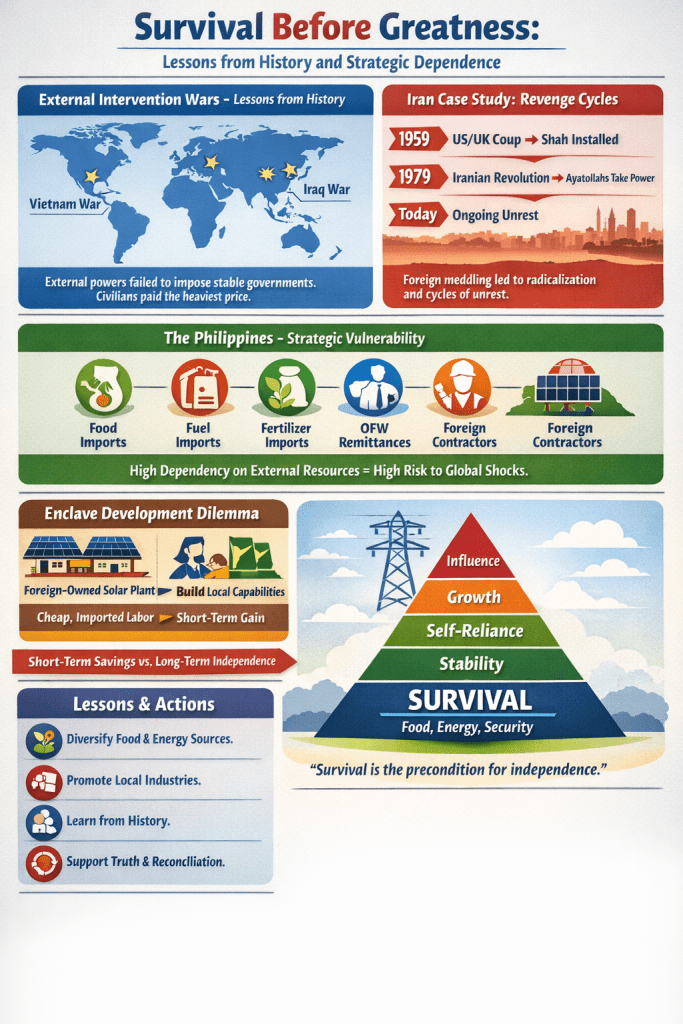
Wars driven by ideology, regime survival, or existential threats rarely yield compromise. External powers often exacerbate these conflicts: Vietnam, Afghanistan, Angola, Iraq—local resilience, not foreign power, determines outcomes.
Lesson for middle powers: Survival comes first. Strategic autonomy, hedging, and selective alliances are safer than attempting to enforce or resolve conflicts beyond one’s capacity.
V. Bamboo Diplomacy: Strategic Patience for the Philippines
Borrowing from Vietnam’s low-profile, adaptive approach, the Philippines can adopt “Bamboo Diplomacy-lite”:
- Flexibility: Engage all major powers without overcommitting.
- Incremental gains: Focus on institutional strengthening, maritime security, and economic resilience.
- Strategic balancing: Maintain U.S. security alliance, engage China economically, cooperate within ASEAN.
- Avoid ideological extremes: Prevent becoming a theater in external conflicts.
Just as the repair economy sustains equipment, bamboo diplomacy sustains national interest without exposing the country to catastrophic risk.
VI. Strategic Chokepoints: The Strait of Hormuz
The operational realities of global security illustrate systemic fragility:
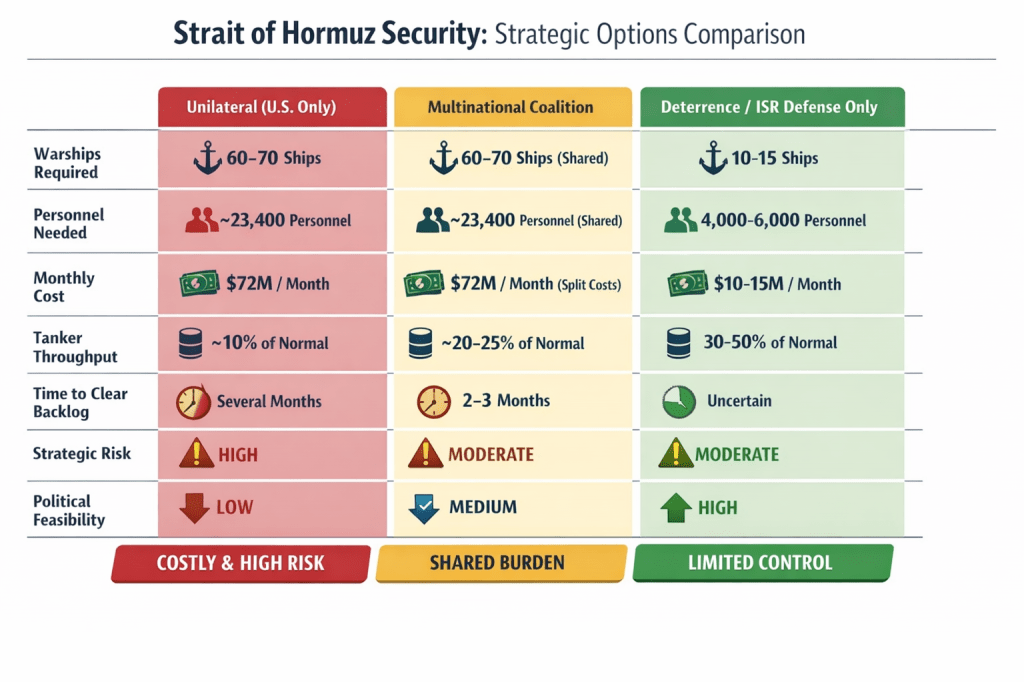
- Unilateral escort operations require 60–70 warships, 18,000+ sailors, and $72 million per month—still only ensuring ~10% normal throughput.
- Multinational coalitions share burden and increase efficiency, but coordination and political sensitivities complicate execution.
- Alternative approaches, like missile defense and deterrence, reduce manpower but leave throughput uncertain.
Implication: Even global powers struggle to guarantee security in critical nodes. For the Philippines, this reinforces the need for self-reliance, domestic capability, and strategic hedging.
VII. Peak Oil, Resource Limits, and Economic Fragility
Beyond geopolitics and defense, resource constraints shape national survival:
- Peak Oil and energy limits: Hubbert’s bell curve predicted production peaks decades ago. Efficiency gains delayed the crisis but did not eliminate it.
- Externalities: Pollution, health impacts, climate risk, and ecosystem degradation are often excluded from market prices, creating hidden costs.
- Philippine vulnerability: Reliance on imported food, fuel, and technology exposes the country to external shocks. Cheap diesel, rice, or electricity may stabilize politics short-term but create fragility in crises.
Lesson: True strategic resilience requires internal capability, resource diversification, and long-term planning—not temporary fixes.
VIII. Integrating Industrial, Military, and Diplomatic Lessons
Across domains, three themes emerge:
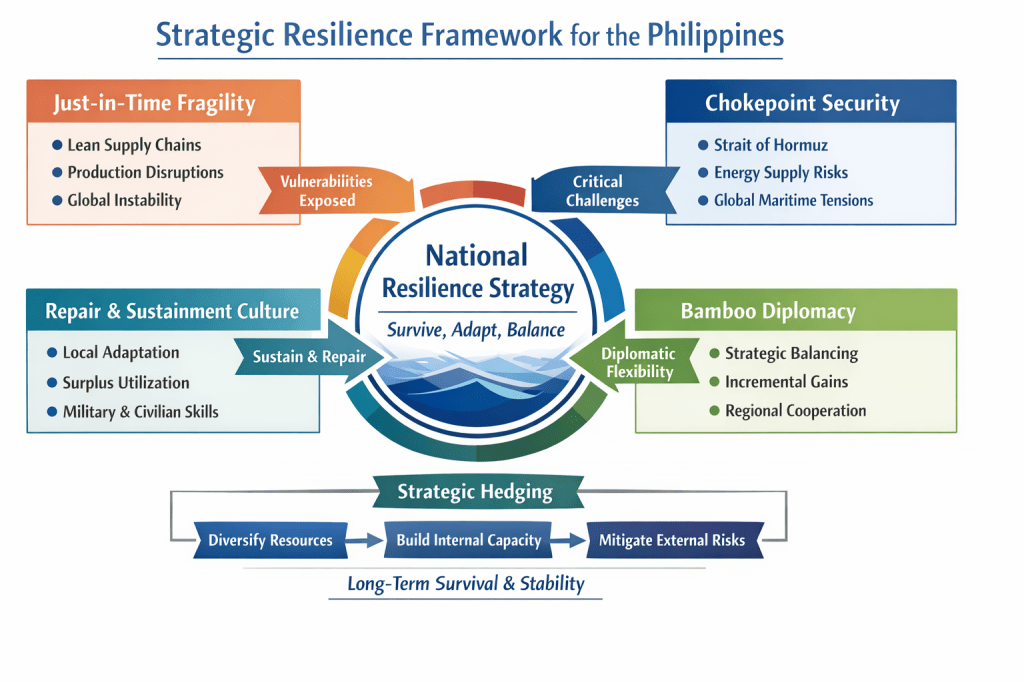
- Resilience over efficiency: Whether in supply chains, military sustainment, or energy security, the ability to absorb shocks matters more than optimal peacetime performance.
- Sustainment over replacement: Repair culture, technical skill development, and hybrid logistics networks create operational depth that offsets resource constraints.
- Patience over provocation: Bamboo diplomacy and hedging allow middle powers to protect sovereignty, manage strategic risks, and survive global volatility.
The Philippines’ combination of cultural adaptability, sustainment capability, and strategic patience is a rare advantage in an era of fragile global systems, rising geopolitical tension, and complex supply chains.
IX. Policy Implications for the Philippines
- Defense and industry: Develop domestic repair and maintenance capacity for military and civilian equipment. Fund surge capacity for critical defense components.
- Energy and resources: Promote renewable energy, storage solutions, and strategic stockpiles of fuel, food, and critical materials.
- Diplomacy: Adopt Bamboo Diplomacy-lite. Avoid overcommitting, balance relationships, and pursue incremental gains in contested regions like the West Philippine Sea.
- Strategic education: Train leaders in risk-based planning, sustainment logistics, and geopolitical realism. Embed repair and resilience thinking into national culture and institutions.
Goal: Build a nation that can survive, adapt, and exert influence without overexposing itself to external shocks.
X. Conclusion — Survival as Strategy
The world is moving toward uncertainty: lean production, complex weapons, contested chokepoints, and protracted conflicts are the new normal. Small and medium powers cannot rely solely on allies or market efficiency. They must:
- Maintain industrial and military depth
- Develop repair and sustainment expertise
- Balance relationships through Bamboo Diplomacy
- Hedge against external shocks while building internal capacity
When you cannot replace, you repair. When you cannot control, you balance. Survival is the prerequisite for influence.
In an era of Just-in-Time fragility, planned obsolescence, and forever wars, the Philippines demonstrates a model of strategic endurance: pragmatic, patient, and resilient. Nations that integrate sustainment, diplomacy, and industrial depth may not only survive global crises—they may define the blueprint for resilient middle powers in the 21st century.


 The Society of Honor by Joe America
As a Toyota veteran (and veteran of Japanese manufacturing in general), JIT and other ways to do modern global supply chains *only exist* because the US security guarantees (with the US military) were integral in creating the relative peace in the post-War world that allow global trade to exist unfettered and unmolested creating prosperity for all. Yes, until now the US is the biggest benefactor of that prosperity, but consider that prior to this world order prosperity was not even shared at all by whoever controlled whatever area of the globe. So until some new, mostly benevolent global hegemon rises, Europe and Asia probably should think wisely about whether or not they should cast the US off and roll the dice with a yet-to-rise new hegemon that might not be as benevolent, or risk falling into a new world order under the thumb of Russia and China. I hope allies have a bit more patience for Americans to get the American house back in order, and certainly it won’t a waste of time to get their own houses back in order in the meantime.
As for the Philippines, I wonder if there is a doctrine of strategic endurance or if absent US help in rebuilding AFP capability, that “endurance” would exist at all. See how countries who try to play multiple sides tend to get burned and left alone, like Indonesia and Pakistan. In any case it is hard to rebuild AFP capability without economic means to do so. Which points to a need to increase the economic means as a priority. Infrastructure and industrialization was always the correct answer going back to 1946, yet I am constantly dismayed Philippine leaders since the start of the Fifth Republic aside from PNoy chose to do the easy and short-lived, rather than the necessary and the long-lasting.
Rely on the US to provide an umbrella or rely on our own (maybe simplistic) means to defend ourselves??
We now know how fast the US dumps their “friends” when opportunistic to do so.
We also know that big countries are reluctant to attack a country which is prepared to go all the way. I think that China would not like to play games with Vietnam, the price would be too high. Trying to walk over Sweden or Finland would also be like sitting in a nest of red ants with every Swede or Fin being a trained “terrorist” (it used to be like that when I was there).
Only a desperate idiot attacks a country like that (USA v.s. Iran) but somebody is about to learn the forgotten lesson from 1975.
Maybe it is not a good idea for a cash strapped country to invest in expensive hardware but in a myriad of cheap, simple and nasty hardware used by 80 million trained “terrorists”. I would run as fast as I could if I knew a bunch of trained Filipino ‘special forces’ were after me.
Hmm I think the question of the transatlantic relationship deserves more nuance than it usually receives.
The truth no European leader wants to hear is that for better or for worse, the US did provide a security umbrella over Western Europe (that later expanded to Eastern Europe) following WWII. That security umbrella against Russian aggression and the USN’s presence in the oceans guaranteeing freedom of navigation enabled prosperity for all.
In that time Europeans have been able to vastly increase social spending at the expense of defense spending, the former which is a great thing, the latter manageable as long as the US provided the ultimate security guarantee, while the quality of life for Americans has suffered. Doing better than one’s parents is the core of the “American Dream,” and American GenZ will be the first generation to be worst off than their parents were.
Now there is a question of who is to blame for our current predicament. Perhaps some blame lies with European countries focusing on mercantilism and not on their own security, yet still feeling a need to needle the increasingly weary US on many things. Perhaps some of the blame lies with both the American center-right and center-left allowing corporatism to capture the US political system and not demanding that the rich pay their fair share so that the US can too have some of those European-style social programs. Europeans complain that American weapons dominate European militaries, but why then did European capitals allow the then-dozens of European prime defense companies that existed at the conclusion of the Cold War to be whittled down to just a handful? Well, we in the US also had consolidation in defense companies, but the US is one country of 335 million while the EU is 448 million spread across 27 often-bickering countries. It is much easier to scale on budget in one country vs having to coordinate budgets across nearly 30 countries.
I say the blame goes all around, and the fixing needs to be a shared fixing done with a process of renewed mutual respect. I find it quite ironic that here in the US the political thinkers who make the most reasonable argument are all former Republicans who were disgusted by Trump and MAGA. They insist that after this phase of craziness settles down, future American Presidents need to go about apologizing to friends and back that up with deeds, probably for decades. But Europeans also need to do more for the transatlantic relationship; many NATO countries didn’t even make the previous 2% NATO pledge (which is NOT paid into NATO but provides for that country’s own defense) for decades, expecting the US to carry the majority of the weight, until Russia came knocking at Western Europe’s door in Ukraine.
There will be a political reckoning in the US this November. MAGA is already in an internal civil war. Trump voters who are not MAGA have abandoned him last year to the illegal tariff wars. Most Americans are in fact embarrassed and appalled. Unfortunately Trump won again due to low information voters (aka busy people who are overburdened with work) believed disinformation spread by MAGA and Russia, while enough voters on the left stayed out and did not vote to punish Biden on the Gaza issue also due to Russian disinformation (how did that work out for Gaza, such a travesty). There is no way Trump will maintain a majority government after the midterm elections, which is why he is openly saying he will steal the election. But unlike in many European parliamentary systems where votes of no confidence would collapse the PM’s government and force new elections, the US has fixed elections per the US Constitution. There is also no way to force Trump’s government out of power until his term expires at noon on January 20th 2029. His power will effectively be neutered through blocked budgets if Democrats win a majority at least in the House of Representatives, which is expected to be a tsunami. Democrats may even win a slight majority in the Senate, which would further block all new appointments.
So here’s to hoping come January next year Trump will be a lame duck, the worse of what Trump can do is neutered, and when the next US President is inaugurated he or she will immediately jet to Europe to apologize to dear friends who were insulted and harmed by a madman backed by a mad cult. I think it foolish to throw away 80 years of friendship over an (admitted serious) argument. The friendship goes back nearly 110 years if one counts back to the conclusion of WWI, and even longer among individual bilateral relations between the US and various Western European countries. Stability and consistency is measured by actions on a curve over time, not on individual or a small set of data points.
Well, let’s hope Transatlanticism gets worked out and fixed for the better. Let’s hope that countries can get back to being friends and get rich together. Let’s hope that NATO will emerge stronger than ever as European partners are finally getting serious with their own defense budgets. I fear the alternatives will all be far worse than the discomfort Trump has caused in the last 10 years. Russia never forgot her tsarist ambition to march all the way to France, nor has China forgotten her 2,200 year ambition to control the whole of Asia and beyond.
‘When it is broken, repair it” (improvise if needed)
Typical Filipino attitude. And often it works.
But, nobody asks WHY it was broken, WHY the failure was not prevented.
Better build something solid which survives anything you throw at it, maintain it properly and you will not have to replace it and can focus on important things.
Two extremes: Shae stadium, torn down after 44 years in service. V.S. Bosra Roman theater of 1800 years old where I enjoyed a concert. The Bosra theater definitely beats any modern place in all ways: acoustics, efficiency, atmosphere and multiple-use.
Another example: The 1000 year old Dicle bridge in Diyarbakir took our very heavy drilling rigs without a complaint while modern 30 year old bridges already need modifications to prevent collapse (e.g. Germany has reserved 500 billion for those repairs). Or Iloilo where the new bridges need repair even before trucks are allowed to pass.
Another example: Like Joe mentioned today, his town was wiped out when Yolanda passed. So was the barangay here. Apart from my house which had hardly any damage. People had called me out on my wasteful construction & design before, but I learned from Barrow Island (where winds in excess of 300kmh occur LOL).
If we talk about survival, it is essential that you can rely on the infrastructure you have build. If you talk about sustainability, building for a long lifetime is essential.
But, you also have to build (design) SMART. Fit-for-purpose. E.g. it is a pipe dream to build an expensive bridge when an efficient ferry would work just as well.
What it all boils down to:
Make a resilient plan.
In my previous life, we always made risk assessments for every project. We went through hundreds of scenario’s. Lots of “What If” cases, any silly exposure you could think of. And there was an authority who then either veto’d or approved the project on its merits before it went to the finance boys. Whatever those smart engineers proposed… when the exposure was too big, the project got shelved.
Local example: Villa Escudero where a dam was build in the 1930’s (I think) and the water turbine still generates power. Well designed, properly build with quality materials and well maintained resulted in minimal operating costs and continuous electricity in a country where blackouts are normal. And now you can enjoy a nice lunch sitting with your feet in the water.
When I look at the current local projects, I wonder… often they fall apart within 5 years. That does not matter because we then have another government. But my dad always told me that you can spend money only ONCE, so better be sensible if you want to build a resilient, sustainable country in a fragile world.
Again a lot of learnings in your comments. Thanks
Allow me to share this draft, this fits.
Philippine Preventive Maintenance: From Afterthought to Institutional Imperative
By Karl Garcia
1. Preventive Maintenance in the Philippine Context: An Alien Concept?
Preventive Maintenance (PM) refers to the systematic, scheduled servicing, inspection, and replacement of assets before failure occurs. In engineering and asset management, PM is not optional—it is the backbone of reliability, safety, and cost control. Globally, well-run transport systems, utilities, hospitals, and industrial facilities treat preventive maintenance as a core operational function supported by data, stable budgets, and institutional discipline.
In the Philippine public sector, however, preventive maintenance often appears to be an alien concept. Maintenance culture remains largely reactive, driven by breakdowns, public outrage, and crisis management rather than lifecycle planning.
The experience of MRT-3 has become emblematic. Years of deferred maintenance, contract instability, and short-term fixes resulted in repeated train failures, derailments, and chronic service interruptions. Instead of preventing failures, the system evolved into one that waits for breakdowns before acting—at far greater cost and risk.
This pattern is not unique to rail transport. It is visible in roads, flood control systems, government buildings, water utilities, and even digital infrastructure. The core issue is not a lack of technical knowledge, but the absence of institutional commitment to preventive maintenance as a governance priority.
2. Budget and Funding Constraints: The MOOE Trap
One of the most critical structural barriers to preventive maintenance lies in public budgeting—specifically under Maintenance and Other Operating Expenses (MOOE).
MOOE is routinely underfunded relative to capital expenditures (CAPEX). Politically, new projects are more visible and rewarding than maintaining existing assets. Ribbon-cutting ceremonies win headlines; lubrication schedules do not.
The implications are severe:
International experience consistently shows that every peso not spent on preventive maintenance multiplies future costs, often by factors of five to ten once emergency repairs, downtime, safety risks, and reputational damage are considered.
In effect, underfunding maintenance is not fiscal prudence—it is deferred liability.
3. Maintenance Contracts: The Philippine Reality
Private Contractors vs. In-House Maintenance
The Philippines has experimented with both outsourced maintenance contracts and in-house technical teams, with mixed outcomes.
Problems arise when contracts are:
The MRT-3 maintenance controversies demonstrated how contract instability can be as damaging as technical incompetence. Frequent contractor changes, unclear responsibilities, and inconsistent standards disrupted preventive maintenance regimes and eroded system reliability.
The Core Lesson
The issue is not whether maintenance should be outsourced or internalized. The real lesson is the need for:
Preventive maintenance cannot thrive in an environment where contracts are temporary, uncertain, and reactive.
4. Technical and Operational Challenges in LRT/MRT Systems
Philippine rail systems face a convergence of stressors:
Systems such as LRT-1 and LRT-2 operate under intense demand pressure. Without disciplined preventive maintenance cycles, wear accelerates, reliability declines, and failures cascade.
What appears to be a technical problem is, in reality, a systems governance failure involving budgeting, procurement, planning, and institutional culture.
5. Systemic Scenarios in the Philippine Setting
Scenario 1: Status Quo
Under current practices:
This scenario guarantees long-term inefficiency and recurring disruption.
Scenario 2: Contractual Fixes
Reforms focus on:
This yields moderate gains but remains vulnerable if budgetary and cultural issues persist.
Scenario 3: Institutionalization of Preventive Maintenance
Preventive maintenance is embedded into:
Maintenance becomes a non-negotiable function, insulated from political cycles and funding volatility.
Scenario 4: Privatization or PPP
Public-Private Partnerships (PPP) can improve discipline and investment, but only if:
Privatization alone does not guarantee preventive maintenance. Governance quality remains decisive.
6. Broader Implications Beyond Transport
Preventive maintenance is not merely a technical issue—it is a development issue.
Neglected infrastructure leads to:
Failures disproportionately affect those who rely most on public systems—the commuting workforce, low-income households, and public service users.
A country that cannot maintain what it builds will never fully capture the benefits of infrastructure investment.
7. Key Recommendations for the Philippine Context
1. Protect and Ring-Fence Maintenance Budgets
2. Institutionalize Lifecycle Asset Management
3. Stabilize Maintenance Contracts
4. Strengthen Technical Capacity
5. Digitize Maintenance Systems
6. Shift Governance Incentives
7. Promote Public Transparency
8. Summary and Conclusion
Preventive maintenance in the Philippines remains underdeveloped due to chronic underfunding, weak institutional frameworks, fragmented contracts, and a deeply entrenched reactive culture.
For public transport systems such as the LRT and MRT, preventive maintenance is not merely a technical necessity—it is a systemic reform challenge involving policy, finance, procurement, technology, and institutional behavior.
Without decisive reforms, the country will remain trapped in a cycle of breakdowns, emergency repairs, and escalating costs.
With them, preventive maintenance can become a quiet but powerful engine of:
In the end, the question is simple:
Will the Philippines continue building infrastructure it cannot sustain, or finally learn to care for what it already has?
When comes to consumer electronics, we have planned obsolescence.
I imagine our projects like flood control are by accident or not like planned obdolescence.
Paul the problem in the Philippines is that even once a project gets cleared, it needs to be done quickly, done cheap, and looking nice is more important than being long-lasting. The complete inversion of the project management triangle, which as a fellow PM you know well. Then there’s can I get someone else to pay for it? Can I get someone else to do the work? But I get to take the credit, right? etc. etc. These are absolute hard truths of what goes on in the Philippines yet I find very few Filipinos who are willing to even admit those problems exist.
A famous engineering example is the 584 km (363 mi) Erie Canal (1817-1825), which is still in use today. At the time it was built, it was the second longest canal in the world after the 1,794 km (1,115 mi) Grand Canal in China (581-618). Similarly to the Grand Canal, the Erie Canal was built mostly by manual labor, shovels, and draft animals. Quite literally, the locals who needed to speed up regional trade kept petitioning the state government of New York and once fed up on waiting for a response started digging the canal themselves (it was later funded by Gov. DeWitt Clinton and the canal was ridiculed as “Clinton’s Folly”).
Can something like that happen in the Philippines? I think not very likely. And when a project does get off the ground and goes off kilter just a bit, proverbially shoot dead whichever leader stuck their neck out as sponsor. Mistakes happen all the time during projects despite extensive risk planning, why not study what caused the problem, recalibrate, and continue instead of wasting effort?
Wrong, the obsolescence is planned for the day after handover. I can send you a picture of the cladding of a dam here close-by. It collapsed within a year. Any 1st year student civil engineering could have told you it would happen, but now a contractor has a job of cleaning it up and rebuilding the dam. A nice top up of the contractor’s bank account. Same for the soil retention of the national highway, same for the bridges in Iloilo. It’s nobody’s fault that they collapse after handover. Sorry, the Iloilo bridge started sinking before handover, a small miscalculation, it should have been a year later, LOL
Nobody’s fault.
Everybody can make a mistake.
Apart from the poor cashier who has to top up the missing register money from her own salary…
I was being kind to the contractors and officials hehe but yeah I am wrong.
I wonder how the four recommendations and actual law writing in the Philippines, executive orders, and alliance engagements (war materials from South Korea, Japan, the US, and others) match. My sense is that the Philippines is doing many of these things but they don’t flow from a purposeful plan. More likely it just makes sense to do them, piecemeal, as they are considered in Congress or by the President.
We had the Afp modernization unfortunately even my hope of a multi year financing ends up in the yearly budget theatrics. We also have this self reliant thus and that. As to independent fireign policy, two presidents handled it differently, one is Trumpish who lambasted everyone and has the gsll to ask the same for help. I like BBMs approach to independent foreign policy better even if I do not think we can make it happen as of yet.
This is one of his major achievements it seems to me. VFA-type agreements allow troops from several other nations to arrive as needed for training or to support the equipment they place here. Other nations are warm to the Philippines today. Under Duterte they grew cold.
Hard to interact and ask help to Nations snd leaders you lambast There was a vorsl video whete jonone talked to Duterte and he was out
Chat gpt version of my reply to you.
Here is a clean rewritten version of your passage, keeping your meaning, tone, and political nuance, but making it clearer, smoother, and more formal.
—
We already have the AFP modernization program, but unfortunately my hope that it would be supported by true multi-year financing often ends up reduced to yearly budget debates and political theatrics. The same can be said about our talk of a self-reliant defense posture — it is frequently declared as policy, yet implementation remains limited and inconsistent.
As for the independent foreign policy mandated by the Constitution, recent administrations have handled it differently. Under
Rodrigo Duterte, the approach was confrontational at times, criticizing allies while still relying on them for support, which made the policy appear inconsistent. Under
Bongbong Marcos, the approach has been more measured and pragmatic. While I prefer this more balanced interpretation of an independent foreign policy, I also recognize that true independence is difficult to achieve at this stage, given the Philippines’ military, economic, and geopolitical constraints.
In the end, our policies often sound ambitious on paper, but in practice they are limited by budget realities, institutional habits, and the country’s continuing reliance on stronger partners.
In the IISS white paper Irineo shared, it is pointed out repeatedly that the AFP is army-heavy when the focus should be on the navy, coast guard and air (for surveillance). While the PA can bulk up with long-range drones, long-range fires, and mobile fires, an army would not need so many soldiers to accomplish that mobility-oriented force. The utility of a land army in a sea-based conflict has rapidly diminishing returns.
Yes, even past Chief of staffs are dominated by the Army guys as in all of them except for FVR.