Global Energy Shocks, Russian Sanctions, and Implications for the Philippine Fuel Market (2026)
By Karl Garcia
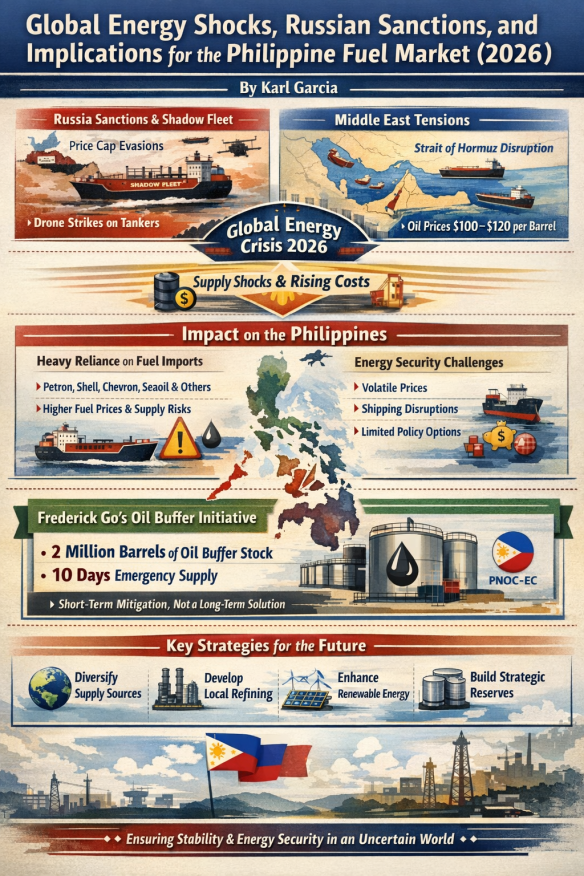
The global energy landscape in 2026 continues to be shaped by geopolitical conflict, sanctions enforcement challenges, and severe oil supply shocks. The Russian invasion of Ukraine in 2022 prompted the United States, European Union, and G7 allies to impose sweeping sanctions on Moscow, including the G7 oil price cap, designed to limit Kremlin revenue while keeping crude available in global markets. The policy’s goal was to allow Russian oil to flow to prevent spikes in global fuel prices but reduce profits to constrain Russia’s ability to fund military operations.
In practice, the effectiveness of these sanctions has been constrained by Russia’s adaptation. The emergence of a “shadow fleet” of aging, opaque tankers, and the use of non-Western insurance and intermediaries has allowed substantial volumes of crude to bypass the price cap, sustaining significant revenue streams even as formal sanctions remain. Secondary sanctions targeting ships, intermediaries, and brokers have increased enforcement costs but have not fully closed these loopholes. Concurrently, Ukraine has attempted to counter this through targeted attacks on Russian export infrastructure, including drones striking tankers and refineries, aiming to decouple crude export capacity from military financing. While these measures slow Russia’s gains, they cannot fully neutralize the revenue flows enabled by shadow fleet operations.
The global oil system is further stressed in 2026 by a supply shock originating in the Middle East, particularly around the Strait of Hormuz. This chokepoint, which channels roughly 20% of global oil exports, has been disrupted by regional conflict and attacks on infrastructure, sharply curtailing tanker traffic and pushing Brent crude prices above $100–$120 per barrel, with the risk of further escalation. These supply constraints magnify the paradox of Western sanctions: energy markets require stable flows to prevent economic disruption, but relaxing enforcement weakens the leverage intended to curb Russian war funding.
Implications for the Philippines
For the Philippines, the consequences are immediate and structural. Under the Downstream Oil Industry Deregulation Act of 1998, the country relies almost entirely on private importers such as Petron Corporation, Pilipinas Shell, Chevron Philippines, Unioil, Phoenix Petroleum, Seaoil, Jetti Petroleum, Cleanfuel, and Insular Oil. These companies import crude or refined products from regional refining hubs in China, South Korea, Singapore, India, Japan, and the Middle East. While diversification mitigates the risk of dependence on a single source, it exposes the Philippine market to global price volatility, shipping risks, sanctions, and export controls.
The 2026 supply shock has amplified these vulnerabilities. Reduced tanker traffic through the Strait of Hormuz, coupled with export restrictions in China and supply prioritization in other regional hubs, has led to higher international crude and refined fuel prices. Philippine importers must secure shipments earlier or pay premium rates, transferring inventory and cost risks entirely to private firms under the deregulated system. Attempts by the government to maintain energy security — such as requesting accelerated imports or delaying price increases — shift the financial burden onto companies, creating tension between market realities and public expectations.
Policy mechanisms once used to stabilize prices, such as the Oil Price Stabilization Fund (OPSF), have long been abolished due to fiscal deficits, making a full return unlikely. Future responses are likely limited to targeted subsidies, temporary tax adjustments, or emergency buffer funds, which are reactive and constrained in scope.
Frederick Go’s Oil Buffer Initiative
In March 2026, Finance Secretary Frederick D. Go announced that the government, through the Philippine National Oil Company–Exploration Corp. (PNOC‑EC), has begun procurement of approximately two million barrels of oil to bolster the country’s fuel inventory amid global volatility. This initiative is a buffer stock measure, designed to provide roughly 10 days’ supply and ensure short-term stability in domestic markets.
It is important to clarify: this is not a legally established Strategic Petroleum Reserve under Philippine law. Rather, it is a government-supported procurement of additional fuel stocks, coordinated with private importers to mitigate disruptions from global supply shocks, shipping delays, and geopolitical instability. While it provides temporary relief to the market and consumers, it does not replace long-term energy security strategies such as domestic refining, energy diversification, or a formal reserve system.
Broader Economic and Geopolitical Considerations
- Rising oil prices exacerbate domestic inflation, impacting transportation, agriculture, and industrial sectors. Consumers face higher pump prices, while logistics and shipping costs increase, affecting trade competitiveness.
- Regional dependencies mean that disruptions in China, South Korea, or Middle Eastern refineries immediately affect the Philippine market.
- Ethical and geopolitical trade-offs arise if stockpiling involves purchases from sources affected by sanction regimes. The Philippines must balance short-term supply stability with responsible sourcing in a volatile global energy landscape.
Conclusion
The Philippine fuel market in 2026 sits at the intersection of global shocks, imperfect sanctions enforcement, and systemic vulnerabilities from deregulation. While deregulation has increased competition and supply flexibility, it also exposes the country to significant price volatility and shipping risks. The government’s procurement of two million barrels of oil, as announced by Finance Secretary Frederick Go, reflects a proactive measure to buffer short-term supply risks.
Ultimately, this initiative should be part of a multi-pronged energy security framework that includes strategic stockpiles, diversification of supply, investment in local refining, and renewable energy development. Only through such a comprehensive approach can the Philippines enhance resilience and maintain both economic stability and energy security in an increasingly unpredictable global market.


 The Society of Honor by Joe America
As of March 20, 2026, France, Canada, Japan, and four other allies (the UK, Germany, Italy, and the Netherlands) have issued a joint statement condemning Iran’s attempts to block the Strait of Hormuz. [1, 2, 3]
Key details regarding this situation include:
Related, and probably more important than oil:
https://shanakaanslemperera.substack.com/p/the-nitrogen-trap
Big implications for Philippine agricultural crops that are not legumes. Yes, the Philippines sources most of its agricultural urea fertilizer needs in Asia, but commodity prices are global with global effects.
Many thanks. Very pertinent.