Are We Ready for the Big One?
The Hidden Power Beneath: Yellowstone, the Ring of Fire, the Philippines, and Submarine Volcanoes
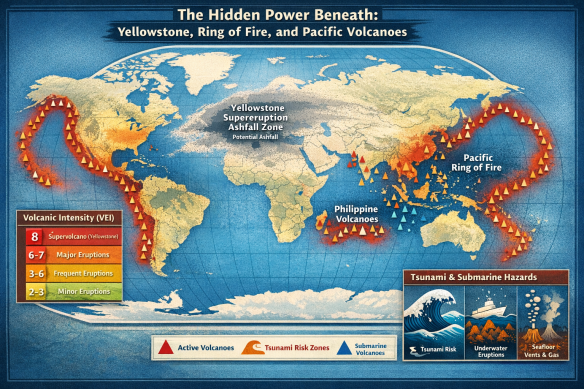

By Karl Garcia
Volcanoes are among the most dramatic expressions of Earth’s internal forces, shaping landscapes, influencing ecosystems, and affecting human societies. Their scale, frequency, and hazards vary widely—from rare supereruptions capable of altering global climate, to frequent regional eruptions, to hidden submarine volcanoes capable of triggering localized tsunamis. Understanding these differences is crucial for risk assessment, disaster preparedness, and scientific insight.
1. Yellowstone: The Sleeping Supervolcano
Yellowstone National Park, in the western United States, sits atop a continental hotspot—a rising plume of magma beneath the North American Plate. Unlike most volcanoes, Yellowstone is intraplate, not located on a tectonic boundary. Its massive magma chamber measures roughly 60 km long, 30 km wide, and 10 km deep, making it one of the largest known magma reservoirs on Earth.
Geological Characteristics and Potential Hazards:
- Yellowstone’s eruptions are supereruptions, capable of ejecting over 1,000 km³ of material.
- The last major eruption occurred roughly 640,000 years ago, with smaller hydrothermal explosions more recently.
- While highly unlikely in the near future, a full-scale eruption would impact global climate, agriculture, and human populations worldwide.
2. Iceland: Hotspot Meets Divergent Plates
Iceland sits atop the Mid-Atlantic Ridge and a mantle hotspot, creating a combination of rift-related and hotspot volcanism. Unlike Yellowstone, Icelandic volcanoes erupt frequently, producing lava flows, explosive eruptions, and ash plumes that can disrupt international air travel.
Notable Examples and Hazards:
- Eyjafjallajökull (2010): Ash cloud disrupted European air traffic for weeks.
- Katla and Hekla: Active stratovolcanoes capable of explosive eruptions.
Comparison to Yellowstone:
- Icelandic eruptions are smaller but more frequent and predictable, while Yellowstone represents a low-frequency, high-consequence risk.
3. The Pacific Ring of Fire
The Pacific Ring of Fire, a 40,000 km arc encircling the Pacific Ocean, hosts the majority of the world’s active volcanoes. Its volcanism arises mainly from subduction zones, where oceanic plates are forced under continental or oceanic plates, generating stratovolcanoes.
Characteristics and Hazards:
- Stratovolcanoes are capable of explosive eruptions, pyroclastic flows, lahars, and ashfall.
- Countries along the Ring of Fire, including Japan, Indonesia, and the Philippines, experience frequent volcanic activity, making disaster preparedness a constant necessity.
Key Insight:
- High human population density combined with active volcanism makes the Ring of Fire one of the most dangerous volcanic regions on Earth.
4. Philippine Volcanoes
The Philippines, part of the Philippine Mobile Belt, hosts over 20 active volcanoes, many located near populated areas. They provide real-world examples of moderate-to-high intensity eruptions with local and occasionally global consequences.
Notable Examples:
- Mayon Volcano: Famous for near-perfect conical shape; frequent eruptions cause evacuations.
- Taal Volcano: Proximity to Metro Manila makes even small eruptions a major threat.
- Pinatubo (1991): One of the largest eruptions of the 20th century; global temperatures temporarily dropped.
Hazards:
- Pyroclastic flows, ashfall, lahars, destruction of infrastructure, displacement of communities.
- Localized but severe economic and humanitarian impact, emphasizing early warning systems and public awareness.
5. Submarine Volcanoes in the Philippine Sea and Mariana Trench
Beyond terrestrial volcanoes, submarine volcanoes in the Philippine Trench, Philippine Sea, and Mariana Arc pose hidden but significant hazards.
Key Features:
- Often erupt underwater, producing tsunamis, hydrothermal activity, and seafloor deformation.
- Can influence local marine ecosystems and threaten shipping routes.
- Monitoring is challenging due to their remote and submerged nature, but early detection remains critical.
Philippine EEZ Significance:
- The Philippines’ Exclusive Economic Zone contains numerous submarine volcanoes, many near fishing and shipping areas, highlighting strategic and disaster preparedness importance.
6. The Role of Civil Defense and Preparedness
Volcanic hazards underscore the critical role of civil defense systems. The Philippines has a long history of community-based disaster risk reduction, leveraging lessons from domestic and international experiences. Key aspects include:
- Early Warning Systems:
- Agencies such as PHIVOLCS monitor volcanoes for seismic activity, gas emissions, and ground deformation, providing alerts to local governments and communities.
- Evacuation Planning and Drills:
- Communities near active volcanoes have pre-mapped evacuation routes and shelters.
- Regular drills educate residents on safe behaviors during eruptions, ashfall, and lahars.
- Integration with Local Governance:
- Barangay and municipal disaster risk offices coordinate rescue, relief, and medical response.
- Public Education and Awareness:
- Campaigns teach hazard recognition, tsunami and lahar signs, and first aid.
Key Insight:
- Civil defense is a societal shield against natural hazards, turning high-risk communities into resilient, informed populations. Without strong civil defense, even moderate eruptions can become catastrophic.
7. If the Big One Hits the Philippines: A Civil Defense Scenario
Imagine a catastrophic eruption of Taal or Mayon Volcano, or a sudden submarine eruption in the Philippine Trench, triggering a tsunami.
Early Detection and Alerts:
- PHIVOLCS detects unusual seismic activity and gas emissions, sending alerts via SMS, radio, TV, and social media.
Evacuation and Shelter Management:
- Residents follow pre-mapped evacuation routes to safe zones outside danger areas.
- Evacuation centers are stocked with food, water, medicines, and hygiene kits.
- Vulnerable populations—children, elderly, and persons with disabilities—receive special assistance.
Civil Defense in Action:
- Barangay Disaster Risk Reduction and Management Offices coordinate rescue, medical response, and emergency support.
- Continuous monitoring allows dynamic rerouting of evacuees if conditions change.
- National and provincial agencies provide mutual aid, logistics, and relief support.
Submarine Eruption / Tsunami Response:
- Coastal early-warning buoys detect unusual sea-level changes.
- Tsunami sirens and evacuation alerts push residents to pre-planned vertical evacuation sites.
- Rapid response units assist stranded communities and prioritize port and shipping safety.
Key Takeaways:
- Preparedness saves lives. Coordinated civil defense can turn potential disasters into survivable events.
- Community drills and education are as vital as monitoring technology.
8. Comparative Summary
| Region | Volcanic Type | Frequency | Hazards | Human Impact |
|---|---|---|---|---|
| Yellowstone | Supervolcano | Rare | Global climate effects | Massive but unlikely |
| Iceland | Hotspot/Rift | Frequent | Lava, ash | Air travel disruption, local |
| Ring of Fire | Stratovolcano/Subduction | Frequent | Pyroclastic flows, lahars | High, recurring |
| Philippines | Stratovolcano | Moderate-to-frequent | Lahars, ash, flows | High, densely populated |
| Submarine Volcanoes | Subaqueous | Variable | Tsunami, seafloor hazards | Localized but sudden |
9. Lessons and Implications
- Volcanic hazards exist across a spectrum—from rare supereruptions, to frequent regional eruptions, to hidden submarine threats.
- The Philippines exemplifies a high-risk, densely populated volcanic environment, where even moderate eruptions can have profound human and economic consequences.
- Civil defense, early warning systems, and public awareness are crucial in reducing casualties and economic losses.
- Submarine volcanoes highlight hidden hazards, emphasizing the need for advanced monitoring.
10. Call to Action: Living Safely with Fire
The Earth beneath us is dynamic, powerful, and unpredictable. From Yellowstone’s supervolcano to the Ring of Fire, from Philippine stratovolcanoes to hidden submarine eruptions, volcanic hazards remind us that nature does not negotiate. But humans can act—and preparedness can make the difference between catastrophe and survival.
Science is our guide. Continuous monitoring provides the early warnings that save lives.
Civil defense is our shield. Coordinated local and national disaster response, pre-mapped evacuation routes, stocked shelters, and trained responders transform vulnerability into resilience.
Public awareness is our frontline. Communities educated on risks, drills, and emergency procedures become active participants in their own safety.
The question is not whether “the Big One” will strike—but when it will strike. Being ready is not optional; it is a shared responsibility of scientists, government, and every citizen. Together, the Philippines can face the Earth’s fiery power not with fear, but with preparedness, knowledge, and resilience.


 The Society of Honor by Joe America
Thanks, Karl. Thanks for the topic, but for the moment I’ve been a bit busy looking at the impact of Trump’s Iran War on Philippine livelihoods. Here we are reeling from the impact of 30-35% fuel price increases. Over there I think it is roughly twice that!
Yeah, insurance premiums and non covetage makes the ships stand still in Hormuz so this will take long.
one man’s thrash is another man’s treasure. our govt has okayed the use of dirty fuel but only in limited capacity. a blessing for older vehicles from 2015 and earlier are sure to benefit. especially those vehicles that had yet to undergo modernisation.
https://www.abs-cbn.com/news/business/2026/3/22/ph-allows-limited-use-of-lower-grade-fuel-to-secure-supply-amid-global-oil-volatility-2155
thanks. change oil can come later.
When disasters happen people want assurance that everything is under control, Trump is good at that even if he does his actions different from his words. Here we demand visibility, for me it is mixed, a mix of empathy and politicking and sincerity so long as there is results.
Venezuela was targetted for its oil, now can he use that oil in times of trouble. Logitics is not that easy, Panama canal is now overwhelmed so Plan B is hard to come by.
I can’t believe arab states have not plan b in case hormuz is non operational. worst example of putting their eggs in one basket! arabs have known for a long time the possibility of hormuz being closed in the foreseeable future, and yet not one of them acted proactively. true, saudi arabia have pipelines that can direct the flow of oil to bypass hormuz but the capacity of their pipelines is nowhere enough. these arabs have all the riches in the world but are busy buying up real estates in other countries instead of ensuring the flow of oil sans hormuz is reality. so now, arabs cannot move their oil products and iran is bombing their oil depots.
Same sentiments, thanks KB
Conspicious by their absence are the Houthis. What could they have in store for us.
Non US affiliated were told they are free to move out of Hormuz, so far only India and China moved a bit because of centuries of good relationship.
Last week fuelpump prices would make an elementary student proud because it was nearing 100,but those were not grades they were gas prices. Now Diesel is nearing 130. Trucks and jeeps are diesel run. The ChineseEVs and the Japanese hybrids slowly lessens the impact, but electricityis also tops so nothing really good is happening.
Funny not funny Saceda remided eveyone that Gloria Arroyo solved every economic crisis during her time. Oh come on.
gloria arroyo could not solve every economic crisis in our country as during her presidency there were still multitudes of filipinos in dire need and living under the poverty line. international monetary fund (IMF) might have loved gloria arroyo but quite a number of filipinos had no love for her, her inability to solve poverty is as legendary as her tenacious cling to power that apparently she had to rig 2004 election in order to get herself re-elected.
Teacher’s pet all thrpughout until the end, Salceda is.
Since the topic of massive natural disasters is not the world’s priority. When Trump failed to ask tge world for help, Benjamin’s turn to invite the rest of the allies after the “near miss” of their nuclear facilites.
UK is not convinced they have to resort to missile defense yet after Diego Garcia(no relations). Theyare still saying it is not tgeir war.
it will get worse for uk’s starmer if he wont move his ass! already the british military contingent based in cyprus had been bombed by iran and were badly hurt. war has been brought to the british and starmer must reply in equal measures. but starmer is afraid of losing the muslim votes for he could well be trounced out of office next election, so he is probly playing put. prefers votes better than his country. in england, an englishman is apparently no longer allowed to wave the english flag for that would be construed as colonialism, but if a pro-palestinian waves palestinian flag nevermind that the state of palestine does not exist, it is okay. so, we see these multitudes of marching pro-palestinians waving their flags and inciting hatred. their numbers so overwhelming that british police are reluctant to act and stop them.
He is deflecting the youtube videos spreading about UKs role in Iran’s downward spiral. If I saw it, the British surely did.
It makes little sense (to me) to spend a lot of money to protect against a 10,000 year event, or a 300 year event, unless it’s Los Angeles or Manila. And it makes no sense to me to build a 1900s nuclear power plant across the bay from Manila, Manila being downwind much of the year. In Yellowstone, which is remote, let it blow up.
I live on an active multi-venting volcano, Biliran Island, and one can look at the height of the mountains to consider the power beneath. Full 100% safety preparation would move everyone off the island. Not going to happen. Risk is a human condition. Volcanos generally announce their arrival. Focus on floods and typhoons. Build for level 8 earthquakes.
Earth is not static. There are hot springs along a small river east of Mammoth, California. Certain areas will cook you. Others you can sit in the water and feel the ground rumbling beneath you as bubbles push up from the river bottom. It’s real. It’s amazing, and a little unsettling. it is unrealistic to expect earth to be nice to people. Enjoy it.
Thank you for your enjoyable comment yes we should enjoy, earth.
Yes. It should be insisted that Philippine building be at least to Florida anti-tropical cyclone (hurricane) standards. Preferably to Japanese building standards which are built to withstand both typhoons and earthquakes.
Taming the Earth can also have negative drawbacks. Here in Los Angeles the Los Angeles River and Santa Ana River basins were both tamed and clad in concrete decades ago. It turns out that while channelizing the entire river can alleviate some flooding, doing so also spawns problems: groundwater does not recharge naturally anymore, much usable water runs off into the ocean, wildlife and native plants in the riverine and littoral ecosystems get endangered, and so on. There should be a balance.
Some show-stopping kill joys.
Minesweepers in the Strait of Hormuz: Possibility and Challenges
The Strait of Hormuz, a narrow waterway linking the Persian Gulf to the Gulf of Oman, is one of the world’s most strategically sensitive maritime chokepoints. Approximately 33–40 km wide, with navigable shipping lanes only 2–3 km across per direction, it is highly vulnerable to disruption through naval mines. This vulnerability has been exploited historically during conflicts, such as the Iran–Iraq War (1980–1988), when Iran frequently mined the strait, and during the Gulf War (1991), when Iraq laid mines to impede coalition shipping.
Minesweepers are specialized naval vessels designed to detect, classify, and neutralize mines. They employ:
Despite these capabilities, minesweeping is inherently slow. Historical operations demonstrate that clearing a narrow shipping lane can take days to weeks, while complete clearance of an entire strait may require months. During the Gulf War, coalition forces took weeks to clear lanes after Iraq had laid over 1,000 mines, and even then, U.S. ships were damaged by undetected mines.
The urgency to clear mines “as soon as possible” in a modern crisis, such as recent threats in Hormuz, is constrained by three main factors:
In practice, minesweepers enter narrow, controlled corridors first, creating a “safe lane” through which commercial shipping can resume. Tankers and large vessels cannot safely navigate without these lanes, because they are too large and fragile to maneuver around mines. Even with modern equipment, the process is methodical and deliberate—speed increases risk exponentially.
The strategic importance of Hormuz—handling about 20% of global oil shipments—makes rapid clearance a high priority. However, naval experts emphasize that “stat” clearance is constrained by physics and combat realities, not just intent. Mine warfare is thus as much a strategic weapon as a tactical threat: a small number of mines can block trillions of dollars of trade, spike oil prices, and cause global disruption.
In conclusion, minesweepers can enter the Strait of Hormuz, but only under controlled, secure conditions. While governments and navies aim to clear mines as quickly as possible, historical precedent and technical realities indicate that even the fastest operations take days to weeks, not hours. Their deployment—such as Japan’s planned mission—reflects both strategic necessity and careful adherence to operational, legal, and safety protocols.
Trump is an idiot. He thought he could “do a Venezuela” on Iran and the Iranian theocrats would give up quickly. Yes, Venezuela under the Chavistas is a mafia state, but the Venezuelans mostly concern themselves with making money. The Iranian regime is also a mafia state, but it is a regime of religious zealots who also happen to be a mafia state and have supporters who don’t care if they will die. Big difference there.
In navies all around the world there has been less emphasis on minesweepers since the conclusion of the Cold War. It was assumed that the arduous work of demining grid-by-grid would be replaced by whizzbang technology. Mine technology has barely changed since mines were called “torpedos” during the American Civil War, nor has the task of demining changed that much away from the central requirement of manual EOD divers to disable mines prior to destruction. The USN under Trump ordered the 4 dedicated Avenger-class minesweepers back home on semisubmersible transport docks for decommissioning on January 20th even though the ships are still operational. To be replaced with LCS that are still sitting in Malaysian ports with untested minesweeping modules… What a travesty.
Only Hegseth can say Trump is smart and the rest are dumb with a poker face.
Hegseth is pretty stupid himself. His speeches remind me of a young squad leader, not of a general or cabinet secretary. No wonder the generals and admirals sit there poker faced. My active and retired military friends, many who outrank Hegseth’s military rank, jokingly mock Hegseth privately as “the Major,” which is derogatory. Sadly, when it comes to the Venezuela action or the Iran War, both were legal in both US civil law and US military law (USMJ). There is “lawful but awful,” “lawful but stupid,” etc.
Major problem, Major pain.
for once, I say, I applauded trump having the gumption to call off iran! iran has got to be stopped, being proxy to both terrorists hamas and hezbollah, who has not done anything good for lebanon, same as hamas who had kept palestinians in poverty, iran is also big time financiers of the foul houthu terrorists who have been raining missiles on saudi arabia and israel for as long as time. it is only a matter of a very short time that iran produces nuclear weapons enough to obliterate the world. iran already has gotten secret pile of enriched uranium not for medical purposes it said it would use, but for developing nuclear war heads.
Fair
modern technology has advanced so much that now, AI and robotics are used in minesweeping.
AI Overview
Yes, modern minesweepers extensively use artificial intelligence (AI) and robots, shifting towards autonomous systems to remove human sailors from danger zones.
These technologies enable unmanned surface vessels (USVs) and underwater vehicles (UUVs) to detect, classify, and neutralize mines, particularly “modern digital mines,” with higher precision and safety than traditional methods.
Here’s how they are used:
Key Examples:
Yes, those technologies exist. The 3 LCS that are supposed to be sent (but are docked in Malaysia) have those robotic minesweeping modules. But they are new, untested outside of theoretical, and the midst of war is not an appropriate place to test new things when the “old but works” are still available.
goodness! this is the best time to test those minesweepers, see if they work or not. look at the ukrainians, they got plonked in a war not of their own making, but is making the most of it, testing war machineries which work and those that dont, making do and quickly adjusting as they go along. already ukraine has amassed a hoard of precious war data so useful in combat.
I’m probably being a bit too generous with the LCS + minesweeper modules. Those ships are not derided as “little crappy ships” by USN sailors and commanders for any old reason.
There is also a huge risk in using high-technology to solve low-technology problems. Eventually the enemy would simply win by draining the resources of the more powerful actor.
Yes, the Ukrainians are very innovative and clever. Here is a recent short documentary produced by Valor, a pro-Ukrainian American group I’m tangentially associated with through aquaintances, on the bravery and tenacity of the Ukrainians. I was not in Kherson for long last year, but did pass through on the way to Odessa. Most of my time in Ukraine was in the east near Kharkiv:
very much appreciated, thanks a million. those dreaded shahed drones are not omnipotent, thanks to the dedicated men with nerves of steel who blasted them out the sky.
My original comment got lost in cyberspace, here is the summary.
Let’s forget about a few thousand deaths when a big volcano erupts, it is insignificant. The real disaster follows 2 months to a few years later. The last big volcano eruption which was fully documented was Tambora on Soembawa in Indonesia in April 1815.
2 months after the eruption, Greenwich observatory noticed strange things happening in the atmosphere. By summer, excessive rains and thunderstorms happened all over Europe and the harvests suffered big time. The summer of 1816 just did not happen. Just more rain, thunderstorms and it even rained worms (yes, it did)… Hunger and riots happened everywhere in Europe. People died by the hundreds of thousands. How many has never been recorded, it was just after the Napoleonic wars and Europe was in chaos anyway. Even though events were documented in Europe, who knows what happened in the rest of the world… Africa???
BUT, this was in times when farmers had mixed farms and were able to switch crops quickly and find some which did not completely fail. It was times when city people and especially farmers were used to preserve foods in summer for winter, so they had stored food.… It was times when authorities chopped heads to stay in control, no Facebook, no TikTok, just ChopChop. And still.
Imagine it happening today in Philippines where city people do not have more food stocks than for this week, where farmers buy their fertilizer the day before they need it, where the majority of the farmers do not have the skills to plant anything beyond corn, sugarcane or rice.
Sure, Joe, you cannot plan for everything nature can throw to you. You build your house to survive an 8 earthquake and the rest we will see when it happens??
In “Peak Oil”, I tried to argue that (especially) Philippines should have gone solar a long time ago. No reaction actually, but see: one idiot in the USA (still supported by 40% of the voters) and “oops¨, we have a war and diesel can reach P200/l in a few weeks. It reached P240/l already in Europe.
My argument: You do NOT have to be a prepper. As a private person, but especially as a country: Use Common Sense and try to be as flexible and independent as possible.
I remember an impressive interview with Fidel Ramos on the effects of the Asian Financial Crisis where he proved with actual facts that The Philippines was least effected because their economy was “simple”, not very sensitive. It was the times that rice still was exported, imports were few and the OFW’s money supported many Filipinos. In other words: a relatively robust self-supporting economy.
Things have changed a lot. There is no vision where we want to be, we float along on the tides which control this world. Like my wife said “We are only a small country” to which I completely disagree, there are 120 million people, Filipinos are scattered all over the world and it should be possible to make us all much less controlled by every bully who wants to have a go at the country. Just look at what Carney is doing, Philippines can do it low-key.
It would start with a vision: Robust sustainable agriculture by skilled farmers, effective food distribution systems (and storage/processing systems), flexible and effective transport systems, independent energy and telecom systems, top of the line robust IT systems (ever been in Korea and seen the effects of fast and reliable IT systems?), schooling with measurable results, effective and distributed medical services geared up to accommodate medium disasters. And the list goes on.
But, we seem to just dabble along and protest against the high prices of diesel fuel, something which is completely out of our control and or leaders pretend everything will be solved if we only install solar waterpumps on farms.
No, not prepping, but using common sense and try to be as independent and sustainable as possible.
Time to ring the alarm bells. Tambora was an event which lasted over 2 years. We now are in a sh.tstorm where the effects will last longer and once the fertilizer price triples, we find out that food becomes unaffordable for the masses and desperate people do crazy things.
My daughter called yesterday and expressed her surprise when a friend told her she could not drop by because the petrol now reached E3 per liter. My daughter had not realized, they have an electric car charged with the solar panels on their roof. Which the neighbours thought was silly when my daughter installed it 5 years ago and now everybody is jealous. Our Swiss neighbour here tried to farm rice sustainably & organic with ducks, fish etc, but he eventually left disappointed because people were not willing to pay 40% more for sustainable organic rice. I am sure that in half a year time, people will find this 40% extra a bargain, but the knowledge now has left the area. People made fun of me when they saw the construction of our house. It was the only building on the island which survived Yolanda without real damage. I still am the only person in the whole municipality who has an electrical installation following most of the rules while electrical fires happen all the time around us.
Where is the common sense, people? Or do we continue happy-go-lucky? I love the happy part and the lucky part, but we should take control.
Leadership is: develop a clear vision, sell it and implement it. Even if originally it sounds a bit silly.
If our leaders do not rise to the challenge, we are on our own and have to somehow anticipate the challenges coming towards us the coming decades and because (probably) none of us is an expert in all fields, we´ll make many mistakes and will have to live with the consequences.
Thank you very much Paul. If no reaction maybe it is silent agreement or what Joe calls nodding silently. Your points were proven valid.
The Ashfall and maybe acid rain like lasted for a long time and it hurted a lot of eyrs and lungs during the Pinatubo erruption enough to send th US bases personnel out of PH. Still fresh in my memory banks.