Why Trump Has Shown Interest in Greenland — And What Venezuela and Cuba Reveal About His Foreign Policy Strategy
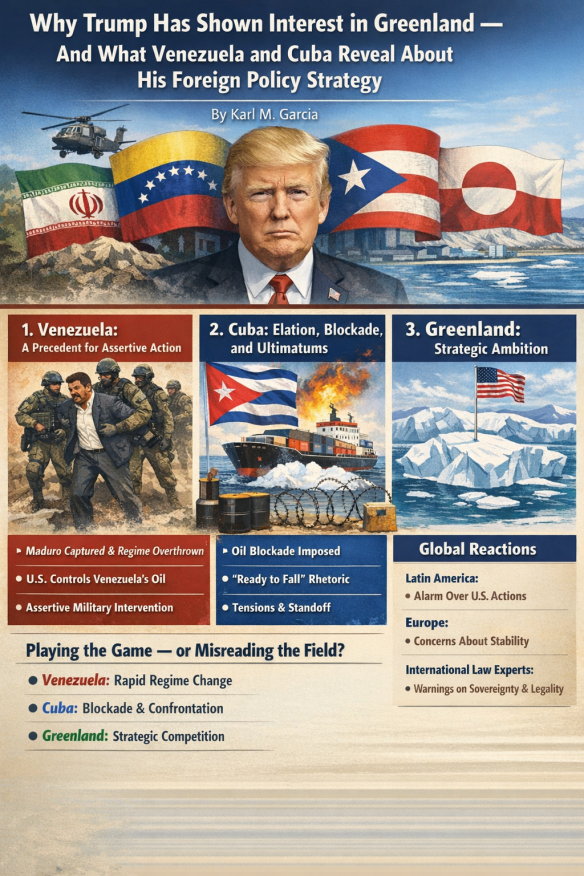
By Karl M. Garcia
Despite President Donald J. Trump’s longstanding interest in Greenland, his foreign policy in 2026 is defined by juggling multiple, high‑stakes international challenges — notably the crisis in Iran, assertive moves in Venezuela, and provocative rhetoric toward Cuba. Taken together, these actions reveal a blend of strategic signaling, power projection, and an assumption that foreign interventions can play out as straightforwardly as the operation in Venezuela — even when they may not.
1. Venezuela: A Precedent for Assertive Action
Early in 2026, the United States launched a military operation in Venezuela that resulted in the capture of longtime President Nicolás Maduro, dramatically reshaping Latin American geopolitics. The raid involved dozens of casualties and the rapid dismantling of Maduro’s regime, signaling Trump’s willingness to use force to remove leaders he views as hostile. U.S. officials also moved quickly to manage Venezuela’s vast oil reserves and energy infrastructure, including negotiating oil agreements under U.S. supervision. These dramatic developments have been interpreted — by both allies and critics — as an attempt to assert U.S. influence and reshape regional power dynamics.
The Venezuela operation sets a baseline for understanding Trump’s statements on Cuba — as though subsequent foreign‑policy challenges could unfold with comparable simplicity and success.
2. Cuba: Elation, Blockade, and Ultimatums
Immediately after Venezuela, Trump directed pressure toward Cuba. He publicly claimed — controversially — that he could “do anything I want” with Cuba in the wake of the Venezuelan operation, suggesting that Havana was “ready to fall” and brushing aside concerns about legal or diplomatic constraints. The U.S. government also imposed an oil blockade that severely limited Cuba’s access to energy, since the island had long relied on Venezuelan oil supplies. This pressure prompted diplomatic protests from Cuba’s leadership and raised alarms about sovereignty and regional stability.
Cuban officials pushed back, insisting that sovereign equality and respect for international law must guide any talks, even as negotiations over trade, migration, and economic relief continue in the background.
3. Greenland: Long‑Term Strategy Meets Geopolitical Rhetoric
Against this backdrop, Trump’s interest in Greenland comes into focus as part of a broader narrative: asserting U.S. influence in strategic locations while signaling strength to rival powers like Russia and China. Greenland’s position in the Arctic and its reserves of critical minerals make it relevant to long‑range strategic planning, even as immediate crises (Iran, Venezuela) dominate U.S. resources and attention.
While Trump sometimes frames the Greenland interest as a security imperative, analysts argue that its resource potential, role in great power competition, and possible technological utility (e.g., cold‑climate data infrastructure) are equally important.
Concluding Context: Playing the Game — or Misreading the Field?
Across these theaters — Venezuela, Cuba, and Greenland — one pattern emerges: Trump’s foreign policy pairs bold, high‑visibility actions with an assumption that complex interventions are relatively simple to execute and resolve.
- In Venezuela, the operation was carried out swiftly and decisively.
- In Cuba, rhetoric about regime change and economic coercion lowers the threshold for confrontation — but also invites resistance and unpredictability.
- In Greenland, long‑term strategic value is elevated rhetorically even as intense global competition and diplomatic complexity make any straightforward outcome unlikely.
In this sense, Trump’s remarks — including suggestions that everything will be as easy as Venezuela — reflect both a political narrative and a risk: conflating singular, dramatic episodes with a replicable foreign‑policy playbook.


 The Society of Honor by Joe America
The Panama Canal is under severe strain from climate-driven droughts and persistent geopolitical pressures, with daily transits reduced from 36–38 to as low as 22–24 ships, backlogs exceeding 160 vessels, and transit fees spiking up to $4 million, prompting carriers to reroute via the Cape of Good Hope or Suez Canal; while Arctic routes like the Northern Sea Route offer substantial distance savings (~7,500 nautical miles Tokyo–Rotterdam) and a potential high-value seasonal corridor, they remain constrained by Russia’s gatekeeping, limited infrastructure, ice-class ship requirements, short navigation seasons (July–October), and environmental risks, making them unsuitable as a year-round alternative for global container trade; in response, the global strategy is moving toward a tiered resilience framework that prioritizes immediate investments in Panama’s water infrastructure, medium-term alternative land or near-Arctic corridors outside Russian control (e.g., Canada’s Gray’s Bay), and long-term seasonal Arctic development under multilateral governance, while recognizing that routes like the Cape of Good Hope remain the only politically low-risk but operationally expensive fallback.
Slightly longer version.
The Panama Canal, historically one of the world’s most critical maritime chokepoints, is facing unprecedented strain due to a combination of climate-driven droughts and ongoing geopolitical pressures. As of late 2025 and early 2026, the Panama Canal Authority has been forced to reduce daily transits from its historical average of 36–38 vessels to as low as 22–24 ships during peak drought periods, resulting in massive backlogs of over 160 vessels and waiting times for Neopanamax ships reaching 17 days. Economic pressures are mounting as well, with transit auction fees spiking to as much as $4 million for a single slot, compelling carriers—especially those transporting LNG and dry bulk commodities—to reroute through longer but more predictable corridors such as the Cape of Good Hope or the Suez Canal. While these alternative routes mitigate immediate congestion risks, they increase voyage time and operational costs, highlighting the critical vulnerabilities in global supply chains linked to Panama’s water shortages. In parallel, Arctic shipping routes, particularly the Northern Sea Route (NSR) under Russian control and the Northwest Passage, have attracted attention as potential alternatives due to their dramatic distance savings—for example, the NSR reduces the Tokyo–Rotterdam voyage from approximately 12,500 to 7,500 nautical miles. However, these routes remain operationally and politically constrained. Infrastructure is minimal: ports, search-and-rescue capacity, and broadband connectivity are sparse, and most commercial vessels require expensive ice-class hulls and icebreaker escorts, which erode fuel savings. Navigation is also highly seasonal, with the Arctic summer window lasting roughly July to October, while winter months remain largely impassable for standard cargo ships. Unpredictable ice movements further challenge the ability of shipping lines to maintain strict schedules, making the Arctic unsuitable for high-volume container traffic. Geopolitically, Russia’s control of the NSR functions as a gatekeeping mechanism, allowing Moscow to prioritize its own or allied shipments and potentially restrict access during crises, which introduces an unprecedented layer of political risk into what might otherwise be an attractive short-cut for global trade. The Northwest Passage faces similar governance uncertainties under Canadian claims and potential US objections, further emphasizing that Arctic shipping is a high-risk, high-cost, and niche solution rather than a reliable alternative to traditional canals. Despite these limitations, global actors are preparing for a long-term Arctic presence. Russia is aggressively investing over $300 billion in the so-called “Arctic Silk Road,” including nuclear-powered icebreakers, new deep-water ports, and power plants, while countries such as South Korea are initiating pilot operations slated for 2026. Canada is developing the Gray’s Bay Road and Port project, providing overland access to the Arctic Ocean for mineral exports, signaling that multilateral Arctic infrastructure may gradually emerge. International regulation has also advanced, with the International Maritime Organization’s updated Polar Code, effective January 1, 2026, mandating enhanced reporting and safety measures for vessels operating in polar waters. Nonetheless, environmental risks persist: increased traffic is accelerating ice melt through black carbon emissions, and further expansion of shipping activity could exacerbate climate impacts in the region.
Despite President Donald J. Trump currently serving his second term in 2026, Greenland remains a secondary concern compared with more pressing international crises, particularly the ongoing confrontation with Iran and the need to secure the Strait of Hormuz, manage regional instability, and prevent escalation in the Middle East. Nevertheless, Trump has signaled sustained interest in Greenland, reflecting a combination of strategic, economic, and technological considerations that extend beyond immediate military necessity. The island’s location in the Arctic offers oversight of potential maritime and aerial routes connecting Europe, North America, and the polar regions, complementing the existing U.S. military presence at the Pituffik Space Base and providing a potential lever against growing Russian and Chinese Arctic activity. Greenland’s rich deposits of critical minerals—including rare earths and uranium—represent a strategic opportunity to diversify U.S. supply chains away from China, support renewable energy and defense industries, and strengthen long-term technological resilience, even though extraction remains costly and logistically challenging. In addition, Greenland’s cold climate and renewable energy potential make it attractive for speculative hyperscale data centers and AI infrastructure, though there is no official evidence that these technological ambitions are a driving factor in Trump’s policy. Publicly, Trump frames Greenland primarily as a security issue, emphasizing defense, while analysts note that his agenda is multi-layered, combining strategic signaling, resource security, and potential economic advantage. Diplomatic resistance from Denmark and Greenlandic authorities underscores the complexities of any acquisition or increased influence, illustrating that Greenland, while not an immediate priority, continues to occupy a space in U.S. Arctic planning and great-power competition, highlighting how even remote, ice-covered lands can hold outsized significance in modern geopolitics.
If you w
I’m going to be frank as an American here: Trump does not have any policy or belief aside from self-glorification and stealing money.
The biggest mistake even smart people make in understanding Trump is trying to read the tea leaves when the man literally tells us what he will do. His central reason is “because he feels like it” after the last person in the room whispered something into his ear. Smart people try to create logical frameworks around illogical impulsive action, which is why people seem to be constantly shocked.
The other thing about Trump is he is a moron. Since the middle of WWII, Denmark has already had an arrangement with the US where the US can pretty much build any bases the Americans want in Greenland. In fact the US closed most Greenland bases after the Cold War, and the Danes would have no issue with the US opening those bases again. If the mineral and extractive wealth is the argument, Denmark has already said many times they welcome US investment to extract any mineral resources the US needs and are willing to grand licenses as long as the US invests.
Note how Trump talks about Venezuela. He wants to “own” Venezuela. He wants to “own” Greenland. He wants to “own” Iran. The word “own” comes up again and again. Not the US owning whatever. Trump owning it. There is some understanding to be had from Trump’s real estate background, but most of it has to do with his infantile need to be seen as great when he never did anything great. He is a nepo-baby who given all the resources managed to fail up in life. He is a consummate liar and conman. He is a megalomaniac. He is a cult leader. He wants to “own” things and put his name on things, like all of the “Trump towers” that he in fact does not own.
The only way to go forward is to delay and resist until Americans get their country back in order again. A lot of Americans are in fact waking up now, even die hard MAGAs. I am confident things will turn for the better. No Kings 3 is coming up this Saturday, March 28th, and it will be big. I am helping as a volunteer for our local Save America Movement chapter, so I may be busy this week.