Problem Solving the Philippines: What the Universal Health Care Act Promises, and Who Has to Deliver It
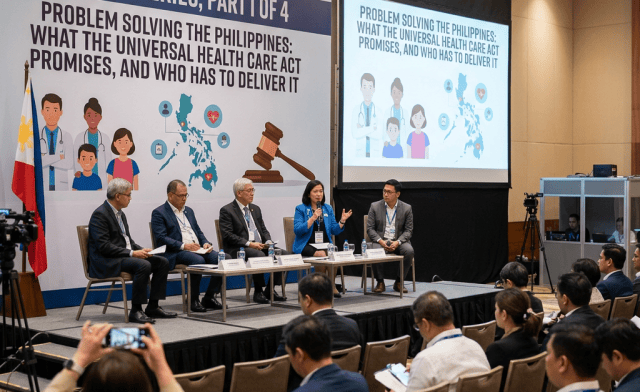
By Giancarlo Angulo
In August 2024 I wrote about the DOF’s move to take “idle” money from PhilHealth, and I said I’d save the deeper discussion of the Universal Health Care (UHC) law for a later post. This is that post, two years late. Before arguing about PhilHealth’s money, I think we should know what the law actually says. This first part covers what Republic Act 11223 promises and who has to deliver it. This is part 1 of 4 in The UHC Series.
TLDR
- RA 11223, signed in February 2019, says every Filipino is automatically a member of the National Health Insurance Program (NHIP), with no co-payment in basic or ward accommodation.
- It splits health care in two: population-based services (free, paid by the national government) and individual-based services (paid mainly through insurance).
- Much of the structure is written as “shall endeavor”. In my reading, that makes it depend on agencies and local governments choosing to build it.
What the law promises
- Everyone is in. “Every Filipino citizen shall be automatically included into the NHIP” (Section 5). A PhilHealth identification card “shall not be required in the availment of any health service” (Section 9). For direct contributors, “failure to pay premiums shall not prevent the enjoyment of any Program benefits”, though missed contributions must still be paid with interest (Section 9).
- A wide range of services. Preventive, promotive, curative, rehabilitative and palliative care, including dental, mental and emergency services (Section 6). What exactly is covered is to be decided through a Health Technology Assessment process (Section 34).
- No co-payment in basic or ward accommodation (Section 9), and “the current PhilHealth package for members shall not be reduced.”
- A primary care provider for everyone. The DOH and local governments “shall endeavor” to give every Filipino a primary care provider who acts as “navigator, coordinator, and initial and continuing point of contact.” Every Filipino “shall register” with one, and, except in emergencies, access to higher levels of care is to be coordinated by that provider (Section 6).
- An outpatient benefit within two years of the law taking effect, including outpatient drugs and emergency medical services (Section 6(b)). PhilHealth’s primary care benefit started as Konsulta and has since grown into YAKAP, which adds a new clinic registration process. I look at how Konsulta, YAKAP and GAMOT measure up against that promise in part 4 of this series.
Two kinds of health services
The law separates who pays for what (Section 7):
| Population-based | Individual-based | |
|---|---|---|
| Examples | Disease surveillance, health promotion, public health campaigns | Hospital stays, consultations, medicines |
| Paid by | The national government, through the DOH | Mainly insurance: PhilHealth, private insurance and HMOs |
| Cost to the patient | Free at the point of service | Covered by premiums and benefit packages |
Who has to deliver it
- PhilHealth pays for individual-based care. The law tells it to “shift to paying providers using performance-driven, close-end, prospective payments” based on diagnosis-related groupings (Section 18(b)), instead of paying per item.
- The DOH is to contract province-wide and city-wide health systems for population-based services (Section 17).
- Local governments are to merge municipal and city health systems into province-wide and city-wide systems overseen by Provincial and City Health Boards (Section 19). These pool money in a “special health fund” (Section 20). The law promises technical and financial support for six years to selected local governments that commit to integration, “subject to further review after the lapse of six (6) years” (Section 41(d)).
- Congress gets a Joint Congressional Oversight Committee that must commission “an independent study to evaluate the implementation of this Act” (Section 39). I could not find that study. I say more about that in part 2 of this series.
A reading of mine: in Sections 6, 17, 18 and 19, the verbs for DOH, PhilHealth and local governments are mostly “shall endeavor”. That is not an obligation to finish, only to try. When a national promise is built on “endeavor” and on hundreds of separate local governments, it gets delivered unevenly. This is an observation about the wording, not a claim about anyone’s intent. Karl Garcia made a related point in January in When Doctors Leave, Quacks Arrive: the central failure is delivery capacity, not financing, because UHC “promises entitlement” but not presence.
What I’m still unsure about
- A law’s text shows what was promised, not what was built. I haven’t audited the DOH, PhilHealth or any local government.
- I’m not a lawyer or a health economist, and I wrote this from the statute text and public reports. If I got a section or number wrong, please comment. Corrections welcome, especially from people who work in health care.
Sources
- Republic Act No. 11223 (Sections 5 to 9, 17 to 20, 34, 37, 39, 41)
- My earlier post: Policy Making is Hard (PhilHealth Edition)
- Karl Garcia: When Doctors Leave, Quacks Arrive (January 17, 2026)
The UHC Series
Problem Solving the Philippines: The UHC Series.
- Part 1: What the Universal Health Care Act promises, and who has to deliver it (this post)
- Part 2 (coming): The study I can’t find, and the rules under the Act
- Part 3 (coming): Whose money? The PhilHealth reserve rule, the Supreme Court and the numbers
- Part 4 (coming): The outpatient benefit the Act promised within two years
Lovingly made with Claude.


Endeavour is not a proper goal, I agree. It is an excuse not to succeed (gadzooks, I’m starting to write like AI, inevitable, I suppose).
Thanks for the brief, one of four parts. Covid was a scramble, for sure, tinged with corruption, a human’s greatest evil, stealing from the sick. Individual health care at private hospitals is good. I’ve migrated through two serious health problems without insurance. Care here is capable of saving lives, for sure.
That said, I’m reminded of the case in Mindanao when I was there, in which the patient, diagnosed with malaria in the province, died of a ruptured appendix during the two hour drive to the hospital in the city.