Exotic Novelties, Infrastructure Hazards: What Makati’s Squirrels Reveal About Urban Governance
By Karl M. Garcia
In parts of Makati, squirrels have become an unexpected feature of the urban landscape. Once regarded as a charming novelty in gated villages, campuses, and landscaped districts, the invasive Finlayson’s squirrel (Callosciurus finlaysonii) has established breeding populations in several areas of Metro Manila.
What initially appeared to be a harmless curiosity now raises larger questions about urban governance, infrastructure resilience, and invasive-species management. The issue extends beyond a single city. It offers a glimpse into challenges that could eventually confront many urban areas across the country.
An Invasive Species Meets a Modern City
Finlayson’s squirrel is not native to the Philippines. Introduced through the exotic pet trade, it is now recognized by environmental authorities as an invasive alien species whose spread can negatively affect biodiversity, ecosystems, and economic activities. The DENR has issued technical guidance for its control and management, reflecting growing concern about its expansion.
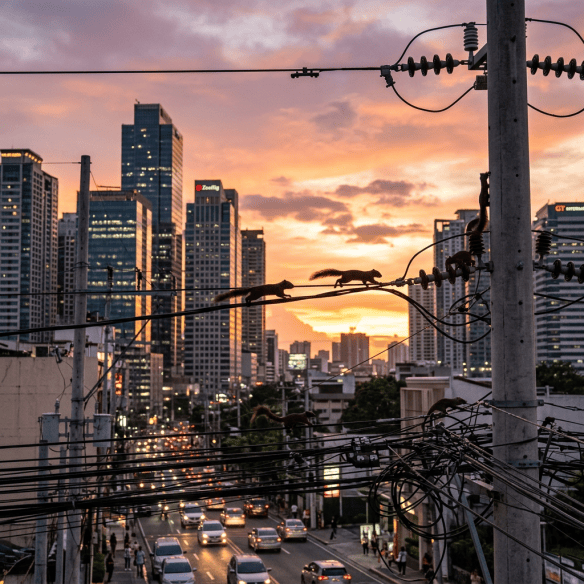
Like many rodents, squirrels possess continuously growing incisors that require constant gnawing. In dense urban environments, trees are no longer the only structures available. Roofs, insulation, utility poles, and overhead cables become part of the animals’ habitat.
The result is a collision between wildlife behavior and urban infrastructure. What residents once viewed as a decorative addition to neighborhood greenery increasingly raises concerns about property damage, service disruptions, and ecological impacts.
The Limits of Existing Policy
The squirrel issue highlights a broader challenge in Philippine environmental governance. National laws and regulations were largely designed to prevent the introduction of invasive species. They are often less equipped to address situations where invasive animals have already become established inside heavily urbanized environments.
Managing invasive wildlife requires balancing multiple objectives: environmental protection, animal welfare, public safety, and infrastructure reliability. These goals do not always align neatly.
As local governments encounter growing squirrel populations, questions emerge regarding capture methods, long-term population control, interagency coordination, and responsibility for enforcement. The challenge is not simply ecological; it is institutional.
Infrastructure Is Also Environmental Policy
Perhaps the most overlooked lesson from Makati is that infrastructure design itself shapes ecological outcomes.
Metro Manila’s extensive network of overhead electrical and telecommunications lines functions not only as infrastructure for people but also as movement corridors for arboreal animals. To a squirrel, elevated cables can serve much the same purpose as interconnected tree branches, allowing movement across neighborhoods without descending to street level.
This observation does not mean overhead utilities caused the invasion. It does suggest that urban design influences how invasive species spread and adapt.
Policies frequently discuss underground cabling in terms of aesthetics, disaster resilience, and protection from typhoons. Yet there is also an ecological dimension. Reducing reliance on exposed overhead networks could limit opportunities for wildlife to use critical infrastructure as travel corridors while simultaneously improving system resilience.
Why This Matters Beyond Makati
The real significance of Makati’s squirrel problem is not the squirrel itself.
The Philippines is becoming increasingly urbanized. As cities expand, interactions between people, infrastructure, and non-native species will become more common. Invasive plants, rodents, reptiles, and other animals are likely to exploit the same vulnerabilities in urban systems.
What appears today as a local nuisance could become a wider governance issue tomorrow, particularly in the highly interconnected urban regions of the National Capital Region. If populations continue expanding, cities may face rising costs associated with infrastructure maintenance, ecological management, and biodiversity protection.
In that sense, the squirrel is less a problem than a warning.
The City as an Ecosystem
Urban areas are often planned as if they are separate from nature. In reality, they function as ecosystems where human infrastructure and biological adaptation constantly interact.
The situation unfolding in Makati demonstrates that cities cannot be treated as sealed environments under complete human control. Introduced species adapt quickly to the opportunities created by urban design, often faster than regulations evolve to address them.
The question is no longer whether invasive species will adapt to Philippine cities. They already have.
The more important question is whether city planners, utility providers, and environmental agencies can adapt just as quickly.


