Policy Making is Hard (PhilHealth Edition)

By Giancarlo Angulo
Note: wrote this Aug 5 so I wasnt able to incorporate what is written in this piece: https://www.philstar.com/opinion/2024/08/12/2377262/awash-unused-funds
Here’s your text with grammar and clarity improvements:
Policy Making is Hard (PhilHealth Edition)
The goal of society is to move things forward—understand, explain, and communicate for a better Philippines.
One way to achieve this is by increasing nuance and understanding regarding current governance in the Philippines.
Governance and policy setting are challenging in general, which is why we have various structures that often cause contention between different approaches.
The type of governance and policy setting I want to highlight is that within the government.
We are not academics, so we must discuss policy in relation to the specific issues we are encountering.
In this discussion, I want to focus on the PhilHealth fund transfer issue.
The PhilHealth:
PhilHealth was established by RA 7875, AN ACT INSTITUTING A NATIONAL HEALTH INSURANCE PROGRAM FOR ALL FILIPINOS AND ESTABLISHING THE PHILIPPINE HEALTH INSURANCE CORPORATION FOR THIS PURPOSE.
The guiding principle of the law is:
– Section II, Article XIII of the 1987 Constitution of the Republic of the Philippines declares that the State shall adopt an integrated and comprehensive approach to health development, striving to make essential goods, health, and other social services available to all people at an affordable cost. The needs of the underprivileged, sick, elderly, disabled, women, and children shall be prioritized. Additionally, it is the policy of the State to provide free medical care to paupers.
All of the enabling laws can be found on the about page of the PHIC website: https://www.philhealth.gov.ph/about_us/
The Universal Healthcare Act (UHC) expanded on this by going beyond the insurance model.
From the UHC:
Section 2. Declaration of Principles and Policies. It is the policy of the State to protect and promote the right to health of all Filipinos and instill health consciousness among them. Towards this end, the State shall adopt:
(a) An integrated and comprehensive approach to ensure that all Filipinos are health literate, provided with healthy living conditions, and protected from hazards and risks that could affect their health;
(b) A health care model that provides all Filipinos access to a comprehensive set of quality and cost-effective promotive, preventive, curative, rehabilitative, and palliative health services without causing financial hardship, prioritizing the needs of the population who cannot afford such services;
(c) A framework that fosters a whole-of-system, whole-of-government, and whole-of-society approach in the development, implementation, monitoring, and evaluation of health policies, programs, and plans; and
(d) A people-oriented approach for the delivery of health services that is centered on people’s needs and well-being, and cognizant of the differences in culture, values, and beliefs.
While the National Insurance Program has the same objective of healthcare for all, the UHC recognizes various interventions for a healthy populace, including a comprehensive set of quality and cost-effective promotive, preventive, curative, rehabilitative, and palliative health services.
What is the current issue at hand?
The issue is that the DOF has asked the PHIC to transfer what it deems as excess or idle funds back to the treasury.
Here are some links that discuss the issue:
To evaluate something like this, we need to structure our analysis of the policy.
Since we are not academics, we can use something practical—a checklist of sorts.
This is my initial proposal for evaluating such policies:
- Problem Statement
- Objectives
- Facts of the Case
- Is it Legal?
- Is it Logical?
- What does the writer think?
The list is simple and short, but my objective is to provide a decent analysis of a policy because, remember, everyone has only 24 hours in a day. The cabinet is the alter ego of the president, and like a fractal, the undersecretaries and assistant secretaries are the alter egos of the secretary. In our complex world, nobody has perfect information. Decision-makers have access to much more and likely better information and analysis than 99% of the people in the Philippines. Policy is made through and by these alter egos.
So, I will try to keep this short and let’s build this up together:
- Problem Statement
The national government needs funds, and any unused funds we have are doubly wasted because of our budget deficit. - Objectives
Minimize waste of funds. - Facts of the Issue
The UHC is the primary reason that PHIC’s budget was increased. The UHC emphasizes comprehensive care. The PhilHealth budget has increased, but it has been slow in implementing primary care. PhilHealth will implement primary care through LGUs and private entities, which, like all government entities experiencing growth, suffer from a lack of absorptive capacity. - Is it Legal?
Does the GAA 2024 really allow the fund transfer? - Is it Logical?
Defensively logical. - What does the writer think?
I agree with Sec. Recto on this.
I would like to present the other viewpoint, but I’ll leave that to other members of society.
I initially wanted to dive deeper into this topic but decided to save that for a future UHC-focused post.
The gist is simple: UHC needs a holistic approach, which is why government policy emphasizes a “whole-of-society” approach. Healthcare for an aging population means we have to make hard choices. The notion of “death panels” might seem like a joke, but it reflects the reality that difficult decisions must be made. Expecting an insurance company that has shown little prudence in procurement and policy over the past two decades to handle this is illogical. This is lawmaking as PR, not as a tool to improve lives.
Some issues are:
- Like education, the infrastructure is lacking.
- Unlike education, we do not have much technology to help bridge the divide.
The proper model is a superbly managed system because we do not have the wealth of places like the US and Singapore. I don’t agree with price caps, but we need a way to control healthcare costs.
The main payer is the government, which covers a sizable workforce as well as indigents, senior citizens, PWDs, and other special populations.
Here are some screenshots of the 2024 1st Quarter FS:

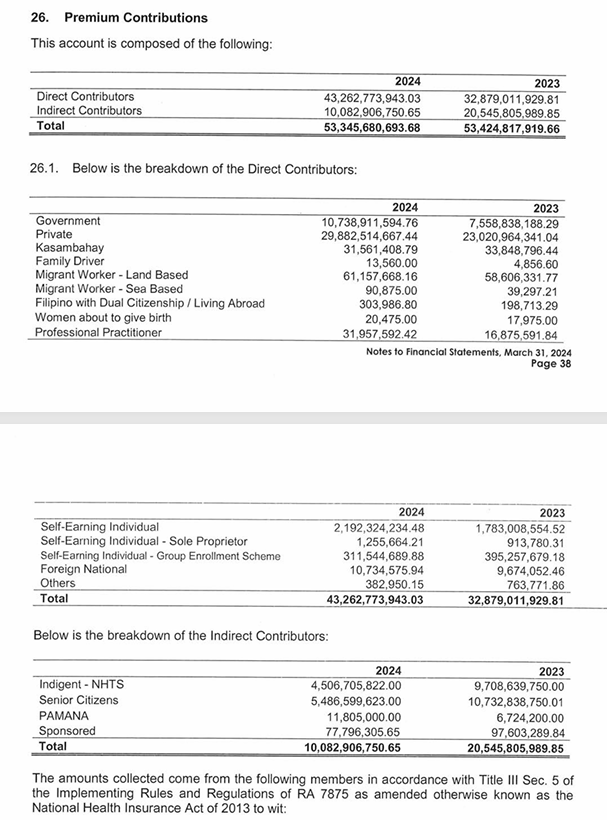
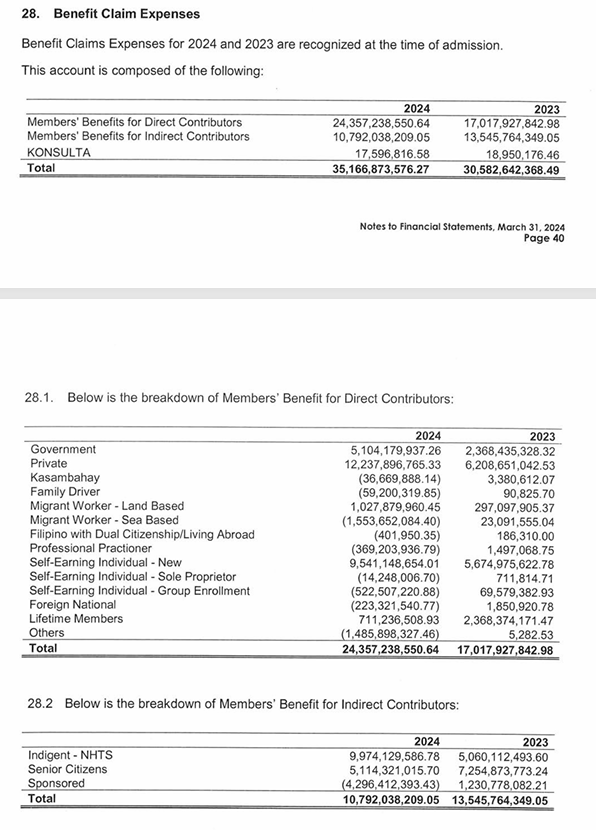
The first 20B remitted by PHIC was used to pay for HCW benefits during the pandemic. Just as the government paid into the PHIC, its inability to roll out necessary programs like Konsulta means it is collecting money from a heavily indebted entity that cannot effectively use it due to absorptive capacity issues.
Apologies on this. I write within 15 minutes or so anytime longer than that and I get bored and would start doing other things.
We want to learn and expand our knowledge.
What did I get wrong?
What did I not consider?
Let us learn together.
NOTE: I asked chatgpt to fix grammar and punctuation. Most changes were related to punctuation.
Comments
93 Responses to “Policy Making is Hard (PhilHealth Edition)”Trackbacks
Check out what others are saying...-
[…] Policy Making is Hard (PhilHealth Edition) Categoriespersonal AnGoL […]


 The Society of Honor by Joe America
Important Copy paste from Philippine Star Article of Boo Chanco.
https://www.philstar.com/business/2024/08/14/2377627/unspent-budget
Ayun naman pala. A trillion pesos, more or less, in unused funds exists because some government agencies have low utilization rates. Yet, why was the PhilHealth fund taken?
Secretary Ralph and Rep. Joey Salceda are right in saying that using idle funds is better than having more government debts or imposing new taxes and/or higher tax rates. But in the case of PhilHealth, the proper thing to do is not to take funds already in the agency’s coffers but to increase benefits for members and/or reduce contributions.
I can’t believe Secretary Ralph Recto doesn’t see the need for this government to seriously fund our universal health needs, beyond just token or lip service. The usual excuse for why we are getting close to nothing from PhilHealth is a lack of funds. Tapos, bubulaga na lang na maraming excess or unused funds. From a recent personal experience with a major surgery, my contributions to PhilHealth since it started operations were of no help…no value.
The explanation for why PhilHealth cannot cover medical imaging and laboratory fees necessary for the regular health checks of senior citizens is the absence of enough funds. Those who try to get anything from PhilHealth realize the system is a joke in light of the meagre amounts being given. Paiyakan pa, as many hospitals complain about their growing receivables from PhilHealth. Mayroon naman palang funds…pero kinuha na ni Secretary Ralph.
The P90 billion that the Department of Finance (DOF) took from PhilHealth may not have come from membership contributions. But PhilHealth also covers non-members, and that is why the government contributes something to the fund to cover the needs of indigents. Now that the DOF has taken back that contribution, there will be less money available because the contribution of paying members must now be used to cover the needs of indigents.
I agree with Secretary Ralph that using idle funds of government agencies makes sense as an efficiency argument. But PhilHealth and, to some extent, the Philippine Deposit Insurance Corp. have the nature of provident funds belonging to private members who contribute to them to cover eventualities like getting sick or a bank run. The government is only the fund manager.
It doesn’t matter that the cash sweep does not affect the viability of these corporations. The point is, the money the DOF took from PhilHealth does not belong to the government anymore. If the DOF did a sweep of funds held by the Department of Public Works and Highways, Department of Information and Technology, Department of Social Welfare and Development, or even such GOCCs like PNOC, there would be no problem because those are really government funds, not funds that the government holds in trust for the eventual private users. In the same way, the DOF cannot do a cash sweep of Government Service Insurance System and Social Security System funds because those are funds held in trust.
If it is true, as Secretary Ralph claims, that PhilHealth still has P500 billion to fund claims of members, then it is clear the management of PhilHealth is totally inept for failing to come up with such programs that will benefit us, its members. BBM must appoint a more competent PhilHealth manager.
But Secretary Ralph is right about idle funds. Low absorptive capacity shows a failure on the part of the agency’s leadership to perform the purpose for which the agency was created. Idle funds mean idle managers. BBM should do a management sweep as well.
Absorbtive capacity meaning you can’t solve the problem with pouring money if you do not know what to do with it.
You can not manage what you can not measure. By golly, what managers need is a ruler or a tape measure.
It is a given there is corruption, but life goes on, if you don’t know what to do with what you have then that is worse than siphoning money.
This is a video example: https://youtu.be/E7tEQPzOFnE?si=Vg4rZ0HMm778Zx42
Cameroonians first try of an escalator in a mall. hmmm. Ok so try and try until you succeed and if you get the same results then according to someone not named Einstein, that is insanity.
Speaking of pouring money. Chinese money had been pouring in Cameroon.
https://www.ecofinagency.com/public-management/1710-44963-the-flow-of-chinese-investment-in-cameroon-is-expected-to-strengthen
we know the trick, the chinese did it to us too. we signed mightily for china’s belt and road and gotten mirage and unfinished projects still in the pipelines. once we signed on the dotted line, all hell apparently break lose! the chinese came closer and their dot lines kept on expanding soon to encompass scenic palawan. chinese navy even started refueling in dabaw, powering maybe the same navy that harassed our fishermen in the shoals. chinese communication towers started appearing inside our military bases, chinese mainland t.v. programs infiltrated in our own local t.v. stations trying to educate (indoctrinate?) filipinos with chinese culture.
but we are resilient bunch and hang on to what is traditionally ours. and now we are trying to undo chinese bad influence with limited success.
apparently philippines has yet to learn its lesson and now seriously planning to join brics! still chasing mirage.
Terrific jolt to my preconceived notion that the transfer was a betrayal of taxpayers because it robbed them of the health care they were promised as their health payments were diverted to other things and essentially became taxes, not health payments. You argue that the money, if left unused, would be a waste, and to that I agree. You argue that the health care infrastructure and payment capacity simply cannot keep up with the new resources allocated via laws, and I can understand how that could occur if laws are so burdensome that they tie Phil Health’s hands. So the argument is sound.
The reason laws are so constraining upon spending is because there are so many crooks in government. We cannot presume good faith honesty. If we could presume good faith honesty, then we could argue that we should get rid of the constraining laws and free Phil Health to do more for hospitals and patients. That is, spend the money for health care. It was paid in by citizens in good faith for health care, not debt relief. So keep up with the faith.
I unfortunately do not think debt is being run up in good faith, for that matter. Who knows where the money is going. Or into whose pocket.
So I understand your arguments. Agree to them given the condition of the condition. But I think corruption is killing the POTENTIAL for better health care.
I thank you for this cold shower, overlaying my bias with facts. More of this and we’d get to some meaningful improvements in these parts.
That is always the issue. Another thing that I’ve not put in there because I haven’t found the time to do a financial model but the GOCC pay and bonuses is currently based on financial health of a GOCC. One part of me really doesn’t want to give big bonuses and pay hikes to the slow management of PHIC.
Ah, well, that leads me to wonder if they are running up reserves to give a picture of good financial health so they can wrack up bonuses. Tragic if so. Bonuses should be for performance, not failing to perform.
it is filipino tradition to save for the rainy days. maybe philhealth just did not realize the rainy days are well and truly here! and when it rain, it pours and philhealth got leach. they should have seen it coming!
recto is probly a fast train, got hold of incentives before it can get incentivized. but why are customers of philhealth not complaining? oh, they do, but who is listening! certainly not recto. am meself is clapping, serves them right them philhealth bosses, sitting on a gold mine, crying poor and asking for more contributions. now, they really have terribly good reason to bite their fingers and cry.
I contributed to philhealth as little as I can, and only the barest minimum required, keeping most of it in the bank. and when the rainy day comes, it is so easy to just transfer fund and pay for medical expenses, saves me the paperwork and having to strangle the smiling officer behind philhealth counter, staying in line huffing and pufing, thirsty and hungry and nearly losing patience, other times docile and groveling and begging philhealth to give what is mine.
Haha, that description of the Phil Health counter is so typical of the first, last, and only time I visited there. Cash works for me. Costs are low vs US, and treatment is good if you find the right hospital.
GOCCs should not prioritize pay and bonuses over research and development and innovation. That is where the surpluses need to go for PhilHealth to fulfill its vision of providing quality and cutting-edge healthcare to all Filipinos.
Doesn’t Department of Health have a separate budget to pay for the HCW benefits during the pandemic?
Difficult topic. Some initial thoughts:
1) large funds of any kind invite abuse in the form of corruption and freeloading. Pension, healthcare, and tax.
2) it is unbelievable how dysfunctional the Philippine system is, from uncollected SSS dues of companies to Philhealth in arrears to hospitals.
3) bureaucracy is by nature cumbersome. But Philippine bureaucracy seems extra unweildy.
I am simply stumped and amazed that anything government related works at all over there. And not surprised that so many things are privatized even as it makes oligarchs powerful. They simply get stuff done while I wonder what the focus of most other people there is.
My assessment is that Filipino government and small business executives do not have the capacity, or the motivation, to build a future into jobs. Big businesses do. Without the notion of an “earned future”, there is no drive to compete. No drive to produce. The problem is solvable. But leaders here refuse to try. They like what they have I’d guess. To change is to make them have to work.
Perhaps Filipino government officials even up to the President are afraid that failure would result in loss of their power, thus never have any courage to explore bold ideas.
I often refer back to historical examples of economic growth in the US/Canada and Europe. As much as the captains of industry like to push a story that growth was all done by businessmen, more often a company’s success was rooted in technologies and practices developed by government agencies released to the public domain, facilitated by a transport infrastructure built and maintained by the government, the companies staffed by workers educated by government-funded public education.
Even in situations where there is a lack of effective regulation and competition, corporations fall back to rent-seeking once they have consolidated enough control in certain industries. This is how I see the major Filipino corporations: they are effectively import businesses that built mega malls to sell the imported goods. Absent any government intervention, they have no reason to change course.
To get the Philippines economy on solid footing, the government needs to find the courage to built out an effective transport system connecting the islands (probably medium/large inter-island mixed-use government run ferries) and better roads to the provincial agriculture. Subsequently build out public-private-foreign partnership owned industry. A major reason why foreign companies don’t set up manufacturing in the Philippines is the terrible transportation and massive government red tape.
Hmmm, lack of boldness. Fits. One screw-up and you’re gone. Too many sailors, not enough marines. The former don’t rock the boat, the latter are like Duterte. Haha. There certainly is little inclination to think and work forward. Inertia that’s tough to overcome. Failure is normalized.
The captain is also absent because he wants to maintain an excuse absolving responsibility just in case the boat is shipwrecked. There’s always an underling to be the sacrificial fall guy, haha. The bangka of the nation is listless for decades. Personal accountability is rare. I’ve read opinions that this is due in large part to a large number of competent and educated people leaving during the Martial Law period.
ahem, filipinos are so like talibans! themselves first, their families and friends second, their nation comes farthest third.
KB, I think one of the biggest roadblocks to national renewal is the divide in understanding between the educated who want a better Philippines and the working Filipinos on the ground level. A comparison to warring Central Asian tribes might be apt. I had a few work stints as a civilian contractor in those parts of the world and people are loyal to their tribe, not their nation. The urban educated Afghans failed to find a way to connect with the provincial Afghans, which ultimately lost the war.
It is extremely hard to bridge that divide.
Even educated Filipinos are extremely divided, and Philippine society lacks what, for instance, we here have at TSOH, the capacity to exchange different perspectives in a productive manner.
The educated can’t discuss the aspects of a divorce bill in any way but yes or no, for instance, instead of weighing the different considerations for a balanced regulation.
Recently, the discussion about Carlos Yulo vs. his mother wants to pin the fault on one culprit, instead of first of all seeing such stuff can be very complex and second no one knows the whole story so how to judge and why judge and not just mind one’s own business.
Kinda in a funky mood today as I see how stuck the country is in so many ways.
You’re right Irineo, I had over simplified, so thanks for pointing out that the educated class also have divisions in opinion as well.
I had been following the divorce debate, and yeah in a perfect situation parents should try to make amends and stay for their children, just like in a perfect situation a woman would not need an option for abortion. Those in Congress opposing the legislation should consider that without the option of divorce, the only option that remains is that people will just separate or have kapuso or kabet.
A young Filipina friend who I had been mentoring for some years and until now that she had never gotten married to her kapuso due to the fact that her parents are separated yet still legally married, and at various times one or both parents refused to sign the consent for marriage since she and her partner were not yet 25 at the time. Her two children (my god children) don’t have their father listed on the birth certificate since there was no valid marriage at the time of their birth, so when her tambay partner decided to cheat causing their separation, she had little few avenues to pursue child support. The only option was to demand a DNA testing, which she would need to pay for. The detractors of the legislation profess to be concerned for the welfare of children, so they should offer an alternative that puts the rights of children first.
I saw the Carlos Yulo drama as well. I commend the young man for being reserved and not talking trash on his mother beyond the simple, straightforward comments. How to get people to change their ways and not be judging? That’d be very hard, since chismis is the oxygen of the neighborhood marites. Wasn’t it Duterte that once said that due to the pandemic lockdowns, the Philippines had become the “Republic of Marites” because most people were tambay? It’s also interesting that the word chismis derived from the Spanish “chisme,” and in every Latin country, there is a strong neighborhood and national culture of chismosang titas.
Interesting aside, AFAIK “marites” also originated in the California Fil-Am community, similar to “pinoy,” before being introduced back home to the Philippines with a folk origin of “Mare, ito ang latest”. In the late 1990s, I attended an all-boys preparatory school run by friars of the Servants of Mary, while our all-girls sister school was run by the nuns of the Holy Child of Jesus. One of the girls in my year’s name was Maritess, who we would often tease for being nosy and gossipy. We were already using “marites” in the context of “chismosa” by then.
https://joeam.com/2020/09/09/the-national-village/ this article somehow paralleled describing the Republic of Marites without knowing of the term..
..and of course people who think they know their stars, politicians, etc, are vulnerable to huge errors in judgment as they don’t really live in a village where one has firsthand knowledge to correct misconceptions and people might still have similar horizons and values..
Even the idea of kapwa needs some degree of revision as I doubt that Filipinos are able to process people they really know beyond the biological limit of the Dunbar number, around 200 people.. that was the size of human Neolithic communities..
OK, OK, I know the Badjao have a mutation that allows them to stay underwater longer.
It does annoy me, though, that many otherwise sensible (?) Titos and Titas in the Republic of Marites act as if they were downright psychic. Or do they all have Trese like abilities?
If they do, they are hiding their successful use very well as I don’t really see the results. 😀
Interesting observation about the concept of kapwa as it relates to the Philippines. I think you’re on to something Irineo, as many Filipinos seem to relate to politicians and celebrities as if they are a personal friend, even if the famous person doesn’t know they exist and wouldn’t give a damn about their superfans. Given the Dunbar number, people’s brains may quickly short-circuit keeping up with all the rich and famous they personally identify with on a first name or nickname basis.
Perhaps this has something to do with Filipino society being quickly catapulted into attempts of modernization, whereas the barrio/barangay-based society that lasted until the end of Spanish colonization allowed some degree of personal connection. Even today, the captains have quite a bit of power in their barangay and the position is often de facto hereditary even if there are official elections.
I’m not sure how this problem can be fixed. As discussed previously, societies can change, but what will be the likely impetus for change in Filipino society? I guess that will be the million dollar question. Some days I can’t help but think, informed by decades of direct observation, that the only way might be complete national restructuring but I worry that would encourage dictators who as we have seen in history, are often not benign. The frustrating bit is that while the Constitution and existing laws are not perfect, if the law is adhered to, that would already result in positive change.
An engineer friend of mine who works for a multinational visited home to the Philippines after 10 years abroad. We happened to be in the Philippines at the same time, so we caught up with each other over dinner. The first thing she complained about is that she had forgotten how terrible the bureaucracy in the Philippines is, as if Filipinos had taken American practices and tradition, then made it somehow 100 times worse until it’s just a choreographed theater “just because it seems important.” Since you’re in Germany Irineo, you must have experienced the famous German bureaucracy also, which often can be unwieldy with all the requirements.
Any sufficiently advanced technology is indistinguishable from magic” is a quote by science fiction writer Arthur C. Clarke
Lots of elite study abroad and learn how the USA/EU does it. Unfortunately we aren’t as rich, this makes certain things impractical for us because we do not afford it.
It would be nice if the Philippines can jump to the latest technology and practices, but you’re right we both know it’s not practical. However, it seems that quite a few citizens and even politicians expect the government to somehow make that jump.
I always likened personal development to climbing a ladder, which can probably be loosely applied everywhere else as well. Climbing a ladder one step at a time might be slow, but one will reach the top safely. If a friend holds the ladder, one can climb step by step even faster. But if there is no assistance, and one insists on jumping multiple steps at a time, sometimes they will find success, but more than likely they will fall back to the ground having wasted their effort and getting injured in the process.
Step by step development, with assistance of foreign development grants and foreign investment if managed well can reap rewards very fast. I visited South Korea in the early 1990s with my grandfather, and remembering how very poor South Korea was. Korea in general had been a poor and somewhat backward nation over the majority of the last thousand years. But in the span of just 20 years they have become a global technology export leader with good political leadership and attraction of massive American investment.
Sokor and the Philippines both sent nurses to Germany in the 1970s. The difference was that the Filipinas usually stayed on and applied for their families to come in the late 1970s and early 1980s, while the Koreans went back home as jobs started to get available at home, thus in the Caritas run international center for mainly nursing professionals in Cologne, Germany, the “Korean center” became small and insignificant while the “Philippine center” grew bigger.
Now the Philippines is sending nurses to Germany again, together with Mexico etc etc
Author Ninotchka Rosca called the Philippines “Land of Constant Beginnings,” and she is right. The country seems like Sisyphus and keeps rolling back.
Even Mexicans are re-thinking immigrating to the US now because Mexico’s economy and quality of life is decent nowadays. Mexicans would rather stay and build their own country, with plenty of well paying industrial work available due to the USMCA FTA.
I do wonder if the fact that not more Filipinos abroad are returning home with capital to build the mother country is due to lacking any faith that the government and country will change for the better. Actually, I had a conversation with a friend who’s a Fil-Am nurse that grew up in Cavite before returning to the US where she’s a natural-born citizen. She shared that most of the remittance she sends home to family is wasted because they either make excuses about not being able to find work, or the nieces/nephews she tried to support the education of decided to start families at a young age instead (they got their partner pregnant).
and shabu, multiply this story a million fold and you got the justification for DU30’s EJKs. I’d add Filipinos opening up balikbayan boxes and not seeing Nike or Levi’s or more chocolate (like Lindor), then texting hey these items are all used and theres no chocolate. talk about entitlement. and drug use. They’re like Matthew Perry, Joey. too much weight to bear for anyone. Have you seen the documentary Daughter from Danang? about a girl adopted went to the US decided to go back to find her family her family is destitute and she becomes their milking cow after contact and she’s all crying saying this is too much for me. hell yeah its too much, its like being covered with leeches. send CDE Filipinos to Mexico have them make their way to asylum, like a modern day Galleon trade jumping ship. give AB Filipinos a break. balikbayan boxes and remittances should be boycotted by OFWs and Filipinos abroad say for a year, go on strike. show the Philippine gov’t & Filipinos they need to pay closer attention to the hand that feeds them. as a group. they’ll make their point loud and clear.
On Digong’s nationalization of the drug war, I disagreed with his approach both on moral grounds and also in lack of effectiveness since I often interact with the poorest members of Filipino society and see the root causes of drug use. Some poor Filipinos use shabu and marijuana as a form of escapism or to numb their hard life of labor (such as tricycle and jeepney drivers). The very addicted tambays often have been “thrown away,” even by their own family. It horrified me to witness multiple tandem rider summary summary executions, especially when the killings were mostly using drugs as an excuse to settle old scores among neighbors and rivals. When a lawless President declares open season on violence, he invites vigilantes and criminals to cloak themselves in all but sanctioned violence. If someone did something criminal they should face the law in court, and it bothered me that there were strong rumors that the PRC drug lords had close ties to the highest levels of government, yet didn’t face justice.
I’ve seen Daughter from Danang, and from a Vietnamese perspective it didn’t do a great job exploring differences in culture. It seemed to be mostly catered towards White American viewers as poverty porn. Yes, there is some of that happening. I’ve even experienced that with extended family I’ve never met (third cousins twice removed or something like that), but overall that behavior is considered quite shameful in Vietnamese society and the shaming is enforced by family/neighbors.
I find Filipino culture to be very generous and giving, but there is also a deep cultural undercurrent of the “hingi hingi” habit among the less educated. I’ve seen entire family clans depend on a handful of OFW, sometimes even literally *one* OFW to send remittance. Filipinos who are stuck inside their subdivisions never see this and have a more rosy view of society. Increasingly I’ve seen a trend of sending daughters abroad to be OFW, while the sons get to be tambay and be little kings at home. It’s not really fair for a Filipina to be mentally broken and work until her 30s and beyond, with no prospect for finding a partner, because daily she is bombarded with sob stories and requests.
I’ve even encountered the “hingi hingi” firsthand years ago, as when I previously had sent balikbayan and remittance to my ex’s family even though she was a US resident, there are always frowning faces and asking of “oh, I thought you would send this one or that one.” Don’t get me to the neighbors, where if I bring the gifts from abroad with me when visiting, they will line up outside the door out of “curiosity,” want to “see” what’s in the balikbayan, and hingi for a razor or some chocolate.
I’m not sure what it will take to break this. FDI through BPO salaries and OFW remittances constitute a large portion of the Philippine economy. These money inflows drives the daily spending in the domestic economy, and while I can stand to be corrected, taking these sources of money away would probably crash the Philippine economy and dive into a deep recession.
that’s a good point. maybe like a one month boycott then. no remittances no balikbayan boxes. like Lysistrata but by OFWs/abroads. really show Filipinos back home, all this can stop. cuz EJKs was one form of this, they got DU30 in office cuz they wanted to spank their countrymens behinds, and spank them they did. spanked them dead. and yeah I agree with you DU30 shoulda taken out more of the bigger fishes. but as punishment, as instrument of the OFWs/abroads, DU30 was perfect. and the opposition doesn’t get this. my beloved Inday Sara will be president soon precisely because of this. the opposition needs to understand this. so if VP Leni or Sec. Teodoro can replace said act of punishment with a more specific boycott, less violent but gets the point across, then probably better than EJKs. i hop e that makes sense.
The thing about those who send remittances is that usually they’re the Filipinos who feel the most responsibility towards family and possess a genuinely kind heart of wanting to help. That’s why I often see them being taken advantage of. I really empathized with them because after they are milked dry, they’re thrown away in the trash by their own family. Maybe instead of banning remittance, the dating apps will be withdrawn from the Philippines since supposedly they will be included in the digital VAT. No more afams being tricked into sending money by tambay probinsyaña who seem to operate scam farms spread by word of mouth throughout their barangay haha.
Drug use is a problem yes, but as many Filipinos remarked to me over the years, the Philippines seems to learn the worst lessons from America then proceed to make it worse tenfold. This is the main reason I opposed Digong’s ineffective strong man strategy of punishing street level users, and giving a blind eye to so-called vigilantes to settle neighborhood scores with straight up murder. The US drug war that started under Nixon utterly failed, and drug cartels only got stronger the more people on the street were punished. Since I think we are in or around the same age range, you have seen that first hand as well in the US LCpl. The drugs need to be stopped at the source, which nowadays is the PRC and the CCP that enables shady PRC biochemical companies to wholesale manufacture fentanyl/shabu precursors sent to the Philippines, US, Canada, Europe. It’s hard to believe one of the reasons why the Qing dynasty fell in China was the Opium Wars, and now they have adopted the same tactics on other countries they want to weaken. There is absolutely a Chinese connection here. The West and its allies are already at war with Russia and the PRC, we just don’t know it yet since no bullets are exchanged as of yet.
James Baldwin once said, “I can’t believe what you say, because I see what you do.” That’s my general mantra in life, especially towards those who boast way too much but have little to show for it. I can’t support Sara Duterte because I don’t believe she will make the Philippines and as a whole, the SEA region more secure against China’s aggression. I’d rather not have the US need to intervene in other wars after the hard fought peace she currently has. My view on VP Leni is if she ever decides to come back and run again is she would focus largely on making the Philippines better domestically by attracting foreign industry to set up shop, while working with MDT and allies on the foreign side. Sec. Teodoro, I see him more of a military hawk, which given the current state of affairs in SEA that is a good thing; there’s no time for weak-kneed leaders now on foreign policy. Sen. Hontiveros is also great; I see her as more of a balanced leader, somewhere between VP Leni and Sec. Teodoro.
I totally agree by the way that EJKs like imprisonment for drug crimes is not sustainable as policy. but EJKs as punishment wrought on by OFWs and BPOs on their fellow countrymen, I think was successful. as punishment. and why DU30 was widely popular and why Inday Sara still is, due to EJKs. thus if more EJKs are to be averted, the opposition has an in here. namely by recognizing that its OFWs and BPOs feeling the pinch , so have them express this very resentment towards their countrymen more constructively. like boycott on balikbayan boxes and remittances. this is a solid political movement the opposition can start doing right now. sure theres economical ramifications but punishment can be meted more humanely. thus gaining OFW and BPO support. Inday Sara will win, and the opposition has not found an in yet. they need to do something soon.
In my observation, the fact that a decent proportion of BPO workers and OFW supporting Digong and EJK is an expression of the new middle class trying to protect its economic and social gains from the their old cohort that they had left behind as their economic and social position improved. As long as their own family members who remained in DE class didn’t get EJK. Since I mostly interact with CDE, I’ve tried to explain the danger of such political positions to deaf ears, at least until their own relatives get killed. There are already existing instruments of law that allows prosecution of criminal activity, the law just needs to be applied evenly and fairly.
About balikbayan and remittances, I think that would be hard to change since the tambay family members back home have been used to being spoiled 2 generations now since the 1970s, while the BPO workers and OFW wouldn’t be working in their job if they weren’t already the family member who cared the most about taking care of family.
Even the poor probinsyaña who joins “AFAM hunter” FB groups or dating apps to go “AFAM fishing”, and successfully catches a big fish, once she migrates to her husband’s country, a large number will find a way to drain his bank account to send the money back home to family. I’ve overheard countless crying men at bars talking about how their Filipina wife screwed them. Well, serves the guy right as well I guess if he’s going to the Philippines or Colombia to marry a girl he met over the internet without first taking time to know her and the family.
My father’s sister directly after him was the one his siblings depended on working in Manila to build a house in Albay. Of course, that took nearly forever as money was siphoned off all the time and took a toll on her health even.
My nanny from Cagayan as the eldest in her family (her father was an Ilokano who had worked in Hawaii to have a bit of capital, her mother was an Ibanag or Itawis) constantly was relied on for nearly everything while she was in Manila.
The Afterlives of Maria Clara by Carolin Hau (available on academia.edu) mention how women who managed to get a job with the many new foreigners arriving in Manila as trade went up there in the 19th century were relied on by entire families. And that these families often were quite eager to see them hook up with foreign men who came alone. Not surprising that in the Noli of Rizal, there is the former labandera Doña Consolacion who is married to the Guardia Civil officer and the former maid Doña Victorina who is married to old and lame Don Tiburcio.
So all these things happened even before OFWs and even around 150 years ago.
It is also interesting how those who work hard are not so subtly derided by a certain mindset. How Mar Roxas was mocked for slipping from a motorbike during Yolanda, while Duterte flying over typhoon areas was respected. VP Leni gained little respect for her hard work.
There are indeed days where I tend to believe the Philippines is totally hopeless and in fact prefers to vote people with the mindset of tambays into office. Well I guess this is elitist?
Haha, you elitist you! 90% of all Filipinos hate you and the ground upon which you walk, unless, of course, they can get there to walk on it, too. The anger of the dog left in the pound, I suppose, or the child still in an orphanage at 49.
was ranting to Irineo and Karl about this. Frustrated people aren’t the best judges.
Haha, seems so, seems so.
There will always be more of the hater crowd to fill in the empty space of the one who was elevated, and the one elevated will be perplexed why their former cohort now marites on them.
Hah! It’s astounding how many similar stories there are on this subject. An IT engineer friend of mine that works in Bahrain for a multinational catering to ME clients has been sending money to her tambay father in Zamboanga for nearly 20 years I think, and until now the house she wanted to build for her parents is still not finished. Instead of her plan of a professional architect and builders, her father insisted he’d hire local laborers and together with them, he would build the house, but instead he made some kind of secret society/cult of the type whose name escapes me in Bisaya. So he trots around where other men who are members call him hari, and all the local members pay dues to the supreme hari who has an organization somewhere in Davao. Could it be another one of Quiboloy’s scams? Haha. Now that she is nearing 40, and with her two brothers unable to propagate the family bloodline, she’s facing pressure to marry any random man and have children to secure the blood.
I considered an argument that I heard previously, where the Europeans who first landed on Philippine shores were seen as lords from across the seas, if not semi-divine due to their more advanced technology. In this argument, the native women were encouraged to couple with the foreigners in order to secure some of that magical power for the tribe to give advantage versus neighboring barangays.
You often refer back to the pre-Hispanic culture’s preference for displays of power. The hard workers doing the people’s work are probably seen as subservient, while Duterte flying on his benefactor’s aircraft was seen as a position of power even if he didn’t actually do anything to help. It’s such a big difference from the US or Europe where when disaster strikes, politicians can rapidly gain a boost in the people’s satisfaction by looking like they are rolling up their sleeves to dig up storm damage.
It seems really difficult to change things, where performative actions are permeated, even expected, throughout society. The crazy thing to me is I would wager most Filipino politicians “know better” since they’re educated, yet lack the patriotism required to move the nation forward. The status quo is how they make their money and maintain their positions.
Have seen this. A friend had an aunt who worked in Las Vegas cleaning hotel rooms etc. Was able to build a few apartment buildings here. The rent was collected by siblings then nieces. When the aunt turned 75 or so and wanted to retire. she had nowhere to go as all of her apartments are already earmarked to her family’s support. I probably have at least a dozen stories from people I know like this. You are right and this really needs to stop. Being a tambay should not be acceptable.
That’s really sad that the tita placed her trust in her family, yet her own blood used her. The aunt probably trusted her family members to hold onto the property title on her behalf, or they may have even forged signatures after paying bribes to the local officials to change ownership. Sadly I have personal experience as well at a smaller scale, which was the first and last time I’ll ever make that mistake.
GC, the other problem is tambay family members (or even neighbors who are not related) have all the vacant time in the world to invent increasingly dire scenarios to ask for money, and if that doesn’t work they will proceed to mentally tearing down the OFW until she relents (it’s almost always a woman OFW who is victimized). If the OFW sets firm boundaries, the tambay family will apologize, stop asking for a while, then later they will test the waters with asking again. /r/Philippines is filled with sad stories like this that follow the exact same script. So heartbreaking.
filipinos often have problems with boundaries or lack of it. always thinking the other party will do the right thing, uncertain where to draw the line, fearful mayhap of offending sensitivities.
kins and relatives expected to be taken care of for life! and without discipline and ground rules laid first and set in concrete, anything and everything goes.
so 1st lay the ground rules no matter how uncomfortable and limiting that is. and expect all to follow.
yay, my friends complained, they are not nuns! not priests! and will always fall off the bandwagon!
yeah? how can they fall off the bandwagon when they have never tried to be on the bandwagon, aber!
anyway, filipinos are forgiving, and 2nd chances are given to many. so long as mistakes are acknowledged and promises are made to minimize and not do the same mistake again, all is well that ends well.
I found that once I set boundaries, the marites will start whispering bad things about me haha. But that doesn’t bother me, because it’s one thing to be generous with what one wants to give and another thing to be pressured into giving to those who are borderline demanding hingi.
What makes me a bit sad is watching many OFW from informal settlements and bukid, usually women OFW that are fully mentally controlled by their families and become the family cash cow. Those who are empathetic and care usually get taken advantage of by those who won’t return the favor, or over value the utang na loob owed to them.
Economically, it connects back to the fact that the Philippine economy would probably collapse if BPO income and OFW remittances were to be suddenly reduced. The consumption economy based on importation would crash. That’s a terrifying way to run any country’s economy. All the captains of industry seem to be absentee rent seekers happy with the status quo. Perhaps they will just abandon the country if there’s a major recession. Where is their patriotism?
families can be so manipulative, I learned that early on. and their guilt trip can be uberly exceptional. after all what we’ve done for you! this is how you repay us! mothers are specially scathing, give me back the milk I’ve fed you!
guilt trips dont work for me. kasi, while under the family’s care, I did not just sit on my butt but did more than my fair share of work. I cook, I wash, clean, do repairs, run errands, pay my fair share of bills, do lots of worrying, etc. I reckoned I have repaid any debts I have incurred.
and when I finally struck out, cut off some emotional baggage, be independent and be my own person, it was so refreshing! lonely at times though having lost the once solid social network around me, but I found my own network and found new friends. met new challenges and forged on forward.
the family did try to claw me back, they missed having me around, they loved me, etc. and when I came for a visit, they go through my things when I sleep! I fear for my safety. it was always money they wanted. I give what I dont need, and keep them at a distance. we are on speaking term, just.
My wife is the prototype of all that you say. Her extended family is murderers and thieves, a cousin being in for 40 years. He’ll be calcified when he’s let out. She’d carve me up and feed me to the fish if I ever crossed her. But otherwise she is totally charming, hilarious, loving, and works hard.
She also takes care of the spirit world with assorted rituals, prayers, curses, lotions, and potions, which leaves me free to watch basketball.
your wife is a goddess, joeam.
I’ve seen my share of families in the CDE, but especially DE where the parents essentially “retired” in their 40s and expected the eldest children to sacrifice their education to take over the family budget. But of course, the mother will still micromanage and lord over the budget which the eldest children are now supporting.
When someone libres a burger, the recipient will ask “Where are the fries? Why not a cheeseburger?”
I recall a handa I attended in recent years where an OFW visited from overseas with gifts for the entire clan. Not to mention that even though I was a guest, I provided almost half of the food haha. The OFW brought chocolates from the ME, and the family complained why aren’t there American or European chocolates. OFW also gifted some phones to various family members. Some got secondhand iPhone 12’s and there were complaints why not a Pro Max? Some others, the extended family members got 7k Androids, and the complaint was why not a 15k Android? The worst part is all the bad mouthing was done behind the OFW’s back. There’s no courage to say it directly. The OFW had saved up for a few years to afford all the gifts, while living in a crowded boarding house abroad.
“sending daughters abroad to be OFW, while the sons get to be tambay and be little kings at home.” theres also alpha tambays mostly the males who got to work outside usually as seamen like in a cruise line but got into a fight (usually with other filipino contract workers too, usually due to gambling) and get sent home, but since they’ve been out the country he gets elevated as some sort of alpha tambay. yeah theres usually a sister or wife doing OFW sending money to fund drugs and drinking. the sad story is the cuckolding thats when the husband is out and his wife is using money from husband to treat trisikad drivers to nights out, ala D5. or his kids using drugs. there needs to be some sort of accounting on how this OFW is screwing up the Filipino family unit. BPO too with ghastly hours of work. all that trickles down to mental illness, drug abuse, all sorts of perversions. all a public health issue. going amok is still very relevant.
Then Senator De Lima was not married and her driver had been separated from his wife for years. To use her as an example of “cuckolding” is offensive. Falling in love as a consenting adult is socially unacceptable somehow? This is the problem with undisciplined, amateurish social media writing. It too often is throwing green turds into the undiscerning water, no matter who gets hit by them, or drinks them. How about exercising more discipline in what you say?
I would add that it is personal with me as Senator De Lima wrote daily notes to preserve her sense and sanity during the early years of her political jailing, and compiled them into books. She asked me to write an introduction to the second of those and I was happy to do so. She is, of course, a member of the Society of Honor, having read the blog and contributing four of Will’s interviews here. Three courts determined she was innocent of all concocted charges, so you might at some point decide to help repair the damage done rather than add to it.
That’s why I took offense.
theres the definition of cuckolding and there’s the personal connection to D5, Joe. i’m just making an example using pop culture there thats popular, if you say its the wrong example then that’s fine. didn’t mean to hurt anyones feelings, though the stuff i posted on Wil’s articles should be more hurtful, but I guess its cuckold (which is weird). but heres the etymology of the word cuckold: from Old French cucuault, from cucu ‘cuckoo’ (from the cuckoo’s habit of laying its egg in another bird’s nest). i still hold that its a popular Filipino occurence one related to OFWs and EJKs (and shabu). i’ll stop posting on De Lima given you know her personally , Joe, i’d not known this. and Wil’s articles i thought were just articles to be commented like any articles here. if theres a protection spell around this subject, I’ll not broach it again. I promise. sorry.
ps. just for the record I’ve always been clear about my distaste for D5 and my taste for Inday Sara. thus i’ve said more distasteful things on D5 and more tasteful stuff about Inday Sara. just to be clear. other Filipino politicians and celebrities i can dither, but these two women my mind has calcified on. better or worst.
That’s an interesting calcification, evidently not affected by De Lima’s innocence or Duterte’s plunge into weirdness. Old age does that I guess, calcifies the brains and joints, leaving one to gum food and spend the day coughing and rattling about refusing to open the drapes to let the light in.
ahem, you know how bad calcification is for your health?
I greatly enjoy regional Filipino cuisine, but god help me at all the dishes that are essentially a plate of heart attack or bowl of diabetes.
My wife has recently taken to cooking really thick pork ribs with lots of meat and a thick outer rim of fat that of course soaks up all the oils from the deep fry. I demand two. One can experience heaven and the forthcoming heart attack with each delicious bite.
From random things you’ve said, I take that your wife is Bisaya. Bisaya food is my favorite after Kapampangan food, with Ilonggo a close third. God protect us from delicious Cebuano food, which is all fried or barbecued to a dark char cancer be damned. Note the marked absence of any vegetables at all, because as any Bisaya can attest of the hatred of utan. I make it a point to include as much “grass” as possible when I cook in Cebu, to the cries of “asa ang kabaw?”
Joe, you should try your hand at cooking. I have a great party trick when I visit a new place for parties where I’ll buy a whole pig from the piggery, and lazily roll the bamboo stake with my foot making lechon Cebuano while downing a Red Horse. It’s always amusing when folk are easily amazed that the Kano can cook Filipino food.
Waray, in the main, but grew up here and there in this kitchen or that. I admire your gift of converting exploration into action. The closest I got to authentic engagement was tossing a thousand peso bill into the tongits pile causing a hilarious riot amongst the aunties and uncles. Oh, and the hundred I put into the basketball pot that made me a true and welcome fan of the game. I tried playing basketball in slippers, but that’s a whole new set of muscles and calluses. Cooking a pig? In my dreams. I’m sure you were the talk of the town. Terrific! Keep up the good work breaking stereotypes.
I’ve often made it a point to learn local culture wherever I travel, regardless of how long I stay. There’s no point to travel for business or pleasure then hole up in a hotel eating a bad local knockoff of American food. To that end in the Philippines, I learned the differences between each region and cultural group.
I find Filipino people, despite all the rough edges shaped by a culture and government they can’t (or don’t yet have the will to) change, to be very endearing. It’s easy to amuse my hosts, from playing basketball with the local kids to doing what the locals do on a level that’s affordable to them. I have plenty of fond memories walking the beach at night collecting shells and mantis shrimp, or wading in through mangrove swamps catching crabs. They seem to be especially amused when I ask if they have a kahoy, which would invariably elicit an embarrassed response that they do, but I should use the butane stove. Then their shock when I start the kahoy going despite it being wet in the monsoon rain. Those old Boy Scout skills I learned decades ago come in handy! Don’t get me going with eating strange pulutan like snake or random forest creatures in Mindanao, I’ll eat anything hah!
It’s easier to have people open up and share about their lives when one can connect at their level. Too many “foreigners” come to the Philippines to take, even fewer give back and form friendships with the locals.
Admirable approach. I’ve shared some of the adventures and charms you recite, on a more modest scale. I typically avoid foreigners (including Americans) because of the outside-in judgments often found in their presence. It’s easier to just “be”, without the judgments.
I do the same. Frankly the behavior of many Western foreigners whether they are chasing women or vacationing is embarrassing, and I don’t like to be associated with that. I’ve gotten the usual “hey Joe!” or “hi Afam” that us Americans get, and those labels are not who I am to say the least. It’s one main reason I avoided NCR for a long time and relocated my trips to Cebu or Mindanao. My goal in the Philippines especially when I was working in Japan, South Korea, Hong Kong which allowed frequent weekend trips is to enjoy life at a bit slower pace and appreciating the culture.
Sadly though, my favorite city Cebu is increasingly becoming even worse with materialism and hedonism fueled by mainland Chinese and Korean men. They’re even able to out-compete Western men with money haha… I used to be able to peacefully walk across big open lots in my usual haunts, but for example Mactan Newtown occupies a large expanse in Mactan and is a magnet for women across Visayas and Mindanao. Last I was there, there were even women plying the trade who migrated from Manila of all places. Cebu is probably worse now than I ever remember Manila, Makati, Angeles to be, though I still end up there out of habit.
Honestly I’ve met very few fellow foreigners in the Philippines who have purely good intentions. Sometimes I’d rather just travel in the bukid or stay on the far side of an island away from the cities to have some peace.
There is no protection about writing about anyone here, but there is the editorial goal of being honest and constructive and not bowing to the sloppy emotionalism of social media to get our jollies. You offer up great insights and you troll. I’m confident you can figure out how to help with the mission here.
“Old age does that I guess, calcifies the brains and joints, leaving one to gum food and spend the day coughing and rattling about refusing to open the drapes to let the light in.” speaking of old age, where is my fellow octogenarian, NH?!!! so long as prostate is limber and lithe, everything else can calcify, Joe. lol. i usually say ‘NH knows’, but he’s nowhere to be found these days.
agree with most of this except the D5 thing
sasalpak lang po ako rito:
reportedly de lima and the driver had a 7yrs loving relationship until it wasnt. de lima was affectionately called tita lei (auntie lei) by the driver’s children and they often asked her advise on many things. it was alleged de lima got them a 2million house, not exactly a lean to but not a mansion either. beneficial for all concern.
The German bureaucracy is known to be complex, but its citizen-facing aspect has undergone a service-oriented overhaul and some degree of digitalization from the 1990s onward. It was always like a complex German machine tool that worked if one followed the instructions. Or, like the German software SAP, which you might be aware of as it is used globally, it too is famously complex but powerful if configured properly. I work in that area, BTW. Probably horrible if one has to build a house, based on what I have heard from colleagues who did.
Dealing with the tax authorities as a freelancer, which I was for a while, takes some getting used to and is more complex than, for instance, in England. Better have a good tax accountant to take care of details over here. It isn’t as infamously complex as it allegedly is in Spain, where a mix of people being not so fond of complex details and a not easy to understand bureaucracy (even Germans who settle in places like Majorca complain about it) makes a lot of people make use of “gestores” (a kind of fixer) even for daily government-facing stuff not just tax matters. Actually, Americans who recently settled in the very popular destination Portugal have complained about the combination of inefficiency, opaqueness, and haughtiness that seems to characterize Iberian bureaucracy. Could be that legacy is the even worse one in the Philippines.
ERP isn’t my current area of expertise, and it’s been quite a while that I’ve worked with SAP, NetSuite, SAS, etc. You’re right, as a EA/PM depending on project, I need to identify the vendors whose products specialize in what the client needs. Developing in-house would waste too much time, even if SMEs are pulled in/consultants hired.
The complexity of the German bureaucracy I’m referring to is more about the paperwork requirements, where Germans are quite particular about exact documentation. Here in the States simplicity is preferred, where often multiple document types are accepted as official documents, and our products often reflect this ethos as well (e.g. American Ford GT vs German BMW M5).
Often in the Philippines, I encounter what amounts to be official theater/security theater, where actions are more performative than having an actual purpose. When I inquire why, even the government official doesn’t know the answer. For example, the process of obtaining a decent job which requires: PNP clearance, NBI anti-terrorism clearance, mayoral clearance, medical clearance with fecalysis results (why stool samples are needed for a job is beyond my understanding), school clearances and transcripts, and more. Just endless paperwork that serves no purpose at all. There’s a meme I often see on pinoy socmed complaining about this, where other countries just required a copy of the job application and education credentials where needed and that’s it. All these extra red tape costs money at each step along the way, and is unnecessary. Just hire the new employee, and if they don’t do a good job after OJT, fire them. That’s what I do for my subordinates that embellished their CV and then couldn’t adjust to the responsibilities.
You bring up a good point about the Iberian connection. As we discussed in previous blog posts, a large portion of the inefficiency might well be traced back to the Spanish domination where Iberian bad habits were combined with local culture. I’ve noticed a similar pattern in Latin America, including in Brazil which was a Portuguese colony before.
Thank you GC for sharing more information regarding the PhilHealth controversy. Perhaps the government explanation is satisfactory and there aren’t any nefarious undertones after all.
What I wonder is if there are excess PhilHealth funds, shouldn’t that money be used to make the healthcare system even better? For example, better staffing of barangay health centers which can be opened for more days each week, better pay for publicly employed health care professionals so nurses, doctors, dentists actually have some incentive to stay in the Philippines if they’re inclined towards service rather than making big bucks in the private healthcare sector.
I’m also perplexed as to why Filipinos didn’t push back more strongly on the redirection of the funds, or maybe Filipinos feel powerless on this matter… might cause a political problem in the future as the biggest contributors to PhilHealth are BPO workers if I’m not mistaken who are a growing voting bloc. Here in the US, foolish Republicans periodically commit political suicide by trying to privatize or take away SSS or Medicare funds (they’re getting hammered for it this year).
I don’t really know anything about money or finance. but I do know insurance is simply bets. life insurance you’re betting the company you’re gonna die soon, the company takes that bet no you’re not buddy and you square your money. over here fire insurance is making insurance companies go bankrupt or simply move out of state unto other scams, bad bet on the company’s part. flood insurace for east coast. annuity is a bet opposite of life insurance in that you’re betting that you’ll live more years, the company says I’ll take that bet. so its essentially Vegas or Macao. finance, Wall Street too is one big betting scheme. designed to screw the little guy. which gets us to pension funds, same shit. rubber and rubber trees and futures market too. Why not divest all together from all that. for example, instead of insurance schemes, why not get into arbolario or folk medicine. lots of Europeans (and some Americans) go all the way to Siquijor (and other similar places) to learn witchcraft and shamanism. same with the psychedelic movement going to Mexico, lately now going to the Amazon to get from deep tribal knowledge. same for the Four Corners region over here, with Hopi, Zuni and Navajo ancient remedies. other tribes as well. not sure if the negritos have as sophisticated folk medicine, i only know them for hunter and gathering, nor even the Badjaos, but I’d assume both negritos and badjaos will know alot about flora and fauna all chemicals really old solutions to modern ailments. why not put all that money to create and grow an industry that’s long been forget in preferance towards pharmaceauticals and modern hospitals which in the end probably kills more people than actually setting them on the right path. this is all anthropology of medicine. there’s a whole market there that I think the Philippines can grow locally using local ancient knowledge. you wanna make wagers, wager on that. go to Siquijor. learn about poisons and antidotes. all chemistry. thanks, gian.
the chinese has acupuncture and herbal medicines. eastern medicine is supposed to supplement western medicine. western medicine is mainstream medicine and uses universal language (greek and hebrew) understandable to all its initiates the world over. eastern medicine is mostly local knowledge, its dosages variable and differs from practitioner to practitioner, the practitioner not always accredited. eastern medicine uses herbs which is natural hence safe, but arsenic is also natural but not safe to have around.
eastern medicines are complementary and have many uses, but if you need hip replacement, you are better off with western medicine. same as heart and lung transplant, kidney transplant, etc. and if you are involved in a motor vehicle accident, bleeding and badly hurt, practitioners of western medicine is almost always the 1st point of call, other than the funeral director.
after viewing x-rays, practitioners of western medicines can pinpoint the exact location of broken bones and fix them, re-attached severed digits, replace damaged organs, give blood transfusions, etc. and when you are on the way to recovery, eastern medicine can complement western medicines and offer wellness, like acupuncture to numb pain. take into consideration that some herbal medicines may lessen, contradict, or exacerbate the effects of western medicine and may well make healing problematic and in some cases, cause organs to fail.
I agree, kb. especially for the now growing industry of plastic surgery there. BUT for only a few hundred pesos you can get a spell done that will make you look beautiful even w/out nose bridge to potential suitors. or a potion, in Visayan called lumay in which a girl’s worn panties is steeped like tea and surreptitiously given to a potential lover to drink who you want to control. this is the reason i never took any preopened drink there. cuz i know it works. so cost efficacy in the Philippines I think the industry of witchcraft and shaman healing is more practical. how many of CDE Filipinos will be able to afford hip replacement or kidney transplant. even pharmaceuticals is too costly. families go bankrupt. go with herbs and spells and magic. this is found in Siquijor but I’m sure other places too, moros have ’em so i’m sure up north they’ll have ’em too. but promote local magic and healing. sure orthopeditics it won’t be able to compete there, okay that’s fine, but for sure cancer treatments even mental illness, lots of facets to human ailments that western medicine has not cornered hell even worsened if you ask me. this is cost effective, kb, perfect for 3rd world, but most importantly supporting places like Siquijor will be good for the culture not only pockets of Filipinos. and its export quality. Western 1st world people love this stuff.
ps. the Chinese require shark fins and rhinoceros horns and pangolin scales. fuck that. and fuck them. they’re bad for the environment. especially their eastern medicine. now acupressure, that’s a different story, kb. lol.
aba, there is plenty more. heard of ayurvedic medicine? one disciple reportedly refused treatment for TB and decided to go ayurvedic, started drinking his own piss to cure himself of TB. but I wont go into that, yan po is totally beyond my pay grade. cheers.
the Indian stuff is fine, kb. the Chinese stuff… booooooooo!!!
this is probly the case of a tail wagging the dog, not the other way round. I dont know its relevance yet.
a journo lecturer in university of santo thomas got the sack for failure to adhere to requirement of providing health permit under the newly implemented manila health permit policy. citing he already had physical done by his own physician and ought not do it again, maybe because of additional fee, P700, involved.
well, if the journo’s physical was done more than a year ago, journo may have to have another physical done as many things can happen within a year. and if his health is not up to par this year, the university may have to cough up big bucks in case journo happens to give up the ghost while in their campus, simbako lang!
and if journo is currently healthy, the findings of manila health permit authority should reflect the prior findings of the journos own physician, but if the findings are contradictory, shouldn’t journo want to know? and the university informed so the university can make informed decision whither to re-hire said journo or not.
the fee for new physical is around P700, money well spent. journo can get that money back via in coming salaries with view of more to come via steady employment. but if journo is well and truly sack because of his failure to comply, methink the P700 is not worth losing the job he enjoys!
QC has something similar. instituted before it got its financial affairs in order. Manila just has too many people if you think about it and far from the financial muscle of a Makati or QC or even Pasig.
mayor lacuna of manila should know all about the recently implemented health policy as she is a physician, and may have to fall back on being physician again, if isko moreno had his way. the two are likely to meet head on as candidates for manila mayoralty come election 2025.
the journo in question may have to interview mayor lacuna and get her views, make the health policy the journo thought unfair, an election issue.
KB, what is “simbako lang!” ? Thanks.
I know this from Mango Ave. girls, isk. its God forbid but thats not a word for word translation just the connotation. the word for word i just Googled right now and its etymology is isimba nako, which is I’ll go to church for it or i’ll pray on it (at church).
Thanks Lance. ;o
like what the corporal said, simbako lang is common bisaya expression to mean, god forbid!
like, I hope he dies, simbako lang! see the irony?
sometimes, we bisayans have morbid sense of humor. and employs ‘simbako lang’ as 2nd thought so if any gods, goddesses, deities or any supernatural creatures happen to hear us muttering something or wishing something not nice to our fellow being, we wont be backfired on, our bad wishes ricocheting and coming back to bite us and doing us harm.
the expression is getting less popular in big cities, but can still be heard in the provinces, villages and far flung barrios.
Haha, Bisaya humor. I’ve had my share of this since I’m mostly in Cebu, where often there is a curse followed by a praise. I still hear “simbako lang” often enough in the settlements. Some younger kids are using more “laysho” words though and Bislish.
Got it KB. Daghang salamat.
“Cebu is increasingly becoming even worse with materialism and hedonism fueled by mainland Chinese and Korean men. They’re even able to out-compete Western men with money haha… I used to be able to peacefully walk across big open lots in my usual haunts, but for example Mactan Newtown occupies a large expanse in Mactan and is a magnet for women across Visayas and Mindanao. Last I was there, there were even women plying the trade who migrated from Manila of all places. “ i was there mid-2000s, Joey. Mango Ave. was my home away from home, Viking sometimes i crossed the street to the Butterfly but prefered the cozyness of Viking theres a small parking lot where where girls would smoke, taxi drivers hang, and those cigarette vendors loitered then around 11pm balut vendors would come by. i did venture to Mactan and was shooo ed away by Koreans. didn’t come by anything specific re Japanese though, they patronized certain establishments but unlike Koreans didn’t really own ’em. now Chinese I never came across while there. i guess they’re new. but Mango Ave girls prefered Japanese to Korean, i guess Koreans were prone to hit them. but i did notice Mactan had more PNP AFP presence like either keeping an eye on Koreans or leeching off ’em. if you have more info about this subject, I guess you can say i’m a fan of its goings on. speak more about this please. Also,
“For example, better staffing of barangay health centers which can be opened for more days each week, better pay for publicly employed health care professionals so nurses, doctors, dentists actually have some incentive to stay in the Philippines” do you know anything about neighborhood clinics in Cuba i saw a Michael More documentary about it once and thought it would be perfect for Philippines. Mango Ave girls regularly went to city health. but if each barangays had a clinic it would probably be more personal care. so if you can cover barangay health centers speak more to it, hell maybe do an article on it, that would be awesome. the logistics of setting ’em up. thanks.
baranggay health centers become unsafe for vmos, visiting medical officers, as there were cases of vmos being killed, or taken hostage for ransom.
these days, we have malasakit centers, 166 of them nationwide. malasakit centers offer one stop shop for those wanting to access dswd, dept of social welfare and development, dept of health, philhealth and pagcor. the centers can be found in secure and fully staffed hospitals in cities and suburbs. services are free but bring IDs. pls no fake IDs. data are collected for billing purposes charged to the government, and also for epidemiological studies like cities with high prevalence of stds, sexually transmitted diseases, like herpes, AIDS and HIV can get the funding they deserved. the more people used the centers, the more the viability of funds is assured.
there are 9 malasakit centers in western visayas, 12 in central visayas, and 10 in western visayas. addresses are available in the internet. anyone can come and visit the centers, have a look around, read what’s on the notice board, check out the brochures, get those forms to be filled up without actually filling them, but just to read what is required to avail of the free services. then check out the cafeteria, the coffee is not so bad. and pls, no unnecessary jokes like bomb jokes that can immediately trigger security.
Malasakit centers for me show the lack of understanding national candidates have versus local politicians.
You will see lots of people not understanding that facing a bureaucracy is scary for 80 percent of Filipinos. That having to travel and face different bureaucracies with practically crazy requirements is maddening.
Sen Bong Go as co author of Malasakit centers understand this. I have seen with my own eyes how this innovation has allowed poor people to access more resources.
about a few decades ago I wrote something like. Let us just import nurses and doctors from Cuba.
thanks, kb & gian. this is the first i’ve heard of malasakit center. so is this a DU30 original or was it started under PNOY and just carried over. it does seem like the Cuban neighborhood clinics. let me read up on this.
This was original but it is a very simple concept. Good mayors do this for their investors making it easier to coordinate. One good thing that was done for this was that it was institutionalized by creating a law for it.
One of the hallmarks of Duterte governance is the belief in OSS One Stop Shops. Just google how many OSS was established during Duterte’s time I can think of 4 off the top of my head(including Malasakit Center), so there are probably more.
https://lawphil.net/statutes/repacts/ra2019/ra_11463_2019.html#:~:text=The%20Malasakit%20Centers%20shall%20be,system%20of%20availment%20of%20assistance.&text=(3)%20Comply%20with%20other%20requirements,capability%2C%20location%2C%20among%20others.
I’m glad senator robin padilla recently brought up conjugal rights, and hubby’s expectation of sex in demand, short of raping the wife when she is not in the mood and says no. if husband has right, the wife has too, and she deserves to be safe in the marital home.
atty lorna kapunan says no is no and rape in marriage is dealt with by the law.
I wonder tuloy if the wife is not in the mood, maybe because she is bone tired of keeping house, looking after unruly kids and taking care of demanding hubby. if only hubby is kind enough to help around the house instead of just sitting and waiting and complaining, most wives will be appreciative and may even be in the mood.
there may well be underlying factors why women’s libido (zest for life) is in decline. a blood test (full blood study) will pinpoint nutritional deficiencies like maybe she is anemic, badly depleted of the serum iron; therefore weak, lethargic and tires easily.
child bearing women tend to be anemic, they bleed every month and if flow is heavy, the blood lost ought to be replenished. most women dont have problem with replenishment, but others do. the malnourished ones and those picky eaters often suffer from nutritional imbalances, have pallor appearances and need help, not rape.
so give the wife a break, let in-laws take care of the kids now and then. and ensure the wife is well fed, vegetables and fruits and lean meat. buy her chocolates and take her out to dinner and lo and behold, the tiger!