The Philippines Must Stop Mistaking Ambition for Capacity
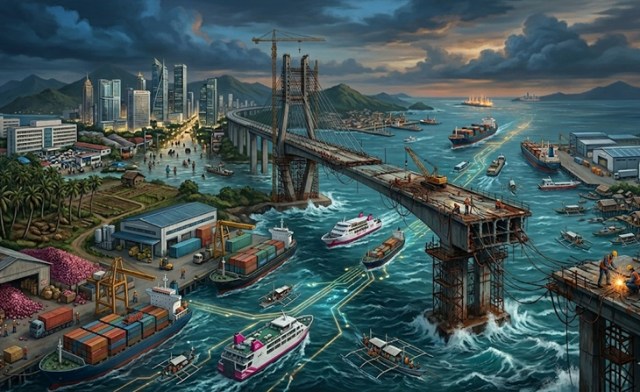
From Megabridges to Medical Tourism, from Coconuts to ASEAN Diplomacy, the Same National Lesson Keeps Returning
By Karl M. Garcia
The Philippines periodically falls in love with visions of transformation.
Sometimes the vision is physical: megabridges crossing seas, reclamation megacities, hyperconnected corridors designed to symbolically “unify” the archipelago through concrete.
Sometimes the vision is economic: becoming a medical tourism hub, a logistics gateway, a durian export powerhouse, a digital economy leader, or the next strategic node in the Indo-Pacific.
Sometimes the vision is geopolitical: regional brotherhood, strategic autonomy, ASEAN centrality, or a uniquely Filipino balancing role between major powers.
Each ambition contains genuine possibility. Each reflects real national potential. And each repeatedly collides with the same structural constraint:
the Philippines often attempts to scale visibility faster than it builds institutional surplus.
This is the hidden thread connecting:
- bridge maximalism,
- medical tourism,
- coconut decline,
- onion crises,
- durian booms,
- infrastructure fragility,
- ASEAN diplomacy,
- healthcare shortages,
- food waste,
- export dependence,
- and the long transition from Maphilindo to ASEAN pragmatism.
At first glance these appear unrelated.
In reality, they are all manifestations of one deeper national struggle:
the transition from an extractive republic to a systems republic.
And the outcome of that transition may determine whether the Philippines becomes resilient in the 21st century—or merely more visibly fragile.
The Archipelago Is Not a Defect to Be Engineered Away
The Philippines often behaves like a continental state trapped inside island geography.
Every sea channel becomes another proposed bridge. Every separation becomes framed as underdevelopment. Every ferry system becomes politically inferior to concrete.
But an archipelago is not a failed landmass.
The country exists because maritime geography, volcanism, tectonics, and coastal circulation produced one. Water is not interrupting the nation.
Water is the organizing logic of the nation.
This matters because development models designed for continental powers do not automatically translate well to maritime states.
Historically, successful maritime civilizations operated through:
- ports,
- shipping,
- coastal exchange,
- distributed nodes,
- navigational reliability,
- redundancy,
- circulation systems.
The sea was not the barrier. It was the highway.
Yet modern Philippine development inherited a continental imagination:
- roads equal progress,
- shipping equals backwardness,
- centralization equals modernization,
- water equals isolation.
This mindset quietly distorts national priorities.
RORO systems become treated as temporary compromises instead of strategic infrastructure. Ports become secondary to expressways. Shipping becomes politically invisible beside megaproject renderings.
But for an archipelago:
maritime capability is not a niche sector. It is foundational state infrastructure.
Infrastructure Is Not Construction—It Is Institutional Endurance
The obsession with “bridge everything” reveals a deeper national temptation: mistaking engineering capability for governance capability.
Modern engineering can build almost anything. The real question is whether the state can sustain what it builds for generations.
A megabridge is not merely a ribbon-cutting event. It is:
- a century-long maintenance obligation,
- a corrosion-management system,
- a disaster-resilience challenge,
- a fiscal commitment,
- an institutional test.
Saltwater corrosion never stops. Marine fatigue never stops. Typhoons never stop.
A state struggling to maintain drainage systems should be cautious about assuming it can indefinitely sustain trillions in exposed marine megastructures.
This does not mean all bridges are irrational.
Some clearly are transformative: short crossings, dense economic corridors, existing commuter bottlenecks, high-throughput urban integration.
But infrastructure realism requires distinguishing:
- strategic necessity, from
- prestige symbolism.
The Philippines does not need to eliminate the sea. It needs to govern circulation across it effectively.
ASEAN’s Real Lesson Is Coordination, Not Imitation
The Philippines should not blindly copy: Indonesia, Thailand, Vietnam, Malaysia, or Singapore.
But it would be dangerous not to study them seriously.
Because the real divide emerging in Southeast Asia is no longer simply:
- rich versus poor,
- democratic versus authoritarian,
- pro-China versus pro-West.
It is:
high-coordination states versus fragmented states.
Singapore mastered circulation: ports, customs, regulatory trust, logistics efficiency.
Thailand built integrated tourism and agricultural ecosystems.
Vietnam synchronized infrastructure, exports, and industrial policy aggressively.
Malaysia developed deeper agricultural value chains and downstream integration.
Indonesia demonstrated both the possibilities and dangers of scale-driven archipelagic ambition.
None are flawless. All contain contradictions.
But each gradually developed stronger national operating systems: institutions coordinating with each other, infrastructure aligned with economic strategy, logistics integrated with industrial policy, long-term planning surviving political cycles.
The Philippines often possesses capable institutions individually. What it lacks is synchronization between them.
That fragmentation appears everywhere.
Coconut Was the First Great Warning
Long before durian or onions, coconut already exposed the problem.
The Philippine coconut industry once anchored national exports and rural livelihoods. But under the Marcos-era levy system, wealth centralized while reinvestment stagnated.
By the time reforms emerged:
- trees were aging,
- productivity had weakened,
- farmers remained poor,
- downstream industrialization lagged,
- value-chain control remained shallow.
The lesson was not merely corruption.
It was:
abundance without governance eventually decays.
That pattern would later repeat across sector after sector.
Durian, Onions, and China Reveal the Same Structural Weakness
Today durian is rapidly becoming Southeast Asia’s newest agricultural gold rush.
Driven heavily by demand from China, the industry is reshaping:
- land use,
- labor allocation,
- logistics systems,
- export incentives,
- pricing structures,
- agricultural priorities.
Thailand dominates not because it merely grows more fruit, but because it governs:
- cold chains,
- phytosanitary standards,
- export certification,
- logistics coordination,
- transport reliability,
- processing ecosystems.
Vietnam scaled rapidly through aggressive synchronization between agriculture and export policy.
Malaysia differentiated itself through premium branding and downstream processing.
The Philippines risks repeating its historical cycle: commodity enthusiasm without systems depth.
And onions perhaps expose the dysfunction most clearly.
A country where onions rot while imports arrive simultaneously is not fundamentally suffering from agricultural scarcity.
It is suffering from coordination collapse.
The problem is not production alone. It is:
- fragmented logistics,
- weak storage systems,
- poor timing,
- inconsistent policy,
- institutional disconnection.
Waste becomes the final accounting of governance failure.
More than 80% of biodegradable municipal waste in the Philippines is food-related. But the invisible waste is larger:
- abandoned harvests,
- spoilage from weak cold chains,
- transport delays,
- failed synchronization between imports and harvest cycles.
Waste is not accidental.
Waste is what abundance looks like when institutions fail.
China Is Not the Problem—Dependency Is
Much Philippine commentary treats China itself as the central danger.
But ASEAN experience suggests something more nuanced.
China does not merely buy products. It reshapes:
- production decisions,
- land allocation,
- labor systems,
- logistics corridors,
- export standards,
- pricing structures.
This creates opportunity. But it also creates dependency risk.
The question is not whether the Philippines should engage China economically.
The real question is:
can the Philippines govern the relationship strategically instead of being governed by it?
Countries that fail to coordinate:
- diversification,
- standards,
- logistics,
- domestic resilience,
- value-chain upgrading
eventually become vulnerable to external demand shocks.
The Philippines has already experienced versions of this with:
- coconuts,
- bananas,
- electronics,
- labor export dependence.
Yet the pattern continues.
Medical Tourism Exposes the Same Illusion
Boo Chanco’s skepticism toward Philippine medical tourism reflects the same structural issue.
Countries successful in medical tourism—such as Thailand, Singapore, and Malaysia—developed healthcare ecosystems with sufficient depth to support both domestic and international demand simultaneously.
The Philippines has not yet achieved that surplus.
The country still struggles with:
- overcrowded hospitals,
- healthcare worker shortages,
- specialist scarcity outside major cities,
- outward migration of nurses,
- uneven healthcare access.
Yet policymakers periodically market the country as a future medical hub.
This risks producing another dual-track economy: world-class healthcare enclaves for foreign patients and elites, strained systems for ordinary Filipinos.
The issue is not whether Filipino healthcare workers are talented. Many are globally respected.
The issue is whether the national healthcare ecosystem possesses sufficient systemic depth beneath the branding.
A country cannot sustainably export healthcare abundance while much of its population still experiences healthcare scarcity.
The Philippines Often Builds Front-End Modernity on Back-End Fragility
This may be the country’s deepest development pattern.
The Philippines repeatedly prioritizes:
- visible projects,
- investor-facing narratives,
- showcase infrastructure,
- luxury districts,
- export booms,
- international branding.
While underinvesting in:
- maintenance systems,
- interoperability,
- backend coordination,
- institutional redundancy,
- logistics reliability,
- governance continuity.
The result is:
front-end modernity, back-end fragility.
World-class malls beside flood collapse. Luxury enclaves beside transport dysfunction. Export booms beside food waste. Premium hospitals beside healthcare shortages. Megaproject renderings beside weak maintenance culture.
The country can appear modern in fragments while remaining structurally brittle underneath.
Archipelagos Punish Weak Coordination More Harshly
This is one of the Philippines’ least understood structural realities.
Continental states can sometimes absorb inefficiency spatially.
Archipelagos cannot.
Every island separation multiplies:
- transport complexity,
- storage requirements,
- infrastructure duplication,
- healthcare access challenges,
- disaster-response difficulty,
- logistics costs.
Which means:
archipelagic states require disproportionately higher coordination capacity.
The Philippines’ geography magnifies governance weakness faster than continental geography does.
This helps explain why:
- food inflation persists,
- logistics remain expensive,
- regional inequality endures,
- healthcare access varies sharply,
- disaster response struggles,
- inter-island integration remains uneven.
The problem is not geography itself.
The problem is attempting to govern archipelagic complexity with fragmented institutional systems.
From Maphilindo to ASEAN: The Long Education of Philippine Pragmatism
Even Philippine diplomacy reflects this evolution.
Maphilindo in the 1960s represented symbolic pan-Malay unity between the Philippines, Indonesia, and Malaysia.
It failed because:
- territorial disputes persisted,
- institutions remained weak,
- national interests diverged,
- Cold War pressures intervened.
The lesson was profound:
symbolic solidarity collapses without operational trust.
Later, BIMP-EAGA succeeded precisely because it abandoned grand civilizational rhetoric and focused instead on:
- shipping,
- trade,
- fisheries,
- tourism,
- practical cross-border cooperation.
Similarly, the transition from Southeast Asia Treaty Organization to Association of Southeast Asian Nations reflected a maturation of regional strategy.
SEATO depended heavily on external Cold War logic.
ASEAN survived because it institutionalized:
- strategic flexibility,
- ambiguity,
- incrementalism,
- coexistence despite disagreement,
- sovereignty management.
Even the Sabah dispute reveals this Philippine instinct toward pragmatic duality: preserve the legal claim symbolically while maintaining broader regional stability with Malaysia.
Over time, the Philippines slowly learned something essential:
in Southeast Asia, survival depends less on absolutism than on adaptive pragmatism.
Climate Change Is Quietly Rewriting the Development Model
Many 20th-century development assumptions were built around:
- cheap energy,
- stable climate systems,
- concentrated megacities,
- predictable globalization,
- uninterrupted supply chains.
Those assumptions are weakening.
The future increasingly rewards:
- redundancy,
- distributed infrastructure,
- decentralized energy systems,
- resilient logistics,
- regional self-sufficiency,
- adaptive governance.
Ironically, this may favor archipelagic systems—if governed properly.
The Philippines’ dispersed geography could become:
- a resilience advantage,
- a disaster-buffer system,
- a polycentric economic network,
- a distributed food-security structure.
But only if circulation between islands becomes reliable.
Otherwise fragmentation becomes vulnerability instead of resilience.
The Real Opposite of Fragility Is Not Strength—It Is Redundancy
For decades, Philippine development often revolved around extraction:
- extract labor,
- extract remittances,
- extract commodities,
- extract tourism revenue,
- extract prestige,
- extract foreign capital.
But the future may increasingly reward stewardship instead.
Stewardship of:
- infrastructure,
- food systems,
- healthcare capacity,
- coastlines,
- maritime geography,
- institutional trust,
- diplomatic relationships,
- environmental resilience.
Archipelagos naturally reward redundancy:
- multiple ports,
- regional healthcare hubs,
- overlapping logistics routes,
- distributed growth centers,
- diversified export markets,
- decentralized energy systems.
The future may therefore favor distributed resilience over hyperconcentrated efficiency.
The Philippines’ Greatest Untapped Resource May Be Coordination Itself
The country does not fundamentally lack:
- talent,
- ambition,
- geography,
- strategic location,
- agricultural potential,
- globally competitive professionals,
- demographic strength.
Its recurring bottleneck is synchronization.
Synchronization between:
- agencies,
- infrastructure systems,
- agriculture and logistics,
- healthcare and labor policy,
- ports and roads,
- diplomacy and economic strategy,
- national plans and local implementation.
The Philippines often thinks in terms of projects.
But successful states are built through systems.
A successful durian industry is not merely more durian trees. It is:
- cold chains,
- standards enforcement,
- logistics coordination,
- processing ecosystems,
- market diversification.
A successful medical tourism industry is not merely luxury hospitals. It is:
- healthcare surplus,
- workforce retention,
- transport reliability,
- accreditation systems,
- institutional trust.
A successful archipelago is not merely more bridges. It is:
- circulation efficiency,
- maritime integration,
- distributed resilience,
- maintenance discipline,
- interoperable systems.
The Future Belongs to States That Govern Circulation
At first glance:
- bridges,
- coconuts,
- onions,
- medical tourism,
- ASEAN diplomacy,
- healthcare,
- durian,
- logistics,
- maritime infrastructure
appear disconnected.
But they are all fundamentally about circulation: the movement of food, goods, people, capital, trust, energy, healthcare, and political stability.
The most successful states in Southeast Asia increasingly govern circulation effectively.
Not perfectly. Not without corruption. Not without contradiction.
But with greater institutional coherence.
And that may ultimately become the defining test not only for the Philippines—but for Southeast Asia itself.
Because in an age of climate instability, geopolitical fragmentation, supply-chain disruption, healthcare strain, and rising infrastructure costs, survival will increasingly belong not to countries that dream the biggest—
but to countries that govern reality the best.


• The Philippines often builds façades to make things pretty — leaving the rotting frame underneath.
• Most Philippine communities outside of Luzon and interior Mindanao have ready ocean/port access — building car industry then leveraging batteries and local steel plate for electric RORO networks is an opportunity.
• Medical tourism is a joke — people might very well possibly die en route due to medical emergency and sitting in a traffic jam, then get challenged with a bribe demand upon arrival. It happens more often than one thinks.
• Like teachers who can’t find a position and leave, this year’s batch of new nurses have just passed their boards yet can’t find jobs. Or the job is actually for a medtech in the West but the Philippine requirements is for BSN (lol). A few families asked me for advice on what to do and I said, apply abroad. At least there’s the new DepEd initiative just unveiled that will hire some 32-33k teachers for new positions so teachers can return. Beef up and build new public hospitals.