Philippine Independence and the Long Struggle for Democracy
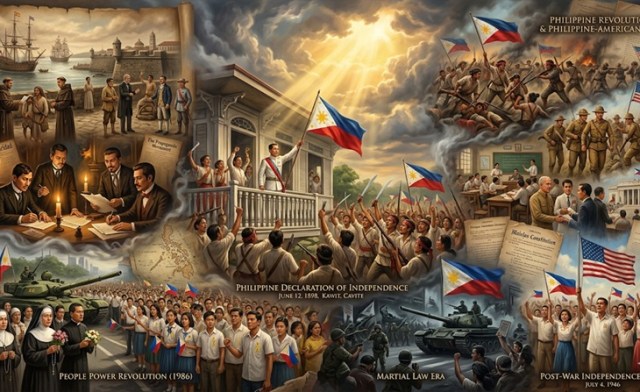
By Karl Garcia
Filipinos achieved a historic milestone with the Philippine Declaration of Independence in 1898. Though that independence was short-lived, it marked a decisive assertion of Filipino agency and national identity—a moment when a people long subjected to foreign rule claimed the right to govern themselves. Even if fleeting, this achievement set a precedent: Filipinos could envision and demand self-determination.
Colonial Foundations: Spain and the Birth of the Elite State
The Philippines entered global history in 1565, when Spanish colonization formally began under Miguel López de Legazpi. For over three centuries, the archipelago was governed as a distant outpost of the Spanish Empire.
Spanish rule left deep marks:
- Governance was based on personal loyalty, patronage, and hierarchical control rather than institutional strength or national ideals.
- By the late 19th century, the educated class—the ilustrados—emerged, advocating for reforms and inspiring a national consciousness. Figures like José Rizal, Marcelo H. del Pilar, and Graciano López Jaena symbolized this awakening.
The revolution led by Emilio Aguinaldo culminated in the Philippine Declaration of Independence on June 12, 1898. Though the subsequent American occupation interrupted this newfound sovereignty, the act of independence itself demonstrated that Filipinos were capable of self-rule—a powerful and enduring legacy.
American Rule: Democracy Without Full Sovereignty
After Spain ceded the Philippines to the United States, the Philippine–American War broke out, and the archipelago came under American administration. The Americans introduced elections, legislatures, and public education, but within a colonial framework. Political participation largely favored the landowning elite.
While American rule democratized elite power, it did not dismantle the structures of inequality. Landlords and provincial bosses acted as intermediaries between the state and the masses, entrenching systems of patronage and political dynasties that persist to this day. Still, even under American rule, the memory of the 1898 independence remained a touchstone of national aspiration.
Full Independence and the Promise of Democracy
The Philippines finally gained full independence in 1946, emerging as one of Asia’s first postwar democracies. This milestone reaffirmed a fundamental truth: sovereignty matters, even if the road to stable governance is long and challenging. Independence, no matter how hard-won or brief in earlier moments, was the foundation upon which modern Filipino democracy was built.
However, the post-independence era revealed enduring challenges. Colonial-era elites continued to dominate politics and the economy, creating a system where political power often translated into personal enrichment rather than broad-based development. The struggle for a truly inclusive democracy was far from over.
Martial Law: Authoritarian Modernization
The tensions within the system culminated in Ferdinand Marcos’ declaration of Martial Law. Marcos claimed the need to modernize and stabilize the nation, but authoritarian rule concentrated wealth and power among a few, curtailed freedoms, and disrupted democratic institutions.
Yet even this period could not erase the lessons of independence. Public mobilization eventually restored democratic governance during the People Power Revolution, reaffirming that sovereignty and citizen action remain central to national life.
Post-1986 Democracy: Freedom Without Complete Reform
The 1987 Constitution reinstated democratic checks, civil liberties, and local autonomy. But political dynasties and patronage networks persisted, often adapting to the new system rather than being dismantled. While challenges remain, the country continues to build on the legacy of independence—struggling, yes, but never surrendering the principle that governance belongs to Filipinos themselves.
The Enduring Importance of Independence
The Philippine experience demonstrates that independence is not merely a historical footnote—it is a statement of possibility. Even when sovereignty was interrupted or constrained, each assertion of independence shaped national consciousness and kept the vision of self-rule alive. Short-lived or partial independence does not diminish its significance; it strengthens the resolve to pursue a democracy that reflects Filipino aspirations.
Independence is both a right and a responsibility. The lessons of the past century show that democracy is not an event but a process: building institutions, fostering civic engagement, and ensuring that power serves the people. Every step, even the smallest, toward sovereignty matters.
The Philippines’ story is one of resilience: a nation that declared independence against great odds, survived foreign domination, endured authoritarianism, and continues to strive for a democracy that truly belongs to its people. That journey, beginning in 1898, underscores a simple truth: independence—no matter how brief—can never be forgotten, for it is the foundation upon which the nation stands.


“The Philippines’ story is one of resilience: …” – Karl G.
On the last essay (Magdalo and Magdiwang Factions), JoeAm commented “The people broadly don’t grasp the concept that it takes discipline, not resilience, to succeed.”
For me best of both worlds is doable.
Resilience may also mean succeeding after failing or recovery after a lapse, so discipline maybe the reason for resillience in those cases.
As I reflect further, resiliency is important if you are poor and powerless. Discipline requires the luxury of freedom of choice, and awareness of the options available, and of one’s power to persuade others of “a better path”. Jesus was disciplined I figure. Job was resilient. Most Filipinos choose to be Job when they’d be better off preaching a disciplined path.
Many thanks for that insight Joe.
No one is ever fully removed of all agency. The resilience analogy can quickly become misused (bahala na), excusing passivity even in areas where one still has agency. That leads to situations where when effort is made, it often suffers from under-preparation; the resultant failure then becomes finality rather than a baseline towards a corrective (pwede na).
I’ll put it another way:
Filipinos can be deeply aspirational — their Austronesian forebears, after all, conquered the maritime world in ocean-going canoes. The risk was huge, but it was backed by knowledge, experience, and practice.
Somewhere along the way, those peoples who became Filipinos retained the aspiration but developed a tendency to tunnel-vision on end-results at the expense of the preparatory steps that make success likely. When nationalist myth-making is stripped away and sources are reconstructed carefully — ironically by “foreign” historians like Scott, Junker, Anderson, McCoy — it becomes clear that even by the time of Spanish arrival, the more notable Philippine polities were already governed by Bruneian second- and third-son chieftains, and their societies had lost much of the capacity for the longer-term planning and execution that had once powered the maritime reach of the ancestors. Even the vaunted “trade networks” boasted by nationalist historians were mostly, in actuality, Philippine nodes being visited by foreign traders on much more capable ocean-going vessels — the Philippine-node was the end of the spoke, the periphery, easy to overlook when the node’s resources not needed.
That said, obsessing over regression is its own trap — one Philippine academia which has heavy nationalist influence is wont to do. Acknowledgment (for better or for worse) is enough to establish a baseline; what matters is moving forward, not being trapped by the past, or worse, imprisoned by an imaginary one.
Nor is it true that freedom of choice and awareness of options can be so thoroughly stripped away as to leave one fully helpless. There always exists a margin of agency, however narrow.
I’ll note here that the pre-Spanish alipin (or uripon) — often translated pre-Scott as “slaves” but better understood as “bondsmen” — were not primarily war captives. Most entered debt bondage voluntarily, selling themselves or their families to repay utang (physical and relational obligation). So even within pre-Spanish bondage, entry was a choice in most cases. Agency persisted for those who chose bondage even where the options narrowed severely.
So what is to be done? One must move within the available margin and push against the boundaries — something Filipinos do, in fact, quite well, sometimes to my personal annoyance. One also seeks teachers who have knowledge, experience, and practice, to expand the boundaries of what is possible.
I don’t agree with the framing — “Jesus was disciplined, Job was resilient” — since that framing perpetuates the problem when Filipinos have already shown a preference for surface-level resilience (i.e. bahala na); using that analogy doesn’t do much to move in a positive direction. The more useful reading of Job is not resilience but integrity: Job refused to lie to himself or to God, even as he accepted what he believed was divine punishment. His endurance was not passive accommodation but principled refusal to misrepresent his own condition.
What is discipline though? Discipline is self-control, consistency, and steadfastness in service of one’s purpose — and it requires integrity. Externally forced compliance, however consistently coerced, produces only the appearance of discipline. Lasting self-discipline is inseparable from internal character and honesty — which is integrity.
One should not mistake external condition (which is involuntary) for internal character (which is the well of agency). Neither Job nor Jesus were “free” in the sense of the “Jesus was disciplined, Job was resilient” analogy — Job suffered personal devastation; Jesus lived under Roman occupation and heavy religious authority. What allowed both Jesus and Job to succeed in their commitment to their purpose was not their access to freedom but rather the depth of their integrity: the consistency between conviction, word, and action within the circumstance they found themselves in.
Resilience for the powerless, discipline for those with the luxury of choice is a false binary that if accepted assigns virtue by class and more positive alternative paths are foreclosed. Rather the question should be whether one is willing to act from integrity within whatever margin of agency one has however small. Integrity, unlike freedom of choice, cannot be granted by circumstance or stripped away by it — integrity can only abandoned from within.
What the seafaring forebears possessed — and what was gradually lost by the time the Spanish arrived on the shores of Cebu — was not aspiration alone. The aspiration was backed by integrity toward purpose: knowledge, experience, and practice deliberately built before the voyage ever began. Recovering that is not a question of class, privilege, or how much freedom one has been allowed but rather is a question of character. Well they say character is something that is built, not given or inherited.
Well, you are at doctoral level, I am at high school, and most of the rest of the world deals with gossip, empowered by social media these days. The matter of choice, and awareness that one has choices, whether rich or poor, is one that Filipinos must figure out. The day worker can build a palace if the hollowblocks are laid right. Or a very interesting structure if the brick laying follows no discernible plan, but proceeds nonetheless. Lotta bricklaying going on.
Yeah we are in agreement on people needing discipline, not resilience to succeed. I believe that most human concepts have dual natures, a good face and a bad face. Here I am attempting to express discipline’s good face that opens new opportunities by voluntary discipline rather than a discipline that is coerced and resented.
Excellent post, Joey. I note the mention of “agency” and “aspiration” and even “bahala na” w/o the mention of the different economic classes A-E. You say that all have agency, all have aspiration.
I like that.
Obviously agency and aspiration are a matter degree, and largely influenced by circumstances often outside of one’s control. But then you bring in the importance of Integrity.
I like that too!
I hope your post generates some discussion at TSOH.
Not much in our world is binary, agency or no agency, aspiration or no aspiration, integrity or no integrity, character or no character. Filipinos are everywhere on the multidimensional chess board, and the reasons are even more complex. The marshaling of a peoples’s energy toward self-enrichment requires awareness on the part of the people as to their own powers, and a leadership that is interested in building a nation instead of fancy houses.
“Not much in our world is binary, agency or no agency, aspiration or no aspiration, integrity or no integrity, character or no character.” – JoeAm
I agree, and that is what I like about Joey’s essay. As I read it, he agrees with your premise about not much in our world being binary. Then he makes suggestions that empower the individual within the non-binary limitations of his situation.
I did not include the MORES classes in my reply because the socioeconomic status changes the degree of room by which a Filipino has to operate within, which is how much impact the magnitude of results from the applied agency; socioeconomic status does not change agency itself. Everyone has agency. It is a matter of whether the agency is in a realized or unrealized state.
Of course those who have greater realized agency have greater responsibility. In the words of Peter Parker:
But the proverb appears in other places, such as in the Sword of Damocles legend, medieval French ideas of noblesse oblige, or Jesus’ Parable of the Faithful Servant (Luke 12:48):
https://bible.usccb.org/bible/luke/12?48
Basically he who demands social and status privilege is morally required to fulfill their social duties. For that reason, I am much harsher in my opinion on Philippine elites than I am of the lower classes. If the elites cooperate, progress can be had much faster. Since Philippine elites don’t really cooperate, personally I think that effort should be mad at the lower strata of society to develop new leaders who may rise up from there.
Thanks Joey, even I am “trying hard” to be balanced in my view like in that resilence and discpline as to why not both?
But we live in a prism, not everything is black and white.
As to the elites and masa.
I too had my share of criticism to both sides but of course, I listen or read all your views. Some asked me once why I do this, for one I am surroubded by highly intelligent people and gusto ko mahawa sa kanila. ( I want to be infected by their intellegence).
LOL, as if IQ were covid. Good morning, Karl.
Good Morning Joe. Hehehe
**Thanks Joey, even I am “trying hard” to be balanced in my view like in that resilience and discipline as to why not both?** – Karl
Of course both…I believe is that the point is each is a tool for different purposes.
When I was growing up, my Dad, a German, used to get peeved when our “Kasambahay” would use a knife to open a can of Skyflakes crackers. You know how Germans are w/ regard to using the proper tool. But heck, I must confess I did use a knife too when it was easier to find. Seemed to work fine when it came to Skyflakes cracker cans. Of course if done too often, it tended to damage the knife.
the German word for misusing a tool is “Zweckentfremdung” – literally “purpose alienation”.
Haha I recall how my former yaya who also migrated to Germany found the variety of cleaning fluids here crazy initially, saying “sa Pilipinas Ajax lang tama na”.
Also, I guess the German default is more on systems/order and discipline so resilience is less needed on a daily basis. Except in the train system that sucks by now.
The old folks’ stories about the end of WW2 when people had to be resilient are horror stories and the Wiederaufbau (rebuilding) was when that hell passed.
Meanwhile the Filipino default is probably resilience as systems mostly don’t work, the jeepney being a provisional solution that became almost permanent.
Intramuros only was properly rebuilt from the 1990s onwards. An originally well-planned Manila became what we know today, even as it has modernized heavily now.
Almost all the provisional buildings Munich got in bombed out lots after WW2 are now replaced, though one which is a beloved grilled chicken spot was allowed to stay.
OK, my IT career basically was: at the start, deaing with messes – in the middle, fixing messes – now it is making sure messes are avoided as much as possible..
so I guess I have gone from resilience to discipline in over 3 decades. The default of nature of course is entropy. No avoiding that.
“OK, my IT career basically was: at the start, deaing with messes – in the middle, fixing messes – now it is making sure messes are avoided as much as possible..
so I guess I have gone from resilience to discipline in over 3 decades. ” – Irineo
Well done!
“Meanwhile the Filipino default is probably resilience as systems mostly don’t work…” – Irineo
Yes, that was my comment in the early years of my arrival here in the US – “Over here, things generally work!”
When you go to a pay phone, it generally works. Vending machines generally work. Traffic lights work. Countless examples.
In the Philippines, you better have a Plan B & C, because in all probability, your Plan A won’t work.
Eyjax in Pinas, Ayax elsewhere. Konting kuskos, ayos. Superwheel pala yun.
I damage the spoon.
I have an acquaintance who used a knife to open those Skyflakes tins (which are thinner, though nowadays plastic Skyflakes buckets are common). She also used a knife to open delata. Not at all unusual and still a default way to open aluminum cans in the Philippines. I used to scold her often that she should buy a can opener because one day the knife might break or slip and cause injury. Well one day the knife did slip and the injury tore some tendons. Not being able to afford medical services she is now partially lame in the hand. Seems like a small investment in a can opener could’ve avoided that.
Back when I used to visit often (once a month or more) from Japan / South Korea I kept some of my stuff in Cebu. I enjoy cooking so I had my (expensive) Japanese and German master crafted knives. I came back once to see that someone had borrowed the knives to hack at bones, mango tree branches, etc. I nearly had an aneurism… lol
Sorry to hear about your friend, I got brachial plexus palsy, due to a vehicular accident, my left hand also is a little lame
Good article, Karl, but I would say it is a bit of a romanticized version of our country’s journey to nationhood and independence. It heavily mirrors the way history was taught in Philippine schools and colleges back in my day—and probably how it is still taught today.
The conventional narrative is that when we fought for and declared our independence on June 12, 1898, we were proudly announcing that we had come of age as a nation, fully capable of handling our own affairs.
But from his own writings, we know José Rizal didn’t see it that way. He believed we weren’t ready. I believe Trinidad H. Pardo de Tavera agreed with him, and ultimately, the United States arrived at the exact same conclusion. The difference was that the US was willing to treat Filipinos like adults anyway—albeit in a guarded fashion at first, and then with fewer restrictions as time went by.
As a result, we became partners with the United States during that period of colonial tutelage. Following our defeat in the Philippine-American War, the US did not simply impose a system on us from above. Instead, they built it in deep consultation with us—specifically with the principalia, the educated elite class. Keep in mind, as your article points out, it was this very same class that had demanded independence from Spain and led the revolution in the first place.
By the mid-1920s, however, the US realized the arrangement wasn’t working. It was recommended that Washington backtrack on the governance concessions it had granted to Philippine leadership. This correction would have materialized with the appointment of Nicholas Roosevelt as Governor-General. Yet, when Filipinos fiercely rejected him, the US obliged and withdrew the appointment. The structural changes were never made. In doing this, the US was treating us like adults—even if, deep down, they believed we still weren’t quite there.
Our history books tend to gloss over the fact that we were active partners during this American period. It was not a simple master-slave relationship. Whatever systems were set up—whether cultural, political, or economic—were forged in consultation with Filipinos. It was done through the elite class, of course, but it carried the tacit permission of the rest of the nation.
I appreciate your comments. As for your last sentence, until now that is the pattern, and symptoms that persist.
as I already commented in the article on the Malolos Constitution, in 1898 it was mainly Tagalogs (even if Magdalo vs Magdiwang was provincial versus urban Tagalogs already) and Kapampangans (the 8 stars of the flag, even as the Macabebe would deliver Aguinaldo to the Americans later) on board, maybe some Ilokanos (come to think of it now, maybe Aguinaldo was afraid of how much power Heneral Luna might have had once the retreat to the Cordilleras brought the Republic to the latter’s home territory) but the Visayans had separate Republics declared while Bikol and Samar were only on board due to Vicente Lukban – and the Sulu Sultanate totally declined.
Now WHAT IF the USA had not colonized the Philippines (and the other navies in Manila Bay in 1898 especially the English and the Germans who had business interests in Manila) what would have happened? Very likely Visayans going their own way per island, then warlordism in Luzon.
Bikolanos on one hand had Simeon Ola who resisted the USA for longer, but the abaca planters were probably happy that the US Navy had a ship in Legazpi City to make sure the shipments of that raw material for marine cordage were secured so who knows?
as we also know the Moro Wars took way longer than the Philippine-American War and what happened after it including Sakay and his “Tagalog Republic”. Mindanao was only formally made part of the Insular Government of the Philippines in May 1920.
Also, celebrating Independence Day on June 12 was probably something Macapagal declared to gain some glory from Aguinaldo who was just barely still alive during his term. Before that it was celebrated on July 4, strictly speaking the Republic will soon be octogenarian.
P.S. of course the symbols of Aguinaldo’s Republic, the flag and the national anthem, were what persisted as a reminder of the aspiration of Independence.
Thanks, Irineo. I really enjoyed the elements of your post regarding the independence struggle of our nation. I used ChatGPT to understand it better and its input was a big help to me.
In the Philippine struggle, I saw division (regionalism, etc.), mediocrity in meeting tough challenges, and weak patriotism. Chat reminded me that those were typical weaknesses of developing nations and gave me the examples of Italy, Germany, and the United States.
Here is an excerpt from my conversation w/ Chat:
>>The Significance of [Irineo’s] Final Point
I think the most important sentence in the entire post is actually the last one:
That suggests he sees the First Philippine Republic less as a fully realized nation-state and more as a founding myth or national aspiration.
In that interpretation, June 12 is not important because Aguinaldo successfully united all Filipinos in 1898. It is important because it marks the moment when a political community called “the Filipino nation” publicly claimed sovereignty, even if the nation itself was still being formed.
Viewed that way, the revolution’s significance lies not in what it accomplished immediately, but in the national project it launched.
So the gap between your interpretation and [Irineo’s] may be this:
Those perspectives overlap, but they lead to very different conclusions about what 1898 means.<<
https://www.facebook.com/manolo.quezon/posts/pfbid0cDMk196ueKqW8y8SVJjJpCvciAm1TmtftcP3my8DGsa2hCgijXPoRqfwfLURmhmZl this Facebook post by MLQ3 is quite enlightening:
—————————-start of quote—————————
The birth of the Philippines in 1896 was one thing; consolidating the territory was another matter. While most Filipinos would attribute the unification of the Philippines to the 1896 Revolution, in reality it was a series of local revolts against the Spanish, and later against the Americans. It remains debatable as to whether these revolts either identified wholly with Gen. Emilio Aguinaldo’s Malolos Republic, or whether, had they all succeeded, whether would unite under one contiguous territory. Already when the first American troops landed in Negros Island, Negrenses were threatening to create their own republic…
By the end of the first decade [of the 20th Century], “regular provinces” comprised half of the Philippines. These provinces had elected and appointive Filipino officials, many of whom owed their positions to Quezon, Osmeña and the Nacionalistas. Combining their local political experiences learned from the last years of Spanish rule, with the “political education” they were getting from the Americans, the Filipinos proved within a short period of time that they had the ability to be equally adept at governing the colony. In its first year at work, the Philippine Assembly had already shown a marked adeptness in introducing additional provisions or new amendments to existing colonial laws, and in negotiating with the Philippine Commission and the Governor General over matters of policy formulation, funding and government personnel changes. Quezon and Osmeña were at the top of all these processes. They were fast becoming astute leaders of the political party they helped build, of the Assembly that they presided over, and of the colonial regime they co-governed with the Americans. If Rizal was credited for having conceived of the “Filipino,” and if Bonifacio and Aguinaldo were the leaders who gave this imagination a reality with the Revolution, to Quezon and Osmeña must be given the distinction of helping construct the political and administrative structure that would be associated with the term “Filipino.” The Americans may have created the colonial state, but it was these two leaders who gave flesh to it and putting the foundations that the future Republic would stand on. –Patricio Abinales, Re-constructing Colonial Philippines: 1900-1910
1. Provinces under martial law Aug. 30 & Oct. 25, 1896
2. The extent of the Revolution as of 1897
3. Resumption of Revolution, May-June 1898.
4. August 1, 1898: Ratification of June 12, 1898 proclamation of independence by elected/appointed representatives
5 The Visayas in the Malolos Government
6. Malolos Congress, comp. of elected/appointed delegates (incl. Visayas, in stripes), on Sep. 29, 1898, ratified June 12, 1898 Proc. of Indep.
———————end of quote—————–
the main quibble I have with the 6th map is that most delegates outside what is now called the “Lingayen-Lucena corridor” were appointed not local people.
of course Manolo Quezon is somewhat partial to his grandfather as can be expected, even if he is a pro in terms of being clean with facts.
I would add though that the Philippine Assembly in 1907 was elected by the local elites as there still was a property requirement.
By 1935 the Commonwealth had suffrage for literate men (still less than half of all back then), and a few years later that was extended to women.
By 1973 the literacy requirement was dropped, CV you will for sure remember how the illiterate could put thumbprints on ballots I think..
Very interesting, Irineo, and thanks. Nice to look at old maps with old names on them.
“By 1973 the literacy requirement was dropped, CV you will for sure remember how the illiterate could put thumbprints on ballots I think.” – Irineo
Yes, I vaguely recall that. Pres. Marcos, Sr. also reduced the voting age to 18 in 1973, but by then I was 21. I remember voting in at least the first election under Martial Law. I felt it was a sham election, but wasn’t really that involved. I was too busy trying to figure college life out and politics wasn’t high on my priorities.
**If Rizal was credited for having conceived of the “Filipino,” and if Bonifacio and Aguinaldo were the leaders who gave this imagination a reality with the Revolution, to Quezon and Osmeña must be given the distinction of helping construct the political and administrative structure that would be associated with the term “Filipino.” The Americans may have created the colonial state, but it was these two leaders who gave flesh to it and putting the foundations that the future Republic would stand on. –Patricio Abinales, Re-constructing Colonial Philippines: 1900-1910**
An inspiring history, indeed. Too bad our leadership could not follow through and be equal to the challenges of nation building as envisioned by our heroes. C’est le vie…sadyang ganyan lang.
well, the nation-building probably continued on the ground while the leadership kept living in the mansion of state Quezon and Osmena built, allowing that “mansion” to grow more and more dilapidated like many old buildings in Manila. Having one state meant people learned some degree of English and some degree of Tagalog. People like the old woman I tried to ask for directions from in Cebu in 1975 who spoke neither English nor Tagalog are probably rarer nowadays.
Contact via migration to Manila especially after the war brought a lot of people from different regions together, including the parents of my cousins born in Quezon City in the mid-1950s to late 1960s who were a Bikolano and an Ilokana. That was in fact not even a rare mix.
The diaspora brought even more contact between ethnic groups even as there was often friction way up into the 1990s.
Now the attempt by Rodrigo Duterte to somehow push for a Mindanao secession in early 2024 didn’t really have a chance. Also, the country has been operating under the same Constitution for nearly 40 years now. By comparison, the first constitution lasted from 1935-1973 = 38 years.
So the Philippines exists even as it tries to figure out what it is and where to go, it just is that way.
Just a thought.
Appointment of non-locals prevents what we call dynasts or nepotism.
But it seems that it relocated and spread dynasts
“So the Philippines exists even as it tries to figure out what it is and where to go, it just is that way.” – Irineo
Kayâ nga Land of happy fools? 🙂