Magdalo vs. Magdiwang: The Factional Tragedy of the Philippine Revolution
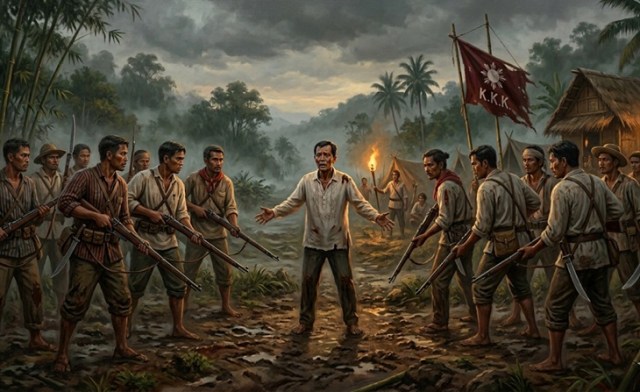
By Karl Garcia
The Philippine Revolution of 1896–1898 is celebrated as a defining moment of national courage, a period when ordinary Filipinos rose against a centuries-old colonial power. Yet within this heroic narrative lies one of the most tragic and instructive episodes in Philippine history: the factional rift between the Magdalo and Magdiwang in Cavite. This schism, often overshadowed by the larger story of independence, demonstrates how internal divisions can erode even the noblest cause. At the center of this tragedy were Andrés Bonifacio, the impassioned Supremo of the Katipunan, and Antonio Luna, a military strategist whose later life would echo the same lessons of unity, discipline, and betrayal.
I. The Emergence of Factions in Cavite
Cavite province was the revolution’s crucible. Its rugged terrain, coastal access, and network of towns made it a strategic stronghold. By late 1896, revolutionary forces in Cavite had achieved notable victories against Spanish troops, yet the province was far from united.
Two major factions emerged:
- The Magdalo, led by Emilio Aguinaldo, was concentrated in Kawit, Imus, and surrounding towns. Magdalo leaders advocated a more structured command, with clear authority and centralized coordination. They were strategic and disciplined, emphasizing practical governance alongside military action.
- The Magdiwang, aligned with Andrés Bonifacio and the Katipunan, held sway in Noveleta, Maragondon, and other southern towns. Their ideology emphasized collective decision-making, egalitarian principles, and loyalty to the Katipunan’s revolutionary vision.
Though ostensibly united against Spanish oppression, these factions reflected different philosophies: one prioritizing military efficiency and hierarchy, the other revolutionary idealism and grassroots empowerment. Geography, social networks, and local loyalties amplified these differences, creating a fault line that would erupt tragically.
II. Bonifacio: The Supremo’s Dilemma
Andrés Bonifacio emerged from the streets of Tondo, Manila, with no aristocratic pedigree but with extraordinary leadership skills. He founded the Katipunan, mobilizing Filipinos across social classes to rise against Spanish rule. Bonifacio’s charisma, courage, and vision made him the symbol of Filipino resistance, yet his authority was rooted in moral and spiritual leadership rather than formal military or political power.
By 1897, Bonifacio faced the harsh realities of governance and strategy. The Tejeros Convention in March 1897 exposed the limits of his influence. In a bid to unify Cavite, leaders of the Magdalo faction proposed establishing a revolutionary government with formal elections. Bonifacio’s position as Katipunan Supremo was challenged. Though he presided over the convention, he was defeated in the election for president by Aguinaldo, with the vote widely perceived as influenced by social bias and factional maneuvering.
Bonifacio’s attempt to assert authority following the convention was met with opposition. Letters and proclamations show a man torn between loyalty to the revolutionary cause and a profound sense of personal injustice. Ultimately, the political machinations of the Magdalo faction led to Bonifacio’s arrest, trial, and execution in May 1897—a moment that symbolizes the devastating human cost of factionalism.
III. Military Campaigns and Strategic Tensions
Cavite’s revolutionary success owed much to guerrilla tactics and local intelligence. Bonifacio’s forces, initially decentralized, relied on intimate knowledge of terrain and community networks. Magdalo units, however, implemented more formal military strategies, including fortification, regimented training, and coordinated offensives.
The clash of strategies became more pronounced after victories in Imus, Binakayan, and Bacoor. Magdiwang forces often resisted centralized orders, preferring localized action, while Magdalo forces insisted on coordinated campaigns. The resulting tension undermined efficiency and created distrust among commanders. Historian Teodoro Agoncillo notes that the lack of unified command contributed directly to operational missteps in subsequent battles, leaving revolutionary forces vulnerable despite their initial successes.
IV. Antonio Luna: The Mirror of Factional Tragedy
The factionalism that doomed Bonifacio foreshadowed the challenges Antonio Luna would confront during the Philippine-American War. Luna, trained in European military academies, returned to the Philippines with a vision of disciplined, strategic military organization. His insistence on merit-based command, strict discipline, and centralized authority put him at odds with political leaders and generals who prioritized personal loyalty over competence.
Like Bonifacio, Luna faced a dual struggle: fighting an external enemy while contending with internal disunity. His assassination in 1899, orchestrated by officers loyal to political factions rather than military expertise, paralleled Bonifacio’s fate, illustrating a recurring pattern in Philippine revolutionary history: the lethal consequences of internal discord.
V. The Human Cost of Division
The Magdalo-Magdiwang schism and the fate of Bonifacio reveal that revolution is not only a battle against foreign powers but also a test of internal cohesion. When personal ambition, social bias, and ideological differences take precedence over collective purpose, even the most righteous struggle is imperiled.
Bonifacio’s execution deprived the revolution of a visionary leader; Luna’s death weakened the nascent Philippine defense. In both cases, internal division nullified potential advantages and magnified external threats. Letters and memoirs from surviving revolutionary leaders describe lingering resentment, guilt, and recognition of these tragedies, demonstrating that the consequences were not only immediate but moral and historical.
VI. Lessons in Leadership and Unity
The tragedies of Bonifacio and Luna offer enduring lessons:
- Unity is a strategic imperative. Victory is hollow if internal discord undermines command and cohesion.
- Merit must guide leadership. Loyalty and social status cannot substitute for competence in moments of national crisis.
- Vision requires pragmatism. Ideals must be paired with actionable strategy; morality alone cannot ensure survival.
- Internal betrayal is often deadlier than external opposition. Leaders must navigate human weaknesses as much as enemy forces.
The Philippine Revolution succeeded despite these tragedies, but the human cost serves as a cautionary tale: a nation divided against itself risks undermining its freedom before the enemy can.
VII. Conclusion: Remembering the Tragedy
The Magdalo-Magdiwang conflict, Bonifacio’s death, and Luna’s assassination are not mere footnotes—they are central to understanding the fragility of revolutionary movements. They show that freedom is not simply a product of courage but also of wisdom, discipline, and unity.
For contemporary leaders and citizens, the lesson is stark: the survival of a nation depends as much on internal cohesion as on the strength of arms. Bonifacio and Luna exemplify courage, vision, and sacrifice. Their lives remind us that the true struggle for independence is not only against external oppressors but also against factionalism, ego, and shortsightedness.
As the Philippines reflects on its revolutionary past, the Magdalo-Magdiwang tragedy underscores a timeless truth: national freedom requires more than valor—it demands unity in purpose, clarity in leadership, and courage in the face of internal and external challenges alike.


thanks for this important article, to which I have two notes:
1) total unity and agreement in everything are impossible, that is why mechanisms like democracy exist – but good democracy also has mechanisms to prevent a tyranny of the majority.
2) in military command and to some extent in governance, some degree of what the modern corporate world calls “alignment” is needed – but sometimes a certain degree of on the ground flexibility makes sense. Aligning the brillant agility of the Magdiwang with the strong command and control of the Magdalo was something the Philippine revolution did not manage and if we are honest Philippine governance to this day still fails to balance those aspects.
And yes, how you describe the two factions shows how hard simplistic good and evil teleserye narratives are. It is just as complex as with Heneral Luna.
In any case finding sensible ways of working together is still often a struggle in PH today.
Many thanks for the valuable inputs.
that is why today, we are taught teamwork at work. not everyone can work with a team and find it very difficult to fit in, and so they were given marching order, or discharged, whether honorably or dishonorably, does not really matter. a discharge is a discharge. look at ex congressman kiko bazaga, who was expelled from congress. he was given second chances one too many times and squandered them all! instead of working with fellow congressmen, he often put them on edge by accusing them of stealing money from the kaban ng bayan at every chance he got. his vlogs are also very critical and belittling of his fellow congressmen and women. when barzaga could not come up with evidence of the wrongdoings he accused the congressmen and women of, the house has enough of him and close the door on him, for good. though he can still work within the public sector as he has not been banned from public service, may god have mercy on him.
these days, applicants for jobs for armed personnel are given not only physical but also specific psyche test to check their aptitude, mental fitness, acuity and ability to fit in.
usually preference are given to candidate who play sports, not lone wolves. anyone who plays sport are likely to be already disciplined, mentally and physically, and can take advice or command from coaches without feeling slighted, embarrassed. and they rarely close the door for improvement.
I think two things Philippine academia does not acknowledge enough, but both contribute to internal factionalism that dooms organization, is:
1.) The tendency towards the predecessor or “becoming main character” — “becoming datu” (aka “I want to be the boss, but all my rivals want to be the boss too”).
2.) A romanticization of highly energized, almost pseudo-religious, movements that experience rapid growth before dramatic collapse — including the Katipunan.
predecessor of*
True!
academia always taught student to be individuals, to think for themselves, to be competitive, to attain the highest standard and that means, above all others! there can only be one summa cum laude.
what summa cum laudes have to realize (if they have not already) that life happens after graduation, that they have to transition from classroom to society and be among mortals who have as much right as they do. that life is never equal, others have more rights and privileges, have more money, more material possessions, successful, etc. finding themselves will be true test.
Filipinos should probably be glad the education system there is not organized by First Rank, Second Rank, and Third Rank system (jinshi jidi) where everyone below basically wasted their effort as it is in East Asia (including Vietnam). Yes, the Top 3 Ranking is technically not used anymore by any of the countries that formally used the system but Top 3 Ranking is still used informally. My dad was a First Rank student back in the day; imagine the level of discouragement there where his son only “achieved salutatorian” (in truth, I hardly put effort into high school and university). Well the top rankers work under me now, so I had the last laugh.
In any case my belief is that unless a person is studying a STEM course, it’s much more important to have a broad breadth of knowledge and experience building during college. Most people are not in specialist roles in life so it is more useful to know a little bit of everything and how to utilize the practical application of knowledge. Well okay, since the tech-fascists are trying to take over the world, perhaps STEM students should study mandatory humanities classes first before moving onto STEM.
Modern Relation: I’ve been following the Digital Media Anti-False Information Act (H.B. No. 9465) debate with interest from the standpoint of a cybersecurity practitioner, though with this Senate who knows if the bill will pass and get signed into law.
Inquirer — A measure to fight disinformation:
The important provisions of the bill provided countermeasures against the following:
As usual Makabayan and associates have raised civil liberties concerns such as freedom of speech and abuse of the proposed law in order to go after opponents (e.g. cyberlibel law). Still I think this legislation is quite important since the money networks fueling these online networks quite plausibly come from a foreign adversary (i.e. China; see Arroyo-Duterte nexus). Guardrails should be emplaced ot assuage these concerns.
A while back in response to Irineo sharing two old comments by “Mike” I did an analysis lining what the commenter shared back in April 2017 with events are they are now known. The Philippines is indeed Patient Zero (along with Hungary until recently a Russian-funded incubator of illiberism ) where disinformation strategies were first developed by Russia (and later China) to attack the existent liberal world order in order to install authoritarian networks.
When one thinks of “warfare” one automatically thinks of tanks roaring across a flat plain or soldiers jumping off of beaches. One perhaps even thinks about nuclear mushroom clouds. With the Russian-Ukraine War, it has been clear that the past of man-heavy assaults is obsolete in a world of modern warfare. Drones play a prominent, evident role in the physical battlefield. What isn’t talked about as much is the increased role of psychological warfare, of which memetic warfare in cyberspace in a battle for minds looms just outside of the cultural and governmental influence of friendly nations.
The analysis looks best on a tablet or monitor. Make sure to toggle “Expand All.”
The Philippine Petri Dish
Loyalty to persons versus loyalty to principles, like merit as the basis of appointments. It is relentless, with personalities always pointing the nation to failure. Well, greed seems to hold the scale of justice, and popularity or votes, not that blindfolded lady. Why else would De Lima be jailed 7 years and Imelda none. Why else would the Senate be a clown show. It won’t change. The people broadly don’t grasp the concept that it takes discipline, not resilience, to succeed.
Yes discipline not resilience. I think the next step should not for us Pinoys to self deprecate and flagellate that we pinoys really have no discipline. Recent speculations of hazing even in sports is also not the way to go.
That’s a huge dilemma, how to be honest but not critical. 126 years of personality politics overwhelms those who want to put ideas for a better nation ahead of personal convenience or comfort or wealth. Like Senator Hontiveros. A most principled lady who gets slammed by DDS with lies, as if lies were a proper Filipino principle. Well, it is in the realm of personality politics. The principled need to fight harder, not retreat like Robredo or wait for an invitation like Hontiveros. They need to band together, not split apart, playing personality politics. Filipinos organize around emotions, it seems to me, not success.
I guess this addresses the concerns of Pablo and CV recently.
In my case, yes, Joey’s post does address my concerns.
I will add that the Ilustrados generally, but especially Rizal, del Pilar, and Mabini were very influenced by Roman law and Classical Antiquity. Mabini in particular though he did not study in Europe was perhaps the most affected of the Ilustrados in the Derecho Romano (Roman Law) he studied at UST. In particular, Mabini was quite interested in studying the Fall of the Roman Republic just as the American Founders were interested in the same subject, in order to design a system that could withstand constitutional stress without falling into dictatorship. Sadly Mabini was not successful during his time, dying young. The Fifth Republic has tried to get back to some of the earlier principles though, I think. The main problem is a patrician-like class that once that class has monopolized power within their own social order, spread out to become “tribunes of the plebians” to create chaos that ultimately could create a crisis that enables the rise of dictatorial “solutions.”
“I will add that the Ilustrados generally, but especially Rizal, del Pilar, and Mabini were very influenced by Roman law and Classical Antiquity. ” – Joey N.
I could see that in Mabini, but Rizal and del Pilar? I didn’t see that.
In Rizal’s works, I saw a man that had incredible insight into human nature, much like Shakespeare. I haven’t delved much into del Pilar’s works, but judging from his activities in the Propaganda Movement in Europe, I didn’t see a “legal mind” at work unlike Mabini.
Considering that Mabini never left the country, I am really impressed by his legal mind. He saw right away that the Declaration of Independence drafted by Rianzares Bautista was a declaration of protectorate, not independence. He also saw that Aguinaldo’s declaration of himself as dictator would not sit well with other nations whose recognition we would want – notably the US, England, and France (perhaps Spain too?). He recommended “revolutionary government” at the Malolos Convention.
Remember that Mabini studied in an academic environment that was heavily censored. I recall that when Rizal left the country for the first time and his ship took on passengers in Singapore, he was surprised that not all passengers were Catholic!
Thanks for the essay, Karl. Apolinario Mabini was critical of Aguinaldo’s leadership, accusing him of placing personal ambition ahead of patriotism. He did this in his treatise “La Revolución Filipina” which he wrote while he was in exile in Guam after the defeat of the Philippines against the Americans.
Here are his words in the original Spanish (Joey might appreciate them) followed by an English translation:
English Translation
Incidentally, I first read Mabini’s “La Revolución” at an Austrian website which was dedicated to the memory of José Rizal. You will recall that Rizal’s bosom buddy was the Austrian Ferdinand Blumentritt. It may have been 15 or more years ago that I stumbled upon an entry they had “50 Letters between Rizal and Blumentritt.” Through those letters I gained an appreciation of Rizal the man. I learned that there was more to know about him and his ideas than simply that he was very brave and very smart.
Thanks for the insights and your passion for Rizal.
The Philippines might not be Rome, but some Filipino leaders throughout history might as well have been Romans.
The Roman Republic celebrated three main virtues: virtus (courage and male virility), iustitia (justice but more about the letter of the law rather than the spirit of the law), pietas (absolute devotion and respect to gods, fatherland, family, regardless of morality).
In the end the Roman Republic fell to disorder not because the Romans did not adhere to their virtues (they did, quite strictly), but because the virtues sought to celebrate earthly glory rather than God and to celebrate the singular person rather than the whole civitas (city, society).