Beyond Projects: Building the Architecture of National Transformation
Part I — The Philippines at an Inflection Point
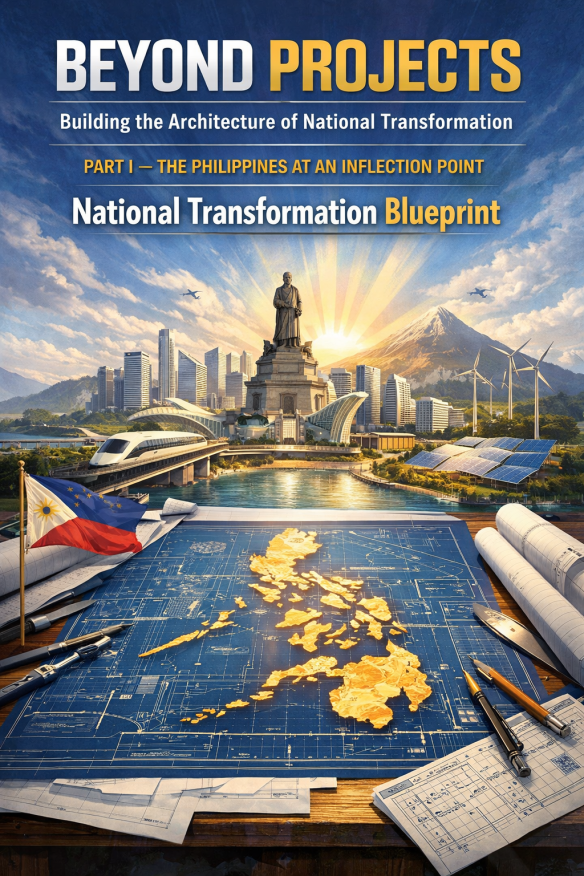
By Karl M. Garcia
Every generation inherits a different development challenge.
For much of the twentieth century, the Philippines struggled to build the physical foundations of a modern nation. Roads, bridges, ports, schools, hospitals, power plants, irrigation systems, and telecommunications formed the backbone of national policy. These investments were necessary. Without them, economic growth would have remained elusive and millions of Filipinos would have been left without access to basic services.
Today, however, the country’s challenge is fundamentally different.
The Philippines no longer faces a simple shortage of infrastructure. It faces a shortage of integration.
Over the past two decades, expressways have expanded across Luzon. Railways are returning after decades of neglect. Airports are being modernized. Seaports continue to grow. Renewable energy projects are accelerating. Digital connectivity has improved dramatically, while government services are gradually becoming more accessible online.
Taken individually, these developments represent significant progress.
Taken together, they raise a more important question.
How do these investments work as a system?
Development is often measured by the number of projects completed, the amount of capital invested, or the kilometers of roads constructed. These indicators remain important, but they do not capture whether the different parts of government and the economy reinforce one another. A modern expressway that does not connect efficiently to ports, logistics hubs, industrial estates, and digital infrastructure delivers only a fraction of its potential value. Likewise, a modern port without efficient customs procedures, reliable transport links, and capable institutions cannot fully support trade and industrialization.
The challenge is no longer simply building more.
It is building better connections.
History suggests that nations rarely become prosperous through isolated successes. They succeed because they create systems in which transportation, education, finance, technology, governance, and industry evolve together. Each reinforces the others, creating cumulative gains that far exceed the contribution of any single investment.
This is where the Philippines now stands.
The next stage of development will depend less on constructing individual projects than on designing an integrated national architecture that allows institutions, infrastructure, technology, and people to operate as one coherent system.
The distinction is subtle but profound.
Projects produce assets.
Systems produce capabilities.
That difference may determine whether the Philippines becomes merely a faster-growing economy or a genuinely transformed nation.
From Building Things to Building Systems
Governments naturally gravitate toward projects because they are visible.
A bridge can be inaugurated. A railway can be photographed. A new airport terminal provides tangible evidence of progress. Political leaders understandably celebrate these achievements because citizens can see and use them.
Systems are different.
They are often invisible.
Their value lies not in their individual components but in the relationships between those components. A logistics network functions because ports, highways, customs agencies, shipping companies, warehouses, digital platforms, and local governments coordinate effectively. A healthcare system depends not only on hospitals but also on data, financing, supply chains, education, research, and governance. Likewise, an innovation ecosystem requires universities, investors, entrepreneurs, regulators, and industries to reinforce one another over time.
No single institution owns these systems.
No ribbon-cutting ceremony captures their importance.
Yet they ultimately determine national performance.
Countries that consistently outperform others understand this distinction. They recognize that development is an exercise in systems engineering rather than project accumulation.
This perspective changes how governments think about investment.
Instead of asking, “What should we build next?” policymakers begin asking, “How does every investment strengthen the overall system?”
The answer often reveals opportunities that conventional planning overlooks.
A port is not simply a transportation facility.
It is part of a manufacturing strategy.
A railway is not merely public transport.
It reshapes labor markets, housing, education, and regional development.
Fiber-optic networks are not just telecommunications infrastructure.
They enable artificial intelligence, digital commerce, precision agriculture, financial inclusion, and public administration.
Infrastructure is therefore not an end in itself.
It is the physical expression of a broader national strategy.
An Archipelagic Nation Requires Archipelagic Thinking
Every country develops within the constraints—and opportunities—created by geography.
For continental states, roads often become the primary arteries of economic activity. Borders connect directly to neighboring markets. Population centers expand across continuous landmasses, allowing transportation networks to develop with relative simplicity.
The Philippines operates under different conditions.
More than 7,600 islands create one of the world’s most geographically complex states. Economic activity depends on the continuous movement of people, goods, information, energy, and public services across water. Typhoons, earthquakes, volcanic activity, and rising sea levels add another layer of complexity. Supply chains must remain resilient despite frequent disruptions. Governance must function across dispersed communities separated by oceans rather than highways.
These realities are often described as disadvantages.
They certainly create costs.
But they also create strategic opportunities.
Maritime nations throughout history have demonstrated that geographic complexity can become a source of resilience, innovation, and economic dynamism when institutions are designed around it.
The question is not whether geography matters.
The question is whether institutions respond intelligently to geography.
Too often, Philippine governance has attempted to manage an archipelagic nation using administrative assumptions better suited to continental states. Planning frequently occurs in sectoral silos. Transportation, energy, communications, environmental management, industrial policy, and local governance are often designed independently, even though they interact continuously in practice.
The result is fragmentation—not because of geography alone, but because institutions frequently mirror administrative boundaries instead of functional relationships.
An archipelagic country requires governance that is equally interconnected.
Maritime transport must complement highways and railways.
Digital infrastructure must support logistics.
Energy systems must strengthen industrial competitiveness.
Education must anticipate future labor market needs.
Environmental management must reinforce economic resilience.
These are not separate agendas.
They are components of one national system.
The World Is Entering a New Era
The urgency of systems thinking becomes even clearer when viewed against global change.
The international economy is being reshaped simultaneously by technological transformation, geopolitical competition, climate adaptation, demographic shifts, and supply-chain restructuring.
Artificial intelligence is changing production.
Automation is transforming manufacturing.
Semiconductors have become strategic assets.
Energy transitions are redefining industrial competitiveness.
Climate risks increasingly influence investment decisions.
Meanwhile, geopolitical tensions are encouraging companies to diversify supply chains beyond traditional manufacturing hubs.
Countries able to provide stable institutions, reliable infrastructure, skilled labor, digital capability, and resilient logistics will attract investment.
Those that cannot may struggle despite possessing abundant natural resources.
The Philippines occupies a potentially advantageous position.
Located at the center of Southeast Asia, the country sits astride some of the world’s busiest maritime routes. It possesses a young population, an English-speaking workforce, growing digital capabilities, abundant renewable energy potential, and expanding partnerships with regional and global economies.
These strengths, however, are not guarantees of success.
Comparative advantage is not permanent.
It must be organized.
The nations that benefit most from global transformation will not necessarily possess the greatest resources.
They will possess the greatest capacity to coordinate them.
Beyond Growth
Economic growth remains essential.
It creates jobs, reduces poverty, and expands fiscal capacity.
But growth alone does not define national development.
History contains many examples of economies that grew rapidly without building resilient institutions. Others expanded industrial output while neglecting education, environmental sustainability, or social cohesion. Some achieved impressive macroeconomic indicators only to encounter governance crises that undermined decades of progress.
The objective should therefore extend beyond increasing gross domestic product.
The goal is to increase national capability.
Capability refers to a society’s ability to solve problems, adapt to change, manage crises, innovate continuously, and improve living standards over generations.
Infrastructure contributes to capability.
Education contributes to capability.
Effective institutions contribute to capability.
Scientific research contributes to capability.
Industrial competitiveness contributes to capability.
When these reinforce one another, development becomes self-sustaining.
When they operate independently, progress remains uneven.
This distinction explains why some nations recover quickly from crises while others struggle to regain momentum. Strong systems absorb shocks because they possess redundancy, flexibility, institutional memory, and adaptive capacity.
The Philippines has repeatedly demonstrated resilience in the face of disasters, economic disruptions, and political transitions.
The next step is transforming resilience from a social characteristic into an institutional one.
A Different Way of Measuring Success
Traditional development metrics remain valuable.
Economic growth, employment, poverty reduction, educational attainment, and infrastructure investment should continue to guide policy.
Yet an increasingly interconnected world requires additional measures.
How quickly can government agencies coordinate during emergencies?
How efficiently do ports connect with industrial zones?
How rapidly can innovations move from universities to industry?
How effectively do digital systems support public services?
How resilient are supply chains during natural disasters?
How adaptable are institutions when technology changes?
These questions measure capability rather than output.
They recognize that national success depends not only on what exists but also on how well different components work together.
The future will belong to countries that master coordination.
Toward a National Architecture
Every successful nation eventually develops an organizing framework that aligns public investment, private enterprise, institutions, and society toward shared objectives.
Some countries organize around manufacturing.
Others around technology.
Some around trade.
Others around energy.
For the Philippines, the organizing principle should be its archipelagic character.
Rather than treating the sea as the boundary separating communities, the nation can recognize it as the connective tissue that links them. Ports become gateways of industry. Maritime logistics become engines of integration. Digital networks reduce the tyranny of distance. Infrastructure becomes an interconnected operating system rather than a collection of isolated assets. Institutions become platforms for coordination rather than administrative silos.
This is not merely an infrastructure agenda.
It is a governance agenda.
It is an economic agenda.
It is an industrial agenda.
Ultimately, it is a nation-building agenda.
The Philippines has reached an inflection point where incremental improvements, while valuable, are no longer sufficient. The choices made today will shape not only the next election cycle but the country’s trajectory over the coming decades.
The central challenge is therefore not deciding which project should come next.
It is deciding what kind of national system those projects are intended to create.
That question will define whether the Philippines simply builds more infrastructure—or builds a more capable state.
The succeeding sections of this essay argue that infrastructure must be understood as the operating system of national development, connecting institutions, industry, technology, and governance into a coherent architecture capable of sustaining prosperity, resilience, and continuous learning throughout the twenty-first century.


A checklist of issues. The objective: integration across the islands that fracture ideas like a train backbone. I see integration steps being taken on various islands. Luzon is getting a buildout of the Subic-Clark-Manila-Batangas corridor with trains and expressways as the backbone. Common stations are being built to bring separate trains together. Sumitomo wants to take a larger role in operating trains, a form of integration. Airports and docks are being upgraded. Tacloban’s new terminal is first class. Mindanao is a country in itself to work on. The oligarchs are spreading their retail and housing construction across the islands, and are able to keep them stocked. Added cost, yes, but not a barrier.
Energy infrastructure would be my recommended top priority. You can grow if investors have it. Water is second. Internet third, cabling and satellites. AI data centers will be addressed ad hoc, no national integration required I think. Farm to market roads, a priority in the 2027 budget I think, would be about 93rd in my list of where money should be spent. It’s only top priority because these useless roads keep the local dynasts fat and happy.
Leaders should serve the nation, not themselves. It’s an intellectual infrastructure priority.
You can’t be dumb and thrive.
Speaking of infrastructure. Defense engages other nations and the Marcos Administration has done well at building this infrastructure. There are six strategic relationships now, most documented with visiting forces agreements. Japan is the second most advanced of these, behind the US. Here is an example. Transferred ships are not WWII clunkers, they were built in the ’90s. They lack modern missile and other technology, but fit Philippine needs well.
https://www.navalnews.com/naval-news/2026/07/philippines-confirms-deal-to-acquire-five-japanese-abukuma-class-destroyer-escorts/
Related:
https://bworldonline.com/economy/2026/07/07/761833/sumitomo-seeking-to-expand-phl-railways-energy-footprint-dof/
Joe,
Some parties are questoning our independent foreign policy when it comes to China and Russia. I sometimes am in a dilemma myself.
Again I ask for your thoughts.
Thanks.
China is a threat to sovereign rights, Russia is not. President Marcos seems to be driven by the principle that the Philippines has no enemies and is peaceful to all. This allows commercial relations with China to proceed while limiting friction only to the legal and defense matter of China’s offending presence and acts in the WPS. When China went out of bounds to that by sanctioning Defense Secretary Teodoro, the President said “that is not helpful”, a low intensity rebuke of China.
The Philippines is close to Ukraine, and engaged with Russia only for Philippine best economic interests. I’m sure President Zelensky also can compartmentalize this as an issue the Philippines must resolve, how to get oil and investments. It is hard to demand that a poor man reject donations to the tin cup because it might offend someone’s own interests. I am personally impressed by President Marcos’ principles. They are very consistent and steadying.
Many thanks Joe.
Dropping a link about our allegedly soft diplomacy.
Actually it was addressed to the DFA secretary
https://www.philstar.com/opinion/2026/07/08/2540528/dfa-secretary-lazaros-soft-diplomacy
I totally agree with the editorial. DFA is too soft. They don’t need to be belligerent, but accepting China’s more offensive diplomatic acts portrays the national sense of sovereignty as weak. The position should be “firm”.
The Ukrainian ambassador recently expressed concern about Marcos’ Russian oil diplomacy; he also stated that Ukraine understands the exigent need for the Philippines to address the ongoing fuel crisis domestically. In the same statement the Ukrainian ambassador reiterated Ukraine’s appreciation for Philippine support for Ukraine’s sovereignty. So the Ukrainians understand nuance here.
Russian investments on the other hand — personally I have an issue with. The singular corrupting factor in Western democracies and businesses is in fact Russian money, and the disinformation networks Russian money funds. See Irish reporter Caolan Robertson on how Russian money has basically taken over Ireland’s enterprises and how Russia is able to skirt sanctions to further their warmongering in Eastern Europe using pass-throughs. However, I didn’t detect any serious attempt by Marcos during his trip to Moscow to attract major Russian investments.
Ah, thanks. Russia has no material investments in the Philippines according to Gemini:
“Russia does not have material investments in the Philippines. While both nations have explored cooperation in energy (such as purchasing ad-hoc crude oil shipments) and trade agreements, overall economic engagement remains limited. Historical overtures inviting Russian firms to participate in Philippine infrastructure and development remain largely prospective.”
Yes, that’s right. Btw Russia follows the same concessionary model as China’s predatory lending trap tactics — the Russians just replace the lending trap with the mercenary support of strongmen trap. As the Philippines doesn’t have this issue, anything the Russians have to offer beyond oil is worth much less.
I expanded my querry to organized and cyber crime.
Russia and the Philippines: The Short Version
Russia has never been a major economic player in the Philippines. For decades, bilateral trade and investment remained modest, constrained by geography, the Cold War, and the Philippines’ close economic ties with the United States, Japan, and other Asian partners.
Relations warmed significantly during the administration of Rodrigo Duterte, when Manila explored Russian investments in energy, defense, and heavy industry. However, most of these initiatives failed to progress. Following Russia’s 2022 invasion of Ukraine, sanctions and the risk of U.S. CAATSA penalties led the Philippines to cancel major defense procurements and shift cooperation toward less politically sensitive sectors such as agriculture, fertilizer imports, and food trade.
Contrary to popular perception, there is little evidence that the traditional Russian mafia has established a significant physical presence in the Philippines. While intelligence agencies raised concerns in the early 2000s about possible attempts to establish criminal footholds, Russian organized crime has never developed territorial influence comparable to Chinese syndicates involved in POGOs or Japanese Yakuza networks.
The greater threat today comes from cyberspace. Russian nationals have been implicated in major cybercrimes, including the high-profile Coins.ph cryptocurrency theft, while Russian-based ransomware groups, hackers, and disinformation networks continue to target governments, businesses, and financial institutions worldwide. For the Philippines, cybercrime and digital financial fraud now pose a far more significant security challenge than conventional organized crime.
In short, Russia’s influence in the Philippines is limited economically, minimal in terms of traditional organized crime, but increasingly significant in the cyber domain. The country’s primary challenge is no longer guarding against physical criminal infiltration, but strengthening cybersecurity, protecting critical digital infrastructure, and improving resilience against cyber-enabled financial crime and information operations.
Ah, thanks. Crime and corruption are more deeply embedded in Russia than about anywhere. Philippine dynastic thieves and agency fixers are amateurs by comparison. Or maybe I’ve read too many Martin Cruz Smith novels following Inspector Arkady around Moscow, lol.
And here is improved logistics infrastructure as Ayala brings in Maersk as a 40% holder to manage things.
https://bilyonaryo.com/2026/07/08/maersk-parent-groups-investment-arm-buys-40-of-ayalas-ac-logistics-to-unify-fragmented-ph-supply-chains/business/
Very good news. Maersk one of the largest Cargo Companies if not the very largest.
I also read about our Air Cargo I will look for the link. It is about the only all cargo airline
Here is the link
https://portcalls.com/skyway-airlines-adds-third-freighter-to-fleet/
That’s terrific. Great infrastructure add. I hope Skyway succeeds big time.
Me too.
Karl, I believe the addition of another airplane is more of a project, not the national architectural system that you were writing about. The system would include where the plane lands, how the cargo is handled before it gets to its final destination, etc.. (“How efficiently do ports connect with industrial zones?”)
The whole thing is the system and a key partner is (sad to say) the government. If the cargo plane lands in Manila, and the cargo gets stuck in traffic, that is not good. I remember from his Memoirs that Lee Kuan Yew saw all the paperwork needed to unload cargo from a ship, so he placed all the offices in one building instead of having people run all over town to get all the paper work completed. He said that if it normally took a ship’s captain 5 days to unload its cargo and sail off, his goal for Singapore would be 3 days. He knew it was important for the Captain to get his ship back on the high seas sooner than later.
The addition of an airplane by Skyway is definitely something to celebrate…but I would not lose the focus of your topic of a National Architecture (as opposed to a private enterprise’s architecture). If we lose focus of that, we never get the national architecture that you envision.
“The central challenge is therefore not deciding which project should come next.
“It is deciding what kind of national system those projects are intended to create.
“That question will define whether the Philippines simply builds more infrastructure—or builds a more capable state.” – KG
In what form would you expect this National Architecture to take, who would craft it, who would approve it, how long would the effort take, how much would it cost, and what is the probability it would achieve completion by the target date? If that is too much to contemplate, assign it to Claude or Gemini. For myself, I think it is a pipe-dream with so many complexities and contingencies that it will never get off the ground. What will get off the ground is individual initiatives that can articulate clear benefits (profits, public appreciation) and adopt the intent of a hazy National Vision as a part of the feasibility study.
“In what form would you expect this National Architecture to take, who would craft it, who would approve it, how long would the effort take, how much would it cost, and what is the probability it would achieve completion by the target date?” – JoeAm
These are excellent questions and they are not are not found in Karl’s Part 1 of Beyond Projects: Building the Architecture of National Transportation. Perhaps he addresses these questions in Part 2? We need to be patient.
I’m not asking Karl, I’m asking you as an advocate of a National Architecture. Do you consider it feasible?
I read a lot of criticisms of the Philippines, most of which hold the Philippines up against ideal goals, generally to be like X country. But the Philippines is Y country, how can it be like X? And what is the real chance of reaching perfection, as expressed by the critic? This relentless grinding of the Philippines against an idealized and impossible to reach target does not help the Philippines get to that target, in my view. It’s all stick, no carrot. It’s like listening to arguments about who is the greatest basketball player, Jordon or James? Words in the wind. A National Architecture is easy to state. Get rid of corruption and invest in highest and best needs. As those needs are argued, a National Architecture will grow from the conclusions. Which is sort of what is happening now but no one has articulated it.
Here’s a summary of PPP projects in the pipeline. It’s substantial. If there were a National Architecture, would some be dropped off? I’m guessing very few. Most are under the National Government so exclude farm to market roads. Roads and trains and boats and planes. Er, airports. Ports. Tracks. Expressways. Bridges.
Links to the chain CV, I consider small.wins, strong links to the chain
Thanks for the thoughts, Karl. I believe your essay addresses JoeAm’s points, especially the section “From Building Things to Building Systems.” As I understand JoeAm’s input, he is talking about building things or what you called projects…ports, airports, transportation corridors, etc. etc. If I am understanding your essay, you want to go beyond these visible projects to a national system that basically links or integrates all these projects towards a national vision.
Correct me if I am wrong.
Correct CV
The Philippines is thick with plans that try to do that. But pragmatics get in the way, like rights of way issues or mall oligarchs who want the common station next to THEIR mall, not the other guy’s. Plus covid and AI throwing wrenches into the plans. And try cutting localities off their farm to market roads. So how do you stop the realities to get to integrating all the time-affected plans and budgets?
I do think ports and trains connect when the time is right. If we had China’s resources and governing style, then the state could command progress here and there in an integrated manner. The Philippines already has a huge debt problem. And works through votes and laws, and across opposing 6 year administrations. So the integration is slow and haphazard, and ideas that it can be otherwise are idealistically great but pragmatically non-starters.
I asked Gemini if there is a greater Manila development plan. You could do something similar for the nation. It would be more elaborate and impossible to impliment smoothly.
Gemini:
Yes, the most comprehensive framework for the broader region is the Metro Manila Dream Plan (formally the Roadmap for Transport Infrastructure Development for Metro Manila and Surrounding Areas), alongside the nationwide Philippine Development Plan 2023-2028.
Endorsed by the National Economic and Development Authority (NEDA) Board, these strategies stretch beyond National Capital Region (NCR) borders to encompass the Greater Capital Region, which includes Central Luzon (Region III) and Calabarzon (Region IV-A).
The master plan aims to transition the area from a congested, single-center (monocentric) layout into a polycentric network by focusing on key development strategies:
-Integrated Mass Transit: Core infrastructure includes the Metro Manila Subway and the North-South Commuter Railway (NSCR), both of which have been steadily advancing toward completion.
-Regional Decentralization: It aims to establish regional growth centers in locations like Clark, Subic, Batangas, and Lipa to draw economic activity away from the crowded Metro Manila core.
-Urban Expansion: Planned expansions extend into neighboring provinces in Bulacan, Cavite, and Laguna to manage urban sprawl and housing spillover.
The Metro Manila Dream Plan was officially approved and adopted by the National Economic and Development Authority (NEDA) Board in September 2014.
The plan was formulated between 2013 and 2014 through a joint study conducted by the Japan International Cooperation Agency (JICA) and the Philippine government under the administration of President Benigno Aquino III. It established a roadmap with strategic milestones set for 2016, 2020, and 2030 to systematically eliminate traffic gridlock and modernize infrastructure across the Greater Capital Region.
OT: I’ve been quite busy lately but on my off-time I went into a deep-dive on the engineered bamboo topic.
I produced two papers, using mainly Philippines government and global intergovernmental organization data (e.g. UN) sourcing, one styled as a study and the other as a journalistic investigation piece. I believe both will be a relatively easy read compared to some of the other “heavier” work I’ve done before on our topics.
The short version conclusion is that engineered bamboo might not be the best use of the Philippines’s energy even if the Philippines goes the most logical route which is import-substitution replacing imported wood products with domestically manufactured engineered bamboo. DA’s statement at the investment forum that contained more than a few contradictory goals was my first indicator. Just as a reference, the actual global market for engineered bamboo is about $4 billion (not $72.1 billion cited by DA at the forum); an example of the cherry-picking typical in Philippines communication or a signifier pointing to a lack of due diligence, either of which is bad and 18x bigger than actual verifiable numbers. In any case I’ve tried my best to be open-minded on the subject (I actually love bamboo as a building material).
Hope everyone finds the subject as fascinating as I did.
Feasibility Assessment — Financing an Engineered Bamboo Products Industry in the Philippines:
https://claude.ai/public/artifacts/9035b5cc-fff7-4f4c-83ec-9c0491c6a6b6
Deep Dive Investigation — The Bamboo Gamble:
https://claude.ai/public/artifacts/4611bb7d-cd1f-4eba-b409-7d0b9ff04810
The links were broken, so here are both again.
Feasibility Assessment — Financing an Engineered Bamboo Products Industry in the Philippines:
https://claude.ai/public/artifacts/d8aa74a5-3e7f-41a6-8690-e5f0ca1d1f8e
Deep Dive Investigation — The Bamboo Gamble:
https://claude.ai/public/artifacts/ed003909-86dd-4852-83b0-d0535666e7de
Thanks Joey!