Beyond the Headlines: The Next Test for the Philippine Economy

By Karl M. Garcia
Over the past year, the Philippines has received a series of encouraging endorsements from major international institutions. The World Bank has recognized that the country’s debt-to-GDP ratio remains manageable despite years of elevated public spending and has officially reclassified the Philippines as an upper-middle-income economy. The International Monetary Fund (IMF), meanwhile, continues to assess Philippine public debt as sustainable and notes that the country is not among the emerging economies facing debt distress because of prudent fiscal management and a well-balanced debt portfolio.
These are achievements worth recognizing.
For a country that has navigated a global pandemic, inflation, supply chain disruptions, geopolitical uncertainty, and rising global interest rates, maintaining investor confidence and fiscal credibility is no small accomplishment. It reflects years of disciplined macroeconomic management across successive administrations and institutions.
A map circulating online showing countries with active IMF lending programs reinforced that point. The Philippines was absent from the list—a reassuring sign that it continues to finance itself through domestic and international capital markets rather than emergency financial assistance.
But good news deserves careful interpretation.
Being off the IMF borrower map and receiving favorable assessments from international institutions are signs of economic stability. They are not guarantees of economic strength.
International organizations evaluate countries largely through macroeconomic indicators: fiscal sustainability, debt composition, financial stability, institutional quality, and economic resilience. These indicators matter because they influence borrowing costs, investor confidence, and a country’s ability to withstand external shocks.
Yet they do not always measure how ordinary Filipinos experience the economy.
A country can enjoy investment-grade credit ratings while millions remain in low-productivity work. It can attain upper-middle-income status while families continue to struggle with rising food prices, expensive electricity, congested transportation, and wages that often fail to keep pace with the cost of living.
There is no contradiction.
It is the difference between macroeconomic stability and inclusive prosperity.
The Philippines today is undoubtedly more resilient than it was two decades ago. Inflation has generally been managed more effectively than in previous eras. The banking system remains well-capitalized. Foreign exchange reserves provide an important cushion against global volatility. Public debt, while elevated after the pandemic, remains manageable compared with many peer economies.
These are foundations worth protecting.
But stability is not the destination.
It is the platform upon which long-term development must be built.
Today’s global economy is increasingly defined by recurring shocks rather than isolated crises. Climate change is intensifying natural disasters. Geopolitical rivalries continue to reshape trade and investment. Commodity prices remain volatile. Technological disruption is transforming labor markets. Supply chains can be disrupted by events occurring thousands of kilometers away.
For an economy like the Philippines—integrated into global markets and dependent on imported fuel, industrial inputs, and international trade—the question is no longer whether external shocks will occur.
The question is whether the country’s institutions are capable of absorbing those shocks without sacrificing years of economic progress.
That challenge extends beyond government finances.
It also applies to millions of Filipino households.
For decades, Philippine development has been measured by a straightforward question: How many people have escaped poverty?
It remains an important measure.
But it is no longer sufficient.
The more relevant question today is this: How many families can remain out of poverty when the next crisis arrives?
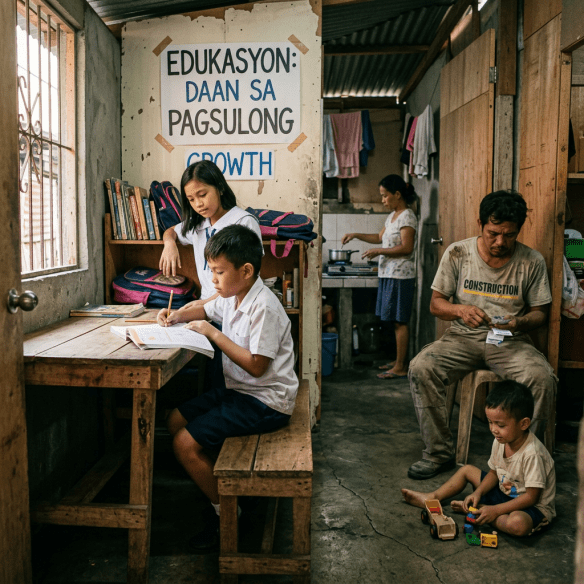
The pandemic, inflation, increasingly destructive typhoons, prolonged droughts, and global economic uncertainty exposed a difficult reality. Many households that have climbed above the poverty line remain only one hospitalization, one failed harvest, one lost job, or one disrupted small business away from financial distress.
Many Filipinos have escaped poverty statistically.
Far fewer have escaped vulnerability.
That helps explain why public anxiety often appears disconnected from favorable economic indicators. A family may own appliances, send children to school, use digital payments, and earn above the official poverty threshold while still lacking the financial resilience to withstand even a modest economic shock.
The country’s challenge is no longer simply poverty.
It is economic fragility.
Ironically, the Philippines has already built many of the foundations needed to address this challenge. Conditional cash transfers, Universal Health Care, disaster assistance, emergency ayuda, digital payment systems, livelihood programs, financial inclusion initiatives, and local government interventions collectively resemble the framework of a modern social protection system.
The problem is not the absence of social protection.
It is fragmentation.
Programs often operate independently rather than reinforcing one another. Assistance frequently arrives after hardship instead of preventing it. Eligibility rules struggle to reflect the reality that millions of Filipinos move in and out of vulnerability as economic conditions change.
Building resilience therefore requires more than expanding welfare programs.
It requires integrating them into a coherent system that helps workers transition between jobs, supports farmers confronting climate risks, enables small businesses to survive temporary disruptions, and prevents temporary setbacks from becoming permanent poverty.
Social protection should no longer be viewed merely as assistance for the poorest.
It should be viewed as economic infrastructure.
Just as roads, ports, railways, power grids, and digital networks support commerce, resilient social institutions support productivity by ensuring that households can recover from shocks without losing years of hard-earned progress.
Economic resilience also depends on recognizing a part of the economy that is often overlooked.
Much of what Filipinos casually describe as the “underground economy” is neither hidden nor criminal.
It is informal.
Neighborhood sari-sari stores, junkshops, market vendors, repair shops, home-based enterprises, and countless microbusinesses form an indispensable network connecting manufacturers, suppliers, and consumers across the archipelago. They distribute goods where large retailers cannot operate efficiently, provide livelihoods during downturns, and frequently become the economy’s first line of adjustment during crises.
Rather than existing outside the economy, they complement the formal sector.
Reducing unnecessary barriers to formalization—through simpler registration, lower compliance costs, improved access to finance, and better digital government services—would strengthen both productivity and inclusion while preserving the entrepreneurial dynamism that characterizes many Filipino communities.
The same long-term perspective applies to inflation.
Public discussion often focuses on interest rates, and rightly so. A credible central bank remains indispensable.
But many of the country’s recurring inflation pressures originate elsewhere: expensive electricity, agricultural bottlenecks, logistics costs, vulnerable food supply chains, fuel imports, and insufficient competition in certain sectors.
Interest rates cannot unclog ports.
They cannot modernize irrigation systems.
They cannot lower global oil prices.
Nor can they build transmission lines.
Inflation, therefore, is not only a monetary issue.
It is also a structural one.
The Philippines’ greatest challenge remains structural transformation.
Productivity must accelerate. Manufacturing must move into higher-value industries. Agriculture must become more competitive and climate resilient. Innovation, scientific research, and digital capability must become central pillars of economic policy. Infrastructure must reduce the cost of moving people, goods, energy, and information—not simply add kilometers of concrete.
Above all, institutions must become more capable of learning, coordinating, and sustaining reforms beyond electoral cycles.
The World Bank’s recognition of the Philippines as an upper-middle-income economy should therefore be viewed as a milestone, not a finish line.
History is filled with countries that reached middle-income status only to remain there for decades. Escaping that trap requires more than prudent fiscal management. It requires institutions that encourage innovation, strengthen human capital, improve productivity, and make growth more resilient to shocks.
The encouraging assessments from the World Bank and the IMF validate years of disciplined economic stewardship. They remind us that credibility is difficult to earn and easy to lose.
But international recognition is not the same as national transformation.
The next chapter of Philippine development will not be defined solely by remaining off the IMF borrower map or achieving another income classification. It will be defined by whether the country can convert macroeconomic stability into stronger institutions, more competitive industries, better infrastructure, broader opportunities for entrepreneurs, more resilient households, and sustained improvements in the daily lives of Filipino families.
Ultimately, that is the true measure of development.
Not simply how well an economy performs during good times, but how well its institutions, businesses, and people withstand the difficult ones.
That is the difference between stability and strength.
And in an era of permanent uncertainty, it may become the Philippines’ greatest competitive advantage.



Another good one, Karl. Thanks!
“It will be defined by whether the country can convert macroeconomic stability into stronger institutions,…”
Based on your recent essay about the justice system, perhaps the Dept. of Justice is a good institution to start work on w/ regard to getting stronger.
Thanks again CV!
A most interesting read. To some extent it says, look, things will not always progress well, so be prepared for hell. Then we’ll judge you.
Well, how about at least a pause to acknowledge that things are going well and we owe thanks to President Marcos for not going weird on us, but going sensible.
I take issue with this statement: “The country’s challenge is no longer simply poverty. It is economic fragility.”
The nation is not economically fragile. It is resilient. Government authority is used actively, almost dictatorially, to preserve stability. Banks don’t fail here because BSP won’t let them. Money is sent to the poor and elderly regularly in different ways, ayuda or discounts. It’s socialistic in a way. PAL was on its ass after covid and today is adding routes around the world. For sure the nation needs a stronger manufacturing underpinning, and agriculture is lax and sloppy, but they are progressing. There is no economic fragility in my book, any more than there is in any nation that gets tested by war, disease, or economic cycles.
I think the nation is more likely to become an economic rising star than a shattered china doll. Like, it’s cooking in some respects, not collapsing.
https://business.inquirer.net/598975/pse-tops-capital-raise-goal-pipeline-hits-p-204b#
And with a global ambassador like Alex Eala, and strategic alliances with sane and sound countries like Canada, its reputation will shift more and more to the positive. We can help in that regard, of course, or we can help drag the nation into the mud. That’s easy enough.
I appreciate you seeing what is best. Just continue to remind me or us if we are leaning on pessimism. I am for a better Philippines and it is unfortunate that my article was seen as pulling the PH to tge mud and I will never do that on purpose.
Oh, I think the article was not pulling any direction. It states the situation well. Caused me to think which is rare, lol.
Ah, thanks.