Why the Philippines Needs a Top Five National Priorities Framework (2027–2040)
By Karl M. Garcia
Executive Summary
The Philippines possesses enormous economic potential and equally ambitious national goals. Policymakers seek faster growth, modern infrastructure, affordable electricity, food and water security, quality healthcare, world-class education, digital transformation, environmental sustainability, and credible national defense. Yet no nation has unlimited financial resources, institutional capacity, or administrative attention.
The challenge facing the Philippines is therefore not a lack of ambition—it is prioritization.
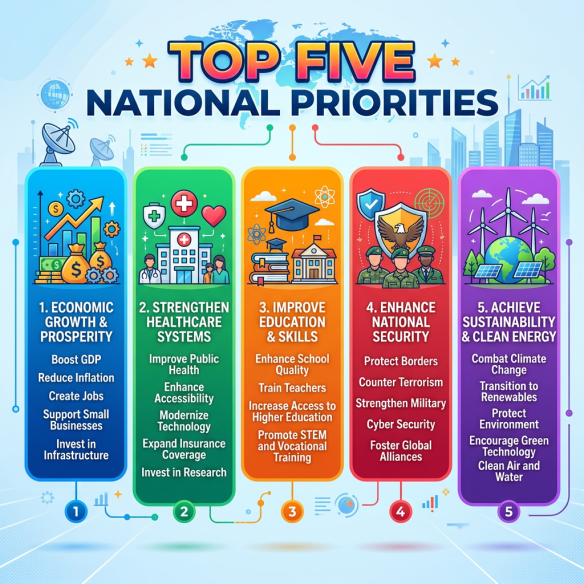
This paper proposes a Top Five National Priorities Framework (2027–2040) that aligns national aspirations with institutional capability. The period is significant because it spans multiple administrations, encouraging policy continuity beyond electoral cycles. Rather than pursuing dozens of competing initiatives simultaneously, government should focus on five mutually reinforcing priorities capable of delivering the greatest long-term economic and strategic returns:
- Economic and Industrial Transformation
- Infrastructure and National Connectivity
- Human Capital Development
- Governance and Institutional Excellence
- National Security and Resilience
Together, these priorities provide a practical roadmap for transforming the Philippines into a prosperous, resilient, and globally competitive nation.
Why National Priorities Matter
Every government operates under constraints. Budgetary resources, skilled personnel, political capital, and administrative attention are all limited. Every peso spent on one program is unavailable for another.
Countries that successfully transformed themselves into advanced economies understood this reality. Japan emphasized industrial modernization after World War II. South Korea invested heavily in export-oriented manufacturing and education. Singapore prioritized governance, infrastructure, and human capital. China combined industrial policy, infrastructure investment, and institutional reform to sustain decades of rapid growth.
Although the Philippines cannot simply replicate these models, they illustrate an enduring principle: successful development requires disciplined prioritization.
National priorities should therefore function as a strategic filter for legislation, budgeting, and public investment. Major government programs should demonstrate how they contribute to one or more core national objectives.
The Top Five National Priorities
1. Economic and Industrial Transformation
Industrialization should remain the principal engine of national development.
The Philippines must expand manufacturing, modernize agriculture, strengthen technology industries, encourage innovation, attract productive investment, and increase exports. A competitive industrial base generates employment, raises incomes, expands government revenues, and strengthens national self-reliance.
Economic transformation is not simply one objective among many—it provides the resources necessary to achieve nearly every other national priority.
2. Infrastructure and National Connectivity
As an archipelagic nation, the Philippines faces unique logistical challenges.
Roads, railways, ports, airports, power systems, telecommunications, water infrastructure, and digital networks reduce business costs while improving national integration. Future infrastructure should also be designed for climate resilience, recognizing the country’s vulnerability to typhoons, flooding, earthquakes, and rising sea levels.
Infrastructure is therefore a long-term productivity investment rather than merely a construction program.
3. Human Capital Development
No nation becomes prosperous without investing in its people.
Quality education, healthcare, technical training, scientific research, engineering, and digital literacy are essential for long-term competitiveness. The Philippines possesses a young population whose demographic advantage can only be realized through sustained investment in human capital.
4. Governance and Institutional Excellence
Strong institutions determine whether public investments succeed or fail.
Digital government, regulatory modernization, transparent procurement, professional civil service, evidence-based policymaking, and sound public financial management improve the effectiveness of every government program.
Institutional quality often produces greater long-term returns than any single infrastructure project because it improves the performance of the entire public sector.
5. National Security and Resilience
Security extends beyond military defense.
A resilient Philippines requires food security, water security, energy security, cybersecurity, public health preparedness, disaster resilience, and climate adaptation alongside credible armed forces.
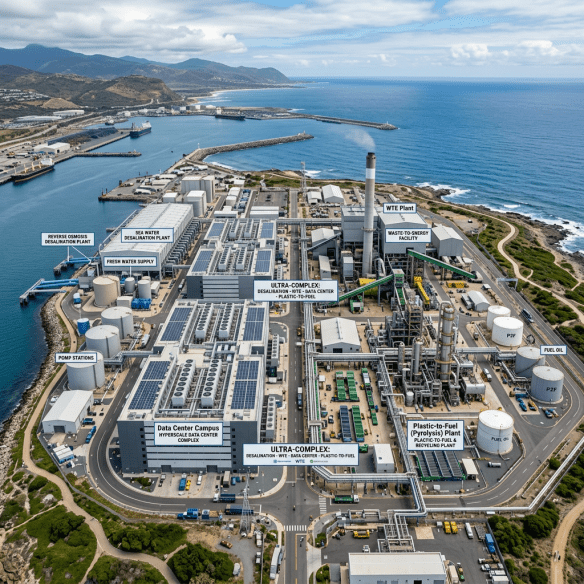
Strategic investments in desalination, wastewater recycling, watershed protection, and modern water infrastructure should increasingly be regarded as components of national security rather than simply public utilities.
Case Study 1: Electricity as a National Development Challenge
The Philippine electricity sector illustrates why national development requires systems thinking.
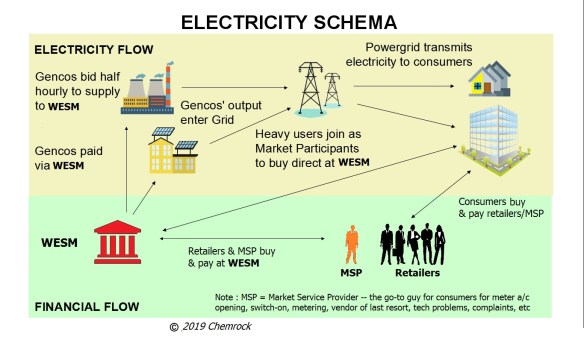
Public debate often focuses on individual technologies such as coal, natural gas, renewable energy, battery storage, or nuclear power. Yet affordable and reliable electricity depends on an integrated system consisting of generation, transmission, distribution, energy storage, digital grid management, financing, regulation, and institutional coordination.
No single technology can compensate for weaknesses elsewhere in the system. Additional generation produces limited benefits if transmission capacity is inadequate, while modern infrastructure alone cannot overcome regulatory uncertainty or inefficient permitting.
Rooftop Solar and Net Metering
The rapid growth of rooftop solar has generated an important policy debate. Homeowners invest substantial private capital in solar installations, yet exported electricity is generally credited only at the generation charge rather than the full retail rate.
Consumers argue that this undervalues their investment, while distribution utilities maintain that they must continue funding grid maintenance, backup supply, and reliability services.
President Ferdinand Marcos Jr. has also supported the proposed Sariling Kuryente Act, which seeks to simplify and reduce the cost of household solar installations by streamlining permitting requirements.
The broader lesson is that successful energy transition requires not only technology but also efficient regulation, public safety standards, and capable institutions.
System Loss Charges and EPIRA Reform
Another major policy debate concerns system loss charges.
In his 2026 State of the Nation Address, President Marcos proposed amending the Electric Power Industry Reform Act (EPIRA) to prohibit passing system loss charges to consumers and questioned the continued imposition of VAT on those charges.
System losses include unavoidable technical losses as well as non-technical losses arising from theft and other inefficiencies.
Critics of complete abolition, including business leader Manuel V. Pangilinan, argue that utilities must recover legitimate operating costs to maintain and modernize electricity networks.
The central issue is therefore not simply whether system loss charges should exist, but how costs should be allocated fairly while preserving incentives for infrastructure investment, efficiency, and reliable service.
Case Study 2: To Desalinate or Not?
Water security is emerging as one of the defining strategic challenges of the twenty-first century.
Although the Philippines receives abundant rainfall, climate change, population growth, pollution, seasonal droughts, and saltwater intrusion are placing increasing pressure on freshwater supplies, particularly across the country’s more than 7,600 islands.
Desalination has historically been considered too expensive for widespread adoption. However, advances in membrane technology, renewable energy, and energy-efficient systems continue to reduce costs.
The more important question is not whether desalination is affordable today, but whether the Philippines can afford not to develop this capability over the coming decades.
Countries such as Israel have demonstrated that desalination, water recycling, and efficient water management can transform chronic scarcity into long-term resilience. Several Gulf states have likewise built extensive desalination capacity despite limited natural freshwater resources.
For the Philippines, the origin of the technology—whether Israeli, Arab, European, Japanese, South Korean, or otherwise—is secondary to its effectiveness.
Desalination should complement rather than replace watershed protection, rainwater harvesting, groundwater management, wastewater recycling, and conservation. Building domestic expertise, supporting research, and integrating desalination into long-term infrastructure planning represent strategic investments in national resilience.
Like electricity, water security demonstrates that some capabilities appear expensive today but become indispensable tomorrow.
Financing the Framework
Achieving these priorities will require disciplined and diversified financing.
Government should combine public investment with public-private partnerships, multilateral development financing, official development assistance, and responsible private-sector participation. Sound fiscal management and transparent governance will encourage investment while ensuring that limited public resources generate the greatest long-term returns.
Implementation Roadmap (2027–2040)
Phase I (2027–2030): Building Capacity
Strengthen governance, digital government, workforce development, regulatory modernization, transmission expansion, and strategic infrastructure.
Phase II (2031–2035): Expanding Capability
Accelerate industrialization, logistics modernization, renewable energy deployment, research, innovation, and regional economic integration.
Phase III (2036–2040): Achieving Competitiveness
Develop advanced industries, resilient infrastructure, integrated digital systems, globally competitive institutions, and sustained productivity growth.
Progress should be measured using transparent indicators covering economic performance, educational outcomes, infrastructure quality, governance effectiveness, resilience, environmental sustainability, and public service delivery.
Conclusion
The Philippines does not lack vision. Its challenge is ensuring that national ambition is matched by institutional capability, disciplined governance, and consistent execution.
A Top Five National Priorities Framework (2027–2040) provides a practical strategy for aligning limited national resources with long-term development objectives. By concentrating on a small number of mutually reinforcing priorities, government can maximize public investment, improve policy coordination, and sustain reforms across successive administrations.
The electricity sector and the question of desalination illustrate the same lesson: enduring prosperity cannot be achieved through isolated projects or short-term political solutions. National resilience requires integrated systems, capable institutions, strategic infrastructure, and investments that anticipate tomorrow’s challenges rather than merely reacting to today’s crises.
Ultimately, the success of the Philippines will not be measured by the number of ambitions it proclaims, but by the discipline with which it pursues its highest priorities. A nation that focuses its resources on a few strategic objectives can accomplish far more than one that attempts to pursue everything at once.
Selected References
Asian Development Bank. Asian Development Outlook.
Department of Energy. Philippine Energy Plan.
National Economic and Development Authority. Philippine Development Plan 2023–2028.
Philippine Statistics Authority. National Accounts of the Philippines.
World Bank. Philippines Economic Update.
International Energy Agency. World Energy Outlook.
United Nations. Sustainable Development Goals.





Top-5 and justice / corruption is not on the top? It should be number 1, 2, 3, 4 &5. The laws are actually comprehensive and good, but none is applied because you can get away with murder (literally). Once you get a fair chance in an honest & effective court and the law is applied quickly, then the rest will follow automatically and you the top-100 is realized.
Good to see you Paul! Anyway on the laws being comprehensive and good, once one sees that laws are actually written more towards an outside audience (international investors, intergovernmental bodies, foreign aid, and so on) to attract investment and aid, rather than domestic application, everything starts to make sense. Besides, the ones who write the laws and the ones who break the laws are often from the same dynasties.
I think this is already a deeply ingrained negative expression of Filipino culture that is quite hard to shake, hence the existence of special economic zones and freeports where the rules are applied more consistently outside of any one dynasty’s control. Recently I did some analysis on how the positive expression of Filipino culture might be harnessed towards the good. If you’ve the time, feel free to check it out.
“The Only Route Open”
https://claude.ai/public/artifacts/1c9dc7ac-14e3-4f5c-a5bb-38d5fae5a8da
“Make the carrot visible”
https://claude.ai/public/artifacts/b7fe1c9a-703f-47f2-98d5-c02ef6981ae8
Thanks Paul or Pablo
You are correct of course and again a good catch, It was on top of my head but forgot to include in my list
Ever since I first played the original SimCity (1989) on my elementary school’s Macintosh Plus, I have been a fan of city-building and resource management games. Back in 1989 I was fascinated with building the most eco-friendly SimCity, which is still my preference to this day in modern city-building and resource management games. I quickly found out that when I built an eco-city too soon without a strong broad-based economy, the city would quickly suffer calamity due to deprioritization of other needed areas — famine, energy shortages, resource fragility, lack of environmental resilience, and so on.
Even with the 5 categories here in this article, my feel is the categories are still overly large. It’s great to envision possibility, but it’s better to get to the next step first. Focusing on smaller wins may be a better way to go — it’s less intimidating also which allows room to grow execution confidence to tackle the next problem which may be larger and more complicated. Building out a more resilient energy grid seems to be the lowest hanging fruit, and the Philippines should focus the most effort on grabbing that first as it enables everything else.
TBH,
I had you in mind when I wrote this.
This is the gift of comment threads you will be free to scrutinize and be scrutinized and since I am still writing, artivles to improve on the next article.
Yes of course, I noticed and thanks Karl for taking the time to try to put my many comments together into an article 😁
To be completely fair I think almost everything in this article is important. My suggestion has to do more with scoping in order to make big goals more manageable by clustering a bunch of small similar goals together. Of course individual “components” are just as important as the “subsystem” (cluster) and the “system” (the result of architecture), all operating within a “framework” (the interlocking pieces).
We may think of it this way:
1. Have stuff be built to stand independently, but be open to later connection to the overall system.
2. Cluster things which require hard (required) interdependencies.
3. Prioritize things that enable other things first.
The connectivity within an architecture can be thought of as the connective tissue, for example the spokes in a hub-and-spoke or star topology type system, or the connections between a meshed system. In technology we often use APIs as the connective layer that allow components to interact with each other. In general systems theory these connections are called interconnections, which are the relationships, flows, and feedback loops that unify components into a cohesive whole.
That’s why I suggested the most urgent priority should be modernizing the electrical generation infrastructure.
joey, president bong marcos has same idea i.e. modernizing electrical generation infra, instead of meralco continually charging consumers for system failure year in and year out.
AI Overview
It has been going on for 25 years. Meralco’s authority to pass on system loss charges to consumers is not the result of a sudden “system failure,” but rather a legal provision codified under Republic Act No. 9136, known as the Electric Power Industry Reform Act (EPIRA) of 2001.
What is System Loss and the Legal Basis?
Recent Developments and Pushback
Thanks KB. Pax Silica will also drive electric grid modernization. Luzon already has the most reliable grid due to the industrial activity in Calabarzon.
in 3 or 5yrs, we can see see how pax silica is actually going. we will still be here, hopefully!
Excellent. I think speedy law-based justice, lland use laws, and anti-dynasty + anti-corruption laws work in matrix fashion to bring more capability to all five “building” priorities. If I look at the Philippines today I’d say that PROGRESS is being mde in all five areas. President Marcos seems to have the priorities as follows based on where he shows up:
Big activity in 1, 2, and 3. Some work on 4 and 5.
Many thanks Joe!
Capability First: Why the Philippines Must Build Before It Can Share Keeping Up with Singapore, Not the Kardashians
People often joke about “Keeping Up with the Kardashians”—trying to project wealth and success without building the foundation that created it. Nations can fall into the same trap.
The Philippines should not pursue prestige without capability. Instead of trying to look like a regional power, we should become one by steadily building the institutions, industries, and infrastructure that make national strength possible.
A better comparison is “Keeping Up with Singapore.”
Singapore did not become one of Asia’s most prosperous nations overnight. It invested for decades in ports, logistics, education, governance, energy security, finance, and technology. South Korea built industries. Japan invested in resilience and manufacturing. Indonesia is strengthening its maritime economy. Vietnam has expanded its export industries.
The lesson is not to imitate them blindly but to learn from them. The real competition is not with our neighbors—it is with our own underdevelopment.
This principle also explains why the Philippines should invest in strategic fuel depots, petroleum reserves, and refining capacity.
Some Filipinos ask, “Why should we allow fuel depots for allied forces when we do not even have enough fuel ourselves?”
The concern is valid.
The answer is that we should not build fuel infrastructure primarily for our allies. We should build it first for the Filipino people.
A nation cannot share what it does not possess.
A country cannot become a logistics hub if it lacks strategic fuel reserves. It cannot support humanitarian operations if it struggles to fuel its own response. It cannot sustain military operations if it depends entirely on vulnerable supply chains.
Capability comes before partnership.
That means the Philippines should first:
Only after meeting our own national requirements should excess capacity be made available for allied use through agreements that clearly benefit the Philippines.
This is where a stable and rules-based Indo-Pacific—sometimes described as Pax Pacifica—can serve Philippine interests as well as those of our allies.
Many assume these arrangements benefit only the United States. They need not.
If negotiated wisely, they can bring investment in ports, airports, shipyards, fuel storage, pipelines, digital infrastructure, and disaster-response capabilities. They can create skilled jobs, encourage technology transfer, strengthen supply chains, and improve deterrence against coercion.
Every fuel depot should strengthen Philippine energy security.
Every upgraded port should improve Philippine trade.
Every logistics facility should serve disaster response, economic development, and national defense before supporting allied operations.
The guiding principle is straightforward:
Filipino capability first. Allied capability second. Shared capability always.
This is not about dependence. It is about building national strength that also makes the Philippines a trusted regional partner.
The same philosophy applies beyond energy.
We cannot become an industrial nation without industries.
We cannot become a maritime power without ships, ports, and shipyards.
We cannot become an innovation economy without scientists, engineers, and world-class universities.
We cannot become energy secure without producing, refining, storing, and distributing energy effectively.
We cannot protect what we do not build.
The Philippines should therefore pursue a capability-first strategy:
The objective is not simply to “keep up” with Singapore or any of our more developed neighbors. It is to build a Philippines that future generations will be proud of—a nation whose prosperity is rooted in capability, whose security is built on resilience, and whose partnerships are based on strength rather than dependence.
The central lesson is simple:
You cannot give what you do not have.
Before the Philippines can become a regional logistics hub, an indispensable ally, or a leading maritime nation, it must first build the capabilities that make those ambitions possible.
Own it. Refine it. Store it. Secure it. Then share it.
methink, there is problem with this statement: The answer is that we should not build fuel infrastructure primarily for our allies. We should build it first for the Filipino people.
coz, actually, our allies are not summat parasites (unless they are chinese!) that mooch on us! now, about our allies specific fuel infra to be built here, ang gastos niyan ay sagot ng allies nation, it is mainly their expenditure, we only provide the land for our allies to rent or lease.
iba naman yong fuel infra para sa usage natin, sagot yan ng national government.
two different things, but if our allies also uses our own fuel infras, we can charge them the going rate. no free lunch, ika.
Thanks for the important correction.
I will research furthet on this.
Who Pays for the Fuel? The Logic of Allied Cost-Sharing
A common objection to developing strategic fuel storage and other dual-use logistics infrastructure is deceptively simple: Who is going to pay for all that fuel?
The answer is that the Philippines does not necessarily have to carry the entire burden. But neither should it assume that allied forces will simply provide free fuel or finance Philippine infrastructure. The decisive factor is the legal and commercial architecture governing access, ownership, storage, replenishment, and reimbursement.
Modern military alliances and defense partnerships operate through formal arrangements—treaties, logistics agreements, implementing arrangements, government-to-government contracts, commercial leases, and cost-sharing mechanisms. The principle is straightforward: the party consuming the resource, reserving capacity, or requesting the service should bear an agreed share of the cost.1. Acquisition and Cross-Servicing Agreements
One established mechanism is the Acquisition and Cross-Servicing Agreement (ACSA) used by the United States and many defense partners.
Under an ACSA-type arrangement, armed forces can obtain logistics support, supplies, and services from one another. Fuel can be among the items exchanged. Reimbursement does not necessarily have to take the form of an immediate cash payment; depending on the agreement, settlement can involve cash reimbursement, replacement-in-kind, or an equal-value exchange.
The important point is institutional: military logistics support is not based on an informal promise that one ally will indefinitely subsidize another. It is governed by agreed rules for valuation, accounting, reimbursement, and liability.
For the Philippines, this creates an important policy possibility. Strategic fuel infrastructure could be designed from the beginning to accommodate allied logistics arrangements, provided that the necessary bilateral or multilateral agreements are negotiated and authorized.2. Storage Is an Asset With a Price
Fuel itself is only one component of the cost.
A strategic fuel facility requires tanks, pipelines, pumps, fire protection, environmental safeguards, security, inventory management, testing, maintenance, transportation links, and reserve capacity. These create both capital expenditure and recurring operating costs.
Consequently, a Philippine strategic petroleum reserve could potentially operate under several complementary models.
The Philippine government could maintain a national strategic reserve for energy security. Commercial petroleum companies could lease storage capacity. Foreign companies could use commercially available capacity. Allied militaries could reserve or utilize designated capacity under defense agreements.
These are not mutually exclusive.
The objective should therefore not be to construct a facility that becomes a permanent fiscal burden on the Philippine government. It should be to create strategic capacity with multiple revenue and security functions.3. A Dual-Use Fuel Hub
This is where the concept becomes particularly powerful.
A strategically located fuel-storage complex can simultaneously serve:
The same tank farm can therefore have both economic utility and national-security utility.
During peacetime, commercial users can pay storage, throughput, handling, and related fees.
During a disaster, the government can draw upon the reserve.
During a military contingency, authorized Philippine and allied forces can access the system according to predetermined agreements.
This is fundamentally different from building a facility exclusively for a foreign military.4. Allied Access Should Have a Financial Architecture
If allied forces are expected to use Philippine fuel infrastructure, the agreement should establish in advance:
This is particularly important because the Philippines should avoid creating an arrangement in which it absorbs the permanent cost of infrastructure principally utilized by wealthier partners.
The better model is cost-sharing in exchange for access and resilience.
An allied partner might, for example, finance particular storage modules, contribute to infrastructure upgrades, purchase reserved capacity, pay storage and handling charges, or establish standing fuel-replenishment arrangements. The precise mechanism would depend on the agreement and applicable Philippine law.5. NATO Demonstrates the Broader Principle
The NATO experience illustrates the distinction between national defense expenditure and genuinely shared infrastructure.
Allied fuel infrastructure can be treated as part of a broader collective logistics network. Investments in pipelines, storage, transportation, and supply-chain resilience can therefore become shared security investments rather than merely the responsibility of the country in which a particular facility happens to be located.
The lesson for the Philippines is not that Manila should expect NATO-style collective financing.
The lesson is more fundamental:
That distinction matters enormously for a country with limited fiscal space.6. World War II Offers an Earlier Precedent
The underlying principle is also not new.
During World War II, the United States and its allies developed elaborate mechanisms for accounting for material and services provided to one another. Under Lend-Lease, the United States supplied enormous quantities of military and economic assistance to its allies. At the same time, arrangements sometimes described as reverse Lend-Lease involved allied governments providing goods, services, facilities, transportation, and other support to U.S. forces operating on their territory.
The historical lesson is not that every modern alliance operates like Lend-Lease.
It is that large-scale coalition warfare requires accounting mechanisms for the enormous logistical ecosystem supporting military operations.
Modern defense partnerships have more sophisticated legal, financial, and commercial instruments to perform that function.7. The Philippine Opportunity
This opens a larger strategic question.
Instead of asking:
“Can the Philippines afford to stockpile enormous quantities of fuel for itself and its allies?”
we should ask:
“Can the Philippines create a commercially viable strategic fuel network in which national reserves, private-sector storage, disaster resilience, and allied logistics reinforce one another?”
That is a very different proposition.
A properly designed system could establish a baseline national reserve while allowing commercial operators and authorized foreign partners to finance additional capacity. The Philippines could retain sovereignty over the strategic reserve while monetizing excess or commercial storage capacity.
In effect, the country would be transforming fuel storage from a passive expense into strategic infrastructure.8. The Strategic Principle
There is an important principle here for Philippine defense planning:
Do not build infrastructure for an ally simply because the ally might need it. Build infrastructure that is useful to the Philippines first, then structure it so allies can contribute to and utilize it.
That reverses the usual dependency model.
A Philippine strategic fuel hub should therefore be justified by Philippine requirements—energy security, disaster response, maritime security, economic continuity, and defense resilience.
Allied access becomes an additional source of financing, utilization, interoperability, and strategic value.
The same principle can apply beyond fuel.
Ports, airfields, communications networks, repair facilities, warehouses, cold-storage systems, power infrastructure, fiber-optic networks, shipyards, and transportation corridors can all be designed around dual-use resilience.
The strategic objective is not to create foreign bases disguised as infrastructure.
It is to create Philippine infrastructure that remains valuable in peacetime, indispensable during disasters, and strategically useful during a crisis—while allowing partners to share the cost when they require access.
That is the essence of resilient sovereignty.
The question is therefore not simply who pays for the fuel.
The better question is:
Who benefits, who uses it, who owns the infrastructure, who bears the risk, and how is every participant required to pay its fair share?
If those questions are answered in legally binding agreements before the crisis arrives, strategic logistics becomes an instrument of sovereignty rather than another source of dependency.
Wherever the US has agreements with allies to build facilities and bunkering depots overseas, the US basically pays for all of it. The ally typically pays for surrounding infrastructure like access roads. The ally also gets privileged access to stuff such as the fuel at pretty much what the US paid for the fuel. Usually there are no payments going back and forth. Allies contribute to each other with in-kind help. So the proposed Davao bunkering depot for example, would be paid to be built by the US, and the fuel stored there will be paid by the US as well, with the PN/PC having privileged access.
Many many thanks. Actually these are all familiar but my opinion was emotional and rash. As we say ang tumakbong matulin kung matinik malalim. Haste makes waste. Literal involves splinters.
Yeah no worries Karl. There is a lot of Makabayan-polluted commentary in pinoy socmed, about the proposed bunkering depots but also with Pax Silica, EDCA, and so on. We are having the same problem here in the US where the liberals (Democrats, anti-Trump Republicans) are on the verge of a tsunami election, only to have bombs thrown by the far left who demand perfection. I am incredibly disappointed in Bernie Sanders that he is once again flirting with the far left as a way to cement his legacy (he’s 84 years old).
In my estimation the US (even under Trump) has been quite assiduously careful about Philippine concerns about sovereignty and how that legitimate concern is used by illiberal actors to create chaos. That’s why EDCA is structured as maintaining full Philippine sovereignty, granting US access, while the US also builds, stocks more modern equipment and ammo, and shares advanced expensive stuff by “forgetting to bring home” things like the Typhon systems. Typhon system costs a lot more than fuel, so I would expect that when such bunkering depots get built PN/PC probably can just tell their American partners “hey I need some fuel,” and the Americans will say “sure why not!” The payment will be in-kind contributions or simply as a gift between friends. Probably these US-funded, US-built, Philippines-owned EDCA locations will be expanded to other allies like Japan, South Korea, Australia, Taiwan; the opening of access has already started as during join exercises the other allies use these locations too. All contributes to protecting Philippine sovereignty, which I think is a good thing.
The real question on the Philippine side is whether or not the Philippines would take advantage of co-locating logistics and industrial centers next to these bases which conveniently have military grade airfields, dry docks, and naval docks. One can check out Japan and South Korea, which both had their early logistics and industrial centers built around major US bases. Some of those US bases don’t exist anymore (consolidated or turned over to the locals), but the logistics and industrial centers remain.
sorry po, I was not nitpicking, really really! I was just reminded kasi what happened in 2018 when chinese military aircraft refueled in davao twice sa panahon ni president duterte, my research say there is no record that china did not pay for the fuel, yeah right, like there is also no record that china did pay for the fuel, though sources from davao said that protocols were observed, what those protocols were, hard to say, president duterte and his ilk were not known for their honesty, haha.
thank the lord though, we did not become province of china as digong would have wanted.
and to think, that the same chinese aircraft may have harassed us in west phil sea, shining laser beam at our pilots, nearly causing accident.
I appreciate your comments kb, re China I dont hate them enough to dump caskets but I dont like most of action of Chinese Gov and Military and militia.
Breaking the Cycle Between Poverty and Corruption
By Karl M. Garcia
Executive Summary
The slogan “Kung Walang Korap, Walang Mahirap” became one of the most recognizable political messages in modern Philippine history. It conveyed a powerful idea: corruption diverts public resources, weakens institutions, discourages investment, and limits opportunities for economic and social development.
This paper proposes an alternative policy perspective: “Kung Walang Mahirap, Mas Mahirap ang Korapsyon” (“If there is no poverty, corruption becomes harder to sustain”). This formulation is intended as a policy proposition rather than a literal causal claim. It emphasizes that while poverty does not cause corruption, widespread economic hardship can create conditions that make certain forms of corruption—such as vote-buying, patronage politics, and petty bribery—more difficult to eradicate.
The central argument is that the two slogans should not be viewed as competing explanations but as complementary insights into a reinforcing cycle. Corruption contributes to poverty by weakening institutions and misallocating resources, while persistent poverty can increase vulnerability to corrupt practices by limiting economic choices and reducing citizens’ independence from patronage networks.
Breaking this cycle requires more than anti-corruption campaigns or poverty alleviation programs alone. It demands an integrated national strategy that strengthens institutions, promotes inclusive economic growth, expands educational and employment opportunities, modernizes government, and encourages active civic participation.Introduction
For decades, corruption and poverty have remained among the Philippines’ most persistent development challenges.
Corruption reduces the effectiveness of government spending, weakens public trust, discourages domestic and foreign investment, and undermines confidence in public institutions. Poverty, meanwhile, limits opportunity, increases inequality, and may increase vulnerability to certain forms of corruption by making citizens more dependent on political patronage or short-term economic assistance.
Neither challenge exists in isolation.
Weak governance can slow development, while persistent poverty can make institutional reforms more difficult to sustain politically and socially. Rather than debating which problem should be addressed first, Philippine policymakers should recognize that progress requires addressing both simultaneously.Understanding the Relationship
Corruption exists in different forms.
Grand corruption involves the misuse of political authority or senior public office for substantial private gain. Examples include procurement fraud, large-scale embezzlement, regulatory capture, and abuse of discretionary powers. Such practices divert resources away from infrastructure, education, healthcare, disaster preparedness, and other public priorities.
Petty corruption occurs in everyday interactions between citizens and officials, including informal payments, facilitation payments, or small bribes. Although individually less significant, these practices collectively erode public confidence and disproportionately affect lower-income households.
Poverty does not make individuals inherently more corrupt. Most people living in poverty obey the law despite severe hardship. However, economic insecurity can reduce available choices. Citizens struggling to meet immediate needs may become more susceptible to vote-buying or patronage politics, while poorly compensated public employees may face stronger financial pressures.
These realities do not excuse corruption, but they help explain why poverty reduction can complement anti-corruption efforts.Lessons from the Philippines and Abroad
The Philippine experience demonstrates that improvements in governance and public administration have often accompanied stronger economic performance. Likewise, governance failures have reduced public confidence and slowed development.
International experience offers similar lessons.
Singapore dramatically reduced corruption through professional public administration, competitive public-sector compensation, effective law enforcement, independent institutions, and sustained investments in education, housing, and industrial development.
Hong Kong significantly reduced corruption by establishing an independent anti-corruption commission while simultaneously reforming public administration, simplifying procedures, and strengthening accountability.
South Korea combined industrialization with democratic reforms, judicial strengthening, and increasing institutional accountability.
The Nordic countries developed transparent governance systems supported by independent institutions, strong rule of law, universal education, accessible healthcare, and high levels of public trust.
Botswana demonstrated that prudent fiscal management and comparatively strong public institutions can help transform natural resource wealth into long-term national development, although governance challenges remain.
These experiences suggest that successful countries reduce corruption not through enforcement alone, but through long-term investments in capable institutions, economic opportunity, education, transparency, and public trust.A Philippine Strategy
Breaking the poverty-corruption cycle requires an integrated national strategy.
Strengthen Institutions
Continue improving procurement transparency, judicial efficiency, digital government services, independent auditing, and merit-based recruitment throughout the civil service. Oversight institutions should remain adequately funded and operationally independent.
Promote Inclusive Economic Growth
Economic growth should create opportunities across regions and sectors through industrialization, agricultural modernization, infrastructure investment, innovation, and support for micro, small, and medium enterprises.
Invest in Human Capital
Expand access to quality education, healthcare, nutrition, technical training, and lifelong learning. Civic education should also strengthen ethics, democratic participation, media literacy, and financial literacy.
Accelerate Digital Governance
Digital platforms can reduce opportunities for certain forms of corruption by increasing transparency, simplifying procedures, reducing unnecessary face-to-face transactions, and improving public access to government information.
Strengthen Local Governance
Support local governments through transparent budgeting, participatory planning, evidence-based policymaking, and stronger citizen oversight.
Encourage Private Sector Integrity
Businesses should strengthen compliance systems, promote ethical corporate governance, invest in workforce development, and compete fairly within transparent regulatory frameworks.
Empower Citizens
Ultimately, the strongest safeguard against corruption is an informed, economically secure, and engaged citizenry capable of holding both public officials and private institutions accountable.Policy Recommendations
The Philippines should pursue five mutually reinforcing national priorities:
These priorities should be implemented consistently across administrations through long-term national development planning supported by measurable outcomes.Conclusion
The slogan “Kung Walang Korap, Walang Mahirap” remains an important reminder that corruption undermines development and deprives citizens of opportunities.
This paper proposes a complementary perspective: reducing poverty can make corruption more difficult to sustain by expanding economic opportunity, strengthening citizen independence, and reducing reliance on patronage politics. It does not suggest that eliminating poverty alone would eliminate corruption.
The relationship between corruption and poverty is circular rather than linear. Corruption contributes to poverty, while persistent poverty can reinforce conditions that enable certain forms of corruption to endure.
The Philippines should therefore avoid treating anti-corruption policy and poverty reduction as competing priorities. Instead, they should be pursued as mutually reinforcing pillars of a comprehensive national development strategy.
The country’s long-term success will depend not only on punishing corruption after it occurs, but also on building institutions, creating opportunities, investing in people, and strengthening democratic accountability so that integrity and prosperity grow together.
Political slogans can inspire a nation. Sustainable public policy, however, requires recognizing the complexity behind those slogans and translating them into practical, evidence-informed reforms that improve the lives of all Filipinos.
Paging Francis.
about hongkong:
The consensus view: Urban planners and locals note that while the physical hardware (buildings, transport) is newer, the institutional momentum, civic freedoms, and independent planning standards are viewed by many as having eroded compared to the late British period, hongkong now being unified with mainland china.
not all is well in hongkong!
Fuel Depots, Military Bases, and Sovereignty in the South China SeaWhy Building on Disputed Islands Does Not Settle OwnershipBy Karl M. Garcia Executive Summary
The South China Sea is one of the world’s most contested maritime regions. China, Vietnam, the Philippines, Malaysia, Brunei, and Taiwan each claim parts of its islands, reefs, and maritime zones. Over the past several decades, several claimants have constructed military facilities, airstrips, ports, and fuel depots on occupied features.
The central question is whether constructing military bases or fuel storage facilities on disputed islands creates legal ownership. Under modern international law, the answer is generally no. Infrastructure may strengthen a state’s logistical capabilities and physical presence, but it does not by itself establish sovereignty or generate new maritime rights.
The experience of the failed Republic of Minerva in 1972 illustrates this principle. A privately financed artificial island did not become a recognized country simply because it was built. Likewise, artificial reclamation or military construction in the South China Sea cannot, on its own, create lawful sovereignty. International Law
The United Nations Convention on the Law of the Sea (UNCLOS) distinguishes between naturally formed islands and artificial islands. Artificial islands and reclaimed land do not generate new territorial seas or Exclusive Economic Zones (EEZs).
The 2016 South China Sea Arbitration reinforced this principle by concluding that large-scale reclamation cannot transform submerged reefs into legally recognized islands capable of generating maritime entitlements.
This principle applies equally to all claimants, regardless of their size or military power. China and Vietnam
China has developed extensive infrastructure on several occupied features, including ports, airfields, radar systems, missile sites, and fuel depots. These installations greatly improve operational reach but do not resolve the legal disputes over sovereignty.
Vietnam has likewise expanded facilities on features it occupies, including defensive positions, harbors, and logistics infrastructure. Vietnam argues these developments support territories it lawfully administers, while other states contest those claims.
Both countries have improved their military capabilities in disputed areas. However, these activities remain subject to international disagreement and do not automatically confer legal ownership. Lessons from the Republic of Minerva
The Republic of Minerva demonstrates that building land or structures does not create a state. Recognition, lawful sovereignty, and adherence to international law remain essential.
Similarly, reclaiming reefs or constructing military facilities in the South China Sea does not alter the legal status of disputed maritime features.
Capability and legality are not the same. Implications for the Philippines
For the Philippines, this distinction is significant. The country may strengthen its own maritime presence by constructing ports, coast guard facilities, logistics hubs, and fuel depots on areas under its lawful jurisdiction. Such investments improve national resilience, disaster response, maritime security, and deterrence.
However, infrastructure should be viewed as an expression of effective administration—not as a substitute for lawful sovereignty. Diplomatic engagement, adherence to international law, alliances, and credible maritime capability remain essential. Conclusion
Military bases and fuel depots are important strategic assets. They extend operational endurance, support humanitarian assistance, and strengthen national defense. Yet they do not determine ownership of disputed territory.
The Republic of Minerva reminds us that engineering alone cannot create sovereignty. Likewise, land reclamation in the South China Sea cannot by itself rewrite international law.
For all claimant states—including China, Vietnam, the Philippines, Malaysia, Brunei, and Taiwan—the enduring foundation of maritime order must remain international law, peaceful dispute resolution, responsible statecraft, and sustained national capability rather than the simple construction of facilities on contested land.