The Long and Winding Road to Capability
Why the Philippines Must Build a Capability and Learning Republic Founded on Discernment


By Karl M. Garcia
Every civilization is built twice. It is first built with roads, ports, farms, factories, schools, laboratories, and institutions. It is then rebuilt, generation after generation, through the knowledge, judgment, and capabilities that people inherit, improve, and pass on. Every generation therefore receives not only an inheritance but also an obligation: to leave the Republic wiser, stronger, and more capable than it found it.
That has always been the story of human progress.
History is often celebrated through great inventions and spectacular discoveries, yet civilizations have never prospered simply because they possessed abundant resources. Many lands blessed with fertile soil, strategic geography, or immense mineral wealth remained poor for centuries, while others with few natural advantages became centers of commerce, science, and innovation. The difference has always been capability—the ability to transform what nature provides into something of greater value.
Fire became metallurgy. Rivers became agriculture. Wind became navigation. Coal powered the Industrial Revolution. Electricity transformed production. Silicon enabled computation. Data now fuels artificial intelligence. At every stage of civilization, the decisive advantage belonged not to those who possessed the greatest abundance, but to those who learned faster, organized better, and adapted more effectively.
The history of civilization is therefore not merely the history of resources. It is the history of capability.
Yet capability begins with something even more fundamental: discernment.
A society cannot build wisely unless it can distinguish truth from falsehood, evidence from assertion, competence from confidence, innovation from imitation, and long-term national interest from short-term political or commercial reassurance. Knowledge alone is insufficient if people cannot evaluate its quality. Information is abundant, but wisdom remains scarce.
This challenge has become particularly urgent in the age of artificial intelligence, social media, cyber warfare, algorithmic persuasion, and information overload. Never before has humanity possessed so much information while simultaneously struggling to separate reliable knowledge from persuasive misinformation. Confidence often overwhelms competence. Popularity is mistaken for expertise. Viral narratives frequently defeat careful analysis.
Modern societies increasingly operate within what may be called a Reassurance Economy. Politicians promise certainty. Financial fraud markets effortless prosperity. Influencers monetize confidence. Technology companies frequently advertise simple solutions to extraordinarily complex problems. Citizens are surrounded by competing claims, each demanding immediate trust.
Trust remains indispensable because no society can function without cooperation. Yet trust without discernment becomes vulnerability. Discernment ensures that trust is placed wisely, institutions remain accountable, and public decisions rest upon evidence rather than illusion. In the twenty-first century, discernment has become a strategic national capability every bit as important as infrastructure or military power.
A Republic of Discernment therefore becomes the necessary foundation of a Capability Republic.
Capability is much broader than technology. It is the capacity of a nation to transform education into productivity, scientific research into innovation, infrastructure into competitiveness, waste into resources, geography into strategic advantage, institutions into public confidence, and knowledge into enduring prosperity.
Wealth is accumulated capability.
Productivity is applied capability.
Innovation is expanding capability.
Resilience is protected capability.
This perspective fundamentally changes how development should be understood. Economic growth is not simply the accumulation of money or consumption. It is the steady expansion of national capabilities that enable people and institutions to create greater value over time.
The Philippines now confronts precisely this challenge.
For generations, the country has functioned largely as a Transit Nation. We export raw minerals before refining them. Agricultural products often leave our shores before higher-value processing occurs. Millions of talented Filipinos create prosperity abroad because opportunities remain insufficient at home. Increasingly, even our digital skills generate value primarily through foreign-owned platforms.
We continue exporting potential while importing finished value.
This model may produce income, but it rarely produces enduring national capability.
The unfinished task of Philippine development is therefore not simply industrialization. It is transformation.
Nothing should leave the country in its lowest-value form—not minerals, agricultural products, fisheries, electronic waste, wastewater, biomass, data, creativity, or human talent. Every resource should pass through successive stages of learning, refinement, manufacturing, research, innovation, entrepreneurship, and design before reaching global markets.
The twenty-first century will reward nations that master transformation rather than extraction.
Such transformation requires a different philosophy of development.
Too often governments ask citizens to change their behavior before building the capabilities that make better behavior possible. We encourage recycling where recycling industries barely exist. We urge commuters to abandon private vehicles before providing reliable public transportation. We encourage businesses to embrace artificial intelligence while underinvesting in digital infrastructure, scientific research, and technical education.
Individuals are frequently asked to solve problems that only capable institutions can solve.
Capability comes before behavior.
Infrastructure comes before habit.
Institutions come before culture.
History repeatedly demonstrates this principle. Prosperous societies did not succeed because they possessed uniquely virtuous citizens. They succeeded because they patiently built institutions that rewarded competence, innovation, honesty, and continuous improvement. Over time, those institutions shaped culture itself.
Culture often follows capability more than capability follows culture.
This understanding elevates education from social policy to national strategy.
Schools do far more than prepare children for employment. They prepare future entrepreneurs, engineers, researchers, artists, public servants, innovators, and citizens capable of thoughtful judgment. Universities become engines of industrial competitiveness. Scientific research becomes economic infrastructure. Artificial intelligence becomes a multiplier of human capability rather than a substitute for it.
The same philosophy extends to manufacturing.
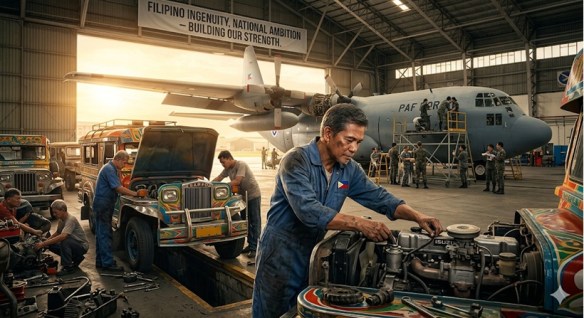
The Right to Repair is often discussed as consumer protection or environmental policy, but it is equally an educational strategy. Communities that learn to repair eventually learn to manufacture. Communities that manufacture eventually learn to design. Communities that design gradually learn to innovate. Innovation seldom begins with sudden inspiration. It usually begins with understanding how existing systems work.
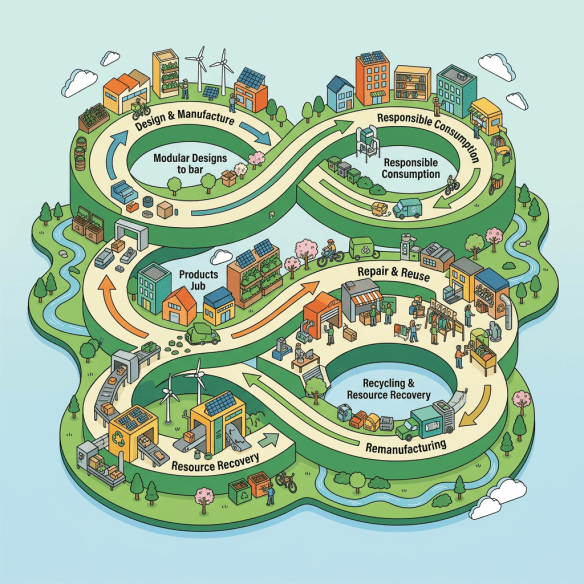
Likewise, the circular economy is not merely about environmental protection. It is about recovering lost capability.
Waste itself is rarely the problem. Unused capability is.
Electronic waste contains valuable metals waiting to be recovered. Agricultural residues become biofuels, fertilizers, advanced materials, and industrial feedstocks. Wastewater becomes freshwater through treatment and reuse. Plastics become recycled polymers for manufacturing. Artificial intelligence enables increasingly efficient sorting, recovery, logistics, and production.
Environmental stewardship and industrial competitiveness therefore reinforce rather than oppose one another.
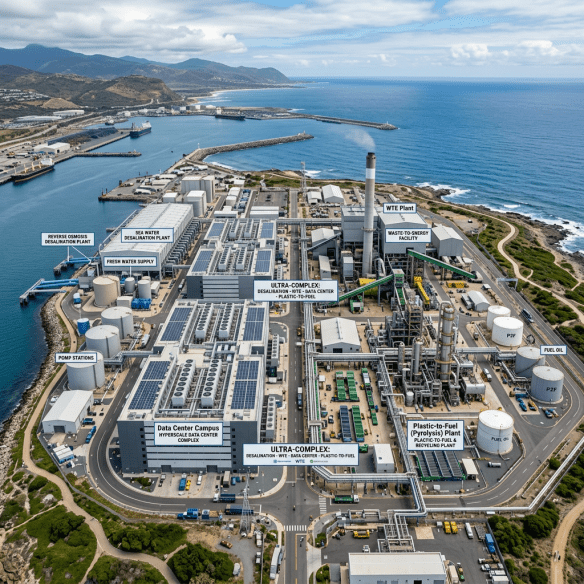
This philosophy finds perhaps its clearest expression in the idea of the Ocean Refinery.
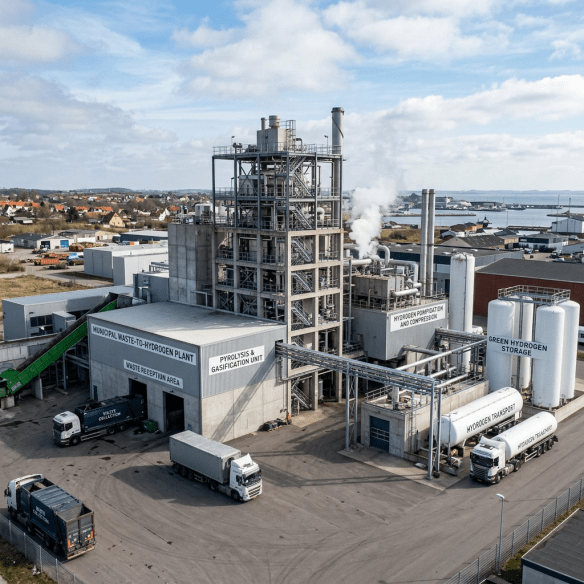
Instead of treating seawater, wastewater, municipal waste, agricultural residues, plastics, carbon emissions, and industrial by-products as separate problems, they become inputs within integrated systems capable of producing freshwater, hydrogen, recovered minerals, recycled materials, clean energy, industrial feedstocks, and new manufacturing industries.
Waste ceases to be something discarded.
It becomes something refined.
The Ocean Refinery is therefore much more than an engineering proposal. It becomes a metaphor for nation-building itself.
Schools refine human potential.
Universities refine knowledge.
Laboratories refine ideas.
Factories refine materials.
Artificial intelligence refines information.
Markets refine innovation.
Government refines institutions.
The Republic itself becomes the nation’s greatest refinery, continually transforming every form of capital—human, natural, industrial, digital, maritime, financial, institutional, and environmental—into greater national capability.
This broader understanding also transforms national security.
The Philippines inherited security institutions designed primarily for territorial defense. Protecting sovereignty will always remain indispensable, particularly for an archipelagic nation. Yet modern resilience increasingly depends upon capabilities extending well beyond traditional military strength.
Cybersecurity protects digital infrastructure.
Food security protects social stability.
Energy security sustains industrial production.
Scientific research strengthens technological independence.
Resilient supply chains reduce strategic vulnerability.
Disaster preparedness protects economic continuity.
Institutional adaptability enables recovery from unforeseen crises.
National security has become inseparable from national capability.
For the Philippines, geography itself should become an instrument of prosperity rather than an obstacle to development.
The seas should no longer divide islands; they should connect industries, communities, logistics networks, fisheries, renewable energy systems, research institutions, digital infrastructure, tourism, and regional commerce. Maritime governance, advanced shipbuilding, ports, marine science, offshore renewable energy, and digital connectivity together define the foundations of modern archipelagic power.
An archipelago connected by capability becomes stronger than an archipelago merely connected by geography.
Technology alone, however, cannot secure such a future.
Artificial intelligence cannot compensate for weak institutions. Data without analysis becomes noise. Information without judgment becomes confusion. Knowledge without execution accomplishes little.
Execution remains the true measure of capability.
This is why the Capability Republic must also become a Learning Republic.
Learning cannot remain confined to classrooms. It must become a permanent function of government, business, industry, and civil society. Every infrastructure project, disaster response, technological breakthrough, policy reform, economic crisis, and institutional failure should strengthen future capability through systematic learning.
Successful organizations conduct after-action reviews.
Innovative companies continuously improve.
Scientific communities build upon accumulated knowledge.
Governments should do the same.
Institutional memory prevents societies from repeatedly solving the same problems. Evidence replaces ideology. Continuous improvement replaces complacency. Adaptation replaces rigid bureaucracy.
Political will remains essential, but capability delivers what political will promises.
Political will announces ambitious projects.
Capability completes them.
Political will passes legislation.
Capability implements it.
Political will often depends upon personalities.
Capability resides within institutions that endure long after individual leaders have departed.
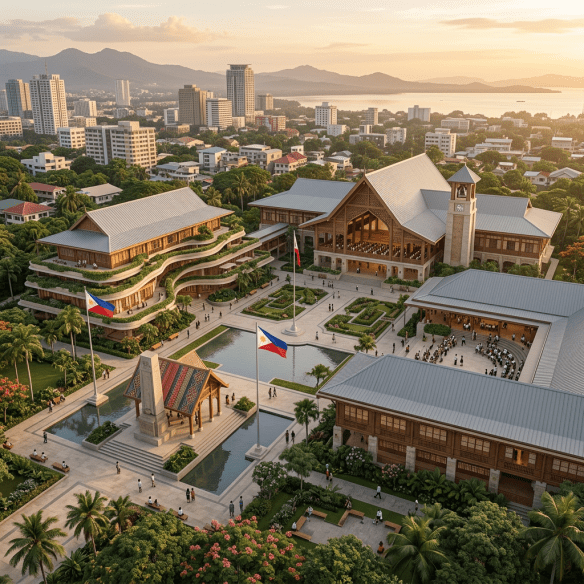
Ultimately, the Philippines should aspire to become more than a developing economy. It should become a Maritime Knowledge Republic—a nation that transforms its archipelagic geography into enduring prosperity through science, education, manufacturing, innovation, environmental stewardship, digital sovereignty, and institutional excellence.
The strongest nations of the twenty-first century will not necessarily possess the largest militaries, the richest deposits of natural resources, or even the most sophisticated artificial intelligence. They will be those whose citizens think critically, whose industries innovate relentlessly, whose governments execute competently, and whose institutions learn continuously.
The Philippines already possesses the essential ingredients for such a future: a strategic location at the crossroads of the Indo-Pacific, abundant natural and marine resources, democratic institutions, entrepreneurial energy, a young population, and one of the world’s most adaptable workforces.
The challenge is no longer discovering new advantages.
The challenge is transforming existing advantages into enduring capability.
Capability behaves much like compound interest. Every generation that builds stronger schools, more trustworthy institutions, deeper scientific knowledge, better infrastructure, and more innovative industries leaves the next generation with a higher starting point. Prosperity accumulates because capability accumulates.
Civilizations endure because they learn.
Nations prosper because they transform.
Republics flourish because they build institutions that enable ordinary people to achieve extraordinary things.
That is the long and winding road to capability.
And it is the road the Philippines must now choose to travel.




Karl,
I don’t think you can discuss the winding road to capability without addressing the high cost of energy in the Philippines.
Hawaii used to have super high electricity rates. They have since adopted solar energy which has greatly reduced their power rates.
Maybe along with eGovDH the Philippines should look at Hawaii’s solar energy model and see if it is feasible and worthwhile for the Philippines.
Oh yes I did by prpoosing wte and please read the Ocean refinery part, renewables, energy was discussed. Kind of weird but please do.
“… energy was discussed. “ – Karl G.
Well, more like mentioned, not really discussed. But I saw your follow up post on energy which discusses more extensively the need for building an energy system. Thanks. Look into what Hawaii did. You may find it interesting. I noticed it when I was there that most homes at least in the Honolulu area have solar panels on their roof tops.
Next blog, I already scheduled it. We have solar too. Though Loren Legrda and son are in hot water for other reasons, I guess. The son was instrumental in Solar growth, he deserves props for that.
Thanks, Karl….from the little I know of Hawaii’s model, the government has to be involved. It is a big project and involves a lot of money and agencies, including banks for financing. Hawaiians also got federal and state tax credits to help finance the purchase of a solar panel system.
I reread it and it was barely mentioned, my bad.
Oh, I actually mis-spoke w/ regard to Hawaii’s electricity rates. They are still high, but bills of many if not most of electricity consumers are much much lower because they do not purchase from the electric company but generate it from their own solar panels. So while the rate per kilowatt hour may still be high, they purchase much much less kilowatt hours from their Electric Company. That is how I understand it anyway.
Meralco, Rooftop Solar, and the Challenge of Fair Energy Pricing
As more Filipinos install rooftop solar panels to reduce their electricity bills, a growing debate has emerged over Meralco’s net-metering system. While homeowners invest their own money in solar equipment, the electricity they export to the grid is credited at only the generation charge rather than the full retail price. Many consumers believe this undervalues their contribution, while Meralco maintains that it must still recover the costs of maintaining the power grid, providing backup electricity, and ensuring reliable service.
The controversy has also expanded beyond pricing. Meralco has urged stricter enforcement against unregistered or “guerrilla” solar installations, arguing that improperly installed systems could endanger utility workers during power outages if they continue feeding electricity into the grid. Although modern certified solar inverters include safety features such as automatic shutdown during blackouts, authorities remain concerned about installations that do not meet technical standards.
Another major concern is the complexity of the registration process. Homeowners often face numerous documentary requirements, engineering certifications, inspections, and lengthy approval periods before they can legally participate in net metering. These administrative hurdles discourage many households from registering their systems, limiting the growth of distributed renewable energy.
Ultimately, the issue is not whether rooftop solar should be encouraged, but how to create a system that is fair to both consumers and utilities. Streamlining application procedures, maintaining rigorous safety standards, and reviewing how exported solar energy is valued could help strike a better balance. As the Philippines seeks cleaner and more affordable energy, modernizing its policies on rooftop solar will be essential to building a more resilient and sustainable electricity sector.
Karl,
Many of the public schools in the San Francisco Bay Area have solar panels, usually over formerly open parking spaces. So now they are covered parking spaces and they are a big help during warm weather months.
My local school district which installed solar panels in various schools is projected to save over $40 million dollars net of equipment amortization AND financing costs after 25 years of continuous electricity generation. The initial years’ savings is much less because that is when they pay off loans/financing costs, etc. But after about 13 years, the savings really pour in.
I’m happy to see our public schools benefiting from this cash flow benefit, not to mention clean energy generation. My 4 grandchildren are elementary public school age.
Karl,
Another Solar panel project that the state of California is working on is placing solar panels over the thousands of miles (4,000) of irrigation canals. A University of California study determined that such a project would help reduce water loss through evaporation AND allow for clean energy generation. It is still in the study stage because the engineering challenges are great. It is called Project Nexus.
I am excited about this one because it both saves water (now a valuable and expensive resource) AND produces clean renewable energy unlike fossil fuel based energy systems.
Hopefully this project comes to fruition faster than the High Speed Rail project that California has been spending on for a while now with nothing to show for it.
Why Electricity Remains Expensive in the PhilippinesCheap Power Is Not About Choosing the Right Fuel—It Is About Building an Energy System That Outlasts PoliticsBy Karl M. Garcia
Few issues affect Filipinos more directly than the cost of electricity. High power prices strain household budgets, increase the cost of doing business, raise food prices, discourage investment, and weaken the competitiveness of Philippine industry. Despite decades of reforms, the country’s electricity prices remain among the highest in Southeast Asia.
The Philippines’ geography is often blamed. As an archipelago of more than 7,000 islands, it is expensive to build transmission networks, interconnect isolated grids, and transport fuel. Unlike energy-exporting nations, the country also imports much of its coal, oil, and increasingly liquefied natural gas (LNG), exposing consumers to fluctuations in global energy markets.
These structural disadvantages are real, but they do not tell the whole story.
Indonesia is also an archipelago, yet electricity there is generally less expensive. Its abundant coal and natural gas resources certainly help, but the larger lesson is institutional. Indonesia has pursued long-term energy and industrial development with relatively greater continuity across administrations. Affordable electricity is rarely the result of a single fuel or technology. It is the product of decades of coordinated investments in infrastructure, regulation, financing, and governance.
This distinction is important because public debate often revolves around choosing between coal, natural gas, renewables, or nuclear energy. In reality, no single technology can guarantee affordable electricity. Electricity prices depend on the performance of the entire energy system.
Generation is only the first step.
Power must move efficiently from generating plants to homes, factories, hospitals, and businesses through transmission lines, substations, distribution networks, and submarine interconnections. When transmission becomes congested, cheaper electricity cannot reach consumers, forcing system operators to dispatch more expensive plants closer to demand centers. Consumers ultimately pay for these inefficiencies.
Transmission infrastructure therefore deserves as much attention as new power plants.
The Philippine archipelago requires a modern and resilient national grid that strengthens interconnections among Luzon, the Visayas, and Mindanao while extending reliable electricity to isolated island communities. Investments in high-voltage transmission lines, digital grid management, and additional submarine cables can reduce congestion, improve reliability, and create a more competitive electricity market.
Reserve capacity is another frequently overlooked cost.
Electricity systems cannot simply produce enough power for average demand. They must maintain reserves to respond immediately when a power plant unexpectedly shuts down or when electricity demand suddenly rises. As renewable energy expands, these reserve requirements become even more important because solar and wind generation depends on weather conditions.
This is where battery energy storage systems, pumped-storage hydropower, flexible natural gas plants, and demand-response programs become essential. Rather than competing with renewable energy, they enable renewable energy to operate reliably within the power system.
China’s recent experience illustrates this challenge. Despite becoming the world’s largest producer of solar and wind energy, parts of China have experienced renewable energy curtailment—electricity that cannot be fully utilized because transmission networks, storage capacity, and market rules have not expanded quickly enough.
The lesson is clear.
An energy transition is not simply about producing more electricity. It is about building an electricity system capable of delivering, storing, and managing that electricity efficiently.
The Philippines is already moving in this direction. Offshore wind projects are advancing, battery storage investments are increasing, LNG import terminals have begun operating as domestic gas production declines, and discussions on nuclear energy continue. These developments are encouraging, but they must be matched by investments in transmission, storage, grid flexibility, cybersecurity, and modern electricity markets.
Financing also plays a significant role in electricity prices.
Power plants, transmission lines, substations, and storage facilities require billions of pesos in long-term investment. Investors demand higher returns when projects face permitting delays, uncertain regulations, changing policies, or prolonged right-of-way disputes. These financing costs eventually become part of the electricity prices paid by consumers.
Lowering regulatory uncertainty can therefore reduce electricity prices even without discovering new energy resources.
Market design is equally important. Competitive electricity markets should reward efficiency, reliability, and flexibility rather than simply installed generating capacity. Transparent pricing, efficient dispatch rules, streamlined permitting, and predictable regulation encourage investment while reducing unnecessary costs throughout the power sector.
Energy policy should also be viewed as industrial policy.
Programs such as the Tatak Pinoy Act and CREATE MORE seek to expand manufacturing, attract higher-value industries, and strengthen domestic production. These goals depend heavily on affordable and reliable electricity. Semiconductor manufacturing, artificial intelligence, cloud computing, modern logistics, and large-scale data centers all require stable power supplies at internationally competitive prices.
Food security also depends on energy infrastructure. Modern refrigerated warehouses, cold-chain logistics, and food processing facilities require dependable electricity. Better logistics reduce food waste while lowering operating costs throughout agricultural supply chains.
Emerging technologies such as waste-to-energy facilities may also complement broader waste management and energy strategies where economically and environmentally appropriate. Although they cannot replace renewable energy, they may provide dependable dispatchable electricity while reducing landfill volumes under strict environmental safeguards.
Ultimately, however, the greatest challenge facing the Philippine energy sector is not technological.
It is institutional.
Electricity infrastructure lasts for decades. Transmission corridors, offshore wind farms, LNG terminals, battery storage systems, nuclear programs, and industrial zones require long-term planning that extends well beyond a single presidential administration. Policies interrupted by political transitions increase uncertainty, delay investment, and raise financing costs that eventually appear in consumers’ electricity bills.
The Philippines does not need to replicate Indonesia’s fuel mix or China’s scale of investment. Instead, it can learn from both experiences.
Indonesia demonstrates the value of institutional continuity in infrastructure and industrial development. China demonstrates that renewable energy succeeds only when generation, transmission, storage, reserve markets, and electricity market design evolve together.
The Philippines possesses abundant renewable energy resources, a growing economy, and increasing investor interest. What it needs most is an energy strategy that integrates generation, transmission, financing, industrial policy, and governance into a single long-term national framework.
Affordable electricity will not come from one fuel, one technology, or one election cycle.
It will come from building an energy system in which infrastructure, markets, regulation, financing, and industrial development reinforce one another year after year.
In the end, the country’s greatest energy challenge is not simply that it is an archipelago.
It is whether it can build institutions capable of making progress accumulate faster than politics interrupts it.
Thanks for the extended report on energy in the Philippines. Something for the long and winding road. I don’t have the patience for that. I prefer freeways. Luckily I have a choice.
I appreciate that aspirational goals are good to have but aspiration must be linked to action or the goals will remain in aspiration only. I would also caution against bundling a multitude of disparate goals together — in order to save effort and make goals less intimidating it’s useful to break them down then cluster goals that share interdependencies.
Many many thsnks Joey I still persist that Ambition, Capaciy and Capabiloty is a long and winding road that is a highway to hell or seventh heaven too much heaven.
“I still persist that Ambition, Capaciy and Capabiloty is a long and winding road that is a highway to hell or seventh heaven too much heaven.” – Karl G.
Dang, Karl…those typos can be annoying, hehehe
Long and winding road is okay, for the elite in their Air Conditioned homes and cars and resorts. But the bulk of Filipinos do not have the luxury of that time. The need is urgent…but then we are resilient which is what the elite hope the “masa” will be…so they (the elite) don’t have to work so hard to change things.
Karl,
I’ve had a chance to look more closely at this essay of yours and have come up with a question for the group not necessarily for an answer, but for discussion of possible answers:
>>On the article’s point about filtering out the noise of the ‘Reassurance Economy’ and politicians selling quick fixes:
What specifically can we discern as the primary ‘fake reassurance’ currently holding back Philippine governance—and what is the hard, unglamorous truth we should be facing instead?<<
On Reassurance it could be anything from botlled water safeness marketing , supplement efficacy marketing or a leader saying there there cheer up and chin up.
Wharever it mens, yoy are correct that there are inconvenient truths if we must handle the truth not by griining and bearing but by….capability.
“On Reassurance it could be anything…” – Karl G.
I was hoping you could narrow it down to the “primary” fake reassurance.