From Rizal and La Solidaridad to algorithms and artificial intelligence
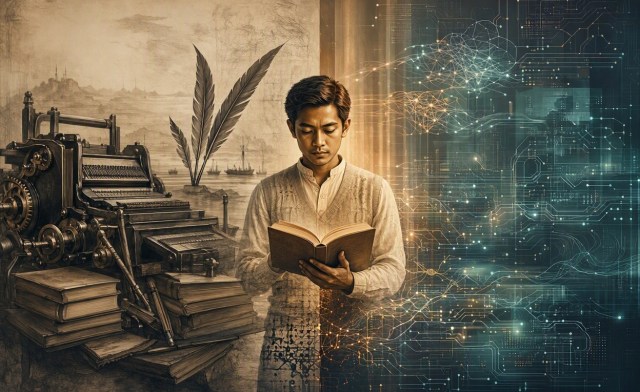
By Karl M. Garcia
Every generation inherits a country it did not create.
It inherits a language, a culture, a history, a religion, institutions, stories, assumptions and accumulated knowledge.
Increasingly, it also inherits something less visible: systems that decide what information it encounters.
Algorithms select what appears on a screen. Search engines determine what becomes visible. Social platforms shape what is amplified. Artificial intelligence can now summarize, compare, translate and generate information at a scale no previous generation experienced.
The machinery has changed.
The fundamental human question has not:
How do we learn from what we inherit without surrendering our capacity to judge it?
This is more than a question of education.
It is a question of culture, history, citizenship, technology and national development.
It is also a question of independence.
A country can be politically sovereign while remaining intellectually dependent—consuming other people’s theories, technologies, narratives and institutional models without developing enough capacity to examine, adapt, challenge and eventually contribute its own.
Intellectual independence does not mean thinking alone.
It means thinking with enough capacity to decide for ourselves.
We inherit.
We examine.
We learn.
We test.
We adapt.
We create.
And eventually, we decide what deserves to be passed on.
That is discernment.
WE LEARN CULTURE BEFORE WE LEARN TO QUESTION IT
A Filipino child does not begin by studying the historical origins of hiya, pakikisama or utang na loob.
The child experiences them.
Respect your elders.
Say po and opo.
Help your relatives.
Return a favor.
Do not embarrass the family.
Get along with others.
Work hard.
Remember where you came from.
Much of this contains genuine wisdom.
But culture transmits more than wisdom. It also transmits assumptions.
After enough repetition, a practice stops feeling like a choice. It becomes instinct.
This is how culture survives across generations.
But transmission does not automatically distinguish between a principle and the circumstances that produced it.
Something can feel natural simply because we encountered it before we learned to question it.
That is why education must do more than transmit conclusions.
It must teach people how conclusions are formed.
The mature learner eventually asks:
Why do we believe this?
Where did it come from?
What problem was it originally solving?
Does that problem still exist?
What evidence supports it?
What happens when circumstances change?
This is where tradition becomes discernment.
RIZAL DID NOT CHOOSE BETWEEN THE WORLD AND THE PHILIPPINES
José Rizal lived before the internet, but he did not live in an intellectually isolated Philippines.
His world was already connected by ships, books, newspapers, correspondence, universities, scientific societies and the printing press.
He studied languages, history, science and literature. He encountered European intellectual traditions and engaged scholars and reformers beyond the archipelago.
Yet his purpose was not simply to absorb foreign ideas.
He used ideas from elsewhere to examine Philippine reality.
That distinction matters.
Independence is not the absence of outside influence.
It is the ability to encounter outside influence without becoming intellectually subordinate to it.
Rizal did not need to become European to learn from Europe. Nor did he need to reject European thought to remain Filipino.
He could encounter an idea, examine it, adapt it and place it against Philippine circumstances.
That is a more demanding form of independence than either imitation or isolation.
It requires enough confidence to learn from others and enough judgment to disagree with them.
LA SOLIDARIDAD AND THE TECHNOLOGY OF INTELLECTUAL LIFE
The Propaganda Movement offers an early Philippine example of how information infrastructure can expand intellectual possibility.
Marcelo H. del Pilar, Graciano López Jaena, Mariano Ponce, Rizal and others operated across geographic boundaries. La Solidaridad, founded in Barcelona in 1889, became an important vehicle for reformist ideas.
Its circulation was limited. Its audience was not mass in the modern sense. Yet its significance cannot be measured simply by readership.
It helped create a network of ideas.
The printing press created reach.
Correspondence created connection.
Books created shared references.
Arguments created intellectual communities.
Technology provided the channel.
Human beings supplied the judgment.
The same pattern has appeared in every information revolution.
Newspapers expanded the public sphere.
Radio expanded simultaneous communication.
Television expanded mass visual culture.
The internet expanded access.
Social media expanded participation.
Artificial intelligence is expanding the ability to synthesize and generate information.
Every information revolution changes the scale, speed and structure of communication.
None eliminates the need for judgment.
In fact, the more powerful the information system becomes, the more consequential judgment becomes.
THE EDITOR IS NO LONGER ALWAYS VISIBLE
Traditional media always involved selection.
Editors chose headlines. Publishers chose manuscripts. Broadcasters chose programs.
Media was never a perfect mirror of reality. It selected, emphasized and framed.
Digital systems have not eliminated selection.
They have automated, personalized and accelerated it.
Two people can open the same platform and encounter very different information environments.
The question is no longer simply:
What was published?
It is also:
Why did this reach me?
And:
What did not reach me?
A provocative claim may attract attention. A familiar opinion may reinforce an existing belief. A simple explanation may travel farther than a nuanced one.
But:
Visibility is not truth.
Popularity is not proof.
Repetition is not evidence.
The modern reader therefore acquires a responsibility once associated primarily with editors and publishers.
The reader must become the final editor.
DISCERNMENT IS NOT CYNICISM
There is, however, an equal danger.
Once people discover that information can be manipulated, they may conclude that nothing can be trusted.
That is not independence.
If every institution is assumed to lie, every expert is dismissed as compromised, and every established fact is treated as propaganda, skepticism can become another form of dependence—dependence on whichever alternative story happens to feel convincing.
Discernment requires something harder than suspicion.
It requires calibrated trust.
What is the source?
What evidence does it provide?
How strong is that evidence?
Are there independent sources?
What remains uncertain?
What would change the conclusion?
Where does the source’s expertise end and interpretation begin?
This allows us to distinguish:
skepticism from cynicism,
criticism from rejection,
uncertainty from ignorance,
and evidence-based disagreement from mere contradiction.
Intellectual independence does not mean believing nothing.
It means knowing why we believe something and how strongly the evidence warrants believing it.
HISTORY MUST SURVIVE CONTACT WITH EVIDENCE
The same discipline must be applied to national memory.
Filipinos inherit historical stories. Some are well documented. Some are contested. Some are cultural traditions. Some are later constructions.
These categories are not interchangeable.
The history of the supposed Code of Kalantiaw illustrates why.
For generations, it was presented as an ancient Philippine legal code. Later historical scholarship established that its supposed precolonial provenance was not credible and that the source was a much later fabrication.
The lesson is deeper than discovering that one story was wrong.
A false story can still have a real social history.
People believed it. Schools taught it. Institutions repeated it. Generations remembered it.
Its existence therefore tells us something about the society that accepted it, even though the historical claim itself does not withstand evidence.
The desire for historical dignity is understandable, especially in a society whose colonial experience often diminished indigenous achievement.
But dignity cannot depend on invention.
Reality does not need embellishment to become worthy of respect.
The Philippines has an actual history rich enough to examine honestly: archaeological evidence, indigenous societies, trade networks, languages, political communities, cultural systems, resistance and achievement.
We do not need invented antiquity when the real past is already complex.
MEMORY, TRADITION AND HISTORY ARE NOT THE SAME THING
The Maragtas tradition illustrates another distinction.
Pedro Alcantara Monteclaro’s Maragtas, published in 1907, should not simply be treated as an ancient surviving document establishing a precolonial migration exactly as later popular accounts sometimes describe it.
But historical reliability and cultural significance are different questions.
A tradition can preserve identity.
An oral narrative can preserve memory.
A legend can reveal how a community understood its origins.
A story can tell us what people valued without establishing every event as historical fact.
Likewise, contested historical questions should not be forced into false certainty.
The alleged Rizal retraction belongs to a different evidentiary category from the Kalantiaw fabrication. It remains a subject of historical debate involving documentary authenticity, provenance and interpretation.
A mature historical culture therefore needs a vocabulary for degrees of confidence:
documented, probable, contested, uncertain, discredited.
The objective is not to doubt everything.
It is to match confidence to evidence.
KNOWLEDGE IS SUPPOSED TO CHANGE
The history of scholarship teaches another form of humility.
The migration model associated with H. Otley Beyer was once highly influential in explaining Philippine population origins. Later research in archaeology, linguistics, genetics and related fields challenged important parts of that framework.
This does not require assuming that earlier scholarship was dishonest.
It demonstrates something more important:
Knowledge is revisable.
A theory can be reasonable given the evidence available at one moment and become inadequate when new evidence appears.
That is not necessarily the failure of scholarship.
It can be evidence that scholarship is working.
Science progresses partly by discovering that earlier explanations were incomplete.
History progresses when sources are reexamined.
Engineering progresses when failures reveal weaknesses in design.
Medicine progresses when evidence overturns established practice.
Institutions progress when measurement reveals that programs do not work as intended.
A society that cannot revise its understanding eventually turns knowledge into dogma.
“HOW DO WE KNOW?” AS A NATIONAL HABIT
Perhaps one of the most valuable questions Philippine education could cultivate is deceptively simple:
How do we know?
Who produced this?
When?
Where?
For what purpose?
What evidence supports it?
Is there independent corroboration?
What assumptions are being made?
What evidence contradicts it?
When did the claim first appear?
What would cause us to revise our conclusion?
These questions apply far beyond history.
They apply to political claims, economic promises, health information, viral posts, advertising, scientific claims, government statistics and AI-generated content.
Historical literacy therefore becomes information literacy.
And information literacy becomes a form of civic capability.
IDEAS SHOULD BE TOOLS, NOT IDOLS
Intellectual independence also requires freedom from intellectual tribalism.
We should be able to read Marx without becoming Marxists.
We should be able to read Ayn Rand without treating Atlas Shrugged as economic scripture.
We can study Keynes and Friedman, Acemoglu and Robinson, Kahneman and other influential thinkers without assuming that any one framework explains the entire world.
We can study Western political thought without assuming that Western institutions automatically fit Philippine conditions.
We can study Asian development without assuming that another Asian country’s trajectory can simply be copied.
And we can study Filipino thinkers without treating them as infallible.
Rizal can be essential without being beyond criticism.
Mabini can remain indispensable to Philippine political thought without providing an answer to every twenty-first-century problem.
Ideas should be tools, not idols.
The question is not whether an idea is foreign or Filipino.
The question is:
Does it help us understand reality?
THE PHILIPPINE TEST
Ideas travel across borders.
A theory developed in Europe may illuminate Philippine society.
A policy developed in East Asia may contain useful lessons.
An institutional model from North America may solve a problem elsewhere.
But no imported framework arrives without assumptions.
The Philippines has its own geography, archipelagic structure, history, local governments, family networks, migration economy, demographics, political institutions, inequalities and cultural practices.
So the question should never simply be:
How do we copy this?
It should be:
What survives contact with Philippine reality?
What does it explain?
What does it miss?
What assumptions does it make?
What evidence supports it?
What must be modified?
And what can Philippine experience contribute back to the original theory?
This is how a country moves from being a consumer of knowledge to a producer of knowledge.
CULTURE SHOULD BE ADAPTED, NOT SIMPLY PRESERVED
The same discipline applies to Filipino values.
Consider utang na loob.
At its best, it expresses gratitude and reciprocity. Someone helped you. You remember. When you become capable, you help someone else.
But reciprocity can become dependency. A favor can become political loyalty. Assistance can become control. Gratitude can become permanent indebtedness.
The value worth preserving is gratitude.
The dependency is not.
Consider pakikisama.
Cooperation is essential. But cooperation becomes conformity when disagreement is interpreted as betrayal.
A modern expression of pakikisama might therefore be:
Work with the group while helping the group improve.
Then there is hiya.
It can restrain selfishness. But it can also produce silence.
A worker does not complain. A student does not ask. A victim does not report. A junior employee sees something wrong but remains silent because the person responsible is senior.
The answer is not to eliminate hiya.
It is to redirect it.
We should be ashamed of corruption, cruelty, dishonesty and abuse.
We should not be ashamed of asking questions, admitting mistakes, seeking help or demanding accountability.
Likewise, respect for elders should not become automatic deference.
Respect the person. Examine the proposition.
The objective is not to erase Filipino culture.
It is to separate its enduring purposes from habits that no longer serve them.
FROM PERSONAL TRUST TO SYSTEM TRUST
Filipino society places great importance on personal trust. That is understandable.
But a modern state cannot operate entirely through personal relationships.
A citizen should not need to know someone inside an agency to obtain a legitimate service.
A business should not require political connections to receive a permit.
A contractor should not need a patron to compete.
A patient should not need influence to receive appropriate care.
A student should not need family connections to access opportunity.
The institutional principle is simple:
Trust people, but verify systems.
The goal is not to eliminate relationships.
It is to prevent relationships from becoming prerequisites for rights, services and opportunity.
This is modernization without cultural erasure: preserving solidarity while making institutions less dependent on personal connections.
FROM VALUES TO INSTITUTIONS
Utang na loob can teach gratitude.
Institutions should not depend on personal indebtedness.
Pakikisama can encourage cooperation.
Institutions must still protect disagreement.
Hiya can encourage social responsibility.
Institutions must protect people who report wrongdoing.
Respect for elders can preserve institutional memory.
Professional systems must still allow younger experts to challenge established assumptions.
Family solidarity can strengthen social responsibility.
Public institutions must still use merit rather than family privilege.
The objective is to translate constructive cultural purposes into systems that remain fair even when personal relationships are absent.
That is a deeper form of modernization than simply replacing old customs with imported ones.
THE REAL TEST OF AN INSTITUTION
The question is not whether an institution has admirable people.
It is whether its design can survive ordinary human limitations.
Can a qualified person enter without knowing the right person?
Can an employee tell the truth when the truth is inconvenient?
Can a junior professional challenge a senior official when evidence warrants it?
Can decisions be documented?
Can citizens understand what an institution is supposed to deliver?
Can performance be measured?
Can failure be identified?
Can mistakes be corrected?
Can leadership change without destroying institutional memory?
Can a successful program survive the departure of its champion?
These questions move governance away from personality and toward architecture.
Because people change.
Leadership changes.
Administrations change.
Institutions must therefore be designed to learn beyond the individual.
THE REAL OBJECTIVE IS INSTITUTIONAL LEARNING
No institution is perfect.
The more realistic objective is learning capacity.
A hospital needs systems for reporting errors.
An engineering organization needs safety review.
A military needs after-action assessment.
A university needs academic scrutiny.
A government agency needs performance measurement.
A democracy needs elections, oversight, journalism, civil society and lawful political competition.
The common principle is:
No institution should depend entirely on the wisdom of the person currently in charge.
Good institutions detect errors.
They investigate them.
They correct them.
They preserve the lesson.
They reduce the likelihood of repetition.
Institutional excellence is therefore not perfection.
It is the capacity to learn.
INSTITUTIONS MUST OUTLIVE PERSONALITIES
A recurring weakness in public administration is the tendency for successful programs to become identified with individual leaders.
A reform-minded official improves an agency. A mayor creates an effective program. A general modernizes a capability. A president launches a major project.
Then leadership changes.
Personnel change. Priorities change. Budgets change.
The program weakens.
The country starts again.
This is institutional fragility.
The deeper question is not merely:
What did this person accomplish?
It is:
What remains functional after this person leaves?
A successful initiative becomes national capability only when institutions can carry it forward, evaluate it and improve it.
AI CHANGES THE COST OF KNOWLEDGE
Artificial intelligence makes discernment more important because it changes the economics of information.
Earlier generations often faced scarcity.
Books could be difficult to find. Archives could be distant. Translation could require enormous effort. Research could take hours simply to locate relevant material.
AI can reduce many of these barriers.
It can translate, summarize, compare, organize, explain, generate, search across large bodies of material and help people identify possible connections.
These capabilities are extraordinary.
But abundance creates a paradox:
When information becomes cheaper, judgment becomes more valuable.
An AI system can produce fluent prose without guaranteeing factual accuracy.
A search engine can retrieve a popular claim without establishing that it is well supported.
A social platform can show thousands of people repeating something without transforming repetition into evidence.
A polished summary can omit the qualification that changes the meaning.
Therefore:
Fluency is not accuracy.
Confidence is not knowledge.
Popularity is not proof.
Automation is not judgment.
THE DANGER IS NOT AI. IT IS INTELLECTUAL OUTSOURCING.
The deepest AI question may therefore not be whether machines can perform increasingly sophisticated cognitive tasks.
It is whether humans will continue performing the intellectual work for which they remain responsible.
Why read the original document if a summary exists?
Why compare arguments if a chatbot can synthesize them?
Why examine evidence if an answer arrives immediately?
Why struggle with a difficult concept if an explanation is available in seconds?
These shortcuts can increase productivity.
They can also become habits.
There is a fundamental difference between:
using AI to extend reasoning
and
using AI to avoid reasoning.
The first can increase capability.
The second can transfer responsibility.
AI can become a research assistant, translator, tutor, brainstorming partner, comparative tool and interface to enormous bodies of information.
But it should not become the final authority over questions whose consequences belong to humans.
The proper sequence is:
human question → tools → evidence → examination → judgment → action.
Not:
machine answer → human obedience.
The machine can extend cognition.
It should not inherit responsibility.
A COUNTRY NEEDS INTELLECTUAL INFRASTRUCTURE
Independent judgment cannot be placed entirely on individuals.
No citizen can personally verify every scientific paper, economic statistic, historical document, government dataset and technical proposition encountered in modern life.
Knowledge is distributed.
Verification is distributed.
Expertise is distributed.
That is why societies need institutions that support judgment:
Libraries.
Archives.
Universities.
Research centers.
Schools.
Museums.
Statistical agencies.
Professional organizations.
Public records.
Serious journalism.
Scientists, historians, writers and artists.
Together, these form a country’s intellectual infrastructure.
Physical infrastructure moves people, goods, energy and information.
Intellectual infrastructure helps society determine:
what information exists,
where it came from,
what evidence supports it,
what knowledge should be preserved,
what knowledge should be challenged,
and what new knowledge can be created.
A country cannot demand independent thinking from its citizens while allowing the institutions that sustain independent thinking to decay.
PRESERVING MEMORY IS NATIONAL CAPABILITY
The problem is not only access.
It is memory.
Newspapers disappear. Magazines deteriorate. Photographs fade. Broadcast recordings are lost. Old books and komiks become difficult to locate. Websites disappear. Digital platforms change.
This creates a historical vulnerability:
We are producing more information than any previous generation, while some of it may be less durable than information printed a century ago.
Future Filipinos should be able to examine what Filipinos actually read, watched, created, argued about and believed.
That means preserving not only canonical literature but popular culture; not only official documents but public commentary; not only books but photographs, recordings, newspapers, magazines, websites and other digital artifacts.
Digitization is therefore not merely a technical project.
It is an act of national memory.
A country that repeatedly loses its intellectual record must repeatedly rediscover itself.
FREEDOM REQUIRES A CHAIN OF KNOWLEDGE
There is also a civic dimension.
Freedom of expression matters. But expression alone does not produce informed judgment.
Citizens also need access to records.
They need the ability to investigate claims.
They need institutions capable of preserving evidence.
They need education capable of developing judgment.
The chain is:
access → information → understanding → judgment → participation.
A weakness anywhere affects the whole system.
Information that cannot be accessed cannot easily be examined.
Information that cannot be examined cannot reliably inform judgment.
Judgment without meaningful participation cannot fully shape public life.
Intellectual independence is therefore not merely a philosophical virtue.
It is part of the infrastructure of a functioning republic.
FROM FAMILY SOLIDARITY TO INSTITUTIONAL FAIRNESS
Modernity does not require the destruction of Filipino solidarity.
The overseas Filipino experience demonstrates something more complicated.
A worker may leave the country precisely because of obligations to children, parents, siblings or a spouse.
The geography changes.
The relationship does not necessarily disappear.
Modern technology can allow family members to contribute from Manila, Cebu, Singapore, Dubai, Toronto or a home office serving a global client.
Modernity has therefore not simply weakened Filipino solidarity.
It has expanded the places from which solidarity can operate.
The challenge is to connect:
family prosperity → community capability → national development.
Family should remain a source of solidarity without becoming an alternative to merit, rights and institutional fairness.
GLOBAL EXPOSURE CAN BECOME INSTITUTIONAL LEARNING
The OFW and BPO economies transmit more than money.
They transmit expectations.
A worker may encounter organizations where documentation matters, professional expertise is valued, performance is measured, customer complaints produce processes and accountability is built into workflows.
Those experiences can change expectations at home.
A worker accustomed to transparent procedures may ask why local procedures remain opaque.
A professional accustomed to merit-based recruitment may question why personal connections remain influential.
A worker accustomed to performance measurement may ask why public agencies cannot measure their own service delivery.
This creates a potential feedback loop:
global exposure → new expectations → institutional pressure → reform.
International exposure therefore need not produce cultural surrender.
It can produce institutional learning.
THE PHILIPPINES AS A LEARNING SYSTEM
This may be the deepest connection between culture, information and governance.
We should stop asking only whether the Philippines has the right laws, leaders or plans.
We should also ask:
Can the Philippines learn?
An individual learns to ask:
How do I know?
A good institution asks the same question.
An individual learns:
I may be wrong.
A good institution creates mechanisms for discovering when it is wrong.
An individual learns:
Evidence can change my mind.
A good institution creates procedures through which evidence can change policy.
An individual learns that a predecessor may have known something important.
A good institution preserves institutional memory.
But the individual must also recognize that the predecessor may have been wrong.
A good institution therefore preserves knowledge while correcting errors.
This creates a larger cycle:
discernment → knowledge → institutional learning → better outcomes → public trust → stronger institutions → greater capacity to learn.
That is not merely cultural development.
It is national capability.
FROM INFORMATION TO CAPABILITY
Information alone does not make a country independent.
A nation can consume enormous quantities of information while producing little knowledge of its own.
It can import technology without developing the capability to maintain it.
It can borrow policy frameworks without developing the research capacity to test them.
It can use advanced software without understanding the systems beneath it.
It can ask foreign institutions to define its problems without developing enough intellectual infrastructure to define them itself.
The deeper progression is:
information → understanding → knowledge → capability → contribution.
The same progression applies to culture:
inheritance → examination → adaptation → institutionalization → capability.
And to national development:
memory → judgment → learning → systems → outcomes.
This is why intellectual independence is not an abstract cultural aspiration.
It is an economic and institutional capability.
Countries that can learn can adapt.
Countries that can investigate their own problems can design solutions suited to their circumstances.
Countries that preserve knowledge do not repeatedly reinvent what they once knew.
Countries that generate research become less dependent on borrowed explanations.
Countries that translate knowledge into institutions convert education into national capacity.
THE GOAL IS NOT TO THINK ALIKE
Intellectual independence does not mean that Filipinos should reach identical conclusions.
A healthy intellectual culture will contain disagreement.
Economists will disagree. Historians will disagree. Scientists will debate. Artists will challenge conventions. Citizens will argue about public policy.
That is not necessarily dysfunction.
The danger is losing the ability to distinguish:
argument from assertion,
evidence from repetition,
expertise from authority,
conviction from knowledge,
and uncertainty from false certainty.
A mature intellectual culture does not eliminate disagreement.
It makes disagreement more intelligent.
FROM RIZAL TO ARTIFICIAL INTELLIGENCE
The circumstances have changed almost beyond recognition.
Rizal needed books, correspondence and printing presses.
The next generations had newspapers, radio, television and magazines.
Then came computers, the internet, search engines and social media.
Now artificial intelligence.
Each technological revolution has expanded the capacity to create, access and distribute information.
But the human responsibility remains remarkably familiar:
Read.
Investigate.
Compare.
Question.
Learn.
Adapt.
Decide.
The lesson from Rizal is therefore not that Filipinos should reject foreign influence.
It is almost the opposite:
Engage the world deeply enough to meet it as intellectual equals.
Read European thinkers.
Read Asian thinkers.
Read American thinkers.
Read Filipino thinkers.
Read those we admire.
Read those we disagree with.
Use technology.
Use AI.
Use every tool that expands the capacity to learn.
But retain responsibility for judgment.
THE REAL MEANING OF INDEPENDENCE
The deepest form of independence is not freedom from influence.
No society is free from influence.
Cultures exchange ideas. Languages borrow. Technologies travel. Religions cross borders. Institutions adapt. Science is cumulative. Knowledge itself is international.
The objective is therefore not purity.
It is agency.
Can we encounter an idea without automatically adopting it?
Can we reject an idea for reasons stronger than where it came from?
Can we change our minds without feeling that we have betrayed ourselves?
Can we acknowledge that our ancestors were wrong about something without dishonoring them?
Can we learn from other societies without becoming copies of them?
Can we use technology without allowing technology to determine what we value?
Can we use AI without outsourcing judgment?
Can we preserve tradition without becoming prisoners of precedent?
Can we modernize without becoming culturally rootless?
These are the questions of a mature society.
WHAT SHOULD WE PASS ON?
Perhaps the most important inheritance should not be a fixed list of conclusions.
It should be a habit of examination.
Respect elders.
But ask questions.
Honor tradition.
But investigate its origins.
Love the country.
But do not manufacture evidence to make it look older or greater.
Help your family.
But do not turn gratitude into permanent dependency.
Cooperate with others.
But retain the courage to disagree.
Be humble.
But do not be ashamed to demand your rights.
Remember history.
But distinguish memory from evidence.
Study religion.
But distinguish understanding from conversion.
Protect religious freedom.
But preserve pluralism.
Study foreign ideas.
But test them against Philippine reality.
Use AI.
But do not outsource judgment to it.
Build institutions.
But do not make them dependent on personalities.
Measure performance.
But do not confuse activity with results.
Preserve institutional memory.
But do not preserve mistakes merely because they are old.
Teach values.
But teach children why those values matter.
And when evidence changes:
allow understanding to change with it.
A nation does not become weaker when it discovers that one of its cherished stories was inaccurate.
It becomes stronger when it can say:
We were wrong about this. Now we know more.
That is not the destruction of identity.
It is intellectual maturity.
CULTURAL CONTINUITY IS NOT CULTURAL IMMOBILITY
The Philippines does not have to choose between tradition and modernity.
It can carry tradition forward without carrying every assumption forward with it.
It can preserve the value while changing the form.
It can honor memory while correcting the record.
It can respect ancestors without surrendering the future to them.
It can study other civilizations without surrendering its own identity.
It can build institutions that are distinctly Filipino in purpose while meeting universal standards of competence, accountability, evidence and human dignity.
A living culture does not merely preserve itself.
It learns.
And learning necessarily involves change.
The question is not whether culture changes. It always does.
The question is whether change is conscious or accidental, examined or imposed, adaptive or merely reactive.
Discernment gives culture agency over its own evolution.
FROM INHERITANCE TO A CAPACITY OF OUR OWN
Every generation inherits a culture it did not create.
Stories it did not write.
Institutions it did not design.
Technologies it did not invent.
Knowledge it did not produce.
Assumptions it did not choose.
We cannot control everything we inherit.
But we can control how critically we engage with it.
That is why the deepest form of independence is not freedom from outside influence.
It is the capacity to encounter influence without losing the ability to choose, adapt and create.
We do not need intellectual isolation.
We need intellectual capacity.
We do not need to reject foreign ideas.
We need the ability to interrogate and adapt them.
We do not need to distrust every tradition.
We need to distinguish wisdom from habit.
We do not need to distrust every historical narrative.
We need to distinguish memory from evidence.
We do not need to reject religion.
We need religious literacy capable of sustaining pluralism.
We do not need to destroy Filipino values.
We need to translate their constructive purposes into modern conditions.
We do not need institutions that never fail.
We need institutions capable of detecting, correcting and learning from failure.
We do not need AI to think for us.
We need to use AI without outsourcing judgment to it.
The objective can therefore be stated simply:
Learn from everywhere.
Think from here.
Question what we inherit.
Respect what deserves respect.
Correct what evidence disproves.
Adapt what remains valuable.
Build institutions that can learn.
Use every tool available.
Keep judgment human.
Create knowledge of our own.
And contribute it to the world.
The real inheritance is not everything we received.
It is our capacity to decide:
what deserves to be remembered,
what deserves to be believed,
what deserves to be questioned,
what deserves to be changed,
and what deserves to be passed on.
Perhaps the most valuable tradition of all is not obedience to the past.
It is the courage to examine the past so that the future does not inherit our mistakes along with our wisdom.
And perhaps the measure of a mature nation is not how much information it can consume.
It is whether it can turn information into understanding, understanding into knowledge, knowledge into capability, and capability into institutions that can learn.
That is the journey:
from inheritance to discernment,
from discernment to knowledge,
from knowledge to capability,
from capability to institutions,
and from institutions to genuine national agency.
We inherit a country.
We examine it.
We learn from the world.
We test what we have been taught.
We preserve what deserves preservation.
We correct what must be corrected.
We build what is missing.
We create what does not yet exist.
And then—
we pass on a country more capable of thinking, learning and deciding for itself.


This piece is chock full of ideas that break us (me) out of our intellectual laziness. Each headline is a profound statement that tests convention.
“Knowledge is supposed to change.” Never read anything more profound in my life. We are so hung up on what we know, which is frightfully limited. We defend points that are based on contexts and events that are on the move, or vary depending on range, angle, and deflection. Yet we preen as if we were little godlike knowitalls.
The article should be “required reading” for every President and legislator.
Mamy many thanks for the very kind words.
“We are so hung up on what we know, which is frightfully limited. We defend points that are based on contexts and events that are on the move, or vary depending on range, angle, and deflection. Yet we preen as if we were little godlike know-it-alls.” — JoeAm
I agree with the sentiment. It is precisely why I find “fit in or get out” a troubling standard for a discussion forum. If our knowledge is limited and circumstances are always changing, disagreement should be met with curiosity and argument—not with pressure to conform or leave.
Just a humble opinion.
“Fit in” does not restrain ideas, it restrains manners, and content to the extent that a non-Philippine focus, or rude behavior, does not fit in with the editor’s goals for the blog. The goals, and the integrity of discussions, require a sensible conformity. Just as a fashion magazine would not publish auto racing wins or abusive language. The blog discussions move well with changing contexts, and they conform mainly as to intelligence and respect. You can’t fit into that?
President Marcos continues to impress, recognizing students need to be able to express their ideas, and commenting that knowledge is changing. Philippine students did better on PISA assessments.
https://www.pna.gov.ph/articles/1284944
“José Rizal lived before the internet, but he did not live in an intellectually isolated Philippines.” – Karl G.
Pardon the nit-picking, but actually the Philippines in Rizal’s day was intellectually isolated. The Spaniards had a censorship program that limited what came into the country. Remember the Noli and Fili were banned books.
If you read his correspondences from Dapitan, especially to Ferdinand Blumentritt, he does complain of the lack of intellectual stimulation and as I recall he believes it will drive him crazy (or words to that effect). That is why, at Blumentritt’s urging, Rizal came up with the idea of serving Spain in Cuba as a medical doctor for the Spanish army.
Two travelers (Bowring, British and Jagor, German) to the Philippines in the 19th century commented that education in the Philippines was stuck in the 17th century or words to that effect.
The Mercado household had a library which Rizal of course read. Yet when he first traveled out of the country and hit Singapore, he was surprised that not everybody was Catholic. That was the impression he got growing up in the Philippines including his education at Ateneo Municipal and University of Santo Tomas. When he got to Spain he was shocked to find people protesting against the Church. His Philippine education did not teach him that.
though what you say is generally true, the Philippines was slowly moving out of isolation.
This timeline is very important:
1815 – end of the galleon trade
1821 – Mexican independence (some of the first Filipino nationalists were inspired indirectly by this)
1834 – formal opening of Manila to foreign trade
1847 – Claveria decree on Filipino surnames
1855 – Sual and Iloilo open up to foreign trade
1860 – Cebu and Zamboanga open up to foreign trade
1863 – education decree of Queen Isabel II (incompletely implemented in the Philippines, but still more than before)
1869 – Suez canal is opened
1870 – Philippine Penal Code (Rizal complained that it was extremely conservative and British justice was better though)
1880 – telegraph line between Manila-HK is opened
1890 – first phone lines in Manila
1892 – Manila-Dagupan railway line is opened
1894/5 – electricity in Manila
foreign trading houses in Manila were the business partners of many ilustrado families – and the employers of many a Katipunero including Bonifacio who worked at the German Fressel company as a warehouseman.. for sure many books came in via the American, English and German owners of these trading houses.. Bonifacio had Jefferson in his library.
Add also the conflict in Spain between liberals and conservatives. So you had one year where a liberal like Capt. General Carlos Maria dela Torre treated the rich non-Spanish people in Manila almost as equals and the one just after him who sent Gomburza to the garrote. That is why at the start of the Noli you have reactionary Spaniards as well as the Spanish officer who tells Ibarra what happened to his father – even if liberal 19th-century Spaniards were conservative by today’s standards.
And of course the Suez canal brought the ilustrados to Europe way more quickly, in just around 3 months, and they could even send telegrams home. That got a lot of stuff started..
The Ilustrado Propagandists not only tried to ally with the Spanish Liberals but specifically with the Progresista faction who were the most sympathetic to the Propaganda Movement reform agenda. The problem is that the Propagandists “bet on the wrong horse,” as the height of Propaganda Movement hope during the La Gloriosa (Glorious Revolution) years of 1869-1872 were quickly reversed when the Progresistas pushed too far, too fast, and the ultra-conservative Carlists took power in a counter-revolution. One would wonder what alternative history would’ve happened if the Propagandists and the Spanish had stuck with the Moderados (e.g. Isabella II). The abrupt change in how the colonial administration treated Indios between de la Torre and Izquierdo in 1871 was a direct result of the metropole political instability.
Another interesting point is that non-Filipino historians like Schumacher point to the disillusionment of the Propagandists due to Spanish instability thwarting their goals, while Filipino historians like Angoncillo elevate a more vague self-actualization of consciousness that led to autonomous mass radicalization. The latter is still commonly taught in Philippine education. The former, separated from nationalist framing, is probably more true.
Thanks for that perspective but having one too many outliers is enough to change.
Here is the tightened TL;DR essay, preserving the deeper distinction between isolation and unequal connectivity. The Philippines Was Never Truly Isolated
By Karl M. Garcia
The Philippines was never completely cut off from the world during the Spanish period. It was connected to Mexico and the wider Spanish Empire through the Manila-Acapulco galleon trade, while Manila also maintained commercial and cultural links with China, Japan and Southeast Asia.
The problem was not absence of connectivity. It was narrow and unequal connectivity.
For much of the Spanish era, access to education, books, foreign languages and political ideas was concentrated among colonial institutions, religious orders and a small educated elite. Missionaries commonly used local languages for evangelization, while Spanish literacy remained limited. Censorship existed, and the colonial economy restricted direct foreign commercial contact. Yet ideas still entered through merchants, missionaries, travelers, schools, printing presses and the movement of people.
The decisive change came in the 19th century.
The last galleon sailed in 1815. Manila was formally opened to foreign trade in 1834, followed by the opening of other ports. The expansion of export agriculture created new commercial wealth. The 1863 education reforms expanded formal schooling, although implementation and Spanish-language access remained uneven. Then the opening of the Suez Canal in 1869 sharply improved communications with Europe.
The result was a new kind of Philippine connectivity.
Filipinos increasingly traveled abroad, studied in Europe and encountered liberalism, constitutionalism, nationalism, science and new political ideas directly. The ilustrados—including José Rizal, Marcelo H. del Pilar and Graciano López Jaena—were not simply passive recipients of Western thought. They adapted ideas from the wider world to Philippine conditions and used newspapers, organizations, novels and political writing to challenge colonial institutions.
This helped create something more consequential than intellectual modernization: a Filipino political consciousness that increasingly understood the archipelago as a nation rather than merely a collection of colonial communities.
The deeper historical lesson is therefore not that Spain kept the Philippines completely isolated for 250 years and suddenly opened it in the 19th century.
It is that the Philippines was connected to the world through a narrow imperial network—and the 19th century progressively widened that network.
Trade changed.
Education changed.
Communications changed.
The movement of people changed.
And, eventually, the movement of ideas changed.
The Philippine Revolution did not emerge from nowhere. It developed in an archipelago whose connections to the wider world had gradually become broader, faster and more accessible to Filipinos themselves.
The real transformation was not from isolation to connection. It was from controlled connectivity to increasingly open connectivity—and from that connectivity came the intellectual foundations of Filipino nationalism.
Off topic but keeping updated on the BPO industry. A ” big dawg” of the industry expresses optimism and continues to expand in the Philippines. They say AI compliments BPO activities, it does not replace them. And many Filipinos are moving up the skill-set ladder.
https://business.inquirer.net/613317/teleperformance-upbeat-on-bpo-operations-in-ph-despite-ai-rise
Teleperformance recently had an executive shakeup. CEO and CFO were both replaced after the stock price crashed earlier this year. Closest competitor Concentrix faces similar pressures. Agentic AI would be replacing low complexity tasks script-bound like password resets, account lookups, order tracking, that don’t require “transformation” by a human problem solving.
The BPO industry in the Philippines has insane turnover rates (40-50%) which is caused by a number of reasons (burnout, toxic Filipino middle management, voluntary separation). The turnover rate is normally “not a bad thing” since it lets Filipino BPO workers exit and rejoin in a more flexible way. It will can potentially become bad if agentic AI replaces low complexity workers faster than human workers can upskill.
BPO isn’t an area I invest in, but had a quick read of Teleperformance’s industry wire releases and once parsed it seems to me that Teleperformance’s AI investments are following the pattern I previously wrote about more broadly a few articles back: replace low level work with agentic AI, upskill workers who can be trained for AI-enabled tools for much smaller higher value GCCs, then not rehire attritions from turnover. I suspect there won’t be a mass layoff that would disrupt employment figures. But the revolving door nature of BPO work in the Philippines will likely be closed as well. So Filipinos will need to adapt. I’m sure a number of Filipinos will become capable of much higher value work.
Thanks for that view of things.
Another reason why I hope Pax Silica works out. Not only for the many Filipino agents I’ve spoken with that apparently have engineering and computer science degrees, but for those who can be trained for the technical track.
Looked up the OFW salary of semiconductor supply chain workers (technicians, not engineers) in Taiwan as an example: ₱54,000 to ₱65,000 per month.
Typical BPO workers usually get paid ₱15,000 to ₱25,000 per month.
The calculus for Filipinos going abroad vs staying home is whether or not they can get 70% of the abroad salary, typical behavior for other countries with labor export as well.
So that means if Pax Silica technician jobs pay ₱38,000 to ₱46,000 Filipinos likely would rather “stay home” in the Philippines.
One should not look at BPO AI-related job losses as a negative as long as those workers can be transitioned to higher value work in stuff like Pax Silica. When we first had the AI apocalypse (which will still happen) discussion, Pax Silica was not a thing yet. Big “upgrade” opportunity for Philippines here. Need to push through Pax Silica.
TL;DR
Pax Silica is potentially much bigger than a semiconductor investment program. It could be the Philippines’ chance to move from being mainly an ATP country into a more complete technology ecosystem.
The opportunity is to connect:
Minerals → materials → components → chip design → fabrication → advanced packaging → AI hardware → logistics → R&D.
New Clark City could become the physical hub, but the industrial ecosystem matters more than the industrial park itself.
The realistic goal should not be “build a Taiwan-style leading-edge fab immediately.” The more achievable path is to climb the value chain through IC design, specialty and mature-node chips, advanced packaging, chiplets, power electronics, sensors, semiconductor materials and equipment services.
The Philippines’ mineral resources—particularly nickel and copper—also create an opportunity to move from ore exports toward higher-value processed materials and components, provided environmental safeguards are strong.
But four constraints could make or break the strategy:
1. Reliable and competitive electricity
2. Secure industrial and ultrapure water
3. Engineers, technicians and semiconductor specialists
4. Technology transfer and Philippine supplier development
The biggest danger is creating another foreign-investment enclave: impressive factories, but Philippine companies, workers and universities remain peripheral.
So the real metrics should be local value added, Filipino engineering capability, R&D, supplier participation, technology transfer, domestic materials processing and higher-skilled jobs—not simply investment pledges or factory floor area.
Bottom line: Pax Silica gives the Philippines an opportunity to stop asking “How do we attract another semiconductor factory?” and start asking:
> “How do we build an integrated Philippine technology industry around the semiconductor capabilities we already have?”
I was referring to technical semiconductor manufacturing jobs that would be confined to New Clark, but yes, a goal would be to build an ecosystem around the New Clark “anchor.” Part of that ecosystem would be to moving the Philippine minerals/mining industry up the value chain to be plugged into the manufacturing activity in New Clark. But I suspect that would be later discussion with the US and partners (Netherlands, Taiwan, South Korea, Japan, Singapore) once the anchor is established. The discussion would likely also be contingent on New Clark being a success, so primary focus needs to be there first. Later other expansions like silicon design center, battery design center, etc. can be added on. But important to get the anchor right first.
Also the technology originators (US, Netherlands for lithography; Taiwan, South Korea, and Japan for process) probably will never give up their leading edge technology. But that is not a problem. Focusing on leading edge is not only extremely expensive but also unrealistic for the Philippines. Not saying that the Marcos Jr. administration negotiation team is focusing on that though (they’re not). The leading edge is just a small fraction of semiconductors. It is much more realistic as well as less risky to go for a few process nodes behind the leading edge. The current leading edge node is 2nm. Most of the semiconductor industry is actually on 22nm-65nm (aka “mature” nodes). China, for example, is way behind on 45nm-90nm or even older. I don’t believe China’s claims that they broadly made 7nm or 28nm nodes (in broad practice they are basically making ++++ versions of much bigger process nodes then rebranding as “equivalent” to smaller, newer nodes).
On electricity modernization, I did an analysis about it here (which Irineo reposted):
Start of something big
Thanks for the salary sizing. I hope it succeeds big time.
Eversince, the resgnations seldom lead to higher poition transfers.
Yes, BPO resignations are usually not permanent but more of for personal reasons (salary, burnout, family). It’s fairly easy (as of now) to re-enter BPO with the same company or a competitor.
Correct.
not really OT, from FB: (1) What an insightful, timely comment by Jopin… – Segundo E Romero | Facebook
I’m currently doing a follow-up deep analysis to my “No Saviors” exploratory analysis. Should be done soon but so far there are interesting things that surfaced once one connects mass culture with the cultural “operating system.”
hello joey can you point me in the direction of the No Saviours exploratory analysis. Thinking about cultural operating system a lot lately.
Good to see you GC!
Yes, after nearly 30 years of observing the Philippines I feel as if there is a fundamental disconnect due to the cultural operating system that runs patronage. I don’t believe Philippine culture is bad or flawed — and I think orgs like Angat Buhay and M4GG are starting to see how they can nudge culture towards a more positive direction while respecting the base culture.
Here you go GC:
No Savior — ANALYSIS · 2028 ELECTIONS · OPPOSITION POLITICS
https://claude.ai/public/artifacts/f6070512-52d5-45ad-b9fb-911c8fcac4ec