PARSING SOME PAX SILICA OBJECTIONS
From Silicon Sovereignty to the Philippine Principle of Using What We Already Have
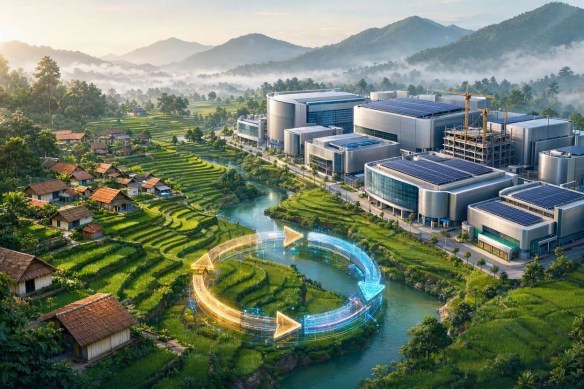
By Karl M. Garcia
INTRODUCTION: THE REALITY BEHIND THE HYPE
The debate surrounding Pax Silica and the proposed industrial development around New Clark City should not be reduced to a choice between industrialization and environmental protection.
Nor should it be reduced to whether the Philippines should join an American-led technology and semiconductor ecosystem.
The more important question is much bigger:
Can the Philippines turn geopolitical opportunity into genuine industrial capability?
That is where the distinction between hype and reality becomes useful.
Investment announcements, strategic partnerships, semiconductor targets and prospective export revenues can create enormous expectations. But industrialization does not happen because a country announces an industrial hub.
It happens when the country develops the energy, water, logistics, skills, suppliers, materials, financing, technology, institutions and markets that allow industries to operate competitively—and remain competitive.
The proposed Pax Silica hub therefore deserves both support for its potential and skepticism about its assumptions.
The Philippines needs semiconductor investment.
It also needs water security.
It needs advanced manufacturing.
It also needs agricultural protection.
It needs data centers and digital infrastructure.
It also needs reliable electricity.
It needs foreign capital and technology.
It also needs domestic suppliers and capabilities.
And it needs to respect Indigenous Peoples’ rights.
These are not contradictory objectives.
They are the actual work of industrial policy.
The question is not:
Pax Silica or no Pax Silica?
It is:
What kind of Philippine industrial ecosystem should Pax Silica help create?
That question leads somewhere more interesting.
It leads to e-waste.
To recycling.
To landfill mining.
To urban mining.
To construction and demolition waste.
To minerals and materials.
To housing.
To land-use planning.
To Indigenous participation.
And to a recurring Philippine weakness:
We are often better at proposing new projects than maximizing the value of what we already possess.
1. PAX SILICA IS AN OPPORTUNITY, NOT INDUSTRIALIZATION ITSELF
The Philippines has legitimate reasons to pursue semiconductor and advanced-technology investment.
Semiconductors and electronics already form one of the country’s most important industrial and export sectors. The Philippines also has an established base of assembly, testing and electronics manufacturing, along with engineering talent and an increasingly important role in the regional technology supply chain.
The opportunity is to move upward.
From assembly toward:
design, advanced packaging, materials, equipment, engineering services, research, manufacturing and higher-value components.
But targets are not capabilities.
A target for exports does not create an export industry.
A promised investment does not automatically create domestic suppliers.
A data center does not create an energy system.
A semiconductor facility does not create a semiconductor ecosystem.
The hard question is what remains after the ribbon-cutting.
Does Philippine content increase?
Do Filipino engineers gain capability?
Do local companies become suppliers?
Does technology transfer occur?
Does domestic manufacturing deepen?
Does the country develop specialized materials and industrial services?
Does the investment create a larger ecosystem rather than an isolated enclave?
That is industrialization.
2. WE SHOULD NOT TURN PAX SILICA INTO A CHOICE BETWEEN AMERICA AND CHINA
There is another temptation: to interpret the semiconductor and critical-materials discussion as requiring the Philippines to choose between economic relationships.
That would also be a mistake.
The Philippines can participate in strategic technology partnerships with the United States, Japan, South Korea, Taiwan, Europe, Australia and other partners while continuing to trade with China and other economies.
The objective should not be ideological purity.
It should be resilience and capability.
If China supplies a material competitively, Philippine industry will probably continue buying some of it.
The question is whether the Philippines becomes permanently dependent on imported materials and technology—or progressively develops alternatives where doing so makes economic and strategic sense.
That means diversification, not decoupling at any cost.
The principle should be simple:
Trade with everyone where practical. Partner strategically where useful. Build domestic capability where important. Avoid unnecessary dependency where dangerous.
Pax Silica can therefore be useful without becoming the entirety of Philippine industrial policy.
3. INDUSTRIALIZATION BEGINS WITH THE SYSTEM AROUND THE FACTORY
A semiconductor facility is only one node in a much larger system.
It needs:
reliable electricity,
high-quality water,
wastewater treatment,
roads and ports,
telecommunications,
skilled workers,
housing,
schools and universities,
specialized suppliers,
chemicals and materials,
industrial machinery,
maintenance and repair,
financing,
regulatory capacity,
and eventually:
recycling and end-of-life recovery.
This is why the location of an industrial hub cannot be evaluated simply by asking whether there is available land.
The real question is:
Can the surrounding system support the industry for decades?
That is the difference between an industrial estate and an industrial ecosystem.
4. INDIGENOUS RIGHTS CANNOT BE TREATED AS AN OBSTACLE TO INDUSTRIALIZATION
The concerns raised by Aeta communities regarding development in and around New Clark City deserve examination on their legal and factual merits.
They should not automatically be dismissed as opposition to progress.
The Indigenous Peoples’ Rights Act recognizes ancestral domains and ancestral lands as legally significant territories with economic, social and cultural dimensions.
Ancestral domain is not simply a residential neighborhood.
It can encompass forests, agricultural areas, inland waters, hunting grounds, burial sites, worship areas and other resources associated with Indigenous communities.
Therefore, Indigenous rights must enter development planning before major decisions are effectively irreversible.
That means:
- proper delineation;
- meaningful consultation;
- legally required consent processes;
- environmental assessment;
- livelihood protection;
- transparent benefit-sharing;
- and independent monitoring.
This is not anti-development.
It is part of responsible development.
5. BCDA’S HISTORY SHOWS WHY LAND IS NOT A BLANK SLATE
The issue is particularly important because New Clark City exists within a much longer history of military land conversion.
The Bases Conversion and Development Authority was established under Republic Act 7227 to convert former military reservations into productive uses and support national development.
But conversion does not mean every hectare becomes a blank slate.
The history surrounding Sacobia illustrates the point.
When Sacobia was incorporated into the Clark Special Economic Zone, the relevant government issuances recognized the need to respect vested rights and valid ancestral-domain claims.
The principle is important:
Economic-zone status does not automatically erase pre-existing rights.
Public land is a national asset.
But a national asset is not merely something to be monetized.
Its value includes economic, environmental, cultural, social and strategic dimensions.
6. INDIGENOUS RIGHTS SHOULD NOT MEAN DEVELOPMENT BECOMES IMPOSSIBLE
The opposite extreme is equally unhelpful.
Respecting Indigenous rights does not necessarily require freezing every potentially productive area forever.
Where legally and environmentally possible, the objective should be coexistence.
There are already examples of negotiated benefit-sharing arrangements involving government entities, NCIP and Indigenous communities.
The larger principle is worth developing:
Not development against Indigenous Peoples, but development with Indigenous Peoples where the legal, environmental and community conditions permit it.
Industrialization should create stakeholders—not merely spectators.
That could mean employment pathways, training, community enterprises, revenue sharing, infrastructure and long-term participation.
The details must be negotiated transparently.
But the concept is straightforward:
If development uses a community’s resources, the community should have a meaningful place in the value created.
7. THE E-WASTE CONTRADICTION
Now consider the emerging technology economy.
The Philippines wants to participate more deeply in semiconductors, electronics, artificial intelligence and digital infrastructure.
Yet we already have a growing stock of discarded electronics.
Computers.
Telephones.
Appliances.
Batteries.
Cables.
Circuit boards.
Industrial equipment.
The question is not simply whether the Philippines should allow imports of recyclable materials.
Some recyclable materials containing hazardous substances can be imported under regulated environmental procedures and applicable international rules.
The more useful question is:
When does importing secondary material make strategic industrial sense, and when does it simply turn the Philippines into someone else’s waste-management destination?
Those are different things.
8. WE SHOULD NOT BECOME THE WORLD’S CHEAP WASTE DESTINATION
Environmental groups are justified in scrutinizing waste imports.
The Philippines should not become the cheap endpoint for the developed world’s consumption.
But there is an important second principle:
Opposing imported waste should not mean opposing domestic resource recovery.
In fact, the two positions can reinforce each other.
Instead of saying:
Bring us your e-waste.
We should first say:
Let us recover ours.
9. WE ALREADY HAVE THE MATERIAL
The Philippines does not suffer from a shortage of discarded materials.
We have:
- e-waste;
- scrap metals;
- plastics;
- discarded appliances;
- end-of-life vehicles;
- construction and demolition waste;
- glass;
- industrial residues;
- organic material;
- and enormous quantities of material already buried in disposal sites.
These are not automatically valuable.
Recovery costs money.
Contamination matters.
Logistics matter.
Material concentrations matter.
Commodity prices matter.
Environmental liabilities matter.
But that is precisely why this should become an industrial and scientific question, rather than merely a waste-management question.
10. FROM WASTE MANAGEMENT TO URBAN MINING
A discarded smartphone is not merely garbage.
It is a small concentration of metals, plastics, glass and electronic components.
A discarded vehicle is not merely a carcass.
It contains steel, aluminum, copper, plastics, glass and reusable components.
A demolished building is not merely rubble.
It contains aggregates, steel, glass, wiring and other materials.
An old landfill is not merely a hole in the ground.
It can be an environmental liability.
In some circumstances, it may also contain recoverable materials.
This is the logic of urban mining.
The Philippines should begin mapping its existing material stocks.
Not everything should be excavated.
Not everything is economically recoverable.
Some materials should remain safely contained.
But we should know what exists.
11. THE SECOND MINE
This suggests a broader industrial concept:
The first mine is geological.
It extracts resources from natural deposits.
The second mine is anthropogenic.
It recovers resources already extracted, manufactured, consumed and discarded by society.
Its deposits include:
landfills,
demolished buildings,
obsolete electronics,
scrap yards,
end-of-life vehicles,
industrial residues,
and other accumulated material stocks.
This does not replace conventional mining.
It complements it.
Mining companies already possess geological, materials-processing, heavy-equipment and environmental-management capabilities that could potentially be applied to secondary-resource recovery.
Construction and demolition companies possess another part of the capability.
Waste companies possess another.
Manufacturers possess another.
The opportunity is to connect them.
12. ROBOTS AND AI CAN CHANGE THE ECONOMICS
The economics of resource recovery will also change as automation improves.
AI-assisted sorting can identify materials.
Computer vision can distinguish components.
Robotics can disassemble dangerous or repetitive equipment.
Sensors can characterize waste streams.
Automated systems can separate metals, plastics, glass and other materials.
Data systems can track material flows from collection to recovery.
This matters because one of the historic problems with recycling is that labor-intensive sorting and inconsistent material quality can make recovery uneconomic.
Technology does not magically solve that problem.
But it can change the cost structure.
The Philippines should therefore view AI and robotics not only as technologies for offices and data centers.
They can also become technologies for:
mining waste,
sorting materials,
remediating landfills,
recycling electronics,
and recovering resources from cities.
That is a much more tangible application of advanced technology.
13. LANDFILL MINING SHOULD BE STUDIED, NOT IDEOLOGIZED
Environmental advocates are right to demand safeguards around landfills.
But landfill mining should neither be romanticized nor rejected automatically.
The proper position is:
Study it.
Characterize the site.
Determine its composition.
Test for hazardous substances.
Evaluate groundwater and methane risks.
Calculate potential material recovery.
Estimate excavation and processing costs.
Determine whether excavation would improve or worsen environmental conditions.
Some landfills may justify partial excavation.
Some may be better remediated in place.
Others may contain little recoverable value.
The answer should be site-specific.
Science first. Economics second. Environmental safeguards throughout.
14. THE SAME PRINCIPLE SHOULD APPLY TO THERMAL TREATMENT
Waste policy should also avoid another false binary.
“Burn everything” is not a waste strategy.
But “never thermally treat anything” is not necessarily a complete strategy either.
The appropriate question is what happens to the residual fraction after reasonable material recovery.
Some material can be reused.
Some recycled.
Some composted.
Some processed into alternative fuels.
Some may be appropriate for carefully controlled thermal treatment.
Some will ultimately require secure disposal.
The Philippines already has regulatory frameworks governing alternative fuels and raw materials in industrial processes.
Any expansion of thermal treatment should nevertheless require rigorous emissions standards, continuous monitoring, feedstock controls, ash management, independent auditing and lifecycle assessment.
The objective should not be:
zero waste at any cost.
It should be:
maximum safe resource recovery with minimum environmental harm.
15. ZERO WASTE IS AN ASPIRATION, NOT A SUBSTITUTE FOR SYSTEM DESIGN
Zero waste is valuable because it forces society to rethink consumption and disposal.
But physical systems produce residuals.
Recycling produces residues.
Separation produces rejects.
Contaminated materials exist.
Composite products exist.
Some recovery processes eventually become uneconomic.
Every mature waste system must therefore answer:
What happens to the residual?
A serious environmental policy does not avoid that question.
It answers it.
16. THE HOUSING LESSON: A BUILDING IS NOT A SYSTEM
The same problem appears in Philippine housing.
The Urban Development and Housing Act, Republic Act 7279, recognized the importance of locating socialized housing and relocation near employment opportunities where feasible and considering on-site development to minimize displacement.
The underlying principle is simple:
A house without access to livelihood is an incomplete solution.
Yet relocation has repeatedly separated families from jobs, schools, transportation and social networks.
The problem was not the physical house.
It was the system surrounding the house.
17. EVEN PUBLIC HOUSING SHOWED THE DIFFERENCE
The AFP/PNP housing experience provides another cautionary example.
The official record should be described carefully.
As of July 31, 2017, the National Housing Authority reported that only 8,837—or approximately 14%—of 63,836 completed units under the AFP/PNP housing program were occupied.
That left 54,999 completed units unoccupied.
The reasons were not simply that beneficiaries refused to live there. They included project location, beneficiary and awarding issues, infrastructure and utility deficiencies and other systemic problems.
The lesson is larger than military housing:
A completed physical asset is not automatically a successful public investment.
A house becomes valuable when it is in the right place, connected to infrastructure, affordable to its intended users and integrated into their lives.
The same principle applies to:
industrial parks,
economic zones,
recycling facilities,
data centers,
transport systems,
and cities.
18. WE KEEP BUILDING THINGS WITHOUT ALWAYS ASKING WHETHER THE SYSTEM WORKS
This may be one of the Philippines’ deepest development problems.
We ask:
How many units were built?
How many hectares were developed?
How many kilometers were constructed?
How much investment was announced?
But the harder questions are:
Are they being used?
Are they productive?
Are they connected?
Are they affordable?
Are they environmentally sustainable?
Do local businesses participate?
Do communities benefit?
Does Philippine capability increase?
This is the difference between construction and development.
Construction produces physical objects.
Development produces functioning systems.
19. PAX SILICA SHOULD BE JUDGED AS A SYSTEM
The proposed hub should therefore be evaluated on more than hectares and investment figures.
Ask:
Where will the electricity come from?
How reliable is it?
How much water will be required?
Where will that water come from?
What happens to wastewater?
What happens to electronic waste?
Where do construction materials come from?
Where will workers live?
How will workers commute?
What happens to surrounding agriculture?
How will flooding and drainage be affected?
How will Indigenous rights be protected?
What Philippine suppliers will emerge?
How much value will remain in the country?
How much technology transfer will occur?
What happens when equipment reaches end of life?
These are not anti-industry questions.
They are industrial-policy questions.
20. PAX SILICA COULD BECOME AN EXPERIMENT IN CIRCULAR INDUSTRIALIZATION
There is an opportunity hidden inside the controversy.
If the Philippines genuinely wants to develop a semiconductor, electronics and AI ecosystem, it should not stop at importing inputs and exporting outputs.
Over time, it should develop capabilities around the entire lifecycle.
For example:
materials
↓
components
↓
electronics manufacturing
↓
semiconductor assembly and advanced packaging
↓
data and digital infrastructure
↓
industrial services
↓
product use
↓
repair and refurbishment
↓
e-waste collection
↓
component recovery
↓
materials recovery
↓
re-entry into manufacturing
That is circular industrialization.
Waste from one industrial activity becomes feedstock for another.
21. IMPORT TECHNOLOGY BEFORE IMPORTING WASTE
This does not mean the Philippines should never import secondary materials.
It means we should be strategic about what we import.
Importing advanced technology can increase domestic productive capacity.
Importing waste does not necessarily do so.
Therefore, wherever possible, the Philippines should prioritize importing:
technology,
equipment,
expertise,
process know-how,
testing capability,
automation,
and capital—
then use those capabilities to process domestic resources.
The formula is simple:
Import the technology.
Build the capability.
Process the domestic resource.
Move up the value chain.
22. RESOURCE SOVEREIGNTY DOES NOT MEAN SELF-SUFFICIENCY
This is an important distinction.
Resource sovereignty does not mean producing everything domestically.
No modern industrial economy does.
It means understanding:
what we have,
what we need,
what we can produce competitively,
what we should diversify,
and where dependency creates unacceptable strategic risk.
That includes minerals underground.
But it also includes materials already above ground.
The discarded smartphone.
The obsolete computer.
The scrap vehicle.
The demolished building.
The old landfill.
These are all part of the country’s material inventory.
23. LAND IS ALSO A RESOURCE—BUT NOT A RESOURCE WITHOUT RIGHTS
The same principle applies to land.
Land is finite.
Its value can be agricultural, residential, industrial, ecological, cultural, strategic or some combination of these.
A sophisticated national land-use policy should therefore ask not simply:
How much is this land worth?
but:
What is its highest legitimate social value?
That value must include environmental carrying capacity, food production, water systems, disaster risk, cultural rights, Indigenous rights, transportation and long-term national development.
This is why land-use planning and industrial policy cannot remain separate conversations.
24. THE INDIGENOUS QUESTION AND THE INDUSTRIAL QUESTION BELONG TO THE SAME SYSTEM
If industrial development affects Indigenous communities, the answer should not automatically be:
Cancel development.
Nor should it automatically be:
Development must proceed.
The better answer is:
Design the development correctly—or determine that this particular location is not appropriate.
Map rights.
Establish environmental baselines.
Determine water impacts.
Identify agricultural areas.
Identify no-go areas.
Identify potentially suitable development areas.
Establish consent and benefit-sharing mechanisms.
Create employment and training pathways.
Consider community participation in enterprises.
Provide independent monitoring.
Then make the decision transparently.
That turns conflict into governance.
25. ENVIRONMENTALISM SHOULD HELP DESIGN THE INDUSTRIAL SYSTEM
This is not an argument against environmental organizations.
It is an argument for making environmentalism more ambitious.
The strongest environmental position should not merely say:
Don’t import waste.
It should say:
Don’t import waste because we intend to build a world-class domestic resource-recovery system.
It should not merely say:
Don’t burn.
It should say:
Recover everything that can reasonably and safely be recovered, then determine scientifically what to do with the residual.
It should not merely say:
Don’t build here.
It should say:
Here is where development should go, here is where it should not go, and here are the conditions under which it can proceed.
That is environmentalism as systems engineering.
26. FROM PAX SILICA TO A PHILIPPINE INDUSTRIAL STRATEGY
The Philippines can connect several agendas that are normally discussed separately:
Pax Silica
with
semiconductor industrialization,
critical materials,
e-waste recovery,
urban mining,
landfill remediation,
circular manufacturing,
renewable and reliable energy,
water security,
Indigenous participation,
housing,
transportation,
and strategic land-use planning.
This would be much more ambitious than debating whether one industrial hub should proceed.
It asks a more fundamental question:
What kind of industrial ecosystem do we want the Philippines to become?
CONCLUSION: USE WHAT WE ALREADY HAVE
The deepest lesson of the Pax Silica debate may ultimately have little to do with Pax Silica itself.
It is about how the Philippines thinks about resources.
We cannot continue behaving as though development means constantly finding:
new land,
new raw materials,
new disposal sites,
and new places to put old things.
We already possess enormous quantities of underutilized resources.
We have discarded electronics.
We have scrap.
We have old buildings.
We have construction waste.
We have old disposal sites.
We have underused public assets.
We have human capital.
And we have land whose economic, environmental, cultural and strategic values have never been fully integrated into national planning.
The answer is not to freeze development.
Nor is it to develop everything.
It is to become much better at designing development.
Pax Silica should therefore be subjected to rigorous scrutiny—not because the Philippines should reject industrialization, but because the Philippines should demand better industrialization.
The country should welcome investment without becoming dependent on investment announcements.
It should welcome technology without assuming that technology transfer happens automatically.
It should pursue semiconductor leadership without forgetting the energy, water, materials and human systems underneath it.
It should defend Indigenous rights without assuming that development and Indigenous participation are inherently incompatible.
It should oppose becoming a dumping ground without confusing waste imports with the legitimate trade in recyclable secondary materials.
And it should aggressively develop domestic resource recovery.
Landfill mining should be studied.
Urban mining should be developed.
E-waste recovery should be industrialized.
Robotics and AI should be applied to resource recovery.
Thermal treatment should be scientifically evaluated rather than treated as either salvation or heresy.
Housing should be connected to livelihoods.
Public land should be evaluated according to its full national value.
And industrial projects should be judged not simply by what they build, but by the ecosystem and capability they create.
The Philippines does not need to choose between industry and environment.
It needs to learn how to build industries in which environmental stewardship itself becomes economically productive.
That is the deeper promise of a circular economy.
And perhaps that is the most useful way to think about Pax Silica:
not as an industrial destination, but as a test of whether the Philippines can finally learn to build an industrial system.
Before importing another country’s waste, recover our own.
Before opening new resource frontiers, understand the resources already inside our borders.
Before building another project, make sure the system around it works.
And before calling development successful, ask:
Who benefits?
Who bears the cost?
What happens to the environment?
What rights are affected?
And is the Philippines actually becoming more capable?
The country’s future should not be based on becoming a convenient destination for other people’s waste, capital or strategic requirements.
It should be based on becoming a country capable of turning its own:
materials,
land,
people,
technology,
and institutions
into lasting productive national capability.
That is the real test—not whether we can build another industrial hub, but whether we can build an industrial Philippines.


A very timely, interesting, provocative article. Notes:
Note that this railroad backbone of the Pax Silica effort is given high priority and has international engagement in the planning. It also addresses an aspect of the power infrastructure.
https://business.inquirer.net/610218/construction-of-subic-batangas-railway-eyed-for-2027
Port to port connection. Nice.
Incredibly important as such a railway system would link the manufacturing hubs with the export hubs.
a feasibility study funded by both estados unidos and sweden, I look forward to the result. I was disappointed though that DOLE sec tolentino was not sniffing around, and I do hope tolentino did not feel it is below him to be proactive, the feasibility of job ops to be had for filipinos is too good an op to pass. dapat magsipagunat-unat na po si tolentino, so filipinos dont have to go overseas when good jobs are here in the offing. estados unidos and sweden pay well even for such temp workers as filipinos.
Proactive, a seldom used tactic hereabouts, yet Marcos is, on trains and other infrastructure. Maybe he’ll turn to skills development soon.
Introducing PSEIR, and related opinions about Pax Silica.
https://www.philstar.com/business/2026/09/10/2555157/philippines-industrialization-and-hype-vs-reality-pax-silica
Thans for this
Good to see that the government is actively addressing detractors with facts and a clear proposition with what will be gained. One can sense that the Marcos Jr. administration considers Pax Silica to be a top priority for the further development of the Philippines, which I hope will be carried forward by the next administration (which makes ensuring the Dutertes don’t regain power even more important). Interesting that pharmaceuticals are looped in. Pharmaceuticals are actually quite complementary to other forms of high-tech manufacturing.
Yes. I think this project is what President Marcos wants his reputation attached to, for rehabilitation. He’s all in.
https://www.sunstar.com.ph/manila/anti-pax-silica-protest-held-amid-economic-corridor-forum
it is disappointing karapatan staged rally vs pax silical become summat violent, kapolisan were hurt as well ralyistas. dapat dialogue not violence, according to spox claire castro.
I am closely watching dole sec tolentino but he was not at the forum, kahit pangusisa lang naman wala siya. I thought he would be inquisitive enough to be present at the forum, in support of his mandate which is to ensure jobs for filipinos. if tolentino was not invited, he could have invited himself in, the way rallyistas invited themselves to blockade at the hotel forum site. it was left to president marcos tuloy to all and sundy to put our side of the coin.
an economic forum without the dole sec is I think, unthinkabogable! maybe tolentino doesnot want to show his face dahil workers much awaited pay increase was put on hold, until the further notice that never seem to eventuate. still, tolentino could have backed up marcos and say that with pax silica, jobs are coming to filipinos, instead of filipinos going overseas to find jobs.
most recent news: pay increase of 60 pesos per day have been approved and will come to effect on 26 september 2026, yay! yay! yay!
China is playing victim with the incoming or upcoming secondary sanctions. US under Trump is alienating even allies and it is not just tariffs.
That’s true. Good point.
trump promised 5K for every adult american voters if republicans win midterm election 2026. this must be a kind of vote buying american style, lol! and if republicans indeed win midterm election, trump will likely alienate even more allies.
unlike other countries, analysts said estados unidos has enough reserve to weather come what may.
This is illegal, even his supporters don’t believe it, and it won’t be paid.
Since taking office for his second term, Trump has promised “checks” four times:
1. $5,000 “DOGE Dividend”
2. $2,000 Tariff “Dividend”
3. $12,000 “Obamacare Refund”
4. $5,000 Midterm “Trump Dividend”
If the so-called Midterm Dividend was actually paid to 267 million US adults over 18 years old, it would cost $1.335 trillion which is nearly 72% of the entire US annual discretionary budget of $1.87 trillion.
None were paid. He is rapidly losing supporters. His baseline of support of “MAGA” Americans has remained consistently 33-38% in the last decade since 2016, and it is starting to break since the Iran War. His supporters were fine with all of his corruption until his corruption and malfeasance hit their own pocketbooks. Turns out one cannot eat culture wars.
with trump, I think, the only predictable thing about him is his unpredictability.
Yeah, which was one of his strengths but no longer. His support is down to what we call in the US the “Bush Line,” which is about 32%. That’s below his historical stable base support. No one believes him. And besides he controls both houses of congress, he can pass the 4 checks whenever he wants but he hasn’t because he won’t.
Re:
1. I think this is broadly correct, though (just quibbling) I’d characterize Pax Silica as a US-led, Western-aligned initiative to take away China’s growing technological power, rather than the “choosing the US” framing common in national op-eds — wrong whether it comes from the dynast-conglomerate view or the far-left view. It is more correct to describe Pax Silica as an attempt to re-orient the global supply chain away from illiberal states and back toward the broader liberal democratic community, with the US as lead coordinator — though the op-eds I’ve read rarely mention that Japan, South Korea, Taiwan, and the Netherlands will be major players in the re-alignment. The underlying technology still sits largely within “the West,” and China remains well behind on process technology, so this is about taking away China’s capacity to scale.
2. I wrote an analysis about this here looking deeper at how marginalized groups get used cynically by politics and business in the Philippines, with op-eds sometimes laundering the interests of powerful groups: https://joeam.com/2026/08/12/from-strategic-learning-to-resilient-sovereignty/#comment-509459. Of course, the indigenous and farmers asserting rights should be helped regardless of their claims’ merit (I think the indigenous claims may have some validity, while the farmers are documented squatters only arriving in the early 1990s) — either way, they should be provided help to be made whole.
3. IMHO the e-waste issue is a bug-a-boo and a major distraction. Most of the illegal e-waste dumped in the Philippines comes in via criminal activity — mainland Chinese gangs facilitated by Filipino partners, similar to how POGOs operated before those criminal networks were dismantled a few years back. Per my reading, the illegal e-waste ecosystem has existed since the 1980s but accelerated substantially after China banned e-waste imports. AFAIK no global government has e-waste dumping as an official policy, so the fix is more domestic enforcement.
4. Water and power are important issues. Thankfully, modern datacenters largely re-cycle water in closed loop systems — no closed loop system is perfectly efficient, so they need minimal daily top-ups. The biggest problem is noise, from cooling fans and on-site power generators (gas turbines, etc.). Pax Silica leans toward solar, both on-site and off-site, so hopefully that’s being addressed in negotiation. Missing the point is that datacenters, which are the cause du jour, are a minor part of Pax Silica — Pax Silica is mainly about advanced semiconductor chip manufacturing similiar to Taiwan’s TMSC and South Korea’s Samsung and SK Hynix.
5. For housing, my observation is that Metro Manila developers prefer higher profit condo complexes since that’s what the market dictates. Even with many condo units sitting unoccupied, building lower cost housing doesn’t make market sense — it would take government policy to build affordable housing at the scale needed.
1. Ah, good point.
2. Agree.
3. Yes.
4. Yes, and good point about the goals of Pax Silica.
5. Some developers are doing low end development. I think it depends on the quality of the jobs as to whether or not this will be an issue. My sense is that it will not be.
China not only fulfilled Deng Xiao Ping’s declaration of having rare earth instead of oil. Though declined they still have a firmidable stockpile of oil.
They electrified China systemically, they are leader in robotics
They just recently made it faster to connect to Indo China via the Pinglu canal.
They might forget Taiwan and wps…..in my dreams.
It was in 1992 that Deng Xiaoping declared during his Southern Tour through southern China that he declared “The Middle East has oil, China has rare earths.”
However, “rare earths” are in fact not rare and are abundant. Mining and processing rare earths was originally developed here in California. What China accepted was environmental destruction through invasive mining to mine and process rare earths, something developed nations won’t accept due to environmental conservation laws. Advances in mining and processing technology makes “cleaner” and less destructive mining and processing available, and rare earth projects are popping up outside of China. China is not the technology originator, just like Middle Eastern countries do not possess their own petroleum drilling and refining technology. That technological capacity and capability still exists solely in the West. And it will be re-aligned.
I request you to repeat yourself regarding Clinton metal or mineral policy that reinforce Chimas rare earth refining.
This is a long time Republican lie — I know because I was an up and coming member of the party apparatus at the time and we all repeated it as a political attack. I was a youth volunteer at Claremont Institute for many years, which IYKYK. It’s common here in the US for Republicans to lie and base attacks on lies, especially following Pat Buchanan and Newt Gingrich as they formulated attacks against Clinton in the 1990s.
There was no specific Clinton policy with regard to rare earths and China. What actually happened was the general wave of globalization which had been the American political consensus since the 1980s, and the hope shared across the West that by letting China join the global economy China would democratize. That view was bipartisan and uncontroversial in the US back in the 1990s leading up to the 2000 WTO accession which was also supported in the UK and most EU countries as official policy.
By 2010 Hillary Clinton as Secretary of State under Obama raised the alarm of a “wake up call” with regards to how in actuality China gamed the system by implementing “capitalism with Chinese characteristics” — authoritarian state capitalism. That advice was the impetus for Obama’s “pivot to Asia” and the TPP as an attempt to contain China, which Trump immediately killed in 2016. Biden resurrected TPP under another name: Indo-Pacific Economic Framework for Prosperity (IPEF), which by the way is one of the predecessors of Pax Silica, which is a Trump rebrand of the Biden policy.
In short, no one policy “allowed” China to dominate rare earths mining and processing. And it is incorrect to blame specifically on Clinton something that was the consensus view of the bipartisan US Congress and Western Europe at the time.
Thanks for the needed enlightenment.
An abundant but untapped source for Silica.
Waste-Glass-Derived Porous Silica: Synthesis and Structural Characterization
https://www.mdpi.com/1996-1944/19/3/601
Spent some time earlier to read the full study:
The silica recovered via this process is not really suitable for precision manufacturing where high purity silica is needed — the recovered silica is heavily contaminated with soda and lime, which the study points out. The study also acknowledges that the mesoporous alignment of recovered silica is not that great despite large amounts of energy consumed in the recovery process. This type of recovered silica is only good for stuff like making fiberglass insulation, filtration substrate, industrial abrasives, and the like, but costs more to make than just using virgin stock. Electronics-grade silica, to put into perspective, has a required purity level of 99.9999999% pure (9N purity).
Thanks Joey maybe they will find away to make recovered waste be cleaned and cheaper than virgin minerals or metals.
Even recycked plastic is not that enticing notwithstanding petroleum prices.
Np. Materials recovery really doesn’t make sense unless the resources (money, including energy) spent on recovery is less than the resources spent just digging/pumping up virgin materials from the ground — just market dynamics here. I worry that circular economy is a white whale. A lot of major proponents are industry voices, just like how responsibility for conservation was shifted from the producer to the consumer (e.g. recycling). IMHO it makes far more sense to conserve in the first place by consuming less than to expect maintaining the hyper-consumption trajectory and excusing that consumption with recycling or recovery that is “just around the corner.” Hyper-consumption behavior is also part of market dynamics.
White whales white elephants white knights, some I already wrote about, but sometimes the Don Quixote in me says, go towards.the windmill, charge!
thanks for this article Karl, it does put a lot of things into perspective – even if I am not following this in that much detail, in fact I am not able to follow PH stuff in too much detail recently, that article and skimming through the discussions here so far gives an idea of where it could go.
I also asked Gemini to give me a summary of potential jobs to be created by Pax Silica FWIW. Because that is usually one of the most important pros for something, the cons always exist.
As you mentioned it is a system and therefore its parameters can be adjusted a little..
Thanks for your insights
Heavy on skills. I hope universities and their students “see forward” and get young Filipinos headed toward the gravy train. I note mining is not mentioned. I think mining is going to get revitalized as well and there will be the addition of Philippine ore processing.
if pax silica is to recruit workers, it would most likely advertise online and when vacancies are open online, applicants from all over the world will apply, from united states, japan, korea, singapore, taiwan, india, etc, and competition will be fierce. if bong marcos cannot give filipino job seekers a fighting chance, or secure now an assurance that 60 per cent of pax silica jobs will go to filipinos, I think, his legacy will be that he was the president who cannot secure the greatest job opportunities for filipinos.
Jobs will come on line slowly. There are a lot of smart Filipinos. Maybe there will be alignment. I hope so.
It’s very hard for foreigners to legally work in the Philippines outside of management in PEZA. Once upon a time I considered moving to the Philippines and tried — this was long before the rise of “digital natives” and WFH.
When I need to talk with Philippine based customer service I’m just astounded at how many graduated engineers and technicians work as CSAs. Most have shared with me that they are working in BPO out of necessity to support their parents and/or siblings, but they really want to pursue their dream jobs in the fields they studied. If Pax Silica pushes through, I’m very confident that the Philippines has more than enough well qualified engineers and technicians who can be trained into world class manufacturing.
That’s good to know. Thanks.
I am reminded that when looking for work, a lot of smart people and even university IT and engineering grads cannot get to interview stage. the landscape of looking and landing jobs these days has changed a lot specially when applying online. AI and not a person will trawl tru all the online resumes submitted. it is a pity that a lot of smart people cannot technically address the selection criteria, let alone pass AI’s scrutiny. the very smart candidates though will conduct a mock submission and let AI judge their resume to see if their resume stand the chance of proceeding to next level which is the interview stage. depending on AI’s opinion, will then they submit their real resume online.
know what’s funny? there are resumes submitted online that not only sound but also look like carbon copies of resumes previously submitted, by another person/s.
The AI resume/CV screening is a thing nowadays but probably a bigger problem in the Philippines is the lack of available jobs for each graduating cohort. Job requirements inflation is an indicator, though it’s not as bad as it was before. The Philippines still produces ample STEM graduates who are trained in *theory.* Equipped thus with theory the graduates can be plugged into training pipelines for something such as Pax Silica. I personally think the Philippines is better positioned than most think for the industrialization of the current age.
Over the last few months I’ve been working on a 4-part analysis series of the state of Philippine electricity modernization that is pertinent to our ongoing topic of Pax Silica. This is an industry I happen to know something about from direct experience, though full disclosure I’m not focused industry expert.
I read about 40 studies and policy papers, as well as historical US, PH, JP, and UN data, taking notes along the way and manually creating a rough systems sequencing map. My research notes, spanning dozes of files, were later organized with the help of Claude (Opus 5 Max, Thinking, with custom connector to my private LLM). For convenience I have linked the studies I read to the analysis, with the studies available in the Reference Compendium’s source list.
My conclusions is that Philippine electricity modernization is simultaneously more urgent and more achievable than either the typical despair or aspiration alone in Philippine discussion circles would suggest. The Philippine electrification fragmentation is both real and comparatively severe in relation to peer countries with similar state resources — contributing factors are a combination of 7,641 islands, high typhoon frequency, and active seismic events that only Papua New Guinea rivals among the comparator states examined — but my comparative research highlights that this is a solved problem elsewhere (e.g. Indonesia’s three-track strategy, Chile’s SIC-SING merger, Japan’s Tokyo-Osaka frequency-converter buildout) rather than a uniquely Philippine curse that drives a bahala na mentality by some strains of Philippine discourse. My analysis found that what has actually been missing is not technology or even capital, both of which have shown up reliably when the terms were workable — Terra Solar, the pumped-hydro pipeline, and Palawan’s own microgrid transformation all prove this — but institutional follow-through: right-of-way friction rooted in genuine local political incentives, a nuclear program still recovering from a fifty-year-old corruption scandal, a transmission monopoly entangled with foreign ownership questions, and permitting gates that run months to years past their own statutory targets.
My analysis pulls out that a possible realistic path forward, as detailed across the sequencing and policy recommendations, is to stop treating this as one undifferentiated problem and instead sequence it by whichever constraint actually binds at each stage — resolving regulatory and institutional questions that cost nothing before spending scarce capital, finishing what’s already funded before starting what isn’t, and matching financing vehicles to what each geography can actually attract rather than applying one national formula. In other words, break up the system into a multi-component system-of-systems where each component solution fits what is needed in the area the component affects. For example Luzon and increasingly the Visayas can lean on private auction-driven capital; Mindanao’s hydro rehabilitation needs to be paired with the watershed governance it has never received; Palawan needs internal grid hardening now and a domestic interconnection later, not a bet on a slower international one (the Palawan-Sabah power interconnection). Philippine systems designers need to stop chasing exquisite solutions outside of existing capability and capacity that encounter execution stops when reality breaks the perfect-in-theory plan. None of the seventeen policy recommendations that came out of my analysis require new technology — they require settling a transmission-ownership question, building a coordination mechanism DOE and NGCP have lacked since 2014 when generation approvals were decoupled from transmission capacity, and formalizing LGU revenue-sharing and permitting processes ahead of project roll-out that currently run on ad hoc friction instead of published rules.
The common throughline I found in my analysis is that every obstacle root cause when traced back turned out to be a human and institutional choice rather than a geographic or technical inevitability, even if the latter two are commonly pointed out in excuse, which is exactly why sustained public and political pressure may be the one lever available to close the gap. The 2026 Iran-conflict energy shock and the emerging Pax Silica opportunity both demonstrate that the stakes have moved well past electricity access as a domestic development question — they now touch national economic strategy and energy security directly. Whether the Philippines actually builds the resilient, modern grid my research shows is achievable depends less on any remaining technical or financial constraint than on whether enough of the Philippine public keep insisting that the institutions responsible for it finally do. A light at the end of the tunnel is that when the problem becomes too large, such as in the food control scandal investigation, the public may finally be “waking up” to the gravity of the situation at hand.
Leaving my full analysis here for further discussion:
Reference Compendium: Electricity Infrastructure Modernization in Archipelagic & Geologically Fragmented States [Analysis]
Sequencing Plan: Realistic Sequencing of a National Electricity Modernization Plan [Analysis]
Policy Recommendations: Seventeen Regulatory & Institutional Recommendations for Grid Modernization [Analysis]
Energy & the Philippine Future: The Current (A Narrative Essay) [Analysis]
A Claude summarization of my goals for each sub-analysis is as follows: