You don’t need an anti-dynasty law to break the dynasties. Here’s how to do it.
Analysis and Opinion
By Joe America
Power is like water, it flows downhill. The dynasties exercise it within their realms. The Dutertes run the Davao realm. The Espiñas run my Biliran realm. The Marcos clan is joined with the Romualdez clan. Even the Aquinos are dynastic.
Barangay captains know where their bread is buttered. And they know how to extend the governor’s or mayor’s power to the voters.
But dynasties have three critical weaknesses.
- They are just regional in scope.
- They bicker with one another.
- They will turn on a dime if someone with more power comes along.
Political parties are amalgamations of dynasties. Their job is to angle for advantage. To do this, they brag and they bicker.
This structural braging and bickering was recently displayed by Sonny Trillanes in an unfortunate comment he made on X. He argued that Senator Hontiveros would be a better President than Leni Robredo. Hooookay! Load the cannon and fire! I despaired over the tweet. Such an unnecessary division of the “good guys”, sure to anger a whole lot of pinks. I can’t imagine what he or we will gain from such a sowing of spite.
How will we ever stop the eternal bickering that makes the Philippines a nation of tribes instead of a nation of principle and progress?
The most common solution we hear is for the Legislature to enact the Constitution’s demand to end dynasties: “SECTION 26. The State shall guarantee equal access to opportunities for public service and prohibit political dynasties as may be defined by law.”
Unfortunately, enacting a law goes against the grain of power so it hasn’t been done in 37 years.
But it seems to me it does not take a Constitutional amendment to defeat the dynasties. It takes two things:
- A broad national party or umbrella organization to unite subordinate parties under principles, not personalities.
- A strategy to take over cities, because it is there that voters receive their guidance, in real terms.
Step 1. Philippine democracy is weak because its political parties are small fiefdoms, little gatherings of people who have power in their LGUs or families, but without any national gravitas. The people with national gravitas are boxers and actors and populists who have the knack of being darlings in the titillating tabloid world we live in. So policymaking and the nation’s well-being never drive elections. Jazz does, and temporary agreements among powerful families.
Strong political parties like those in the US don’t exist here. Principles define US parties, mainly for or against a strong national government. Here parties are shaped by peoples’ interests. The interests tend to be self-dealing, not nation-building.
The solution is to establish a national initiative that is stronger than the parochial interests that today drive parties. Those opposed to dynastic rule can do this by forming a unified political umbrella organization that acts like a huge, influential, over-the-top political party. Read: “Organizing to win in 2028“
Hard to do, yes. Bring the Philippines in from the feudal darkness, yes.
Step 2. The strategy to take over cities is a matter of math and influence. Control the cities and you control the barangays. Control the barangays and you control the voters. Well, “influence” is probably a better choice of words than control. But “command” is the reality of today, in a vertical power society. Which the Philippines happens to be.
Here are the 10 largest cities in the Philippines.
- Quezon City, 2,960,048
- Manila, 1,846,513
- Davao City, 1,776,949
- Caloocan, 1,661,584
- Taguig, 1,223,595
- Zamboanga City, 977,234
- Cebu City, 964,169
- Antipolo, 887,399
- Pasig, 803,159
- Cagayan de Oro, 728,402
We can do a quick run-through and start to develop a strategy. Quezon City, Joy Belmonte is aligned with Sara Duterte, does she really want to be there? Manila, work with Isko, bring him in. Davao City, forget it. Caloocan, bring Sonny Trillanes back to his senses and get him elected mayor next year. Taguig, Cayetano land, what does he want, can he be a team player? Cebu City, went the wrong direction, bring them back. Pasig, Vico Sotto III, an anchor for the future.
Those are off the top of my head. I’d also recommend bringing the Binays in, for Makati’s business strength. Naga should be in if Robredo is running for local office there. It’s a regional hub and good governance prototype.
As you worked at this, you’d start to see movement. The more movement you could show, the more you would get.
You don’t need a constitutional amendment to break the dynasties. Because you don’t have to break them. You have to respect them, work with them, and show them the best path to success for them, and for the Philippines.
To do this, most of us will need to develop new disciplines because we are generally aggressive in protecting our clans, echo chambers, and ideas from outside, and not skilled at building into the outside to merge clans and echo chambers and ideas. Here are a few of the essential disciplines needed:
- To expect and accept imperfection, not perfection. The expectation of perfection is unrealistic, and it’s destructive..
- Develop the ability to give in order to get. A part of the giving must be to stop criticizing allies, and to let go of injured feelings.
- Develop a build mentality as a way to approach those with whom we have differed in the past. “Let’s build a bigger force for the development of a Philippines on the move.”
- Develop common ideals with which all can agree. Defining a vibrant future (hope, opportunity), inclusion, economic growth, ending corruption, territorial sovereignty, technology infrastructure, better agency operations, seeing children’s development as essential, etc.
This is easy to say, hard to do. It is a combination of purposefulness and forgiveness. Like building intellectual bridges, I suppose, over a river of emotions.
I’d welcome your views on this.
_________________________
For deep readers amongst us, I refer you to the following paper on dynasties in the Philippines: Term Limits and Political Dynasties in the Philippines: Unpacking the Link
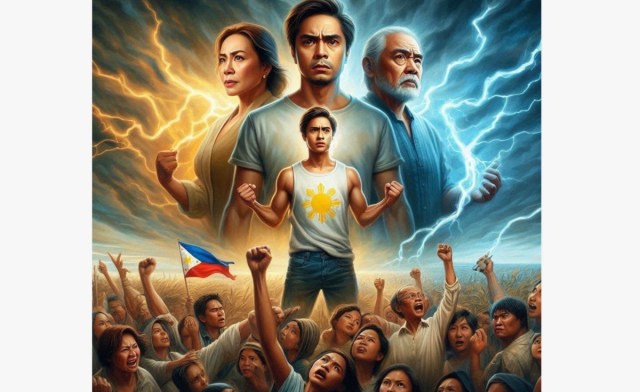
Cover photo by Bing image generator using the prompt: “Represent three filipino families fighting for power, in oils.”
Comments
146 Responses to “You don’t need an anti-dynasty law to break the dynasties. Here’s how to do it.”Trackbacks
Check out what others are saying...-
[…] Party that is the easiest path to breaking the dynasties. I’ve written about it here (“You don’t need an anti-dynasty law to break the dynasties“). The hardest path is getting dynasts to pass an anti-dynasty […]
-
[…] Seating the idea of a peoples’ coalition of Left and liberals: YOU DON’T NEED AN ANTI-DYNASTY LAW TO BREAK THE DYNASTIES. HERE’S HOW TO DO IT […]
-
[…] Seating the idea of a peoples’ coalition of Left and liberals: YOU DON’T NEED AN ANTI-DYNASTY LAW TO BREAK THE DYNASTIES. HERE’S HOW TO DO IT […]


 The Society of Honor by Joe America
More than THANKS, Joe America, on how to do away with dynasties!
Sent from Yahoo Mail for iPhone
I think they are a lot like churches, the place people go to find an anchor and comfort and an opportunity to get ahead by being with like minded people. Echo chambers, off the internet. If businesses were required to provide career paths based on skill and achievement, people would turn to jobs to get ahead, not bow so much to local families.
Whew, Trillanes, please don’t be like Heneral Luna. Even as the very similar passion is admirable, there is stuff that might be right but doesn’t need to be said, especially about people on the same side.
As for the idea outlined in the article, it is good but not easy, as most Filipinos don’t think win-win yet as of now. And some alliances I really don’t get.
That the Queen of Cebu, aka the Governor, seems somewhat wacko is clear. Maybe it is just like in the movie Wicked, where the Wizard of Oz is actually a jerk, and all the allegedly Wicked Witch Alfaba wants is to be “Defying Gravity.”
But Queen Joy of Quezon City aligning with Sara Duterte, I don’t get at all.
Oh well, the Cayetanos are also an example of a family that seemed quite decent yet went another way. In fact, I wonder if Sonny Trillanes is “going Alan Cayetano” now? The more I find out about the Philippines, the less things make sense, or what are my unknown unknowns?
The title picture is great, though. I didn’t know I actually have a direct line to a movie director who was a scriptwriter for two big outfits. The 6 X 2 hour miniseries with still to be defined title could be co-produced by ABS-CBN and GMA – for Netflix, shall I ask him if that would fly?
Sure, if it is something you are comfortable doing. And you are right, concepts such as this are hard to do. First of all, someone of authority needs to grasp it. Then start piecing it together. It requires no shift in allegiance from anybody as far as party goes, unless they want to switch. It merely glues the pieces together under an umbrella of principle, building a new power dynamic. It also breaks down if everyone wants to be president.
Well, Joey did say he was looking forward to seeing some of my crazy stories on the big screen, I don’t know if big stories are my talent, and now I am half joking about a mini series, but I kinda realize now that the Philippines might be around where the Greeks were when Homer wrote the Iliad, they discussed their politics loudly in the agora which was the marketplace (one ancient Greek politician even trained having a loud voice by yelling at the sea on the beach) and watched dramas which were either tragedies or comedies. This was BEFORE the philosophers got down and looked at stuff more rationally. Filipinos need the right STORY, and that is the talent many of the more rational folks in Philippine politics lack. So does the opposition need a short ad starting Joshua Garcia as the man with the sun on his shirt?
As for everyone wanting to be President, the present structure of the Senate promotes that. Every Senator is a President-in-waiting. I see only two solutions – whether they are doable is unclear given that the Philippines is hard to reform – either have a smaller Senate where everyone is President for a year like in the Swiss Federal Council, or have a Senate by Regions where the focus of Senators is their own region. Sure, in the latter, one could say Congress is already by region, but in my scenario, the Congress would be national parties only by per % of the vote. Sell the idea to the local barons who would no longer have to compete with Congressmen for representing their chiefdoms. End of fantasy. The first step indeed as you said Joe is to win enough Rajahs for a reform of the Realm.
https://tvline.com/wp-content/uploads/2024/04/shogun-toranaga-hiroyuki-sanada.jpg?w=600&h=400&crop=1
Hmm, Toranaga always spoke of The Realm in Shogun. OK, Irineo, stop the tripping. 😉
Haha, yes, Toranaga was da man! My objective, though, is to change nothing but the concept of a dominant party. Changing the Constitution is futile.
I’ve been in a weird funk after my Marine high school classmate lost his fight with his inner demons and ended his own life recently. Not sure why his passing hit as hard as it did; I haven’t seen him personally for over a decade after he took to drifting and periods of homelessness. He was small of stature, and my 6-foot-plus frame towered above him in high school. His mane of firey red hair probably didn’t help either. His death caused me to start reflecting on the meaning of “patriotism,” especially in the context anti-democratic movements around the world.
Now I hadn’t served in the military myself like many of my classmates, despite receiving letters of recommendation and acceptance to the academy. Call it youthful rebellion against my father, whose past military service was always a source of tension. I was adamant in breaking the generations of family military service. I didn’t want to become a broken military man later on. Instead I pursued the civilian corps and various NGO work throughout my college and young adult years. I had never equated the civilian corps work to be patriotic.
With my friend’s passing, I had the opportunity to hear an eye-opening explanation of patriotism by retired US Navy CDR: https://www.youtube.com/watch?v=3WV_Ocov-Dk
Apparently Joe had written about this previously as well: https://joeam.com/2013/11/01/believing-in-the-philippines/
It seems that to be a patriot, one must first become a good citizen. What differentiates good citizens from patriots is that patriots take the next step of sacrificing something, or even their own life, for the good of their community and nation. So by that definition, my friend and my father, despite their personal flaws sacrificed for the greater good. Even more so for my father, who came from an established and wealthy family. But also by that definition, civilian corps work is also patriotism. Patriotism doesn’t need to be expressly military related. One can become a patriot by choosing a lower paying job, like a doctor who serves her community health center rather than pursuing cash-only private hospital practice. Or choosing service despite being looked down upon by society, putting everyone else before one’s self.
Contrast this with the empty nationalism whipped up by many Filipino leaders. Nationalism is by definition an ideology of grievance. It requires that others, and other nations, must lose for the self and one’s nation to succeed. Nationalism easily separates “the other,” those who don’t subscribe to the same ideals or have a different interpretation. Trump is nationalistic. So is Duterte. The rampant red-tagging in the Philippines to break down opponents as enemies of the people, despite groups who have a proclivity to red-tagging others having interesting ties to the CPP/NPA and PRC. Endless chest-beating about strength by leaders to hide weakness, with their followers following along the drum-like sound of communal chest-beating. Demanding military attacks on the Chinese incursions, some kinetic show of strength to appease the hawks, then expecting to run and hide behind the coattails of Uncle Sam by invoking MDT.
It seems to me that Filipino society, beyond the regional and ethnic rivalries that defines the national discourse, must find a way to make better citizens. Every level of society, no matter how low, has a lower rung to step on. The labandera. The basurero. Even those low castes will look down on the desperate kaykay who is willing to eat pagpag they greedily snatch up from street-side food stalls, as I saw firsthand in my forays in Tondo. In other societies after the dawn of modern democracies, there have long been periodic movements of patriotic civic service. Cities and nations have organized community cleanup events where large numbers of volunteers show up to help beautify their city and neighborhood. After all, maintaining a community is a form of service. Yet in the Philippines, it’s still common to see someone throw their trash on the ground even if there is a garbage bin steps away, one must take care not to step on dog feces or spit on the sidewalks, in restaurants visitors will make a big mess and expect the staff to clean up for them even if there is a sign asking to kindly “CLAYGO.”
Filipino general society from the highest level down to the lowest has internalized the belief that someone else will always take care of a problem. After all, it would be too troublesome to clean after one’s self, that’s what why lower people have jobs! And by extension, politicians and local leaders know this well so they make sure they create an image of the caretaker of the people. There’s no need to worry about anything for one’s self, when the leader will take care of it! I think this naturally inclines Filipinos to be inclined towards leaders who will take care of them, protect them. A somewhat childish view that removes one’s own agency to affect change around them, even if a little bit.
While the educated who yearn for a better more modern Philippines often wonder why examples from other successful nations can’t be applied “here,” the sad fact is people will be quick to accept a laughably small P500 bribe each election then loudly gripe about the leaders they elected; this view misses for forest for the trees. The reason accept the vote bribe is part desperation, but also because those bought voters are expecting to receive even more benefits from the leaders they help elect once in power. They complain, not because of bad leadership, but because they didn’t receive more. The promise of getting taken cared of was broken, a classic bait-and-switch that happens every single time in Filipino elections, yet people will just switch their vote to another party, hoping for better results.
Many European societies emerged from the darkness of the feudal times and entered the Enlightenment once the printing press made becoming educated more accessible. Information power. More people suddenly no longer needed to listen to the narrative told by their barons, lords and churchmen. They could learn from that age’s form of mass media and apply their own understanding. Critical thinking and the ability to question power was no longer the exclusive domain of the learned in robes. Yet in this age of digital information, the Philippines which has one of the highest penetration of the internet in the world, many Filipinos would rather consume the digital opium on their phones rather than ask relevant questions of their leaders. Today’s mobile phones fit in one’s pocket and are more powerful than supercomputers of yesteryear that filled up entire university computing rooms. An endless source of information and facts, wasted on mindless consumption and even worse, disinformation.
The oft-cited examples by Filipino nationalists of the national success in Singapore and South Korea make a willful, even cynical omission. The nationalists don’t account for the fact that enough Singaporeans and South Koreans collectively stood up and said “ENOUGH!” to their prior bad leadership. The modern national consciousness of Singapore and South Korea was followed closely by the development of a strong sense of national civic duty and participation. Basically, Singaporeans and South Koreans decided that at a minimum, everyone is expected to be a good citizen. Amazing for two countries, the former which was the Wild West of SEA and a den of thieves, the latter a historically mediocre and impoverished nation dating back thousands of years.
I fear expecting “good” local leaders might not be enough for the Philippines. There are always other local leaders who are willing to maintain the den of thieves in order to maintain dynastic power. As for a way for Filipinos as a whole to stand up and decide they’ve had enough, and become good citizens first, then patriots after. People need to learn a patriotic sense of sacrifice for the community, for their own family’s futures, rather than expecting it to be given. I don’t know how to accomplish this. I suppose the transformation has to start somewhere.
4AM here in Los Angeles. Longer than I thought it would be. Sorry all.
No prob, as many great insights (and a lot of great art) come from pain. Your long comment is a great contribution here, as it graphically describes the Filipino condition. The reliance on saviors is especially relevant. I believe VP Leni, after losing the election, was a bit reluctant to be cast as a savior in a country that isn’t particularly nice to those who help it seems and loves the grifters though as Joe said it is due to self-dealing.
RIP for your friend.
I’ve pondered Leni Robredo. She is not fed by beating others to the top. She is fed by helping people, tangibly. It is so very different from most. Nuns are like that. It is not weakness, but the strength of who she is. And like a nun, she will leave the outer world in the Lord’s hands.
Oh I would actually argue that Filipino society LOVES helpers, as long as they can get something out of the helper. But the moment the helper can no longer give, they are trashed. That’s what happened to Leni, where she was associated with providing aid through her OVP and later NGO following natural disasters. Of course a small organization with a small budget is unable to be everywhere at once, but people trashed her nonetheless since they were not able to “get something.”
I tend to think it’s our mistake as educated and as people who have seen more of the world to frame our understanding of the Philippines in terms of the concepts we’ve learned elsewhere. I don’t think those concepts can’t apply to the Philippines at the present time because Filipinos aren’t widely exposed to the concepts yet. From what I’ve observed among the masa, there is a strong connection between the Filipino concept of gratitude with the expectation of “can I have more.”
Some of my trips have been related to Catholic relief groups, which generally don’t proselytize, and certainly not in the Philippines where most people are Catholic. We are there to simply help. But most of the people we helped simply came back to get more stuff or benefits, yet rarely attended Mass. When we ran out of clothes, canned goods and other things to distribute the people gave disappointed looks or some verbally abused us, then just went across the street to the evangelical groups proselytizing. See, the evangelicals “get it.” They don’t give anything, no relief, no help until the people convert and attend their service. Want more stuff? Need to continue attending. Need to donate money to the pastor. That’s how my Cebuana ex-gf’s family became born again. That’s how Quiboloy’s KOJC works too.
Sorry for your loss.
I suggest you chronicle your experiences to articles.
We will be all looking forward to your articles.
I have seen much of Philippine society from different aspects, but I tend to try to avoid the Western (mostly modern post-1970s Western white leftist) propensity to to “Westplain” other cultures. I think that would diminish others’ ability to seize their own destiny. While some ideas like human rights and equality are universal, there is also nuance shaped by a people’s cultures. So I try to instead be an observer whose musings are more of an expression of observation, than to push my own agenda. I’m here to learn and further understand. I’m not sure if I’d be a great article writer.
If you write to learn rather than preach, you avoid the problem. I write to provoke, in the main. And my history here gives me near citizen status. Most appreciate the poking because others don’t do it. And they see it as supporting what they believe, but are powerless to advance. My guess is you’d be a megaphone for people, or a catalyst for the well read. But only write if you are inspired to do so. You owe nobody anything. We just operate a platform.
By living in the Philippines for a long time, you have skin in the game. Certainly American outspokeness, which many Filipinos are not used to, is a powerful tool to amplify the societal wrongs and injustices you’ve witnessed in the Philippines. As for me, I neither grew up in the Philippines nor am I a long-term resident. I don’t have a Filipina partner. I’ve visited and had long stays though with opportunity to interact and observe. I do enjoy it here in these comments sections as I’ve learned a lot from everyone’s perspectives. I’ll see where things go with writing, but no promises from me for now. I already preach far too much in my own family, church, and work, haha.
Fair enough, for sure.
No pressure and nothing owed to anyone.
I’m sorry about your friend’s decision to end his life. Demons are easy to come by, hard to get rid of. sometimes impossible. Robin Williams comes to mind. RIP for your friend.
I don’t see a popular outcry happening, even though the reason for it is clear. Corruption and self-dealing over national well-being. Complacency is huge. That’s why I argue for change within the system to reframe self interests by starting to compile a new power base that brings in multiple parties and cities without demanding too much from anyone. But that is seen as power as it collects, for that is currency in the political arena.
Tough for former soldiers dealing with PTSD. The VA has been failing on supporting generations of retired soldiers for years, with positive improvements finally being made in this administration. Some, like my friend, found purpose in the service and felt lost once he got out. In a way I wish he had served his 20 years for the support system of brothers and sisters, but he was was medically retired with a Purple Heart and CAR, among other awards, after his third GWOT tour. Sometimes demons are a lingering moral injury… my friend spoke of his only regret was an action where children killed were unfortunately used as human shields by terrorists, which became his personal demon.
Complacency is also a sign of ignorance and political naivety. Similar to how children will either obey parents, or find ways to get their way by gaming the rules set by adults. The anti-Pinoy blogs used to attack fellow Filipinos for being stupid, which I don’t agree with as it’s an elitist view. Education and awareness can help reduce ignorance.
Humans are naturally selfish creatures, however if one feels satiated in their needs, there may be more of a willingness to share the excess to help their community become better. I think that solving kitchen table problems should be on the first order of things. Easiest to do and has the maximum immediate effect to peoples’ lives. Depending on a “few good politicians,” is treading the line with dangerous territory, but it might be the only choice left.
Tough one, for sure.
Re. complacency, as I think about your remarks. To get out of complacency, say to protest, you have to have a place to go if the protests succeed. I don’t think people can relate to that place. The Philippines is largely a nation without a future, because citizens broadly can’t see one. It isn’t ignorance, really. It’s just a hole they don’t know they have. The ignorant ones are the leaders who are transactional rather than visionary building a vibrant future.
“Ignorant” is sometimes a loaded word, but to me ignorance means someone just simply isn’t informed. I’m using this in the context of the idea of “woke.” Ignorance isn’t the fault of the person, but rather lack of access to information with which to form a view based on truth/reality. Ignorance can be solved with sharing information that connects to a person’s life so they open their eyes to how making changes can benefit them and their family. This is what Black American political theorists meant by “woke,” which has now been watered down and vilified by the American right. Now as to the leaders who are transactional rather than visionary, I would say they are stupid, because they have access to information and they should know better.
The powerful everywhere who don’t have patriotic duty use the same tools, religion, law, fear and ignorance to oppress the masses. The GOP has embarked on a nearly 3 decade mission to do just that in US red states, by defunding schools and sowing discord. Many Filipino dynasties do the same from what I can tell. However, in this day and age the powerful can no longer gate-keep information, if people are willing to seek out reliable sources for it, such as your Twitter account and blog. How to bring people out of ignorance which is no fault of their own by steering them towards good information is key. Armed with information, hopefully Filipinos will “wake up.”
I understand that definition of ignorance, but there is another level, for example, when you make clear what is missing, such as a grasp of future rewards for current effort, and there is no comprehension of the concept, then you know that culturization has driven out something that cannot be formed without living the concept in some way. It cannot be intellectualized.
It’s hard for Filipinos to understand the concept of future rewards due to the political system they live under that is beholden to dynasties whose self-interest is to keep people at the margin just below mass revolt. In this sense I think that while I cannot say if the dynasties are geniuses at this form of control, they sure are good at it. There’s always a boogeyman to be blamed anyway, from the oligarchs to other politicians, or god forbid, the foreigners that colonized physically and economically even mentally. But most people are not stupid. Filipinos are some of the most clever and ingenious people out there. If they see examples of their fellows being given an opportunity of a better life, they will start questioning why they can’t have the same and demand it. To be honest, I’m always surprised why the oligarchs don’t push for more change. It’s in their interest for the nation to have success so they can sell more stuff to people who have more disposable income. This is the hard part to achieve; that first push that’s needed to lead one to a better direction. In a way, we are privileged to live in relative comfort to be even able to have the bandwidth to dedicate to discussion. That’s why I was disappointed in Isko Moreno. He’s a politician who has lived on both sides of the divide, and to me would’ve been a natural bridge to guide others across.
Andrew Lim wanted to write about conceptual weakness in the Philippines, I know that is a minefield, but it does exist. With the generation of NH, Sonny, and Edgar Lores, one could feel they grasp or grasped what they wrote in English. Even if many of them have or had VERY Filipino accents rarely heard today. Many of today’s Filipinos might have perfect accents like in the call center but a limited understanding of things, like many who sing international hits perfectly. I believe school teachers hating those who ask WHY play a role in all that.
If English sentences are just “Miss Universe speeches” with no connect to reality, what to expect? Though Tagalog has not improved things. I really have no idea what can be done.
Wrongful deaths while in duty often times loses like dying due to lead poisoning and arsenic poisoning while inhaling the paint in ships.
In pro wrestling most wrongful deaths suits fsil to succeed.
As to PTSD.
At least there is a mental health awareness month. Small victories.
Yes. The fact that American soldiers often suffer from PTSD is an indicator of the high morality of the US servicemen and women. Most try to do right by human rights and legal standards which is why they suffer from moral injuries, compared to the military of terrorist states like Russia and China. The children who died were used as human shields by the terrorists without the American soldiers knowing, so their death was unintentional. But my friend still struggled with it thinking he could’ve saved the children somehow. Hope he’s at peace now.
Ah, thanks. I’d not thought of it from that angle.
This high morality is problematic for me. simply because most suicides (veterans) are undertaken by veterans who never themselves killed civilians. although there are suicides due to this, am not discounting it. i’m just saying its less, than this assumption of moral vs. immoral war, like for instance there would be less suicides by WWII vets cuz it was “moral”. but it was moral because of the PR surrounding it after the fact, not because it was actually moral. like Vonnegut tried to tell us this whole time. Dresden was unnecessary. but i doubt the pilots that dropped those bombs committed suicide in larger numbers. I’m thinking the reason theres so much suicides (veterans) cuz the re-entry back in to civilian life isn’t better. meaning vets get out, and like the student loan and GI bill stuff, they major in fine arts or english, etc. and get out and just don’t make it. or for those that skip school and go directly to work, get fired, and house foreclosed, now they got a family to feed and all that just crumbles. hardships. that’s where you find the suicides, not so much in the killing of babies and civilians. most people i know that have killed babies and civilians actually laugh and brag about it. cuz thats the training. especially combat arms. most don’t get into moral dilemmas, though theres lots of shoot no shoot situations but ROEs handle that too. so theres really not much moral dilemmas experienced. JAG handles most of that. if you honorably discharge, you’re free to go. without the baggage. again i’m not discounting that folks who have killed women and children will commit suicide, only that the bulk will not be this. it’ll be more economic and run of the mill not succeeding in life stuff. re-entry issues. i hope that makes sense. because if we pull on that moral dilemma thread, we’ll not pull on the economic thread. cuz that affects more people. solutions are there. but i have no data, just a sense of how things are. my sampling might not be enough. but if you fix re-entry, like more support not in hand outs or patronizing stuff, then you’ll alleviate more suicides. oh and psychedelics too, that’s more for PTSD, depression anxiety addiction etc. etc.
I only know my own war and experiences after the fact. I’d not judge what others have to deal with in or out of war. I’d never considered the magnifying aspect of high moral sensitivity before and it makes sense to me, based on my own equivocations about this or that. It may not be the only or the dominant reason, but does it fit? Yes, definitely.
I’m sure theres studies done on this, i just don’t know how to Google the specifics. but the implication here is that GWOT was an immoral war. which being a Bernie guy I totally agree. but pound for pound how many instances took place where women and children were killed, then factor in the number of vet suicides, then factor in the MOSes of those vets for said suicides, and I guarantee you with no data, just hunch, that most of those suicides will not have anything to do with killing women and children, Joe. more to do with either existing mental condition or re-entry. ps. i’m coming at this from the perspective that all wars are immoral, Joe. so the very fact you’re sent there is already immoral. I just don’t think moral dilemmas phase many vets. most of the folks that did come in contact with women and children much less affected them adversely will have moved on. no moral dilemmas. most.
take for instance the Abbey gate suicide bombing. the Marines lit the whole place up, women and children and men, just lit it up. this was largely covered up but stuff is seeping out now. But I guarantee you, none of those Marines are having any moral dilemmas as we speak. they’d had poured one out for their homies, last week was the 2nd anniversary. but not have batted an eye lash at those they lit up. cuz that’s the psychology. vengeance etc. whatever. it balances it out the fact that their homies died or were injured. eye for eye. i’m sure this is true for all wars, Joe.
I think not.
Here are two articles that tell me black and white assessments of the morality of wars, and killing within wars, miss the mark.
https://www.oregonlive.com/opinion/2013/01/military_suicides_reflect_the.html
https://deploymentpsych.org/blog/staff-perspective-thoughts-about-morality-war-marine-veteran-shares-his-comments
Thought provoking article and interview by Capt. Kudo. His ability to eloquently express the issues is needed, but so often lacking. After more than 20 years of the GWOT, I’ve often heard families with both Vietnam War and GWOT veterans describe the jarring re-entry into civilian life to be quite similar between the two wars. Moral ambiguity and the feeling of survivor’s guilt is a heavy thing.
My dad and uncle are both graduates of Thủ Đức. Decades later, my dad never talks about his experiences aside from the military comradery that he misses. Sometimes crass people ask him how many VC he killed, and he just frowns. He never confirmed nor denied, but the fact that he was a special forces captain and that he still occasionally wakes up screaming is telling. He doesn’t need to speak on it, because his missing heel and shrapnel laced legs tell the story in itself.
Ah, the joining of time, through you. Well, I feel no need to talk about those times. They were surreal is all I’ll say, and thanks to your father for his service to his nation.
It was von Clausewitz who said “War is politics by other means.”
The over glorification of war and military is probably a result of a smaller and smaller fraction of the American public serving in the military.
But war is just another form of politics, for better or for worse. I seldomly meet former soldiers who will talk about their combat experience, instead preferring to talk about camaraderie or experience traveling the world. In the end, in the grand scheme of things what happens after the political aims are achieved (or not) that matters.
Tragic way to go about it. I am endlessly amazed at the inability of humans to talk to find solutions. Power is an aphrodisiac, from the family to the planet.
Former US SecDef Jim Mattis said in more recent terms: “If you don’t fund the State Department fully, then I need to buy more ammunition.” I find general staff, and officers in general to mostly be deep thinkers. Well read on the follies of history when it comes to war and the importance of trying to first exhaust diplomatic means. The weight is heavy on their shoulders since the blood of the young men and women fall on their shoulders when the political class sends the military to war.
Karl’s father, for example.
I don’t think war is immoral, always. Vietnam was stupid, Bush I’s Iraq was moral, Bush II’s Iraq was immoral, Afghanistan was moral but failed. WW II was moral, the bombs within it immoral. But deemed necessary. Humans are not nice people, so the idea that wars are ipso facto immoral strikes me as somehow polly annaish. lol
If you have to parse immoral and moral within each war, Joe. that s a clue. the whole thing is immoral. simply because of scale. look at Gaza. and to think that Oct 7 was totally preventable had Bibi only put troops there, alas they were guarding the W. Bank. same with Ukraine totally preventable. same with GWOT, had they only focused on bin Laden, instead of expanding to democracy building pipe dream. WWII also had they anticipated the spread, which a lot of people did actually. but were unheard. before things get to industrial scale theres points where things can be averted. this is where scalpel assassination type violence are useful. but theres no money in that, so the preference of modern states will always be for industrial scale wars. the quicker you label these wars as immoral the quicker you can opt for lesser more specific use of violence, like Joey’s matriarchal pee pee cutting method. thats what we need more of, not industrial wars.
ps. great articles by the way, Joe. but he himself has indicated he doesn’t know why Marines committ suicide. losing buddies is not the same as having a moral dilemma. same having TBI as well. that shoot no shoot situation about those dudes on a motorcycle he tells well that happened a lot, most were within ROEs thus lowering moral dilemmas affects, also the guy laying down an IED lots of folks would call that a good shoot. and not blink. but again not every Marine had these experiences, but the suicides happening out numbers them. so moral dilemmas cannot be the reason , Joe. i’ve not seen a study that actually matches suicides with a persons actually experiences in combat, but without that i’m willing to venture that Marines in the air wing or support would have more instances of suicide. cuz combat arms Marines tend to get together with buddies more than support Marines. i know one right now, got out was homeless for a bit, issues upon issues. but never considered suicide. just drank a lot, but got a break i think thru VA or some vet organization VFW Legion etc. cable company that just moved to Austin from CA was really good at sales used his Marine stories so he got all his buddies together now he’s head of the sales department of said company with his buddies as his staff. if we can scale that type of networking, we can cut the suicides i guarantee. we focus on moral immoral stuff thats too high falutin’ we’ll just waste a lot of money. thats all i’m trying to say here. this notion of moral dilemmas = suicides is the wrong path. sure it simplies things, but doesnt fruit any solutions really.
Re-entry is definitely a big issue for all the wars starting with after the Vietnam War. Civilians and the USG are quick to say “thank you for your service,” but when a soldier, marine, sailor or airman is out, no one really cares anymore. This needs to change. Very few answer the call to service, whether military or civilian service. Collectively as a nation the US could do better. My buddy felt really lost as a civilian, and in some way I wished he was able to do his full 20 years for the sense of family rather than being medically discharged. By the way, the kids that got killed were being used as human shields by the terrorists. Of course there were women terrorists too who he had no qualms taking out. He killed quite a few from the stories he told me. True though that even among veterans, there are relatively few who were in actual combat. My friend had a CAR though so I had no reason to doubt his stories.
I’d be more interested to know what he did after the Marines first examine the economics and logistics, before i’d entertain the civilian deaths as the reason for suicide. again not discounting the moral dilemma angle, just saying the Marines do a really good job steeling your moral sensibilities is all.
Anyone correct me if I’m wrong here, but my understanding is the AFP, much like the PNP, stays in their region of responsibility. No doubt there are very professionalized AFP personnel, like the sailors now on the front line of the WPS issues, but to my understanding they are few and far between. US military personal are highly professionalized and constantly rotate to new areas of responsibility with each tour of duty, which if the AFP/PNP did the same could reduce entrenchment and development of alternate agendas that don’t support the overall mission.
PNP became a crime organization under Duterte and still has misfits in the ranks. AFP has been led by patriots of military morality (Lorenzana, Teodoro) and is as close to US standards as you are likely to get without more investment and some warring. They are deployed against domestic rebels and are prone to excessive measures from time to time. But otherwise, on the right track. The Coast Guard has the most interactions with China and seems professional and tough from what I can see.
One of the first experiences I had with the Philippine government was with a policeman who tried to blackmail me into paying a bribe for some concocted violation. After he realized I’m American and not a Filipino-American, he backed off and acted like my servant. This was at the turn of the millennium. Left a bad taste since then, especially as I hear more stories of policemen treating friends badly (most are poor) and botching crime investigations.
I saw that Teodoro recently advocated for more high-end equipment and weaponry, such as his bid to fund 40-ish new jet fighters. I do hope he reconsiders because that would just blow a hole through the defense budget. Perhaps he’s seeing the US-EU funding of Ukraine’s newly donated fighter jets and thinks the US will pay for maintenance and support. I think the US will pay if there’s an active war, but currently there is not. I just think the defense would be much better served with as many long-range cruise missiles and anti-ship missiles as possible, fitting them onto as many mobile carriers (army) and missile corvettes (navy) as the Philippines can afford. Even China would hesitate if a cheap missile could sink one of their multi-million or billion dollar ships. The Chinese anti-air/anti-missile defense isn’t as good as the US Navy’s AEGIS system.
Yes, I agree on the particulars of that jet deal. But as for working for the State or working for personal interests, AFP works for the State and PNP works sloppy. PNP has no CSI, are behind a lot of crimes, and serve corrupt masters, including the Dutertes. AFP is honorable and striving to get better.
I’ve come to accept the spiffs paid to cops, fixers, and street level workers. It’s a gratuity, in a way, that feeds their families and keeps us out of the government offices. Win win. Ending corruption has to start at the top. Then it will end in the streets because workers will have careers rather than jobs that don’t pay commensurate to effort or risk.
Have you had a look at the US Marine Commandant’s recommendation to pivot to focusing on take-and-hold island hopping? There is a big emphasis on light infantry supported by mobile (wheeled) guns and long-range missilery. In WWII, the Filipino forces were also light infantry and performed very well in the latter years. The Philippines could be served better by being a heavy missile armed denial force to complement the US and Quad, who can handle the fighters, bombers, and navy. More of BrahMos and similar anti-ship missiles may be a good thing. The US is about to unload her huge stockpile of long-range JASSM cruise missiles, which are still modern, for longer ranged missiles. If the AFP could support using the land based JASSM it would be a huge boon and keep the Chinese Navy at an arm’s length in case of future conflicts.
Your earlier comment about air assets I have a trouble with. Yeah missile defense is very good and not only nice to have but our Navy and Airforce needs build up and it is still in the better late than never stages so I do not agree that they are a huge waste of money.
MacArthur and Eisenhower built an Army and forgot about the Navy and Airforce because they thought that they would be here longer. Actually they did stay here longer until Pinatubo errupted but the point remains.
Completely agree on principles… worried about feasibility. I’m curious if the Maritime Forum had any ideas on this topic you can share here Karl?
Not yet abut feasibility. But regarding our National will to fight.
https://maritimereview.ph/a-need-for-a-national-will-to-fight/
Now this is the first of my for part article on plans, programs and roadmaps. https://maritimereview.ph/roadmaps-and-programs-part-1-of-4/
Regarding the Forum. Generally speaking I myself initiated discussions with the retired admirals on kore than one occasion.
Our budget is heavy on personnel services and the military is no exception. The uniformed personnel problems are exacerbated by the ballooning or soon to burst pension stuff thanks to top many generals I kept on mentioning in this platform.
This year or next year rather 50 B is allocated for modernization. The 20 US multitole fighters are yet to pass congress scrutiny of what’s in it for me (joke not joke and sorry not sorry).
Thanks for sharing these articles Karl. After reading them, I feel even more sad that PNoy’s substantial work to protect Philippine rights was thrown away by the following administration.
While every nation should strive to maintain a strong defense, my reasoning regarding feasibility of the desired defense articles versus what’s able to be supported by (even an expanded) AFP budget doesn’t necessarily need to preclude principles. The Philippines need not go alone. The US is there standing by, and the inclusion of the Quad where those nations’ respective interests aligned with the Philippines is a powerful addition.
Even NATO countries are starting to realize (the French being the slowest to accept reality) that even for countries as rich as individual European NATO countries, going at it alone on defense may quickly bankrupt the nation. Instead what can be seen is NATO is reconfiguring to where each country is focusing on its greatest strengths. They have called this new strategy “NATO Complementarity.” A few examples:
1. UK – naval, expeditionary warfare, nuclear deterrence
2. France – air force, expeditionary warfare, nuclear deterrence
3. Italy – air force, naval
4. Germany – armor, air force
5. Poland – armor
Each nation focuses on the area the nation is best at in the warfighting domain, while complementing partner nations in the alliance.
Of course, your assertion that the Philippines needs to stand up for herself is the correct one. All nations should strive to do so. The maximum amount of defense spending should be allocated according to what the nation can afford, and make goals to increase the budget. That’s why I think the Philippines can focus on cost-effective assets for now while continuing to build up the air force, navy, army and coast guard. By feasibility, I meant that sometimes I think if the larger goal isn’t broken up into steps, it becomes quickly overwhelming. There also needs to be a national resolve to stick with the plan and make adjustments along the way as needed when new lessons are learned.
On fighter jets, I’ve always believed that canceling the F-18C/D program in the 1990s was a huge mistake which set back the AFP decades. The politicos at the time used the Asian Financial Crisis as an excuse, but when a fighting force becomes so degraded, it must basically start from scratch again. The US learned this lesson the hard way when America had to rebuild her military from scratch following the entry into WWI, and rebuild from a state of neglect following the entry into WWII. I don’t think there’s any shame on leaning on defense partners until a country’s own forces can be built up. In the early stages of WWI the US relied on a mixture of British/French rifles, fighter planes and other heavy equipment. The US basically just provided the manpower at first before the US was able to develop its own equipment.
One of the replies to this came from LCX who sometimes has Amoral tendencies. Hope that is not the result of PTSD and I hope his mention of Mango avenue is not just a coping mechanism.
LOL! I got PTSD from Mango Ave. , karl. too much of a good thing all at once. but seriously, PTSD and TBI are physical and legit sources of suicide. this immoral vs. moral , as such as the above reasoning go which have convinced Joe and Joey that immoral wars garner more suicide. i just reject that. that feels more like a political tinge on a real and ongoing problem. like the reason for school shootings is we have too many guns. similar rationale, but misses the point. sure guns scale things up more bodies, but in England they have no guns more stabbings. same in China. so thats not the source. but i digress. all wars are immoral. now assasinations scalpel type use of violence you can totally convince me of its less immoralness. but big lumbering wars thats less specific thus causing more civilian casualties, thats just immoral. industrial scale of violence. but again I think the current suicide trends amongst veterans have nothing to do with this (less than being implied here). thats the only point am making here, karl.
All I can say is that for me, I ran AWAY from the Fields Ave. and Mango Ave. girls 😅
Re citizenship, first of all, I recall an article some years ago by a Spaniard who said that Filipinos barely respect public spaces. Prof. Vicente Rafael, who lives in Seattle BTW, also mentioned that in the Philippines, public space is a free for all and even mentioned a mall owner telling him they play the music loud inside to remind people who is in charge. True, instead of bombastic nationalism and performative heroism, more bayanihan would be nice.
But as we know, decency lost in 2016 and bayanihan lost in 2022. How often was VP Leni asked peremptorily by some people where she was when typhoons came, as if she was the one in charge because she had helped once, and she always helped. Seems if you help in the Philippines, you are seen as a helper, and that is bad, as you noted most want to be lords.
MLQ3 noted that PNoy lost clout when he said the citizens are his bosses. They then treated him like many Filipino bosses treat underlings. VP Leni’s bayanihan, which I wrote about in this blog, could have been a native concept of citizenship, but it seems she has retreated now.
There’s the famous metaphor by Aristotle about the tragedy of the commons: “That which is common to the greatest number gets the least amount of care. Men pay most attention to what is their own: they care less for what is common.”
Of course, in pre-colonial Philippines, various cultures saw the public space as being free where one can take resources from. In modern times, this was still evident in the rush of migration into Mindanao. There’s no need to take care of the public good, because God will just replenish it, or the community will just raid and take the resources of their neighbor.
While the practice is rare nowadays even in the bukid, I’ve witnessed a few instances of moving bahay kubo, which the concept of bayanihan was supposedly based on. The bayanihan theory purports that such an act of service is considered heroic, selfless and without expectation of payment. But I would counter that if the men and boys who helped moved the bahay kubo were not rewarded with a feast (or at least food) afterward, no one would volunteer in the first place. The expectation of a reward is built into the practice itself in reality. The act of helpfulness is in a way a form of performative heroism by community members who I presume were not of the warrior class. Sometimes I’m troubled by the lack of nuance often present in concepts emanating out of the Philippine Revolution, when Filipinos as a whole are a nuanced people.
Leni and PNoy are educated and Western-facing. To them they see the act of helping as the “right thing to do” to help others. I also agree with them, since when something is wrong, the true hero is the person who “does something.” I don’t necessarily think that being seen as a helper in the Philippines is a bad thing. However, the bad follows when the helper stops helping due to lack of appreciation or exhaustion of resources. After all, the datus were also seen as helpful when they returned with the warriors and loot from raiding the neighboring settlements. I would even say I’ve observed that in the Philippines helpers are showered with effusive praise by the helped. However, once the help is halted, they face an unimaginable amount of abuse and attacks, because the helped can no longer extract beneficial tangibles out of the helper. In this way, the ancient datus also often got overthrown by the strongest warrior when they were no longer a “help” to their community.
The Philippines around 1521 had anything from half a million to 3 million people, so natural resources existed in abundance. No need to establish traditions like the stone fences used as demarcation lines for farmland in places as different as Korea and Italy. Or traditional mechanisms to prevent cheating when it comes to land borders, like the yearly pacing off of land markers I have heard is still done in Franconia in the north of Bavaria.
Of course, that led to chaos in various phases of land titling. I have late 19th century land purchase documents from my abaca farming ancestors, where a kind of affidavit that certain people had tilled the land for 30 years with two witnesses was almost a land title.
For a time, land titles were Spanish old school, adapted better to the huge hacienda of South America, where it was enough to name the neighbors in every direction. 1890s land titles at least had solares, aka land area in them. American era Torrens titles had proper coordinates.
Dr. Gideon Lasco explained the Filipino propensity to litter with the fact that nearly everything about one or two generations ago, especially in the provinces, was biodegradable. That is true, remembering suman sa ibos wrapped in banana leaves, but do I treat the wrapper of my ice cream the same way as the banana leaves? The trouble with a lot of cultural Romanticization is exactly that it glorifies outright pagkabobo as in behavior straight out of the Juan Tanga story.
Of course, even in well organized countries, more people feel less responsible for public space. Public squares in Bavarian small towns where people know each other are cleaner by default than in Munich which is only kept squeaky clean by squads of street cleaners I used to meet with their machines from 4 a.m. onwards when I was still a traveling consultant. The banks of the Isar River that runs through Munich are kept somewhat clean in summer months by security patrols that go around checking the young crowd that hangs out and parties there.
As for datus, the thing with helpers reminds me of Philippine organizations in Germany. The first two major organizations in the 1970s were run by a Filipina married to a major nursing recruiter AND a Filipina working for a Catholic organization with funds to help new migrants. Sources of help. Around the 1980s, some subgroups decided they no longer needed the former patrons as that is what the first two leaders were. Some groups were run by Filipino husbands of nurses who had freshly gotten their migrant visas to Germany, some by German husbands of Filipina nurses. These groups usually clustered new migrants around them, often from the same ethnic subgroups. Sometimes, the groups fragmented into hometown based groups or province based groups, such as a Bikol group where the Sorsogon folks made their own group.
Nowadays, most nurses that come here are required to speak and pass at least A level German before getting a work visa and have to pass B level German to stay once here, and they are better informed also thanks to vlogs by fellow nurses, so less need for “Ninongs/Ninangs”. Needless to say, some of the “Ninongs” and “Ninangs” who kind of had the newcomers around them were not only helpers but also exploited them in a way, so nowadays is way better.
The old guard patrons fought the 1980s “ingratos” tooth and nail, of course. I witnessed that.
I have a friend from Barili, Cebu whose relatives are presently in a legal fight over the family land titles. Never mind those relatives don’t live on the land, nor have any investments tied to it. My friend’s parents run a small piggery on their land, but their relatives are convinced the land could be sold for a resort development. Not a high end resort, but the sort of homegrown beach resort popular with locals and eco-tourists that are popping up all over the place in Cebu, of which the latest example is Balamban. It sounds like a huge headache where families will fight it out even over something they haven’t contributed to, just because they felt that they deserved it.
Throwing refuse in public spaces (often on the ground as one walks) has been the natural human behavior until recent times. I recall there was official public anti-littering laws in Ancient Greece, but the law itself was not enforced by officials. The modern phenomenon of anti-littering laws was closely tied to the realization in the 1800s that public sanitation was related to the spread of certain diseases. There are plenty of records of people in England for example, who tossed out their bath water and human waste from their latrine buckets directly out their windows onto the streets below. As humans consumed more manufactured goods (non-biodegradable) there was an even greater government emphasis on proper waste management, with the attendant laws explicitly punishing littering as a form of social disorder. This didn’t happen until the 20th century. So widespread public sanitation and enforcement of anti-littering is a relatively new phenomenon even in the West. It’s definitely a learned behavior, an evolution of culture that continued to be imprinted in subsequent generations by social reinforcement and learned behavior. The difference it seems, is that enough offenders are nabbed and fined here to make a difference with deterrence while similar laws are not enforced evenly in the Philippines. Hard to extol the benefits of public cleanliness, when I have witnessed a teacher berating his students for littering… then proceed to litter himself. I think there’s also the aspect of large portions of Filipino society just assuming that someone else will take care of the problem, to clean up the problem.
It seems those ninongs and ninangs carried on the spirit of the datus! The datu spirit expected permanent adulation for help given, no matter how little. Then others who think they should be datu break off to form their own chiefdoms. However, one thing I gleaned from your example is that Filipinos are capable of learning and deciding for themselves once they break out of the confining walls of the social construct that makes up Philippine society. The incredibly difficult problem to solve is how to advance Filipino society, while honoring positive aspects of the old society.
I’ve listened to Dr. Xiao Chua and others explain that one of the reasons why Filipinos “lost” their culture and society is because the Spaniards imposed Catholicism upon Filipinos, compared to let’s say the French who didn’t aggressively impose the same religion on the Vietnamese, Cambodians and Laotians. I think that might have a subtle affect, however to use the Vietnamese example various Chinese dynasties “dominated” Vietnam for a 1,000 years, a period in Vietnamese history named “The Chinese Domination,” yet the Vietnamese emerged relatively unscathed culturally. Could be that the Kinh (Vietnamese) people had already developed a unified culture that was also open to absorbing other cultures (ethnic Chinese, Chams, Tais, Khmers, most highland tribes), which the archipelago was culturally and politically fractured. I would even argue that while Catholicism was introduced by the Spaniards, Filipinos developed parallel syncretic beliefs that combined native religions with Catholicism, just like Filipinos had with prior introductions like Hindu religion, Buddhism, or Islam.
Munich was one of the pioneers of modern hygiene in the fight against cholera. A today very clean city was unbelievably dugyot in the early 19th century. Stuff like drainage systems, which the Romans once had but later Europeans hadn’t maintained, were reinvented in that era.
Some Filipinos managed with hardly any Ninongs by having strong clans, for instance a clan of Ilokana maids who had the Manang who came first instruct all new Adings how to manage life in the big bad city, be it Manila or HK. But that limits the scope of what could be learned.
Modern Filipinos are using social media, which suit their non abstract mode of learning best. Personal (someone talking to you who’s like you) visual, and oriented towards specific stuff. School in the Philippines doesn’t teach abstraction well, so most of what is learned is useless.
Xiao did his PhD on the Black Nazarene in Quiapo. He has contact with other scholars, like one investigating the devotion around Our Lady of Joroan, Tiwi, Albay. She has a sea parade, not a fluvial one like her counterpart in Naga, BTW.
Probably the lack of sense of nation among non-elite Filipinos (who spoke mostly just their own languages) from Rizal’s to Quezon’s time played a role. There was a bit of common schooling by the 1950s, and mass media probably shaped today’s Philippines more than anything else..
Europeans had the unfortunate benefit of the memory of many epidemics and pandemics, including the Black Death. Also as settlements experienced early modern urbanization, the density concentrated in a smaller area required rediscovery of public sanitation methods invented long ago. From the Roman aqueducts to the qanats of the Middle East, to ancient water engineering in the Indian subcontinent, solutions were created for problems that impeded the growth of population. Once again, I think that the Philippines position as a former land of natural plenty may be the root influencing some of the problems afflicting modern Philippine society. People just never needed to think about such “big” things before.
Speaking of ancient engineering feats, some Filipinos I’ve interacted with pointed to the rice terraces of the Cordilleras as an example of ancient Filipino engineering feats, though rice terraces are present elsewhere in Asia (Vietnam, Burma, China, Japan, Indonesia), the Near East/Central Asia, Africa, even the Americas. Cordillerans likely descended from ancient Tai speaking people as identified in the Uppsala genomic study, and may have brought over terracing technology from the mainland. Ironic to uplift the rice terraces as an example of a “world wonder” though, as Cordillerans have been pressured and dispossessed of their native lands, seen as backwards indigenous tribes by the majority groups around them.
Interesting about Xiao Chua’s PhD thesis on the Black Nazarene of Quiapo. I’m actually interested in how introduced religion was influenced by native religions. Living near the Mexican border, I’m quite familiar with how Catholicism interacted with native Mesoamerican cultural practices. The cultural echoes still live on in such practices like el Día de los Muertos, which has some elements from Aztec religious practice during the celebration of the war god Mixcóatl. In Latin America, there was a series of nationalistic movements called Indigenismo resulting from civil wars in which the revolutionary factions made a clean break with the Spanish legacy, emphasizing their Romantic, nationalistic view of nativism instead.
I’m not familiar with the older (pre-1990s) Philippine school system, but sometimes less educated friends ask me to help with their kids’ projects. Ninong problems. But from what I have seen, in addition to problems such as emphasis on useless memorization, the Filipino history subject itself seems to be more of a government-mandated view of nationalistic history. If mass media has shaped today’s Philippines more than domestic policy, it might not be a stretch to say that Filipinos might continue to absorb culture from abroad (American, Japanese, Korean, Chinese) sooner than developing a more cohesive national identity. It’s already happening in Cebuano-dominated regions. The level of Tagalog proficiency is just enough to pass subjects in school, while everything else is handled in English, Cebuano, or Bislish.
Probably in the postwar period until 1970s, the major film houses shaped consciousness more than anything taught in school, especially not what Dr. Xiao calls barong Tagalog nationalism. From the 1970s (rural electrification) until social media came about, the major TV networks including their teleseryes and Sunday variety shows with the slang used there possibly were the greatest influences. Someone should do a real study about that though, I’m just guessing.
PPop stars interviews seem to show major influences of KPop and KDrama among the young.
I recall what a Fil-Am entrepreneur once said to me, that it sometimes seems to him that the Filipino is an empty slate, a tabula rasa. That is a bit Anti-Pinoy, but did he have a point?
I don’t think tabula rasa in context of needing an opportunity to start from the beginning is bad or anti-Filipino. I think it is what happen to a lot of Filipinos who left PH and landed in countries where opportunities are plentiful. It is like being born again where the once impossible dream can be realized. It is in the nature of most Filipinos to be resourceful, industrious and ambitious. The nurturing they get from their adopted countries give them self-confidence to go after what they want because there are several avenues they could take to arrive to their desired destination in life.
I read a FilAm study about the differences in OFWs in authoritarian countries and democratic ones. He studied OFWs attitudes and perception from those in Singapore and Middle East versus those who are in Canada, Australia and New Zealand. He found that those in authoritarian countries liked what they see and perceived that PH could progress better under an authoritarian rule. Likewise, the OFWs in democratic countries developed democratic ideals and with these countries’ offering pathways to citizenship, they ended up as residents progressing to full citizens. Is this human nature or tabula rasa?
That is fascinating. I suppose one could read as “just DO something directional. And stop the nonsense.”
Something that has always been very interesting to me is the pipeline from Filipino LGBT street lingo, to conyo, to being mainstreamed. There is a very vibrant scene in Manila that developed many popular phrases going back decades, and now there is another scene developing in Cebu.
I still encounter many rural families that depend on their “radyo” for outside information, with unreliable electrical supply in the bukid (or no electrical supply at all). Even in the cities I guess there are informal settler families that also use solar/battery powered radios since they can’t afford to pay for electricity. I’ve both heard and observed that in many families, the extended family will gather at the richest tita/tito’s house to watch the single TV available. So watching teleserye and competition shows was a family affair. This was probably more common back in the day as more families have TVs now.
Another aspect I wish there was a study on is how social media with Filipino meme culture developed national views. Facebook Basic (FB Free) didn’t allow videos or personal pictures to be shared for a long time without paying for a load, so it was common for memes to be reposted instead. Nowadays, short-form video like TikTok and Reels seem to be the strongest influence.
Your Fil-Am entrepreneur friend probably is right about the Filipino tabula rasa, even if it’s a bit anti-Pinoy. Another educated Fil-Am tito friend of mine described the Philippines as being stuck in something akin to a perpetual cargo-cult, absorbing outside influence and eagerly consuming outside culture while disregarding the development of their own.
Development is a process that requires letting go of the precedent ways. Byebye black telephone. But it generally happens so slowly or smoothly we don’t recall when exactly it happened that you had to be a techie to operate your car. Propose a definable forward goal in the Philippines and you get heavy pushback from powerful interests who would be affected. That’s why it’s hard to build train lines (rights of way) or pull down the rats nests of wires holding the buildings up. Or go to English. Moribund.
I find Luddite thinking to be relatively common in less educated Filipinos. Luddites, if we recall, were a movement of English textile workers who opposed the automated machinery of the early Industrial Revolution, fearing it would cost them their jobs producing textiles the traditional manual way. And cost their jobs automation did. But in the end most Luddites were able to adapt and find new jobs, often better paying jobs. Their life also got easier with automated machinery taking over the tedious, often dangerous factory work.
Take for example, smallholder farmers and contract farm laborers who refuse to move towards machinery and modernization. Some even oppose forming collectives, or the collectives they formed don’t advocate for anything that actually increases production rather advocating for keeping the status quo. The government needs to be doing a better job with educating resistant industries and sectors on what are the benefits of modernization that will make stopping the old practices worthwhile to the affected people. The hierarchy of power in the Philippines often looks down upon the progressively lower rungs are stupid imbeciles to be commanded, but come on, people are not stupid. Explain to someone in a way they can understand and connect with, and their view can be converted when they see the positive benefits to be gained for themselves and their family.
Yes. People have to experience the gain. Achhh, the size of the problem is mind boggling. One step at a time I suppose.
This reality is where my idea about agriculture reform originated. A small government task force could be stood up with a budget and motivated agriculturalists, with the only oversight being to show results big or small. Once the task force delivers tangible results to the pilot, that could help to remove the hesitancy among the private sector.
Tabula rasa, on one hand, lacking true legacies, but Luddite on the other, which is the worst of both worlds.
I prefer the Laptop und Lederhose Bavarian model of modernity, though I have no Lederhose.
Even the simplest American has some idea of what America is and what it stands for, and there is a common denominator of narrative even across most of the political spectrum.
Tabula rasa, aka a people with no sense of itself, can’t shape much of an OWN future, I think.
Munich made a choice not to permit skyscrapers higher than 99 meters in 2004, by referendum. That is the height of the Cathedral of Our Dear Lady. Manila LOOKS more “mowdern” but we build BMWs here, MAN trucks etc etc. – and have working public transport.
I starting thinking again about the friend who from his POV as an émigré, described Filipinos being left behind in the home country as being in a cargo-cult. Yes, it’s a bit anti-Pinoy, but I think he does have a point that meshes with the tabula rasa theory. There is a tendency I think to eagerly consume outside cultural practices, yet forget one’s own legacy (or even to be ashamed of it). Then there’s others who refuse to give up the old ways and march into modernity. No matter how much government prodding or NGO help they receive, they will just take what they can (reminds me of my agriculturist friend’s clients) while kicking and screaming about any little change.
I’ve also heard comments in the past that described the Philippines mega-cities as shrines of consumerism. Before my first visit, I had thought our American malls were huge (in my county, the first ever mega-mall was built decades ago) but the sheer size of the SMs and Ayalas shocked me. Like I mentioned before, sometimes it really seems that the Philippines took American tendencies and made it extra OA, for better or for worse.
I also think that the mistakes made by the founders need to be talked about, acknowledged and if possible fixed while “keeping in the spirit” of the revolution and founders. From what I understand, the founders had intended to remake the Philippines into a new construct, yet abandoned the project halfway. Quezon’s ideas probably were the most well-formed and probably would’ve fixed a lot of the deficiencies (aside from my belief that Tagalog shouldn’t have been made the official language, it should’ve been English), but he died before implementing his plan.
In the most recent revolution and subsequent Constitutional change, multiple groups perceived the goals differently and projected their own desires upon EDSA, leaving most to be disappointed after. But I still think the current Constitution can be workable, with some amendments, to build a foundation and identity that respects the previous periods while building upon the present so the future can stand on top of a solid foundation.
Re Tabula Rasa. I read that as another chance to start anew without knowing the full conversation.
Actually, I think that Fil-Am enterpreneur and friend of Ninotchka Rosca meant her “Land of Constant Beginnings” that never learns as it remembers little.
Maybe because people are mostly in survival mode? I find the efforts of GMA with series like Amaya, Maria Clara at Ibarra and Pulang Araw to give Filipinos an idea of where they came from, as people with a legacy, not just empty consumerism, “jejemony” and as Joey mentioned cargo cult, laudable for all the flaws of Suzette Doctolero’s scriptwriting, sometimes cringe, sometimes getting lost.
Ah, OK
“Filipino general society from the highest level down to the lowest has internalized the belief that someone else will always take care of a problem.”
Sounds like arrested development. Arrested development is when human development stop prematurely.
Could it be the product of a matriarchal society? For all the bluster and machismo of a lot of Filipino men, they are in fact often under the influence of their mothers, sisters and wives. You can see this dynamics in the PH’s First Family. Filipino women are not coddled like Filipino men by their mothers. In general men are pampered because they are seen as future breadwinners while women are most often left to their own devices as long as they emulate their mothers’ qualities and are taking responsibility in the household. A number of Filipino moms are the original tiger moms of Asia.
There is no overt gender discrimination in PH. I do believe there are more men in PH government because it is seen as the seat of power and money which are important factors for family providers. The PH had not seen its first woman President until Corazon Aquino. Some think it is a fluke that she became one and believe it happened because her man’s life was taken away. Might be, but PH already had two women Presidents and US is just at the verge of voting for her first.
@JP, nice characterization of the gender outputs here. I tend to see Filipinos as orphans, never really being loved. But that matriarchal view fits, for sure. Maybe it’s a bit of both. The colonizers are the unloving orphan home battleaxes and mama is the way to get past the guarded doors, or find some direction outside. Sometimes loveless. Mamas here are tough.
JP, I think you’re uncovering part of the dynamics in Filipino society here, however I don’t think pre-colonial Filipino society in the major polities was matriarchal. Rather, there was an understanding of the power of both sexes. Often I think the datu who personified male power (physical) was complimented by an equal babaylan who personified female power (spiritual). When the datus went off on raids with the warriors, often the babaylan was the leader in charge of the community. So that maps to the present day where men are usually expected to be the breadwinner while women often have near absolute power over the household. There’s no look more terrifying than “that look” the mama, tita or ninang gives when they’re displeased.
However to your point, I think it can be expanded that the gender dynamics have recently been upended since the first major waves of OFW in the 1970s. While men also worked as OFW (seamen, laborers), if I’m not mistaken there was an increasingly large percentage of women OFW growing in subsequent OFW waves. I’ve encountered many cases where the woman is the sole breadwinner, with the daughters following the example after SHS, while the men and boys essentially are tambays enjoying their bisyo. I’ve met far more Filipino families in the lower economic classes where the woman is the breadwinner, than families with a male breadwinner. I also believe this was one of the factors that contributed to Duterte’s rise, where tambays and under-employed men identified with someone as to “take back” their “physical power” by voting for an avatar in Duterte.
In Filipino society and politics however, I believe the internalized belief that someone else will take care of the problem derives from the captains, mayors and governors essentially being the modern day equivalent of datus and rajahs. This according to my reasoning, is because people tend to think of these leaders are giving them “stuff,” akin to datus returning with spoils of raids to distribute among the people. If instead this belief derived from the matriarchal half of the pre-Spanish society, people would not be so quick to abandon the leaders they saw as “not giving enough stuff.” After all, I’ve rarely met a Filipino who abandoned their mother, no matter how maldita and demanding their mother is, but I’ve met plenty who abandoned their fathers.
there was a youtube video i saw of the last truly matriarchal culture in China. thats still in operation. and although women had power like being premiscuous in the end it was brothers and sons that had the true power. and in anthropology, it’s always been like this. theres no matriachal culture like where Wonder Woman came from. never ever in the history of humanity. theres always males that held the power. whether in the foreground or background, its always males. same in prison, women’s prison theres less violence. so the main take away is whoever can mete out justice thru violence is the one with power. women are less prone to this, whilst it comes natural for men. but for sure LGBTQplus understanding in the Philippines is more sophisticated than in the US where its black and white. sin or virtue. more shades of gray over there. but women don’t run amok, they’ll cut off your pee pee while past out, but they don’t run amok. therein lies the difference. specific violence vs. general violence. women and men.
Patriarchy vs matriarchy is a fairly modern construct, often muddied through the lens of Western Christianity, Western feudalism, and later Marxist thought and American Second Wave Feminism. In truth, early tribal societies were likely matriarchal with a strong emphasis on egalitarianism between the sexes. There is much archaeological evidence of this, such as the prominence of female goddesses in early society to the point where some societies’ most powerful god was female.
Just to think about this another way — in a tribal society, men are expendable. They are just there to create more children, hunt for additional protein, and to go to war to raid other tribes. The large portion of hunter-gatherer life regardless of where in the world consisted of women running the show in the community. Women and girls were the biggest providers of food from the gathering aspect of hunter-gatherer, and also built/maintained the homes. We can also see evidence that survived longer, such as in warrior nuns of various societies (Japanese onna-musha come to mind). Women were trained at defense and who also usually the last line of defense, but in a way were the most important defense as women had the responsibility in many times to defend the home (and by extension defend the community).
It has been theorized that patriarchies developed when sedentary society started to develop, with the shift from hunter-gathering to farming. Men no longer needed to frequently go on raids or hunt, and the ego-centric model theorizes that men started to monopolize violence (power) from the previously egalitarian matriarchic system. This started happening in the Bronze Age as humans started settling in one place to farm. Thus the monopolization of violence into the state started the earliest patriarchal societies. With the accumulation of wealth (agricultural products), some leaders seized hereditary control to develop the chiefdoms into early forms of kings. This has been hinted as the origin of patronymic surnaming so hereditary lineages could be identified, and the system was later adopted by commoners.
As for the Philippines, Filipinos are an Austronesian people. We can look at evidence in other Austronesian societies, and Indonesian, Malaysian, Madagascar Malagasy culture still contain many echoes of the prior matriarchal egalitarian culture. If we further look to Polynesians whose lineage comes out of Austronesians, and had minimal influence from outside cultures (Indian, Arab, Chinese, European, etc.) their societies were definitely matriarchal/egalitarian before the first contact with Western peoples.
But yeah, I have heard a few cases of selosa Filipinas cutting off the guy’s ano, haha. There was even a case of a Filipina doing that here in California about 10 years ago if I recall.
that makes sense the bushmen of Africa will never beat their women up, whilst the Arabs (and Muslims) will on the daily. the difference may simply be matrilineal (tracing lines of consanguinity via mom’s side) vs. matriarchal (meaning women hold the power, like actually carry out general violence which i agree tends to coincide with farming). i’m defining matriachal here as women in power not egalitarian basically like Wonder Woman’s tribe on Themisera. thats not documented. bushmen and native Americans to include Cebuanos/as as described by Pigafetta their women were definitely free to screw whom ever they wished. that’s probably a better litmus test. than general violence. are women more sexually active and free to chose. like ladies choice. re Polynesians i think Gaugin documented. like Pigafetta but thru paintings. but Ireneo has indicated that noble chieftain daughters would be more constrained. which kinda makes sense too.
Guns and gold is the rule of the game. Guts – sometimes, with tamed guns but for regions with loose arms, the gutsy goes to the gutters. It will take a million years for this state to happen unless Filipinos miraculously change its heart – a heart to love the Motherland, we’ll never this new day dawning!
There are witness accounts of how some Filipinos laughed after Rizal was shot. There was a bit of a civic culture when Filipinos respected Magsaysay for bringing the killers of Moises Padilla to justice.
Now a lot of Filipinos seem to have reached the state Rizal warned about at the end El Fili, where people side with injustice, now who will even make a sacrifice if at best he or she gets a statue but otherwise little real respect much less indignation at injustice.
when princess diana funeral car passed by, people on the road were clapping! bon voyage!
anybody making sacrifice would be so lucky to have gotten a statue. maybe, people make sacrifice because they want too, some may not be thinking of what rewards they would get later on. like so many unknown soldiers still lay in unmarked graves, unrecognized.
many give because they want to, and dont want thank you, god has already thanked them. maybe its vanity for rizal to think his is the only justice. coz the balance of destiny did swing, and see how the spaniards later got driven away from philippines! with tails between their legs and all the way to sunny spain! where vats of sangria awaited them.
Yes, it seems like such an impossible task, that 110 million people are so oppressed that they make decisions that assure their oppression. I doubt change will come from the people, nor from the dynasties. But it can come from an amalgamation of power. The goal then should be to unlock the oppression and let Filipinos live for a change.
Thanks for visiting the blog and offering up a viewpoint.
ah, in philippines these days, oppression is always taken as opportunity, a chance for any wannabe hero/savior to rise and shine and be seen, epal time! in this day and age of social media, all is needed is tiktok. see how jinggoy and mayor zamora came to head, all because of donation and relief goods to be given soon after bagyong catrina left. then there is state of calamity to be declared and offers of goods, goodwill and promises will surely pour in. and then more photo opportunities for politicians and interested laypersons, selfies for future use.
allegedly, jinggoy wants his own relief goods to be given straight to constituents by his own staff, but the lgu wanted to be told beforehand before goods can be dispersed, that way there is less gulo, less accidents, and no people scrambling one over the other, pushing and shoving that old people and the vulnerable like pregnant women and children got squashed and trampled under foot. goods will be dispersed but in an orderly manner. had jinggoy had his own way, the strongest cohort would apparently get to the line first and damn all others.
lgus will see to it that the goods given are not out of date and safe to eat. unlike the food deped used (during sara’s time) for feeding program that cost billions, some nutribuns are out of date, and presumably no longer safe for children to eat.
An anti-dynastu law might be another one of the unimplementable laws if ever passed into law.
Still it is about vote buying, private armies, Manipulation and name recall…Remember the name or else.
Those kind of stuff that makes anti dynasty laws inutile.
I forgot to add that a good song and dance number also wins elections.
Yes, populism and vote-buying, the way elections are won. I think you really can’t dictate that millions of people suddenly go honest. But power is currency here, and it may be possible to gather it up, piece by piece.
Stephen Covey, the author of the book, The 7 Habits of Highly Effective People coined the words abundance and scarcity mindset. The scarcity mindset views life as a finite pie where success or satisfaction is limited leading to comparison, competition, fear, and suspicion. The abundance mindset sees life as an infinite ocean of possibility with plenty to go around fostering collaboration, gratitude, personal growth and generosity.
There is nothing wrong with your strategy, Joe but as you said, it will be very hard to do. The people who will spearhead the change (getting rid of PH dynasties) are the ABUNDANCE (A) mindset types. There will be plenty of positivity and optimism in them. They will try to convince the SCARCITY (S) mindset people into joining their movement. Some of the S people are the dynasts who will feel that their piece of the pie is being taken away from them. Some may be overtly welcoming but covertly angry and suspicious. Some may even react to the idea violently. PH has a history of doing away with people who advocate for change. She has a reputation of being one of the most dangerous country for journalists and environmental activists.
@Joey
Are you familiar with him?
https://www.ktvu.com/news/san-francisco-activist-returns-home-from-philippines-after-attempted-assassination
No, I’m not familiar with him, but I follow a leftist newspaper so I know of the “State’s” hostility to activists. It’s a tragic statement of how humanity is not a strength here. The interesting thing is, though, that as I wrote the article, my view shifted from “eliminating dynasties” to accepting them. They are the Philippines. But it is possible to organize a lion tamer political organization that puts them in a constructive place, rather than destructive.
JP, great point you brought up here about abundance vs scarcity mindsets.
An observation I have had over the years is that dynasties tend to keep people within a scarcity mindset where they think life in terms of zero-sum limited resources they need to grab right away before someone else gets it, rather than in a view of rising tides lift all boats. People are living just below the level where they would mass protest. EDSA/PPR was one of the rare instances where issues boiled over, and I think dynasties have been careful to watch the pot since then, so to speak.
One can see this scarcity mindset in the mad rush for relief goods or rice handouts, which I’ve experienced during Catholic relief missions, even though there is abundance for the number of people arriving. Or people will try to game the system to send other family members to hoard more resources rather than letting other community members take their share.
While there are certainly dynasties who act with malice, honestly I don’t even think most dynasties have bad intentions, but they’re afraid they will lose their source of money but most of all their power and prestige. If there was a way to increase their constituents’ welfare without disturbing power and prestige, there may be more dynastic families who are willing to give up the source of money. Unfortunately, their small-mindedness prevents them from having the courage to take the next step.
I’ve actually attended a speaking engagement that highlighted Brandon Lee. I was turned off because he reminded me of another activist, Rachel Corrie who famously died after being run over by a bulldozer in Gaza. The Igorots and Cordillerans, along with the indigenous tribes in Mindanao are in a lot of trouble where their land which was long considered useless is now identified to be on top of large caches of resources. I don’t doubt both of their good intentions, but I tend to think performative activism is ineffective and is another form of White Savior syndrome (despite Brandon Lee being Chinese-American). I just personally don’t like the “New Progressives”, who are basically far leftists (Socialists, Communists) who successfully took over the American progressive movement via entryism (an old far left tactic to gain broad support by taking over mainstream parties dating back to the French Revolution).
After I left the Republican Party in my mid-20s, I identified as a New Deal Progressive in the vein of FDR, JFK, LBJ. I also think that American far leftists took (some would say appropriated) Black American political theory too far, and with too much misunderstanding. One can see this in how the theory of intersectionality has been warped, or how good causes like BLM were essentially hijacked by White far leftists to further their own causes, similar to how they are tone-policing actual Palestinian peace activists now in the Israel-Hamas War. Never a good thing when outsiders are telling the actual affected people what to think. Igorots and other Filipino indigenous tribes would be better off having champions who are actually lawyers who can defend rights in the Filipino courts. Shouting with placards tends to solve nothing, especially by an American who apparently didn’t understand Filipinos or the local issues very well.
OOT: A computer that is assembled in the Philippines. It is from a start up called NagaTech. It is a frankensteined laptop from various circuitry from various computer parts company. No need to reinvent the wheel. My son built his first gaming computer by buying hardware from New Egg.
This why I believe that with knowledge transfer or permission to reverse engineer an existing aerial/underwater drone, PH can start assembling drones in PH.
https://unbox.ph/gadget/nagatech-sipag-laptop/
Good development from NagaTech. Reminds me of MyPhone (and also Cherry, CloudFone), the company that rebranded cheap Chinese Androids. I hope they take it to the next level and do more complete assembly in the Philippines.
Unfortunately, I’ve encountered a mentality in the Philippines where “cheap” and “not name brand” is equated with low quality automatically. Gaming culture is strong nowadays in the Philippines, and the kids would rather dream of a name brand like ASUS Republic of Gamers over something even like ACER Predator, because ASUS charges a higher price (jokingly referred to by American gamers as the “ASUS tax”) so thus is equated with more prestige and quality.
Whereas here in the West, plenty of high schools (especially magnet schools) are introducing kids to technology via the budget, low tech way with single board computers (SBC) like Arduino and Raspberry Pi. I’ve seen schools introduce kids as young as 8 years old to simple computer programming. SBC are cheap, some costing just $5 with high end models with more memory costing about $70. They’re not a gaming computer, but are sufficient to show young minds how a computer works, how to build a simple computer, and basic programming skills.
Here’s an example out of Italy where researchers developed a low-cost long-range underwater acoustic modem. Commercial versions normally cost $10,000 and above, while the university students made their version using a Raspberry Pi for just $400.
https://spectrum.ieee.org/underwater-communication
There are other concepts such as long-range wireless communication that can be done with a basic understanding of radio technology and electromagnetic waves. In college, the early WiFi tech was very expensive. We built our own internet routers using secondhand PCs (my first router was a 20+ year old 1980s Intel 486 I scavenged from the trash behind a business). For WiFi adapters, early models had notoriously bad range due to bad antenna design, so we built our own antenna amplifiers using Pringles cans.
A lot of these technologies are well known and there is no technology transfer needed, at least for older revisions of the technology. SBCs for example, have a heavily opensource community built around them where programmers both experienced and beginner freely share code and help each other fix bugs on github. When even some big companies are using SBCs (to the point Raspberry Pi encountered a shortage due to commercial buyers), it has to be asked why such tinkering isn’t more common in the Philippines. Consumption mentality in the Philippines holds back curiosity in many ways, especially when the majority of products consumed are imported.
“Unfortunately, I’ve encountered a mentality in the Philippines where “cheap” and “not name brand” is equated with low quality automatically.”
Americans went through that attitude too with Japanese products after WWII. They produced tchotchkes in the beginning that Americans looked down as trashy knickknacks. In 1962, the US and Japan started bilateral exchange programs in the field of science and technology. The US.-Japan Cooperative Science Program was established and had done collaborative research projects ever since. The Japanese technology boom that happened in the preceeding decades made Americans appreciative of Made in Japan products. Japan is now one of the world’s leader in technology transfer.
This journal article has the historical background of how Japan became a successful modern technological country after its economic devastation in WWII:
https://www.jstor.org/stable/41858750?seq=3
I still prefer knowledge transfer and asking for permission from knowledge originators to be respectful and on the safe side against future legal challenges. I like doing a diligence search before embarking in any prototypical endeavor as a form of respect for those who may own the intellectual property I am going to utilize. I like the idea of paying them for their efforts either in tangibles or intangibles.
I think a comparison of the initial American view of Japanese, then Korean products being seen as cheap knockoffs is only loosely applicable to the Philippines. At the time the US was still a leading manufacturing nation of consumer goods and vehicles, of which the products were at a much higher level than Japanese products. Later on, Korean products were unfavorably compared to Japanese products after the Japanese products gained a reputation for reliability. The Philippines doesn’t have any appreciable manufacturing capacity as of the moment, so my interpretation of the attitude towards products in the Philippines is it follows a strictly consumerist attitude.
The Japanese manufacturing industry certainly was helped by the programs you mentioned. I spent over two decades working in the Japanese manufacturing sector off and on, so I’m familiar with the Japanese-side efforts to increase quality, namely the implementation of the Kanban method and Just-in-Time (JIT), which are now widely adopted in industry even in the US. But yes, the Japanese and Taiwanese technology booms were a concerted effort of US investment and native industrial policy. The same thing happened in West Germany, as post war US policy was to tie allies closely via bilateral and multilateral trade agreements to ensure peaceful relations.
For opensource technologies, the only permission needed according to most opensource license models is the acknowledgement, attribution to previous contributors, and releasing the technology for further use by subsequent contributors. Actually the opensource community encourages as much use of the software and hardware as possible. How companies earn using opensource is usually by providing a value-add, such as management services. The technology industry for example largely runs on opensource at its core, with proprietary technology usually being the “secret sauce” in the business model. I’m considering an idea with a few Fil-Am technologists who are about to hit retirement age where they want to bring a non-profit program back home to the Philippines teaching kids technology using the SBCs I previously mentioned.
The Philippines side unfortunately has a lot of trained engineers and other skilled people who are not actually working in their field. Some are lucky to gain work visas abroad, but most are stuck back home doing lower level jobs like as a technician. Once I had PLDT service my internet line in Lapu-Lapu City and was shocked that the technician was a software engineer by training. Being in the industry I quizzed him on a few concepts since I just couldn’t believe it, and he passed with flying colors. He lamented that he tried applying to foreign work visas to no avail after finding out that he couldn’t find work in the Philippines.
Some other examples of the under appreciation of learned skills in the Philippines is all the bank apps. Banks in the Philippines often need to fall back to pen and paper causing long queues, because the bank app will fail, and the ATM (which was outsourced to South Korean firms who sell the machines) will fail as well. I’ve rarely encountered a time with my US accounts will not work in the app, even more rarely when the ATM is not working, and certainly never had an issue with the bank branch’s systems failing at the teller.
My career was with a US bank, as technology was changing operations in a big way. We had down times maybe once every 5 years. I only recall the reason for one. A snake crawled into an electrical building at the op center and blew out the circuitry. The redundancies and attention to detail on operating routines kept it running. It was a big deal to have a problem. Here I think there are two differences. The attention to detail is not rigorous, and when there is a problem, flip to authoritarian mode and treat customers as if they are the problem if they complain.
these days, disgruntled bank customers can air their gripes via tiktok, they just have to be inventive or creative in order to evade the cyber libel claptrap. there are other ways too, there is now bank ombudsman and then, if enough noise is made via tiktok, there is always the senate inquiry and things will come to a head. if all else fail, isumbong mo kay tulfo!
I no longer visit the branch and the online services work great. They might be down short periods for maintenance, but it is brief and announced ahead of time. My wifi is not as reliable. I use PNB for most of our work. Double security to sign on, fully integrated account set. Easy peasy.
Most of the time I stick with my Wise account. I prefer to interface with Filipino banks as little as possible. The experience can often be infuriating, especially dealing with the branch or finding out the ATM I queued for suddenly ran out of cash. Of course, it helps to be American. I get better treatment than what I’ve observed Filipinos getting.
It does help to be American. It also helps to have money. My wife was trying to get a 40K withdrawal at PNB many years ago, 8 months pregnant. The in-branch limit was 50K so they sent her outside in the hot sun to use the ATM. They gave me 40K inside all the time. Today, different branch, different balances, they escort her into the managers office when she walks in the door.
Addendum, I think the banks are good online. In branch, it is nonsense, paper, and authoritarianism, like every place but Jollibee, haha. Nobody can afford Valium or it would be the drug of choice.
Pps, my Philippine bank has a more robust set of online services than my US bank.
Jeez. I’m part white (French) but it’s not apparent at some angles. I’m easily mistaken for Chinoy in the Philippines so I get grief sometimes. Nothing a firm attitude doesn’t fix though. Amusing how quick everyone wants to be my “friend” after.
I haven’t had issues withdrawing large amounts, however I live quite “poor” when I’m in the Philippines so it’s not a big issue. My best friend who is a Filipina who works in HK for a tech multinational however has many problems until the teller’s eyes pop out when they see the amount of money in her BPI balance. Still I find the looking down upon and general imperiousness of many Filipinos who have even a modicum of authority to be distasteful.
Haven’t noticed lack of robustness with my Chase account. I’m more annoyed that business accounts no longer have preferential treatment at the teller due to automation when I need to do more complex transactions. But generally, needing downtime for maintenance is a sign of lower robustness in a system. I’ve never worked for a large company where we make changes that required downtime. Triple redundant systems, push changes to first two, flip the switch, then update the third system.
Joey, if I win this Mega Millions on Friday. do you think I should go with Chase or Wells Fargo or Bank of America? cash vs. annuity, i’m thinking annuity cuz I fear i’ll just be irresponsible with it. but I’ll want to give out debit pre paid cards, as well as maybe get the best travel credit card for myself. the draw back to Mango Ave. is strong, but I think i’ll want to just trample around Canada instead. maybe look for bigfoot. but i think i’ll eventually want to invest in the Philippines, mostly also to counter China, but I’d like to focus on lumad, badjao, aeta issues, how do I go about doing that? thanks. may be tongue in cheek, unless i actually win, but the process i’m serious about re the blog at hand.
If you win the Mega Millions, you should invest the lump sum into a new crypto offering called JoeyCoin haha.
But if you want to invest in indigenous Philippine tribes, the best way to help them is by going on the ground with NGOs, like I did in the past.
I was thinking more in terms of setting up a business not really NGO. for example theres negritos in Naga Cebu but theyre not from there but from Negros originally and I think were refugees after WWII and had since lived in Naga Cebu I think around Toledo Cebu too. but theres tribes still active in Negros of negritos, still doing hunting and gathering. so I was thinking maybe encourage said life style, have anthropologists from all over come to study, and said anthropologists will help ’em out with some sort of eco tourism scheme to get tourists to visit. then have them in turn go to college, but recognize the value of hunting gathering like how in Greenland even though the danes have civilized them they still prefer to hunt and gather. essentially the service being sold to the rest of the world will be hunting gathering expertise and the spiritual growth it entails. oh and lots of merch too, from hoodies to mugs to books and art. Taos NM would be the model.
Taos is an excellent model. Definite Castaneda vibes there.
yeah I was thinking start in Cebu and Negros, then move on to Caraga in Mindanao (never been) and Panay. if the Taos (Santa Fe) model works, expand it to Badjaos. then Mindanao lumads. thats an old map, i’m sure all that black mark has shrunk. maybe gian knows about Luzon area. but if you save hunter gatherer culture in the Philippines you save the Philippines. thats the thought here.
Santa Fe/Taos just produces really intereting art. I watched a youtube video once explaining how hunter gather cultures tend to produce more art and do so more democratically. just not as sophisticated as in todays standard of art but thats where the Santa Fe/Taos model comes in. theres theology to be mined to amongst negritos, Joe.
just checked Mega, no winners. it’ll have to be next Tues. pots now at $800 million. i just might have to expand this project to encompass the whole of SE Asia , Joe, from Thailand to PNG.
ps. for sure we’ll have funding left over to bring in Ireneo’s Bavarian Devil’s Wheel to Mango Ave. it’ll be a hit.
Yes, redundancy is emphasized in the American military and enterprise. We go through great lengths to ensure that the business doesn’t go down, with backup upon backup procedures.
This surfaces something that happened to me as a 23 year old kid decades ago filling in as a project manager (I was a junior analyst at the time). I wrote migration code that I didn’t properly debug, and it failed spectacularly during a live presentation in front of visiting Japanese executives. I fully expected my head to roll, but my manager at the time advised me to immediately own up to the issue and form a strike team to manage the disaster recovery. The department was bleeding hundreds of thousands of dollars a day. Took us the better part of a week to identify the damaged database, reconstruct a new database, test then roll out to production. I personally wrote the after report to the executives. In the end all was well, I kept my job, and lessons learned in addition to praise was shared around the team.
Can’t see something like that happening in the Philippines. I’m likely to see people running around like a chicken going into the bbq whose head isn’t quite fully chopped off yet. Full panic mode by staff and redirection of blame to the customer is what I usually see. The sad part is Filipino customers just accept it as a fact of life. An inconvenience built into daily life.
The other difference I see besides the lack of attention to detail you pointed out, is the lack of out of the box thinking and the yolo mentality of taking things as they come rather than planning ahead. Filipinos are often very competent workers based on their training, but Irineo pointed out the difficulty with abstract learning which prevents creative thinking in problem solving which Americans excel in. The lack of forward thinking is also a problem. For example, it often floods in the Philippines yet it seems no one is able to conclude that proper drainage is necessary. In the US, storms dumping 10+ cm rain in a day are shrugged off, while in the Philippines during habagat season while there’s consistent light rainfall, the average daily rainfall is laughably small compared to the torrential rain we have here in the Southwest US, yet causes massive flooding.
Hmm, I can imagine that for example ITIL with all its known best practices like having RCA (root cause analysis) for Major Incidents, having SLAs (service level agreements) with availability levels etc etc are skills some who work in international data centers in PH have.
The question is, do these skills get transferred to local companies if those who have the skills move there, does old school Filipino management even understand it, and do people with such skill sets which include a certain culture of problem solving even stay in the country?
BTW ABS-CBN concert organization seems similar to other Philippine non-service. International BINI fans and local BINI new fans used to KPop service levels are all over social media with their gripes, and ABS is master of deadma. They have to level up to stay successful, especially in the international market, which they barely have entered, still following the shoreline of the “overseas barangays.” Unlike SB19, which dared Chicago and Dallas, where they had mostly non-Filipino concert goers last year, even as their Fil-Am partners also had a learning curve.
When I was a young project manager, I was running a project with a budget in the multiple millions of dollars and a timeline of 12 months. The client was insistent we would hire Infosys or Cognizant (Indian outsource companies). I asked Infosys to give a proposal, and they came back with a 9 month development estimate that would cost more than half our budget. I was so pissed that that weekend I showed up at the office in my pajamas, gathered some spare servers together and coded my own POC (proof of concept). The Indians backtracked and lowered their estimates, but by that time I had already made my point. We went with American consultants as I had originally suggested. Americans had a higher rate, but were more flexible and got the job done faster vs Infosys who had a lower rate, SLA, but took forever to accomplish everything since every decision was phoned back home to India.
I think it has to do with the culture we are raised in, and the culture we are exposed to. These problems aren’t unique to Filipino culture. Indians also have similar problems thinking outside of the box. I think it has to do with collectivist vs individualistic cultures, and authoritarian vs democratic mindsets. With Filipino culture, there is a collectivist culture that frowns on individualism while there is also some would say a authoritarian tendency that can be seen in all aspects of life. So I’ve seen Filipinos often “waiting” for commands rather than taking initiative to solve the problem on their own, or with the group.
Is every Filipino like this? Certainly not. I think the more educated and exposed to ideas a Filipino is, the more they are able to break out and think outside of the box. But too often in the Philippines if someone thinks outside of the box they are considered elitist, a braggart, and thrown back inside the box. The Visayans even have a term “supakero,” which has a harsh sound to it almost on the level of a dirty word. In Tagalog I guess it would be “oposisyonista,” which sounds a bit more conyo than in Cebuano. The Filipino diaspora usually has not issue with thinking outside of the box since they are exposed to the adopted culture and are given the space to dissent.
Yikes about BINI. People in other countries have more choices, so they expect higher levels of service for what they paid. ABS-CBN has mostly a captive market in the Philippines and are used to that, so they probably thought they could make the minimum effort. I was there during the first wave of K-Pop. A lot of acts and production companies died. The ones who survived and still guide the current fifth gen were the ones who adopted Western style service.
I worked with Big C in its German branch as a bridge head. NDA means I can’t say that much, but yes, of course, there were reasons for having my kind of role. There were reasons why those with the best showing in working with Westerners got sent to Europe for some years. These people certainly played an important role upon returning home. There were CBTs on how to communicate assertively but politely, which even I found useful with my cultural baggage..
The book Black Box, which is about dealing with errors and learning from them, has an example of a Korean airlines crash where the co-pilot was too polite to the pilot in telling him they were running out of fuel and the pilot in his position of power didn’t catch on what he was saying. Korean Airlines retrained its people after the black box revealed that mistake. Similar incidents and interactions between nurses and doctors in the USA due to power dynamics had similar consequences that were mentioned in the book as well. I believe that Mamasapano also had similar dynamics, but the investigation focused on finding culprits, not on lessons learned.
Filipino firms that work truly internationally and not just in the overseas barangays have to learn a lot. Weird that even Tala Entertainment, ABS-CBNs Fil-Am/Fil-Can partner, allegedly had its Pinoy staff giving Filipino non-service level. Bagong salta, or revert to old ways with Pinoys?
No worries about NDA. I have plenty of my own. Just a fact in large companies.
I wonder how many in the Filipino diaspora would return if there was a PNoy 2.0. More than a few Fil-Am friends reaching the age where they want to retire from corporate life said they would return if Leni had won to help build the Philippines. When BBM won, they changed their minds. Most of these Fil-Am friends either grew up during Martial Law or had parents/relatives who were affected.
But then again, during the waning years of the Spanish Empire, there were plenty of Ilustrados who tried to take what they learned traveling the world back home and they didn’t meet success. Some even faced ridicule. I don’t know if the distance in time of over a century would make any difference to the acceptance of modern day “Ilustrados.” Probably they would be ridiculed still by the modern day “masa.”
Not sure about bagong salta occurring in the European diaspora, but it definitely occurs in the American/Canadian diaspora. There’s still the treatment of non-Filipinos with effusive, sometimes fake praise and placing on high thrones, while Filipino customers are treated badly as if the customer is the one who is being done the favor.
When I was growing up, Vietnamese-Americans were still largely outnumbered by Fil-Ams (we still are), yet most of my Fil-Am friends wanted to “become Vietnamese.” It was a point of pride to date a Vietnamese guy or girl. That is, when the Fil-Am kids weren’t trying to become White, Black, Mexican, or even Native American. I even had a professor at Berkeley who styled himself as a Native American (including clothes and accompanying cultural accoutrements), and was shocked to find out he was a Filipino. Interestingly, they say the Filipino culture runs deep though because the children even if they are part-Filipino will identify as being Filipino more, such as an old girlfriend who was I’d say 1/16 Tagalog, but identified strongly as Tagalog taking on aspects of the Manila cultural scene, even though she wasn’t even raised by a Filipina (raised by her Thai-Italian mother).
Hmm.. re ilustrados those who didn’t like them weren’t even masa, as they had little say then, it was badly educated rich people like Aguinaldo who didn’t get along with the likes of, say, Heneral Luna.
As for Filipinos permanently abroad, many are in danger of becoming de facto pied noirs, a term normally used for French colonialists who grew up in Algeria who had to leave after they went independent.
The Filipino identity that defines itself as the lowest common denominator is problematic, with the time of Duterte as the worst of all.
Quezon was not an ilustrado. He was more like an ABS-CBN star, Tisoy with a common touch.
Sad also that the intellectual consiglieri of Bonifacio and Aguinaldo, meaning Jacinto and Mabini, had as little real influence as the economic consigliere Virata had on Marcos Senior. Pandisplay lang siguro, one can see the results or lack thereof.
It might be difficult to have another highly educated and thoughtful president like PNoy again. But the executive need not be the smartest person in the room, nor the strongest. The executive simply needs to be able to appoint capable advisors who can provide policy that the executive can lobby through Congress. I think the tendency towards strongmen types who promise to “fix everything” personally is a big mistake, in addition to not being possible under the Constitution and separation of powers. But that’s what many Filipinos commonly believe and demand…
” I even had a professor at Berkeley who styled himself as a Native American (including clothes and accompanying cultural accoutrements), and was shocked to find out he was a Filipino. “ that English chair at Pomona College spat i shared reminds me of this. cuz i’m sure this dude operationalized all this Native American stuff. for grants etc. i’m on PhD twitter (cuz I’m a Google PhD myself) and this issue seems to be hanging on everybodies heads identity politics DEI stuff. i’d be interested to know if he was also the type with they/them pronouns to cover all the bases. so maybe its not a Filipino thing in this instance, though I totally agree that Filipinos tend to be cultural chameleons but instead a product of academia’s experiment into DEI and critical theory. and the dude was just milking it.
Ah no. This is back in the late 90s/early 00s. There was no such thing as DEI back then because the political right hadn’t weaponized it yet. Political correctness had barely existed as a political right talking point because Gingrich had only introduced it a few years earlier in 1995.
I had plenty of conservative professors at Berkeley, they’re still teaching there today. At the time I was still in the Orange County GOP which is very far right in relation to the old Reagan wing. Politically I was a conservative foot soldier active in youth politics. The Filipino professor never struck me as anyone but the stereotypical cultural chameleon that identified with any culture but Filipino, which was common in Fil-Am communities back then. Apparently he used to run with the Black Panthers too back in the day.
By the way, the weaponization of DEI and CRT, which previously were obscure academic terms that only graduate law students learned, is a sign of the crumbling of values in the GOP. No one can define those terms lol. As for political correctness, that was just the GOP raging that they can’t say racist things. Note Lee Atwater’s famous frank admission in 1981 (dashes are my edit of the quote):
You start out in 1954 by saying, “N-gger, n-gger, n-gger.” By 1968 you can’t say “n-gger”—that hurts you, backfires. So you say stuff like, uh, forced busing, states’ rights, and all that stuff, and you’re getting so abstract. Now, you’re talking about cutting taxes, and all these things you’re talking about are totally economic things and a byproduct of them is, blacks get hurt worse than whites.… “We want to cut this,” is much more abstract than even the busing thing, uh, and a hell of a lot more abstract than “N-gger, n-gger.”
Americans of all political stripes have more common cause than they think, in the center of the political conversation. The more we find out, a lot of these divisive societal issues have been engineered and funded by the Russians, and now the Chinese and Iranians. DOJ just unmasked a big Kremlin network yesterday that is funding right wing propagandists. There’s hints that soon the other shoe with drop indicting far left communists and anarchists funded by China and Iran. Stuff like this has been going on for years. It used to be regulated to the fringes, but starting with Gingrich the GOP fell for the Russian psyop hook, line, and sinker. The communists and anarchists, well they have always fallen for it. No coincidence that the Green Party leader Jill Stein and the anarcho-fascist Lt. Gen. Mike Flynn were able to secure seats at the table with Putin himself at a a gala for RT (Russia Today, the Russia state propaganda channel that’s been banned in many countries).
saw this yesterday:
“By the way, the weaponization of DEI and CRT, which previously were obscure academic terms that only graduate law students learned, is a sign of the crumbling of values in the GOP. No one can define those terms lol. “ I tend to agree that most GOP don’t know how to define woke, DEI and critical theory (gender, race, etc.). for me I’m just focused on how all this is expressed in academia, since they are the source of this. critical theory begot DEI, eg. theory to practice. granted there was affirmative action which was a product of civil rights like the bussing to white schools of black kids. those are related policies. DEI however is this notion that diversity is the whole point more important than actual skills talent experience. like you got 5 applicants, 3 are white, 2 black and brown, and they pick the black applicant who is the least qualified just to satiate DEI. because the theory goes critical at the power structure which favors whites, that to destroy this system you have to stick these wrenches in the cogs. so in essence putting unqualified folks as sabotage. eg. like that bald drag queen Biden appointed in the Dept of Energy who stole other peoples’ luggages in airports. but i digress, the focus should be in academia, so aside from the Pomona College example, of black English teachers wanting more funding when denied accused their chair of racism who then was about to get booted out but sued the school the court sided with him (the chair) thus the school had to back track. there’s another example of a black English teacher who taught literature and i guess some of the assigned reading had the n-word in it so a student his TA steeped in CRT got him kicked out for racism (he shoulda sued). then this example of a black student at SFSU also steeped in CRT going around policing dread locks as cultural appropriation only for blacks. which is weird cuz i thought Indians (from India) invented that. copied later by blacks in the carribean.
https://www.compactmag.com/article/a-black-professor-trapped-in-anti-racist-hell/
here’s a good video of Bonita Tindle, very sympathetic , but I’m more curious as to who her CRT teachers were and their curriculum. I gotta feeling it’ll connect with Pomona College, the Telluride program spats:
these are just the well documented examples, theres also the Philosophy professors that refused to use students preferred pronouns (saying I’ll just use your name) who were fired by their schools, sued and reinstated. but here’s Telluride:
“The Telluride Association maintains a low profile, even in higher-education circles, but it has played an important role in shaping the US elite. Its alumni are ideologically diverse: queer theorist Eve Sedgewick and postcolonial theorist Gayatri Spivak (its first female member), Georgia politician Stacey Abrams and journalist Walter Isaacson, neoconservatives Paul Wolfowitz and Francis Fukuyama (who served on Telluride’s board). Launched by mining entrepreneur L.L. Nunn in 1911, a few years before he founded Deep Springs College, Telluride aims to cultivate democratic communities among high-school and college students. It runs houses near Cornell and the University of Michigan, where students receive scholarships, govern themselves, and incorporate intellectual life and service work into their residential communities. In 1954, Telluride started its high-school summer program.”
My point here, theres an actual issue here. sure most MAGA are racist. but even in the heart of academia which unleashed all this, they are having problems. I don’t know if you’re still plugged in to Berkeley, but i’d be curious as to how that Filipino slash American Indian professor of yours from the 90s to 2000s, 2010s to now , made use of DEI and CRT in his favor. and where he stands now given the examples above. because he’d be on the ground floor of this and coming full circle to the problems experienced at academic depts now, Joey.
here’s a good article on that Pomona College spat, but its behind a paywall though if you sign up you can read like 2 articles for free (its a good site, I’m finding out): https://www.chronicle.com/article/when-a-department-self-destructs
and this one’s the Pomona College newspaper doesn’t get into details but points you to the English chair’s substack (and he goes into much details): https://www.claremontindependent.com/post/pomona-professor-writes-essays-on-college-discrimination-investigation
ps. i love this stuff, its like how the sausage is made in academia. which kinda connects to the whole moral dilemma = suicide, cuz my issue is many vets get out and go to school (cuz that’s the model for success), finish up their GI Bill and they end up getting their bachelor’s (many in fact from for profits like Univ. of Phoenix which is a scam) and they come out with no actual skills and they just end up doing one stupid gig after another, and soon van life like that movie Nomadland from that same director that did Eternals. essentially they got sold a bad bill of goods, then its downward spiral from there, to suicide. that is what i’m more tracking as happening, Joey. hence the interest here. these folks are defrauding students.
but that Telluride stuff is really well written.
Yes, lack of attention to detail, blame mentality, and lack of foresight. These are skills. They can be taught. Today we are reading how Sec of Education Sara Duterte failed to spend 7 billion pesos that was supposed to be used to improve kids’ skills and knowledge. Then a couple of weeks ago, we learned that the Philippines scored poorly on global achievement tests because the tests were on a computer and they didn’t know how to use a mouse. Most schools have no computers at all. And a laptop purchase program is being investigated for corrupt dealings. Corruption is the bottom line culprit here. Greed.
apparently, of the 22 metro manila schools that took pisa exam in 2022, only six schools passed, five were private and one public school, the benigno aquino high school in makati.
Sad state of things when education is not up to par. I fully believe that a strongly funded and supported public education system is fundamental to a nation’s success. That’s what drove the American economy for decades. Only recently has US public education been chipped away in the last few decades, with focus on defunding so the religious right can justify demanding for voucher schools. Imagine if the education system in the Philippines was better, how many young inquisitive minds would be created each year to propel a modern Filipino economy? The only young Filipinos I’ve met who had success were the ones who figured it out themselves, despite lack of support in their education.
My kids went to DoD then to private Catholic schools and had been blessed with good education. The schools had small child-to- teacher ratios, great nutrition programs and safe after-school activities. It filled the bill for a young two income household at the time.
I think the key in public and private education is parents’ participation. I do not notice a lot of differences in my kid’s education and their friends’ public education. I know their parents are very much involved in providing the public school’s needs as they are always knocking at my door to fundraise for list(s) of must haves for particular classrooms. We also pay for public school taxes (though our property tax assessment) even though our kids do not use them.
I remember the parent-teacher associations (PTA) in PH schools. Do they still exist? It takes a village to raise and educate a child. A strong and caring community is needed for children to succeed and be productive members of the society.
JoeJr goes to a private school here. Parents are fully engaged.
I was lucky to attend private Catholic schools throughout my youth about 4 decades ago. Parochial school for elementary grades, then a scholarship to a friar run preparatory school for high school. My high school expected students to be student-athletes with a strong emphasis on civic duty. Needless to say, the experience prepared me immensely for college. I had already completed most of the college credits to qualify as a 3rd year by the time I entered Berkeley, due to the support of the friars and teachers who taught college level courses as extra classes.
Even in my time I noticed a stark difference in public education quality between school districts in affluent communities vs poor. US public schools are mainly funded from property taxes of course. The divide in quality has gotten worse especially in districts that can’t afford to pay for everything. Teacher quality is still quite good I think, but it’s unfair that a thankless job like teaching needs to contribute their own salaries to students’ supplies. The fact that many American teachers still buy missing supplies with their own money goes to show how invested in their students’ education most US teachers are. Things are getting worse with the GOP and libertarian plan over the last 40 years being to defund public schools and redirect tax money towards vouchers for religious schools and private schools. Most of the families sending children to those schools can afford the tuition — they just want a handout on the government dime.
PTA still exists in the Philippines, however just like in the US, the effectiveness of the PTA depends on the level of parent engagement. In middle class and up areas, parent engagement is higher. Working class Filipino parents overall don’t seem to care much about their student’s education, besides pressuring the student to graduate so they can help start supporting the family. Sometimes this isn’t the fault of the parents themselves — they don’t know any better. The parents of these students see any degree as a ticket out of poverty for the whole family, just like completing SHS used to be seen as a mark of success, and utang na loob places immense pressure on learners.
I’ve met Filipino DepEd teachers who were very invested in their students, doing all they can with limited resources to help their students. These teachers are beloved by their students and are still visited by their former students years after graduation. But more than likely, I encounter DepEd teachers who are domineering and abusive. When those teachers make mistakes, they expect full compliance with their wrong view to safe face and assert authority, even after the teacher realizes they were wrong.
Too many Filipino learners in the national school system struggle with paying for the “extras” that aren’t included in the mandated “free K-12” education, such as uniform requirements, daily pasahe and baon to go to school. The rarity of a good learning environment and the student’s struggles causes many students to be disengaged, wondering what is the point of school. They’re more likely to engage in juvenile delinquency, drug use, or general tambay behavior. Some students are very driven to achieve however and will do anything they can to earn with sidelines so they can pay for their daily needs.
RA 10931 (Universal Access to Quality Tertiary Education Act) passed by Duterte is making things worse I’m afraid. It has been used as a money grab by private universities of questionable quality, while not providing a good college education. Another example of DuterteNomics providing half-baked, half-thought out “solutions” to appease the populist base who supported Duterte. Many families that are too poor to afford the supplies, pasahe and baon for SHS, much less college are now sending their kids into the “tuition-free” programs as they describe it. Many of the tuition-free courses offered are intended to target areas of the Philippine economy that lacks workers such as: Education, Criminology, Agricultural Studies, and now BBM had expanded the program to include Engineering and Tourism I believe. The first tranche (or horde) of students taking advantage of tuition-free were funneled mostly into the Education course to produce more teachers for DepEd. I’ve had the chance to interact with quite a few of these students. By and large, they hate the Education course and are only availing the tuition-free program to go to college for “free.” Imagine the next generation of Filipino teachers being dominated by teachers who absolutely hate the profession and all that entails. That won’t help Filipino learners at all. Many of these tuition-free students make a minimum effort to attend classes, compounded by the other issues such as affordability of supplies, uniforms, school projects.
Indeed, it does take a village to raise and educate a child. The middle class and upper class mostly don’t care, as they have access to private schools they can pay for. The lower economic classes are mostly left to fend for themselves with the scraps. I worry for the state of schooling in the Philippines too, as good teachers increasingly quit due to inadequate support and inflexible demands from school administrators, as well as being attracted to the much higher BPO pay as a call center agent. Dedicated young teachers want to go abroad to teach English in South Korea, Japan, China and Thailand (Thailand seems to be the most hyped new location according to YouTubes I saw and student teachers I’ve talked to). Teaching used to be considered an honorable and respected profession in the Philippines. The future seems murky, and the next generation will be the ones paying for the inadequacies and lack of urgency from the current generations.
Had it been easy to go to nationally recognized jesuit colleges instead of Berkeley, Joey? coming from catholic school already, like is there a pipeline to go to Fordham or Seattle Univ. etc? i’ve always wondered this process vis a vis SCOTUS. and lesser district judges and US attorneys. cuz they end to be putting out most of the lawyers that end up in gov’t. though the evangelicals with Liberty and Regent have attempted to catch up. though the Jews don’t really have this private school path, they tend to be public school all the way.
I was accepted to Notre Dame among other universities. Catholic universities don’t have any special considerations for applicants, like other colleges Catholic institutions accept students based on both scholarly and civic merits. Over 20 years ago, Berkeley was tied for rank 2/3 with Stanford, with Harvard being rank 1. Not sure about rankings now. My first and second choices were Harvard and Stanford, but I came to the realization that there was no way I could accept the acceptance letters. I had a mix of circumstances. Too poor to afford tuition and living costs, while my father had just lost big in the still ongoing Dotdom crash so on paper we were “multimillionaires” so didn’t qualify for aid either. The scholarships I received weren’t enough. I was barely able to afford Berkeley. I’m used to the hustle and had 2 part time jobs and a couple of sidelines going at any given time. Many days I didn’t eat due to lack of budget for food. Lucky to have had upperclassmen friends who graduated who treated me out for dinner from time to time.
As for the judicial “pipeline” going all the way to SCOTUS, that’s not quite true that Catholic educational institutions are engineering the pipeline. It’s the Federalist Society run by Leonard Leo, who is a reactionary anti-Pope (“Traditionalist”) Catholic. 6 out of 9 SCOTUS justices are Catholics, though it’s important to make a distinction about “which kind of Catholic.” Roberts, Thomas, Alito, Kavanaugh, Coney Barrett are all TradCaths, while Gorsuch masquerades as an Anglican former-Catholic for the same reasons that TradCaths hold. TradCaths reject Vatican II and all popes following Vatican II, and are especially strong in the American Church. Conservative American Catholics have increasingly been influenced by evangelical reactionary ideologies, growing out of the alliance between reactionaries among American Catholics and Evangelicals (see Moral Majority movement of Jerry Falwell Sr.) Prior to 1979, Falwell and the Southern Baptist Convention had completely opposite political views (including supporting abortion). The Moral Majority was engineered to bring Reagan into power. These movements are funded by billionaires to divide Americans so billionaires can get more tax breaks.
Sad fact is that Filipino youth nowadays are more likely to know how to use touchscreen interfaces derived from mobile devices than mouse and keyboard computers which are necessary for serious work. A company I worked in where I had to deal with their BPO partners in the Philippines had a hard time training BPO agents on the computer-based tools since almost none of the incoming batches of prospective workers had any experience with computers. This was just in the last half-decade and it will get worse.
A lot of Filipino kids are social media and online engagement addicted even before they start kinder. Very few are able to concentrate long enough to read books. Well, it’s a problem in the US too I suppose. Some American schools are now proposing outright device bans during school hours. Not sure how to fix this. Perhaps earlier exposure to reading, writing and using computers would help. Reading and writing helps develop the imagination and the subsequent critical thinking. It’s like an exercise of the brain rather than of the fingers. When I was a kid, we were dirt poor so my only companion were sports and books. I regularly read 10-15 books each week. The local public library’s librarian was almost like a best friend to me.
Another idea to fix this problem is to hand out affordable Chromebooks. There are some that can be bought for $200 retail price, and I imagine that if there’s a bulk purchase the price could be even lower. After all the bill-of-materials is largely taken up by the chip itself and the screen. I think such an education Chromebook could be had for less than $100 if it was mass produced. To take the Raspberry Pi example, one could buy a Raspberry Pi single board computer for maybe $35 and an LCD screen for $10-15. 3D print the laptop chassis. That’s a homegrown laptop right there. Ironic that Western SBC enthusiasts usually have the wherewithal to buy more expensive gear but they like to tinker with cheap stuff. Better yet, produce it in the Philippines through localized manufacturing.
The Philippines could easily fund its own education tech needs by manufacturing the computers but, well, no commissions. It really is that simple.
Sounds like something familiar… it seems one of the big reasons why manufacturing hasn’t taken off aside from a few Korean or Japanese companies with local partners (who take big cuts), is because the government and politicians are addicted to tariff money from imports, while private industry is afraid to go at it alone.
How do we go over that hump is the problem. PH is wringing her hand about what to do to provide world class skills for the 11th and 12th grade students. She could provide hands-on experience in IT hardware manufacturing and assembly. Several pilot programs can be funded to give it a go. The finished products can then be distributed to schools with computer needs. I know it will not be as simple as saying it but it is worth a look see. A collaboration with NEDA, DICT and other government agencies will probably ease the manpower and funding burden.
There will probably not a lot of money to be had by the middlemen in this kind of endeavor but for once, for the children and the country, I beg politicians and civil service people to do the right thing.
I’m confident Sec Angara knows the idea. Whether he can initiate anything is hard to say.
The video below is a recent example of knowledge transfer to Filipinos:
The title is wrong it was in April 2023, not 2024. But it did result already in one global hit for a group from Star Music / ABS-CBN involved in the “music camp” with international songwriters that work for the likes of Ariana Grande. OF COURSE, they get paid by the royalties as their names are on the song. BUT, the singer-songwriters involved in the camp learn, further upgrading skills, and I believe ABS-CBN wants to open more markets with them later. What will probably happen first is that more of the artists involved will release international hits. The PPop Girl Group BINI and the Boy Group BGYO already have, some months in succession.
One may like the stuff or not, but London reactors Waleska and Efra Herrera have called “Cherry On Top” “American Pop, just way better – leveraging Filipino vocal skills of course. Singing is one craft where Filipinos have NO inferiority complex, even superiority complex, though older productions were either cringe or just mimicry, aka covers of international stuff. ABS-CBN is managing to bring out global pop with a vaguely Filipino flavor to it, good enough. Filipino competitors may ride this wave and level up further, like Japanese cars before.
Do I really care that much about this stuff? Well, successes in this area can, like Manny Pacquiao and Carlos Yulo, give Filipinos a feeling of can-do that spreads out to other areas.
I have an article coming out in a few hours (after I sleep), which tackles that a bit.
I think we go for those with Messianic complex because we are not like Tina Turner we are more like Laura Brannigan when it comes to heroes.
I meant Bonnie Tyler.
This is perceptive Joe.
One of the things that our long experience with local stuff is that state capacity is not that much minus all the legalese further knee capping state capacity.
An anti dynasty bill even if stated in the constitution is another imagined good by the framers of the constitution without the hard thought of how impossible operationalizing something of that scale.
We need solutions that are practical and the proposed way of handling political dynasty is a good approach that we should improve upon.
Agree totally.
Those with Strict Solid management laws are exposed by those who.import their garbage.
Singapore exports its rubbish to Malaysia, Australia, etc
Duterte once shipped back garbage to Canada.
Now we are talking about history of anti littering?