‘Rope a dope’ as a Philippine defense strategy
Analysis and Opinion
By Joe America
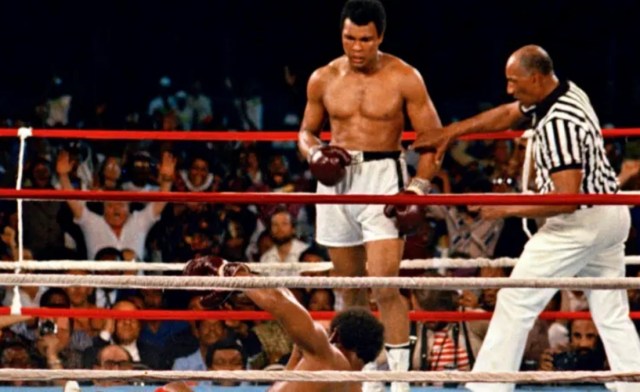
Most older Filipinos know Muhammad Ali well. He fought Joe Frazier in the “thrilla in Manila” in 1975. In 1974 he fought George Foreman in “The rumble in the jungle” in Zaire, Africa. What a pair of fights. What a boxer, that Ali.
In the Zaire fight he deployed perhaps one of the most brilliant boxing strategies ever, the “rope a dope”. He curled up against the ropes protecting his face with his gloves and his body with his arms, letting George Foreman pound and pound until he ran out of steam. Then Ali came out of his shell, pounded back, and won the fight.
The Philippines could use the strategy against China. Rather than shy away from China, the Philippines could poke China by sailing often in China’s illegal territorial claim, then curl up against the ropes, letting China get her bad publicity and waste energy supporting a do-nothing fleet 1,200 kilometers from Hianan. Then poke again, harassing that monster Coast Guard ship with buzzing little ships. Haha. Drop water balloons down the smokestack. Then fall back to the ropes.
Gray zone China with frequent overflights and sail-throughs, nevermind her petulant angers. Make CHINA’s claims irrelevant by ignoring them, then falling back to the ropes.
The current passivity just normalizes China’s presence. Keep China busy shooting water cannons, eh? Keep it non-normal and the audience booing.
Another application of the rope a dope strategy would be to close China’s nickel mines then roll with whatever punishments China deals back. Respond again by nationalizing China’s state owned corporations here (Dito, electrical grid, Manila Bay reclamation companies) or pulling OFWs out of Hong Kong, and roll with China’s punch bank. Gloves up, arms in.
Oh, yes, it will be painful. As Ali took it.
But it was tolerable, for the needed outcome. What is our desired outcome? China out of the Philippines until her leaders respect Filipinos.
Oh yes. And definitely file a court case. Sue for damages.
And take it to the UN General Assembly.
Punch back.
Curl up.
Punch back.
_________________________
Cover photo from USA Today’s entertaining article “Revisiting ‘The Rumble in the Jungle’ 40 years later”.


 The Society of Honor by Joe America
Nice rope a dope Strategy.
I did watch reruns of both back then.
Close nickel mines to export but find a market domestically
we can make use of our market
hopefully that 90 percent DE will shrink
Gradually
by jobs Jobs jobs
and allow many buying tambays and less non buying tambays.
I did an exploration of mining here once and it seemed to me that the Philippines was giving its goods away cheap. I think they are trying to correct that now. But China loves the nickel, so it is like a kidney punch if they are shut down. Yes, look for other markets or plant trees there.
Yes lots of remediation to be done post closure. And yes tree planting on denuded areas not in the middle or even side of highways or roads.
Starting to explore what parts of a supply chain can be set up in the Philippines with regard to mineral wealth already mined would be a great start. Filipinos need to learn about the Art of the Value Add. The higher up the supply chain, the more value is added and thus more profits to be had. Keeping as much of the supply chain domestically, and only importing the required missing inputs keeps most of the profits in-house when the eventual product is exported. It’s 2025, and the old joke about the Philippines still being a top copra exporter hundreds of years later is getting old. We must get with the times.
Btw, not sure if you like coffee or bubble tea and frequent cafes, but many of those tambays actually have nice gaming Androids with which they play ML at the cafe with, and an allowance their mother hands out every morning. Provided of course by their ate who is working hard as an OFW overseas. Heck the last time I was in the Philippines those young boys asked me why I was still using an “old” iPhone. They had newer phones than me 😅
The Philippine Far Left often propagates the narrative that the “exploitative West” imports Filipino natural resources (and in fact even Apo Hiking Society followed that narrative in their mid-1980’s song “American Junk”, though that still had the context of calling out Reagan for still supporting Marcos Sr.) yet it is absolutely a victim mindset to stay at the bottom of the food chain instead of gradually moving up. The mindset of “mahirap kasi tayo” as if that was something inherited. Though a poor mindset can be passed over generations, that is true.
I have read a bit in the book “The Story of Abaca” as to how the Salem, Massachusetts exporter that bought Albay abaca in the 19th century to make shipping rope had to keep prodding the planters to cut it well, the local shippers to make sure it arrived dry but often to no avail.
It was easy money, but that soon dried up when some businessmen decided to plant abaca in Davao during the American period and not only with bigger plantations but also some of the post-processing done in Manila before. The Filipino Far Left might scream about Davao.
Eventually, what happened to rubber happened to abaca, seeds where planted elsewhere.
Costa Rica and Ecuador now also plant abaca, aside from the fact that marine rope is now synthetic fiber since the 1930s (meaning the abaca planter’s son Irineo Salazar of Tiwi, Albay who passed the bar on Nov. 18, 1935 “upgraded” on time and didn’t go poor like some relatives) and I can still remember the kind of narrative the kind of teachers who showed Kidlat Tamihik in school would teach about the “very evil” First World moving biological wealth elsewhere.
There is another book about the Bikol abaca boom titled “Prosperity without Progress,” and that probably is exactly about the one-day-millionaire mindset. It might also apply to mining there.
You’ve no idea how many times I’ve heard “mahirap kasi tayo” in the Philippines. When I related that I also experienced poverty yet was able to rise up through education, hard work, and a bit of luck, the Filipino may then presume that by luck I meant I had a generous backer. I don’t think any parent actually teaches this mindset to their child, but when a child has no role models to inspire them, no mentors to guide them, everything feels out of reach. I’ve even had mentees that I successfully helped to get placed into a BPO job self-limit, telling themselves “I’m not qualified for this supervisory promotion” despite having experience and being well-qualified. Mahirap kasi tayo is really a mentality of self-limiting.
I often wonder if when the Filipino far-left repeats things such as the exploitive West narrative scooping up cheap resources, if the elite kids that like to engage in far-left activism have ever thought that no, it is the FILIPINO bossing that exploited the trabahador. The foreign buyer is simply buying at whatever lowest price they can find around the world to serve as inputs into industrial outputs elsewhere. Or maybe the far-leftist actually has an agenda of agitating the already desperate in hopes of some delusion of leading a revolution or serving as an intellectual, but not really helping the one that is supposedly being advocated for.
Here’s a more up to date story on one of my travels:
Having a chance to stay longer in Mindanao, I chose to explore Zamboanga Sibugay. I met a trabahador who didn’t have a steady job, despite having a tricycle because Sibugay is sparsely populated besides Ipil City. This trabahador had some rubber trees because he had heard it was a good way to earn (it was not). The price fetched for dalawan tapped from the goma once turned into the local rubber latex middleman was a pittance. Not really worth his time. Yet he continued for years tapping rubber weekly as latex prices declined. He then heard that he could buy calamansi marcot and turn a big profit, so he spent about 5K in borrowed money to do that. Well by the time the calamansi had its first harvest, it turned out all the other men without steady employment had also bought marcot from the same seller, so there was a glut of calamansi. The glut ordered the prices down, and besides, the middleman buyer reasoned, the calamansi won’t be fresh anymore after being transported around Mindanao. So the tabahador still collects rubber latex, still harvests calamansi which he can’t fetch a good price for, and his family is still poor. The bandwagon effect is real there in the Philippines, and people would jump on in case of FOMO, without thinking about even a general plan because they heard it was a good way to earn from someone they trusted.
Of course, that trabahador, like many others I met, blamed his financial misfortune on others. It’s unsurprising then that since the Joma inspired discourse had had a chance to permeate society for about 50 years that people would use those greedy foreigners as another excuse. Personal growth can’t start unless personal responsibility happens first.
Well, I guess you now see why Filipinos abroad often don’t return to mentor.
The cheap shot that they are also “foreign exploiters” is at times used.
The Filipino Far Left probably also wants to be datus with the poor adoring them for handouts, except that the trapo datus sell their BS better because they know them much better.
BTW I used to believe the propaganda that Cuba is salsa Communism and somehow happy, I have heard from people who have been there that it is a very sad place and that central planning has destroyed their agriculture, even as it supplanted the old hacienda system.
As for gaya-gaya business models, that apparently happened to kebab joints in the Philippines in the mid-1990s. Everyone rushes into the new flavor of the month business there, it seems.
While we are on a cynical bent (note: not pessimistic), I find it to be entirely absurd that the very returning abroad who tries to help improve the Philippines is derided quietly under baited breath as a foreign exploiter “who is not really Filipino anymore,” yet when it comes time to hand out small gifts or envelopes of cash on holidays, the same person who spoke so derisively lines up with all his family to receive from the “generous” abroad. I had a similar experience as well early on in high school, when I thought to hand out small bags of pamasko (American chocolates) to the neighborhood children during Pasko to the children neighboring my friend’s Batangas compound. The children of course were gleeful with their chocolates, but I’ll never forget the resentful looks on their parents’ faces that seemed to say “this kuripot foreigner didn’t give money in the pamasko.” Mind you, I was just a high schooler at the time, so the idea I’d hand out money was absurd.
I also challenged a UP student around those years on what exactly his agenda was regarding wanting to foment a “communist revolution among the oppressed.” The UP student was from an affluent family with a private driver… he must have been one of those legacy students you mentioned about. His reply was that he wanted to lead the revolution and overthrow the oppressors. I asked then, who would be the new leaders? His reply: people like himself of course. This episode really enlightened me about Joma’s philosophy, which I had just learned about at the time. Indeed with this level of self-important delusion it’s no wonder the Filipino far-left always fails to become the datu when against the dynasty trapos. That doesn’t make their delusions any less dangerous though…
I mentioned before about my high school classmate and self-appointed rival with the corporate lawyer father. Well he spoke effusively about his Cuba trip that was facilitated by a group of Mexican communists (Cuba travel was still illegal under US law at the time). Later I had a chance to go to Cuba myself, and what I found was an island full of bright and intelligent people who were artificially held down by the rule of the Castros. Going to Cuba was like being sent back in time, with meticulously maintained pre-1959 American cars intermixed with dilapidated Ladas. It is impossible to survive in the Cuban “communist paradise” with its voucher rationing system without engaging in the black market capitalism to obtain basic goods or food. Cuba has tried to introduce market reforms (capitalism) but my understanding is that hasn’t helped much as Cuba’s government is still very ideologically driven. No wonder so many Cubans try to escape across to Florida.
I think gaya-gaya businesses and FOMO is one of the bad forms of diskarte. Or ningas kugon as Karl says. Often these gaya-gaya businesses get capital from an OFW or abroad relative. Asking for puhunan is a common thing, as is “can I utang X amount, I promise to pay back.” Of course it would never be paid back if the business fails. More than often the borrower simply disappears for a while. Young people taking out motorcycle loans for the latest fad underbone or “naked bike,” then spending all their time running from the bank’s repossession team. There needs to be a self-reinforcing system of accountability and personal responsibility if that behavior is to change.
I believe that people should have freedom to do what they want within the confines of the law. But I also believe that good government policy would be to identify, present, and facilitate a set of sound decisions to make it easier for people to make choices. Of course people will be free to be foolish if they like, but I think if enough people choose the decent choices arrayed in front of them, more than a few will see the benefits and follow. The first set of choices the Philippines government should facilitate are attracting investment for factories and making available well-paid manufacturing jobs ASAP. Take advantage of mineral and resource inputs the Philippines already has, and import the lacking. Include defense industrial manufacturing. There are many defense assets if manufactured in the Philippines would both improve the economy and improve national security: rocket artillery is a lot simpler than “tube” artillery (mortars and howitzers) could be a start. Slap those new rocket artillery pieces on as many outlying islands and PN vessels as possible. Being afford the opportunity of better jobs would alone probably help a lot with slowly changing bad habits.
Just like the generic lemonade stand pricing story.
People rush to the new lemonade stand because they are thirsty, then they saw something cheaper, they snubbed their recent suki, then they saw a promotion gimick of a lemonade seller doing cartwheels or something they just clapped their hands without buying lemonade….pfft
Since we also talked about strategy and business and rope a dope is a winning strategy.
Now this is about william peackock’s corporate combat.
Corporate Combat: The Application of Military Principles of Strategy and Tactics to Business Competition
Author: William E. Peacock
Publication Year: 1984
Key Themes:
Successful corporate leaders employ military principles in their strategic decision-making.
The book compares historical military victories and defeats with corporate outcomes, emphasizing lessons learned.
It discusses various military strategies and how they can be applied to modern business challenges.
The book draws parallels between significant military victories and defeats and corresponding outcomes in the corporate world. By comparing these historical events, Peacock emphasizes the lessons that can be learned from military history, suggesting that understanding past strategies can provide valuable insights for contemporary business leaders12.
Peacock discusses various military strategies, such as maneuver warfare and attrition, and illustrates how these concepts can be adapted to address modern business challenges. This approach encourages readers to think critically about competition and develop strategies that are both innovative and grounded in proven tactics35.
Overall, Corporate Combat serves as a unique resource for business professionals seeking to enhance their strategic thinking by integrating lessons from military history into their corporate strategies.
Combine hopelessness whem dowm and victim of talanka mentality when up, what do you get?
Victim mentality which may result to success or revenge or status quo.
More Opportunities can be available if less talangka from the ka levels, being looked down and slave driven by the one percenters or feeling alta is bad enough.
One of the great things that American does well is the belief in an even playing field and equal opportunity for all. Or at least used to do well until the age of current oligarchs, which will be defeated once again like the old Robber Barons of the Gilded Age. The American ideal of equality was never perfectly applied, but at least here people think they have a chance to rise up through hard work. The frontier mentality of Americans also fosters more independent thinking.
The Philippines has been stuck in an informal system of power coming down from the top, and to get anything done a Filipino needs to convince a backer to support them. A hilarious, but very sad example is “In order to process an ID, please provide a valid ID.” How Filipinos regardless of economic or social class is able to navigate a system that has so many roadblocks with some self-styled important official “checking” is beyond belief. I can understand why there are feelings of hopelessness, because when everyday is a fight and battle to just get simple things done, there is no time left to think that maybe, just maybe, there’s a chance to rise up.
To use my favorite GoT reference, we must break the wheel! But without barbecuing everyone.
Another cynical comment disclaimer.
It took years after the founding fathers ideal of equal opportunity for all declaration or declamation to tame the marginalized it is not yet even contained until now.
That maybe an OA outsider’s view.
But even here, when are idealistic, you are a rebel.
This is true Karl. Introspective Americans realize that the ideal was never fully realized, yet we Americans must keep marching towards the ideals of the US Constitution. Biden is very fond of saying this.
I think that descriptor of how idealism is seen in the Philippines matches what I know. Rizal’s idealism was both mocked and twisted to be used by others who didn’t carry Rizal’s ideals. Wonder how different the Philippines would be if Rizal didn’t get executed.
If PBBM does more want US escorts then he must allow PN escorts with our worry of backlash because we are allowed to deploy warships during peacetime within our EEZ
Not just US escorts but invite other allies with interests in maintaining trade in the Western Pacific. South Korea, Japan and Australia come to mind. It probably won’t hurt to invite Vietnam as a show of solidarity.
The PRC thinks they are so clever, building out A2/AD networks on stolen reclaimed islands and features. You saw the PRC reaction to Biden “forgetting” the Typhon system, which threatens that A2/AD network. Hope you saw the USN strapping giant SM-6 ship-launched missiles onto Super Hornets and calling it the AIM-174. The PRC was super mad about that, as the AIM-174’s range dashes the careful PRC plan of keeping USN super carriers at an arm’s length.
Just like in WWII in the fight against Imperial Japan, American and Filipino ingenuity can work well together.
As for those “imperialism” shouters, if it were up to me I’d just paint them as commie sympathizers, because that’s what those far-left agitators are. All complaints, no solutions. Curiously they have little to say about Russian and PRC aggression. I’d reframe the narrative as “are you for democracy and the Philippines or not?” If not then get out of the way, all rights of domestic free speech duly respected of course. These people thrive on oxygen given to them by breathless media coverage. Take away the optics they seek and they asphyxiate themselves with in-fighting.
Good luck with reclamation look at what is happening toi the Japanese airport.
Kansai International Airport (KIX) in Osaka, Japan is the world’s first airport built on reclaimed land and is currently sinking.
Explanation
KIX opened in 1994 and is built on two artificial islands in Osaka Bay.
The airport is sinking due to subsidence, which is the settling of compacted fill.
The airport is sinking at a rate of 2–4 centimeters per year.
Engineers anticipated that the airport would subside over 50 years, but some sections of the islands may sink another 13 feet by 2056.
The airport has been the target of extreme weather conditions, including Typhoon Jebi in 2018, which flooded the building and temporarily closed the airport.
Efforts to prevent further sinking
Workers have hollowed out the area underneath the passenger terminals.
Plates have been put underneath the hydraulic jacks.
The columns have been hoisted up in stages.
The composition of the seabed soil has been modified.
I’m not an engineer but I imagine land reclamation is hard to do correctly. Even if done correctly, there is a constant battle with the ocean which wants to reshape the reclaimed land back to the natural shoreline made by ocean currents that requires replenishment of new reclaimed material and reinforcement of concrete sea breaks and berms.
The Economist ran an article a few years back about the challenges the PRC is facing. Short version is the much feared bases on stolen reclaimed islands and features are not that scary after all in a real war due to the tyranny of distance. And besides, corrupt PRC engineering firms and lack of knowledge to actually do land reclamation correctly has those reclamation projects already show signs of degradation, sinking and crumbling.
https://archive.ph/ENC81
With a bit of luck, the Chinese will defeat themselves, just like they have throughout their country’s illustrious 2000+ year history. The Han Chinese despite what they believe, have never won any expansionary war that wasn’t led by a foreign hegemon lording over the Han, like the Mongols or Manchu. Just ask the Koreans and Vietnamese, who had to deal with bopping over confident Chinese invaders on the nose for the last 2000 years, to fill in the blanks on the exact strategy needed to counter Han Imperialism, including teaching some humility to those Mongols and Manchus alongside the pesky Han.
So the Century of humiliation was a big understatement.
It is like Germany’s former greatness in the “First Reich,” aka the Holy Roman Empire, was also a bit overrated. It had its great moment when Emperor Otto repulsed the Magyars on Bavarian territory, Lechfeld battle.
The Bavarians under Arnulf the Bad had been quite successful in dealing with the Magyars, then still pagan, not yet Christian Hungarians, even giving them a similar Red Wedding as Humabon gave to Magellan’s people after Lapulapu.
The Game of Thrones reference is intentional, as these were tribal tactics, not strategies. Siegfried in Wagner’s operas or the old story of the Nibelungen Ring (I think one inspiration for LOTR) was a trickster, tribal character, but in the original Nibelungen story, Atilla killed him.
Yet still, the Holy Roman Empire remained more of a Germanic tribal Confederation that elected its “Emperor” just like the Visigoths elected within the Amaling or Amelungen clan who would be their “King”. The Amaling had a queen who killed her sister, locked her up in a steam bath. That these quarrelsome tribal people would rule Rome only for a while was clear even as they had some of the Roman comforts already like steam baths and huge malls (char of course). Justinian’s general Belisarius landed in Southern Italy and steamrolled over the Goths. It didn’t matter if they destroyed Italy’s cities as most of the Eastern Romans were more Greek..
Two points actually: never overestimate the enemy even as one should not underestimate. Also, tribal tactics are weak against Imperial and invasive strategies, Philippines must level up.
That deserves to be in caps. “ALSO, TRIBAL TACTICS ARE WEAK AGAINST IMPERIAL AND INVASIVE STRATEGIES, PHILIPPINES MUST LEVEL UP.”
Nice two points. (It sounded like basketball)
In short yes, the so-called “Century of Humiliation” was the Chinese nationalist reaction to the thousands of years old Han national myth that the Han are superior to all, everyone else is a barbarian, and that China is literally the center of the world in the sinocentric system of concentric rings of influence. This national myth started since the first major Han dynasty, the Qin in about 200 BC and is integral to Han identity. As such every Chinese dynasty considered every country to be their vassal, with the vassal governing their native land “on behalf” of the emperor, regardless if the Han had actual influence there or had even visited militarily there. We need to understand the mindset of Han nationalism which goes hand-in-hand with Han imperialism in order to fight the present day PRC’s expression of that nationalistic imperialism. Han culture is inherently imperialistic, like Russian culture, and they have never given up that myth despite what some Western academic apologists arguing that “China’s government is not her people.”
When I shared that China has never had any external expansionary period where China conquered outside territory on their own, this is true. Expansionary periods occurred during foreign warlike “barbarian” dynasties ruling over the conquered Han, such as the Early Jin (Jurchen), Later Jin (Jurchen again), Liao (Khitan), Yuan (Mongol), Qing (Manchu) to name a few of the many. In fact at the start of the “Century of Humiliation,” the Han were already under the domination of the Manchu Qing for over 200 years. The Han were not “humiliated” by the Manchu domination because well, the Han re-wrote the national myth in their minds to sinicize their barbarian overlords as “actually being Han” in spirit. This pattern of mythic delusion in service of nationalism went way back in history 2,000 years.
The present PRC has its own myths of greatness. Mao’s Chinese Communist forces were badly equipped, badly trained, and only won in the end because Chiang Kai-shek’s Nationalists did all the fighting against the Imperial Japanese in WWII, with Mao promising to “come soon” to aid the Nationalists, but never did. The Chinese Communists and Chinese Nationalists had a cease fire then due to the Japanese common enemy. So after WWII, Mao simply restarted the Chinese Civil War and was able to drive the war-weary Nationalists to Formosa (present day Taiwan). Yet every year the CCP hosts the China Victory Day Parade through Tiananmen Square, taking credit for defeating the Japanese when it was the Nationalists who did all the fighting.
Aside from the PRC’s disastrous actions in their “volunteer” participation in the Korean War, for which they claim victory, the only other actual conflict the PLA had been in was the 1979 Sino-Vietnamese War where the PRC invaded Vietnam. The PLA was soundly defeated and driven back in retreat across the border, yet they claimed to this day they won (see a pattern?). Other than that the only other quasi-military experience the PRC has are some African peacekeeping missions under UN auspices, in which PLA peacekeepers ran away at the first sign of African gunmen putting up a challenge.
So this is to illustrate the corrosiveness of delusional national myths, which in the case of the Han Chinese has lasted 2,000+ years. There were no true “vassals” of Chinese emperors in the sense of the word vassal. Instead we have delusional Chinese emperors thinking they owned the world, and where the “vassals” were actually countries that wanted Chinese “stuff,” mostly porcelain and silk, and had to go through the motions of obeisance that the Chinese emperors demanded to get the trading permit.
I’ve noted before that the Philippines also suffers from some delusional national myths of greatness. It probably would be in the Philippines’ national interest to reflect on reality, exercise caution due to the sheer numerical superiority of the PLA, and work together with allies as soon as able to counter the Chinese imperial delusion.
I appreciate your imparted knowledge and wisdom, our resident advanced AI mensa.
Again, just to reinforce John Mauldin maps out the spread of the Han VlVhinese together with others and yes Mainland China is still full of Han Chinese, concentrated on the East.
The illusions of grandeur begins with a leader who thinks so like Alexander the Great for instance said he came, he saw and he conquered as translated by his Anglo-Saxon slave chronicler (joke)
https://imageio.forbes.com/blogs-images/johnmauldin/files/2016/02/ethnolinguistic-groups.png?height=640&width=640&fit=bounds
The link to the whole article, it is about China’s strategy in maps by John Mauldin, an associate of George Friedman.
https://www.forbes.com/sites/johnmauldin/2016/02/25/5-maps-that-explain-chinas-strategy/
Very interesting article. Written in 2016 but seems to hold true to what we can see today. Here are the two final concluding paragraphs:
“China, therefore, has three strategic imperatives, two of them internal and one unattainable in any meaningful time frame. First, it must maintain control over Xinjiang and Tibet. Second, it must preserve the regime and prevent regionalism through repressive actions and purges. Third, it must find a solution to its enclosure in the East and South China Seas. In the meantime, it must assert a naval capability in the region without triggering an American response that the Chinese are not ready to deal with.
The Chinese geopolitical reality is that it is an isolated country that is also deeply divided internally. Its strategic priority, therefore, is internal stability. Isolation amidst internal disorder has been China’s worst case scenario. The government of President Jinping Xi is working aggressively to avert this instability, and this issue defines everything else China does. The historical precedent is that China will regionalize and become internally unstable. Therefore, Xi is trying to avert historical precedent.”
Since that article was written, the internal instability within the PRC has only gotten worse. It’s not obvious to the outside world unless one spends an appreciable time inside China itself and is skeptical of the rosy picture painted by pervasive PRC propaganda.
Case in point, the forced sinicization of the Tibetans and Uyghurs, an obviously non-Han people that has the democratic nations appalled. The takeover and attempted genocide of Tibet was to solve a prior internal crisis within the early CCP regime, and the current genocide of the Uyghurs serves the same purpose for the current internal crisis. The PLA has cadres of idle Chinese young men, the wumao (also derisively called the 50-cent army for the pay they receive per post), who obsessively post and repost approved inflammatory nationalistic rhetoric on Chinese socmed. When unapproved posts that seem innocent to Westerners are censored and black holed within hours by PRC internet censors, the allowance of bellicose rhetoric is a big tell. There has been talk for some years that in addition to taking over the 9-dash line, the PRC should take over those “rebellious Han separatists” in Vietnam and Korea. Yep, in the PRC’s imperial mind, informed by two millennia of Han imperialism, they consider Tibetans, Uyghurs, Vietnamese and Koreans as breakaway Han people which cannot be further from the truth. I’m sure they can come up with something to rationalize how Filipinos are actually also Han, by dent of Austronesians originating from Formosa, which was never actually controlled by the Qing or prior empires but was claimed under the Mandate of Heaven.
When nations are on the brink of internal collapse, those nations often try to redirect domestic anger outward as belligerent nationalism. Such as what happened many times in the Roman Empire, European empires, the Russians, and of course as I mentioned elsewhere, with various Chinese empires.
Fun times.
True even with fact checkers and Inrernet a lot of news is filtered even the obvious.
I posted about ghost cities before.
They watched Field Of Dreams and took to heart when they heard:” Build it and they will come”.
The Local government debt is gargantuan whem combined and with their massive build up for sure they have a humongous foreign debt.
Yet they only advertise that US and others owe them a lot of dollars.
Did Sun Tzu tell them to focus only on guile and deception and forget the other tenets of the Art of war?
And those PRC local governments are only able to build those ghost cities because of tacit approval from the party leadership where every plenary level takes its own cut of the corruption. Shoddy construction methods, sand adulterated concrete and rusting “stainless steel” rebar. All in the name of corruption and to keep the non-elite masses busy. The CCP contract with the Chinese after all is “look the other way on communism as long as your salary rises.” Well salaries in China are not rising anymore because the party bosses are taking too much from every level. Chinese people are upset but don’t know who to blame yet.
In terms of the CCP nationalists, they are quite few in number. Most are idle youths or former PLA veterans. The PLA veterans are the PRC’s biggest worry as there’s an instant revolutionary army to overthrow the CCP if there ever was one. Great lengths are made to keep PLA veterans happy. The majority of Chinese people don’t seem to care about communism or not, they just want stuff and better salaries. I don’t think the bellicose messaging really breaks through to the average Chinese, but if war breaks out they will be dragged along like everyone else in the region.
Xi’s regime since the early 2010s is when all this started happening, because the CCP under his increasing control has gone back to gangster leadership with Xi as the top gangster. Xi abandoned the measured adoption of “market capitalism with Chinese characteristics” and made it into “with Xi’s characteristics.” The uneducated Xi envies Mao’s Little Red Book so much that he released his own Little Red App, which is required reading by Chinese students. Xi may yet surpass Putin as the world’s secretly richest man, given the much larger size of the PRC. Even Mao wasn’t this brash as Mao still somewhat believed in the central Marxist-Leninist ideology, filtered through his Maoism of course.
All this is not to say that the PRC should be underestimated or that feelings of moral or other superiority should be smugly felt over the PRC. Too many people have analyzed the PRC’s behavior as meticulously and masterfully planned, but their actions are rather ad-hoc and random, often testing the waters before making a bigger reaction. The problem is most of the SEA countries never countered, and instead cowered. We should study and understand what is driving the PRC’s belligerent behavior, and counter it with a swift knock on the head while the opponent swings wildly. Teddy Roosevelt once said “speak softly and carry a big stick; you will go far.” Meaning: know your abilities, have allies to fill in ability gaps, have humility, but be prepared.
Speaking of Steel, the Yang siblings shell company here is a steel company meaning they steal sub rosa…..
Sanjia steel.
If Sara Duterte wins, back to glory days for the Yangs. These issues were overtaken by the next issue. All dismissed as a demolition job.
https://globalnation.inquirer.net/250172/michael-yangs-family-tried-to-make-cdo-their-kingdom-paocc
https://www.philstar.com/headlines/2024/09/29/2388760/michael-yang-associate-linked-web-criminal-activities
How many Yangs of the world are in Cambodia, Laos, Sri Lanka , Sub-Saharan Africa and maybe beyond.
A lot of Yangs if Pogo ops are an indicator. Sara Duterte would move the country toward China. The Cambodian model I suppose. Filipinos would be the servant class.
I think it is dangerous to broad brush all Chinese as bad actors (not saying you are Karl, just an general observation of some of the rhetoric coming out of the Philippines from regular DE’s). Chinoys identify themselves are fully Filipino, and I’m sure the vast majority will choose loyalty to the Philippines. Some of the dangerous rhetoric is based in a combination of “Chinese” being easy targets and taggable “fifth columnists,” perpetual foreigners, but I think that rhetoric has more of its roots in poor Filipinos both wanting to be “rich like the Chinese” but also envying alleged Chinoy success, while being immensely proud if they “married into” a “Chinese” family and gained a “Chinese” surname. Well I’ve met a lot of poor Chinoys too.
The easiest way to have an idea into where loyalties may lie is in the person’s name. Does the person in question have a “mainland name” that is Han (Mandarin) or does their name have non-Han origins, for example Hokkien? To continue the example, if someone has Hokkien ancestry, did that person in question “standardize” (as it is called in mainland China) their name to a Han name?
I don’t think it is wrong to do business in another country, so I don’t think it is wrong to do business in the PRC. But if the person’s loyalties were never rooted in the Philippines, or if their loyalties had shifted (usually due to the dirty money that PRC state-owned companies shower around), they would start using a “standardized” name. That is a “big tell.”
In the case of Tony Yang aka Yang Jianxin, his alleged origins is in Jinjiang, Fujian, which is traditionally Fuzhounese also known by the ancient name of Minyue. However judging from his physical attributes, he appears to be a full Han. Descendants of Yue people look more like Cantonese and Vietnamese people, or Chinoys. Even if his family origins were Hokkien, Hoklo, Teochew, Hakka, all non-ethnically Han groups that the Han majority has forced to assimilate in the last 100 years, having the name “Yang Jianxin” means that he sees himself as part of the Han majority. If he had kept a traditional name, for example if he is Hokkien, his name would be “Yiang Kiansin.” In Chinese-Filipino transliteration, it might be something like “Kansin Yan.”
Tony Yang was probably one of the early businessmen who were sent out to initially make money as the PRC was suffering from economic crisis during the Asian Financial Crisis as well. Conveniently these businessmen were now well-placed to further PRC objectives later on. As such there are many Tony Yangs all over SEA, Sri Lanka and Africa. Nothing goes on in the PRC without tacit approval of the PRC authorities when it comes to large amounts of money being moved, as otherwise how would corrupt CCP party officials get their cut? People like the once-powerful Jack Ma, the former richest man of China, were disappeared for years for minor infractions of barely speaking out a bit of their mind and daring to have other ideas than what the party officials had directed him to have.
These differentiators are important. If the Filipino public or government starts broad brushing all “Chinese” in the Philippines, that plays right into the PRC’s hands. In fact, one of the main points that the PRC’s wumaos are authorized to push on PRC socmed to justify taking over neighbors is to save “our fellow countrymen from oppression.” Sounds very Nazi or Russian if you asked me.
Check out @easy_jonathan aka Dr. Jonathan Sy on Twitter. He was an Angat Buhay pandemic volunteer, by the way.
Invited me to a Twitter space about and with Chinoys once. Very enlightening also regards the different schools like Chiang Kai Shek HS or Xavier.
His most humorous posting was that his surname in the Northern Chinese variant is associated with a boring Communist party functionary, while it has a badass sound in its Hokkien variant, Sy.
I think I am following Jon Sy already per your previous mention.
Here’s something interesting. The surname “Sy” is the Chinoy version of Hokkien “Si.” The etymological root means “West.” “Xi” as in Xi Jinping is the Han Mandarin version of the same root word. The origin of the surname Xi/Si is actually Han, though in centuries past there were Han who fled oppression from megalomaniac Han kings/emperors and settled in Yue kingdoms along the coast, becoming assimilated into Yue culture. This is quite different from the Han project after all the other ethnic cliques in the Chinese Revolutionary coalition were defeated. The KMT started the project of modern sinicization and forcing everyone to identify as Han. The CCP, who had common origins as the KMT, continued and accelerated that project. China suddenly becoming 98% Han is a recent phenomenon in the last 100 or so years, and was accomplished by forced assimilation aka genocide.
China’s LGUs’ debt management are now more transparent if this fact checked info is factual.
The assertion regarding local government debt in China is largely accurate, reflecting ongoing challenges and regulatory efforts. Here’s a detailed fact-check based on recent developments:Local Government Debt Management
In summary, the statement about increased regulation and transparency efforts is correct, but it is crucial to recognize that the scale of local government debt continues to pose significant risks to China’s economic stability.
China’s VP will attend the Trump inaugural ceremony. They want more talk with the US, and I’m sure economic matters are high on their agenda. The US is rather tired of China’s hacking and spying and might be inclined to rattle the economic cages a bit.
The PRC’s economic agenda is to try to coax American investment back into China to prop up the PRC’s ailing economy. Though with sending the PRC VP rather than Xi going himself is sure to feel like a slap on the face to Trump who values looking strong standing next to other strongmen. Choosing between enriching himself and his children through China deals, or to throw red meat to his MAGA base? That indeed would be interesting to watch.
Agree. I’m thinking cordiality will last, oh, about the length of a handshake.
I wonder if Trump remembers which side to stand on to assert power during a photo-op handshake. Was it the left side? Or the right? I know what side Xi and his subordinates always jockey for.
Trump will be to Xi’s left, facing the cameras. Could be a comical scene if they try to upstage each other.
This is the position of the subordinate partner. Note that Xi often tries to maneuver to the right, facing the camera. A relaxed arm in this position denotes strength.
2019 Trump Xi handshake.
Well the ethno-linguistic history of the Han and their relation to today’s PRC is … complicated.
Short version is the “foreign barbarians” who conquered the Han during various periods sinicized themselves (most famously the Mongol Yuan) over time. The last “foreign barbarians” to conquer China-proper were the Manchu Qing, and the famous “Chinese queue” hairstyle is actually a hairstyle of the Jurchen and Manchu nobility. So there were some Chinese nationalist cliques in the Chinese Revolutionary War period who went back to the traditional men’s long hairstyle held up by the fanzi hairpin.
As for the Han, they originated in the Central Plains along the Yellow River to west near modern Beijing. The Han eventually forced other peoples dwelling in ancient China to “become Han.” From wiki as a quick understanding:
“The term “Han” not only refers to a specific ethnic collective, but also points to a shared ancestry, history, and cultural identity. The term “Huaxia” was used by the ancient Chinese philosopher Confucius’s contemporaries during the Warring States period to elucidate the shared ethnicity of all Chinese;[34] Chinese people called themselves Hua ren.”
So “Han” can be understood as an ethno-cultural group, emphasis on both ethnic and cultural. The cultural aspect are the non-ethnic Han peoples being forced to identify as Han over the course of 2,000+ years. Here’s a short list, also from the same wiki:
”
Wu (吴语): Jiangzhe people (江浙民系)
Hui (徽语): Wannan people (皖南民系)
Gan (赣语): Jiangxi people (江西民系)
Xiang (湘语): Hunan people (湖南民系)
Min (闽语): Minhai people (闽海民系)
Hakka (客语): Hakka people (客家民系)
Yue (粤语): Cantonese people (岭南民系)
Pinghua and Tuhua (平话和土话): Pingnan people (平南民系)[60][61][62][63][64]
Jin (晋语): Jinsui people (晋绥民系)
Mandarin (官话): Northern people (北方民系)[65]
Northeastern (东北): Northeastern people (东北民系)
Beijing (北平): Youyan people (幽燕民系)
Jilu (冀鲁): Jilu people (冀鲁民系)
Jiaoliao (胶辽): Jiaoliao people (胶辽民系)
Central Plains (中原): Central Plains people (中原民系)
Lanyin (兰银): Longyou people (陇右民系)
Southwestern (西南): Southwestern people (西南民系)
Jianghuai (江淮): Jianghuai people (江淮民系)
”
The Han people are everyone on the “Mandarin” section and below. The upper part of the list are non-ethnic Han people who were forced to sinicize, sometimes identify as Han, but most of the time still keep their traditions. This can be most simply seen by the different human ethnic phenotypes contrasting each group.
Especially since the Chinese Revolution, both the Kuomintang and CCP, led by ethnic Hans, heavily emphasized and forced sinicization. Prior to the Chinese Revolution, the ethnic groups of the upper part of the list were still somewhat separate and autonomous. The Han-ification of China was further helped by Western sociologists and researchers who saw China through the lens of their own ethno-nationalism at the time which made the process of final sinicization a lot easier. But the people of the upper list did not necessarily see themselves as Han prior to the Chinese Revolution 100 years ago.
So, for example, Vietnamese people are a Yue people who moved south and were able to become independent 2,000 years ago. Notice that “Viet” and “Yue(t)” are cognates coming from the proto-Yue language. Chinese-Filipinos are mostly Hokkien, with smaller origins in Cantonese, Taishanese, Teochew, Hakka, all Yue peoples. Depending on when that overseas “Chinese” community got its start, they may or may not identify themselves as Han, or as the Chinese would say, “Mandarin.” Even within the PRC today there is a distinction between the groups, and the Han look down on other groups that they claim are also Han, for example the Han look down on the Cantonese. Each of these major ethno-linguistic groups were their own tribes originally, with their own language (which are now called “dialects” even though its an independent language, similar to how other Philippine languages were and are still commonly referred to as “dialects). By the way, forcing the “dialect” label is a form of sinicization. A Cantonese cannot understand a Han who speaks Mandarin and vice versa.
See here, the early expansion of the Han Empire which aside from the Qin, who were also Han), were the only times the Han actually conquered on their own. The Han originated roughly between the city-states of Dai and Handan. After the Han dynasty expansion, when the Han Empire collapsed the Han people shrank back to their original city states in their homeland. Later, the Han “couldn’t go back” as the nomadic “barbarian tribes” like the precursors of the Mongols, Jurchen, Liao, and Manchus took over the northern part of China which caused southward pressure to other non-Han kingdoms that the Han in their delusion called “dukes” (what later history would call “Manchuria” during the colonial period). In this map in yellow we see Nanyue, and Minyue, which the map conveniently translates to “Southern Viet” and “Middle Viet.” Nan means south, Yue is cognate with Viet. Viet Nam means Yue Nan in reverse, which the Han Emperor demanded the name change after the Han-Nanyue War. Yep, at the earliest period of East Asia history, the Viet kingdom/confederation included all those yellow areas, as well as Hainan Island. This must be new information to most of our fellow friends here! I don’t see Vietnamese people demanding to take back all that land, their original homeland, but the Han insist they must take back everything they ever touched, and more due to the imperialistic mindset that is integral to Han culture. We must understand what shapes a culture if we must fight or defend against that particular people.
Thanks for demystifying it, you are very right, it is complicated .
I observe Chinese social media from time to time, especially the more nationalistic elements that are by the way seeded by PLA intelligence units to stoke anger in the Chinese people. I’ve noted before the faltering PRC economy and their own domestic and social problems. When autocratic nations can’t or won’t fix their domestic problems, the convenient option is to identify an external enemy, which happens to be the US and US allies like the Philippines. But the Chinese also know that alone the Philippines is quite weak militarily. So to justify the minerals and fisheries grab that both earns wealth and mollifies domestic anger, a story invented about “traditional Chinese territory” aka 9-dash line, with the evil Americans preventing China from regaining her supposed glory by retaking “traditional Chinese territory.”
Thanks again, for this Joey.
The Military historians slash anthropologist/sociologist have unending roles in a military establishment.
But when it comes to things we rediscover when it comes to interpretation of Han history,If you can’t make it fake it.
This is true. Many American generals and admirals are sometimes called “warrior monks” as they are very well-read in history and philosophy. In order to defeat an enemy, one needs to understand the enemy. Mass rushes without planning like what the Celts and Vikings used to do, and probably what pre-Spanish Filipinos did, sometimes works but once the morale is broken against the enemy shield the bravery disappears quickly. Hope AFP will be more like the Filipino troops in the Battle of Yuldong (thanks Irineo for reminding about this tidbit of history).
My dad tried to brush up on his military history by asking me to google for him before when he was still healthy enough to do extensive research.
His old school approach of reading books was amazing the National defense college lent him books and he can produce a few mini books in a few weeks.
I remember he did a monograph on national interest and Civil Military relations
Nowadays he just forwards news.
That’s amazing of your dad Karl. Does your dad have any published papers? It would be interesting to have a read sometime.
Again to reinforce your comment by AI research so to speak. So far perplexity works for me after Gemini gave me weird reference sources more than once.
Land reclamation is indeed a complex and challenging process that involves creating new land from bodies of water, such as oceans, seas, or lakes. The challenges associated with this practice can significantly impact its success and sustainability.
Challenges of Land Reclamation
Technical Complexity: Each reclamation site presents unique challenges related to soil composition, contamination, and geographical features. These complexities require careful planning and technical expertise to address issues like soil stabilization and erosion prevention13.
Environmental Impact: Land reclamation often leads to significant environmental consequences, including habitat destruction, loss of biodiversity, and disruption of natural ecosystems. For instance, projects can alter ocean currents and wave patterns, affecting marine life and water quality45.
Financial Constraints: The costs associated with land reclamation can be prohibitively high. Expenses include materials, labor, equipment, and environmental mitigation efforts. For example, in the Netherlands, the cost of reclaiming land is estimated at around €100 per square meter35.
Regulatory Compliance: Navigating legal and regulatory frameworks is another challenge. Reclamation projects must adhere to specific permits and environmental standards, which can vary by jurisdiction and require substantial expertise to manage13.
Long-Term Sustainability: Achieving long-term sustainability in reclaimed areas is crucial but difficult. Continuous management is necessary to ensure that the restored land remains viable over time15.
Specific Concerns in China
In the context of China’s land reclamation efforts, particularly in the South China Sea, there are additional considerations:
Geopolitical Tensions: Reclaimed islands have raised concerns regarding territorial disputes and military presence. However, some analysts argue that the strategic value of these bases may be limited due to logistical challenges posed by distance in a conflict scenario1.
Engineering Challenges: Reports indicate that many Chinese reclamation projects are already showing signs of degradation, such as sinking and crumbling infrastructure. This raises questions about the capabilities of domestic engineering firms involved in these projects14.
Historical Context: Historically, China’s expansionist efforts have often faced resistance from neighboring countries like Korea and Vietnam. This historical backdrop suggests that external pressures may continue to challenge China’s reclamation ambitions1.
In summary, while land reclamation can provide new opportunities for development, it is fraught with challenges that require careful consideration of environmental impacts, technical expertise, financial resources, and regulatory compliance. The situation in China exemplifies these complexities on a geopolitical scale.
I’ve concluded that Joey is an advanced AI computer.
I agree!
Beep boop beep boop bzzzt 🤖
Ba weep granna weep ninny bong
Thanks for that summation Karl!
Welcome.
The imperialism shouters are less dangerous than those Filipinos who believe that „China is the future, America is a declining Empire“ with America of course full of redneck MAGAs, homeless people all over California and an opiod crisis while China is the upcoming power.
There is a strand in Philippine culture that likes to switch allegiance at the flick of the finger, from Congress supermajority thru datus of Manila switching allegiance from Brunei to King Philipp II (saying now we are Filipinos, joke lang) or principalia dropping Spain for USA, USA!
Both the imperialism shouters and the lapdog types have a subordinate mindset as opposed to what I would call a real sovereign mindset, not just yelling sovereignty as a pose.
Indonesia blasts Chinese fishing ships that enter its waters, but China still built them a train.
China BTW is similar in behavior to pre-WW1 Germany when it comes to industrialization and naval build-up (Karl, look up Tirpitz in case of interest) in competition with England.
It is similar to pre-WW2 Germany in its hate of the West, as in „we were great, but they humiliated us“ – for China it is the Century of Humiliation, for pre-WW2 Germany it was the Thirty Years War, Napoleon and Versailles. There is even an echo of „Master Race“ mindset in the way Mainland Chinese sometimes act abroad. What I know of that mindset is that it does NOT respect subservience. Indonesia proves that it respects those who stand up to it.
Duterte was China’s tuta, but got no Mindanao train. Java got its speed train now. Though there might be one difference and it is the Philippines is a keystone in a global conflict.
The example of Adenauer refusing Stalin’s offer of German reunification in exchange for Germany leaving the Western alliance might apply, and his statement „Unity without Freedom is useless“ as well. There might have been Germans of the old school (it was the 1950s) who called him „Rhine Alliance member“, an old insult to Germans too friendly to the West especially to France, referring to the old alliance that supported Napoleon, but he ignored that if ever.
For the Philippines, how it deals with being in the center of a global conflict, more than ever (1569-1571, 1898-1901, and 1942-1944, were just warm-ups compared to today) will test it. Well, in Europe, I kind of worry if Trump will tell Putin, „Vlado, let’s make a DEAL, you take the Baltics and I take Greenland, and when I take Canada NATO is practically dead“ and Putin smiles, hope that doesn’t happen. Fortunately, nothing of that sort will happen over there, since indeed Asia is rising (Sokor is building an airport for Poland BTW) and as the Russian saying goes, where there is gold there is always blood. But the Philippines has leverage due to that.
To be honest, I’m really surprised that Pinoy socmed has American right-wing talking points all over it, just filtered down and with even less context. Many Filipino netizens in my feed are curiously very invested in the Los Angeles fires, despite knowing nothing about even the basic facts. Then there is the homeless situation or other issues Americans are facing, blown out of proportion. A democracy and free speech is susceptible to information warfare, but that is the price we pay for freedom.
Contrast with PRC propaganda in C-dramas, Chinese apps, CCP state media filtered down by Filipinos reposting it. All depict a perfect China with fabulous wealth and no societal problems. Well, a journalist friend is a China watcher and he witnessed directly one of the recent vehicular and stabbing attacks by angry young men upset at the CCP promise of upward mobility starting to crack. None of that appears in the Chinese apps as it’s all censored by the CCP. It does take a degree of credulity to take everything one hears and sees as proof positive though without question. And how often do Filipinos instantly change their opinion based on the next information stream they encounter? I fear that socmed and the shadow cyber information war being waged by Russia/PRC has only made everything worse.
I do think that the Philippines should be cautious about thinking the Philippines archipelago is as strategically important nowadays than it was in centuries or even decades past. The Philippines already lost 30 years of essentially free defense build up after kicking out the American bases, and since then the US has built bases elsewhere. Strategies and capabilities have been adjusted to account for possibly needing longer range and endurance. Must remember that until very recently, the EDCA sites were not even refurbished until after the agreement was signed. Those EDCA sites are AFP bases but maintained the rough size, capacity, capability that the US had left the bases as built following WWII. Having allied bases in the Philippines helps greatly with mitigating the tyranny of distance, but isn’t entirely necessary anymore. So the Philippines should increase the strategic value of her location once again.
Well, Filipino credulity is one reason some believe Marcos Sr.’s rule was a Golden Age. I call it North Korea with a Bee Gees soundtrack. The airbrushed photos of that age make it look too perfect.
Whereas MLQ3 noted that TV Patrol made the Philippines look more dangerous than it really is. That is, of course, a post-1986 TV show.
Agree that the Philippines has played its cards badly. Mahinang diskarte. Malapit na mapusoy.
When Fil-Ams who had their origin in the old middle class who escaped Martial Law rationalize the Marcos nostalgia prevalent in the Philippines, their understanding is because “Marcos Sr. gave the poor stuff which endeared his family to the poor.” I think the reality is a bit more nuanced. In a way, today’s pro-Marcos crowd are reactionaries who are rejecting the ideals of EDSA. The pro-Marcos crowd has often been accused of whitewashing the history of Martial Law, something akin to reactionary Americans who yearn nostalgically for the 1950s golden age that never existed for most Americans even at that time. Of course much of this has to do with propaganda. In the Marcos case, Imelda ran a pretty effective propaganda campaign throughout Marcos Sr.’s rule, and in the American case the positive propaganda of American post-War idealism was misappropriated.
Just like reactionary Americans or reactionary Europeans breathlessly share about homeless-ridden “Democrat” cities, or alleged incompetence in addressing natural disaster, I suppose that reactionary strain requires populist resentment against the elites. By elites, undemocratic (small D) propagandists have identified the educated, “people who don’t look like us,” and the political class who support those groups. Never mind that the reactionary propagandists are working on behalf of the Western oligarchs who are the actual problem (in the Philippine case, working for dynastic interests in the dynasties’ Game of Thrones). Digging a bit deeper it seems to me that the populist resentment derives from “other people got stuff, I didn’t get stuff, therefore I’m upset.” Inadequate educational and economic opportunities extinguish critical thinking as when humans feel like they are under the stress of survival mode they look for something or someone to blame. So then there’s people like me who can travel to Lanao, Cotabato, Sulu, with some degree of caution exercised, while Filipino friends with terrified expressions of concern were so worried for me. Undoubtedly in the age of visual media then social media the problems have gotten worse as people can point to a picture or video shared by someone they trust as proof-positive confirming their prior biases and beliefs. I got a very angry response from a Cebu-based acquaintance a while back when I asked them why they were so super invested in the recent typhoon destruction in Bikol when they aren’t even affected. That acquaintance literally felt like “they were there,” and experienced the destruction directly. Of course the acquaintance also shared their sentiment as a way to try to recruit my agreement to confirm their political priors (they are pro-Duterte/Sara and anti-Marcos Jr.). When I asked why didn’t they blame the Dutertes for the destruction in Cebu and Bohol after Odette… crickets.
I think the Philippines need a long, hard think on what the Philippines stands for and what are Filipino values in relation to Filipinos but also the world. If those values are democracy and the rule of law, the values of democracy and rule of law are powerful weapons to equip in a fight against an imperialistic dictatorship that is encroaching. The Philippines needs to think about how Filipino titans of business can be recruited and how new industries can be grown by new entrepreneurs that aside from economic benefits also provide benefits to national security. For example, if the AFP modernization was done faster and didn’t wait until PNoy was in power to get moving, if identified possible mineral deposits were explored and exploited earlier, if manufacturing was set up that progressed to a local military-industrial complex, the Philippines would’ve been in a much better position than now. Yet it is not unusual for me to hear from some Filipino friends their indignation that “we are the oldest ally,” “the US didn’t give us brand new jet fighters and navy ships,” therefore “we must appease China and become their subordinate.” Waiting for a benefactor to shower down stuff rather than working with that benefactor to build lasting, native industrial infrastructure was an old move, but the wrong cards to play once again…
” . . . long, hard think . . .” Neither leaders nor people think in those terms. Conceptual ideas are relegated to universities as meaningless in a world of reaction to issues, not planning.
Fair enough. If a way can’t be found to drag people forward, kicking and screaming need be, then I hope either a.) The US comes to the rescue again; unknown in the US political climate b.) Other Asian US allies and Australia can fill in the gap of the US is MIA.
The world bought into commie propaganda for decades on (sometimes) American heavy-handedness in enforcing the principle that territory cannot be changed by war. Humans often don’t appreciate what they have until it’s gone, and the American political climate no longer has the same base reality and common foreign policy across parties like before.
It is said: “The quickest way to know what someone does is when they stop doing it.”
The end result may be highly detrimental to the US, the Philippines, and the world nonetheless.
If the system is transactional, I suspect the best approach is to string together a series of meaningful transactions. Base them on improving Filipino wealth and opportunity. With opportunity will come more conceptual thinking. Slow but steady.
Well the great part about American mercantilism is that I think American interests could still feel fulfilled participating as one of the higher levels of the value add in the supply chain. There are numerous examples, such as Thailand being a major manufacturer of computer storage, or Indonesia being a major chip packager. All using American-developed technologies and factories planted with American co-investment. I think the “co” part is the key because it seems to me Filipino leaders think they should just receive stuff for free with no effort.
On the military industrial side, ammunition and basic arms will be a big requirement in the new age of world war we seem to be teetering on. If war-torn Ukraine is serious about setting up basic arms manufacturing industry for rocket and tube artillery that complies with NATO standards, I see no reason why the Philippines in a time of increasing urgency can’t see to do the same.
Totally agree. One of the northern European nations, Sweden?, is developing drone swarm warring techniques. The PH is manufacturing a few boats here. I’d say do a lot more of that with drones rather than buying jets. Let the US cover the air.
Sweden due to their previous non-aligned status has developed quite a few indigenous technologies that are pretty good. A long line of effective and rugged fighter jets as well as missiles (including the critical need for anti-ship missiles). For a while there seemed to be a group within the PAF that was pushing for the Swedish Gripen fighter rather than the American F-16, EU Eurofighter, French Rafale after the Asian Financial Crisis canned the original F-18 plans. All well and good, except the Gripen due to the rugged and austere airstrip requirement actually costs almost as much as an F-16. The PAF eventually settled on the Korean FA-50, which is a miniaturized F-16. There is a new fighter competition with the above contenders, up to 40 jets on tender. I would rather have the AFP focus on light fighters like the FA-50 for homeland patrol, and have more well funded allies handle the heavy lifting. The money for 40 4th Gen fighters would be better spent on rockets and missiles, a lot of them. Fighters are a prestige war asset and the Philippines would be smart to make sure every peso is well spent, lest the PAF ends up like the Thai AF and Navy that has an aircraft carrier yet no real use for it. The Thais spent so much on what amounts to a royal yacht that there was so money left to buy fighter jets for a carrier air wing.
There is a strain of military thinking in the Philippines that pushes for high end assets “to keep up” and look formidable, yet lower end assets are ignored. Cadets practice with rusty M-16s, there isn’t enough mobility sea, land and air based; the PAF only has a handful of helicopters and transport aircraft.
The Russian invasion of Ukraine has identified that the basics are what’s needed. Rocket and tube artillery, small arms, drones. The Ukrainians have a lot of experience by now and it’s a bit shocking that Filipino generals and admirals aren’t being sent to learn; even American and European advisors are taking notes on the ground. The AFP would do well as a mobile light force that can exploit gaps while the US and others do the heavy forward pushing.
This all reminds me of how Aguinaldo prioritized nice uniforms for his Army.
Or how in CAT (pre-ROTC in high school) the “officers” prioritized shiny boots.
All military units prioritize shiny boots and belt buckles I think. You don’t start the day without them, and without following the rules that improve the odds you won’t get killed later on. I tell you, the drill sergeants break you down and remake you, but that clashes with the freedoms of liberal education, so ROTC is a bad idea.
Not much has changed Irineo. When I visited Jose Rizal Memorial SU in Dapitan a while back, I had a chance to observe ROTC drills. The cadets were drilling marches that did not match in pace nor line, just around in circles in the field, led by officers that seemed to be more interested in making papansin to the prettiest students rather than actually leading anything serious. I noted that the drills with “rifles” were just wooden sticks and batons, and in a moment of candid American-ness I blurted out a question why the M-16 brought out for demonstration was heavily rusted. The officers did not like that at all, and started posturing aggressively. Then I stood up, and with a “giant” towering over those officers they backed off a bit. Ah, and the officers were wearing immaculately starched uniforms and shiny boots.
Not really sure how showmanship, which may impress young girls, would win in an actual war. I’ve also heard directly from students that many seem to heavily resent the ROTC program. I suppose ROTC isn’t currently mandatory, though pushed by Duterte who did not finish his own ROTC program, but students who can’t fit into regular NTSP due to lacking slots are pressured into ROTC, since ROTC is technically under NTSP and thus fulfills the NTSP requirements. It’ll be pretty hard to maintain an effective peacetime military unless that military’s ranks are filled with patriotic well-trained volunteers, much less fight a “hot war” with the type of training I saw that day in Dapitan. If NTSP and ROTC is being used as a form of nationalistic indoctrination and control, which is now proposed to be mandatory for SHS, then the pushers should just say that. Compared to ROTC in American colleges, and the ROTC program as McArthur originally envisioned, ROTC seems like a complete mess.
By contrast, Poland has this. The “defense training” they had in all Warsaw pact countries for high school kids BTW was also real preparation for fighting a war. Poland now is, of course, looking more East than West, even as they are most probably keeping one eye on Germany. Actually, even during their time in the Warsaw Pact, Poland was somewhat aloof of Russia. That kind of attitude does show more character than some Filipinos have shown toward China.
https://www.euronews.com/my-europe/2024/12/23/poland-introduces-mandatory-firearms-training-for-schoolchildren-amid-russia-threat
Ninotchka Rosca has a scene in her novel State of War that is surreal, mentioning women on the roofs of Manila doing squats in June 1898 as they heard the Americans were “bigger.” Inspite of her Far Left background (and her feminism), she does have a great sense of humor. Wondering whether the Philippines will always have the same attitude towards conquerors, somewhat like the diplomat who allegedly told Filipina OFWs to lie down and enjoy if raped by Iraqis, this was IIRC when they attacked Kuwait. That is the context of my comment to Joe on having no expectations. What can we do if the Philippines wants to be like Laos or Cambodia?
It’s just very hard in the Philippines due to “relatively young” national identity that is further set back by ill-conceived and possibly corrosive national myths. Once the outer layers of those national myths are pulled back, underneath lies a highly confused mix with no order at all. For some odd reason, the revolutionaries and those in the early Insular Era decided to create a mythos that is more similar to a European-style mythos of national greatness, except they forgot the part that European countries mostly started with one supermajority ethnic group with known and long-established clear histories. When historians need to start filling in the blanks, is it really history anymore no matter how many academic terminology is wrapped around those words?
The Philippines one day has to come to face the facts that yes, it does seem that based on what’s known in written history, various Filipino peoples going way back in time have always bowed down to foreign conquerers. And that some of the national heroes like Lapu-lapu may have been a foreign conquerer (of a small island) himself. All this isn’t necessarily a bad thing, it’s just history after all. The big difference is if Filipinos can then go “ah, let’s make our own new future now going forward.” A Fil-Am historian friend once told me, that for a relatively young nation, the Philippines seems to be constantly be looking into the past not to inform, but with an odd nostalgia.
P.S. I will share a bit about the brief back history on Laos and Cambodia as it relates to China and SEA a sometime later today. The answer as always is “it’s complicated.”
The Philippines does not emulate anybody these days I think. The US aspires to be like Venezuela. It’s a whacked out world and the Philippines is doing fine. No economic crashes or school shootings. Just doing her thing.
I think ROTC is dead, withe the passing from favor of whacknut Sara and appointment of a more enlightened Sonny Angara as Sec of Education. The shiny boots, starched uniforms, parades, marching in formation, saluting, etc, are ways to organize, discipline (in a constructive way), and accomplish things by thousands of troops who must act as one. If they ran by civilian rules, it would be incompetent chaos.
And THAT, is the difference with Sweden, Joe. It is not the clever planes which Sweden has, nor the ingenious vessels. It is the people. When my Swedish friend brought his Thai girlfriend home, she had one good look at his special room and wanted to run away. He had to explain that the handguns, machine guns, rocket launchers etc. etc. was not a drug dealers paraphernalia but that he was a lieutenant in the Swedish army and had to keep the primary arms and communication equipment of his unit in his house. So did all officers. And he had a week training per year with his unit and some Saturdays in between. Any army attacking Sweden would be confronted with dedicated and well trained and perfectly armed groups all over the country. Where that will lead to, the Americans have experienced in Vietnam, but Sweden perfected that. A perfect ROTC would be shaped along these lines and the country would be invincible. However, my wife had been an officer in the ROTC and I think it was a joke. Cannon fodder. No strategic skills, no communication skills, no arms. But they could parade. No way the ROTC could ever be trained in the way the Swedish army was and a load of arms distributed around the country like that would be extremely interesting.
She thought he would have battle axes, longswords, bow and arrow, lances, and spears, considering how he looks like. 😉
Right. Totally different view of discipline, defense, and commitment. But there is an innocence to the ignorance here. The emotional and mental constructs simply do not exist. Were American Indians savages? Not if you’re an Indian. I tire of the judgmentalness of we the more experienced and more studied, versus people who have no world view. Their view is very pragmatic. How to get the motorcycle brakes fixed to get out on the road to get more riders and bring home a thousand pesos. While we preen our enlightenment as if they were intentionally stupid.
Sorry for that. I’m slipping into a bit of a defensive funk.
Joe, it is fair to feel a bit defensive. It only shows how much you care about the Philippines and Filipinos.
I do think that one of the biggest hindrances is the Philippines as a whole not taking problems seriously and leaving it for another day, or just trying to forget it all together as if the problem doesn’t exist. The problem doesn’t go away if it is ignored. Ignoring problems is not a solution. Not saying that you’re ignoring the problems, clearly you are not if you have this blog platform that talks through problems and solutions. I do think a lot of Filipino lawmakers are ignoring the problems though and take on a “bahala na” attitude in hopes of miracles.
You’re right that Filipinos who do not have the education, know-how, or experience shouldn’t be judged too harshly. Despite that, perhaps shying away from (constructive) criticism doesn’t help their lives get better either. Sometimes constructive criticism can appear to be harsh, but what I look for is if the one providing criticism is extending a hand to pull the other up or not. I tune out all those who criticize yet don’t want to help provide solutions.
So it’s really the job of the lawmakers, President, government officials who have either been elected or appointed by the people into positions of responsibility that bear the onus to find solutions. These powerful men (and women) have the education, know-how, experience, or some combination there-of to make change. When they fail at the job they are elected to do, they must be criticized. But we must also recognize that these people are only in their elevated positions because the voters put them there in the first place.
When I got President Aquinos attention back in 2012 or thereabouts, I was writing against the winds of criticism, pointing out that a President has a tough job and different responsibilities than critics have. Well, no different for President Duterte or President Marcos. Or any legislator. Or agency head. The challenge is to sift through the many things they are responsible for and give them credit for the good and dings for the bad where bad looks at things from their perspective, not ours. The list of good far far outweighs the bad. Yet people judge by the bad, and so voters pick up on that and it is hard to get a good successor. So it becomes a choice for us. Do we really want to spend our precious words joining those who undermine success, or do we want to try to build something, by building on all those good things.
As a footnote to this, the people who helped with the Roxas defeat were Maria Ressa, Ellen Tordesillas, Raissa Robles, among news media and others. They had helped with the battering of Aquino and Roxas.
Finland has a similar practice of army reservists keeping their military-issued weapons at home, as do the Baltic states. Well, when one’s country has been constantly threatened by imperialists for hundreds of years, I can’t blame them. But with the home storage of military-issued weapons also comes with a healthy respect for weapons and the accompanying discipline needed to have that respect for the tools of war.
It’s in stark contrast with many American gun owners of the reactionary and libertarian type who play soldier and buy expensive custom AR-type rifles adorned with attachments that may cost more than the rifle itself. Sometimes I run into these folks on the rifle range and they ask me why my own AR-15 is a stock “Colt” pattern model with iron sights. The only attachment I sometimes use is an underslung tactical light, which doubles as one of my flashlights at home. There is discipline required to to “shoot down the sights,” which is why all I need are iron “mechanical” sights. Optical and electro-optical sights of all types are but tools to augment skilled honed first on iron sights.
To be fair to the Philippines, the AFP itself is increasingly becoming professionalized. ROTC as it exists as a quasi-independent requirement under NTSP is not professional. ROTC seems to me to be used for indoctrinating control (and for male officers to chase tail) among a population of young students rather than to identify suitable officers to pipeline into the AFP. If ROTC is not used for control, then it should be made wholly voluntary. Not the current system where it seems like to me that NTSP slots are kept somewhat artificially low as to force students who were unlucky enough not to receive an earlier NTSP sign-up slot to be pushed into ROTC.
Fully agree on organization and constructive discipline. There is a need for order in militaries.
However that’s not what I saw when I observed those ROTC exercises in Dapitan. I’ve heard similar stories being related by students in Cebu as well. Most of the students did not want to be there, and the purpose of ROTC seemed to be more for control of the population than to identify promising officer candidates. That purpose of control seems to align with whatever Bato blathers about, and now we have that clown Padilla repeating the same too. Mandatory ROTC may be dead, but all-but-mandatory ROTC by nature of not enough regular NTSP slots is still very much a thing. I’m not for forcing anyone to do anything as that breeds resentment and people trying to get out of duty because they don’t believe in the goals to begin with. If a program exists it should be voluntary with clear incentives and benefits shared so people will volunteer to come willingly.
Right. Unless a nation is at war and needs a whole lot of lieutenants, ROTC has no business being in schools. Schools free people up, sort of an anti-discipline.
Seems wise to me. I think a misplaced sense of sovereignty keeps the Philippines from letting go of big investments. Trying to be a big shot rather than a niche strong warrior.
Emulating what looks strong without first realizing and focusing on one’s strengths is sure to spell disaster in any conflict.
Well, I think the Philippines is far from wanting or expecting to engage in armed conflict.
Not wanting, not expecting, sure. But most of all, not prepared nor able to engage in any armed conflict apart from an internal conflict like the BIFF engagement 2 years ago.
That’s why the Philippines is the colonized, not the colonizer. Filipinos are minding their own business and failing to recognize that the world is populated by stupid men with guns and egos and a need to stomp on people who are minding their own business.
Tagalogs and Visayans seemed to have no problem with internally colonizing Mindanao. Some of the stories I’ve heard from elderly Mindanaoan groups were quite sad. The story that sticks with me with told by a Butuanon lola, a coffee farmer, whose land was almost all stolen by Cebuano migrants, facilitated by Tagalog and Cebuano officials who disregarded title documents. The result was the Lola’s husband was killed in the local conflict, plunging her family into poverty. Her children and grandchildren no longer know how to speak Butuanon, a common theme across Caraga where the Kamayo were similarly affected. Similar conflicts occurred on the Zamboanga peninsula, as recently as less than 20 years ago.
Sadly not wanting or expecting doesn’t seem a very good defense strategy. Even in the fight against the Islamists, the tide wasn’t turned until the US, Australia sent their special forces to advise. Well that’s ok too, if lessons were learned.
We have a number of Chinese drones and last week the US is considering banning them all together.
https://www.forbes.com/sites/davidhambling/2025/01/07/us-considers-ban-on-chinese-drones-for-national-security/
Then the affected manufacturer sued.
https://www.channelnewsasia.com/world/dronemaker-dji-sues-pentagon-over-chinese-military-listing-4689091
Cheap and capable. They are tools is all. But bigger military drones are what is needed.
Real opportunity and the realization that a future exists, not just the day to day, can indeed change mindset to more strategic and less transactional.
Unfortunately, there are Filipinos who believe a pact with China will benefit the Philippines. Maybe they should have a closer look at those very close to China like Laos and Cambodia, I am sure Joey can fill in on those countries.
Idiocy is an aspect of humanity, I have concluded, and social media is its fertilizer.
Re: Cambodia and Laos in relation to the PRC and Philippines
I’ve mentioned before that the Han have always had imperialist and expansionary ambitions since the time of their first organized kingdom over 2,000 years ago. Believing one’s nation has the “Mandate of Heaven” and the central country in the world does lead to some delusional myth-making. The Mandate of Heaven principle, which the Han had actually stolen from the Zhou who had used it to justify them overthrowing the Shang, confirms that the emperor of China owns the entire world, even if his soldiers or traders had never stepped on that land in question. Practically speaking, mountainous Laos and jungle-y Cambodia were separated from Han territory by the southern kingdoms of China-proper, and beyond by Vietnam, Siam and Burma. Besides, at its apex the Cambodian Khmer Empire was quite powerful in its own right.
Traditionally the Yue who became the Vietnamese just wanted to be left alone. Peaceful existence but a fierce willingness to fight invaders back aggressively or fight with guile is still a set of central virtues for Vietnamese today. It’s probable that if the rajah of rajah of Champa had been able to keep control of his subordinate rajahs from piracy, if the Khmers had not descended into anarchy and banditry after the Khmer Empire fell, if the Laotian mountain tribes didn’t raid the border, or if the further away Burmese and Siamese didn’t keep trying to conquer the entirety of mianland SEA, that Vietnam would’ve been happy with being confined to Northern Vietnam.
Following the Dai Viet-Champa War which stopped Cham piracy, various Vietnamese kings (now emperors) decided to address the banditry situation and the constant threats by the Burmese and Siamese by marching across mainland SEA to the borders of Siam and Burma. Champa was subsumed into Vietnam-proper. Cambodia and Laos became protectorate vassals. This resulted in the empire of Vietnam, otherwise known as Đại Việt. Around the time just prior the French incursion, Burma happened to have a powerful warrior-king again, and Burma conquered Siam. AFAIK the Vietnamese emperor was preparing to march on Burma to assist frenemy Siam shortly before the Nguyen dynasty went into disarray due to internal dynastic struggles. So Cambodia and Laos have always been within the Vietnamese “sphere of influence” for the better part of 600 years. Many Khmers and Laos tribes speak Vietnamese, but Vietnamese of course do not speak Khmer or Laotian languages. Interesting aside: though separated by distance, Vietnam and Korea have always been rivals. In 1897, the King of Korea decided he should be called an emperor too out of centuries-old envy to the Emperor of Dai Viet but fear of the Emperor of China’s reaction, despite not controlling any non-Korean territories. The Empire of Korea (which lorded over only Koreans) would fall 13 years later to Imperial Japan.
This historical framing informs us a bit why there were events such as the 1979 Sino-Vietnamese War. The cause of the 1979 Sino-Vietnamese War was due to the newly victorious Vietnamese communists removing the Khmer Rouge from power. The Khmer Rouge were Maoists, and the Communist Party of Vietnam (CPV) are Marxist-Leninists, but beyond that Pol Pot’s nationalism sought to distance the Khmers from Vietnamese influence. The CPV drove back the much larger CCP forces across the border after 3 weeks, and thus kept influence over Cambodia for quite some time all the way up to the end of the Cold War.
The modern stance of Cambodia and Laos can be traced back to the collapse of the USSR, which provided large subsidies to both countries. Both countries were quite anti-PRC and pro-USSR. Even though both countries are still led by single-party states by the formerly Marxist-Leninist parties that were/are still allied with Vietnam’s CPV, the loss of USSR subsidies and the inability for Vietnam’s economy at the time to replace those subsidies eventually led to deals being made with the PRC. Both Cambodia and Laos in the early 2010s started seeking investment from the PRC as due to having corrupt governments they could not gain loans elsewhere. Well with Chinese loans, the PRC doesn’t mind if the debtor skims a bit off the top for corruption or does not uphold human rights, in contrast to Western-backed loans. This resulted in the so-called debt trap, and Cambodia losing control over Sihanoukville Port.
Cambodia and Laos are still closely aligned geopolitically with Vietnam. It may be that as Vietnam rises economically Vietnam would replace the PRC as Cambodia and Laos’ main loan source, but that is just conjecture. Cambodia and Laos’ situation, and those countries voting for pro-PRC positions in ASEAN is more of a factor of desperately needing the PRC money, not outright loyalty of Beijing. If Cambodia and Laos can find other loan sources that would still enable their governments to skim off the top or ignore human rights, it may well be that the countries would not choose the PRC. Possible solutions is to find a way to either reform Cambodia and Laos governments, or provide alternate lending sources. The former is up to the Khmer and Laotian people, the latter is difficult as Western-backed loans rightfully have good governance and human rights provisions.
So once again, the situation is a bit more complicated than it seems. Philippine media and politicians taking the lesson that it’s a situation of “China’s tuta” is probably the wrong take, and is too simplistic in thinking. Hard to make decisions by going with the simple answers route, especially in a charged and dangerous environment. That may be why many of the solutions end up turning out wrong.
Thanks for this brief. Very insightful perspective.
Thanks for this extremely interesting summary.
Mainland SEA does echo Europe a bit in terms of its constant wars, and the strategic innocence of the Filipino is due to NOT having had such a history.
I was curious about who got colonized first in Asia, and it was clearly the island places that were conquered first, whereas the conquest of the mainland came when European powers had advanced organization and firepower.
Yep, the tuta rhetoric is simplistic, just like the “baka ma-Laos ang Pilipinas” rhetoric I used against DDS sometimes. The Philippines, with its MC syndrome, does know too little about the rest of SEA, even about its Indonesian cousins, never even mind the anti-Malaysia faction.
All some urban, “educated” Filipinos want to be is Singapore or a province of China, believing that China will grant them patronage. The other side indeed uses the tuta or laos rhetoric.
BTW is it true that some conflicts had Thai Kings dueling it out with Muay Thai?
‐——-
Re SEA peoples, my father sees all the peoples that somehow originated in Southern China, aka the Tai-Kadai who are related to the Thai, the proto-Austronesians (seems there are mountain tribes in Southern China and Northern Myanmar that dance something like Tinikling) and even the Southern Chinese and Vietnamese as “Nusantao” (the Indonesians use the term Nusantara I think to refer to Insular SEA) aka Southern peoples, clearly different from the Chinese.
But then again, being European, I know that even now, every place here has its own story and could construct its own nine-dash lines. Every country has its “Greater” version.
Bavarians claim Mozart as their own, Salzburg could be a Sabah claim, but it isn’t.
———
The Finnish PM recently said that Europe’s break from history is over, though.
Well, I have been noticing over the past decade how emergency supply guidelines were updated, emergency warning systems tested, and in 2024, bomb shelters were checked.
My mother’s stories about American and English bombers over Berlin and Russian mortar fire advancing or my father’s stories of the Battle of Manila, even if they rarely spoke of these, seem both long ago and closer nowadays. If I were a believer, I might already be praying.
Yes indeed and it seems most Filipinos know little about SEA history, or how SEA relates to the PRC. There were indeed a lot of wars back then, and various major SEA empires (Đại Việt, Ayutthaya which later became Siam, Burma, Khmer, Champa).
When the European powers took over SEA, it seems that they had come at an opportune time when for example the mainland hegemon at the time, Đại Việt, was in turmoil. Siam was the only lucky nation that stayed independent.
I’ve never figured out exactly why the Philippines has MC syndrome, or why even poor Filipinos seem to unironically look down on other countries that just happened to fall on bad times while thinking Filipinos superior. Maybe it’s a “emulate the colonizers” thing of adjacency even though there has been no colonizers for three-fourths of a century now.
It is true that Thai Kings dueling it out with Muay Thai. In fact in some battles including the Fall of Angkor and the Khmer Empire, the Thai King led a contingent of what was recorded as “Thai boxers” personally to storm Angkor. Warrior-kings who personally led the tip of the spear were a common thing in mainland SEA, and there are records of Vietnamese, Khmer, Thai, Burmese and Cham kings leading the charge. While each ethnic group’s fighting style may have been different, the martial history of mainland SEA includes a lot of crazy martial arts alongside sword and spear play. The Thais have Muay Thai, Cambodians have kbach kun boran, Burmese have banshay, Vietnamese have võ thuật. Mainland SEA martial arts mostly descended from folk fighting styles melded with some ideas from Indian martial arts, similar to Chinese martial arts.
It’s a bit surprising your father subscribes to the Nusantao theory. I had thought that Nusantao theory has increasingly become a very tiny minority view that isn’t substantiated by DNA or artifact evidence, compared to the very strong Out of Taiwan theory of Austronesian origin. No doubt Solheim did a lot of good work, but perhaps Filipino academia picked up on his theory and used it to justify a bit of the existing national myth of greatness that was constructed during the revolution?
As I understand it on the mainland side, the Yue, and later the Vietnamese who left the Yue confederation, and the Chams all had engaged heavily in maritime SEA trade. They would’ve undoubtably contacted maritime SEA, especially in what is now Indonesia and Malaysia, possibly to the now Philippines also.
The folk dances in Burma/Myanmar and Southern China (Tai-Kradai) are actually influenced heavily by Indian dances that were transmitted along with Hinduism, then Buddhism. Burma of course borders India where a similar dance is practiced.
“Southern Chinese” are mostly a homogenization of the Yue people and Han who had escaped megalomaniac Han kings (this is a theme among Han kings) and assimilated into the Yue culture. People such as the Cantonese, who are Yue like the Vietnamese, being identified as “Han” is a relatively new happening and occurred during the Chinese revolutionary period when the Chinese Republicans’s (Kuomintang) ideological view of nationalism required everyone to “become Han.” The communist CCP continued that when the PRC was founded, as the KMT and CCP had the same roots despite being bitter enemies in the civil war. During the “Warlord Era,” which preceded the Chinese Civil War, the Han only controlled the area around Beijing and adjacent provinces. The “warlords” were the revolutionary leaders of various other, non-Han provinces whose armies were called “cliques” in Chinese. For example the Ma clique which was a Muslim Hui majority faction. The Hui despite being ethnically mixed with Iranian descent from Silk Road traders from ancient times, provide an example of an obviously non-Han group being now forced to designate as “Muslim Han.” Well the Uyghurs are now being forced to be “Muslim Han” as well in the ongoing Uyghur genocide. Nationalism can do evil things. The Uyghurs do not look remotely like Han people.
There is evidence of the archipelago trading with what is now Thailand and Vietnam, and of course, with Southern China. Luzon people in Malacca and Bruneians in Manila, of course.
Colonialism did cut off those old routes. Everything was galleon trade from then on.
Recent decades have, of course, had Filipinos getting to know other ASEAN countries better, and for those with money, a trip to Japan, Korea, or HK isn’t the only flex, Thailand also is. Hopefully, the Philippines develops more of a mindset of getting along with its neighbors and not just following the old reflex (even before colonization) of wanting to be close to the strongest power, that can be quite lonely and maybe not even the best strategy for success.
Building international bonds is one of President Marcos’ successes, initially to gain investment pledges, but actively pursuing defense support and general economic fit. Here’s the report from the recent Thai official visit. https://www.mfa.go.th/en/content/fm-officialvisit-ph-en
Relations with Japan are excellent, Taiwan wary, South Korea good, the Middle east pragmatic (OFWs), Britain and France good, Australia strong, the US strong, Malaysia good. The Philippines is probably the most global nation on the planet other than the big dogs.
So his foreign policy is a lot like that of PNoy, which makes sense. A relapse into the foreign policy of Duterte’s time is all that must be avoided from 2028, but hopefully, the Philippines (unlike the USA) does not have a relapse.
Yes.
It is undoubtedly true that trade did exist between the Philippine archipelago and the rest of maritime/mainland SEA. One thing I do question though about the historical narrative from the Filipino perspective is how much of that trade originated from the archipelago, or if the traders originated elsewhere in maritime or mainland SEA. Aside from external pressures such as invasions, one of the ways a civilization might advance is by engaging in trading for not only goods, but ideas from neighbors. Pre-Spanish Philippines didn’t seem that advanced to me when compared to nearby Brunei and Majapahit. Comparatively, the Austronesian Cham in today’s southern Vietnam were quite advanced in society, craftsmanship, trade, seafaring, diplomacy and military despite having a rajah of rajahs system similar to some parts of pre-Spanish Philippines (Cebu, Surigao, Butuan, or Sulu).
It’s just my opinion but I think the nationalist narrative that sort of re-wrote parts of history or filled in blanks with conjecture contributes to the continual feelings of somewhat superiority over other countries, then a rapid deflation when that belittled country suddenly seems to overtake the Philippines. This narrative seems to have been helped along by researchers out of UP, which is unfortunate. It probably shouldn’t take “foreign” historians and researchers like William Henry Scott or Laura Lee Junker to uncover the pre-Spanish history of the Philippines, though their efforts are greatly enlightening.
That being said, other nations have come to grips with their past history, good or bad, and decided to move forward to build a new future. The Singapore example is a perfect case study as Singapore is right there in SEA. Ultimately most Filipino leaders seem to take the wrong lessons from the Singapore case, focusing on the authoritarian aspect, rather than all the other multitudes of things LKY and the Singaporean people did to address inter-ethnic relations, melding together a new national identity of what it means to be a Singaporean, and how to generate an economy from what was formerly nicknamed “The Rock” into the “Lion City” and the “Garden City.” If others can do it, then Filipinos can find a way and a national willpower to do it also.
I think Philippine history has a legacy that started with Rizal’s response to the early 17th century history of the Philippines by Spaniard Antonio de Morga, which effectively said the Philippines had nearly everything from Spain.
The proud and sensitive aspect came into play, so Rizal, for instance, put out the conjecture that the archipelago had a confederation, which isn’t true.
The face and power aspect of Philippine interactions came into play there.
Even Dr. Xiao Chua, who can be quite objective in admitting that, for instance, the archipelago did not have the wheel before Spain, admitted in a podcast that he found it quite painful that early 20th century Westerners referred to the Philippines as “Lesser Asia”.
At least Dr. Xiao – like a lot of Filipino millennials – is more open about admitting something hurts than covering it up with bluster like generations before him.
It was also Dr. Xiao who first dared call Rizal an emo, an article which fed a lot of controversy.
I don’t think there’s anything wrong with not having “greatness” in a sense of having a great kingdom or grand empire in the past. In a way, not having those historical encumbrances allows a people to create their own future based on their own ideals, much like what the US, Canada, Australia and Singapore had done. Sometimes history can hold a people back, and more so if that “history” exists in a somewhat artificially constructed form as it is in the Philippines. Of course the counter argument is that a construction can be for the good to push a nation towards a future looking outlook. In the Philippines I find the construction among elites, and sometimes filtered to the masses, to be finding some justification of prior greatness as to be on equal footing with the perceived powerful nations.
Indeed the first step towards progress is often the acknowledgement of past faults and inadequacies, while identifying what good in a group to keep. A problem I constantly encounter in the Philippines, not just with the DE’s but also often the educated, is misplaced pride can prevent acknowledgement of faults and inadequacies and so any proposed solution ends up falling short because there is no will to accept most of what was wrong in the first place. To me pride is empty; pride is different from being proud in one’s accomplishments. If there are accomplishments to be proud of, there would be no need for bluster.
I think this misplaced pride and pursuit of trying to be equal to others creates a cycle where one forgets the actual things one should be proud about in themselves. Though I have my cynical phases regarding the Philippines, I do think that Filipinos of all ethnicities have a lot to be proud of. For example, the emphasis on family and loyalty between people close to each other. Even the hard headedness can be something to be proud of, as Filipinos often keep trying even if things didn’t work out. I just think that what there is to be proud of can be applied in a more effective way that contributes not only to the self, but to the community and the nation. Loyalty to family and barkada can be applied to caring more about one’s community, one’s city, province and nation, because after all Filipinos are all interconnected whether they think they are or not. Hard headedness can be applied to newfound deliberate determination, rather than being a case of attempting to do the same things over and over that doesn’t work. The true meaning of progress is being able to move forward, despite flaws by harnessing what were formerly flaws into new strengths.
Cambodia had the largest Chinese I vestments along our neighbors.
Wrong ako
more accurate to say that China I’d Cambodia’s largest investor.
China is the largest investor in Cambodia, providing financial support for infrastructure, industry, tourism, and more. Chinese investments have been significant in real estate development, the garment industry, and tourism.
Investment types
Investment sectors
Impact
Cambodia is weird to me. But they leave the Philippine alone, so no bother.
I got to read the wiki of Cambodia-Philippines Relations. Cambodia asked help from the Spanish Governor General of the Philippines to militarily assist them against Siam. Maybe that alliance stuck with them a bit so our diplomatic ties remain cordial.
Well not so sure about that as shortly after that alliance, that particular King of Cambodia (a Catholic) who had requested the military alliance was captured and executed by Siam and Champa. Luckily or unluckily, over the next centuries the Vietnamese enforced peace across mainland SEA in a “Pax Vietnamia,” defeating the warlike Chams, Siamese and Burmese. The pesky Chinese were busy being conquered by the Qing Manchu, so they were no threat to any neighbors for a few hundred years. Well until there was a Red Wedding moment within the Nguyen court which made the Empire of Vietnam weak enough for the French to take over with a handful of warships due to lack of organized military response. Besides the emperor of Vietnam was now but a boy-emperor after all his relatives in the line of succession killed each other off. Siam saw what happened and became peacefully Westernized, thus escaped colonization. Burma continued to be belligerent, so as the French were preparing to march on Burma, the British got there first thus Burma became a British colony.
Nice to know that you have dynastic last name. So many Nguyens in Vietnam, the PH Reyeses, Garcias,Santos combined would be no match.
Temporary alliances of convenience, but I think Post world war Japan and the US friendship is very strong. Japan overtook China as having the most dollar reserves, Japan is part of Aukus and Indo-Pac,etc As to your discussion of the PH as strongest ally as myth because of what happened during and after the wars. But this is a “what have you done for me lately” world so if old wounds are healed no use reopening them, let them remain scars to be seen and remembered only when you down or upset but forgotten and shrugged of most of the time.
There are indeed many Nguyens in Vietnam. Back in the day, there was a practice that followers of a new dynasty would change their surnames to the king/emperor’s surname. Surnames in East Asia originally being sub-tribal names, which makes sense in that context. Some others changed their surnames out of fear of persecution by the new monarch, as in the case of supporters of the previous monarch who got his head chopped off by the new monarch, but those were less I suppose. Everyone likes a Winner. Get it? haha.
As pertaining to the “what have you done for me lately” in relation to the Philippines, coming off of 20 years of trying to help those who did not appreciate American help, there is now a very strong sentiment among Americans regardless of political affiliation to give a “two finger salute” to all countries that are not appreciative of US help. This is why Zelenskyy, who was initially being his direct no-nonsense Ukrainian self, was quickly advised to sufficiently be publicly appreciative of American efforts to help. Thankfully he listened to that advice. Americans are usually fine with being criticized as long as its constructive criticism. But who likes being criticized by a demanding friend who had been receiving our generosity? I’d guess no one. In the US, a simple “thank you” goes a long way. But I suppose some may interpret politeness and harmless expressions of gratefulness as somehow being groveling subservience. That’s the main point that I worry when it comes to the Philippines. Besides that, there are nationalistic elements in the Philippines that are demanding what amounts to be “toys” that the Philippines can’t afford to maintain anyway. I trust Gen. Brawner and Sec. Teodoro with having good advisors to identify what’s actually needed. Gen. Brawner and Sec. Teodoro seem to be doing great so far in their roles.
Nguyen was the last winning monarch, I presume.
“As of early 2024, there are reports of Filipino soldiers volunteering in Ukraine. Specifically, 17 volunteers from the Philippines have joined the efforts, with some being veterans from the U.S. However, two of those volunteers have been reported as “eliminated.” There has also been a request from Ukrainian President Volodymyr Zelenskyy to the Philippines for mental health workers to assist in the ongoing conflict.”
President Zelensky was not told that we lack mental healthworkers.
You’re on a winning streak Karl, haha!
haha I am not counting but if it is a winning steak even one would do
I have a close Fil-Am friend, a college classmate, who is currently on the front lines in Ukraine. He is a former USMC Marine Raider captain. Most of the “Filipino” Foreign Legion volunteers are Filipino-Americans. You may be quite surprised that there are quite a few Fil-Ams serving in the US Military. Some of the most effective Ukrainian Foreign Legionaires are of American origin (but also Australian or British).
I have a high school friend who served on the first gulf war. My neighbor’s children are in the US military. Some of my fellow brats children are in the military and some of my fellow brats are in the US military. Quite a few I know personally. The other’s I see greeted on Veteran’s day on Social media.
“We are the oldest ally”, but the Philippines told the USA “See you later alligator at least three times: 1942-1944 (-and I don’t mean those who worked together with the Japanese to ensure the survival of Filipinos. I mean those who gave the same ngiting aso to Yamashita as they gave to McArthur upon return), 1991, and 2016-2022. But I guess some Filipinos remember that as little as an utangero remembers his old utang when shamelessly asking for the next one.
Yes, I know what I am saying, and it is harsh, I wonder where the people of character are over there. My impression was there were once more, or was I just naive?
It is relieving, though, to have almost no expectations. One can’t get disappointed anymore.
Well, no expectations reads to me as a judgment, or one final condemning expectation of an end-state of failure. What I strive for is an appreciation of the barriers that hold Filipinos back (from wealth, health, and satisfaction), and a recognition that there is no ideal state to get to, just one that is better today than yesterday. There was no BPO industry when I arrived 20 years ago, no air force, no peace in Mindanao, fewer cars, an OFW industry that was haphazard not supported, lousy provincial roads, shabby airports with stinky restrooms, and dinky cheap cell phones. It’s better now. President Marcos is not the disaster Duterte was or Trump will be. People still sing karaoke, have fun at fiesta, attend cock fights, get drunk, kill one another, dump trash like a vapor trail behind them, and pee against a tree. There are resorts galore, beaches to explore, mountains to climb, a casino on every corner, and housekeepers available cheap, but not as cheap as before. It would not be the Philippine without all that. It would be a boring suburb of no distinction whatsoever.
I have my share of rants about the Philippines, I agree saying nothing’s changed and nothing will change is hammering a nail in a coffin.
I always have my crowbar with me, if need be to correct misjudgments or wrong opinions
Well, it is true, the things that hold the Philippines back are deeply rooted, the entitlements that promote favors and friendship over competence being huge. But things change. Improve. Banking is electronic now, no need to go to a branch and be treated rudely by staff. AFP is more active, meaningful, and well-armed with an “enemy” other than Filipinos. The Philippines is not as nasty as white America in the MAGA sphere. People are fundamentally peaceful and fun loving. It’s a great place to live. Huge character.
I appreciate your comment without asterisks.
All jokes aside, the indignant “we are the oldest ally” begs something critical to be pointed out, which is that alliance implies a two-way mutual relationship. AFAIK until Trump, successive US administrations since WWII have gone to great lengths to make allies to feel equal, even when often it’s American blood and treasure that is spent. It’s probably correct to say that the Philippines has contributed a lot of value to the MDT, but it’s also probably correct to say that the US has contributed a whole lot more. (Cue here “mahirap kasi tayo”). Contributions should be measured in value of effort, not value of money. Besides suppose if the US did agree to give fighter jets and naval destroyers, would the Philippines be able to pay for sustainment and maintenance alone? There are a dozen defense articles this lay man can think of that logically make more sense than big ticket items that are then left to rot due to lack of maintenance budget.
Perhaps what’s exactly needed is the harshness of reality to wake up the Philippines. If there was one thing GRP had right was the blog name, “Get Real Philippines.” Too bad GRP offered only insults and not constructive criticism with some outlines of a plan to fix things. It sometimes feels like walking on eggshells in the Philippines with interpersonal relationships as constructive criticism is seen as a challenge against one’s honor, though I myself have a lot more leeway because I’m American.
There are plenty of people WITH character in the Philippines. I greatly enjoy the vast array of colorful people. People OF character are few and far between… most people are in survival mode but they do not yet know it, and so do what they must even if that requires moral ambiguity from time to time. Every generation the Philippines sends many of her best out of the country; or it may be more correct to say that those emigrants leave because they don’t see a future where they can fit in and grow. The political status quo may be happy about that for now, as there are less people to point out wrongdoing and abroads usually send remittance back, but then the country will just remain stuck. Something has to change.
I think the notion that the country is not changing is erroneous.
Joe I think that’s a fair statement. After all our recent experiences with the Philippines, while spanning roughly the same 2 decades, has the difference of you living there while I’m a visitor (though sometimes longer term). So we may see things slightly differently even though we want the same goals. There is value to “living the life” everyday, but there is also value in being an “outside observer” who may see the obvious cracks on the suspension bridge that someone up close may not see. There’s value in both is what I mean to say.
So from my vantage point I see a country that yes, has changed a lot especially what can be seen externally. Better roads, better salaries buoyed by local BPO compared to the subsistence living afforded by OFW remittance previously, more cars, more motorcycles. People wear nicer clothes and less people buy from ukay-ukay, while their hands hold nice midrange Androids or even recent iPhones. But all these are superficial accruements. The base problems still have not changed or been fixed, aside from PNoy’s attempt. After all, Saudi Arabia and UAE look amazingly modern at first glance, but upon closer inspection everything is built on shaky petroleum foundations that may disappear in the next decades yet no serious effort is made to prepare. The Philippines today relies heavily on remittances and BPO income. I fear what may happen if legs start getting knocked out from under the table.
Though I mostly hold cynical views, there’s an important distinction with pessimism. A pessimist has given up. A cynic may mistrust human motives, but still holds for the possibility of cautious optimism.
I’ve moved from critical through cynical to appreciative with asterisks. Haha.
I asked Gemini what the difference between people with character and people of character is and it answered:
‐——–
The phrase “people with character” is more common and generally refers to individuals who possess positive qualities like:
* Honesty: Telling the truth, even when it’s difficult.
* Integrity: Adhering to strong moral and ethical principles.
* Courage: Facing challenges and overcoming fears.
* Compassion: Showing kindness and empathy towards others.
* Responsibility: Taking ownership of their actions and their commitments.
“People of character” has a slightly more nuanced meaning. It often implies that:
* Character is their defining feature: Their strong moral compass is central to their identity and how they navigate the world.
* Their character is consistently demonstrated: They don’t just possess these qualities in theory, but consistently act in accordance with them in their daily lives.
Essentially, “people of character” suggests a deeper level of integration between their values and their actions, where character is not just a trait but a fundamental aspect of who they are.
———
That does explain a lot of reactions similar to “what did I do?” from utang to bigger matters, coming from people who seem nice at first or even over a longer period of time knowing them, Joe’s explanation that much is transactional makes sense as well.
While I’m sure that some base positive/negative qualities are genetically derived across all human populations, many bad as well as good habits are learned behavior. If a society does not possess the desirable habits and traits, then that is a reflection on the society itself.
After all, all children start learning how to interact socially and how to navigate power structures at a very young age before the child even enters formal schooling, starting with what they observe and are taught by their families. Western European social expectations are often informed by old feudal structures as well as Christianity, while East Asian social expectations are often informed by Buddhist, Confucian, or Daoist teachings. The Philippines never had the benefit of homogenizing, whether it be through ethnic blood, ideals, or philosophy.
Social expectations in the Philippines are often a confused mixture of pre-Spanish, Spanish introductions and later, American introductions that never fully “blended” in a way. To me this is similar to some of the less successful Latin American countries where the Spanish did not put much effort into changing the culture and rather used those territories for resource extraction. In comparison, Mexico which was the main hub of the Spanish Empire overseas received heavy investment, cultural transfer, and cultural reinforcement from Spain and as such most Mexicans have cultural expectations and habits that are more similar to the Spanish and Europeans. The Mexicans also made a conscious effort to standardize government after their independence, rather than allow various Mexican states to teeter autonomously until internal conflicts flared up (though some conflicts did). Some Filipinos had pointed out to me that Mexico seems to be a cartel nation, and that’s not really true. The cartel violence is an expression of the lack of political willpower of both the US and Mexico to solve the problem at its root, which is American recreational drug usage and plenty of guns in the US that can be transported across the border.
Sometimes I ponder whether the Philippines requires another major nation building period, or if band-aid solutions would continue to be applied. Major nation building periods usually a big societal shock like war, pandemics with death on the level of the Black Death or the Spanish Flu, and so doesn’t seem like it would be a great first choice. The last two chances were post-WWII and EDSA, but it did seem that both projects failed to complete the objectives. The band-aid approach alleviates some problems, but doesn’t address the underlying ills, causing more “lesions” to fester over time. It’s a hard decision. I don’t envy Filipino leaders who are serious and willing to face this problem. I do think Angat Buhay is an attempt to sow the seeds to address the issues once and for all.
The Philippines will have to work out it’s own blend of social expectations to deal with not only being a nation but also being in a world that is far more dangerous to it’s future than ever before. It will have to pay much attention and learn pretty fast as today’s world moves fast.
Yes, Filipinos themselves are nice people for the most part, but as a collective pretty endangered, unlike those who had to adapt to constant invasion earlier like Cossacks, aka Ukrainians or Vietnamese.
I don’t think Filipinos are endangered. There is no racial purity at work and the “invaders” are welcomed, or their wallets are, and it is a soft invasion. There are 110 million souls doing what they do, and intercourse is one of them. The cosmetics companies probably have more sway over lifestyles than foreigners.
The danger of a Philippines with enormous triad influence is real if Inday Sara wins in 2028, knock on wood that she doesn’t.
Hopefully, Filipinos have learned from the Alice Guo debacle and value themselves enough to not want to throw their indeed improving (and yes friendly and interesting) country into the trash because they believe China is a shortcut to great wealth.
Duterte would be a disaster, for sure.
Regular Filipinos can’t be expected to affect change themselves, that’s what leaders are elected to do, though uninterested leaders do seem to keep getting elected by the people… the habit of leaving something for tomorrow and somehow never getting around to doing it is a learned behavior, which is why I’ve long believed that this is very hard to change in the Philippines as the people live somewhere close to a modern version of subsistence, not having enough, but also not totally lacking as well. I think it’s unproductive to expect people who unknowingly live without knowing opportunity to suddenly become “first world,” as many educated Filipinos wish the country to be. At the same time I’m not sure what can be done at a national level. I just know that the way I did help some Filipinos did seem to turn out to be effective, and the ones I tried to help but expected handouts, I cut off.
I’m sure it would be a heavy job for sociologists to figure out exactly how to navigate out of this. The constant invasions of peaceful countries like Ukraine and Vietnam seemed to do the trick, at the expense of being burned into those countries’ national consciousness.
In Germany, politicians don’t do it alone either, as those who know how to acquire and wield power might be cunning but not super intelligent.
That is why the Mafia has bosses and consiglieri. Bonifacio had Jacinto and Aguinaldo had Mabini, but maybe that was not enough to cover all bases.
Quezon once said when compared to Atatürk that he might be tempted to indulge in a similar lifestyle as him if he just as excellent staff as he did. Well, the Ottoman empire already had institutions before Atatürk, one could note.
German political parties have political foundations, which are veritable think tanks. America has foundations outside political parties. The Philippines has Richard Heydarian.
Josephivo once wrote here that the Philippines needs new thinkers, see article below. MLQ3 BTW is reasonably good, but he is just one person. What ya gonna do, as Tony Soprano said.
I did see that a while back during a conversation with Musk, the leader of the AFD stated with a straight face that Hitler was a socialist, because the Nazi Party’s official name had “socialist” in it. Today Musk made a blatant Roman salute twice, and the far-right dismissed it as excited emotion. Do these neo-fascist sympathizers really just have ignorant or even stupid followers?
Nice dig on Heydarian. Well even Heydarian gets it right sometimes, as a broken clock is correct twice a day. A detrimental habit in the Philippines is a penchant to follow the newest fads, such as the popular Pinoy socmed phrase “on trend” might suggest. Of course this isn’t a bad habit of only Filipinos, but it does seem to be quite pronounced there and affects from gaya-gaya business models of misguided entrepreneurship, to copying First World trends in a form of social and political messaging, to the extreme enthusiasm even in the top echelons of government that quickly burns itself out like ningas kugon. The amusing but sad part is that a term such as ningas kugon exists, demonstrating that there is some awareness of the bad habit, yet the bad habit persists like a bisyo.
Well bad habits are hard to break unless something directly and fundamentally challenges one’s worldview. A societal shock to its core. Humans are recalcitrant creatures, preferring to do things the hard way and we do not pull our hand back unless the hand is burned. How many prophets in history were dismissed or burned at the stake for being witches? Likewise those who attempt to think deeply are often dismissed as unrealistic for daring to dream of better futures. One would think that mistakes made by others going before would be translatable to lessons in order to prevent pain or hardship. Well, I guess that’s why humans self-exiled from the Garden of Eden.
Bavaria, I think, started its trajectory to the traditional yet modern place it is today with the societal shock evident in the preamble of its 1946 Constitution:
“Mindful of the physical devastation which the survivors of the 2nd World War were led into by a godless state and social order lacking in all conscience or respect for human dignity, firmly intending moreover to secure permanently for future German generations the blessing of Peace, Humanity and Law, and looking back over a thousand years and more of history, the Bavarian people hereby bestows upon itself the following Democratic Constitution..”
Of course, over here, unlike so often in the Philippines, words are mostly not just “pan-display” and speeches are not just “speech-speech” as Bato said about VP Leni’s independence day address, even as the term Sunday speech here denotes just saying something to sound good.
Sorry to say, the 1987 Constitution of the Philippines had so many wonderful things in its preamble that its preamble sounds to me like those there who quote Bible verses with little comprehension, whereas that of Bavaria is a punch in the gut followed by “let’s fix stuff”.
“We, the sovereign Filipino people, imploring the aid of Almighty God, in order to build a just and humane society, and establish a Government that shall embody our ideals and aspirations, promote the common good, conserve and develop our patrimony, and secure to ourselves and our posterity, the blessings of independence and democracy under the rule of law and a regime of truth, justice, freedom, love, equality, and peace, do ordain and promulgate this Constitution..”
Some may be surprised to know that the 1987 Philippine Constitution is over 5 times longer than the original US Constitution, and is still 3 times longer if all 27 US Constitutional Amendments are added.
I’ve previously argued that the 1987 Constitution, being a Filipino document, is excessively wordy and tries to fit everything within its body while making governing based on the document that much harder.
My own counter-argument is that the US Constitution presupposed that all voting citizens (at that point land-owning Anglo men) would inherently understand how to work within the proper confines of the US Constitution. As the US expanded the franchise, a strong judicial system provided a way to interpret the laws to evolve with the times. The Philippines does not have a strong judicial system so perhaps that’s the reason why the 1987 constitutional framers decided to just cram everything into the 1987 Constitution.
Well both systems have their faults. The US Constitution, often in its vagueness, depended on a civic norms that were to constrain, with the judiciary to provide a final backstop. The current situation the US finds herself in is a breakdown of those norms, and the refusal of a captured Supreme Court to make reasonable rulings. On the Philippines side the built-in complexity creates too many opportunities for gridlock, or Filipinos may just throw their hands up in the air in frustration and just ignore the laws altogether. It seems in the end all peoples pick their own poison. The only question then is whether that poison is fatal or not.
BTW, Joe also did an exegesis of the Preamble of the 1987 Constitution:
He catches that it implores the aid to secure the blessings, aka is passive..
The issue with the 1987 isn’t only the Preamble though. The entire document doesn’t provide any real guidelines or aspirations of what the “new” Philippines can be. In a sense the 1987 Constitution is more akin to the early French Constitutions which had happened in rapid fire fashion during the French Revolution where those French Constitutions didn’t really specify what it meant to be a French nation, leaving various factions to just interpret what they liked. Indeed the most extreme factions like the Montagnards disregarded the French Constitution altogether justifying themselves as breaking the law, to save the law. Well that ended up with bad results… thankfully the Philippines didn’t experience quite as much chaos and terror.
Then there are other nations like the UK that doesn’t have a formal, codified constitution and depends wholly on a strong judiciary that interprets legal precedent. That system can be often abused by the powerful nobles and oligarchs, but managed to reset itself multiple times, the most recent was when the sun finally set on the British Empire.
I’ve often found it interesting that the framers of the original Philippine Constitution followed the French model instead of the American model. The US Constitution is an aspirational document that reinforces the independence of the citizens. But of course good citizens who are engaged in their government also has a requirement of education and a well-informed citizenry, for which the early US founders placed emphasis on building information services (US Postal Service) and educational institutions. The French eventually got over their naive and childlike early constitutions as well, but the French have the benefit of over a millennia of institutions and history going back to the Roman Empire. Perhaps the Philippines is still like an adolescent, trying to figure herself out. I think this aspect is often ignored by educated Filipinos, especially academics, who want to “will” the Philippines into a modern country like other leading nations. I think that’s a mistake. I hope maturity eventually comes. To help with maturing, strong leaders who believe in the national interest over their own interests are needed like other countries had when the country was young.
The committee that put the 1987 Constitution together had the best and brightest engaged in arguments, and they produced a wholly workable document. I always defend it, versus occasional spikes of interest in changing it. The Constitution is sound. The people executing it are not so sound.
How do you find these gems? I’ve forgotten most of them. I was going through some of my 2012 writings and a few were really good and a lot were somewhere between petulance and arrogance. This one is indeed a classic. Thanks for digging it up.
Welcome. Sometimes, I just browse around when there is not much going on..
This is an example of a long hard think or the results thereof, by Juana Pilipinas aka Dee Cee Meyer (in the USA) based on long discussions with the late Edgar Lores who already had migrated to Australia by then..
Long hard thinks are for people with the resources to not have to think of survival alone. The Greek philosophers were mostly wealthy IIRC. This blog was started by a pensioner, and for all you know, most of us are just tambays. Thinking in the Philippines is far removed from the people and thus does not reach them, not even attempts like my father’s Pantayong Pananaw, though Dr. Xiao is known to many, including sidewalk vendors who recognize him. Xiao has what is called kwela in Filipino showbiz. A society needs thought leaders to create ideas and opinion leaders to spread them around. We are not thought leaders here. We are an inuman session of sorts in Joe’s bar, with the Marine from LA in the drunk cell at the moment. Tagay!
Irineo, I was pleasantly surprised just now to see your post because the image looked very familiar (and I like Amorsola paintings).
It clearly seems this was where I jumped in to join the conversation here at TSOH with my very first couple of posts.
I miss JP’s comments. I haven’t seen her that active on Twitter either, before I moved to Bluesky.
Well technically I could be a tambay if I wanted to, but responsibilities of being this generation’s family head prevent that. I’m lucky enough to be financially secure where I probably don’t need to work, but then I probably would be very bored as I’ve been working since a young age.
Based on my own observations, it’s difficult to be a thought leader in the Philippines. Hambogero(a)? Yes, quite possible, but the odd one out trying to think in an innovative way is like a nail sticking out just begging to be hammered down. As it is now, the Philippines just values conformity too much, which is probably why “odd man out” Filipinos often find other ways to express themselves — art, craftsmanship, music and so on.
Re art, music etc, Prof Vicente Rafael noted that the time of Marcos Sr. was a period where people whose political expression was suppressed created a veritable period of some of the best movies and novels.
Though Prof. Rafael unlike many Filipino intellectuals does not look down on popular culture, he missed a bit the Manila sound and the jeprox subculture as expressions of all that as well, even as Manila sound fled into hedonism and was appropriated by the regime just like OPM, and the jeprox subculture which partly influenced me as well (one of the first concerts I went to without elders was Mike Hanopol when he played at UP) was too much on getting stoned.
The troublesome Arroyo period, it seems, was a golden age for Filipino indie rock..
Popular culture can be another way that a society expresses its angst and dreams in a way that is still acceptable.
I first visited during the Estrada years. Both Estrada and Arroyo indeed did preside over some turbulent times. I recall some of the music I heard over the radio during that period to be quite angry indie rock. When PNoy presided, it seemed that popular music took a more hopeful tone.
In the Cebu indie scene, I’ve noticed that ever since Duterte and after the pandemic, the local music has been more hedonistic and celebrating quick gratification. Even the more hopeful budots genre has been slowly becoming quite hedonistic, with fans abusing party drugs while dancing budots, something contrary to the intention of budots to take kids away from using drugs.
Will Villanueva once posted that the youth in the Marcos Sr. era drifted off into marijuana while the old spent their time at Maalikaya. The latter was a “sauna”.
Well, some of us spent a lot on video games like Space Invaders and Galaxians. My clique liked to look for machines which accepted a five centavo coin, thrown in in a certain way, instead of the usual peso coin. Marcos Sr. banned those games after parents of kids like us protested.
Not because we were cheating the joints but because we were wasting a lot of time.
When people face challenges they feel like they have no power to change, they often engage in forms of escapism. I was immersed in the Southern California music scene from the 1990s to 2000s that fundamentally shaped two generations of American thinking. The first part, led by GenX, was markedly nihilistic and hedonistic. There were great bands, like the ska revolution and later No Doubt. I recall sitting in the same garage doing my schoolwork as the then-unknown No Doubt would practice in. My classmate is the cousin of Gwen Stefani. During the 2000s, Millennial music was full of melancholy and begrudging acceptance that our dreams were being taken away from us. Emo and indie music was ascendant. This was the time of the dotcom bust through 2008 securities market crash.
Of course for those Filipinos who were lucky enough to emigrate out of the mess of the Marcos Sr. and post-EDSA years, judging from the Fil-Ams I spent my youth with, many were able to finally spread their wings and reach heights unthinkable back home. Yet inside I think for those Fil-Ams there was always a yearning for what could’ve been as they are now pulled along different currents in their adopted countries. So much can change, but so much remains the same.
Joey,
I know we already had an overdose of the wild fires but if I may.
I wanted to interject that those Filipinos who kept discussing about the forrest fires are not OA.
You are correct they need on the ground information for understanding.
But of all people, that researched extensively foreign news as exemplified by our exchanges here, you rely only on information available.
On my part as it happened I was glued to CNN and of course the reporters will never get used to the shock no matter how many times they experience this, then they interview victims.
As an outsider, this is what i observed about the so-called on the ground knowledge.
End of rant, back to regular programming.
I thought I typed this on a fresh comment thread, now it is in the middle of a hay stack.
Sorry about that, but as Irineo pointed out , that i do call out some comments, some left a mark.
After that move on, but moved on with more understanding from where things come from.
I think Joey means it is OA to jump to conclusions as many Filipinos (and other nationalities) do on socmed for places far away, with precious little context.
GRP did that for the New Year’s Eve attacks in Cologne 2015/2016 BTW. I still commented there at that time, but there was also a German who brought in an own local POV.
Interestingly, benign0 did not attack me for my comment. Maybe he was smart enough to know that I was talking about my home turf.
BTW, re socmed, in 1982, before leaving the Philippines, we were on vacation in Albay. When I came back to Manila, people laughed because I didn’t know the Falkland War had broken out.
But DID IT MATTER that I found out a bit later? Social media makes us OA, I think, as our brains, built for the Stone Age, get triggered by so much bad news and see the world as threatening.
Takes a lot of mental discipline to take a deep breath and step back.
I just typed above or somewhere under your thread with Joe about final nails in the coffin and having a crowbar with me to remove them in case of wrong conclusion.
Even my reaction to that was OA but I learned from it from your reply to it.
Well, I did say to one of the few pinays I dated that I should gift her a “jump to conclusions mat” (Early 1990s SNL “Milton” skit reference, which later inspired the 1999 movie “Office Space”). She did not appreciate that joke, and she did indeed jump to conclusions when she went “full maldita.” She did not return my texts, which if anyone remembers were so hard to type on the T9 keypads of phones from that era, heh!
I don’t think there is anything wrong with taking interest, even going to a deeper level, of events far far away. All humans are interconnected somehow and it’s good to know what’s going on around the world. It does feel a bit strange though to become so heavily invested in things or events that have little relation to one’s life. In the socmed era the “personal investment” has gotten worse with toxic fandoms of athletes, media stars, politicians, or even just “higher up in the food chain” influencers. Makes me wonder how people who can invest so much time into something that ultimately is irrelevant to their personal lives have so much vacant time. I certainly don’t have that luxury. I have bills to pay.
It is a damned if you damned if you don’t world. People also get an overdose of feeds of oversharing and there is a segment who do not like that.
Share something personal you risk being called vain or narcissistic.
Every over investment of interest will garner a “do you have nothing else to do” including commenting on blogs.
everything is a risk so everything is about risk management.
My solution is just to boycott socmed, hehe.
Blogs are a type of social media, Joey. Don’t go. Hehehe
I think that’s fair Karl. When I speak of the OA, it is more the pinoy socmed influencers who are breathlessly reposting drone videos by American socmed influencers. The influencers are only doing it for rage farming and engagement, the drone operators are even going as far as illegally impeding firefighting and rescue efforts, and the followers that buy into it seem OA to me as they will forget in a few weeks and move on.
The murder of the Filipina by the Slovenian is another example of this OA. There was intense outrage on pinoy socmed, people discussing that Slovenes must be some kind of lawless barbarians, when the murder rate in Slovenia is much less than in the Philippines AFAIK. I guess that murder didn’t have sustained engagement as I haven’t seen it in my feeds for a while.
I think having interest in trying to understand events in the world around us is not OA. Using events that are little understood by the reposter or post reactor to drive confirmation bias does seem quite OA, at least to me. I’m quite sure you’re an “understander” which is not OA.
By the way, CNN’s quality of reporting has fallen quite precipitously after their new management came in under the current CEO. The current CNN CEO has decreed that reporting be “balanced,” which in today’s American political environment is a euphemism for “we need to placate MAGA by putting contrarians on air.” CNN now spends more time opining than reporting. American corporate journalism has gone back to yellow journalism which is quite sad. I may have mentioned to Joe a while back that it’s quite sad that as a long-time newspaper subscriber who regularly read a dozen or more papers from the US and world each week since I was a child, I’ve canceled most of my American newspaper subscriptions besides the Philadelphia Inquirer. I’ve even canceled my hometown paper, the Los Angeles Times.
Mine is confirmation unbias.
Thanks again.
Confirmation unbias. Now that’s something I haven’t heard of before 🤣
I am very neologistic
hehehe
Don’t worry there is still online subscriptions.
Me I try to go pay per less by trying to find sources with no paywalls, and my current tool now is chatgpt and perplexity, but I am reading complaints from publishers, I will see how this will proceed. Archive.org lost its lawsuits from publishers, maybe they will use that as precedent.
Most US papers have been taken over by billionaires who have an agenda, compared to the old owners that respected editorial independence. So I choose not to support. I feel dirty enough buying stuff from Amazon because often that’s the only place to get something at a reasonable price.
My news consumption is mainly going directly to independent journalists and independent news organizations. Other than that I have a heavily curated Twitter and Bluesky feed with trusted sources.
I forgot I prioritize google news and yahoo news. in google news some links have paywalls. I maybe kuripot to rely on pay per less to nothing, but it is what it is.
Same here on cancellations. The LA Times was a hard one. It had been a main read for 50 years.
The LA Times and OC Register are my hometown papers. OC Register has always been conservative-leaning, but their owners don’t seem to get the hint that Orange County is now purple as the editors continue to run right-wing biased reports. Some of the local zines have become more organized, like LAist and Voice of OC. LAist did a big exposé recently that started to crack into the blatant corruption of Orange County GOP, resulting in criminal indictments. Sadly, Trump will probably pardon those criminals too as the GOP still values OC GOP’s militancy.
Are we not forgetting the elephant in the room?
Having lived in Africa where the Chinese are getting more and more influence, I see the same here: They are very good at lubricating connections. There are many, many Filipinos whos interests now are aligned with Chinese interests. That is a process the Chinese “drip” carefully nurtures. That is one of the reasons the top layer will never act against Chinese interests in mining, industry and infrastructure. Maybe there are some American companies here, but Chinese companies are part of a single machinery with a common goal. A goal not stated, a policy not published. So, why would Philippines tease China?
Ofcourse, Joe is right, but that requires a country united. A country pissed off being exploited.
We still do not know what deals were made exactly with China, we will never know which hands are tied to China.
Logic, as discussed above, has little to do with it.
Philippines is undermined from within.
We know that China owns a big part of Philippines, either directly or indirectly. We know that there is a policy to increase the political, social and economical influence by China. If the process continues gradually, the Philippine people will happily stay at home and continue with their daily businesses until it is irreversible. If China, however, overplays it’s hand and get aggressive too early, the people might get pissed off and get in action, something what happened in Ukraine.
But for that to happen, people should realise that the top layer is bought. In Ukraine, that was very obvious and the suppression did not make the leaders popular.
In The Philippines, however, it is not so much political oppression, it is economical and social manipulation of the leaders. A silent rot which makes it difficult to rally people around.
The elephant is huge, and Filipinos have mostly, I guess, not learned from history.
Before 1898, three major powers were the top owners of foreign firms in Manila. England, USA and Germany. All three had warships in Manila Bay. It only so happened that USA and UK agreed to drive out Germany, which would have been a harsher colonial ruler, cf. Hereros.
In 1942, according to some of my teachers, I don’t know if this is true, Filipinos were surprised that many Japanese businessmen who had been there for years suddenly wore uniforms. In any case the cruelty of Japanese Occupation made Filipinos lose their sympathy fast.
FILIPINOS REACT MORE TO WHAT IS DIRECTLY IN FRONT OF THEM. That is why Imee Marcos’ argument that China has not invaded any island of the Philippines probably works with some.
What if Filipinos want to believe that being a Chinese satellite will bring them a good life and they don’t care about the rest? Possibly many of the affluent and newly affluent there only care about consumerism and little about freedom. More about Hollywood than Western values..
On the Japanese Businessmen wearing uniforms.
The show Pulang Araw had a sub plot like that
Correction, its plot is exactly about that.
If history repeats as if having many fake birth certificates of Chinese is not already a red flag and if they recognize that it is a red flag all they will do is fire a few people from the lgu civil registry, statistics office,etc
Deport a few Chinese with efforts that will be called best efforts even if it leaves much to be desired and more can be done. Then we forget about the issue.
A sad vicious cycle. Santayana is again correct, and whoever is the correct author of the Einstein quote about insanity is also correct.
Thanks Paul, for an enriching insight. I will also call you Paul from now on.
Superb point. The dynasts put allegiance to China, for their economic benefit, above allegiance to Filipinos.
would the economic elite with business interests with China fall under Dynasts.
Sy, Razon,Gokongwei, etc
What would happen to our economy if we all get pissed off?Paul literally just made me realize that. Not saying look the other way or close your eyes,or not voice out frustrations, but what is the best thing to do?
Yes, I believe they are business dynasts. I don’t know their feelings toward China. It would be important to know before roping the dope.
Thanks Joe!
In modern China, or shall we say, the PRC, traditional Chinese philosophy and culture have largely been extinguished by the Cultural Revolution. Of course the CCP recognized Mao’s folly of using the Cultural Revolution to cover up the previous folly of the Great Leap Forward, and so the CCP carefully curated and reintroduced some aspects of Chinese philosophy and culture, but of course “with Chinese characteristics,” or is that “Chinese-Chinese characteristics?” Today’s PRC’s expression of culture is a bad facsimile of the cultural and philosophical greats of Chinese history, though that’s understandable once one realized that the Chinese philosophy now lauded by the West was historically always suppressed by various emperors.
So what do the Chinese living under the CCP worship nowadays? It’s plain and simple: Money. In the PRC during my short stints there I observed an eternal rat-race of one-upping, posturing luxury, hyper-consumerism that would make the owners of the Philippines’s famous grand temples of materialism aka mega-malls faint in disbelief. All this is supported on the backs of faceless workers that constitute the Chinese masses. And we are not talking about the factory workers, who actually earn a somewhat decent salary. Factory workers in China are somewhat fortunate. Here we are talking about delivery drivers, food service workers, mall workers, who risk getting their social credit score dinged for late deliveries.
When it comes to the mainland Chinese who spread out around the world starting shortly before the PRC’s ascendancy into the WTO, initially they were in search of making money as well. Innocent enough. Over time, as these businessmen visited family back in the PRC starting with Xi’s political faction started levying “more than the standard” corruption payments. Some businessmen felt sufficiently nationalistic that they went along with the system willingly. Others had their families or loved ones subtly threatened by a rising gang of thugs that slowly boxed out the reformist faction within the CCP. In early 2010s, Xi Jinping, the leader of the gangsters, took power and started to really turn the screws on foreign-based businessmen. If Xi could disappear Jack Ma, the richest and most powerful man outside of party leadership, then a smaller businessman could be disappeared as well.
In the Maoist system, but more so in the system of “Xism,” total obedience is expected. All major companies have commissars on their boards and in their management. During the Chinese Revolution, it was common practice for Mao’s forces to requisition a farmer’s hut, even his bed, even “sleeping” on the bed beside the farmer’s wife while the farmer slept on the ground. The CCP is still doing the same in Xinjiang to the Uyghurs. So it would not be so strange to think that the tentacles of the party are everywhere, whether the Chinese businessman wants to comply or not. He has no choice. So every Chinese company or business operation overseas is implied to be controlled to some degree by the CCP back in Beijing. The CCP was so bold as to set up “police stations” overseas, even in the US, to act as their enforcers to businessmen who may pay obeisance back home but enjoy speaking out while in their host countries. The FBI had broken a ring of unofficial CCP police stations and disappearance squads just recently right here on US soil.
By the way, once I observed the POGO situation when it had just started, I had a feeling straightaway that it was a front operation by mainland Chinese criminal elements, likely the old Triads that had been subsumed into the “United Front,” with permission from Beijing. What first appeared as the PRC pushing vice overseas as both an outlet for mainland Chinese who wanted to gamble, but also to make money, turned out to expand into prostitution, crypto scam call centers, etc. And of course the POGOs were used as front organizations for infiltration once the CCP recognized the usefulness for that purpose, even though initially they were money-making ideas. How the Philippines government under Duterte didn’t understand basic facts is beyond me. Unless Duterte and his advisors were “in on it” and knew.
They were in on it which is how Harry Roque was connected with Alice Guo, and of course the Yangs, Pharmally, etc. were Chinese gangster operations.
If and when the PRC ever collapses, it would be interesting to learn what groups were affiliated with the CCP after all in the “United Front,” the supposed “opposition” to the CCP, as if anything is allowable within an authoritarian system to exist without permission. Allegedly during the rise of Xi, he had co-opted the HK Triad gangs as his enforcers at home and overseas, with some posing as “businessmen.” The Triads are allegedly members of the United Front. Just like in Russia, Putin rising alongside the Saint Petersburg mafia being well documented. It wasn’t a surprise to me when the POGOs started being dismantled to see there was heavy criminal involvement.
so loved harry roque’s posturing! tried hard to shame pbbm by pointing out that pbbm was not invited to donald trump’s inauguration. but then, pbbm is in good company, the leader of EU was not invited too. so, cerrado la voca ngayon si harry roque. bitten his tongue.
Harry is a one man plague against civil behavior. He should marry Sara and claim the “Believe it or not” title for most obnoxious family in the universe.
Will do Irineo.
I forgot what you asked me to lookup. I tried scrolling up and down.
Admiral https://en.m.wikipedia.org/wiki/Alfred_von_Tirpitz#Strategic_development_of_the_navy – this was catching up with England
https://en.m.wikipedia.org/wiki/Friedrich_Krupp this steel baron also was part of catching up with British industry. In fact, he visited English steel factories IIRC incognito to learn. I compared the rise of Germany pre-WW1 with China’s present rise, both catching up.
Wow! thanks a lot
When the Portuguese and the Spaniards ran out of resources for their Navy fleet, Enter Rule Brittania here to enslave but never be slaves….oops that is not it,
Rule, Britannia! Britannia, rule the waves!
Britons never, never, never will be slaves.
Rule, Britannia! Britannia, rule the waves!
Britons never, never, never will be slave
======
Thanks to the Admiral the can only sing Rule Britannia in football matches or boxing.
In Hattton vs Pacman the British kept singing that.
Here is a summary of the wiki, I hope it is shorter than the original.
Answer
Alfred von Tirpitz was a pivotal figure in the development of the German Imperial Navy during the late 19th and early 20th centuries. His strategic vision transformed a modest naval force into a formidable fleet capable of challenging British naval supremacy.Strategic Development of the Navy
Initial Vision and Naval Expansion
In the late 1800s, Tirpitz advocated for the construction of a high seas fleet, emphasizing the need for a strong battleship presence to deter potential adversaries, particularly Great Britain. He believed that a squadron of eight identical battleships would be more effective than a mixed fleet, which included cruisers. This approach led to his promotion to chief of the naval staff in 1892 and later to State Secretary of the Imperial Navy Office in 1897
1.First Naval Bill (1898)
Tirpitz presented a comprehensive naval plan to Kaiser Wilhelm II, outlining the need for two squadrons of eight battleships each, along with additional support vessels. This plan aimed to solidify Germany’s naval capabilities by 1905 and was met with significant political maneuvering to secure funding from the Reichstag. Ultimately, on March 26, 1898, the bill passed, marking a substantial increase in naval funding and establishing Tirpitz as a central figure in German military strategy
1.Second Naval Bill (1900)
Following rising tensions exemplified by the Boer War, Tirpitz proposed a second naval bill that doubled the number of battleships planned from nineteen to thirty-eight. This expansion was justified under his risk theory, which posited that even a smaller fleet could inflict significant damage on an enemy’s larger forces, thereby deterring engagement. The second bill passed on June 20, 1900, further entrenching Germany’s naval ambitions
1.Subsequent Developments
Tirpitz continued to influence naval policy through three supplementary bills between 1906 and 1912, responding to various international crises and shifts in diplomatic relations. Each bill sought to bolster Germany’s naval capabilities in light of perceived threats from Britain and other powers
1.Tirpitz’s tenure was marked by both successes and challenges; while he succeeded in expanding the navy significantly, he faced difficulties with political support and strategic limitations during World War I, leading to his eventual dismissal in 1916. His legacy is one of ambitious naval expansion that ultimately contributed to heightened tensions leading up to World War I.
=====
Win some, lose some.
Brittania struck back and the rest is ….
Krupp also was a winner but had a modest ending, He contributed a lot for the steel industry during his heyday. US also wants to be a steel king once more so the Nippon steel presence had mixed reactions.
China must change their sub par steel ways. Are they trying to build ampaws all over the world.
How did Friedrich Krupp’s visits to English steel factories influence German industrial development
Friedrich Krupp’s visits to English steel factories, although not explicitly documented as incognito visits, likely influenced German industrial development by exposing him to advanced British steel production techniques. The Krupp family adopted the Bessemer Process, a British invention, to improve steel production in Germany[1]. This adoption helped establish Krupp as a major steel producer, contributing to Germany’s rapid industrialization and its ability to rival British industry. The Krupp firm became renowned for its technical innovations and low-cost production, playing a significant role in shaping Germany’s economic success in the late 19th century[2].
Citations:[1] The Industrial Revolution | Origin, Reasons & Impact – Study.com https://study.com/academy/lesson/industrialization-spreads-around-the-world.html%5B2%5D Krupp: A History of the Legendary German Firm – EH.net https://eh.net/book_reviews/krupp-a-history-of-the-legendary-german-firm/%5B3%5D Industrial History: Germany – ERIH.net https://www.erih.net/how-it-started/industrial-history-of-european-countries/germany%5B4%5D The Villa Hügel & Krupp Stahl – SmarterGerman https://smartergerman.com/blog/villa-hugel-and-krupp-stahl/%5B5%5D Krupp family – Wikipedia https://en.wikipedia.org/wiki/Krupp_family
Fine between corporate and industrial espionage and benchmarking/ reverse engineering.
‘Neph, if I get the theme of your thread with PiE, can you do a similar analysis on naval strategy by Alfred T. Mahan. He is required reading in the US Naval War College. I am pretty sure your dad studied Mahan during his studies at the College. Then Assistant Naval Dept Secretary Theo. Roosevelt was also a “fan” of Mahan.
Hi Uncle Sonny.
My fellow military brat.
I wish you could share some World War 2 stories we had before and confirm what Irineo said about Japanese businessmen in PH suddenly becoming uniformed warriors. I know you were born in the 40s but for sure your Army(Constabulary) dad and Teacher mom had told you stories.
I will research about our query in a bit.
Here you go Uncle Sonny, I also remember that your Uncle was the Fiest Flag Officer in Command of the Philippine Navy that my Dad surely served under.
Alfred Thayer Mahan’s naval strategy emphasized the importance of sea power in achieving national greatness. Key elements of his strategy include:
“, letting China get her bad publicity and waste energy supporting a do-nothing fleet 1,200 kilometers from Hianan.”
With Starlink out in the South China sea, you can ensure this bad publicity happens in real time, live, Joe. and put it out in TikTok or twitter. etc. etc.
In Neal Stephenson’s book, Termination Shock the protagonist is Sikh Canadian who volunteers at the Line of Control contested borders between India and China. where they can only use sticks and stones to fight. well Laks Singh learned eskrima (and gatka) in Vancouver BC so he dominated w/ his team. story takes place about a decade in the future, so in the story LoC has been opened up to civilians using social media to live stream their attacks but backed by their respective govts. So Chinese and Indians watch these live feeds and cheer and booo their respective sides, and they get sponsorships too. But, the point is the live streaming.
Not really the whole point of the book, just the character/protagonist backgrounder for Laks Singh. The wider point of the book is more based on Mt. Pinatubo. ironically. lol.
In this rope-a-dope article, for the good of the Philippines, I will try to continue to get RSA (Ramon S. Ang) get wind of our conversations here (notwithstanding JoeAm often frowns on my postings).
Howard Cosell’s presence did not seem as prominent in the “Rumble in the Jungle” as in the “Thrilla in Manila.”
https://www.si.com/boxing/2009/10/30/30rumble-in-the-jungle
“George Foreman, who owned a flawless 40-0 record with 37 KOs, was a far-and-away favorite, even in the eyes of Muhammad Ali’s longtime supporter, Howard Cosell.”
When I was working in Teterboro, in the late 80s, I had an eye-to-eye contact with Howard Cosell because the waiting room at EAF (Executive Air Fleet) was small and he could not help but look up when I passed by on my way to the exit to take my break. As soon as, I got out, I said to myself, “Wait, that’s Howard Cosell!”
I regret walking back and taking the opportunity to at least try to get an autograph. O, well ….
EAF (later acquired by Jet Aviation of Switzerland) handled the trips of President Marcos when he was in the Metropolitan New York area, I was told.
After Teterboro, I worked at LAX (the last airport I had worked in).
Browsing through the “Siphonopore” article which Irineo recently provided a link to, I realized I had already talked of the fire at the then-MIA. For the NAIA, I would like to bring up Airport Emergency Exercise (AEE).
Representing Lufthansa, I was the chairman of the operations committee of the Manila AOC (Airline Operators Council) when the still-MIA conducted the first (and only?) AEE. If I may say so, it was through my initiative that it came about. More of it later, if necessary.
More about AEE:
https://simpleflying.com/airport-emergency-exercises-guide/
i7sharp, Joe, et al.
China vs. USA maybe fait accompli, i’ve already shared Termination Shock by Neal Stephenson vis a vis live streaming the South China Sea. but given the stuff that’ll suppose to unfold over the MLKjr. long weekend (this weekend), I’m thinking more about Arrival the movie done by Villeneuve from the short story, „Story of Your Life“ by Ted Chiang. especially that Chinese physicist that co-founded JPL in Altadena who returned to China to set up their nuke, missile and psionic programs. I’m thinking psionic and gravitic propulsions are similar or the same physics wise, meaning consciousness is heavy whilst intent is how you ascertain direction (4D or beyond). Which returns us back to that movie Arrival where Chinese and Americans ended up working together. why or for what, I dunno. something that has to do with the future was hinted in the movie. All goes back to psionic & gravitic physics.
We are here in this comment thread to talk to each other or at least attempt to talk someone, but this type of comment with no intention to engage in dialogue a no no. Yes you do mention names you even list a lot of them but use that to engage.
Putting Joe in a bad light by saying that he frowns to your comments but you will still comment anyways is ….?????
Well, I dump him into moderation now and then so that is a frown, ha. i7sharp is another intelligent commenter whose goals don’t align with mine. What airline executive suites or airlines have to do with defense strategy I have no idea. Howard Cosel was big as boxing became big but he has not articulated a China policy as far as I know. To me it seems simple. Read the article and comment on the topic. Why is that hard to do for people?
He at least has posted about his real life now.
I wasn’t sure at times whether he was just a Bible verse bot.
True. I found the post interesting, actually. But my associative mind, which is pretty limber, could not discover a connection.
It has been about ten years now since I first posted here at TSOH.
Let me cut to the chase before I am permanently banned here.
What “sea change” is needed for a better Philippines?
How about looking into this couple of simple claims and go on from there?:
1. The word “center” is not in the word of God.2. The word of God does not say “the truth shall set you free.”btw,
Re RSA (Ramon S. Ang):
One word:
“Tessie.”
(Citizen Kane: “Rosebud.”)
Doesn’t make sense?
Probably because of the very, very little I know.
In any case, I would like very much to see, at least,
Joey Nguyen’s take on the couple of “simple claims” above.
i7sharp, you won’t be banned. Joe’s just clearing the attic in a manner of speaking, but more like rearranging not really throwing things out (i hope not). but you’ve made your mark here I think, especially with me at least. Like i’ve said, secrets and censorship is the norm when it comes to information. self censorship is one big part of censorship, not the gov’t censorship from power down. then on top of that, either outsourcing your info to “experts” or relying on a party line narrative to be comfortable to stay on the shallow end, and just calling it a day. easier to do this.
I for one was weaned off of X-Files since late elementary to jr. high and reruns thru high school and beyond (also Twilight Zone), then I joined the military. So maybe I’ve always been preconditioned to extraordinary stuff. Granted I myself have never seen anything extraordinary. Your KJV stuff is just one more feather in my arsenal of weird shit to read up on. your numerology fits perfect with i-Ching i’ve been reading. Etymology of arsenal is Arabic literally house filled with art and industry. And I love my arsenal, as you i’m sure also yours.
And this connects to Joe’s South China sea and China blog, because I think the whole China stuff is manufactured. they were set up to fail, by us (whatever us means, or it could be not us, you have to re-read my VP INDAY SARA AND THE JINN (OR UFOS, THE OPPOSITION’S NEW GRAND NARRATIVE) )
USA sent its manufacturing to China in the 1990s, fastforward to 2010s and USA allows China to set-up man-made islands in order to claim 9 dash line now known as 11 dash line. Then all the hoopla around Taiwan. Filipinos are suppose to scream at China ala 1984 Two Minutes HATE. Even ask Joey, China is no contender not even close. BUT from a Marine EABO/SIF perspective though China has numbers, which in a SHTF scenario Marines will be slaughtered first, then USA regroups and wins. also AFP. so it pays to analyze and re-analyze your stance on China vis a vis Philippines. IMHO.
No matter how you cut it, China loses. which begs the question why did we build China up in the first place? just to lose, and I’m thinking its just part of one big Kabuki theatre.
i7sharp, When I wrote that VP Sara and the Jinn blog, I was really just into the Michael Herrera story that time. got permission to spin said story into something Philippine specific and Philippine relevant, and Joe okayed its publish and done. Didn’t think much of it after really, until this late December (2024) and I was hearing all sorts of stuff about the Michael Herrera story how thats gonna blow up in January 2025. So then I was like Oh , interesting. weird chatter in reddit, youtube and Twitter. Then that Cybertruck LV Trump hotel incident happened in New Years day. and sure enough he was one of the whistleblowers set to come out. FBI isn’t releasing his manifesto recovered due to classified info, but he was able to email a podcast.
Where gravitic propulsion systems was named by him specifically.
Now, Saturday Jan. 18 primetime Jake Barber will come out going more into detail about this whole thing. So please read (or re-read) the portion sub titled Fast forward to 2024 ,in that blog, this will get you up to speed on what’s happening. psionic and gravitic. I think are the same physics-wise.
I got back into UFOs around the time the Tic-Tac video was leaked. Never really left it, watched it when it came on now and then, but I never really went after it to research it. Until around 2017 when said video was leaked. So I’ve been watching this stuff since, like religiously. Religiously. And today, this weekend feels really heavy. Heavy. A bunch of big names in the UFO field are all going to DC this weekend, like they were summoned. or something. So either Trump is interested in this, or people close to him are.
But I gotta feeling, and I don’t know anything proprietary anything secret knowledge mind you, what i’ve wrote are all works of fiction (trying to connect it with Philippines per Joe’s blog rules). but fiction base on what that Michael Herrera Indonesia story has fruited. stuff i’ve scrounged up on it online. Now, tonight Jake Barber will come online. and I gotta feeling it’ll be world changing. he’ll be the first domino in this, and everything will come tumbling down after him. in the most recent Michael Herrera interviews (last year, which I’ve shared in the commentary of that VP Inday Sara and the Jinn blog) he says,
the most boring part of all this is the propulsion systems and transportation, eg. UFOs. this single statement was what fruited the Receptors 1 and 2. So Filipinos will need something from which to understand all this and I think these 2 most recent youtube videos are the best start. So start here, but watch that Jake Barber exposey tonight. please. here are the two videos, start here:
Alright, guys, one more hour…
ps— that first video is Lenval Logan, who’s an Air Force military intel guy who ended up in the UAP TF headed by Lou Elizondo. he’s got nothing to do with Herrera/Barber per se, but shows how the military is really investigating this stuff now, consolidating various shops to get to the bottom of this. great interview.
the second video is Farsight remote viewing, the best explanation right now as to what is going on. between Courtney and Aziz, Aziz is a lot more sensical. But i concede its pretty crazy. but suspend judgement and just listen vis a vis the Jake Barber interview about to roll out in an hour.
If you’re more of a what’s gonna happen from here on out typa guy,
this is more of the legal framework happening behind the scenes: https://newparadigminstitute.org/work/ i would say the biggest hurdle right now, which is understandable is who owns the patents to the reversed engineered products or items or crafts. which is more like the nuts and bolts portion of all this. but again,
have some courage and look into that Farsight stuff. no such coverage on this issue that goes that far, as they do. listen to Aziz.
thanks, karl.
“So Filipinos will need something from which to understand all this and I think these 2 most recent youtube videos are the best start. So start here, but watch that Jake Barber exposey tonight. please….”
Lance, thank you. The last two days have been very busy and I was able to only browse (very quickly at that) on the two. I came upon a mention of Marx which I have to re-read. Let me just take this opportunity to add to what I posted a few minutes ago, in reply to Joey:
Richard Wurmbrand’s most popular books are said to be “Tortured for Christ” and “Answer to Moscow’s Bible.” But I think his book, “Marx & Satan,” is also good reading: https://archive.org/details/marx-and-satan-richard-wurmbrandt
i7sharp, how will this discussion help frame a defense strategy for the Philippines? This is a discussion blog about the Philippines, not a personal chat room. (This is the type of question I ask before putting people into moderation, to give them the chance to stop distracting readers or chasing them away.)
I followed the link and found that I would download a text copy which I have no interest in doing. I ask people who post links to detailed readings or You Tube videos to simply summarize what is being said and explain its significance. Help readers get to the point rather than shoving links at them with the demand they do the same reading you have already done.
What i7sharp wrote made me very confused, so I asked Gemini whether Ramon Ang follows the Word of the Lord, and it answered me:
“Whether Ramon Ang follows the word of the Lord is a matter of personal faith and belief.
* Publicly Known:
* Ramon Ang is a prominent figure in the Philippines, known for his business success as the president and CEO of San Miguel Corporation.
* His religious beliefs are a private matter.
* General Considerations:
* Following the word of the Lord is a deeply personal and spiritual journey.
* It involves individual interpretation and application of religious teachings.
* Public figures often face scrutiny and speculation about their personal lives, including their religious beliefs.
Disclaimer: This information is for general knowledge and discussion purposes only.”
Now, as i7sharp asked about sea change, I am totally confused as to what sea he wants to change and why, and whether he thinks he is Moses.
He wants us to tell him what transformative change we want to happen, but he inserted a puzzle after it.
Fascinating readout. Gemini has moral judgment. And small print. Excellent. San Miguel is a Philippine success, from beer to airport construction. Ramon Ang would make an excellent president whatever faith he follows. But I think he is not inclined to roll in that mud.
The word of God is a seed, planted to spur reflection and manage our thoughts to connect with each other well and grow forward as best we can. New words are invented all the time as we grow and the words help us along. Center-right as a political spectrum between the poles of extreme conservatism and extreme liberalism enables us to figure out how to win a Philippine election. So it is a useful word. Idiomatic expressions are fun or instructive but seldom 100% true. They are man’s seeds, planted to help us be moral and thoughtful, all good.
In our current living, truth is very illusive so we don’t know what it is most of the time. So our guesses and beliefs guide us. The word free has many contextual meanings, so again, guess we must do. Few of us are really free, so it is mostly like poetry, or the Bible, we make of it what we will.
Hmm, I am not a Bible literalist.
When the Bible which is meant to be set of allegorical stories and moral teachings are taken too literally, the beauty of the Psalms and Songs are lost, the meaning of God’s teachings as transmitted to Man is diminished. When we chase only the meaning of words, we do not go out and do what God intended, which is to take care of the world God has generously given and take our fellow humans. It’s no use if the word is valued so much, but it is not applied personally.
By the way, the KJV is a political document, commissioned in order to force the High Church and Low Church factions of the then-newly independent Church of England to standardized. Clearly that did not work, as the Anglicans are still fighting between High Church and Low Church views to this day. What I don’t agree with fundamentalism and Biblical literalism can be reduced to: If one does not know how to interpret the Word through the cultural-historical lens of when each book was written, there is a tendency to then interpret through one’s personal lens. After all, we would not rely on a blind man to interpret masterpieces of art.
Most gospels are written years after Jesus died. Only John was a contemporary.
The rest have to rely on second hand info, research for short.
Of course there is loss in translation, even from expert linguists in the planet.
For that reason alone I don’t see the logic of literal exclusivity of KJV, if what i7sharp is the template for his church, but I have heard and read many like him, and I tried leaving the catholic church once upon a time and try the Christian church, but I did not last, so I have witnessed it too, but not sure if they use KJV, I was not particular about that before.
I also spent a time outside of the Church. I also found certain beliefs of “Christians” to be incorrect based on either provable historical facts or simple logic. Besides, I didn’t appreciate that they called me a statue worshiper because that is completely missing the point of looking to saints for inspiration. I argued with them a lot , and when they were wrong they jumped to as hominem. Needless to say, I didn’t last long.
Clinging to the KJV by many Evangelicals can best be explained as missing the point on James VI and I’s propaganda intent, which was then carried on by the early evangelical movement in the US. No surprise that most of the hardcore Anglicans who went to evangelicalism were Scottish Calvinists. The Southern US states in pre-Civil War times had a heavy Scottish population. Well that happens a lot when people take things literally.
Fully agree, but I do not have the tools for arguments about faith and I am very tolerable about religion so far.
13 years of Catholic education that was very open minded about the theology of Protestant groups and other religions helped me a lot. At one time I even thought maybe I’ll be a pastor, hah!
Overall I expect people to live by the Golden Rule. As long as the person tries to be good to others, religion doesn’t matter.
That is my golden rule too.
I too have that length of Catholic education but you were a better student than I am in more ways than one.
We are both very lucky to have had a Catholic education. I find Catholic educational institutions are very well rounded and encourage intellectual curiosity.
I was not in Catholic institutions and had a lot of contact with the strangely misunderstood Catholicism of much of the Filipino middle class, which quotes the Bible often without understanding, sees prayer as a substitute for action, and calls for forgiveness of the powerful but will, as recently proven by the rule of Duterte, be unforgiving of the tambay and willing to let them get shot or as in Marcos Sr.’s martial law randomly rounded up, so those Pharisees can feel safe and continue to pray, probably for more money to spend at the mall. End of rant.
Sonny did teach apostate Irineo a lot about the monastic orders and their intellectuality here, fixing my wrong interpretation of Rizal that unfortunately my deceased friend Carlos Celdran (I had promised to meet him in Madrid the last time we chatted) went by. Rizal was against the likes of those whom he saw as abusing their power as clergy to make people unthinking. BTW, as I live in Bavaria, I have read that Jesuit and Enlightenment influences managed to meld here, while in the Philippines, UP and Ateneo schools of thought still clash, even as it has improved.
Being educated within the rich Catholic tradition of learning isn’t a requirement to understand the world around us, but I have found it helpful especially after I found myself back within the Church.
I haven’t seen many middle class Filipinos post Bible quotes online; perhaps this was more of the “old” middle class? I do see a lot of DE’s posting Bible quotes on socmed though, then proceed to do the direct opposite in their daily lives. But perhaps their Bible postings of quotes out of context happened in a moment of human pain or doubt, so I don’t want to pre-judge them. I’ll judge people by their actions and their personal culpability instead.
You’re right that a lot of Filipinos act as if Pharisees, wearing their religion as a symbol of moral superiority “on their clothing” rather than humbly within their hearts. But I did consider that where people do not fully understand a faith or an idea, but know enough to realize the desirable elements of such, people may seek to use the elements they do understand as moralistic weapons just like Queen Juana eagerly accepted Santo Nino as an object of power to assist her husband Humabon with his conflict with his in-law Lapu-lapu and other local rajahs. The Filipino Protestants, who sometimes vehemently reject the hypocrisies of some Filipino Catholics, end up often being even more hypocritical themselves. Such is the power of using a message of goodness as a moral cudgel and weapon of misguided faith against others. It seems sometimes that people can forget The Parable of the Widow’s Offering where God judges the value of faith according to the heart’s intentions rather than by OA showmanship.
When I first read Noli Me Tángere, I was quite turned off by the anti-clericalism, which I found to be similar to Martin Luther’s screens centuries past. I later understood Rizal to be using the abuses of some friars to illustrate injustice, and most people just ended up misunderstanding the message, myself included initially. In any human institution there is a risk of very human abuses to happen, as has happened in the Catholic Church many times over the millennia. However, the Catholic Church does have an internal mechanism of self-correction and thus a mechanism of growth, however slow that mechanism moves. In Catholic theology, the Church is often described as a Living Body, implying that the Church grows with believers in communion with the Church. The Body is the totality of the faith of all believers and is not static just like a human body. I can’t say that most Protestant denominations today have the same self-corrective qualities, and do worry about the militant attitude of some more extreme Protestant churches that are led by men who consider themselves almost like God themselves… or even higher than God.
The Catholic Church has a long history of learning that stretches back to the earliest monks spending their entire lives recording and copying manuscripts by hand, many of which are exquisitely beautiful. The Catholic Church’s “backwardness” is really a lasting piece of Protestant propaganda from the Wars of Religion. Galileo, who lived during this period, is often cited as the prime example of learned men being persecuted (though the Catholic Church has apologized for this matter). The Catholic Church eventually was one of the earlier adopters of the idea of a spherical Earth, a heliocentric cosmology (after the Galileo affair), the possibility of the Big Bang, or even other life forms other than humans existing in the universe. None of these scientific ideas conflict with Catholic theology as they are examples of God’s majesty that exceeds human understanding until humans were able to chip away a bit of knowledge in recent centuries. Contrast with quite a few Protestant denominations that take the Bible literally, think the Earth is flat, believe the world has only existed for 6,000 years, then need to force what they can’t explain simply together such as the belief that humans used to ride dinosaurs as if a horse.
I don’t see Catholics here expressing “moral superiority” as a faith. It’s not India where the contest is brutal. There is no animosity toward other churches. Muslims have a more pronounced moral superiority backed by extremists. There are no extremist Catholics that I’m aware of. The most strident Catholics get is toward issues like the RH bill or divorce. Catholics are pro-faith in this profession or that, and through daily rituals which are done genuinely, and put no one down.
Animosity in the Philippines is often subdued and indirect, rather than overt. I’ve met very few Filipinos who “warpath” to use the local slang there. Personally I’ve found during my travels that daily life in the Philippines often consists as small contests of power or excessive subservience, even at home among the family. To us Westerners that might seem like there is no conflict going on, but it does exist and is more prevalent than most realize. This is the usual expression of malakas/mahina.
As for religious stuff, Catholics are the majority in the Philippines so while some Catholics do use overt religiosity as a form of moral superiority, the behavior is more common among more fundamentalist Protestants. This moral superiority is also probably an expression of malakas/mahina. Interestingly I’ve observed quite a few born again Filipinos who had previously stressed their faith overtly while they were poor, soon stopped displaying the faith as soon as they got “rich.” Of course a lot of the “new” middle class that Irineo has observed to become born again or other fundamentalist Christian sects usually originated as previous DE’s. This is why I concluded that perhaps moral superiority was being used in the malakas/mahina complex.
Ah, I see. Yes, I see the competitiveness through my wife’s eyes (more her mouth actually, hehe) and agree faith could easily be a part of that.
Oh dear, your wife “warpaths?”
😂🤣😂 Lets just say she can get intense.
This is probably why I never married a Filipina. I’m a bit intense as well and I’d feel bad for the few Filipinas who are “mabait” (“buutan” in Waray / “buotan” in Cebuano). 🤣
Come to think of it, my grandfather (Atty. Irineo) speaking English with his kids, his wife from Sorsogon with some mestiza background speaking Spanish, so my father learned Bikol from the maid, plus the attempt to send one of the daughters to the convent (which failed as she had preferred to play the piano loudly and sing by herself rather than joining the choir, and in general was not exactly as obedient as the nuns wanted) and very performative Catholicism of the women in that house from my Lola to my aunts was typical behavior of a family that had just moved up from living in Tiwi, Albay, real boondocks then, to Daraga due to my grandfather’s becoming the judge there, the first to study in the family. Even as the father of his mother had styled himself Don, being an abaca planter, Spanish documents clearly indicated him as “indio.” The social dynamics of the Philippines and some of their roots become clear in that example. Even the story that my great-grandfather was poor compared to his planter’s daughter wife..
Indeed things are “complicated” there compared to America and Germany. When I first encountered “real” Filipinos, in the Philippines, I had a hard time figuring out what people actually meant as I just took what they said literally. It took me a while to start to watch for nuances in tone, the tilt of the head, facial expressions, and so on. Though admittedly, being an American helped out a lot as many Filipinos were attracted to that aspect rather than me making dumb social mistakes (due to my then-ignorance). Well there are plenty of videos on YouTube of foreigners, especially Americans, speaking broken Tagalog and Cebuano and Filipinos seem to love that acknowledgement. When I’m in the Philippines, somehow I subconsciously adopted Tagalog or Cebuano accented English and local mannerisms. They said it was cute, so I guess it worked out? It does help to diffuse social situations though.
Rizal BTW had close contact in Berlin with the German scientist Rudolf Virchow. That man was also one of the major proponents of the Kulturkampf, the Prussian culture war against Protestantism. We don’t know how much Rizal was influenced by him or by the Protestant pastor Ullmer, where he lived in Wilhelmsfeld near Heidelberg. Though, one must also see the struggles of the First Propaganda movement of Filipino priests fighting for an equal footing with Spanish priests and its end when Gomburza were executed. Some sources say the batch or Spanish priests that came via the Suez canal were far from being as dedicated as their predecessors who had far more risks to take, including never coming home. I have been told of letters by German and Austrian Jesuits sent to the Philippines (often not even identified locally as not Spanish as Hans became Juan sometimes in practice) in the Bavarian state archives beseeching their superiors to send them away from those far away islands, don’t know what time that was but after the Suez canal it was just two months back and forth, not a year.
It is a pretty open field how strongly German ideas influenced Rizal, who was, for instance, a fan of Schiller and translated William Tell into Tagalog. There is a Swiss lady who wrote a book about that and tries to see the parallels between Tell and Rizal’s rebel character Elias. Possibly, the Romantic (big R) idea of the noble rebel/bandit entered the Filipino discourse via Elias and paved the way for the Filipino Far Left. As for priests, the only good priest in the Noli/Fili is Padre Florentino, a Filipino. Though Rizal himself was a friend of Padre Faura, the Jesuit scientist who built a seismic detector that still works, now at the Manila observatory. Rizal was young and exploring a lot of ideas. Let’s add the Spanish conflicts to the mix, where the Carlist vs Liberal conflict was raging, and the latter were often very anti-clerical. It’s complicated.
Germany especially Prussia at that time were the most modern places, and Rizal being treated as a near equal by the likes of Virchow while the Spanish barely gave him the time of day may have been an influence. As a US educator once said, Filipinos are proud and sensitive.
Rizal was indeed young and exploring new ideas. I don’t think his political ideas were fully formed yet despite his brilliant novels, nor did he have a full understanding of the particular craziness that was European politics at the time due to not spending much time there and from which we have the benefit of history to learn. I think it is unfortunate that he was executed, as if the Ilustrados had not faded away they could’ve been capable leaders rather than what the Philippines ended up with. I’m sorry but I’ve just never had a high view of the Katipunan who seemed to me to be ne’er-do-wells, save for Bonafacio, Luna and a handful of others.
Pride and sensitivity are a dangerous combination that can lead one to emotional conclusions and act first, think later. Perhaps that works in a fight of willpower (or as my days close to the street informed; to “out-crazy” the other), but the strategy definitely has a low chance of success when the opponent opposite is calm, collected, and calculating while the other is engaging in power displays whether figuratively or literally.
Yes , correct.
I like being a catholic, it is a peaceful religion, step in history and tradition, the lenten ones, the rites, etc. allows for much freedom too and forgiveness, but only up to a point. the catholic church can be a strict disciplinarian, and defrocked priests, and excommunicated others like martin luther. it can annul marriages too, but not that of princess caroline of monaco allegedly. her annulment vs philipe junot did not come and she married prince ernest of hanover in civil ceremony. she and the prince are now separated.
I find the Catholic Church to be much more open to questions of interpretation than the Orthodox and most Protestants. The only issues that cannot be open to interpretation are those that are established doctrine — doctrine promulgated by multiple Councils of bishops in consensus representing the entirety of the Universal Church. That’s why I frown upon interpretations by singular men (it’s almost always men) who claim they know more than the combined faith history that constitutes the Living Body. Rather than being humble listeners, some of these men even have claimed to speak for God themselves!
Joey wrote: “… Contrast with quite a few Protestant denominations that take the Bible literally, think the Earth is flat, believe the world has only existed for 6,000 years …”
Catholic (Archbishop Fulton Sheen) interviews Protestant (Richard Wurmbrand)
Before I came upon these two links,
“Archbishop Fulton J. Sheen interviews Pastor Richard Wurmbrand”
https://www.youtube.com/watch?v=h6kv8gsCM3s
https://en.wikipedia.org/wiki/Richard_Wurmbrand
I had already personally known Richard Wurmbrand for, I think, a few years.
The way I came to know Wurmbrand makes me think I will eventually know or come face-to-face with RSA.
Joey, how old do you think is the earth (or the world)?
The Earth is about 4.5 billion years old based on geological evidence.
In reply to Joey:
I came upon this just now (after googling for 14.5 billion or 6,000):
https://sites.nd.edu/james-applewhite/2020/03/31/odds-and-ends-rebuttals-to-presented-aig-arguments/
If I may ask:
When was Adam born? 6,000 years ago? If not, how long ago?
You are now in moderation which may result in a delay publishing comments. Comments pertinent to the Philippines and/or the article content will be published. Comments deemed by editors as distractive to the blog’s purpose will not be published.
I am reminded of this:
A submerged bus, there is also a meme about a PCG ship in the middle of a town, because of this just add water and it is already traffic meme
Joe,
You are still the top guy when it comes to the spam folder.
I only release those from familiar names with comments that I think is somewhat and somehow related, if I made an error of judgement please do what is necessary.
I accept your judgment. I very seldom visit that file.
Thanks Joe.
Bottominline lesson
Not enough shipyards and ports
And now some available ports are repurposed for off shore windfarms.
I researched post intimidation.
And it two days to reply because I have to read several analyses
Now Chat gpt, Gemini, Perplexity can summarize and outline in seconds.
Now as to my direct democracy rants
It dies not matter if representative or direct
One absentee voter is enough not to make things happen
An absentee committee chair can not just tell everyone : “I have deputies”.
This applies to Congress to subdivisions.
A Layman’s Reflections:
1.) Demystify the PRC’s actions.
The PRC is often viewed through the Western lens of limited understanding. For example, the Chinese are viewed as if to be masterful planners and strategic minds in the mold of Sun Tzu. The fact is that the CCP, as did countless Chinese dynasties before it, actively ignore the tenets of The Art of War, written over 2,500 years ago. Various Chinese leaders of history past have dismissed China’s rich philosophical history — except when convenient to reinforce the leader’s agenda. Otherwise wise men were persecuted as dissidents.
Following Mao’s long and disastrous rule, CCP leaders attempted to correct this deficiency by spreading power across party potentates, decreasing the power that could be potentially be held by a single sociopathic megalomaniac that so often defines Han (Chinese) leadership. The result was a few decades of steady growth on “5 Year Plans.” Xi Jinping rising to the top broke this as Xi started coalescing power back onto a single individual.
Under Xi, the PRC barrels left and right. Mistakes are papered over and erased by propaganda — propaganda that has become prevalent even in Western circles. The result is that there is an image of perfect strategy when it is really a “make stuff up along the way” strategy. The difference then, is when something works, the PRC seizes opportunities and reinforces it. One can say that such is true diskarte.
2.) Case in point 1: Island Reclamation.
If I recall, the so-called 9-Dash Line started off under Republican China of the Kuomintang when British and Dutch petroleum corporations first suspected there might be vast oil reserves beneath the East Sea (Vietnamese)/West Philippine Sea (Filipino). Still, this was ignored for decades due to the cost of deep sea extraction.
Then came the 1974 Battle of the Paracels between South Vietnam and the PRC, where the South Vietnamese Navy attempted to expel Chinese poachers fishing around the Paracels prompting the PLAN to send numerous naval ships. Victorious by luck when the main South Vietnamese ship exploded due to a struck magazine, the PRC maintained control of the Paracels as a slight to Vietnam (history informs here) despite the PRC’s ostensible communist “ally” North Vietnam gaining control over unified Vietnam a year later.
By the early 1990s, petroleum exploration technology had started to catch up, so the PRC took over Mischief Reef (1995), the center of suspected deposits. Conveniently for the PRC and unfortunately for the Philippines, this happened shortly after American forces were ordered to leave Philippine bases. Well, a lesson for future administrations that it might not be a good idea to order the protectors to leave before being able to put up a sufficient defense. Other illegal reclamation efforts have continued, with the main purpose of securing oil for oil-less PRC, with a secondary military and fisheries purpose.
3.) Case in point 2: Enter the gray-zone.
After the nuclear age, there is a theory that great power conflict carried the risk of mutually assured annihilation if the losing party felt desperate enough. I believe we are past that theory now where no reasonable nation, much less one led by the personal power of a corrupt autocrat who must maintain power over his people in order to have power in the first place — people that would no longer exist in a mutually assured annihilation scenario. Still, great power war comes with great risk and great cost especially for a belligerent party that starts in the weaker position — PRC and Russia.
Much has been said about Russian “little green men,” SCS salami-slicing strategy, and PLAN maritime militia. Where each action lies below the threshold for casus belli, an offense disguised as “defense,” these belligerent actions are often taken to be part of a grand strategy — it is not. Rather, these actions are likely driven by ad-hoc actions by individual units that are ultimately supported by the belligerent state. To see gray-zone tactics as strategic action is a mistake.
The correct course of action then is what Indonesia did — clearly uphold the law, or chase the offenders out. Not doing so will see these small gains capitalized by the belligerent party as the victimized country is deliberating what course of action to take. Ukraine learned her lesson and subsequently took strong actions and defensive preparations. While the Philippines efforts to publicize the illegal actions of the PRC is laudable, not aggressively pushing back whether alone or together with allies is almost akin to doing nothing at all once the news cycle and international sympathy moves on. I rarely see reports of PLAN maritime militia incurring into Indonesian waters now; I wonder why!
4.) Conflicts are often driven by resources.
If wars throughout history can inform, since the dawn of humanity and the hunter-gatherer stage, conflicts often start over control of resources. Left-right, capitalist-communist, “Global North/Global South” are ideologies overlayed as a justification is a relatively new phenomenon that causes underlying reasoning for conflict to be clouded. In the last major world war, we saw the Axis Powers become allies of convenience in pursuit of resources despite disparate national ideology, even between the German and Italian fascists. In general terms, Nazi Germany required Lebensraum (“living space”); Imperial Japan required petroleum and other minerals for industrial expansion; Fascist Italy wanted to preserve a faltering empire abroad.
The upcoming conflicts will be driven by Russia’s coveting of natural mineral resources in Eastern Europe, and the PRC’s distinct lack of basic resources such as petroleum, natural gas, mineral resources that are required in modern industrial processes.
At first glance, being a major mercantile nation, the PRC should not risking conflict when the PRC can simply trade for the industrial inputs that are lacking. After all, Adam Smith’s treatise Wealth of Nations had identified long ago that prosperity may be gained by trading relationships rather by war. After all, nations that “spawned” in inopportune locations with no resources at all can find a way to make do and become fabulously rich — Singapore. When the PRC looks at her industrial input list and realizes that despite China’s large geographical size China is distinctly resource poor, the logical conclusion would be to trade for the missing inputs. Likewise with Russia, which in the Russian case has massive mineral wealth in the Russian Far East that is difficult to tap. For autocratic nations, the sense of control by iron fist at home may cause a sense of thinking that an iron fist can be applied outside borders as well to obtain resources nearby that are “just there.”
5.) Imperialism is in the national DNA.
The USSR spent the entirety of the Cold War using the legacy of Western colonialism that was still fresh in new peoples’ minds to paint the West, and the Western leader the US, as continuing imperialists. Unfortunately this agitprop filtered down from sympathetic Western academia and communist sympathizers who misapplied the theory of moral universalism that upholds certain fundamental truths (e.g. human rights) and incorrectly extended it to attempts by the US-led order to form a common global understanding while making excuses for the abuses in the applied form of communism.
The facts are that when Russian and Chinese culture are more closely investigated, there is a strong cultural element of imperialism that has never been extinguished when many other countries have given up or were pressured to give up imperial ambitions long ago in agreement with post-War US ideology. In a sense, imperialism is in the national DNA of Russia and the PRC and will remain there unless there is a “Truth and Reconciliation” effort on the scale of post-War West Germany.
6.) What choices are before the Philippines?
The Philippines finds herself in this predicament of her own making as result of 20 years of relative inaction since the Mischief Reef incident, despite having a superpower ally in a unipolar for most of that time. Let us remember that PRC aggression started in the first place just a few years after when that superpower ally was asked to leave the Philippines, when the Philippines had no appreciable defense against the then military much weaker PRC. There is a very good reason why economically strong South Korea, Japan, Germany and Italy still facilitate US bases! As the PRC expanded the PLAN and aggressive actions, successive Philippine governments did not ask for substantial assistance from the US, did not address the weak state of national defense, while also taking the course of weak diplomatic protests. If the Philippines government was afraid of backlash from the “anti-imperialist” protestors, those agitators are loud but few, and could’ve been countered by being frank with the Filipino people on the national security challenges and why allied assistance needs to be requested.
There are three choices present for small, militarily and economically weak nations such as the Philippines: a.) work hand-in-hand with a strong ally/allies b.) acquiesce to the imperial demands of the belligerent party c.) do nothing and hope that one does not get trampled underfoot. The second choice do not seem very palatable, while the third choice requires luck in the inaction which doesn’t seem to have great chances due to the Philippines’ geographical location and having the resources the PRC needs. The only logical conclusion is the first choice.
7.) Start formally organizing joint-operations with allies.
The Philippines needs to immediately organize joint-operations with allies, and request allies to conduct FONOPS as frequently as possible. If one notices when USN ships are present in the area, especially warships, the PRC CCG and maritime militia pull back. More joint sail-through are needed. More patrols by air. Send more troops to allied exercises and host allied exercises in the Philippines. The tempo needs to be quickened, and done soon.
8.) Orient AFP footing and overall strategy.
PN and PCG needs focus with more and larger more capable ships, even secondhand. Less focus on PAF, as aside from patrolling national airspace any high-end fighter jets bought amount to being shiny toys and would probably be shot down in event of war. Fighter jets are expensive and the resources should be put into the PA and PMC, with a pivot to an island-hopping and island-defense strategy of highly mobile light infantry. The Philippine Scouts are a historical example of how highly effective light infantry can be even if not as “sexy” as having nice toys. Well Thailand has an aircraft carrier, but cannot afford to buy an air wing for it, so what’s the use of spending all that money?
From my observation of the current war in Ukraine and talking to soldiers currently fighting there, rocket and tube artillery combined with mobile light infantry are highly effective. This combination is not called the “King of Battle” (artillery) and “Queen of Battle” (light infantry) for any old reason.
There should be an emphasis on affordable and effective weapons. If this is the goal, then rocket and tube artillery fit the bill. The technology is simple enough, that the Philippine government should even consider negotiating a license transfer from the US or South Korea for MLRS rocket artillery systems and 155m artillery systems and build in the Philippines. To do this national arsenals should be established.
9.) But what about the trading relationship with the PRC?
Continue trading where it makes sense, but it’s time to diversify sources. Besides all major PRC companies should be suspects of state ownership, and the accompany security implications. Act accordingly.
10.) In conclusion.
While the PRC may have undertaken belligerent steps anyway, the lethargic leadership of the Philippines over consecutive administrations and the grip of inaction undoubtedly made the situation worse. It is no longer the time to sit still. The Filipino attitude of hoping the problem will go away will not make the problem cease to exist. Take advantage of the strengths the Philippines has and look to how those strengths can compliment the strength of allies. The Philippines needs to start moving, and fast.
Thanks. First comments. In case of errors, corrections are welcome.
————
Re single sociopathic megalomaniac, Chin Shih Huang Ti, the man who had the Great Wall built who was a role model for Mao, is an example.
I already saw a potential shift in Chinese Zeitgeist away from Deng Xiaoping not wanting China to be imperialistic (at least he said so) or maybe more on practicing self-restraint like Bismarck did with the Chinese movie Hero.
Of course it is symbolic that the assassin who decides not to kill Chin Shih Huang Ti paints All Under Heaven in calligraphy is basically stating the Tian Tien ideology that China is the ruler of All Under Heaven and all must pay “tribute”.
————
I once explored the evolution of the West in terms of putting absolute power in check. Moses going against the Pharaoh, prophets calling out Jewish Kings, Jesus calling out Pharisees, etc, while codifying rules like the Ten Commandments, the Bible, and Justinian’s Roman law to make principles and rules more powerful than individual men are all part of what made the West both more efficient but also more predictable. In China, God-Kings were never checked.
————
Filipinos have both a penchant for absolute subservience to authorities they have chosen and the idea that rulers can be called out. Duterte hopefully proved that doesn’t work with a ruler who doesn’t care. It probably worked well in the barangays of yore on the archipelago.
Because Philippine democracy always was chaotic, there is an unbroken authoritarian strain within Philippine culture that was attracted to Japan in 1942 and is eyeing China now.
————
The Philippines so far was relatively lucky as the indigenous idea of a datu being subservient to a higher authority in exchange for being treated well worked under Spanish feudal culture and under as MLQ3 noted American democracy which was closer to Tammany Hall during the time America ruled the Philippines than to Kennedy. It had its difficulties under Japanese rule, but MIGHT have adapted and even assimilated some Japanese ideas of duty if that had lasted.
The pro-China faction and the fence-sitters must look closer at China now. Will they stick to the implied social contract that Filipino patronage assumes? Something tells me no, they won’t, though no one can stop the Philippines from trying, if they insist on doing so under Inday Sara.
————
May God help the Philippines find the right way if he exists. Hope Filipinos find the right way.
Well the Mandate of Heaven ideology is a bit contradictory. It states that Heaven (Tian) bestows its mandate onto a virtuous ruler (Son of Heaven) who personifies the perfection of the Four Cardinal Principles and Eight Virtues. The mandate itself is to rule all under heaven as a supreme universal ruler, i.e. “the world” (Tianxia). This is why Han imperialism is problematic as under this ideology, ultra-nationalists who believe in the modern iteration believe it is the right of China to own everyone and everything else. If a rule became “unvirtuous,” let’s say because there were natural disasters or famine, or a lost war, that was a sign that Tian was displeased and withdrew power, because in theory the Son of Heaven would be supremely intelligent, all-powerful, and cannot even be killed by a mere man. In the case of Qin Shi Huang, a meteor was seen shortly before he was poisoned, bringing an ominous sign of foreboding. So when the assassin poisoned Shi Huang, that was explainable in the Mandate of Heaven too, as Tian had withdrawn support. By this reasoning, a general who overthrew a Han king could declare that Tian did not support the former ruler anymore, and that Tian now had chosen the general to become the new ruler. How convenient. By the way, the “all must pay tribute” is a reference to the Son of Heaven, being Tian’s representative, must conquer and tax tribute from the conquered in order to “give” the tribute to Heaven. This is also how the Vietnamese and Koreans, while officially being “conquered” for about 1,000 years, were able to keep their native languages and traditions largely intact — the Vietnamese or Korean king would “pay tribute” to the Han as a form of lip service, then carry on; if the Han invaded, Vietnam and Korea would push the Han back; Vietnam even became an empire in her own right despite the Han thinking they were suzerain.
Here’s an interesting thought along the lines of absolutism as it relates to SEA. In ancient times the Khmers, Thai, and Burmese adopted the Brahmanic as transmitted from India and became highly structured societies with absolutist kings at the top. The ancient Vietnamese, being a Yue culture, was quite egalitarian and practiced sexual equality. Vietnamese women are said to be able to do anything a man can do, and also do things only a woman can do; even today women are highly respected in Vietnamese culture. During the ancient period Vietnam had multiple occasions where the general of the army was a woman (most famously the Trung sisters), and royal dynasties typically started off by popular acclamation of a military leader. Just like in other mainland SEA countries Vietnamese kings and princes were expected to be commanders and generals at the front. On the Cham side, while there is not a practice of sexual equality, the ancient Chams were also a highly egalitarian culture. Cham rajahs were typically popularly acclaimed based on skill and merit as the Chams engaged in expansive trade and constant fighting with the Khmers, Majapahit. The rajah of rajahs of Champa was then elected amongst the other rajahs. Even today, modern Vietnamese and Chams have a belief that one can rise based on his own merits, and society admires those who have had accomplishments in education and business.
Aside: The Cham princess Dwarawati’s influence on her husband Kertawijaya of Majapahit was the main reason why Majapahit converted to Islam, thus Islam in the Philippines has connections back to Champa through Majapahit.
The penchant for absolute subservience while also thinking one can call out the ruler probably goes back to the datu days. I have heard read some history before (in Vietnamese) that translated Cham texts which described the Cham people also organizing their society this way, as pre-city state Chams would follow a chief to get stuff, and if dissatisfied, might go over the mountain to join the other chief. When the Chams had to organize into city-states due to pressure from the very aggressive Khmers, Chams started electing in a sense better leaders, adapting to the circumstances while keeping some semblance of the old system (rajah of rajahs). I just can’t help but think that the pre-Spanish organization of Filipino chiefdoms aside from known polities like Maynila, Tondo, Butuan, etc. were more like “big tribes” just living off the land. Not that that’s a bad thing; history is what it is, and doesn’t constrain modern Philippines from doing things differently. Filipinos today moving from leader to leader seems to me like how ancient Filipinos moved to the next datu. Except this time the political dynasties are colluding with each other, and the game’s rigged. The only choice is to choose outside of a dynastic offering.
Interesting to bring up Tammany Hall and the related machine politics with its patronage spoils system. American democracy was indeed still heavily dominated by machine politics back in 1898. But the turn of the 19th century was also when machine politics was extinguished, and the political patronage in the US along with the spoils system was ended with the rise of the modern professional bureaucracy. I’ve often felt a bit amused, but mostly dismayed that the Philippines somehow took ideas from the US, kept the bad ideas, and perhaps misunderstood the good ideas. The heavy emphasis on paperwork and requirements is also an example of this, with the joke being that “to obtain a valid ID, please present a valid ID.”
Well if all else fails, I’m sure the US would stand in to help in event of war. If the US helps, then undoubtedly the US Pacific alliance network would help also. At least that’d be the theory. There could always be some disastrous scenarios, like Trump not coming to give aid, or Filipino diplomats somehow insulting American generosity and losing most aid as a result. Both would be very bad, but extreme scenarios. I hope both don’t happen.
Mostly I nod my head going through your remarks. Number 7 is being done. It is one of President Marcos’s most impressive work, but of course other nations are not going to sail nto a water cannon fight. I read yesterday that China will now start patrolling and enforcing its nine dash line. That should prove interesting as other nations sail through.
Number 9, agree. Number 10, agree, but there is really no place to move. They work with the US but neither the US nor the Philippines is ready for military face off. The Philippines is strengthening AFP with help from other nations. It’s a slow process given limited funding. I agree that big weapons, jets and submarines and huge ships, make little sense. Small and nimble is affordable. Nimble is a choice and it seems to be half-hearted in the execution.
I’m ambivalent about Marcos Jr.’s efforts to gather international investment as it seemed to not come with hard guarantees, but I am also impressed with his work in shoring up international defense support which appears to have more concrete results. The biggest successes are new investments into the EDCA sites, strengthened cooperation agreements with the US, and the overt message the US sent by “forgetting” the very capable Typhon systems. The Philippines cannot afford to buy big ticket systems, but the beauty of EDCA is there is an unwritten agreement that the AFP may use the stored US materiel in case of need similar to other agreements where US stockpiles are stored on NATO bases in the UK, Germany, Italy and Turkey.
However I do think that the strategy of media exposure of PRC WPS bullying is starting to lose steam. That’s not to mean that the Philippines should give up this strategy. Rather the PLAN and PLAN maritime militia incursions should start to be pushed back more aggressively. A policy more like the Indonesian one would probably work better. I’m against using the term “escort” as is often discussed in Filipino media — the more correct terminology is “joint patrol” as it would be a case of AFP forces patrolling its own sovereign territory while inviting allies to participate. Have a modern American, Japanese, South Korean or Australian warship sailing alongside a PN frigate or PCG patrol boat and let’s see how close the PLAN is willing to approach. My guess is not that close while the PRC sends angry missives over the radio.
Even now, the PRC knows that any all-out war would have the PRC lose even if it may cost a lot of American and Filipino blood spilled if the US and Philippines goes at it alone. The beauty of the US alliance system is that the US would not be going into the fray alone, while the PRC has no appreciable allies to speak of. Out of the countries on the global top 15 GDP list, the US and her allies occupy 13 out of 15 positions.
The hang up seems to be that the Philippine leaders think joint patrols are not needed, I believe because it would be seen by many as undermining Philippine sovereignty. That is a fair position because, that is how many would judge it, no matter how hard we argued that the real loss of sovereignty is PRC taking over Philippine seas. In other words, Marcos has good reasons for declining joint patrols. Insecurity about colonialists, deep-seated.
I seem to recall that the first PRC aggressive action was the 1995 Mischief Reef incident, which happened just after those “colonizers” who happened to be protecting Philippine sovereignty were ordered out. I wasn’t there obviously, but why the leaders after EDSA didn’t more strongly resist the minority far-left faction. A lot of the current problems of the Constitution can also be chocked up to listening to the far-leftists, from defense to land reform and foreign investment. The dynasties can only be powerful precisely because there is a lot of gridlock in Manila. If I were Marcos Jr.’s advisor I would advise to explain the sovereignty situation clearly to the Filipino people, and why the assistance of allies is necessary. If the far-left yells, I would call them out strongly and demand the far-left present alternatives that the far-left must actually help implement.
Right. Me too, but he has better data and must bear the consequences. He likes being on the ropes rather than in the middle of the ring. I can’t say he is wrong. I learned with Aquino that too many people thought they could run things better than him, but it was his job. Not theirs. And he did good work. At some point we need to stop insisting that it be our way if we want Filipinos to start thinking of themselves as strong enough to take bold decisions. A field of relentless criticism inspires no one.
Agreed. It may be that Marcos Jr. thinks the far-left voices factors more heavily into the political calculus than (I think) the far-left actually has power to agitate an appreciable number of Filipinos. I can barely read the mind of a person next to me, so I can’t read Marcos Jr.’s mind. Indeed he has a difficult job as the nation’s executive. Overall I think in the national security space he has done a good job given the circumstances, but there is always “want for more.”
Ha, definitely agree. The article is me scratching that particular itch.
We are all itchy, haha!
The far left has influenced Weltanschauung (the way of viewing the world) of
large part of those who have gone to the Big 4 colleges and not only, as many trained in UP, where that was prevalent, went to teach elsewhere.
That the Far Left mindset barely resonates with the CDEs (who will rather have a shirt with a Western brand logo printed at a print shop than listen to anything Makabayan says) is something the educated Filipino echo chamber misses.
I think that the influence of the Filipino far-left in on the Big Four is not really the worst part. The worst effect was when the absurd ideology of Joma’s ramblings filtered down in diluted form to other institutions, and teachers in K-12 schools. It became like repeating bible verses without understanding anything regarding the context. Once the actual context of Joma’s ideology is understood, I think any rational person would think it’s rather insane and irrational. There are still young senior high and college kids unironically repeating Joma’s saying today, which they had learned from their teacher.
The above may be what some Filipino politicians fear. I think that fear got validated somewhat when Duterte had self-identified as leftist and received support from the Filipino far-left as a result. Then again, in the events leading up to EDSA, the far-left in Makabayan also jumped in at a very late period to “grant” their support. I mean, Makabayan waited until someone else had done most of the work before trying to jump in to get some credit, or to steal credit. They did it again when PNoy was clear to win. This is classic entryist behavior and a sign that the group is actually weak with the people, not strong. So indeed, the CDE’s just want their new custom shirts and gadgets, and they want to go to see movies and drink bubble tea.
Well, that people in the Philippines quote stuff without deeper understanding is an unfortunate result of an educational system that goes by memorization and does not really encourage asking questions to understand things more deeply.
People who give own interpretations of stuff are rare, even funny ones like Pacquiao who allegedly justified his philandering with not violating “thou shalt not covet thy neighbor’s wife” as none of the ladies was in the neighborhood.
You have mentioned call center agents from the Philippines as often being clueless, and that is part of that bad comprehension syndrome as well. It isn’t just bad reading comprehension. As Joe has already written, often incidents are understood but not concepts:
Edgar Lores even diagnosed Filipinos as having judgemental disability:
Trouble is, who will teach the teachers if many of them have similar disabilities?
I suppose Filipinos entered the texting generation fast, and reading became short form. Tic toc is perfect. America followed right behind, and much of the world. You are a dinosaur, Irineo. Concepts are not needed when power is the play.
Yes, I guess I am a bit like a monk writing books by hand right after Gutenberg.
Still, I do like the smell of ink on my fingers – and the parchment.
Many of the best teachers leaving DepEd or going abroad to “level up” other countries like Thailand and South Korea is a problem. In recent years I’ve seen more recruitment ads for teachers to go to Indonesia, a country where English is not its strong point compared to Malaysia. That leaves a few good teachers increasingly beleaguered, fighting an uphill battle surrounded by incompetent teachers and a DepEd that often is more concerned about bureaucracy than teaching. What is the ratio of administrators to teachers now in the DepEd system? I don’t have concrete numbers but I’d have a gander that the ratio is a bit skewed towards non-teachers.
I’d be interested in learning how the Philippines education system settled on rote memorization, which is more akin to the imperial Chinese education system that spread to Japan, Korea and Vietnam. Where the only two positions in a given class that is important are Rank 1 and perhaps Rank 2. Japan, where I worked for a while, is famous for its university entrance exams, where students that are still trying for the exam into their early 20s are derisively referred to as “ronin.” I once dated a quite intelligent Japanese girl who was still trying for Tōdai at the age of 20, and she constantly referred to herself as a failure at life. But even Japan is changing now as of the last 20 years to place more emphasis on other educational aspects than rote memorization.
But of course despite a history of rote memorization emphasized in education, Japan, Korea and Vietnam don’t seem to have any encumbrances to their respective economic rise. I haven’t been to Vietnam due to personal risk as my father is persona non grata, but the Japanese and Koreans I’ve met are deeply introspective, as are overseas Vietnamese. People originating in these countries don’t seem to have a problem with critical thinking, even if the cultures do have an elaborate social dance of respect and power structure that sometimes causes one’s personal thoughts to be a bit subdued or delivered in another way to not offend. Then again these cultures also don’t have a penchant for credulity. I contrast that with some Filipinos I’ve met where I was a bit shocked at first that they’d speak without thinking first about ramifications, to put it kindly. I’ll forever remember that very fat tita who blithely commented how fat I was. Mind you at the time I was quite active in sports, playing American football, basketball, water polo and track. RIP six pack.
I have a cousin who was once an SVP of a Computer University moved to a Southeast Asian neighbor. I forgot which one to run a Computer School at the request of an official that neighbor maybe Cambodia or Myanmar, I hope it is not the latter.
Burma/Myanmar is another case of a people finally rediscovering what it means to be an inhabitant of those ancient lands. Former Burmese-supremacists are now making friends with other ethnic groups and realizing despite differences on the outside, all people yearn for peace and progress. It is the leaders interested in preserving their own power who often hold the people back. I hope your cousin is ok, if your cousin had gone to Myanmar.
Well at least those teachers are still going abroad to work as teachers, not like a former teacher I know who went to HK to work as a maid in the early 1980s, then married an Englishman she met there and now is a widow in London.
AND those who work especially in other SEA countries might bring back firsthand news to relatives about what is happening there. That it didn’t help in the case of Filipinos in the West or even in Northeast Asia is possibly a sense that is something in the realm of “magic”.
Possibly once Filipinos see “nagagawa din naman pala ng mga kamukha natin, di lang pala puti or Hapon/Korean/Intsik ang nakakagawa” it could make some less passive. And of course, what relatives or friends say is what is most real and trusted for a lot of Filipinos.
Japan led the way with hiring foreign English teachers in the 2000s. South Korea heavily hired foreign English teachers in the 2010s. My younger cousin took a sabbatical before starting his graduate program to teach in South Korea. If I recall South Korea has an official program to place teachers, which the Thai program seems to have taken inspiration from. The prior Japanese programs were more on the private side and facilitated by private university entrance testing centers. I don’t think Filipinos entered the market until quite recently (last 5-6 years AFAIK) as less Anglophone country teachers were willing to go abroad due to relatively low pay. In any case the first Filipino teacher influencers started appearing around that time.
I am a bit concerned though as some of these teacher influencers don’t really disclose everything, and only promote the positives. Combined with the free college tuition program for courses such as Education, I’ve encountered quite a few Filipino college students from poor families availing free tuition who are convinced they can get placed into a teaching position abroad. This is concerning as the purpose of the free tuition programs are to address professional gaps domestically… but I do think a lot of those aspiring teachers are going to be burned too, judging by their relatively weak command of English as they came from the poor bukid schools and are attending for-profit colleges that don’t have the best educational reputations… By now the free tuition scheme had been going on long enough that I’m acquainted to a few graduates, who did not meet qualifications to go abroad, or teach at home, and are basically now tambays. A few ended up becoming maids and cashiers in the Middle East as they couldn’t pass their boards.
Thanks!
So Karl, now you know, hindi pa LAOS ang Myanmar.
Laos the adjective, not the country.
Yup.
Re: Rote to critical
It is a difficult transition.
It is recognized that what ails our education is the rote learning tradition.
Years of memorization which is of course the foundation of all of us, but it should be only up to a certain point.
Case in point
Words- we learned words by monkey see, monkey do at first then eventually
we read the dictionary and at first you go straight to definitions, but later on you learn that the dictionary has other uses like etymology, pronunciation, etc
Why would everyone want to know the etymology of a word?
Now as to what is being done. I am dropping a link for guidelines of educator’s to shift from Rote learning to critical thinking.
https://depedtambayan.net/enhancing-students-critical-thinking-skills-strategies-educators/
I don’t know if this is even official or semi official because of the domain. usually it is .gov.ph if official
We have many guidelines. We must avoid the blind leading the blind ……syndrome or epidemic or whatnot.
Not really OT, another Joeam classic:
Found this:
Not one fact out of place.