Why the Philippines Keeps Entering Global Value Chains Without Fully Climbing Them
By Karl Garcia
From Fragmented Governance to Industrial Coherence
Why the Philippines Keeps Entering Global Value Chains Without Fully Climbing Them
By Karl Garcia
The Philippines does not suffer from a lack of development plans.
The constraint lies in the limited integration of these plans into a coherent system of execution.
Across decades, the country has accumulated industrial roadmaps, infrastructure programs, digital transformation strategies, and investment promotion frameworks. Yet execution remains uneven, industrial upgrading remains partial, and participation in global value chains consistently fails to translate into sustained upward mobility.
What persists is not absence of reform, but fragmentation across systems that do not consistently operate in alignment.
A TRANSIT ECONOMY IN A ROTATING FLASHPOINT WORLD
The Philippines has historically functioned as a transit node in global systems.
From the Manila–Acapulco galleon trade to modern labor export, electronics assembly, and services outsourcing, value has often flowed through the country rather than being structurally anchored within it. Contemporary parallels exist in semiconductor assembly, export processing zones, and multinational manufacturing enclaves.
This is not a story of exclusion from global production. It is a story of repeated entry without sustained escalation.
That pattern is becoming more consequential as the global environment shifts.
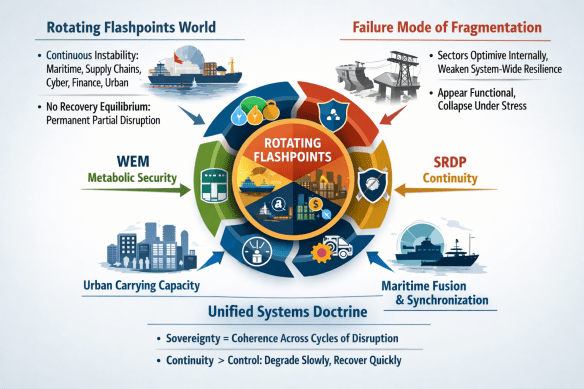
We are no longer operating in a stable equilibrium system, but in a condition of rotating flashpoints—where geopolitical tensions, supply chain disruptions, energy shocks, cyber risks, and infrastructure stresses overlap across domains rather than appearing sequentially.
In such an environment, resilience is defined less by recovery after shocks and more by the ability to maintain system continuity under permanent partial disruption.
For mid-sized, trade-dependent economies, exposure increases when institutions operate without unified coordination across energy, infrastructure, industry, and logistics systems.
THE SEMICONDUCTOR PATTERN: ENTRY WITHOUT ASCENT
The semiconductor sector illustrates this clearly.
For decades, the Philippines has been a significant global player in semiconductor assembly and testing. Electronics remain among the country’s top exports. On the surface, this reflects successful industrial integration.
Structurally, however, it reflects a narrower position within the global value chain—strong in downstream processes, but limited in design, fabrication, and ecosystem control.
The deeper issue is not participation, but the absence of mechanisms that convert participation into upward industrial movement.
Countries such as South Korea and Taiwan followed a different trajectory: coordinated industrial policy, sustained R&D investment, and deliberate upgrading from assembly into high-value semiconductor ecosystems.
The Philippines remained stable within its initial role rather than evolving beyond it.
JEPPNEYS, FDI, AND INDUSTRIAL ENCLAVES
A similar dynamic appears across manufacturing history.
The jeepney sector demonstrates strong adaptive fabrication capacity, but remained fragmented and small-scale, without evolving into an integrated automotive supply chain. It reflects ingenuity without systemic scaling.
Foreign manufacturers such as Toyota, Ford, and Procter & Gamble established production bases in the country, but largely within assembly, packaging, or final-stage processing roles. While these investments created jobs and technical exposure, they did not consistently generate deep supplier ecosystems or technological upgrading at scale.
In more industrially deliberate economies, foreign investment is structured as a learning ladder, where market access is tied to local supplier development and export performance.
The Philippines has had elements of this approach, but without sustained alignment or continuity.
ENERGY AND REFINING: MISSED DOWNSTREAM INTEGRATION
A similar structural gap appears in energy systems.
Singapore has become a global refining and petrochemical hub despite lacking domestic crude oil, driven by infrastructure concentration and regulatory coherence. Vietnam has expanded refining capacity as part of a broader industrial strategy.
These downstream systems matter because they anchor wider industrial ecosystems—chemicals, plastics, logistics, and manufacturing inputs.
The Philippines has had periods of refining activity, but has not consistently embedded energy processing within a broader industrial architecture. As a result, its role in regional downstream value chains remains limited.
The issue is not capability in isolation, but lack of sustained system integration across energy and industry.
CAPITAL STRUCTURE AND INDUSTRIAL RISK
The structure of domestic capital reinforces these outcomes.
Large conglomerates—diversified across banking, real estate, retail, and utilities—have provided macroeconomic stability and capital mobilization. However, their investment orientation tends to favor sectors with shorter returns and lower technological risk.
This naturally channels capital toward real estate and consumption-led growth rather than long-horizon industrial systems such as semiconductors, refining, or integrated manufacturing ecosystems.
Where industrial upgrading succeeded elsewhere, private capital was more tightly aligned with sustained state coordination. In the Philippines, that alignment has been intermittent.
SPATIAL IMBALANCE AND STRANDED INDUSTRIAL CAPITAL
The country’s industrial geography reflects similar fragmentation.
Economic activity is heavily concentrated in a few urban centers, while large regions remain under-integrated into production networks. This creates congestion in core areas and underutilization elsewhere.
Meanwhile, abandoned factories and warehouses are often interpreted as dormant opportunity. In many cases, however, they represent stranded capital—assets made obsolete by technological change, logistics shifts, or mismatched industrial demand.
They are remnants of earlier industrial configurations rather than dormant systems awaiting revival.
GOVERNANCE AS FRAGMENTED SYSTEM EXECUTION
It is common to describe Philippine governance as weak. A more precise characterization is that it is operationally fragmented across overlapping institutional systems.
Infrastructure delivery, for example, is shaped by multi-agency coordination, contractor-led execution, legal bottlenecks, and administrative turnover. Projects do not fail primarily at the planning stage, but during execution continuity.
Delays increase costs, cost overruns reduce trust, and declining trust introduces more procedural complexity—creating a reinforcing cycle of system friction.
The underlying issue is not absence of governance tools, but inconsistent system-wide coordination across them.
FROM SECTORS TO SYSTEMS
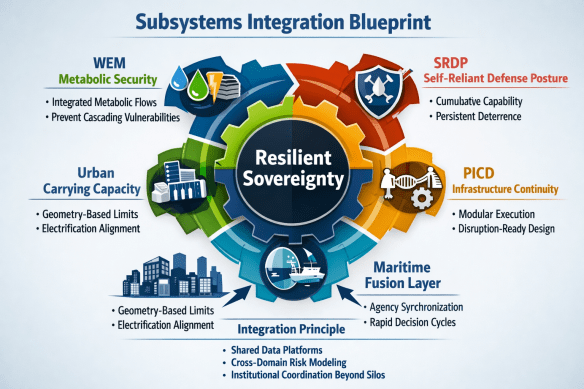
The implication is that industrial development cannot be treated as a collection of sectoral policies.
Electronics, manufacturing, energy, logistics, and digital infrastructure are interdependent components of a single production system. When they are designed in isolation, bottlenecks emerge at their interfaces.
Industrial policy without energy alignment produces constraints. Infrastructure without logistics integration produces inefficiencies. Digital expansion without grid coordination produces hidden load failures. Manufacturing incentives without supplier ecosystems produce enclave economies.
What is missing is not policy volume, but system architecture.
CONCLUSION: FROM PARTICIPATION TO COMPOUNDING
The Philippines is not external to global industrial systems. It is embedded within them.
But embedding alone does not guarantee transformation.
Across semiconductors, manufacturing, energy, and infrastructure, the consistent pattern is participation without compounding—entry into systems without sustained movement up their value hierarchy.
In a global environment defined by rotating flashpoints and continuous disruption, this limitation becomes more consequential. Resilience is no longer sectoral performance; it is systemic coherence under stress.
The central challenge is therefore not to expand participation in global value chains, but to convert participation into integrated, self-reinforcing industrial systems.
The Philippines does not need more disconnected reforms.
It needs systems that operate in alignment, persist across disruption, and compound over time into industrial depth.
Only then does participation become transformation.


 The Society of Honor by Joe America
Democracy changes direction. Budgeting changes direction. Ineffective agencies do not propel consistent progress. The oligarchs are risk averse and tread the edge of bankruptcy (Dennis Uy, the Ayalas who overbuilt, the airlines). Banks are flimsy and unsophisticated, so is lending and accounting, so capital is weak). The Philippines has deep wealth and a deep tax base but discipline and automation are weak to protect the corrupt. There is no conceptual design.
Like the wind.
Related, considerable effort is being put into cleaning up rights of way for major projects.
https://www.abs-cbn.com/news/business/2026/4/23/dotr-solgen-finalize-expropriaton-cases-for-right-of-way-acquisition-1526