Is a Philippine Detroit possible? Checking out Industriepolitik
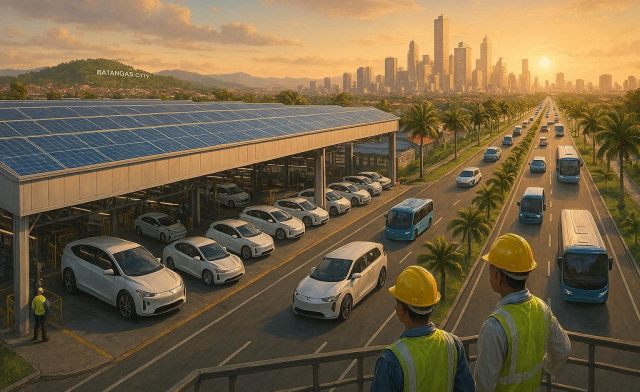
My previous article mentioned Michael Jackson’s father and his frustration with the factory. The Philippines barely has factories: unlike Motown aka Detroit, it never built the industrial base that turns working people into a middle class. That is why the majority of Filipinos live in precarity, and why the poorest remain truly destitute. So I am checking out a plan, laid down by commenter Joey Nguyen, that tries to change that.
The plan argues that the Philippines still has a chance to position itself to build an automotive industry if it adopts a coordinated industrial policy: Industriepolitik as we say in Germany. It lays out a legislative and institutional framework to move the country from basic assembly toward full-scale manufacturing in the electric vehicle sector.
Present situation
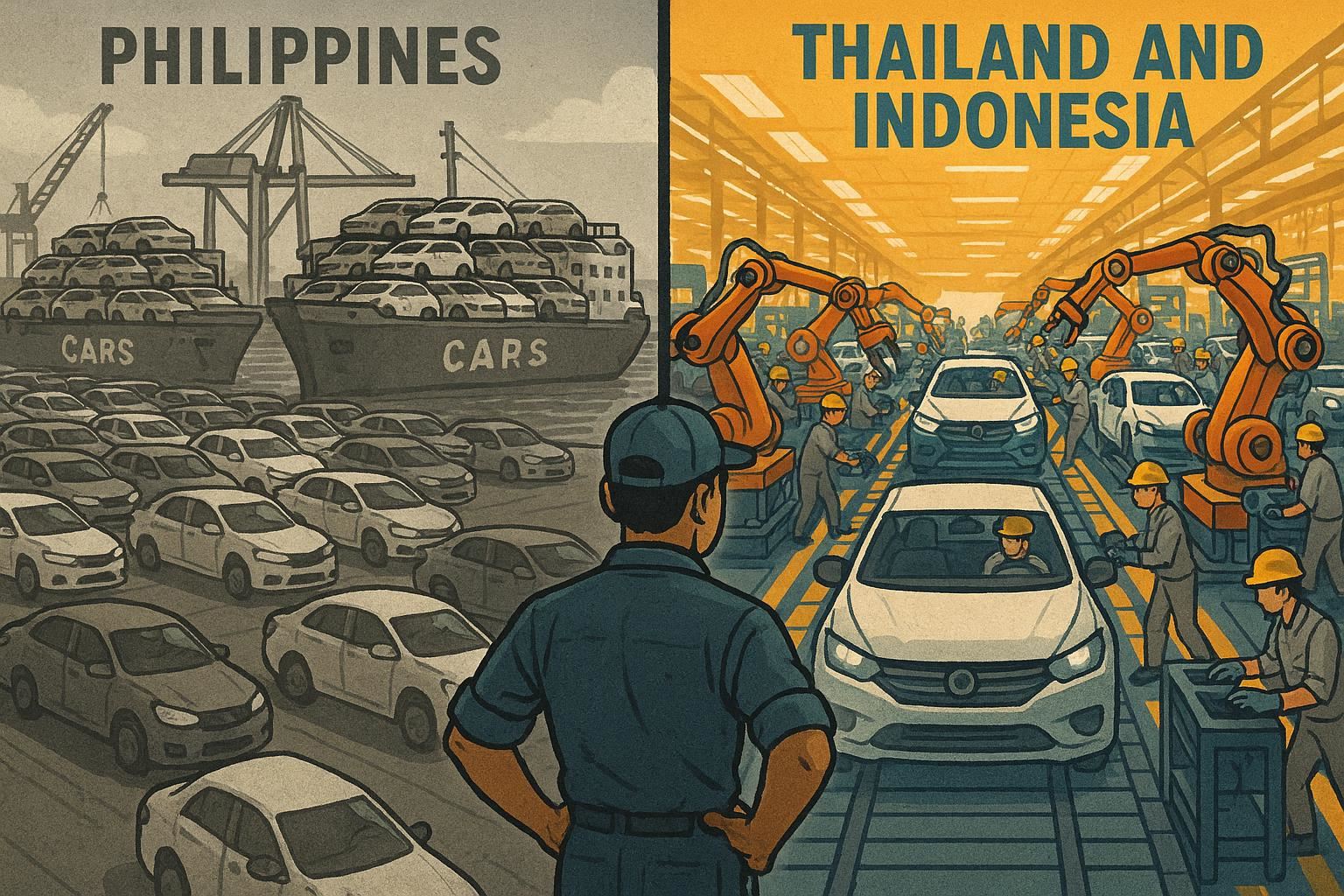
The Philippines is spending between USD 4.5 and 5.5 billion a year importing vehicles it largely does not produce. Only around 20% of the roughly 475,000 cars sold annually are manufactured locally. Meanwhile, regional competitors are pulling ahead: Thailand and Indonesia are attracting over six times more automotive investment, and Vietnam has moved to a nationally branded electric vehicle industry in less than a decade.
This is not just an industrial gap—it is a narrowing window. As the global automotive sector shifts toward electric vehicles, supply chains are being reorganized across Southeast Asia. Within the next two to three years, the region’s production networks may solidify in ways that leave little room for late entrants.
The gap becomes clearer in regional comparison. Between 2021 and 2025, the Philippines attracted approximately USD 2.2 billion in automotive investment, far behind Thailand and Indonesia, which each drew close to USD 14 billion over the same period. Vietnam, starting later, has already established a nationally branded manufacturer and scaled production rapidly. The competitive landscape in ASEAN is no longer emerging: it is consolidating.
At the supply chain level, the disparity is even more pronounced. The Philippines has fewer than 80 automotive-grade parts manufacturers, compared to more than 2,500 in Thailand. This limits the country’s ability to localize production, capture value, and meet the requirements of modern automotive manufacturing, particularly in the EV segment where integration between components is critical.
Critical infrastructure is also missing. The absence of a domestic vehicle testing and certification center forces manufacturers to rely on facilities in Japan or Europe, adding cost and time to development cycles. Meanwhile, what happened to CARS and EVIS programs this year sends mixed messages in terms of policy consistency and continuity.
One further constraint is not capital, but incentives. Philippine conglomerates consistently earn returns of 15 to 20 percent in sectors such as banking, real estate, and telecommunications. Automotive manufacturing, under current conditions, yields significantly lower returns of around 8 to 10 percent. Without policy intervention to close this gap, capital will continue to flow away from manufacturing.
Proposed solution
The solution Joey proposes tries to link what is already there in the Philippines and boost what is not yet there with targeted government incentives. The result is a coordinated legislative package designed to shift the Philippines from vehicle assembly toward full-scale manufacturing in the electric vehicle (EV) sector. Rather than relying on a single incentive scheme, the plan combines five interlocking laws that address financing, demand, infrastructure, and industrial capability.
- The Automotive Resurgence Act (PAREA) would replace the CARS program with a stable, long-term funding mechanism, giving investors greater policy certainty.
- Complementing this, the Electric Vehicle Manufacturing Investment Act (EVMIA) introduces targeted tax incentives tied to local value creation, particularly for firms achieving at least 40% domestic content.
- On the demand side, the Green Public Transport Fund (GPTEFA) aims to accelerate EV adoption in public transport through financing support, eventually transitioning toward mandated electrification.
- This is paired with structural cost reforms under the Industrial Power Competitiveness Act (IPCA), which seeks to bring industrial electricity prices closer to regional benchmarks.
- Finally, the Automotive Center Testing Act (PATCCA) addresses a critical capability gap by establishing a domestic vehicle testing and certification facility, reducing reliance on overseas centers and lowering development costs.
Beyond legislation, the proposal attempts to solve a coordination problem that has historically limited Philippine industrial policy.
The proposal also assigns clear roles to major Philippine conglomerates at the start, effectively anchoring the ecosystem.
- GT Capital/Toyota as the manufacturing base
- Ayala/IMI in electronics and components
- San Miguel in charging infrastructure via Petron
- and AboitizPower in energy supply.
This alignment is intended to bridge domestic capital with foreign investment while creating a nucleus for supplier development, but stay open for further players, especially other foreign auto manufacturers and domestic suppliers.
Keeping the conglomerates themselves in check will be a challenge though, something Japan or Korea managed to handle, but not yet the Philippines.
Taken together, the strategy attempts to do what previous efforts did not: link incentives, infrastructure, and industrial actors into a single system. It also explicitly targets upstream opportunities such as battery materials, rubber, and steel; aiming to use the EV transition as a catalyst for broader industrialization.

On employment and returns, the programme is projected to generate 85,000 direct manufacturing jobs and up to 481,000 total jobs by 2030, growing to 710,000 by 2035. Automotive manufacturing pays 1.7 to 5.8 times the national average across all skill levels. That significantly raises the standard of living and financial stability of the equivalent of an entire medium-sized Philippine city.
The cost of doing nothing is estimated at USD 30 to 50 billion in lost cumulative GDP.
Joey’s analysis predicts a fiscal multiplier over ten years of 4.2 to 6.8 times, meaning every peso of government incentive expenditure returns PHP 4.20 to 6.80 in incremental tax revenues, with “break-even” within 5-6 years.
Let us not forget though that this proposal has to work in the Philippines.
Its success depends on multiple reforms moving in parallel: legislation, infrastructure, private sector alignment, and capability-building; any one of which could stall the entire effort.
The most immediate constraint is political execution. Passing five interdependent laws, sustaining funding across electoral cycles, and coordinating agencies would require an unusual degree of policy continuity. The Philippines has historically struggled to maintain such alignment, particularly for long-term industrial programs that extend beyond a single administration.
A second risk lies in investor response. While the proposed incentives aim to attract both foreign manufacturers and domestic capital, competition within ASEAN is already intense. Thailand and Indonesia offer not only incentives but mature ecosystems, established supplier networks, and clearer execution track records. Even with reforms, the Philippines may find it difficult to shift investor perceptions quickly enough.
There are also capability constraints. Building a domestic supplier base, training a skilled workforce, and establishing technical standards are processes that typically take years, if not decades. The timeline implied by the proposal – capturing a meaningful share of the EV value chain within a narrow regional window – may prove optimistic.
Finally, the strategy assumes effective coordination among major conglomerates with differing priorities and return expectations. While the alignment outlined in the proposal is plausible on paper, sustaining it in practice would require strong institutional mechanisms and clear incentives to prevent fragmentation.
None of these risks invalidate the proposal. But they do suggest that its success will depend less on the design of the policy package than on the state’s ability to execute it consistently and at scale – over time.
Conclusion
The proposal is ambitious, and in many ways it is exactly the kind of coordinated, long-term thinking that has been missing from Philippine industrial policy. It ties together investment incentives, infrastructure, domestic conglomerates, and workforce development into a single framework: something that competing ASEAN economies have executed with notable success. This is the first plan I have ever seen that tries to address the issue of making growth reach ordinary people in the Philippines.
Dear readers, if you have access to politicians, industrialists or technocrats, please feel free to send them this article for consideration.
It is at the very least a template for future Filipino Industriepolitik.
AI use: Bing Image Creator was utilized for all images, Claude, ChatGPT, Gemini and Copilot were used for research.
This article is dedicated to H.Sch., automotive master craftsman, born in Breslau, settled in Stuttgart and retired in Munich; and to F.A.S., a man from the early years of the German automobile industry.
Appendix
The original study is composed of 8 documents which can be downloaded here.
Disclaimer: TSOH and Irineo Salazar are not the originators of these documents. While every effort has been made to ensure their accuracy, no responsibility or liability is accepted for any errors or omissions. Thanks a lot to Joey!


here are more detailed graphics of the analysis, courtesy of Claude
———————-
Present situation
Proposed solution
Possible payoff
————————–
(hoping for an interesting discussion)
wow.. this is a Powerpoint presentation of the article created by Claude.. just click to watch!
https://societyofhonor.wordpress.com/wp-content/uploads/2026/04/philippine_detroit.pptx
The graphics are quite excellent. In context of different people ingesting information in different ways, infographics are often preferred by decision makers.
The discussion on auto manufacturing here has been robust, and we benefit by having Joey’s considerable executive talents applied to the issue.
My thoughts are basic as I’m not informed enough to understand manufacturing realities and risks. I can offer general opinions.
I don’t think the Philippines needs its own auto manufacturing plant, but can push ever upward on manufacturing in other ways.
Thanks Joe. I think Joey’s ideas do use what is already there, including Toyota already manufacturing in the Philippines. NO Filipino-own car company as that is really an extremely tall order. But I did tell him previously that assuming DOST/DTI could act like the Japanese MITI and Philippine conglomerates could act like Japanese zaibatsu is expecting a lot – or even expecting Marcos Jr. to pull off what Park Chung-Hee did to chaebols when even his father didn’t.
My Facebook friend Kowboy Santos – the rock guitarist from Ayala Alabang – reacted like this to my post of this article. 😮
I have 22 views of the article on X where I shared it, 31 reads here, and most interestingly after barely 6 hours 20 downloads of document 6 (impact analysis), 17 of document 4 (the 5-10 year plan), 16 of document 3 (the conglomerates) etc. to 8 of the Powerpoint I made and 7 of document 2 (policy analysis)
So there is some degree of interest this article has generated, and it is something Filipinos did not imagine possible.
I wonder how some other people I tagged on Facebook and X will react – well Giancarlo has praised that this is at least thinking about solutions. I do believe that even a partial implementation might help: let’s say subsidizing PUV modernization if the vehicle is at least Philippine-assembled.
In the software business, that is called quick wins. The Philippines might not have the planning and execution capacity to get a huge plan off the ground, but maybe one has to start BUILDING such capability in small steps, hehe I know Joey finds my music industry comparisons frivolous, but it is like SB19 practiced Go Up dance steps a 1000 times before doing the video, or BINI practiced Da Coconut Nut dance steps for crazy 8 months, both at the start of their careers.
You are right Joe that Pax Silica is also a quick win, though one could utilize that to build a few more local suppliers for cars like Ayala/IMI. I find it WOW that the Philippines already has IMI which is a Tier 1 (meaning Zero Defect) supplier, it is as “unbelievable” – but real – as PAL being on time nowadays.
Or Italian trains being on time and many of them speed trains nowadays. Countries can learn. Maybe a first step is realizing what is possible.
hmm, just 10 downloads of document 7 (PASELP bills) before I posted the first comment, 21 downloads of it now, more than any other.
I am I surprised, didn’t Joey say that Filipinos often want to just copy the result without understanding what is behind it?
Again my silly music analogies, like PPop before it realized it had to follow KPop rigor, not just looks and style.
awright, now document 1 (ASEAN automotive investment report) is also at 21, up from 9.
dear silent readers, hope none of you cry TOO MUCH when reading that.
OK I will look at stats again later, time to start my real life day. 🙂
P.S. https://x.com/gmanews/status/2046139360911733223
ayan, pa-laos na ang Pilipinas, paano na iyan? 😉 😦
Laos, Cambodia, Myanmar, three countries that are currently experiencing disfunction but have extensive histories as unified and powerful regional states — something the Philippines should keep in mind when thinking “we’re better than them, we have time.” Cultural memory of organization enables rebounds, eventually. The Philippines does not benefit from this cultural memory of extensive past organized statehood, but arguably the Philippines has something even better, the backing of the US, US allies like Japan, South Korea, Australia, and the cumulative lessons-learned from friends.
yeah, my wordplay on laos as the opposite of sikat in Pinoy showbiz is corny, but maybe it is just me trying to break the ice for Filipino readers who are often scared of cold logic and complex matters. They prefer to listen to Xiao Chua whom some have described as a showbiz personality – academic hybrid because he IS entertaining – than to my father whose level of abstraction is often considered intimidating. So am I like my father trying to be Xiao => cringe? 😉
sometimes I think the Philippines might be at a similar (not the same, no place is ever the same) place as disunited early 19th century Germany was when the poet Heinrich Heine wrote that the French and Russians control the land, the English control the sea, while Germany rules the realm of dreams.. actually Heine was very frustrated about that state of affairs. Anyhow, enough of poetry, or as Mar Roxas said in his campaign: “trabaho lang ito, walang drama”.
P.S. of course the Philippines doesn’t even rule the realm of dreams like Germany did in early 1800s with its productivity in music and literature.. or like other entertainment and culture powerhouses do these days.
and even with all the help from others as Joey proposed, the automotive plan he made is a HUGE challenge.
But it could be a first step in building the muscle memory needed to actually organize things with a focus on the nation and not just the usual divisive politics, even as politics is everywhere – even in centrally coordinated projects of efficient organizations.
I’m not so concerned about Marcos Jr. being able to get a polished version of my proposed legislation passed through the House. In the Senate there might be a need for horse trading and steering investments towards this or that province in order to gain support.
The Liberal and Progressive Senators elected in 2025 are also pro-democracy. President Marcos Jr. presumably wants to have a positive legacy that is preserved and thus needs an ally to be elected in 2028. Marcos Jr. also has proven to be pro-democracy. There is a big chance for the administration to work with the new Senators. Yes, the Build Better More program is highly necessary. I have a feeling that if something like this industrial legislation passes, the positive results and political coalition building will place Marcos Jr. into one of the greatest Philippine Presidents of all time.
If every other argument fails, one thing holds true: Everyone likes money.
One thing I learned in consulting training was to look for peoples “drivers” (not Kuya Grab but their internal drivers).. yeah 90’s terms I know..
I suspect that one of Marcos Jr.’s greatest drivers is similar to what was Ninoy Aquino’s alleged greatest driver – redeeming his father’s legacy – in the case of Ninoy it was his father’s WW2 collaborator legacy. The huge pride of Filipino elite families can also have this good side.
Yes, and for Marcos Jr. his family’s legacy will be not of his father’s sins, but of the distinction between his goals and the agenda of his sister. I worry the Philippines is at a dangerous crossroads and if indeed China exerts its influence with a Duterte restoration. Becoming richer and a far more industrially capable nation is a form of deterrence in itself.
I find interesting that the expression of concern comes from the Philippines, not WTO or anywhere else. There is intelligence in the business community here. If there is an arrogance of thinking “we’re better than them”, I suspect it’s in sports arenas, and, legitimately in the BPO community. I’ve seen a lot of awareness among my social media followers of Philippine economic shortcomings and need for more manufacturing.
Ps, there is a lot of awareness that the Philippine tourism effort fell way behind other SE Asian tourist destinations. Frasco was a disaster.
https://globalnation.inquirer.net/309555/ph-lags-asean-in-tourism-rebound
This topic caused me to search interstate racism in Asia. Here’s Gemini’s report:
Interstate racism and discrimination within Asia are characterized by deep-seated prejudices, often fueled by ethnic nationalism, colorism, and historical tensions between neighboring countries. While frequently overshadowed by discussions of Western racism, academic and rights reports indicate that systemic, interpersonal, and technology-fueled racism exists across Asia, including within and between nations.
Key patterns and examples of interstate racism in Asia include:
Discrimination Against Southeast Asian Migrants in East Asia: In countries like South Korea, Japan, and Taiwan, a strong sense of mono-ethnic identity has contributed to discrimination against migrant workers, particularly from Southeast Asia, with reports indicating high rates of reported discrimination based on nationality and ethnicity.
Anti-Papuan Racism in Indonesia: Reports have highlighted systemic discrimination and harassment targeting Papuans within Indonesia, which has prompted movements like #PapuanLivesMatter.
Discrimination Against Northeast Indians: In India, individuals from the Northeast often face racism, harassment, and social exclusion, particularly when traveling to urban areas, frequently based on racial slurs regarding their appearance.
COVID-Related Inter-ethnic Racism: The pandemic fueled discrimination within Asian countries, where individuals appearing to be of Chinese origin—including non-Chinese residents and internal minority groups—faced scapegoating and verbal/physical abuse.
Colorism and Casteism: Throughout various parts of South and Southeast Asia, colorism (discrimination based on skin tone) remains prevalent, with skin-whitening products popularised, and caste-based discrimination, such as against Dalits, continues to cause significant social injustice.
Anti-African Sentiment: Human rights monitors have raised concerns over the treatment of African migrants and asylum seekers in various Asian nations, citing prejudiced stereotypes and social exclusion.
Regional Context
Denial and Self-Perception: A 2021 Pew survey found that while a majority of respondents in several East Asian nations viewed racism as a serious problem in the US, fewer than half thought it was a serious issue in their own countries, indicating a tendency to view racism as a “Western” problem.
Rise of Technology-Fueled Racism: UN reports have noted the role of new technologies in worsening racial inequality, including surveillance of minorities in China and the spread of hate speech in Myanmar.
These issues are often intertwined with legacies of colonialism and regional inequalities.
Europe has been FULL of that, and who looked down on whom depended on what phase in history people were. Made in Germany was once something the British decreed to be put on German products that were considered cheap knock-offs of British industrial stuff – at least this is the story I grew up with..
Voltaire (in)famously mocked the Holy Roman Empire (old Germany) as neither holy, Roman nor an empire – the French didn’t see Germany as a proper nation then and it wasn’t one, which is why parts of Germany allied with Napoleon and others didn’t.
Some Northern Germans still use “Rheinbündler” (Rhine alliance person) as a humorous insult to Southern Germans – “Limesdeutscher” (limes German, meaning the Germans south and West of the Roman limes/border, “colonized folks”, not the brave descendants of Arminius who fought Rome) is dying out but still known.
My reference to Italian trains now running on time is about nations being able to change. Think of Casablanca where the German commander barely gives the Italian the time of day but greets the Frenchman. Italians were seen as loud and useless aka Europe’s Robin Padillas back then haha.
In the end there is no intrinsic superiority, it is all about the habits nations build and the work they put in over time. “Bilog ang mundo”.
Yes, I agree with that.
Hmm I see it like this:
could the Philippines now be in a similar stage like Malaysia was when it started making fun of older “Malaysia boleh” sloganeering? Because I experienced the “Katzenjammer” (German for a kind of hangover phase) of Malaysia boleh in early 1999. The last example of “Pinoy conceit” I have was the diplomat who told me that “Vietnamese all go on bikes” back in the mid-1990s. Either there is a reality check today or people have forgotten. I am not there to know for sure.
P.S. “Filipino throat chakra” pride when it comes to its singers is probably the present cultural bastion of “Pinoy greatness” with the other side being Filipinos always saying “hey the Koreans make far better MVs than we do”. It is a very OA part of the culture swinging in both directions.
P.P.S. and of course the present Katzenjammer around Laos/Myanmar/Cambodia has Pinoys on X looking for culprits not solutions. Maybe a few exceptions exist.
I have a number of talents that I never found a professional use for. If someone does find a professional use for their talents, then great! Talents cannot be replicated though… and riding the entire national program on the talents of a few is probably not a good plan. Along the same lines I think nationalism (as opposed to patriotism) can potentially be very destructive as nationalism presupposes greatness from the start and any emotional injury to that belief usually cause strong negative reaction until the cognitive dissonance is broken.
Besides, if one’s country is great already, why even bother improving? A lot of these attitudes were inserted by Filipino nationalism over the last century plus. It did not exist beforehand, so certainly somehow some way the national attitude might be coaxed towards mentalities that have better outcomes.
not everyone has talent but all people have some sort of aptitude for something within the larger machinery of things. As for nationalism, the ilustrados I guess brought home influences from the worst period of European nationalisms that didn’t do Europe any good either.
I always advise younger folks who are still lost, unsure of where to go career-wise, this: A job to be enjoyed as an absolute requirement is a lie by those who have never had hardship. A job is a necessity, and the more salary earned in relation to the effort, allows for enjoying what one wants to enjoy in life.
Re Philippine nationalism: It’s a whole different discussion that might not be appropriate on this article’s comments, but I think the nationalism of the Katipunan which had roots in reconstructed indigenous myths (yet curiously followed a quasi-European framework) had worse effects than Ilustrado nationalism which may have been more “distant” but was rooted in the progressive (for the time period) Spanish liberal movement. In any case I think there can be an argument to be made, from differing viewpoints, that the Philippine Revolution was never truly completed.
and we are seeing how that is playing out nowadays, with the definition of WHO is to be considered “truly Filipino” – and WHAT – being fought out in many arenas, which is one reason I prefer to watch and comment from afar and even that I do sparingly. It might not even be sorted out decades from now.
the Duterte Presidency had even UP called elitist (which in the Philippines means Filipinos who think like colonizers, or Oreos or whatever, fluid meanings) which was the label many of them gave to the Ateneo / La Salle crowd, and even wackier the Tagalog speakers who had mocked the “Englishers” as “elitists” were de facto labelled as “elitists” by people in comment sections who insulted them in Bisaya. OPM is elitist now and budots is “really Filipino”? I kenat anymore.
P.S. re “common sense” – my kinda common sense is the one I developed here in Europe in 45 years or so and is what works here.
which means I don’t really fit in with the elites I came from originally, nor with the masa who will still see my mannerisms from how I grew up as “elitista”. Therefore I just avoid getting too close to the fire that is still burning and which I definitely cannot put out.
And my rare writing here is also me making sure my nudges are not seen as more than recommendations, not a pesky “Bratwurst-eating elitist” (someone called me that quite a while ago) who thinks he knows better than the locals. I don’t. I just sparingly describe how I see stuff.
BEE, bratwurst eating elitist. LOL. I’m fifth generation American German. We are a peculiarly unfriendly lot except when we get together for reunions, then its a bratwurst blowout, only it’s turkey and my Mom’s deviled eggs, which I miss as much as her cherry pies.
The conclusion I’ve come to about the instability of Filipino Identity is that the instability may have something to do with the fact that the two strains of Filipino Nationalism, the Ilustrados and the Katipunan, never truly synthesized.
What I find interesting about the project of Philippine democracy is that ultimately the Ilustrado-style ideological construction and the Katipunan-style emotional masa-rooted were both captured by the elites.
Well, the Ilustrados were always an elite-led project. The Katipunan were taken over by Aguinaldo’s provincial elite Caviteño clique. Bonafacio was not even politically rehabilitated until much later.
In college I read Reynaldo Clemena Ileto’s “Pasyon and Revolution” which certainly had an interesting perspective of how Aguinaldo used folk-religion along with folk practices like blood compacts and pasyon to drive the masa into a frenzy.
What’s ironic is Bonafacio appeared to have deeper, more authentic support of the urban masa — but he lost the power struggle and got executed anyway. Aguinaldo’s Caviteño principalia coalition may have been smaller but was much more cohesive; a lesson of what wins in a battle between organizational structure vs. mass enthusiasm.
Like how the post-EDSA dynasties could be seen in a way as neo-Ilustrados, when Duterte came on the national scene in 2015 I thought “oh no, an Aguinaldo.” Well I was wrong about Duterte being Aguinaldo… perhaps that inheritance is Sara instead.
A provincial cacique threatening to take over a popular urban movement… where have we seen that before?
Like I said, the Revolution may have never been truly completed, and it was never the American interruption that caused the status to be unresolved. This is something Filipinos need to talk through between themselves.
… I’m just an outside consultant here, trying to pitch an industrial project hehe…
yes. it took Xiao Chua (a millenial) to finally question why pit Bonifacio vs. Rizal at all. The rest is an ongoing process.
yes. my input to that was over 5 years ago in the article “The National Village” where the ideas of bayan vs nacion as Pantayong Pananaw put it (including the Xiao Chua version that sees a sambayanan as the hopeful “synthesis” of that “dialectic”) are juxtaposed against a nation that acts like an online village.
and I am someone who left the Philippines decades ago. My real life experience is 3/4 in the West. A co-writer here compared my point of view to a drone shot. Hardly as updated now compared to for instance 5 years ago. So even my drone shot or satellite picture isn’t that detailed anymore.
Friends who are DE often tell me “they’re noisy here” with all the idle gossip. Well I think that applies to the rich as well. The true synthesis probably will still happen at a lower level among the masa. Filipino leaders can either lead to help the process along faster or they will have no choice but to go along.
the DDS narrative already manipulated the synthesis in their way with massive use of social media. Non-DDS leaders will have to retake the Filipino narrative similar to how the (West) German narrative was democratized and oriented westward starting around 1948. Part of OUR problem over here BTW with AfD is IMO a failure to either get full buy-in in East Germany for the Federal Republic’s narrative OR create a new narrative for all of Germany. P.S. one reason the postwar narrative worked better was that it also came with economic recovery, even if gradual. The post-reunification narrative also came with gradual economic recovery, but maybe the expectation that it wouldn’t happen that quickly wasn’t managed enough, and some things didn’t go as planned. Lessons that can apply anywhere.
My main (constructive) criticism of Leni Robredo’s campaign in 2022 (which I followed very closely) is that she didn’t learn Cebuano for her stops in Bisayas. Bikolano isn’t that far from the Visayan languages and even a few words would have helped. Re the volunteers I was a bit unhappy that they failed to spread the Camanava rally (very masa part of Metro Manila, widely attended) and the Bohol old airport rally (HUGE support) enough on social media..
Perhaps this is in a way just an inheritance from Aguinaldo’s small but cohesive supporters who were the cabezas de barangay of the Cavite principalia (including their dependents) that were able to overwhelm the more numerous but less organized nature of Bonifacio’s urban masa bodegero supporters during the Tejeros Convention.
Actually it is quite ironic that in another way today’s elites who might be neo-Ilustrado descendents of the Tagalog (and Pampangan) principalia are organized more like the short bursts of fervor like Bonifacio’s bodegeros. Or perhaps the Ilustrado were never that organized to begin with, being more interested in intellectual sparring and studying problems from afar… whereas Aguinaldo, who I believe I read somewhere that he was derided as being a backwards provincial, was much more organized.
I only understand the Unification of Germany from reading about it and following German media. It does seem to me that West Germans sort of thought that East Germans would just see the progress done in West Germany (because of course some East Germans did bravely try to cross the Berlin Wall during the Cold War), then didn’t do as much of the work needed for integration that should’ve been done.
The Democratic Party, convinced that ‘Minority-Majority’ demographic trends guaranteed long-term dominance, pivoted to Identity Politics — a trap the Republicans had baited them into — while paradoxically catering almost exclusively to comfortable White liberals for whom social justice was a matter of virtue, not survival. By 2024, they still treated the Latino-American vote as monolithic, blind to the vast difference between a 2nd-generation Mexican-American in California and a Texas Mexican-American whose family predates the border itself. One can only imagine how mostly White Democratic consultants viewed Asian-Americans.
An even less-developed version of this behavior exists with Philippine Liberals. Well not that there is much of a liberal party(ies) to be part of anyway…
As someone who once thought about going into politics and started in student/youth leadership positions in the Republican Party (back in the day), one thing I can say is every group the Republicans target are groups which are taken for granted by or dismissed as potential voters by the Democratic Party. Perhaps a similar phenomenon exists in Germany with SPD, CDU outreach in East Germany. If no party representatives ever visit at all to listen (or “listen”) to concerns, wouldn’t most voters just go with the group that appeared to pay attention to their concerns vis a vis the group that ignored them?
Bikolano isn’t that far from Tagalog either; Tagalog, Bikolano, and Proto-Visayan are all main branches of Central Philippine.
IIRC wasn’t the Bohol rally in Taglish? That probably was a big mistake, even though Cebuanos and Boholanos nearly all understand Tagalog. It probably would’ve been better to just have the rally speeches in English while sprinkling in a few Cebuano words.
I fail to see bragging or inferiority as a national condition or issue for the Philippines. When Barak Obama speaks of American “exceptionalism”, or Trump wants to nuke Iran for not kissing his ass, those are national issues that warrant people being chastized when they act on it. It the Philippines it is chekka chekka as far as I can tell. There is no national braggadocio from the Marcos government other than selling openness to investment, and only natural comparatives that the uninformed might make.
The example I kinda belabor is ABS-CBN not just taking the long-term investment risk (over 5 years for two groups, only one is a success at least for now) of idol business as well as becoming a content provider – but I believe ONLY because they had to find a way to earn money again after losing their franchise.
also part of the example is the recently publicized strife with the part of the Lopez clan that wanted to just sell ABS and not even try.
Adversity breeds resilience, strength, character, but probably most importantly of all, opportunity.
Those who are coddled prefer to want the easy way out, even up to wanting authoritarian daddies as long as it’s their daddy.
I do not like it when I see Filipinos, some of whom are my friends and acquaintances, barely surviving then being told they should feel great that the Philippines and Filipinos are so resilient. Survival is not resilience. One should seek to not only survive, but thrive. The government in its role of promoting the common good per the Constitution’s Preamble, has a central role to ensure this.
Corruption is why foreigners don’t invest more here. People thinking they are better is a human condition in this circumstance or that. Expecting Filipino not to be proud of their achievements or associations is asking them to be emotional rocks. The Philippines is marvelously diverse and free of racism. Filipinos are roundly sneered at by the world who thinks of them as servants. Give them a break.
No, corruption is not the reason why foreigners don’t invest more in the Philippines. There are plenty of countries that are wildly corrupt yet receive massive foreign investment. China is massively corrupt and masks corruption to appear higher in the Corruption Index. Vietnam is also quite corrupt. Indonesia ranks slightly above the Philippines in corruption. Yet all these countries receive much more foreign investment than the Philippines. Why? Because corruption isn’t the deterrence. The deterrence to investment is lack of predictability. And in those corrupt countries the corruption is predictable. What has racism got to do with anything? Money sees no color but green.
Okay, yes, you are correct. Per Gemini.
The Philippines faces challenges in attracting foreign direct investment (FDI) mainly due to poor infrastructure, high power costs, and a complex regulatory environment. Other major obstacles include constitutional restrictions on foreign ownership, widespread corruption, and a slow judicial system, which create an unpredictable and costly business climate compared to ASEAN neighbors.
Main Reasons for Low Foreign Investment
Regulatory & Bureaucratic Hurdles: A “cumbersome bureaucracy” and inconsistent, slow regulatory processes create, in some cases, corrupt environments for securing permits.
Infrastructure Deficiencies: Poor transportation networks, inadequate logistics, congested ports, and limited, high-cost electricity hinder operational efficiency.
Ownership Restrictions: The 1987 Constitution restricts foreign ownership in key sectors (e.g., public utilities, education, media, land), making it one of the most restrictive economies in the region.
High Costs & Taxes: The Philippines has had one of the highest corporate income tax rates in ASEAN (30%) and high operating costs, which makes it less competitive than neighbors like Vietnam or Thailand.
Corruption and Legal Risks: Systemic corruption, “red tape,” and a slow, inefficient judicial system make contract enforcement and dispute resolution difficult.
Political Instability: Policy uncertainty and, at times, political instability cause investors to hesitate.
I was hoping Francis had time to reply to this topic. He and I are of agreement that solving corruption immediately is not a requirement to improving economic outcomes for most Filipinos. Corruption is a moral problem, not necessarily an economic problem though the two can compound the others’ effects. Reading Prof. Stefan Dercon’s works on developing countries was really a perspective changer.
Your question was, what stops foreign investment from flowing to the Philippines? Gemini states it quite clearly. Corruption is a part of the problem but there are other substantial and real barriers. The Constitution itself is a formidable barrier, but the Marcos Government is pushing forward sensibly, it seems to me. From Gemini:
On April 13, 2026, President Ferdinand R. Marcos Jr. signed Executive Order (EO) No. 113, issuing the 13th Regular Foreign Investment Negative List (RFINL) to define foreign participation restrictions, effective 15 days after publication.
Key Aspects of the 13th RFINL (EO 113):
List A: 0% Foreign Ownership (Reserved for Filipinos)
Mass media and internet-based platforms.
Private security, small-scale mining, and licensed professions.
Marine resource utilization, cockpit operation, and manufacture of specific weapons/firecrackers.
List B: Up to 40% Foreign Equity (Restricted)
Defense-related products (firearms, explosives) and dangerous drugs.
Saunas, massage clinics, and gambling.
Domestic enterprises with less than $200,000 paid-in capital.
Liberalization and Context
Telecommunications: 100% ownership allowed with reciprocal agreements; otherwise capped at 50%.
Retail: Up to 40% foreign ownership for under P25 million capital.
Renewable Energy: Continues to allow full foreign participation.
The 13th RFINL aligns with the amended Public Service Act, balancing national security with economic reforms.
Yeah I myself looked into building a couple of business ideas in the Philippines during the time I was working in Japan and South Korea, thus was available to jet over to the Philippines on short notice (which I did a few times a month anyway). At the time I found the foreign investment requirements unacceptable.
It was President Ramos who started liberalizing the Philippines economy and finding creating ways to bypass the 1987 Constitution’s ownership clause. PEZA was originally created all the way back in 1969 (as Foreign Trade Zone Authority; FTZA) under pre-Martial Law Marcos Sr. under a totally different Constitution.
So these FDI liberalizations are welcome even though as a Constitutional workaround the activity may only be confined within PEZA and other specified economic areas. Which is in fact good enough for foreign investment in largescale industries like manufacturing plants/factories. Yes, smaller facilities may be limited but that’s fine because in a preferred scenario it should be local Philippine SMEs that serve as suppliers first for large foreign investment, over time with experience and knowledge gained, becoming domestic champions.
I got to the racism topic off your remark about (some) Filipinos seeing themselves as better than others. My associative mind tracking through a topic I find interesting.
I do not see this issue as “racism” in the US-centric White and Black discourse. When some Filipino elites see themselves better than others, it is a complex interplay of association with power (e.g. siding with who appears to be stronger) as well as an overlay of pre-Civil Rights Era US context. So it can become confusing.
Simplified it operates mostly as “I’m already superior; the others are not a threat.” Even further simplified it is a classic The Tortoise and the Hare scenario. My hope is that that certain elite Philippines attitude, which is quite prevalent to varying degrees, learns to be more like the Tortoise than like a Hare.
The foundation of what the Philippines has in parts manufacturing and assembly is impressive. In a way, Detroit already exists here. Is pride worth spending billions for a Filipino brand? No. Are jobs and profits worth an investment risk? If it’s *my* money? Hmmmmmmmmm.
Joey’s argument is that for the conglomerates, the usual rent-seeking business pays out 20% while manufacturing pays out just 7%.
that is why he sees the role of the state in making the investment worth it, I guess a bit like Japan did for the zaibatsu, or Korea for the chaebols. And he also makes the case that for the state, more taxes earned makes it pay off in about 6 years – I haven’t been able to check that computation.
I would also add my visualization of what the jobs mean from the article:
THAT is what this is about in the end, drying up the potential voter base of populists by giving more people stable jobs. Joey mentioned a figure of 15-20% underemployment in CALABARZON in his study which seems shocking to me given the factories already there.
Yes, aside from the moral good of creating jobs for the jobless and the sovereign imperative of building state capacity, one cannot forget the political calculus of building a new and larger base of support.
I think I can cautiously say that out of us all here, I’m probably the only one who regularly interacts with the cohort of Filipinos who are most likely to be drawn to populists like Duterte. They welcome me to stay at their homes when I visit and I eat at their table. If one were to ask them what the two things they want from the government, it is always 1.) a stable job for themselves and 2.) a future for their children. A whole new voter bloc ready to be converted.
Joe IIRC at least used to play basketball with some of the men in his neighborhood and had a fisherman friend when he lived im Mindanao..
though I know from own experience that among Filipinos the matter of status does play a role, so contact is NOT as easy as with foreigners in such cases.
common sense actually, and unlike the weirdos from The Filipino Story, we know that can’t be done by going back to the barangays of 1521.
I once funded basketball uniforms for our community. I gave the coach 5,000 pesos and it was enough for volleyball uniforms too. They made an extra uniform shirt for me, my name on the back. I wasn’t on the team, but it meant a lot to them to have those uniforms. I’ve played in slippers on cement and, trust me, that’s one thing Filipinos do way better than Americans.
This might be a problem more among the elites who are sort of neo-Ilustrados. After all, one of the inheritances from Ilustrados is credentialism in the Philippines. I find the masa to be quite open-minded to people who are “above” or “below” them. Maybe their enthusiastic reaction to someone perceived as having “higher standing” being interested in their lives is a bit weird at first, but they soon settle down. I treat them like I would any other person, and they likewise.
The Filipino Story channel probably gets all mixed up because it’s run by Fil-Ams who might not entirely understand their mother culture (the owner admitted as much that he started the project to express his newfound Pinoy Pride). But aside from that it is also explaining stuff from an elite position, not from the position of the masa.
I guess common sense is called common sense because the elite, having often distanced themselves, lack the common sense of those “below” them.
I was curious as to whether or not National Govt under Arroyo subsidized the BPO start-up. Yes, is the answer. Certainly paid off. Here’s Gemini’s readout on it:
Yes, the Philippine government under President Gloria Macapagal-Arroyo (GMA) significantly supported and incentivized the beginnings of the Business Process Outsourcing (BPO) industry between 2001 and 2010. During her administration, the BPO sector grew from a small sub-sector into a primary economic driver, with employment growing by roughly 1,000% between 2003 and 2010.
Key support and incentives provided during the Arroyo administration included:
PEZA Accreditation & Tax Breaks: The Arroyo administration aggressively encouraged the Philippine Economic Zone Authority (PEZA) to accredit buildings used by BPO companies, granting them incentives such as tax breaks, tax-free importation of capital equipment, and 4-year income tax holidays.
“Philippine Cyber Corridor”: Arroyo established the “Philippine Cyber Corridor” to promote the country as an attractive destination for IT-BPO investments and to boost global competitiveness.
Infrastructure Support: Investment in physical infrastructure, such as improved airports and telecommunications facilities, was prioritized to support the growing BPO sector.
Training Subsidies: The administration utilized the Technical Education and Skills Development Authority (TESDA) to offer training vouchers to “near hires” (applicants needing minor skill improvements). From 2007–2009, over P800 million was allocated for BPO training scholarships, and the program was renamed “Pangulong Gloria Scholarship” in 2009.
Creation of Specialized Government Bodies: She created the Commission on Information and Communication Technology (CICT) to streamline efforts to promote the BPO sector.
While some supporters of former President Joseph Estrada argue that the foundations were laid in 1999, it is widely acknowledged that the aggressive policy shifts, tax incentives, and active promotion of the BPO sector as a national priority took place during the Arroyo administration.
thanks for this added perspective. I wasn’t aware of how much was done.
Arroyo seems more and more like German Chancellor Adenauer to me – a man who was eminently disliked for quite a while but did a lot to lay foundations.
Of course it IS true that BPO gave white-collar jobs and partly made the gap between C and D larger. But what would the Philippines be now without it?
Malls and OFWs, I reckon.
Santa Rosa has assembly operations for both Toyota and Mitsubishi; Hyundai had a short-lived assembly operation as well before withdrawing.
So yes, a partial “Detroit” does exist — a Detroit stuck in the 1920s. In not just the automotive industry, but across industries, the Philippines has been stuck in a cycle of assembly and light components stage of industrialization since the 1960s while Thailand and Indonesia moved up the value chain from assembly into full manufacturing and tooling. Now Thailand, Indonesia, and Vietnam seek to capture most of the EV supply chain integration. The proposal acknowledges there exists a real foundation; what the proposal seeks to do is to create a framework that will upgrade, expand, and move the Philippines up in the value chain.
The proposed legislation does not seek to create a national brand e.g. Filipino Ford or Filipino Toyota.
From Filipino conversations that often center around the shocked realization of Vietnam’s Vinfast, I take a step back and point out that Vietnam actually has a dual-track strategy: A strategy of expanding assembly-to-manufacturing and building a local supplier chain (THACO, Thanh Cong) and a strategy of an assembler which became a domestic national brand (VinFast). The former is the safer bet, the latter is only enabled due to investment room created by the former’s success.
The proposal recommends following Vietnam’s first strategy of expanding assembly operations with existing relationships in GT Capital/Toyota and Mitsubishi before moving into increasing local supplier content that will enable eventual full local manufacturing for those brands (and additional brands). This was also the initial strategy of Thailand, Indonesia, Malaysia, and importantly, South Korea.
Again, this proposal is ultimately not a “make cars” plan, but an investment argument for creating new jobs, new tax revenue streams, and expanding supply chain depth that would enable other non-automotive industries later (like building ships) — National pride, and a Filipino brand would be the eventual positive byproducts, but not the initial aim.
The domestic conglomerate private risk is mitigated by public (government) support by enabling legislation, targeted subsidies that drive desired industrial behavior, and creating a credibility signal that says “the Philippines is open for business” to foreign investors.
Yes, eventually the government would get a return on the public money invested (in the form of subsidies and concessions) by the newly created tax revenue streams, but the aim of the proposal is to develop national capacity and keep investment flows from leaving the Philippines, which would necessitate the other beneficial result of creating many more direct and indirect jobs.
maybe by now, you are getting the gist. we have car assembly plants, assembly is what we are good at. we never have to contend with world wide car recalls and correct faults, maybe paying refunds under the terms of warranty, or paying humongous car insurance claims, and any such problems as doing the round of promotional circuits complete with car test drivers report of world famous car test drivers the likes of stephen corby et al. their reports can either make of break a car manufacturers dream of topping world wide car sales.
and as assembly plants, we only do assembly and not have to compete with other brand car manufacturers and their most modern of cars. but if they like, we can also assemble their cars for them, we have the experience and the know how.
KB your point is actually in agreement with my point. Currently only 2 cars out of 10 cars sold in the Philippines is assembled in the Philippines, by Filipinos, with Filipino salaries. There used to be many more foreign brands in Santa Rosa assembling but they left because the tax incentives were too low. Toyota and Mitsubishi only assemble locally as many cars per year as they can maximize the CARS tax incentives, and presumably that will continue for the broadened EVIS law that is not yet passed. So would it not be a good thing if instead of assembling 2 out of 10 cars sold in the Philippines, that more cars should be assembled there? Let’s say 5 out of 10, or 7 out of 10? My proposal has nothing to do with car exports, though there is room to do so. My proposal is a domestic proposal.
Philippines offers zero tariffs for most imported electric vehicles (EVs) until 2028 under Executive Order No. 12, which create a difficult, though not impossible, price competitive landscape for locally assembled EVs.
Impact of Zero Tariffs on Local Competitiveness
EO 12 does not actually include any incentives for locally manufactured HEV/BEV — it is a pure removal of tariff barriers regime. Without incentives and requirements that encourage local assembly, and with zero-tariff applied, that’s why BYD flooded in while not setting up any local assembly operations because why would they? Theoretically EO 12 would’ve been paired with EVIDA, which is what I he news said at the time, but in practice the synergy doesn’t align.
EVIS supposedly will fix some of these problems by providing the incentives for local assembly. I say supposedly because the bill has not yet been released, much less passed. But if it does pass EVIS appears to be a codified and updated version of CARS expanded to include HEV/BEV. A step in the right direction and likely will checkbox part of the proposal I’ve presented. My proposal ideally would be passed in whole but any one part brings its own benefits.
Again, I am running a t-chart of pros and cons. Recognizing that Filipinos do demonstrate extreme pride in home-grown champions is on the pro side, and any marketing pro would go for the jugular on it. Failing to recognize that advantage would be on the con side.
I brought in the BPO investment as a pro-side argument that says, yes, Philippine government can carry it off. So I argued against myself on the point. But would I put my own money behind it today, with no champion and approved plan, no.
Yes I do recognize Filipinos can have extreme pride in homegrown champions, because who wouldn’t? That’s why it’s fine if most Filipinos think cars assembled in the Philippines is the same as cars manufactured in the Philippines when technically and balance-wise it is not. It’s the job of government and industry to handle the complex bits and present the simplified version for general understanding.
In your other comment you mentioned President Arroyo’s role in expanding the then-organically growing BPO sector with government incentives to attract many more foreign companies. Yes, that was a great thing but I also recognize here that BPO was a much easier task (being that it is mostly in human capital rather than physical capital) than setting up industrial anchors (auto or otherwise). Yet industrial anchors are also more resilient, less prone to the instability BPO is feeling now with the AI disruption, and having physical investments in a factory and infrastructure means foreign investors can’t simply walk away the way they may or may not walk away soon from BPO when agentic AI is sufficient for call center use.
Yes, I suppose manufacturing plants can’t be fired at will, but they must adapt to competition, regulation, and changing consumer tastes, often at significant and unplanned expense. There is no easy, certain path to riches in any industry. The point of the information was certification that the Philippines is not totally inept at embracing major projects and backing them in a “whole of government” approach. A pro argument for your proposal.
Gemini:
The amended Public Service Act (RA 11659), signed in March 2022, primarily liberalizes the Philippine economy by allowing up to 100% foreign ownership in key sectors—such as telecommunications, shipping, and railways—by narrowing the definition of “public utilities” to only electricity, water/sewerage, seaports, and public utility vehicles. It introduces strict national security reviews for foreign investments.
It was a Poe/Salceda bill written under Duterte.
Yes the Arroyo era Cyber Corridor and other policies codified into law indeed were instrumental in making the Philippines a destination for BPO investment.
I guess what I’m trying to stress is there needs to be consistency and predictability in order to foster an fertile investment environment. To use an analogy of buying a real estate property, one would not sign on the loan’s dotted lines if the terms were not clear and the terms could be changed midway; one would expect the terms agreed at the beginning would be the terms throughout the life of the agreement.
As to BPO, the terms in the Philippine investment environment still changed quite a bit, sometimes negatively, sometimes positively as relates to BPO. BPO’s plus side is it doesn’t need investing in physical capital. Moving human capital and renting a new office elsewhere is highly flexible. Traditional industry that requires physical capital expenditures are inherently more risky and need policy to reduce risk by creating consistency and predictability.
Actually, the political calculus should not be one or the other, services or physical manufacturing. Why not both? By now BPO is an established industry after 20+ years. Both can complement each other’s strengths, one providing flexible investments while the other anchoring physical investments that encourage foreign investors to commit to the Philippines in the long-term.
Yes, the nation should be able to manage more than one nation-defining development at a time. My “no” vote on autos is that the nation seems not to have the focus and expertise to handle such complex projects. The BPO experience says otherwise. What are priorities over cars on my list? Ship building. Drones of all kinds for warring. Finished goods consumer products.
I’d like to redirect us again to what looks on the surface as “cars” is not just about cars.
The proposal is actually about developing industrial capacity and industrial competency which enables all the things you mentioned:
1. Developing competency in Steel -> stamped plate -> infrastructure “small” plate -> “medium” and “large” plate which is used for shipbuilding.
2. Developing competency in Electronics and Electric Motors -> goes into drones as well as a multitude of other electronics like Finished Goods (small appliances, major appliances, household electronics).
3. Developing competency in Battery Materials -> BEV batteries, electricity grid storage batteries, moving away from oil to avoid another Hormuz situation.
Ah, good point, thanks.
Okay, just got back and have some time now to answer.
To address each of your points:
Philippine media (both private and governmental) often stress numerators not denominators. Top line numbers make stuff appear to be “many” but in actuality carry no context. This is the mental fog that is “medyo” on purpose in the Philippines that causes understanding the whole picture quite difficult. A more complete accounting is “How many cars were assembled/manufactured in the Philippines vis a vis the total number of cars sold?”
Most of the imported cars are manufactured in Thailand and Indonesia. In the recent half-decade Vietnam entered the Philippines market with Hyundai and other South Korean brands well before Vinfast.
Bottom Line: The Philippines is funding Thailand’s, Indonesia’s, Vietnam’s, China’s economic development with Philippine consumer spending.
2024-2017 is 7 years, so yes these things take time. However never starting means one never gets any closer to the finish line. My analysis is accompanied with a blueprint that includes 5-year and 10-year sequenced goals. However the real rush isn’t about starting now or later… reconfiguring supply chains and maturing technologies mean there are new opportunities.
Bottom Line: The Philippines should leverage its advantages in the US, Japan, and South Korea relationship to direct investment towards the Philippines rather than allow full consolidation outside of the Philippines.
On the surface this is true, but Marcos Jr. still retains a Congressional majority (only simple majority needed) and the Speakership, while also having a Senate majority which could become a Senate supermajority if allied with the liberal/progressive Senators elected last 2025. The constructive criticism I have for Marcos Jr. is he did not utilize his 2022-2025 supermajority effectively. A supermajority allows the passage of any law however minor or major. I will continue this thought on Points 6, 7.
Bottom Line: Lack of leadership is often shown in the preference for EOs which may be diluted or killed off in subsequent administrations. The proposed solution is to embed the policy into statute law, anchoring with conglomerates that are willing and able to commit to long investment horizons, and by using a legislative package format to break up the program goals into 5 interlocking bills where partial passsage or failure still yields partial benefits rather than no benefit at all.
The Pax Silica initiative and this automotive industry proposal are not mutually exclusive. The former is US-led while the latter is PH-led — competing yes for some political bandwidth, but not for the same factories, workers, or tax incentive pools.
Furthermore automotive manufacturing has a huge advantage that tech assembly does not have — deep upstream linkages.
Electronics testing and assembly creates relatively few local supplier relationships (which create direct and indirect jobs).
The automotive ecosystem pulls in rubber, steel, plastics, electronics, and with EVs — battery materials, all which the Philippines can either supply, develop, or both. The upstream linkages is much deeper in automotive, requiring many more local suppliers, resulting in a much higher job creation multiplier effect for both direct and indirect jobs.
Bottom Line: Leveraging foreign “doers” is also a major part of the automotive proposal — by using existing Philippine congolomerate relationships to bring in foreign manufacturing discipline and knowledge in order to upgrade and turbocharge Philippine companies.
Mitsubishi is not “building” EVs. Mitsubishi is assembling imported CKD kits, but will only build as many as to capture the CARS (and soon, EVIS) tax incentives. Toyota, Nissan, Foton, do the same.
Also, I hope we can start putting numbers into context. The PHP 7 billion (USD $116 million, EUR €99 million) investment by Mitsubishi for hybrid EVs (HEV) is appreciated. Vietnam just signed an agreement with Toyota for USD $360 million in HEV expansions, which is actually one of the “lower” investments compared to Japanese investments in Thailand and Indonesia. The Philippines is leaving money on the table…
The proposal continues CKD assembly, seeking to use existing conglomerate-industrial relationships to move into progressively increased local content requirements, with the eventual aim of full local manufacturing.
Bottom Line: The goal of the proposed legislation is not to only attract investments such as the Mitsubishi HEV investment, but to progressively raise local content requirements from Philippine parts suppliers. Therefore keeping the foreign investment inside the Philippines supply chain rather than being remitted as profits on imported components needed to locally assemble vehicles.
A lot of late President Aquino’s programs were in fact EOs; EOs live and die by political capital which may ebb and flow. All the more important to convert EOs into statutory law that will become apolitical and as such would survive multiple administrations.
Bottom Line: Industrial policy cannot survive when politics cannot protect long-term priorities from short-term disruption. EOs are more fragile than robustly crafted and broadly supported legislation. In general, jobs are something that has broad support.
The goal of my analysis was not to identify Legislative Champions, however I did have Sen. Raffy Tulfo in mind, working together with Speaker Dy. President Marcos Jr. has a Congressional majority, and a Simple Majority is easily clinched. The heavier lift would be to create a legislative alliance in the Senate. My suggestion is to start talking with the liberal and progressive Senators elected last 2025 Midterms. A legislative alliance may create the conditions for a pro-democracy coalition to flower going into the 2028 General Election.
The proposal includes a template for the legislative package, with the 5 individual bills addressing different necessary components contained within. I have released this material as freely available for use and adaptation.
Yes, favors of where to send investments may be necessary. Every single major legislation in the US (and in European parliaments) require some horse trading. I still believe that jobs and money, bigger local economies is something any politician would want for their district/constituency.
In the simplest sense this proposal is a “make Philippines cars” plan. But it is not really a “cars plan,” but rather an industrial plan.
Yes, the main eventual product of the plan if executed is to make a made-in-Philipines car (note, not necessarily a “Philippine brand”) where as much as the foreign investment and created value goes towards the Filipino worker and the Philippines.
But the plan enables industry beyond simply building cars:
One can see now when the inputs are expanded the possibilities of other industries developing.
South Korea created POSCO, modeled after Nippon Steel (which in turn was modeled after US Steel/Carnegie Steel), in order to supply the South Korean automotive plan. But POSCO’s creation was not to only serve the South Korean automotive industry; rather it was to become an enabler for further, more complicated industrial activity. POSCO started making rebar, then small steel plate, then automotive steel plate. Eventually POSCO moved into infrastructure steel and naval plate. South Korea’s trains, defense industry, and massive industrial projects would not be possible without the 1962 Automobile Industry Promotion Policy which created POSCO.
Thanks, so my figure of 20% not 30% in the article is somewhat off the mark, and the distinction between assembled locally and manufactured locally is indeed important. How high is the local parts % in the 17% assembled or manufactured by Mitsubishi, Isuzu, Nissan and Foton?
Actually the industry and governmental data available is quite fuzzy. Assembly is made out to appear to be “manufacturing.” Only numerators are pushed but no denominators for context. So the numbers may differ depending on sourcing. 10% might be a wild swing in numbers in most accounting, but for the Philippines media releases it’s probably just a “margin of error,” hehe.
I just double-checked and it appears the numbers in the article (20% local assembled vehicles) and my number (30%) has your 20% locally assembled cars number being correct/closer to correct. So about 2 out of every 10 cars sold in the Philippines are actually assembled in the Philippines.
There is a distinction between locally assembled cars, locally manufactured cars, and local content percentages.
Mitsubishi L300 has about 70% local content, which makes sense when one recognizes that the L300 assembled in the Philippines is actually the 2nd gen (1979) model, giving more time to develop a local supply chain. The L300 is on the 5th gen by now. As for Mitsubishi passenger cars the local content was quite low, typical 10% range. It took Mitsubishi until 2017 to deem the Philippines suitable for investing in a stamping press (to bend metal for the bodywork) for the Mirage G4 which increased local context a bit from the 10% range. To give context a stamping press is not really a complicated piece of manufacturing equipment…
Isuzu had about 50% local content on the N-Series (Isuzu Elf) truck of which the 1st gen (1959) model was locally assembled. The long time since the introduction of the 1st gen model allowed time to develop a local supply chain, like for the Mitsubishi L300. Isuzu no longer assembles locally in large numbers though. AFAIK Isuzu will only import CKDs and assemble to order for commercial buyers. Most Isuzu trucks are now imported from Thailand.
Nissan had a stamping press for the Nissan Almera so that also had high local content. However Nissan largely exited local assembly in 2021. Nissans are now imported from Thailand.
Foton has minimal to negligible local content.
I kinda see possible synergies with what Ayala/IMI already has and Pax Silica stuff.
Does that make sense?
Yes! Pax Silica may have some military compute applications eventually, but it is mainly to secure semiconductor supply chains away from China. China currently manufactures a lot of older semiconductor manufacturing “nodes” (larger, older, and simpler manufacturing process for ordinary electronics). When one thinks of Taiwan’s, South Korea’s and the US’ semiconductor fabs, most of those are fabs on the “leading edge manufacturing nodes,” or that is to say, the newest and most advanced tech suitable for supercomputers, high end consumer electronics, high end computers, and so on. There is A LOT of room to manufacture older nodes, which is in fact the bulk of semiconductors.
To illustrate: Taiwan’s TMSC leading node is currently in the 2 nanometer (nm) generation; South Korea’s Samsung leading node is current in the 3nm generation, US’s Intel is on a 3nm generation. China’s most “advanced node” is claimed to be of 5nm class, yet is much slower than a 7nm class chip that in theory should be larger, less efficient, and more expensive to manufacture. In any case the bulk of Chinese semiconductors serve the general electronics market, which are on “mature nodes” like 22nm, 28nm, 40nm, 65nm, 130nm or larger manufacturing processes. The machines used to make these “mature nodes” are simply the old lithography machines that Taiwan, South Korea, or US used to use.
My point on the numbers is that the Philippines is a big car market. That actually speaks well of the proposal because if it can grab the patriotic component of that market, the venture can succeed big time. The mental fog of medyo is cited why exactly? Only weird policy wonks dig details, media mostly writes fast and shallow, because it’s cheap, or like the Washington Post, boy talk about fog of medyo.
If the proposal were presented in the Silicon valley, it would be a winner. If it were presented in Tennessee they’d stare gape-jawed. In the Philippines, Tulfo would look at it and say I’m not dying on that horse. . . . hmmmmm unless you convinced him to work like Roxas did to get BPOs up and claim that star. You need a real live champion who “gets it” and will drive it. Roxas was Sec. of Trade and Industry. Today it’a Cristina Aldeguer-Roque.
I pointed out the preference for numerators not denominators as an example of how top-line numbers might seem impressive but actually don’t mean much or mean something entirely different when the whole (the denominator) is taken into account. It is a form of marketing-speak. The difficulty of obtaining accurate, recent numbers of “how many cars were assembled in the Philippines in 2025” is an indication of this behavior.
But yes, the Philippines is a big car market. Even without knowing that only about 2 out of 10 cars sold are assembled in the Philippines by Filipinos who are paid salaries that are then spent in the Philippines, it would make sense to most people that more cars should be assembled in the Philippines and more Filipinos should build those cars and be paid salaries, rather than paying for importing a car built by foreign hands.
On the business side, it is a matter of incentives. There is a reason why the American manufacturers and even Hyundai left; the incentives are not there. Japanese automakers are a lot more hardy so they are okay with lower profits but Nissan left, Isuzu almost left completely, only Toyota and Mitsubishi remain. And Toyota, Mitsubishi will only ever invest to assemble as many cars as the CARS program has available tax incentives. Presumably with the proposed EVIS law that codifies CARS and broadens the definition of “ICE” to HEVs and BEVs, any foreign automaker would also only invest up until the point where the tax incentives stop after which no other car would be assembled. The proposal seeks to broaden and make limitless the tax incentives, with the calculus siding with the bulk of benefits remaining on the Philippines side of the ledger.
As for presentation… from the same source of information or data stuff is presented to different target groups differently depending on how that group consumes and understands information. There needs to be communicators who can bridge how one group understands information with how another group understands information. If Sen Tulfo isn’t that person, well, then there needs to be another. This proposal is actually aimed at being President-driven in recognizance that most legislation in the Philippines is driven by the Executive department. The legislative champion should be someone that President Marcos respects and trusts as well as someone who can communicate to his/her fellow Senate colleagues.
OK, nearly 18 hours since this was posted, and we have 21 downloaders of the entire study.
More silent readers and three of us have been discussing, so far quite fruitfully.
Practically no discussion on the shares by Joe, myself and Giancarlo.
I have tagged @ pos2only & @ pnagovph among others.
if anyone has any ideas who might be interested in pursuing this, please tell us.
one further downloader of all documents and one who downloaded just the ASEAN automotive report since then.
BTW we do NOT see WHO we see just HOW MANY downloaded the documents on our consoles.. (and I personally don’t want to bother knowing, and if someone edits the plans and sells them as their own if they get them DONE why not)
I did tag Gerry Cacanindin on FB yesterday but he hasn’t picked up this idea.
He does have a post about the Creative Industries Act and Soft Power a la KPop being a possibility though.
What wonders me the most is that even pos2only who tweeted about BPO risks didn’t pick this topic up.
Or maybe this post by Gerry Cacanindin who IS a de facto liberal thought leader shows what mindset shift is on the PH agenda now:
so here we are talking about Industriepolitik while the Philippines is still trying to shift mindset from datu-centric to system-centric.
Of course that part of Philippine society the liberals address is effectively in “another world” than the part that Joey knows often personally.
Does one part find what AMLC just revealed about Inday Sara terrible while the other part sees it as a “successful raid” they want to get a part of?
Thanks Irineo for your efforts 🙂
Perhaps the article and documents can just be sent directly to President Marcos Jr.’s office via email?
inquiry@op.gov.ph
https://pbbm.com.ph/contact/
… and also the offices of the politicians FVP Leni Robredo suggested in her statement about not running for a national position in 2028.
Well, GC did say something about (paraphrased) “too much ranting, not enough thinking” in the Philippines. The reactions I saw about FVP Leni Robredo’s statements consists of a lot of ranting… I had to deal personally with a dozen or more messages from Filipino friends both in the Philippines and abroad who are feeling despondent at the moment.
I think someone in the Philippines or someone who goes there more often than I do has to send that mail. Who am I to suggest anything?
“Back in the days”, my own experience was forget about any letter you wrote without “endorsement” by someone important.
Well now, I hope there are people who are sufficiently citizens in the true sense of the word. Who will actually push this forward.
maybe VP Leni knows it is better not to be seen as a savior in a country that greets saviors with palms on Sunday and wants them on the cross by Friday.
The way the Filipino public treated PNoy is a living example of that. Well parts of the PH public are like those who watched lions eat early Christians.
I am kinda easy about this stuff now. I have the career equivalent of a lunar mission at the moment. The cutover which is entering its crucial phases..
I will just imagine I am on another planet than the Philippines. Return from orbit after a while.
To be honest a lot of the rantings of “cacique democracy” among the elite commentariat is probably not all that helpful either. Humans want easy solutions, especially when seeing better results elsewhere. Seldomly are the efforts taken to achieve those seen results considered.
Saviorism is also passivity. If someone else will save us, one does not need to expect any effort to help realize the world one professes to want. Those who stay physically passive but loudly complaining might be even worse; those are the ones who would readily accept a dictator, as long as it is their dictator, suitably coded in their ideological framing.
I told my best friend recently that her worry about Sara winning and consolidating power in 2028 could be solved by small acts of solidarity with those who are similarly fighting for democracy and a better Philippines. She said, maybe, next time she goes home from HK, she’d like to check out Angat Buhay and how she might help.
that is summat an anomaly. filipino workers in hongkong overwhelmingly voted for marcos/duterte uniteam! with their overall record breaking votes of over 60K. marcos became president, sara his vice.
What you say is true. But there are also not an insignificant number of Fil-Hong Kongers who are educated Third Republic expatriates from the Martial Law era. My close friend’s family is of the latter, her father having been jailed for a short time as a younger man for opposing the former regime.
“While Hong Kong is not officially defined as a “protectorate,” it is a Special Administrative Region (SAR) of the People’s Republic of China (PRC) that has come under increasingly direct, tight control from Beijing.”
hence, it is only fair to assume that china will pull all manipulative tricks to ensure filipino voters in hongkong vote only for candidates friendly to china in the coming philippines 2028 presidential election, candidates like sara duterte for president.
maybe the same can be said about filipinos working in china mainland, they’ll most likely vote for the candidates endorsed by peoples republic of china. or else.
No, this is not the case. Filipinos living and working in Hong Kong vote as overseas Filipinos like anywhere else abroad, through the Philippines embassy or consulate. If China could really control the vote, that would not explain why OFWs in the Middle East prefer Duterte for example. Masa origin overseas Filipinos and OFW preferring the Duterte candidates is for the same underlying reasons why the Filipino poor support Duterte.
We see that over here in Europe as well. Masa origin hotspots in Europe are Spain and Italy. Germany is a mixed bag, but the divide nowadays between those with Big 4 or similar college degrees and those without is almost a canyon. The most extreme of the latter might go to The Hague to dance budots for the imprisoned Duterte. Among the former, some said already in 2022 that it was going to be their last vote. There was a Pink gathering in a Munich park some time ago to celebrate Duterte being in jail. Just some trees away there was a DDS gathering. Nobody will dare put up loud speakers and dance budots over here but that alone seemed like a statement. There are masa origin Pink supporters here but mostly from a group that regularly goes to Catholic mass. In Italy the Pink core group is overwhelmingly Bicolano – I was in their group chat in 2022 once. Now I keep a healthy distance from Pinoy community affairs in general.
Here in the US (and similarly in Canada and Australia) immigration requirements are quite strict. The US favors employment-based or family-based immigration system while Canada and Australia lean towards a points-based immigration system. So not many masa immigrate to these three countries unless they are the spouse of an “AFAM,” which still isn’t that common. In the US specifically DDS supporters are usually post-EDSA migrants where the first one to migrate was perhaps a Filipino US Navy sailor, a Filipino who worked at an US embassy, and so on, military, blue collar or service jobs. Martial Law period and prior (Commonwealth and Third Republic) origin Fil-Ams typically are highly educated and were Pink.
I was not talking about the middle east, though china also has clouts in middle east, wooing and inveigling the arabs from the influence of the west, iran is ally. china’s clouts can also be felt in africa, that lately, even the president of taiwan was not allowed to visit africa, as african nations close off their space to him. china’s clout even extend to the united nations, taiwan never get a vote to be a member.
though, like you, I’d like to think philippines embassy is safe for filipinos. though prior to polling day, there is nothing to stop the chinese from privately approaching and influencing filipino overseas voters to vote for candidates friendly to china with enticements like maybe free visits to chinese zoo, scholarship for their children, etc.
our embassies can only do its mandate of housing and serving as polling booths, then counting the votes before forwarding the tally to philippines. so far as I know embassies dont meddle or interfere as to whom filipinos vote for.
I haven’t seen any evidence of connections with overseas DDS and Chinese influence/pressure. However there are many DDS who are open to the Chinese narrative for 10 years already due to the simple fact that Duterte bashed the US, Japan, Australia, UK, EU, the pope and so on, while bearhugging Xi and Putin. There is no need for Xi’s operatives to influence anyone when those DDS Filipinos voluntarily brainwashed themselves.
It might seem like a paradox that Filipinos living and working in Europe are for someone who bashes the EU.. but if one looks at their educational background, their lack of confidence in dealing with “puti” (Westerners) and how they are treated as a result (as FOBs even if they are here for decades) and then how they act defensive in their private lives, retreating to their Filipno in-groups.. while the NEW Filipinos here often are on IT visas, completely different crowd. Or take one Pink leader here who is an Ilongga (yes the Ilonggos and Bikolanos were for the most part solid Leni) who works as a secretary at a startup firm, her half-German half-Ilonggo husband is at the European Space Agency.. the two regularly host a kind of Filipino pride Sunday Facebook live interviewing accomplished Filipinos over here.. BTW I once was asked whether I wanted to give an interview, I declined, saying I don’t consider myself that accomplished haha..
One group feels like they are discriminated abroad (a bit like your Super Pinoy US examples), the others feel like they are on a roll. The newcomer nurses are a special case as they have to have at least A-level German learned in the Philippines before getting a visa, and have to pass the B-level Sprachprüfung (language test) to extend, some are former BPO folks.. I guess some will be DDS some Pink, some totally indifferent to the home country. Totally different crowd.
Interesting. In the Philippines Ilonggos are mostly lean-Duterte supporters, though at all are DDS. There is a class distinction as well, informed by the type of job and position the person has. Duterte support also may depend on the foreign husband’s politics; if the husband has right of center-right or far-right politics, the Filipina wife may likely be a DDS. That’s the pattern here with American AFAMs and their uneducated probinsyana wives (whose barangay might have been Duterte supporting to begin with).
I think you should accept the invitation. Filipinos need to see and hear from examples of people of Filipino descent that were able to attain something that is unattainable in the Philippines (even if it seems ordinary to you). Otherwise in the absence of having examples to aspire to, they will aspire to something that can never be reached because it requires talent not just competence, like becoming a NBA player, an actor, or a multiplatinum singer.
What Péter Magyar did in Hungary is highly instructive. Not only did his party reach out to the voters written off as Orban diehards, but once they did reach out patiently kept engaging to link how Orban’s policies harmed those Orban diehards directly. Sometimes it takes a while for the lightbulb moment to arise in people who had been long neglected and forgotten. I was able to convert a handful of Filipinos this way, by linking what Duterte did versus what Duterte did to how it affected the Filipino’s life. It also helps if the potential convert has some sort of economic future (like a goal of becoming a nurse, an engineer, or BPO worker).
yes indeed, as the map of East Germany I posted in a comment shows. Only the AfD heartland is still economically behind, the rest has caught up already but the resentment remains – sometimes it is like that in human history.
Joey you can not convert the converted. You convert the undecided.
That is what KB is driving at, methinks.
Break a leg, lol.
dear me! nobody said a thing about safety, when I see cars the 1st thing that comes to my mind is safety. here in philippines, we drive like kamikazes with scant attention to traffic rules. in china, they already make car that when driven into a lake, it floats! maybe because most asians cannot swim, so their cars had better be, you know, have added safety feature. and china’s leapmotor, strange name for a car said some car test drivers, is seemingly a twin of the byd. apparently, in china copying other car is no problem that most of their cars interior have similar quirks that some find distressing, maybe because they are are reminded of their previous car that spontaneously burned itself crisp. so long as cost of chinese cars is kept low, people buy them!
in philippines, our problem is that cars keep falling into bangins! if china can have cars that float, can we have cars that fly? save our dear selves from falling into bangins.
Summer Heat , EV Battery slow charging.
The summer heat is often treated as a minor inconvenience for electric vehicles, but in a country like the Philippines, it quietly becomes a systems issue rather than just a comfort issue. High ambient temperatures don’t “break” EVs, but they reshape their efficiency envelope in ways that matter at scale.
Range loss of around 10–15 percent during peak heat is not catastrophic for individual drivers, but it compounds when multiplied across fleets, logistics operators, and public transport pilots. Faster cabin cooling demands, battery thermal management loads, and throttled fast-charging speeds all converge on the same outcome: more energy spent on heat management, less on mobility.
This does not undermine electrification—it reframes it. EVs are not fragile technologies unsuited for tropical climates; they are conditional systems whose performance depends on infrastructure design. Shaded or indoor charging, grid-aware dispatching, and smarter charging schedules become as important as vehicle specs themselves.
The deeper lesson is that electrification in the Philippines is not just a question of adoption, but adaptation. Heat is not an exception to design—it is the baseline condition that policy, infrastructure, and procurement must start from.
While high-heat environments do affect battery capacity/range and causes “smart” battery management systems (BMS) to reduce charging speed, it is not really an issue for PHEV/BEV of the last couple of generations which all have active and/or liquid cooling systems.
Just for reference: In the US PHEV/BEV owners usually own their own home with an attached car garage. In the American Southwest/West the temperature inside of a car garage can easily reach 60 C (140 F). Daytime temperatures is usually in the same range as the Philippines in the summer; 31-34 C, but it can reach 40 C for extended periods of time, weeks even (heat dome).
First generation HEV/PHEV/BEV did have issues with batteries, heat being one of them. Nowadays batteries are cooled and the BMS takes care of the rest.
Running the car’s environmental controls (HVAC) for comfort almost always reduces range more than ambient heat does.
Not directly on topic.
Pax Silica, Phase II: Why Urban Mining Must Complete the Strategy
By Karl M. Garcia
The launch of Pax Silica marks a decisive shift in the Philippines’ economic posture—from a peripheral supplier of raw materials to a potential anchor in allied supply chains for semiconductors, artificial intelligence, and advanced manufacturing. Centered in New Clark City and linked to the broader Luzon Economic Corridor, the initiative signals seriousness: move up the value chain, process domestically, and integrate into a trusted industrial network.
Phase I is clear. Extract more strategically. Process more locally. Manufacture with intent.
But Phase I alone is not enough.
If Pax Silica is to endure—not just launch—it must confront a harder question: where will its materials come from over the long term?
At present, the answer remains conventional. The Philippines will mine nickel and cobalt, refine them domestically, and feed them into batteries, electronics, and defense-adjacent systems. This is necessary. It is also incomplete. Mining is capital-intensive, environmentally contested, and exposed to commodity cycles. Import dependence, meanwhile, simply shifts vulnerability outward.
There is a third path—one that is not yet central to policy but is increasingly unavoidable: urban mining.
Urban mining is the recovery of critical minerals from discarded electronics, batteries, and industrial waste. It is often framed as environmental policy. That is a mistake. Properly understood, it is industrial policy—and in the context of Pax Silica, it should be treated as Phase II.
Consider the strategic logic. A tonne of electronic waste can contain significantly higher concentrations of gold, copper, and rare metals than natural ore. Recovery requires less energy than primary extraction and occurs closer to manufacturing nodes. In an era defined by supply chain risk, this is not just efficient—it is stabilizing.
More importantly, it closes the loop.
Instead of a linear model—extract, process, export—the Philippines can build a circular system: recover, refine, manufacture, and recover again. This is how advanced economies are beginning to think about resource security. It is how the Philippines can differentiate.
The foundations for this shift already exist. The Philippine government, through agencies such as the Bases Conversion and Development Authority, is building a master-planned, infrastructure-ready environment in New Clark City. International partners, including USAID and the U.S. Trade and Development Agency, are supporting downstream capability development. Policy direction is moving toward value addition rather than raw export.
What is missing is integration.
Urban mining cannot succeed as a standalone facility. It requires a system: national collection networks, formalized supply chains, and clear regulatory frameworks. Today, much of the Philippines’ electronic waste is processed informally—often efficiently, but at environmental and health cost. Ignoring this reality will fail. Integrating it—through incentives, standards, and market access—will transform it into an asset.
For policymakers, the task is to build a national e-waste grid that feeds into a high-value processing node in New Clark City. This means extended producer responsibility, local government participation, and enforceable environmental standards led by institutions such as the Department of Environment and Natural Resources. It also means prioritizing high-yield waste streams: printed circuit boards, electric vehicle batteries, and, increasingly, data center hardware.
For investors, the opportunity is more compelling than it first appears. Urban mining offers exposure to the same critical minerals that drive global demand—without the geopolitical and permitting risks associated with greenfield mining projects. It aligns with ESG requirements that are no longer optional in Western capital markets. And when co-located with manufacturing, it reduces input volatility in ways that traditional supply chains cannot.
There are risks. Environmental mismanagement would undermine the “green city” narrative that New Clark City depends on. Poor coordination could starve facilities of feedstock. And premature integration with waste-to-energy systems could destroy value by burning materials better recovered.
These are not reasons to delay. They are reasons to design properly.
Pax Silica is, at its core, a bet: that the Philippines can become more than a participant in global supply chains—that it can become a node of control. But control is not achieved through extraction alone. It is achieved through recirculation—through the ability to recover, reuse, and redeploy materials within one’s own industrial system.
Urban mining is not a side initiative. It is the completion of the strategy.
Phase I builds capacity.
Phase II builds resilience.
The countries that master both will define the material foundations of the AI age.
that’s OK as slightly OT, because the raw materials in what we often throw away are valuable.
as long as it isn’t like the now closed Agbogbloshie Scrapyard in Accra, Ghana – or similar places still around there – but somewhat up to safety standards that’s fine..
Many thanks, Irineo. Maybe AI and Robotics sill make Wall-E real in that hub in New Clark, which houses the largest closes landfill in PH.
My Water Energy Materials comment also comes in to systematicslly vonnect everything.
When I have time I like to play economic simulation real-time strategy games (ever since SimCity, 1989). My preference is to play as an environmentally friendly utopian society, so I have an interest here too.
I don’t think it will ever be economically viable to recover valuable minerals from waste compared to virgin mining. I also think it is probably a bad idea to even hamstring the Philippines on fossil fuels like reducing coal energy when that energy is useful for electrifying industry and consumers until a suitable transition can be made to cleaner energy.
It would probably make more sense to conserve resources rather than being more wasteful instead of doing stuff like urban mining.
Pustahan tayo it would work. One pitik on the hands. Joke. As Billy Joel sung, You maybe right, I maybe crazy.
Not crazy Karl. What you want is my ideal world because I care about the environment too. I think humans will get there someday, but that would likely be very far in the future when easily exploitable virgin deposits are already exhausted.
Got it bro
Thinking of electronic waste as an asset under industrial policy. That is likely to drive it where environmental policy is viewed as a cost, not a gain. Total mind reset.
I scheduled this for monday and added a few more sub topics. EDCA PPP and COCO. Maybe in real life DOD will share their urban mining experiences.
Another New Balikitan partner is Japan, an expert at landfill mining after having a hard time with rare earth coming from China and Australia which is a far second on Rare earths and critical minerals.
East Asia never forgets Japan’s ww2 ateicities but we are telling the world the past does not define us. My take.
My big picture TL,DR
The Philippines isn’t mainly constrained by lack of plans or money, but by system fragmentation—its institutions and sectors don’t work together as one coordinated engine.
Because of this, the country often:
The deepest bottleneck is the WEM base (Water, Energy, Materials). If these are weak or unstable, everything above them—industry, cities, agriculture, even defense—stays limited or externally dependent.
Industrially, the country is mostly assembly-based, not yet fully capable of designing and controlling high-value production systems, which keeps it dependent on external supply chains.
Defense modernization is also constrained because it lacks strong domestic industrial and logistics backing.
Globally, warfare and industry are shifting toward “precision mass” systems (cheap, distributed, AI-driven tech like drones). This actually fits an archipelago like the Philippines—but only if it builds local capability to produce and iterate these systems.
The key proposal is to start with modular technologies like drones to build cross-sector capability (agriculture, logistics, disaster response, defense), while simultaneously fixing foundational systems and reducing institutional friction. Core idea:
The real goal is not just reform—it’s to turn a fragmented state into a coherent, integrated capability system where everything reinforces everything else.
Bottom line:
National strength today depends less on individual sectors and more on how well a country’s systems connect and compound together.
You said I have been scratching my head everytime I write.
I have known Joe here right from day one of his PH commenting so I understand hjs position, even I am not exempted from his editorial guideline reminders.
Anyways I was about to post below before that preface.
The Philippines is often treated as if it is always starting over, but in reality it already carries decades of experience, policies, and hard-won lessons. The core problem isn’t lack of knowledge—it’s that lessons aren’t consistently retained or turned into long-term systems because of fragmentation, political turnover, and weak institutional continuity.
Even with real constraints (geography, climate, global pressures), progress is still possible. The key is not constant reinvention, but building continuity so reforms and learning accumulate over time instead of being reset each cycle.
The hope is that future policymakers and students can take what exists now—imperfect as it is—refine it, and make it last longer than any single administration.
And the REASONS for the fragmentation are legitimate. We ought not blame the powerless for the faults of the powerful. Who themselves are locked in a feudal democracy.
if you mean the powerful being locked in feudal democracy, they are probly loving it! fits like gloves. damn. when I was overseas, I was stunned to read a report that china’s president xi jin ping honored and congratulated chinese coastguard that water cannoned the filipinos and rammed their boat, xi praised chinese coastguard too for defending chinese sovereignty. we did not have such report in philippines media, summat coy, maybe cowed. but president marcos must have known about it, coz he hit back by promoting jay tarriela, who has the guts to caricaturize xi a bully, a commodore!
the report further added that those chinese fishing boats massing in the west phil sea did not really come to fish, they were militia and paid for their presence. apparently, their job is to harass and intimidate, gather intel and sometimes to destroy structures like undersea cables. and were paid around $5k per day! no wonder they were earnest.
Thanks for pointing that out. Power assymetry is real, yes if I was rubbing it in, maybe a better way forward is to empower them the right way, but the how part is still a work in progress, for me.
My thanks to Irineo for writing this important article. Thank you all for your help in the subsequent discussion.
My analysis is informed for over a decade and a half in the manufacturing industry with extended stints at Toyota and Honda, both Stateside and in Japan. Furthermore, I have been blessed with a rather eclectic and perhaps even eccentric career approaching 3 decades that brought in perspective from many viewpoints.
The analysis which this article is based on is based on my industry experience with selected help from Claude AI to crunch troves of publicly available government and industry data.
I can only speak for the analysis reports attached in PDF form to this article, which is my own work product: I hereby grant permission, without any expectation of payment or concession, by any subsequent Philippine administration to use, modify, or adapt the 8 work products for the benefit of the Filipino people.
welcome, Joey, and thanks as well for showing one of many possible clear paths.
again, I appeal to those with connections to consider forwarding this to those who can push decisions.
And let me add this note to the discussion, these passages from Heinrich Heine’s 1844 poem “Germany. A Winter’s Tale”.
It starts with the song of the harp girl, a street musician:
Sie sang von Liebe und Liebesgram,
Aufopfrung und Wiederfinden
Dort oben, in jener besseren Welt,
Wo alle Leiden schwinden.
Sie sang vom irdischen Jammertal,
Von Freuden, die bald zerronnen,
Vom Jenseits, wo die Seele schwelgt
Verklärt in ew’gen Wonnen.
She sang of love and love’s lament, / of sacrifice and reunion / up there, in that better world, / where all suffering fades. // She sang of the earthly vale of tears, / of joys that quickly vanish, / of the beyond, where the soul revels / transfigured in eternal bliss.
Heine gets mad at it all being a dream and in his poem responds:
Ein neues Lied, ein besseres Lied,
O Freunde, will ich euch dichten!
Wir wollen hier auf Erden schon
Das Himmelreich errichten.
Wir wollen auf Erden glücklich sein,
Und wollen nicht mehr darben;
Verschlemmen soll nicht der faule Bauch,
Was fleißige Hände erwarben.
Es wächst hienieden Brot genug
Für alle Menschenkinder,
Auch Rosen und Myrten, Schönheit und Lust,
Und Zuckererbsen nicht minder.
Ja, Zuckererbsen für jedermann,
Sobald die Schoten platzen!
Den Himmel überlassen wir
Den Engeln und den Spatzen.
A new song, a better song, / O friends, I will compose for you! / We want to build the kingdom of heaven / right here, on earth, already. // We want to be happy on this earth / and want to go without no more; / the lazy belly shall not gorge itself / on what hardworking hands have earned. // There grows down here bread enough / for all the children of mankind, / and roses and myrtles, beauty and joy, / and sugar-peas besides. // Yes, sugar-peas for everyone, / as soon as the pods burst open! / Heaven we shall leave / to the angels and the sparrows.
Thank you for making that explicit, Joey, and for your humanitarian generosity.
Note this peculiar development. Jeepneys in SoCal.
And about manufacturing . . . fertilizer!
https://www.pna.gov.ph/articles/1273420
This is what I’m talking about regarding Philippines government policy being inconsistent and insufficient, which my policy proposal seeks to address…
Well the State of California is more than happy to help FMC build next-gen e-jeepneys, employing US workers, the invested public capital going back into our state government, the product to be exported back to the Philippines.
FMC’s facility in Santa Clarita is just outside of Los Angeles proper.
FMC’s CEO has been complaining openly for years about lack of policy and assistance from the Philippine government. IIRC Francisco Motors was the last jeepney manufacturer after Sarao ended production; then FMC later ended local production as well.
FMC CEO Elmer Francisco: “Policy drift is expensive. So we chose certainty.”
Stats update: these are the downloads of the past 30 days pertaining to your 8 documents:
I am wondering whether the Philippines is ready to understand what we are saying, or when it will be.
It is like the idea of preemptive water release from a dam drew a blank / dedma with my Pisay batchmates in 2010 (Ondoy).
Giancarlo (also Pisay) finding out that Sta Mesa dam’s architecture is too old to allow that and telling me in the GC is different.
People getting angry that upstream dams released water too late at the end of 2020 and the Cagayan valley was underwater is different.
I know what that the Philippines isn’t starting from scratch, but does it have to hurt itself so often before finally learning?
https://www.facebook.com/behindasian/posts/pfbid02AS2NT9J9N9xQTm3uZEnYQkhqZGrs3RjXE6ueN6UxnmA32STRUE7EX9YBGXLNWYAMl from Behind Asia:
OK, I now asked “anthropologist Claude” and his friend Rico to look at THIS article and its premises (hard before soft power) as a sequel to the first two questions https://joeam.com/2026/04/05/from-pilita-in-vegas-to-bini-at-coachella-filipino-music-rising/#comment-508129 , and this was the interesting answer:
Interesting read, Irineo. My no vote on producing a Philippine auto is perfectly summed up in qualification number one: “One: the Philippines does not have the political leadership or harmony to pass the required laws expeditiously. It would be a drawn-out escapade and the projected GDP and job benefits are unlikely to be met — and this isn’t merely pessimism. It is the specific governance pathology that has sabotaged every Philippine industrial strategy since the 1970s.”
There is also the option of not doing anything which has another descriptor: mediocrity.
Mediocrity is not quite failing, yet very far from excellent. Mediocrity is the average, the moderate, the ordinary, the “just enough effort” because one is forced to expend effort. Mediocrity lacks initiative. Mediocrity accepts the status quo.
If average is what the Philippines wants in general, why not, there is nothing wrong with being average. Average means one is not losing, though there is danger in relying on the ebb and flow rather than taking control of the oars.
One cannot tolerate mediocrity (starting with pointing the finger at oneself) and expect excellence. Mediocrity cannot be covered up by constant pretending one is greater than one is, because mediocrity is obvious to those who know excellence. If the current leaders are failing, it is incumbent on those who purport to care to build movements to get better leaders.
Our fellow writer Will Villanueva started doing that when he stopped writing here.
His group even stood watch at night around the Senate to protect Trillanes when Duterte wanted to arrest him.
I respect that an old EDSA veteran still found his fighting spirit back even if now he can’t do as much due to health reasons.
Now what are we here, maybe we are an inuman session that has resigned, or maybe we are still trying to nudge whom we can.
For me it is back to work tomorrow and the next few weeks, as I am in something where failure is NOT an option.
BTW I ain’t zero defects even if I am down to a handful now, but fortunately my stuff ain’t mission-critical.
But mediocre or not that stuff is something I can do something about, the Philippines isn’t and I am too far away by now.
I’ll be honest, I also felt a bit defeated when Leni made her statement days ago. But Leni is right, we should not depend on saviorism.
Currently I’m playing around with an analysis of how one can move forward reimagining what it means to be the Philippines while respecting the base society and culture, in order to build (political) organizations that work within the cultural context. I still think Leni is onto something that most don’t realize yet…
I did waste a bunch of time though scanning and ingesting somewhat obscure books by John N. Schumacher, John Leddy Phelan, Robert Bradford Fox, along with O.W. Wolters, The Boxer Codex, among others. Then I came to the realization that Claude already had access to most of these works. Amazing.
A year ago you were panning AI, now you are praising. That’s how fast the stuff is coming at us. Our whole mental mindscape is changing. We’re in the river. Best to go down feet first because of all the boulders.
I think you misunderstand my position on “AI.” I have been in the “AI” field long before it was popularized in recent years by OpenAI ChatGPT. My original plan going in to college was to study EECS (electrical engineering + computer engineering) then go to medical school. Robotics-enabled, artificial intelligence-assisted surgery was barely a conception at the time. I had been reading Geoffrey Hinton (Nobel laureaute and “Godfather of AI”) since elementary school, as well as his colleagues in the field Yoshua Bengio and Yann LeCun. I have a machine learning computer server right next to my knee here in my home computer lab that costs as much as a Toyota Corolla. Machine learning is how the models are built (“trained”) that underpin AI chatbots. I have been running some form of machine learning server for close to 20 years…
The issue I have with “AI” as Sam Altman (OpenAI ChatGPT), Elon Musk (xAI Grok), Peter Thiel (Palantir), and their ilk is they are 1.) not technologists and don’t understand the technology 2.) they are trying to force a misunderstood version of science-fiction into real-life. Their products are AI in the traditional definition, but the intention is not as AI but as Artificial Consciousness which is something entirely different. These “AI evangelists” are charlatans on the level of Sam Bankman-Fried. You may read more in Ronan Farrow’s recent expose in The New Yorker Magazine:
https://archive.is/20260424023801/https://www.newyorker.com/magazine/2026/04/13/sam-altman-may-control-our-future-can-he-be-trusted
The other issue I have with “AI” as marketed by the AI evangelists is that in order to create a userbase the chatbots are specifically coded to be yes-men and to confirm prior biases. I have no issue with using a chatbot as a tool, but nearly every regular user (including many who claim otherwise) use AI chatbots as an oracle.
There is a big difference between using a tool strategically as cognitive offloading (e.g. a calculator) to enable higher efficiency in other tasks, and the total, unthinking, uncritical handover of judgement to the AI chatbot in an act of cognitive surrender.
https://arstechnica.com/ai/2026/04/research-finds-ai-users-scarily-willing-to-surrender-their-cognition-to-llms/
Anthropic was formed by the top neural network scientists and computer programmers who left OpenAI because they did not agree with the way OpenAI was going, specifically in the area of benefiting humanity. I use Anthropic Claude selectively as a tool to go through reams of information and data that I otherwise would have to go through manually or build a complicated spreadsheet to sort and parse data. However, I know the material I am looking at, including the data, the books, the literature and so on, all which I have actually read. This is different from chatbot users who ask the chatbot questions uncritically, then copy-paste the answer into their replies, not exerting much effort because they were not that interested in learning to begin with. Experts still exist. I’ll go with experts on any subject. On technology, data transformation, and machine learning, I happen to be an expert here… but even myself recognize there are other experts who have more knowledge than I.
Excellence is not known to those who only know mediocrity. Why demand knowledge from the ignorant? It’s fruitless and mean. Teach, preach, lead by example. Or enjoy the island you’re on, even if it’s not going anywhere.
Joe, to clarify: My criticism is always pointed at elites who complain without action and leaders who want titles but do not lead; never “normal Filipinos” who may not realize the agency they have nor have opportunities within reach opened to them.
I found the comment of “Rico” about Ireland and India as more likely templates interesting as well.
Unfortunately, no real life Ricos came to talk to us – I see you enjoined both FB and X followings to come into the article to discuss so thanks for that. Giancarlo also tweeted this article with the comment that finally this is about real plans, no echo from generated by that either nor by my tagging people.
Well you’re in luck as a nickname I’ve carried since childhood is “Rico” 😉
Aside: Rico en Español is a cognate of the German reich. Now how did a word originating in Proto-Germanic enter into Romance languages, such as the Italian ricco? The Visigoths had a profound effect on both Northern Italy and the Iberian Peninsula.
I’ll briefly address “Claude Rico’s” assertions on Ireland and India, which are broadly correct. However, “Claude Rico” did not consider:
P.S. Whenever Claude doesn’t seem to be giving a good response to your prompt, or when you want to refine your prompt, you can challenge the Claude agent with a skeptical counter-argument to force Claude to expand the neural network in the next response.
For example, I know the “Golden Age” to be something even educated Filipinos will cite, along with the “second-richest country in Asia after Japan.” I also know the “Golden Age” narrative often deployed by some (anti-Marcos) Filipinos ironically originated in Marcosian propaganda in the 1970s. Indeed “Golden Age” and Bagong Lipunan (“New Society”) follow an almost exact formula.
So the following:
One must consider if data is “polluted” by Filipino nationalist viewpoints prevalent on the Internet, which may affect what is provided as a response by the AI. This statement is an example of “numerators over denominators” that is common in promoting a pro-Filipno statement by leaving out a comparative baseline.
The more full statement would be “the Philippines’ economic strength in East Asia was second only to Japan, where China was recovering from the Great Leap Forward, Taiwan was recovering from losing the Chinese Civil War, largely agrarian South Korea was left devastated after the Korean Armistice, while most of Southeast Asia except for Thailand and Singapore were at war or dealing with large-scale internal conflicts.”
The Philippines economic ranking in East/Southeast Asia was not a result of Philippines strength… but relative to the scale of destruction experienced/being experienced by its neighbors.
But even before Marcos Sr. took power the Philippines had already slipped to 7th in Asia…
Yes, but qualifier should be “the US built it,” as the manufacturing plants and factories were US-built leftovers from the Commonwealth and early Third Republic periods. I saw many of these rusting factories around Cavite back in the late 1990s and 2000s. I’m sure they have all been cleared for real estate and commercial development by now.
A lot of this was the effects of the Import Substitution Industrialization under Quirino after the 1949 so-called “Balance-of-Payments Crisis” which was directly caused by government overspending and importing too many consumption goods which depleted Dollar reserves and skewed balance-of-trade.
ISI was copied from Latin American countries where ISI was being deployed at the time (and ended up having destructive effects, just like in the Philippines). ISI was supposed to protect domestic manufacturing and prevent imports, while the peso-dollar peg was supposed to make imported industrial machinery cheaper.
But ultimately what happened due to corruption was a handful of emerging oligarchic families captured domestic manufacturing making shoddy goods while at the same time their allied oligarchs monopolized import-licenses. Additionally wealth was actively moved from rural agricultural populations to the hands of a few elites, supposedly to support industrialization (e.g. Coco Levy Fund).
In the 1980s under Marcos Sr. the Philippines reversed course, abandoned ISI, and moved to the then-newly popular Export Oriented Industrialization. But then EOI was mismanaged too by overspending on debt, made worse by the lingering effects of the 1970s Oil Shocks. Ultimately EOI culminated in the External Debt Crisis when the Philippines declared a moratorium on debt payments in 1983 a few months after the assassination of Ninoy that had caused massive capital flight.
Not only did the Philippines miss the gains of industrialization by not industrializing, premature deindustrialization was an unintended consequence. By concentrating rural wealth into the hands of a handful of oligarchic families, such as in the Coco Levy Fund, while also not industrializing, the Philippines effectively deindustrialized the urban population while forcing most agricultural populations to move into urban informal employment and leaving the rest in a neo-feudal agricultural arrangement.
The ladder into the middle class is built by increasing productivity… not reducing productivity…
Rico to me is an Italian gangster who works for Marlon Brando. That he knows a lot about cars is because his cousin Vinny smuggles dope inside them, so he has to know how to take them apart and put them back together again.
The previous tenant of the first apartment my family was ever able to afford was an Italian dopeslinger who got murdered after a bad deal gone wrong; his corpse unfound for months. The decomposition fluids that pooled around his corpse stained the floorboards in my future room. My parents covered up the vaguely body-shaped stain with a rug and we made do. Later when we finally moved out, I accidentally knocked off plumbing access panel and inside were bags and bags of dope.
It’s a different era. The old are tired, or retired, the young are elsewhere. There are few thinkers left. The working are tired. The gamers are gaming. The greedy are busy scheming. AI is a better resource. We are a cigar club.
Fewer than 80 automotive grade suppliers against Thailand’s 2,500 says more than any investment figure in this piece. The debate also blurs two different things, since the difference between production and manufacturing is what separates an EV plant that anchors a supplier base from one that only screws together imported kits. Industriepolitik has to start at the component layer or it funds assembly forever.
thanks for dropping by. I think the highlighted measure in the 2nd document attached to this article intends to address that and specifically mentions incentives and Thai policy as a template. For more details, I am sure Joey Nguyen who created the detailed study that I summarized for further dissemination can elaborate.
https://joeam.com/2026/04/22/is-a-philippine-detroit-possible-checking-out-industriepolitik-3/#comment-508012 – here are some details from Joey in a previous comment.