MIGRATION, REINTEGRATION, AND LABOR MOBILITY IN THE PHILIPPINES
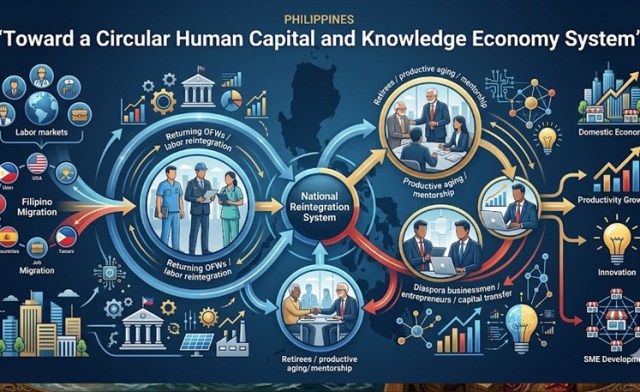
Toward a Circular Human Capital and Knowledge Economy System
By Karl Garcia
EXECUTIVE ABSTRACT
0.1 Problem Statement
The Philippine labor migration system remains heavily dependent on external employment flows, producing high remittance gains but weak domestic reintegration outcomes. The system underutilizes two strategic populations:
- Returning Overseas Filipino Workers (OFWs)
- Retirees and aging overseas Filipinos
- Filipino businessmen and diaspora entrepreneurs
0.2 Core Argument
The Philippines must transition from a linear labor export model to a circular human capital economy, where:
- Labor
- Experience
- Savings
- Entrepreneurship are continuously reintegrated into national development systems.
0.3 Key Innovation
This paper introduces a three-layer reintegration architecture:
- Labor Reintegration (OFWs)
- Productive Aging Reintegration (Retirees)
- Knowledge Economy Reintegration (Businessmen & diaspora capital)
1. INTRODUCTION
1.1 Historical Context
The Philippines has institutionalized labor export as an economic strategy since the 1970s. While successful in stabilizing foreign exchange inflows, it has created structural dependency.
1.2 Structural Limitation
Current migration policy is:
- Remittance-centric
- Weak in reintegration
- Fragmented across agencies
1.3 Strategic Shift Required
A shift toward human capital circularity is required to:
- Reduce domestic skill shortages
- Improve productivity absorption
- Build knowledge-based industries
2. CURRENT MIGRATION AND LABOR STRUCTURE
2.1 Economic Contribution
- OFW remittances: >USD 40B annually
- Major sectors: maritime, healthcare, domestic work, construction
2.2 Structural Gaps
- Weak reintegration systems
- Limited skills matching
- Fragmented returnee support
2.3 Underutilized Capital Pools
- Retiree savings and pensions
- Returnee expertise
- Diaspora business networks
3. THREE-LAYER REINTEGRATION FRAMEWORK
3.1 Conceptual Model
Figure 1: Circular Human Capital System
        +----------------------+
        |  Overseas Employment |
        +----------+-----------+
                   |
                   v
        +----------------------+
        |     Remittances     |
        +----------+-----------+
                   |
                   v
   +---------------+----------------+
   |                                |
   v                                v
+---------+                  +------------------+
| OFW     |                  | Diaspora Capital |
| Return  |                  | & Businessmen    |
+---------+                  +------------------+
   |                                |
   v                                v
+------------------------------------------------+
|      NATIONAL REINTEGRATION ECOSYSTEM          |
|  - Skills reuse                                |
|  - Investment deployment                       |
|  - Knowledge transfer                          |
+------------------------------------------------+
                   |
                   v
        +----------------------+
        | Domestic Economy     |
        +----------------------+
3.2 Layer 1: OFW Reintegration
Focus:
- Skills matching
- Employment transition
- MSME entry pathways
Tools:
- National Skills Registry
- Reintegration vouchers
- Local employment acceleration zones
3.3 Layer 2: Retiree Productive Aging System
Retirees are repositioned as economic knowledge assets.
Functions:
- Mentorship in TESDA and universities
- Advisory roles in LGU development planning
- Local investment in cooperatives and SMEs
Figure 2: Retiree Reintegration Flow
Retirees → Skills Mapping → Mentorship Networks → SME/Community Investment → Local Economic Output
Key Concept:
“Retirement is not exit, but reallocation of experience capital.”
3.4 Layer 3: Businessmen and Knowledge Economy Integration
This layer integrates:
- Filipino entrepreneurs abroad
- Domestic business leaders
- Returnee investors
Functions:
- Technology transfer
- Capital formation
- Industry scaling
Figure 3: Knowledge Economy Loop
Diaspora Businessmen ↓Capital + Knowledge Transfer ↓Local SMEs / Industry Clusters ↓Productivity Growth ↓Reinvestment Cycle
4. POLICY ARCHITECTURE
4.1 Institutional Layering
Figure 4: Governance Architecture
              NATIONAL GOVERNMENT
                     |
   +-----------------+------------------+
   |                                    |
DOLE / DMW                        NEDA / DTI
   |                                    |
   v                                    v
OFW Reintegration            Industrial & SME Strategy
   |
   v
Local Government Units (LGUs)
   |
   v
Reintegration Hubs (Regional Nodes)
   |
   v
Community + Enterprise Ecosystems
4.2 Proposed Institutional Additions
- National Reintegration Authority (NRA)
- Diaspora Investment Office (DIO)
- Retiree Productivity Council (RPC)
5. GLOBAL BENCHMARKING FRAMEWORK
5.1 Japan
- Senior re-employment systems
- Community-based advisory roles
5.2 South Korea
- Diaspora-linked startup investment systems
- Export-linked knowledge transfer
5.3 India
- Strong IT diaspora reinvestment networks
- Venture capital returnee pipelines
5.4 Key Insight
Successful states treat returnees as:
“Second-phase economic actors, not completed labor cycles.”
6. ECONOMIC IMPACT LOGIC
6.1 Transition Pathway
Labor Export Economy ↓Remittance Economy ↓Returnee Reintegration Economy ↓Knowledge + Capital Circular Economy
6.2 Expected Outcomes
- Higher domestic productivity absorption
- Reduced regional inequality
- Increased SME scaling
- Stronger innovation systems
7. CITATION FRAMEWORK (FOR FORMAL PUBLISHING)
This paper uses a structured policy citation system:
7.1 Source Categories
- S1: Government Data
- PSA, BSP, DOLE, DMW, NEDA reports
- S2: International Institutions
- World Bank, ILO, OECD migration studies
- S3: Academic Literature
- Migration studies, labor economics, development theory
- S4: Case Studies
- Japan, South Korea, India diaspora systems
- S5: Field Data (Proposed)
- LGU reintegration pilots
- OFW returnee surveys
- MSME performance data
7.2 Citation Format
(Author, Year, Category S#)
Example:
- (World Bank, 2023, S2)
- (Philippine Statistics Authority, 2025, S1)
8. STRATEGIC RECOMMENDATIONS
8.1 National Reintegration System
Unified system integrating OFWs, retirees, and diaspora capital.
8.2 Retiree Economic Activation Program
- Mentorship
- Advisory councils
- Local investment channels
8.3 Diaspora Knowledge Economy Platform
- Business matching system
- Industry integration portal
- Co-investment frameworks
8.4 Regional Reintegration Hubs
- Innovation nodes
- Training + enterprise clusters
8.5 Capital Recycling Mechanisms
- Reintegration bonds
- Co-investment funds
- Returnee equity incentives
9. CONCLUSION
The Philippine migration system is not merely a labor export mechanism but a latent development architecture.
By integrating:
- Workers (OFWs)
- Retirees (experience capital)
- Businessmen (knowledge + capital systems)
the Philippines can transition into a circular human capital economy where migration becomes not loss, but structured national regeneration.
FINAL SYSTEM MODEL (MASTER DIAGRAM)
          GLOBAL LABOR MARKETS
                  |
                  v
        +----------------------+
        |  Filipino Migration  |
        +----------------------+
                  |
     +------------+-------------+
     |            |             |
     v            v             v
 OFWs        Retirees     Businessmen/Diaspora
     |            |             |
     +------------+-------------+
                  |
                  v
     NATIONAL REINTEGRATION SYSTEM
                  |
                  v
     KNOWLEDGE + CAPITAL ECONOMY
                  |
                  v
     PRODUCTIVITY + INNOVATION GROWTH


I’m inclined to think reintegration is like putting toothpaste back into the tube. The only way to do it is to create suction, that is a LOT of available jobs that will pull people back into the job market. Matching college graduates to jobs vs matching OFWs to jobs, which is more important? It’s hard to bring seafarers back, or professionals who make a lot of money. I’d advocate for building manufacturing, the big job creator, and let reintegration occur naturally. The Philippines does not have a depth of employment. It is shallow, day workers, contract workers, family businesses. The nation needs careers, not just jobs. Jobs don’t have pulling power. Careers do.
Nice analogy before thinking of overwhelmong reintegration solve our job situation first. The call centers losong jobs to AI are not the call center agents, it is the Quality Analysts, Systems anslysts, Team leads because AI can read speadsheets a gazillion times faster and can do real time dashboards which is what client wants and that is the BPO sector alone. Where no one wants to he demoted bav to taking calls.The highest paying AI proof (hyperbole) are welders but not for everyone. I See more nail salons, hair salons.
Back to high tech high touch megatrend prediction.
The diesel prices is driving less fish catch rotting vegetables with no end in sight for the middle east crisis. Trump just put words in the mouth of King Charles that they both do not want Iran to have nukes.
Hmm… some quick observations as I have working experience in all the mentioned countries:
Many thanks Joey for spending time for your reply.
on lunch break from my
moon missioncutover, some notes on how some countries solve issues with keeping people or getting them back:1. Romania did or does it with low taxes, I think IT professionals had special rates even. So they can live relatively well over there compared to say, Germany. People do like to stay at home if it is possible to do so and aren’t as greedy as some assume them to be.
2. India has its own IT companies that send their best abroad but for a limited duration on foreign projects. I was told that two years in Europe can be enough to build a house in India. Coming back they of course can rise in the ranks of their company and earn more at home as their qualifications have increased.
3. Indonesia I heard very actively takes care of its students abroad via its Embassies. Maybe they help some return to government positions. What I also heard is that Indonesia has been very intent on keeping highly qualified technocrats at home.
I wonder how successful the Balik-Scientist program of DOST is, for example. It is as old as Marcos Sr. – a Pisay classmate and myself were at Malacanang for some reason with other Pisay students and suppressed laughter when Makoy called for the Balik Scientists to come forward and no one came..
we lost some, we gain some: filipinos leave philippines for greener pastures overseas, but we also get a number of foreigners coming to live in philippines, finding philippines a land of opportunity. we have koreans living here and running successful businesses, owning shops, restaurants, etc. same with indians, we have indian doctors practising here and living with their families here as well. indians also have consultancy firms here and working along side filipinos. japanese too, have businesses here, lived here and even learned to speak tagalog as well.
we also have foreign retirees living and spending the rest of their lives here, where medicals are affordable as well as housing and accommodation.
Yes, I can verify this statement as factual. 🙂
and for my batchmate and myself in Malacanan I think in 1980, it was a “Try Not to Laugh Challenge” with a dictator talking five rows in front of us, clearly surprised that there were no Balik-Scientists in the room. I wonder if anyone from what was then called NSDB and later became Ministry of Science, later DOST, lost his position or was exiled to a difficult place as a consequence of Makoy getting somewhat shamed. Good we managed NOT to laugh.
this would probly answer your question why filipinos earning bigger bucks in other countries come back to work and live in philippines:
AI Overview
Overseas Filipino Workers (OFWs) often return to the Philippines despite lower pay due to the desire to be with family, the high cost of living abroad, and the ability to leverage accumulated savings for a better lifestyle at home. Returning allows them to invest in businesses, avoid extreme homesickness, and live in a familiar environment. [1, 2, 3, 4]
While the desire to return is strong, some studies also indicate that many struggle to find similar high wages, finding it difficult to find stable, high-paying work at home.
this may answer the question why filipinos return to the philippines to live and work.
AI Overview
Overseas Filipino Workers (OFWs) often return to the Philippines despite lower pay due to the desire to be with family, the high cost of living abroad, and the ability to leverage accumulated savings for a better lifestyle at home. Returning allows them to invest in businesses, avoid extreme homesickness, and live in a familiar environment.
While the desire to return is strong, some studies also indicate that many struggle to find similar high wages, finding it difficult to find stable, high-paying work at home.
my apologies for the double entry!
Yes those are good points KB and I find what you shared to be true for Diaspora Filipinos who have accumulated enough savings in order to go “back home” where they plug into the aspiring middle class like CV’s friend who retired to Ayala Alabang.
There is also a curious trait I’ve only seen in Filipinos which is the tendency for middle class families abroad whose purchasing power would make them Class B or upper Class C back home will send their children for “summer vacation” to the Philippines, then surprise! the kid is enrolled in a private junior high school to preserve their Filipino-ness. That happened to a few of my Fil-Am elementary classmates, and it happened with my best friend who is born and raised in HK.
It is really hard to find a stable and well-paid job in the Philippines. It is really hard to open a new business where giant oligopolic incumbent block entry into most valuable areas, and where the rest need the right backers in the right places. Back in my early 20s I wanted to open a business in the Philippines but after much exploration I partnered with a business venture in Singapore instead, which later expanded to Malaysia.
I guess or conjecture that kb was or is an immigrant or ofw but I maybe wrong.
you have no idea! I was called a village idiot at one time, sometimes a drunk, one time camp crame detainee, but a very hard worker. being hyperactive, I hold down three jobs! and can manage with only a few hours of sleep a day. moneywise, I am okay, thrifty to a fault, but generous too. I give it forward, pay it forward, to honor the people who help me on the way. the charity of christ urges us!
Yes, you are correct, I have no idea. The ceame I remember a bit. The generosity too.