Before Colonization: The Maritime, Networked, and Layered Foundations of the Philippines
By Karl Garcia
Introduction: Beyond the Myth of Isolation
The history of the Philippines is often told as a simple sequence: early settlements, followed by centuries of isolation, and then sudden transformation with the arrival of Europeans. In this narrative, the archipelago appears peripheral—its development delayed until external forces brought change.
This view is misleading.
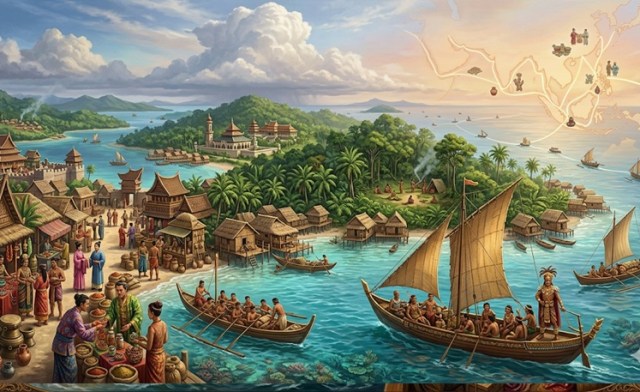
Long before Spanish colonization, the Philippines was already part of a dynamic and interconnected Asian world. Its societies were shaped not by isolation, but by mobility, exchange, and layered interaction across thousands of years. From the first human settlers to Austronesian voyagers, from early metal-age trade networks to Islamic sultanates, the archipelago developed as a maritime civilization embedded in regional and interregional systems.
To understand Philippine origins, we must move beyond linear narratives and adopt a different framework:
The Philippines was not formed by a single migration or a single influence, but by layers of movement, mixing, and maritime connectivity.
I. Deep Origins: Before the Austronesians
Human presence in the Philippines stretches back tens of thousands of years. Long before the arrival of Austronesian-speaking peoples, the islands were inhabited by diverse groups of hunter-gatherers who adapted to forests, rivers, and coastal environments.
These early populations were not uniform. They represent multiple waves of migration from mainland Asia over long periods. When Austronesians arrived around 4,000 years ago, they did not replace these earlier inhabitants. Instead, they interacted with them—through intermarriage, exchange, and cultural adaptation.
The result was layered continuity, not replacement.
This early blending helps explain the biological and cultural diversity that still characterizes the Philippines today. Austronesian culture became dominant, but it was built upon an older human foundation that never disappeared.
II. The Austronesian Transformation: A Maritime Foundation
The arrival of Austronesian-speaking peoples marked a turning point in Philippine history. They brought:
- new languages (now the basis of nearly all Philippine languages)
- advanced boat-building and navigation technologies
- horticulture and farming practices
- pottery and new material cultures
But most importantly, they brought a maritime way of life.
Unlike river-valley civilizations, Austronesian societies developed in an archipelagic environment. Their survival depended on:
- mobility between islands
- fishing and coastal resource use
- inter-island exchange
They were not simply farmers expanding outward. They were maritime-oriented societies who integrated agriculture into a flexible subsistence system.
Communities were typically small, kinship-based, and decentralized—often described as barangay-type settlements led by local chiefs or datus. No single political authority unified the archipelago.
This decentralized but connected structure would define the Philippines for centuries.
III. The Early Metal Age: Trade, Technology, and Proto-Globalization
Between roughly 3,000 and 2,000 years ago, bronze and later iron technologies spread into Island Southeast Asia. These developments were part of wider regional systems connected to mainland Southeast Asia and southern China.
Artifacts linked to the Dong Son culture—particularly bronze drums—demonstrate long-distance exchange networks extending across the region.
However, metallurgy in the Philippines was uneven:
- some communities practiced local production
- others relied on imported goods
- metal objects often functioned as prestige items
At the same time, extensive trade networks emerged:
- jade from Taiwan
- beads from India
- shared pottery traditions across islands
These exchanges formed a decentralized maritime interaction sphere, in which goods moved through chains of coastal communities following monsoon routes.
This was not globalization in the modern sense—but it was a form of proto-globalization, linking societies across vast distances without centralized control.
The Philippines stood near the center of this system, acting as both corridor and connector.
IV. Cultural Layering: Southeast Asia, India, and China
As trade networks expanded, new cultural influences entered the archipelago.
Southeast Asian Integration
The Philippines maintained continuous interaction with neighboring regions:
- Borneo
- Sulawesi
- the Malay Peninsula
These connections facilitated not only trade but also migration and cultural exchange.
Indian Influence (Indirect and Selective)
Elements associated with Indian civilization reached the Philippines primarily through intermediaries such as Srivijaya and Majapahit.
These included:
- Sanskrit-derived vocabulary
- symbolic and religious ideas
- concepts of leadership and law
However, the Philippines was not deeply Indianized. These influences were selectively adopted and integrated into existing Austronesian systems rather than replacing them.
Chinese Commercial Networks
Chinese contact developed over time, with early references during the Tang dynasty and intensifying in later periods.
By the Song, Yuan, and Ming eras:
- Chinese ceramics, silk, and goods flowed into Philippine ports
- local products such as gold and forest goods were exported
Polities such as Tondo and Butuan became active participants in these exchanges, linking the archipelago to East Asian markets.
V. The Indian Ocean World and the Spread of Islam
Through Southeast Asian intermediaries, the Philippines became indirectly connected to Indian Ocean trade networks dominated by Persian and Arab merchants.
By the 14th century, Islam began to spread into parts of the southern Philippines:
- Sulu
- Mindanao
Here, Islamic sultanates emerged—more centralized than earlier kinship-based communities. These polities were integrated into wider Muslim trade networks spanning Southeast Asia and beyond.
Islam introduced:
- new religious systems
- legal and political frameworks
- expanded commercial connections
This marked one of the clearest transitions toward state-level organization in parts of the archipelago.
VI. A System in Motion: The Philippines Before Spain
By the early 16th century, the Philippines was a complex and interconnected maritime society.
It consisted of:
- diverse linguistic and cultural groups
- active trading communities
- layered religious traditions (indigenous beliefs, Islam, syncretic practices)
Coastal settlements were engaged in trade with:
- Chinese merchants
- Malay and Indonesian traders
- broader Asian networks
Yet political organization remained decentralized. No single power unified the islands, making them flexible—but also vulnerable.
VII. Spain and the Reordering of a Maritime World
The arrival of Ferdinand Magellan in 1521 marked the beginning of sustained European contact. Though his expedition failed, it opened the way for colonization.
In 1565, Miguel López de Legazpi established the first permanent Spanish settlement.
Spain did not create Philippine society from nothing. It reorganized and transformed an already existing system built over thousands of years.
The decentralized nature of local communities allowed Spanish forces to establish control gradually—through alliances, conversion, and conquest.
Conclusion: A Maritime Civilization Before Colonization
The Philippines was never isolated. Long before European arrival, it was part of a maritime world defined by movement, exchange, and adaptation.
Its history is best understood through three interlocking dynamics:
- Maritime orientation (mobility over fixed settlement)
- Networked exchange (trade without centralized empires)
- Layered development (migration, mixing, and cultural integration)
This perspective challenges the idea that Philippine history began with colonization.
It did not.
Long before Spain, the archipelago was already:
- connected to Asia
- shaped by trade
- enriched by multiple cultural influences
It was not a blank slate waiting to be written upon.
It was a crossroads of the Austronesian and Asian worlds—a civilization of sailors, traders, and communities linked by the sea.


Thank you, Karl. Wonderful snapshot of the decentralized Philippines, then, and now even. In this light, today’s dynasties are nothing new. They are the Philippines as it’s been for thousands of years, defying modern governmental, political, social, and economic institutions. We ought not wail about the dynasties I think, but better implement ways to make sure they are honest and productive. And for sure the nation should be building boats.
Yes, Joe that is the way to go. Thanks.
I have been looking into why it doesn’t work anymore like it did before and have come across several factors that make today different:
1) there is no more up the mountains option (ilaya) for those not satisfied with their datu
2) the datu no longer necessarily needs his own people to produce food – imported rice is often cheaper
3) even the haciendero equation of needing labor no longer works as before – some just sell their resources or rent out to POGOs
4) the datu can live in BGC far from the people in his locality, send his children to college in Singapore, all that
5) not even the modern weapons against financial impunity work due to PH bank secrecy laws that protect “crookery” (c) MRP.
6) small communities work well with personal arrangements due to the Dunbar number – bigger communities need more explicit rules, not just fluidity
One can blame whatever processes changed the old balance, but the new balance (haha sounds like shoes) cannot be like the old one.
I asked Claude to act as a political scientist (but one critical of the usual lazy consensus of whatever kind common in the Philippines) and this is most remarkable out of what I got:
I asked how one could change things to utilize the best of the old culture and got this answer:
not surprised that the Robredo model is part of the answer.
Some ideas I had before; I don’t believe any require legislation (are within exec authority):
In addition, perhaps the “Robredo Model,” which under some form is used by the Good Governance Mayors, should become standardized into a “Robredo Method” based on the late Jesse Robredo’s mayorship of Naga. Something I thought might be useful would be a modern-day sandugo blood pact; maybe something along the lines of the Cordilleran practice of bodong or peace pact between one or more tribes to engage in mutual collaboration.
The diaspora (including OFW) probably still holds most of the power due to education, skills, remittance power, yet they are not organized in any major way. Social media nowadays might be able to facilitate that but then that would require civil society leaders abroad — a thankless job. AFAIK most overseas Filipinos don’t vote for various reasons.
Irineo I’m not sure if it was intended but I found your point on cheap imported rice to highlight the original datu relationship. In the datu patronage system one of the main functions of a datu was to maintain food security, including redistribution in times of crop failure which Laura Lee Junker observed in Raiding, Trading, and Feasting. But it’s not just cheap imported rice that reinforces modern datu power. Cash transfers and remittances might have separated direct material dependency on the datu, but rather than liberating the modern “clients” of the modern “datu,” decoupling material dependency for survival just meant clients were cheaper to maintain. Modern patrons need to provide even less than a datu of the past provided, while using utang na loob to retain the same political loyalty. It seems to me that this behavior actually got worse after 1987 when Marcos cronyism which had broken old patron networks was itself broken up and had the wealth of Marcos cronies redistributed to a new set of dynasties.
I asked Claude to give me a wrap up of how local power was from the Third Republic today (with some prompt wizardry of course) and got this:
(OK, cacique as a term is a bit dubious as it is more applicable to Latin America, still it is established)
The big picture that emerges is that no one really had the “datus” under control. There is BTW the theory that even if the USA had left the Philippines alone, it might have succumbed to Aguinaldo’s various “generals” fighting one another like the 1950s warlords but without any state to hold them together.
I followed up with a question on how land reform and migration changed things and got this:
that big picture doesn’t look good.
and now a look at the roots with some prompt magic on Claude:
I specifically asked about Bikol because it never had that many large haciendero clans, it always had a pronounced ilaya (and a tradition of people going there) and a very specific middle class culture.. possibly the presence of natural disasters also played a role.. in any case civic society there is different from what it is in Iloilo City.. that place is probably way more patrician in its liberalism..
The pattern of mass energy, then elite capture — is the defining structural feature since the 1897 Tejeros Convention feud between Bonafacio’s Magdiwang and Aguinaldo’s Magdalo that has endured until the present. In this way Bonafacio’s execution at Maragondon was the first demonstration which systemized: the masa can start, but not finish revolutions, because system change requires the organizational and institutional resources the masa do not yet have.
I think most readers of Philippine history know the “cacique democracy” epithet used by Liberals became popularized after Benedict Anderson’s 1988 New Left Review article “Cacique Democracy in the Philippines: Origins and Dreams.”
Yes, “cacique” is a Carib Indio word for chieftain so it has Latin American origins. In Hispanophone and Lusophone Americas “cacique” broadly means a local political boss who exercises polical power in a system of bossism-clientelism (i.e. caciquismo) similar to the Peninsular caudillo-gaucho (i.e. caudillismo) system.
By the reign of the liberal Queen Isabella II the liberalization allowed for political parties, but without many rules clientelist networks arose under “caciques.” It was also common during this time for publications in the Philippines to bemoan the local caciques, according to some Spanish-language documents of that period (I was fortunate to read a few in person years ago when I visited a friend at UST).
As Bonafacio styled himself as “Supremo,” one of the auto-granted styles of Aguinaldo was “El Caudillo,” I guess in an attempt to have a perceived higher title than the commonly used cacique.
The term “cacique” persisted under the American Period and I guess was forgotten for a while until Benedict Anderson’s 1988 article.
I think the main issue pro-democracy Filipinos is a failure of imagination to utilize levers of power one can capture in the existing system — there is too much focus on starting over with a new transformation to copy-paste American-style or Euro-style democracy, which can’t happen unless there is another revolution.
But what is wrong with a Philippine-style democracy that respects Philippine heritage while integrating new ideas necessary for modernity? I think there is a lot of mine regarding alliances and coalitions between datus in centuries past. That is still the operating logic of the Philippine system as shown by how dynasties are constantly forming and switching coalition alliances with every election.
Check out the following link to see what I’m playing around with now:
https://claude.ai/public/artifacts/f6070512-52d5-45ad-b9fb-911c8fcac4ec
created two pictures with AI that summarize the discussion between Joey and me, the first one is how the “datus” evolved over the centuries, the other is Joey’s idea of a modern political alliance that utilizes the best aspects of Philippine culture.
Joey’s proposal would look more like this, the link to it is below the picture:
https://claude.ai/public/artifacts/f6070512-52d5-45ad-b9fb-911c8fcac4ec