Between Magellan and Legazpi: The Forgotten Gap, the Rise and Fall of the Habsburgs, and Why the Philippines Became More Mexican Than Spanish
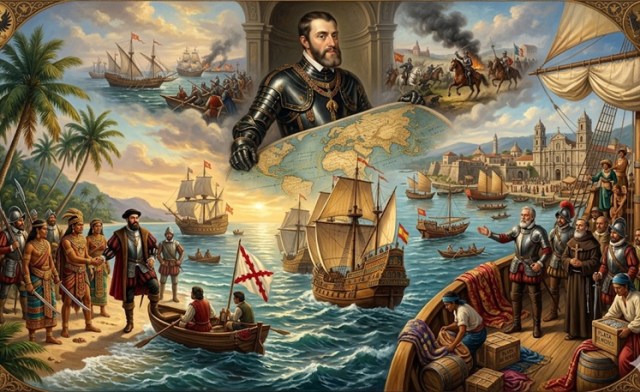
By Karl Garcia
Many histories of the Philippines move quickly from the arrival of Ferdinand Magellan in 1521 to the conquest of Miguel López de Legazpi in 1565, as if Spanish rule followed immediately after first contact. In reality, there was a gap of more than forty years between these two events. This period is often overlooked, yet it explains one of the most important facts about Philippine history: the islands did not become a typical Spanish colony governed directly from Europe. Instead, they became part of the Spanish Pacific world, administered through Mexico, influenced by American-born Spaniards, and shaped by global politics in Europe — especially the rise and decline of the Habsburg dynasty that ruled Spain during the early colonial period.
To understand why the Philippines became tied to Mexico, we must look not only at events in Asia, but also at the power struggles in Europe.
Magellan, Charles V, and the Global Ambitions of the Habsburg Empire
When Magellan sailed in 1519, Spain was ruled by Charles V, one of the most powerful monarchs in European history. He belonged to the House of Habsburg, a family that controlled vast territories across Europe and the Americas.
Charles V was not only King of Spain. He was also Holy Roman Emperor and ruler of lands in Germany, Italy, the Netherlands, and Austria. His empire stretched across continents, and his goal was to compete with Portugal for control of global trade.
Magellan’s voyage must be seen in this context. Spain wanted access to the Spice Islands, which Portugal already dominated. The expedition was part of a global rivalry between two European empires, not a plan to colonize the Philippines.
When Magellan reached the islands in 1521, he claimed them for Spain, but the Habsburg Empire had too many wars in Europe to focus on distant territories. After Magellan’s death in the Battle of Mactan, Spain did not immediately return.
The empire’s attention was elsewhere.
The Habsburg Wars and the Delay in Colonizing the Philippines
During the decades after Magellan, the Habsburg rulers were involved in constant conflicts in Europe. They fought wars against France, against Protestant states in Germany, and against the Ottoman Empire. These struggles consumed money, soldiers, and political attention.
At the same time, Spain was building its empire in the Americas. The conquest of Mexico and Peru brought enormous wealth, especially silver. These colonies became far more important to the Spanish crown than distant islands in Asia.
Because of this, the Philippines remained outside direct Spanish control for more than forty years. Spain did not ignore the islands completely, but it lacked the resources to establish a permanent colony while fighting wars in Europe and organizing its American territories.
The delay between Magellan and Legazpi was therefore not an accident. It was the result of global politics.
The Pacific Empire Built from Mexico
By the mid-1500s, the situation changed. Spain had secured control of Mexico, known as New Spain, and had discovered a reliable route across the Pacific. From Mexico, ships could sail west to Asia and return using northern currents.
This made the Philippines valuable as a trading base. The goal was not to conquer a large land empire, but to create a link between China and the Americas.
In 1565, Miguel López de Legazpi sailed from New Spain, not from Spain itself. His expedition included Spaniards born in the Americas, Mexican natives, and other colonial soldiers. From the beginning, the Philippines was governed through Mexico City.
This arrangement became permanent with the Manila–Acapulco Galleon Trade, which connected Manila to Acapulco for more than two centuries. Silver from Mexico paid for Chinese goods, and the Philippines served as the meeting point of Asian and American trade.
Because of this system, the colony developed closer ties to Mexico than to Spain.
The Later Habsburgs and the Limits of Spanish Power
After Charles V, Spain continued to be ruled by the Habsburg dynasty, including Philip II of Spain, under whom the Philippines was formally organized as a colony. Philip II made Manila the capital and strengthened the galleon trade, but his reign was also marked by enormous military expenses.
Spain fought wars in Europe, the Mediterranean, and the Netherlands. The empire remained powerful, but its resources were stretched thin. Because the Philippines produced little gold or silver, it never became a priority compared to Mexico or Peru.
As the Habsburg line continued, Spain gradually weakened. By the late 1600s, the dynasty faced financial problems, military defeats, and internal decline. The death of Charles II of Spain in 1700 ended the Spanish Habsburg line entirely.
This event led to the War of the Spanish Succession, which reshaped the Spanish Empire and brought the Bourbon dynasty to power.
For the Philippines, these changes in Europe meant that the colony remained distant, underfunded, and dependent on Mexico.
Why the Philippines Felt More Mexican Than Spanish
Because the Philippines was colonized during the Habsburg period and administered through New Spain, its development followed a different path from other Asian territories.
- Soldiers often came from Mexico.
- Priests and officials often came from Mexico.
- Trade depended on Mexico.
- Laws were often enforced through Mexico City.
Even everyday culture showed this connection. Foods, words, and customs traveled across the Pacific along with silver and silk. Filipino society absorbed influences from Spain, but also from Latin America and Asia at the same time.
This is why the Philippines cannot be understood simply as a Spanish colony. It was part of a trans-Pacific empire created during the height of Habsburg power and maintained through the American colonies.
Conclusion: Empire, Dynasty, and Distance
The gap between Magellan and Legazpi reflects more than a delay in colonization. It reflects the realities of a global empire ruled by the Habsburgs, whose attention was divided between Europe, the Americas, and the seas.
Spain reached the Philippines during the rise of the Habsburg Empire, colonized it through Mexico at the height of its power, and governed it from afar as the dynasty declined.
Because of this history, the Philippines became something unique:
not fully European, not fully American, not fully Asian —
but a colony shaped by the politics of Europe, the wealth of Mexico, and the trade of the Pacific.


Most interesting indeed. Mexican Asia rather than Spanish Asia. I’ve had it wrong all these years. Mexico botched it though by not establishing Hass avocados as a mainstay of Philippine cuisine. The avocados here are for dessert I think, not guacamole. Very different taste.
Update. Hass avocados are grown on Mindinao!!! And are even exported. But I guess Filipino tastes charted a different course.
Avocado does not store well once it is ripe unless the fruit’s flesh is processed then flash frozen. The lack of widespread refrigeration and freezers probably contributes to Filipinos not eating much avocado.
Filipinos also eat avocado as a sweet desert like in abukado lamaw (similar to the young coconut lamaw).
Sometimes I don’t really trust “official” data (government or business) coming out of the Philippines since “common knowledge” in the Philippines is that there is widespread adoption of refrigeration but actual spot checks makes it quickly apparent that many lower class urban dwellers don’t have access, much less provincial Filipinos. Anyway, refrigeration is a must for harvested avocados, and freezers are needed to preserve ripe fruit.
The two Asian countries that produce the most avocadoes are Indonesia and Vietnam. In both countries avocadoes are integral to the local cuisines.
My Hass avocadoes are just about to start ripening. I am eyeing at Costco a convertible refrigerator/freezer unit (or two) for my garage. My tree produces way too many avocados to eat at once or to even give away. Ditto for the persimmons, peaches, apples, oranges, tangerines, guava. My saba and lakatan banana trees have not been that productive in recent years.
Thanks Joe for the info and update on Hass Avocados.
apparently hass avocado is kano! and originated in the state of california, 1st propagated by rodulf hass, an american postal worker. I dont like hass avocado, the ones we have in cebu have smooth skin, bigger and good for sharing. I think they are west indian type of avocado and are sweeter, not as oily as hass though.
Thanks guys, it made me look up on avocado more.
porbida, filipinos more mexican than spaniards, that’s awful! I thought we pinoys are micronesians of some sort, stock wise. culturally, we have connection with mexico, the black nazarene originally comes from mexico. mayan culture? dont they sacrifice humans to their pagan gods! and the spaniards change all that. subdued the mayans too and made them christians, and like us baptised by the cross.
though the chinese were quick to capitalize on our ancestry and even once tried to convince PNoy of his chinese origin, from south china. PNoy visited south china but he was just too remote and further down the ancestry chain that he probly felt less connected. but the chinese were successful with ex pres duterte that digong felt deep kinship, was pro china and even employed a chinese as his finance minister.
apparently, the chinese also tried the trick on ex pres obama but obama was cool to the idea. he was more kenyan than chinese!
Irineo posted something about Son Tua related to the mother of Mike Arroyo.
If you mean contemporaries of Son Tua during the late Spanish colonial era — especially the wealthy Chinese and Chinese mestizo merchant class in 18th-century Manila — several other powerful figures and clans emerged around the same period, though Son Tua (later Don Antonio Tuason) became one of the most exceptional because of his political role during the British occupation of Manila (1762–1764).
Some notable contemporaries or near-contemporaries included:
A key distinction:
This elevated the Tuasons from merchant elites into quasi-feudal landed aristocracy. Their estates eventually covered huge portions of what became:
In broader context, the Philippines under Spain had several overlapping elite groups:
By the late 1700s and especially the 1800s, the Chinese mestizo class became economically dominant in many regions because they controlled retail trade, credit, warehousing, and agricultural commercialization.
Some later major Chinese mestizo dynasties descended from this environment included:
An important historical nuance: Many “Spanish” elite families in the Philippines were actually heavily Chinese mestizo by bloodline after generations of intermarriage and Hispanization. Spanish surnames often concealed Fujianese ancestry. The Tuason surname itself was likely a Hispanized transformation tied to “Son Tua.”