From Datus to Revolution: The Evolution of Filipino Resistance
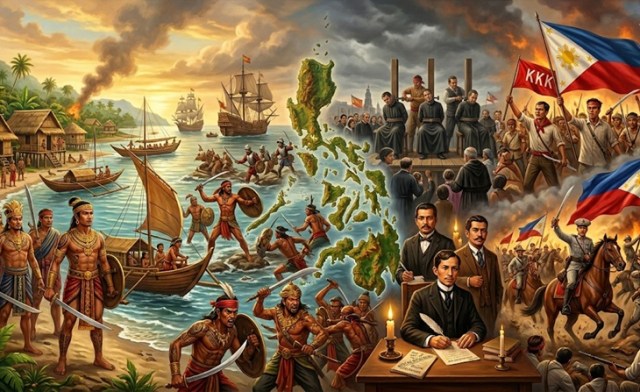
By Karl Garcia
The history of Filipino resistance to foreign domination is a long continuum, beginning long before the Spanish arrived in the archipelago in the 16th century. Prior to colonization, the Philippine islands were a patchwork of independent polities, each ruled by local chiefs—datus and rajahs—whose authority stemmed from kinship, trade influence, and control over land and labor. These leaders commanded loyalty from their subjects through a system of reciprocal obligations: tribute, protection, and social governance.
When Spanish expeditions arrived, many datus and rajahs initially accommodated the newcomers, negotiating their continued authority in exchange for allegiance to the Spanish crown. The colonial government employed a strategy of co-optation, incorporating local leaders into the colonial bureaucracy as principales, responsible for tax collection and local governance. While this arrangement preserved some of their privileges, it curtailed their autonomy and made them instruments of colonial control. Still, accommodation did not preclude resistance.
Throughout the 16th to 18th centuries, sporadic uprisings erupted across Luzon, Visayas, and Mindanao. Some datus and rajahs in Luzon protested excessive tribute or forced labor; Visayan chiefs occasionally resisted Spanish control over trade networks; and in Mindanao, Muslim sultans such as those of Sulu and Maguindanao waged sustained armed campaigns against Spanish expansion. These revolts, however, were usually localized and short-lived, hampered by the fragmented nature of pre-colonial polities and the military superiority of the colonizers. Over time, most datus and rajahs chose pragmatic cooperation over rebellion, securing survival within the colonial framework but ceding much of their political independence.
By the 19th century, broader patterns of unrest began to emerge, culminating in the Cavite Mutiny of 1872. Prior to this event, Filipino soldiers and laborers occasionally engaged in mini-mutinies, small-scale and reactive protests against forced labor, low pay, or abusive officers. These mini-mutinies were scattered and uncoordinated, yet they revealed a growing discontent among ordinary Filipinos and foreshadowed more organized challenges to colonial authority. The Cavite Mutiny, though limited to about 200 participants, had enormous symbolic significance. The Spanish authorities, fearing liberal ideas from Europe, framed it as a nationalist conspiracy, using it as a pretext to execute Fathers Gomez, Burgos, and Zamora—Gomburza. Their deaths resonated across the islands, inspiring a generation of reformists and planting the seeds of nationalist consciousness.
Out of the ashes of Gomburza’s martyrdom arose the Propaganda Movement, a network of Filipino intellectuals and writers, including Jose Rizal, Marcelo H. del Pilar, and Graciano Lopez Jaena, who sought to expose the abuses of the colonial system and demand political reforms. Based mainly in Europe, these reformists used the pen to advocate for representation in the Spanish Cortes, secularization of parishes, freedom of the press, and educational reforms. Rizal, through his novels Noli Me Tangere and El Filibusterismo, revealed the systemic injustices suffered by ordinary Filipinos, inspiring both reflection and action.
While reformists advocated for change within the system, a more radical current of resistance emerged among ordinary Filipinos. Andres Bonifacio, a working-class Manila native, admired Rizal’s ideas but believed that independence required direct action and armed struggle. He founded the Katipunan, a secret revolutionary society committed to overthrowing Spanish rule. Though Rizal himself disapproved of violent methods and never met Bonifacio, his writings provided the intellectual and moral foundation for the revolutionaries.
Meanwhile, Emilio Aguinaldo began organizing provincial resistance, particularly in Cavite, leveraging both local networks and the rising nationalist sentiment inspired by earlier reformists and martyrs. Exile hubs such as Hong Kong became sites for correspondence, planning, and exchange of revolutionary ideas, linking intellectual reform to practical revolutionary strategy.
From the datus and rajahs who navigated the early colonial order, through sporadic local mutinies and the symbolic martyrdom of Gomburza, to the organized activism of the Propaganda Movement and the revolutionary leadership of Bonifacio and Aguinaldo, Filipino resistance evolved over centuries. It was a continuum: early accommodation gave way to protest, intellectual advocacy blossomed into nationalist consciousness, and ultimately, grassroots organization enabled armed struggle. Each phase laid the groundwork for the next, shaping a Filipino identity grounded in resilience, justice, and the pursuit of self-determination.
In tracing this trajectory, it becomes clear that Filipino nationalism was not born overnight. It emerged from the interplay of pragmatism and idealism, local power structures and colonial oppression, sporadic defiance and coordinated revolution. From pre-colonial leaders to modern revolutionaries, the Philippine struggle for freedom reflects a long history of adaptation, moral courage, and enduring hope—a testament to the nation’s unyielding spirit in the face of centuries of domination.


Indeed, an interesting history.
Fiefdoms and a string of continuous fights against oppression of many shapes and forms.
But, what is new?
In The Netherlands, we had the 80 year war against Spain and had to fight the French, Germans and now Russia & America & BigTech against oppression. An uncle was the last one who was working for a count in the East of The Netherlands, first as a serf and later more or less as an employee.
Freedom must be fought for and a history of oppression is never an excuse.
And that is where The Philippines needs to be stronger.
Forget about the excuses that most people are used to being treated like serfs and lack initiative.
Put Rizal in the background and highlight the fights against the oppressors and put the strong freedom fighters in the foreground. Create a culture of “Don´t shit on me, I will kill you” instead of halfheartedly singing the National Anthem every Monday morning at the start of business and screw the fellow citizens thereafter. I loved Anthony Bourdan’s Vietnam episode where he was talking to an ex-VC fighter who told him that he now was his friend, but he would kill Anthony if ever he came as an enemy. It would never come in my mind to screw this fisherman over. This while the fishermen in our village are being abused every time.
Remember the P5000 support? They got P30000.
Remember RA8550 stopping illegal fishing? The illegal fishing constructions are being erected with permission of the mayor while the fishing stock is deminishing rapidly.
Remember Yolanda where major international support was available? Only direct family got the support.
Time to get nasty, stop being so very “balimbing” maybe?
On the other hand, the nice and gentle people in our barangay are great to live with. It is safe, they are friendly beyond expectations and make my life very pleasant. But, it hurts every time corruption damages our fellow barangay people and nothing gets done against it.
A bit (lot?) more Bonifacio and Aguinaldo in our mids would be needed.
Luckily, many younger people seem to get the picture and try to fight the corruption / serf-dom.
Maybe they always have dne this and this resulted in the NPA.
When the kids get older, they seems they mellow and the old rules take over.
I hope the new generation is a bit more self-aware & aggressive and the abuse will be fought.
If you are looking for something new in history….nada! joke only . Thanks Paul for your ever enlightening insights
the Dutch example is interesting as it doesn’t only have fighting all the time.. it has the history of waterschapen as the proto-democratic institutions, even if I have read that they in the middle ages sentenced people to death who made the water dirty. You tell me, as a Dutchman you will know your history better.
the respect for people who BUILD is also extremely huge in the Netherlands – if I am interpreting the text on the Afsluitdijk monument (I was there once) correctly based on Dutch being very close to German, it says a living people build their future. In the Philippines, simple uncooperativeness is often stylized as revolutionary and “atapang atao” are respected too much even if they are sometimes just irresponsible while builders and responsible men are respected too little – my observation at least.
Yes, the Afsluitdijk is impressive, it is huge and made to withstand a 1000-year storm. All Filipinos should have a look at that and then come back and re-evaluate their defenses against climate change because even this big Dutch construction is currently made higher in anticipation of the rising sea levels due to climate change.
But, the place to visit really is Neeltje Jans, the work island in the Oosterschelde dam which makes it clear WHY and HOW the water-works were made. And impressive exhibition, my grandkids came out shaken and scared. Failing that, visit Madurodam where you can see the most important buildings in Netherlands in miniature, but also WHY and HOW the sea was tamed.
I think that the Dutch history clearly teaches WHY people have to cooperate. If my (grand) parents c.s. would have behaved like Filipinos, they would have drowned. You cannot tame the sea with shitty substandard projects. : floods of 1953 woke up the people and just like the man-on-the-moon project, all noses were lined up to achieve the target.
Another strange thing is that (like you mentioned), there are the “waterschappen” where a whole district decides how they are going to manage the water. This is serious business, but the waterschappen officials are elected and they take their job very serious. Also here: if you are selfish, people drown. So, history taught the lesson that cooperation is essential. But, elections also mean that you have to explain things to the people. So, the strange Dutch thing of “polderen” developed. Basically talk and talk until you have a working agreement. Dutch meetings tend to be unique, ALL people are allowed to say their opinion. From CEO to cleaner. And every opinion is taken seriously. The common denominator will be accepted as the final solution and as we all know, the result of cooperation is more than the sum of the individuals.
This is completely different from politics where lies, manipulation, promises and corruption are prevalent. If the waterworks would be managed like politics, Netherlands would be an empty country.
Philippines has a long way to go. I saw a shimmer of change after Yolanda, where people really started to help each other. Like in any flood. But then, after a month, it is forgotten and the flood control money disappeared and people do not realize HOW important these projects will become, so corruption became “business as usual” again while the reaction should have been more like the French Revolution.
Maybe we only learn when things go wrong badly. The Dutch paid the price (and still, many people try to cut corners), Philippines has not yet experienced big, preventable, disasters like which are predicted for Manila, Cebu, Iloilo etc. Look at the Namria maps and you’ll straight away sell your beach property and move 30 meters up. Absolutely scary.
I clearly remember the aftermath of Yolanda, when the next storm was forecasted, people panicked and everybody moved to shelters. The storm sizzled out. The storm after that, people stayed at home and prayed in church that the storm would pass by. Maybe Filipinos are too used to natural disasters to take storms, floods, volcanoes, vessels, etc serious.
Pity because my Dutch history teaches that if you take that serious, social structures develop to make defenses happen and that again results in a much stronger, integrated society.
compared to other countries, philippines has the bad luck to be situated in the ring of fire, yet filipinos thrived and live and rebuild after major disasters.
AI Overview
The Philippines’ struggle to maintain infrastructure compared to Holland and Germany stems from extreme geological and geographic vulnerabilities. Sitting on the Pacific Ring of Fire and the typhoon belt, the country faces a compounding barrage of earthquakes, volcanic eruptions, and over 20 typhoons annually. [1, 2, 3]
The stark difference in resilience and maintenance ease comes down to three main factors:
1. Geological and Climate Extremes
2. The Built Environment
3. Economic Capacity and Funding
Holland & Germany: Wealthier nations with massive, centralized tax bases. They can afford to over-engineer projects from the start (e.g., the Dutch Delta Works) and can sustain meticulous, preemptive maintenance without compromising their national budgets. [1, 2, 3]
The Philippines: Despite high hazard exposure, it balances disaster recovery with a developing economy and a massive population. Funding is frequently diverted from new infrastructure development into urgent disaster response and emergency repairs. [1, 2, 3]
Karl Garcia wrote: “Throughout the 16th to 18th centuries, sporadic uprisings erupted across Luzon, Visayas, and Mindanao. Some datus and rajahs in Luzon protested excessive tribute or forced labor; Visayan chiefs occasionally resisted Spanish control over trade networks; and in Mindanao, Muslim sultans such as those of Sulu and Maguindanao waged sustained armed campaigns against Spanish expansion. These revolts, however, were usually localized and short-lived, hampered by the fragmented nature of pre-colonial polities and the military superiority of the colonizers.”
I was saddened to learn, in studying our Philippine history, that most of the revolts during the Spanish era were overturned by finding a local or someone on the inside to betray the movement. The Dagohoy revolt was one exception.
Even during the Philippine-American War, I believe Gregorio del Pilar was betrayed by a local, as was Aguinaldo.
I don’t necessarily judge the betrayers, as based on the values of the time, they likely did not know any better. I’m just saddened.
I mention this just to say that there is a nuance to Pablo’s call to revolt against the enemy (“time to get nasty”). Remember how “nasty” we got against Marcos, Sr.? That did not get us very far now did it?
Marcos snr. got kicked out, certainly. But the structure, the corrupt politicians remained. And Marcos’ clan even took some pocket money with them (and been allowed to keep it) so his family has been living in comfort and able to buy elections.Not exactly “time to get nasty”, more like a small adjustment so everything can stay the same.
But, as a warning: the last time people got nasty (the Russian / French / Chinese revolutions) ended up with undesirable change. I hope there will be a sense of reality and the Filipino people will find a way to eliminate all corrupt politicians (latest estimate I read in this forum was somewhere around 90%) without doing harm to those lovely small people trying to survive.
“I hope there will be a sense of reality and the Filipino people will find a way to eliminate all corrupt politicians (latest estimate I read in this forum was somewhere around 90%) without doing harm to those lovely small people trying to survive.” – Pablo
Yeah, I agree…these “small adjustments” as you call them, are not enough, obviously. Over time, you will come to realize that Filipinos are not the Russians, or the French, or the Chinese. Nick Joaquin wrote of our heritage of smallness. “Small adjustments” might be all we are capable of, collectively speaking.
Karl Garcia wrote: “Throughout the 16th to 18th centuries, sporadic uprisings erupted across Luzon, Visayas, and Mindanao. Some datus and rajahs in Luzon protested excessive tribute or forced labor; Visayan chiefs occasionally resisted Spanish control over trade networks; and in Mindanao, Muslim sultans such as those of Sulu and Maguindanao waged sustained armed campaigns against Spanish expansion. These revolts, however, were usually localized and short-lived, hampered by the fragmented nature of pre-colonial polities and the military superiority of the colonizers.”
I was saddened to learn, in studying our Philippine history, that most of the revolts during the Spanish era were overturned by finding a local or someone on the inside to betray the movement. The Dagohoy revolt was one exception.
Even during the Philippine-American War, I believe Gregorio del Pilar was betrayed by a local, as was Aguinaldo.
I don’t necessarily judge the betrayers, as based on the values of the time, they likely did not know any better. I’m just saddened.
I mention this just to say that there is a nuance to Pablo’s call to revolt against the enemy (“time to get nasty”). Remember how “nasty” we got against Marcos, Sr.? That did not get us very far now did it?
Re values at the time, hoping it wont go backwards.
I edited an I article I scheduled in the future which is related (I think)
The Two-Way Corruption Trap: Poverty, Deception, and the Collapse of Trust By Karl Garcia
“Walang maloloko kung walang manloloko.”
There would be no victims if there were no deceivers.
“Walang manloloko kung walang nagpapaloko.”
There would be no deceivers if nobody could be deceived.
“Walang korap kung walang mahirap, at walang mahirap kung walang korap.”
There would be no corruption without poverty, and no poverty without corruption.
At first glance, these old Filipino sayings seem contradictory. But together they reveal something deeper: many of the country’s most persistent problems are not isolated failures. They are feedback loops.
Corruption feeds poverty. Poverty creates vulnerability. Vulnerability enables manipulation. Manipulation erodes trust. And once trust breaks down, corruption becomes even harder to fight.
The result is a self-reinforcing cycle that can trap societies for generations.
Most discussions about corruption focus on politicians stealing public funds. That is certainly part of the story. But corruption is broader than theft. It is any distortion of institutions away from their public purpose and toward private gain.
It can take the form of bribery, kickbacks, political patronage, regulatory capture, favoritism, disinformation campaigns, or the quiet expectation that rules apply differently depending on who you know.
Over time, corruption ceases to be an exception. It becomes part of the environment.
Citizens begin to assume that permits require connections, promotions require favors, contracts require influence, and government projects carry hidden costs. Distrust becomes normal.
The danger is that people adapt.
When institutions consistently fail, citizens develop survival strategies. They rely on personal networks instead of formal systems. They seek patrons instead of protections. They prioritize immediate needs over long-term reforms.
This is one reason vote-buying remains stubbornly persistent. Most voters understand what is happening. Yet when economic insecurity dominates daily life, short-term assistance can feel more tangible than promises of future governance improvements.
Poverty does not cause corruption by making people immoral. It creates vulnerability by narrowing choices.
At the same time, corruption deepens poverty.
Funds intended for infrastructure, education, healthcare, and public services are diverted or used inefficiently. Investors face uncertainty. Economic opportunities become concentrated among those with access and influence. Public systems deteriorate.
The poor pay the highest price because they depend most heavily on functioning public institutions.
Corruption, in effect, acts as a hidden tax on those least able to afford it.
This creates a vicious cycle. Poverty makes corruption easier to sustain, while corruption makes poverty harder to escape.
Yet an even more troubling development has emerged in the digital age.
Historically, lies and rumors traveled slowly. Today they travel instantly.
Social media platforms reward attention, emotion, and engagement. Outrage often spreads faster than verification. A compelling narrative can travel across the country before facts have a chance to catch up.
The result is not merely misinformation. It is a growing crisis of trust.
People increasingly struggle to determine what is true, whom to believe, and which institutions deserve confidence. Political debates become tribal contests rather than evidence-based discussions. Journalism is judged by perceived allegiance rather than accuracy. Expertise is viewed with suspicion. Facts themselves become contested.
This is what scholars increasingly describe as an epistemic crisis: a breakdown in society’s ability to establish a shared understanding of reality.
Such conditions make governance far more difficult.
A nation does not need unanimous agreement on every issue. Democracies thrive on disagreement. But they require some common foundation of facts. Without that foundation, every policy becomes propaganda to one side and every criticism becomes conspiracy to the other.
The challenge extends beyond domestic politics.
Modern geopolitical competition increasingly involves influence operations, disinformation campaigns, cyber activities, and narrative warfare. Countries that are deeply polarized and fragmented become more vulnerable to external manipulation.
A society that cannot maintain informational coherence eventually struggles to maintain strategic coherence as well.
This is why the solution cannot be reduced to moral appeals alone.
Most people already believe corruption is wrong. Most citizens prefer honesty to deception. Yet systems can produce bad outcomes even when many individuals hold good intentions.
If dishonest behavior is rewarded while honest behavior is punished, people adapt to the incentives they face.
The real challenge is institutional.
Simpler procedures reduce opportunities for rent-seeking. Transparent systems reduce discretion and favoritism. Stronger economic security reduces vulnerability to manipulation. Better education strengthens critical thinking and media literacy. Consistent accountability helps restore public confidence.
Most importantly, institutions must become reliable enough that citizens no longer feel compelled to navigate society through personal connections and informal arrangements.
Trust is not built through slogans. It is built through repeated experiences of fairness, competence, and predictability.
The hardest truth is that corruption persists not because societies lack good people. It persists because systems can trap good people inside dysfunctional incentives.
When distrust becomes normal, honesty begins to appear naive. When institutions repeatedly fail, cynicism starts to look like wisdom. When manipulation becomes profitable, truth struggles to compete.
This is how societies drift into decline—not through a single dramatic collapse, but through countless small adaptations to dysfunction.
The Philippines does not simply face a corruption problem, a poverty problem, or a misinformation problem. It faces a trust problem.
And trust is the invisible infrastructure upon which everything else depends.
Without it, reforms struggle. Investments hesitate. Institutions weaken. Communities fragment.
With it, societies can solve problems that once seemed impossible.
The old Filipino sayings endure because they capture a reality that remains painfully relevant. Corruption and poverty reinforce one another. Deception and vulnerability feed each other. Distrust sustains the cycle.
Breaking that cycle requires more than punishing wrongdoers. It requires rebuilding the systems that make integrity practical, honesty rewarding, and trust rational.
Because the greatest danger is not corruption alone.
The greatest danger is when people stop believing that anything better is possible.
Karl,
I question this statement of yours: “The hardest truth is that corruption persists not because societies lack good people.”
In terms of nation building, it likely depends on what you mean by “good.”
Thanks for the catch, any suggestions?
Yes, good can be good at doing bad things, but that was not I meant.
For a definition of “good”, I just have to look at 90% of my fellow barangay Filipinos. Lovely, hardworking, poor but honest people trying to improve the lives of their children.
It is in the top 10% where you can find the dishonest, corrupt ones spoiling it for everybody, eventually also for themselves.
Unless your definition of “good” should include those people who do not accept nonsense and are inclined to fight injustice, then you could argue that Philippines only has less than 10% of good people.
But, that argument falls flat if you follow Thomas Schellings’ theory of critical mass. Sociologists estimate that you need about 30% to bring around change. And it appears we just do not have them.
But also this argument falls flat because we probably DO have them, they are just not organized. When Gina was in action, I was amazed at the people she mobilized, loads of them, very motivated and still lovely. Nothing like the aggressive protesters of the 1960’ies when I grew up. More the Mandela/Ghandi style activists, (but then better looking, LOL). Maybe I am prejudiced because I was surrounded by smart university student, but the atmosphere was amazing.
I do believe that we here have a sliding scale from “Good People” to “A..holes” with a very heavy emphasis on “Good”. They make my life great here and I just wish that a new “Gina” would rise so their lives would actually improve and allow them to build up a life without having to go to the Middle East or America to feed their families.
Many thanks. Lol on good looking.
Pablo wrote: **Unless your definition of “good” should include those people who do not accept nonsense and are inclined to fight injustice, then you could argue that Philippines only has less than 10% of good people.**
Good point, Pablo. If we are discussing the nation’s problems, maybe we have to use this definition of yours (as I pasted).
I believe this is Rizal’s definition of good people, from his character Padre Florentino in the Fili:
“We must win our freedom by deserving it, by elevating the mind and the dignity of the individual, loving what is just, what is good, what is great, even dying for it, and when a people reaches that height God provides the weapon, and the idols fall, the tyrants fall like a house of cards…
While the Filipino people has not sufficient energy to proclaim, head erect and bosom bared, its rights to social life, and to guarantee it with its sacrifice, with its very blood; while we see our countrymen in their private life feel a secret shame, hear the roaring voice of conscience which rebels and protests, yet in public life keep silence or even echo the words of the abuser in order to mock the victim; while we see them wrap themselves up in their egotism and praise with a forced smile the most iniquitous actions, begging with their eyes for a share of the booty, why give them independence? With Spain or without Spain they would always be the same, and perhaps, perhaps worse! Why independence, if the slaves of today will be the tyrants of tomorrow? And tyrants they will be, because he loves tyranny who submits to it!”
BTW, I remember a Filipino priest in his Sunday homily describing some corrupt Filipino politicians justifying their corruption by saying “I was just trying to provide for my family.”
How many ordinary Filipinos accept that reasoning, and probably counter with “If I were lucky enough to be in your position, I would do the same?” I ask myself, a Filipino, that question and cannot guarantee I would behave differently from the corrupt politician.
“Simpler procedures reduce opportunities for rent-seeking. Transparent systems reduce discretion and favoritism.” – Karl Garcia
I agree, and that is why I got excited when I read about Estonia’s X-Road solution to fight corruption. It looked like “simpler procedures….transparent systems” and it looked affordable. The Philippine version is the eGovDX, I believe.
I sounded it out to fellow Pinoys in two or three different cyber forums, including this one. It did not generate any excitement, I felt.
I asked Gemini for an update on the Philippine e-government project.
The Philippines’ e-government project is advancing significantly, driven by the eGov PH Super App and legislative milestones like the E-Governance Act. Over 40 national government agencies have been integrated, bringing services like IDs, permits, and bill payments onto centralized digital platforms to eliminate long lines and repetitive data entry.
Key aspects of the ongoing digital transformation include:
eGov PH Super App: The flagship mobile app consolidates multiple national and local government services into one platform. It features digital IDs, an eReport system for lodging citizen complaints, and is being upgraded with AI to support local languages.
eLGU System: This initiative requires local government units (LGUs) to establish digital portals. It empowers residents to process business permits, community tax certificates, and building permits online.
Legislative Backbone: The Senate passed the E-Governance Act to institutionalize these changes, mandating the Department of Information and Communications Technology (DICT) to link all government websites securely through the Integrated Government Network.
Centralized Data: The government is shifting from fragmented agency servers to a centralized cloud system and integrated data center to improve security and efficiency across all departments.
Thanks, Joe. The question is, does the experience of the average Juan de la Cruz in the Philippines reflect Gemini’s report? I think you will find that it doesn’t. The main challengers to the program are those I call The Gatekeepers, i.e. those who profit from the status quo and would suffer financial loss if the eGovDX system worked the way it is supposed to work.
I believe that so far, the Gatekeepers are winning. But you tell me as you are “boots on the ground.” Gemini can tell you how they are winning, i.e. what road blocks they are throwing so that full implementation is delayed as long as possible.
On my wish list a few months ago was that the triumvirate of Almirol, Aguda, and especially Pres. Marcos, Jr. (nothing moves w/o the stamp of approval from Malacañang….and I don’t mean “symbolic stamp.”) would have the good intentions of seeing this through, hopefully before the end of Marcos, Jr.’s term. The goal: “Simpler procedures reduce opportunities for rent-seeking. Transparent systems reduce discretion and favoritism.” – Karl Garcia
So we have what Gemini reports. What do boots on the ground report?
I have a draft.
From Portals to Platforms: The Real Test of E-Governance in the Philippines
The policy discussion on e-governance in the Philippines has often focused on digitization metrics: the number of online services launched, permits automated, payment systems integrated, or transactions shifted to digital platforms. The discussion paper of the Philippine Institute for Development Studies on the relevance of e-governance in revenue generation among Philippine cities reinforces this trajectory by showing that cities with fully automated Business Permits and Licensing Systems (BPLS) tend to achieve stronger business tax growth and higher business registration rates. Yet the deeper implication of the study is more structural than technological: digital systems generate value only when they operate as part of an integrated governance architecture.
The Philippines is no longer behind in digital government because it lacks systems. It is behind because its systems do not yet behave like a system.
We now have portals, apps, digital payment gateways, online licensing mechanisms, appointment platforms, and increasingly sophisticated front-end interfaces across government agencies. The Bureau of Internal Revenue has electronic filing systems. The Department of Trade and Industry operates online registration services. Local governments increasingly digitize permits and taxation. Customs processes have incorporated electronic documentation and risk management tools. But beneath this visible layer of modernization remains a fragmented institutional architecture where agencies continue to function as semi-independent islands of data, workflows, and enforcement rhythms.
This produces a deeper governance reality: digitization has advanced, but system integration has not. Enforcement exists, but it is not continuous.The Illusion of Digital Progress
The Philippines has undeniably improved its digital governance capacity over the past decade. Citizens can now complete transactions online that once required multiple in-person visits. Local governments increasingly automate permitting and payment systems. National agencies promote interoperability initiatives and shared databases. The state appears more digitally capable than at any previous point in Philippine administrative history.
Yet these gains remain structurally limited because they largely represent digitized silos rather than an interoperable governance ecosystem.
A citizen may complete a process online, but information does not reliably travel across institutional boundaries. An online permit application in one agency does not automatically synchronize with tax, customs, environmental, procurement, or local enforcement systems. Verification processes still require repeated manual submissions because the state lacks continuous cross-platform coordination.
The result is a paradox of modern governance: the interface appears integrated, but the underlying architecture remains fragmented.
This is precisely where the PIDS findings become significant. The paper demonstrates that e-governance improves revenue generation most effectively when systems become fully automated and operationally integrated rather than partially digitized. The implication extends beyond local taxation. It suggests that the real benchmark of digital governance is no longer digitization itself, but interoperability.The Real Benchmark: Interoperability, Not Digitization
Globally, advanced digital states no longer define success simply by placing services online. The frontier is interoperability: systems communicating by default rather than by exception.
Under this model:
In such systems, the state behaves less like a collection of offices and more like a coordinated operating system.
The Philippines has not yet reached this threshold.
Instead, governance remains administratively compartmentalized. Data structures differ across agencies. Technical standards are inconsistent. Institutional incentives reward departmental autonomy more than systemic integration. As a result, many digital reforms improve transactional convenience without fundamentally transforming state coordination capacity.
But even if full interoperability were achieved, a second structural constraint would remain.The Hidden Constraint: Episodic Enforcement
Across regulatory domains—taxation, customs, procurement, transportation, environmental regulation, health compliance, and local governance—enforcement in the Philippines is not absent. It is episodic.
Regulatory activity intensifies during crises, scandals, media attention, or political pressure, then recedes once visibility declines. Enforcement operates less as a continuous administrative condition and more as a cyclical visibility process.
This creates what may be called an episodic enforcement regime, where compliance is shaped less by constant systemic pressure than by waves of public attention and institutional mobilization.
The enforcement sequence is familiar:
This is not the absence of enforcement. It is intermittent enforcement density.Customs as the Anchor Example
The Philippine customs sector illustrates this dynamic particularly well.
The Bureau of Customs periodically launches highly visible anti-smuggling campaigns, port inspections, seizures, and enforcement drives. These operations often intensify after revenue shortfalls, corruption controversies, or publicized smuggling cases.
Yet beneath these bursts of activity, structural constraints persist:
The result is a system where the visibility of enforcement exceeds the continuity of enforcement.
The same pattern appears elsewhere:
Across sectors, enforcement is not absent—it is episodically concentrated.Why Episodic Enforcement Emerges
This pattern is not simply the product of weak governance. It reflects a resource-and-incentive equilibrium under institutional constraint.1. Limited enforcement bandwidth
No state possesses unlimited administrative capacity. Continuous granular enforcement across all sectors is resource intensive. In the Philippine setting, institutional fragmentation further dilutes available enforcement bandwidth.2. Visibility-driven incentives
Performance is often measured through visible actions:
This encourages enforcement behavior that is simultaneously functional and performative. Visibility becomes both governance mechanism and political signaling device.3. Fragmented institutional coordination
National agencies, local governments, regulatory bodies, and enforcement institutions frequently operate with overlapping mandates but uneven coordination. Without interoperable systems, enforcement continuity becomes difficult to sustain across jurisdictions and time horizons.The Structural Link Between Fragmentation and Episodic Enforcement
This is where digital governance and enforcement logic converge.
A fragmented state architecture naturally produces fragmented enforcement capacity.
Without interoperable systems:
Consequently, enforcement relies heavily on episodic mobilization because continuous systemic monitoring is administratively difficult.
This creates a self-stabilizing equilibrium of managed inconsistency:Comparative Contrast🇸🇬 Singapore: embedded continuous enforcement
In Singapore, enforcement is deeply embedded into interoperable state systems. Digital identity, licensing, customs, taxation, and regulatory monitoring operate through integrated infrastructure. Compliance is continuously monitored rather than periodically activated.
The key feature is that enforcement functions as infrastructure, not event.🇲🇾 Malaysia: hybrid industrial enforcement
Malaysia demonstrates stronger continuity in sectors tied closely to industrial value chains and export competitiveness. Enforcement persistence varies by sector but remains more integrated where economic stakes are concentrated.
The key feature is sector-dependent continuity.🇻🇳 Vietnam: directive-heavy continuity
In Vietnam, enforcement continuity is more politically centralized. Administrative rigidity may reduce flexibility, but sustained directive enforcement creates higher continuity across strategic domains.
The key feature is centralized enforcement persistence.Why the Philippines Differs
The Philippines differs not because it lacks rules or digital reforms, but because it lacks continuous enforcement architecture.
Instead, governance often relies on:
This produces a governance rhythm characterized by bursts of enforcement visibility rather than embedded compliance continuity.Digitization Without Continuity
When fragmented digital systems combine with episodic enforcement, a critical structural outcome emerges:
Digitization improves transactional visibility without guaranteeing governance continuity.
Government becomes more digitally present but not necessarily more systemically integrated. Citizens encounter online interfaces, yet compliance monitoring remains inconsistent across agencies and time horizons.
This creates a major distortion: the appearance of modernization can outpace the actual integration of state capacity.
Even perfect digitization would not fully solve this problem without enforcement integration.Integrated Synthesis: Fragmentation Across Space and Time
Two structural dynamics ultimately define the Philippine governance condition.1. Spatial fragmentation (systems problem)
Government institutions remain digitally compartmentalized across agencies, jurisdictions, and administrative platforms.2. Temporal fragmentation (enforcement problem)
Enforcement intensity fluctuates according to political attention, media visibility, crises, and institutional mobilization cycles.
These two forms of fragmentation reinforce each other. Weak interoperability limits continuous enforcement, while episodic enforcement reduces incentives for long-term system integration.Conclusion: From Portals to Platforms, From Episodes to Continuity
The Philippines is not defined by the absence of enforcement or the absence of digital systems. It is defined by two deeper structural conditions:
Digitization has made government more visible. Episodic enforcement has made governance more performative. But neither has yet produced a continuously integrated state.
The future test of governance reform is therefore not simply whether services move online. It is whether:
If both occur, the Philippines moves toward a platform state with embedded compliance capacity.
If neither occurs, the country will continue building faster interfaces over fragmented systems and intermittent enforcement—sustaining the persistent illusion of modern governance without its structural continuity.
And in that combined gap—between system fragmentation and enforcement episodicity—lies the real architecture of the Philippine state.
Thanks for this massive draft of your essay, Karl. A few months ago, I had a discussion w/ Gemini on the progress of eGovDX in the Philippines and much of what Gemini reported matches what you speak about.
The Gatekeepers in our country thrive on our division. The goal of eGovDX is unity, largely through “interoperability.” In my elementary school years in the Philippines we were taught: “In unity there is strength.”
So the goal of the Gatekeepers was to make sure that the system fails to reach interoperability. They did not want the people to achieve strength. I even went into some detail with Gemini on how they have so far achieved that goal of theirs. Power failures is one way. I won’t bore you folks with more details.
My initial optimism hinged on the power of the triumvirate (Marcos, Jr., Almirol, and Aguda). The $64 question of course was Marcos, Jr. – was he a patriot, or a Gatekeeper. Almirol and Aguda were the technical people. It was up to Marcos, Jr. to deal with the elite, while they dealt with the technical stuff.
Add to that the proficiency of the Filipino in matters digital! We are good at computers. Under the right leadership (which currently would be Marcos, Jr.) the troops, I am confident, could easily deliver.
But alas it was not to be, at least not in the manner countries like Estonia have been able to do with the tool. 😦
The culture using a tool influences how effective the tool will be. Estonia is part of the Baltics, and I consider the Baltics and Scandinavia to be the most forward-looking parts of Europe culturally.
Philippine government offices even today are probably more often than not a 21st century version of Baltic and Company, the comic strip.
“Philippine government offices even today are probably more often than not a 21st century version of Baltic and Co, the comic strip.” – Irineo
You are saying that is a reflection on our culture, right?
Thank you for taking time, btw
I kept on repeating, that if more things are integrated maybe things would be better.
I wanted to say, we are on the right track, but are we really?
Speaking of architecture, here is a literal take.
Even in urban planning Architect Felino Palafox projects work abroad, but here it is always a work on progress.
I watched his presentation once last year, and I was impressed by his projects abroad, but for PH, some of his plans pushed through but others maybe later.
Criticism is easy when perfection is the goal. I shrug off most criticisms of the Philippines these days because I look at the trash the US has become so easily and persistently, and in fact the Philippines is easier to understand and respect. There are do-gooders here, do-badders, and those who are disengaged or drifting in whatever breeze is most powerful. About 5%, 5%, and 90%. Not much different than the US.
I recall writing about the need for automation and drones years ago, and shipbuilding, and rail networks and expanding Manila to Clark and Subic. These things are being done, in Filipino time. A step here, a step there. The oligarchs are driving a lot of the improvements WITHIN the system. In the US they have taken over the system.
I love the Philippines. I detest the US.
Good question. Haphazard I’d imagine, but wouldn’t know for sure. My last experience with LTO was excellent for drivers license renewal. But they botched the system by switching to another vendor, for corrupt reasons I imagine. They’ve been ordered to put the old system back. Cebu City property taxes are paid online, a great easing of hassles. But you still have to visit to get an official receipt. Haphazard, as I said. Or hits and misses.
“Cebu City property taxes are paid online, a great easing of hassles.” – JoeAm
So before the online facility, it was a hassle to pay taxes to the Cebu City government? Did you need a “fixer” for that? I would think that the hassles would be when you need something from the government, like a permit, or a license and not when the government needs something from you.
Taxes are a responsibility, from my view, and moving from lines in sweaty crowded buildings to tapping a few buttons in the comfort of one’s home ought to be recognized as doing it the right way. Fixers skip past the lines, rather like flying business class. It’s a cultural solution. My wife uses fixers for car registration services. Easy peasy.
“My wife uses fixers for car registration services.” – JoeAm
My wife uses me as the fixer for car registration services, and of course I use the Post Office as you probably are well aware of American cultural solutions to responsibilities like car registration. I think the Dept. of Motor Vehicles here encourages us to renew on-line, but I still use the Post Office. It is an old habit, I guess.
Speaking of responsibilities, a lot of car owners here in my neck of the woods do not register their vehicles. I suspect high cost of insurance and getting Smog requirements are two reasons for risking not insuring one’s motor vehicle.
Then to make matters worse, enforcement of car registration is lax. It is not uncommon for people to get into an accident involving a vehicle that has no insurance.