Is Justice Only for the Rich in the Philippines?
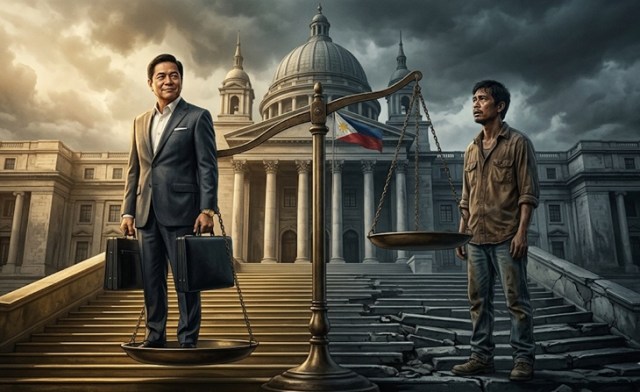
Inequality, institutional weakness, and the long struggle to make the rule of law real
By Karl M. Garcia
Few ideas resonate more deeply in the Philippines than the belief that justice favors the wealthy.
It appears in conversations after every corruption scandal, every controversial acquittal, every delayed investigation, every violent incident involving political clans, and every viral case where ordinary citizens seem punished swiftly while influential figures maneuver comfortably through the legal system.
For many Filipinos, the conclusion feels obvious: the poor go to jail, the rich go to court.
And yet the full truth is more complicated than either outrage or cynicism alone can capture.
The Philippine justice system is neither fully functional nor completely broken. It is neither entirely captured by elites nor genuinely equal before the law. Instead, it exists in a difficult middle ground shaped by history, inequality, weak institutions, democratic contestation, and uneven state capacity.
Justice in the Philippines is not absent. But it is profoundly unequal in accessibility, speed, consistency, and survivability.
That distinction matters because it explains why frustration persists even when institutions occasionally work.
Justice as a lived experience
Most discussions about justice focus on legal theory: constitutions, rights, statutes, courts, and procedures.
But ordinary people experience justice differently.
Justice is experienced through:
- how police respond,
- whether cases move,
- how expensive legal action becomes,
- whether witnesses feel safe,
- whether the poor can defend themselves,
- whether victims are heard,
- and whether powerful people appear accountable.
For many Filipinos, the system feels less like a neutral institution and more like a maze whose difficulty changes depending on social class.
A wealthy defendant may secure elite legal counsel within hours. A poor detainee may wait years before trial while relying on an overloaded public attorney.
A corporation may litigate environmental or labor disputes indefinitely. A small farmer may abandon a legitimate claim because transportation costs alone become unbearable.
A politically connected figure can survive prolonged legal warfare. An ordinary citizen may already be economically ruined before a verdict arrives.
Thus inequality in justice is not always about explicit corruption. Often it is about unequal capacity to endure the process itself.
Colonial origins and elite continuity
The roots of this imbalance are historical.
The Philippines inherited deeply unequal social structures from centuries of colonial rule. Spanish colonial administration concentrated land ownership and local authority among principalia families. American colonial governance introduced democratic institutions but largely preserved elite economic dominance.
After independence, electoral democracy expanded faster than social redistribution.
The country developed competitive elections, constitutional frameworks, and formal legal equality without fully dismantling entrenched concentrations of wealth and political power.
As a result, Philippine democracy evolved within a society where economic elites retained enormous influence over:
- land,
- media,
- local politics,
- business networks,
- campaign financing,
- and in some areas, law enforcement itself.
This does not mean courts are merely puppets of oligarchs. That simplification misses reality.
Rather, it means institutions operate within a society already shaped by unequal power relationships. Over time, those inequalities inevitably affect access to legal protection, representation, and influence.
Why the poor fear the process itself
For wealthy individuals, the legal system may be frustrating. For poor Filipinos, it can be terrifying.
The costs begin immediately:
- transportation to hearings,
- notarization fees,
- document requirements,
- missed workdays,
- attorney expenses,
- police interactions,
- bureaucratic complexity,
- intimidation by officials,
- and uncertainty about rights.
Even filing complaints can feel intimidating in communities where local political networks dominate everyday life.
Many poor citizens avoid pursuing justice altogether because they assume:
- they cannot afford it,
- the system will not protect them,
- powerful individuals may retaliate,
- or the process will simply consume years without resolution.
In this sense, inequality in justice is partly psychological. When citizens stop believing institutions can protect them fairly, rights become theoretical rather than practical.
A constitutional guarantee means little if ordinary people believe invoking it is dangerous or futile.
The role of delay as structural inequality
One of the most overlooked forms of injustice in the Philippines is procedural delay.
Cases lasting years or decades are not rare. Court congestion remains severe. Judges manage overwhelming caseloads. Public prosecutors are stretched thin. Public attorneys handle impossible workloads. Investigations often suffer from inadequate forensic capability and staffing shortages.
This creates a system where time itself becomes a weapon.
For affluent litigants, delay can be strategic. For ordinary citizens, delay can be devastating.
A corporation can survive ten years of litigation. A laborer fighting wrongful dismissal may not survive ten months without income.
A political dynasty can absorb prolonged controversy. A grieving family may exhaust all emotional and financial resources before reaching resolution.
Thus delayed justice becomes unequal justice even without direct bribery or overt interference.
The process favors those with greater endurance.
Why high-profile cases damage public trust
Public trust in justice systems is shaped less by ordinary cases than by symbolic ones.
When influential individuals appear insulated from consequences, the psychological impact extends far beyond the specific case itself.
Each controversial acquittal, delayed corruption trial, suspicious plea bargain, or unresolved political killing accumulates into a larger national narrative: that accountability weakens as power increases.
Even when courts follow legal procedure correctly, public confidence may remain low because the broader pattern appears unequal.
This creates a dangerous feedback loop:
- Citizens lose trust in institutions.
- Cynicism spreads.
- Conspiracy thinking increases.
- Faith in due process declines.
- Public anger shifts toward emotional or extrajudicial solutions.
Once trust erodes deeply enough, every legal outcome becomes politically suspect regardless of merit.
The temptation of strongman justice
When formal institutions seem weak, many societies become vulnerable to “strongman justice.”
Citizens begin prioritizing speed over due process. Harshness becomes confused with effectiveness. Extrajudicial methods become normalized. Legal safeguards are portrayed as obstacles rather than protections.
The Philippines has repeatedly experienced this tension.
Periods of public frustration over crime, corruption, and institutional weakness often produce support for leaders who promise immediate action unconstrained by procedural limitations.
This sentiment is understandable. But history shows its dangers.
A justice system weakened in the name of efficiency rarely remains selective forever. Once due process erodes, protections weaken for everyone—including ordinary citizens.
The challenge is that many Filipinos simultaneously fear both:
- weak institutions,
- and abusive institutions.
This dual fear explains much of the country’s political volatility.
Media, spectacle, and unequal visibility
Justice in the digital age is increasingly mediated through visibility.
Some cases receive enormous national attention. Others disappear entirely.
Wealthy individuals may use media influence, public relations strategies, or online networks to shape narratives. Meanwhile, marginalized victims without visibility may struggle to gain attention at all.
Social media has democratized exposure in important ways:
- videos can go viral,
- abuses can be documented,
- independent journalists can investigate,
- and public pressure can force institutional response.
But it has also created new problems:
- trial by publicity,
- misinformation,
- selective outrage,
- partisan interpretation,
- and emotionally driven judgment detached from evidence.
Online outrage sometimes compensates for weak institutions. But outrage alone cannot replace institutional legitimacy.
A democratic society still requires functioning courts, evidence standards, and procedural fairness.
Otherwise justice becomes performative rather than reliable.
Corruption is real—but capacity also matters
Public discussions often assume every institutional failure results from corruption.
Corruption is undeniably serious in the Philippines. But not every failure stems from malicious intent.
Many problems emerge from weak state capacity:
- understaffed courts,
- poor digitization,
- inadequate police training,
- outdated evidence systems,
- overloaded prosecutors,
- insufficient public defenders,
- weak witness protection,
- and fragmented bureaucracy.
A weak state creates opportunities for corruption because institutions lacking efficiency and transparency become easier to manipulate.
This distinction matters because anti-corruption rhetoric alone cannot solve systemic dysfunction.
Even honest institutions can fail if they are under-resourced, overloaded, or poorly designed.
Real reform therefore requires both:
- ethical accountability,
- and institutional modernization.
Why the middle class feels increasingly cynical
The Philippine middle class occupies an uncomfortable position within this landscape.
Many middle-class Filipinos pay taxes consistently, comply with regulations, and support institutional order. Yet they often feel neither protected like elites nor socially prioritized like the poorest sectors receiving targeted assistance.
This creates resentment toward unequal enforcement.
Traffic laws may apply strictly to ordinary motorists while politically connected convoys bypass rules. Bureaucratic penalties may burden compliant citizens while large-scale violators negotiate exemptions. Administrative inefficiency consumes time and income disproportionately from working professionals.
Over time, many citizens begin feeling that systems punish compliance more than power.
This perception is socially dangerous because democracies rely heavily on voluntary trust and cooperation from the middle sectors.
The judiciary remains imperfect—but important
Despite legitimate criticism, it is important not to collapse into total institutional nihilism.
The Philippine judiciary has repeatedly demonstrated moments of independence. Courts have ruled against administrations. Journalists continue exposing abuses. Civil society organizations challenge powerful actors. Human rights groups pursue accountability. Some corruption prosecutions succeed despite political pressure.
These victories may feel inconsistent or insufficient. But they indicate that democratic space still exists.
This is an important distinction from fully authoritarian systems where institutional resistance disappears entirely.
The Philippine system is better understood as contested rather than completely captured.
Different factions, interests, reformers, opportunists, activists, and institutions continuously struggle over its direction.
The anti-dynasty question
Any serious discussion about justice eventually encounters the issue of political dynasties.
Local political concentration affects:
- policing,
- prosecution,
- regulatory enforcement,
- public contracting,
- and administrative appointments.
In some regions, political, economic, and familial power overlap so extensively that institutional neutrality becomes difficult to sustain.
This does not mean all dynasties are uniformly corrupt or abusive. Some govern competently. Others maintain genuine local support.
But structurally, concentrated political continuity increases the risk of institutional dependency and reduced accountability.
The unresolved constitutional issue of anti-dynasty legislation therefore remains deeply connected to justice reform.
Economic inequality and legal inequality reinforce each other
The justice problem cannot be separated from broader inequality.
Extreme wealth concentration affects:
- access to education,
- quality legal representation,
- political influence,
- media reach,
- lobbying power,
- and social protection.
Meanwhile, weak justice systems discourage investment, weaken entrepreneurship, and reduce public trust.
Thus economic inequality and legal inequality reinforce one another in a cycle: wealth shapes institutional access, while unequal institutions preserve wealth concentration.
Breaking this cycle requires more than moral outrage. It requires long-term institutional engineering.
What meaningful reform would actually require
Real justice reform is less glamorous than political speeches suggest.
It requires sustained investments in:
- judicial modernization,
- digital case management,
- forensic capability,
- police professionalism,
- witness protection,
- public legal aid,
- prosecutor staffing,
- prison reform,
- anti-corruption transparency,
- campaign finance regulation,
- and civic education.
It also requires cultural reform: a society that values institutions enough to improve them rather than merely exploit them.
This is difficult because distrust itself weakens reform momentum.
Citizens who believe institutions are hopeless become less willing to invest emotionally or politically in fixing them.
The danger of total cynicism
Perhaps the greatest threat facing Philippine democracy is not merely corruption, but normalized hopelessness.
When people conclude that:
- all politicians are thieves,
- all courts are compromised,
- all laws are selective,
- and all institutions are fake,
then democratic legitimacy slowly collapses.
At that point, societies become vulnerable to:
- authoritarianism,
- populist vengeance,
- disinformation,
- political tribalism,
- and extrajudicial thinking.
A democracy cannot survive if citizens no longer believe lawful accountability is possible.
Justice in the Philippines remains unfinished
So, is justice only for the rich in the Philippines?
No—but wealth, power, and connections undeniably shape legal outcomes, institutional access, and procedural endurance in ways that disadvantage ordinary citizens.
That reality is visible enough that denying it would sound detached from lived experience.
At the same time, claiming the entire system is hopeless ignores the many Filipinos inside institutions—judges, lawyers, journalists, investigators, civil society advocates, and ordinary citizens—who continue struggling to preserve accountability under difficult conditions.
The Philippine justice system today reflects the broader condition of the nation itself: democratic but unequal, functional yet overloaded, resilient yet fragile, hopeful yet deeply mistrustful.
Justice is not absent in the Philippines. But it remains uneven, delayed, contested, and unfinished.
And perhaps that is the country’s central challenge: not merely creating laws, but building a society where ordinary people genuinely believe those laws belong to them too.
Comments
45 Responses to “Is Justice Only for the Rich in the Philippines?”Trackbacks
Check out what others are saying...-
 Case Notes: Three Supreme Court Rulings and the Numbers Behind the Legal Hybrid – On The 8 Spot says:
 […] years of litigation, while a worker fighting wrongful dismissal may not last months without income (“Is Justice Only for the Rich in the Philippines?”). In “Too Many Lawyers, Too Little Justice” (January 2026) he links court congestion to […]
-
[…] not alone in worrying about trust. Karl Garcia argues in “Is Justice Only for the Rich in the Philippines?” that when citizens stop trusting institutions, every legal outcome becomes suspect whatever its […]


Terrific review of the Philippine pseudo-justice system where the entitled get privilege and the poor get treated like animals. The police do the easy work as thugs and not the hard work of intellectual justice, CSI, and investigations that exclude privilege from the process. Filipinos need to assign the same dignity and respect to the poor and imperfect that they assign to sports stars or dynasts, then justice will be possible. Unfortunately, the poor and struggling like to see others suffer, as they have suffered, so the dignity of being human seems beyond the reach of almost all. As the Philippines gets richer and smarter, maybe this can change. But I think it will be a long arduous trek toward real justice.
“Unfortunately, the poor and struggling like to see others suffer, as they have suffered, so the dignity of being human seems beyond the reach of almost all. As the Philippines gets richer and smarter, maybe this can change.” – JoeAm
Insightful observation of the Filipino. I do pray that we get richer and smarter and bring about change in ourselves.
I think the richer part is happening, the smarter part is in reverse around the world but maybe AI will drive us more to facts and sense. My wife paid a visit to her hometown recently, a fishing village along the coast of Leyte that used to be a scruffy bunch of wooden shacks where people were hanging on for dear life. Now the homes are hollowblock and the signs of money from OFWs and foreigners are definitely there. It’s taken 15 years to go from impoverished to getting by. Cebu is for sure rich. The amounts of money there are staggering, mostly from businesses. Tourism, foreigners (from everywhere, especially China), BPOs, malls galore, Mactan stuffed with resorts. The Philippines has pockets of success and quiet riches and intelligence. I think the nation is emerging from its century of abuse.
“My wife paid a visit to her hometown recently, a fishing village along the coast of Leyte that used to be a scruffy bunch of wooden shacks where people were hanging on for dear life. Now the homes are hollowblock and the signs of money from OFWs and foreigners are definitely there.” – JoeAm
Sounds great. I’m curious, how does your wife feel about the transformation of her hometown?
She’s pleased.
I hope your wife is not livid! very recently violence has visited a school in tacloban city with 3 students shot dead. in cavite, students were stabbed too. I do hope philippines will not be live in united states where students have to pass by a metal detector door before they can enter school.
there is nbi inquiry as well as a senate inquiry. very unusual for shooting to happen at school here in our country. kids here should not have access to gun at all!
“Citizens begin prioritizing speed over due process”
LOL
In my experience, there is no due process. NONE. Therefore, strongman justice is the only option people have.Is that really true? In my experience: YES. Several court cases in my direct surrounding and none was concluded…. Justices bought who are stalling the cases, complaints thereof stalled in Manila. Even a simple straightforward adoption case took 6 years and several supporting payments.. Wife battering case stalled indefinitely, a murder case deliberately botched, another murder case without punishment. A land grabbing case already ongoing for decades. Not a single example of justice served, not even in a long, long time.
Citizens need to enforce their own justice. There is no other option. And it is the fear of people sitting in the executioners seat which keeps society somehow running.
After a year’s experience working in planning and preparing / validating the municipal plans, I can say that I have not seen a single law (not ONE) implemented and not a single complaint being actioned upon, not a single court case involving land, education, medical, planning, permits having been resolved.
What other options do citizens have but to revert to violence?
Oh, there are other options. There is a police force which is (in spite of anything else) reasonable and is prepared to argue. There are the barangay captains who resolve most of the conflicts, there is the inbred decency and patience of the common people. And there is an astonishing capability to accept injustice and find ways around it, through bribes, relations, talks, patience…
But justice as a system?Forget it.
Can it get better? Why would it? ALL people in charge use the system to their advantages. Whole families (dynasties) are involved in keeping the status-quo.
Thanks Pablo for your very pragmatic suggestions to address a very frustrating situation.
As a disclosure, our family had to endure a lenghty trial of a loved one.
maybe we should say something about the public defender’s office attached to our dept of justice. it provides free legal service to the poor and the indigents. like what public defender atty persida acosta has previously done: defended the poor who cannot afford legal representation against a giant pharma company whose vaccine against malaria (dengvaxia?) has killed a few kids. the parents blamed the vaccine for killing their kids. it was quite an event resulting in the vaccine being banned in our country. yet in other country, the vaccine is well received and deemed safe.
I agree. When the Corporal write about ACLU, I tolld him we got PAO, and I also mentioned in the current esay that they are spread to thin and overloaded.
PAO always said, put your case early on so you can be ticketed and put on the waiting list. have patience and your turn will come. same thing in the public hospital. if you need transplant, you’ll be put on the waiting list until an organ donor can be found.
dont be put off by what PAO said that they are overloaded and spread thin. they have a number of accredited lawyers employed for the purpose of giving free legal aid to the poor, they have big budget year in and year out. and the bad news? if PAO’s budget is not used up or liquidated within a certain time, the money will go back to the kaban ng bayan. to be divided among upper echelon public servants as work bonus!
Thanks for that KB
Many thanks Joe. On the part where the struggling wants many others to struggle with them is so true, it can be seen in labor struggles and at the worst, arm struggles.
arm struggles? I know you mean armed struggles but I just thought of bunong braso, arm wrestling.
anyhow thanks for a very encompassing article which has SO many facets, almost too much for a Monday morning with work from home starting soon..
1) My father wrote something I vaguely remember about a movie titled “Sa Iyo ang Batas Akin ang Katarungan” as embodying the way many masa think about justice in the Philippines – “the law is on your side, justice is on my side”. Turns out the movie is from 1988 starring Bong Revilla and most important I think that was the time my father was part of MTCRB and could watch movies for free, but anyhow..
..I recently saw previews of Sigabo starring Coco Martin and wondered how his roles have changed and how that reflects what Filipinos like to see (popularity is an index for striking a nerve in the people): Ang Probinsyano as someone who still tries to solve issues of justice within the state system even as it is flawed, Batang Quiapo as someone who is “criminal” on paper but has a deep sense of justice and even ends up as Mayor of Manila in the end – and now with Sigabo you have the character of Coco Martin playing someone who is from the street who was in jail but is tapped by an agent of the law played by his love team partner Julia Montes, who plays a special forces cop or something like that.. so in the end it is two who are part of both street and state who are fighting a system that is flawed at all levels.. but I guess what sells best to the Filipino public are dreams just like FPJs original Batang Quiapo was one.
2) The Hanns-Seidel foundation from Bavaria co-funded and supported programs to modernize the PNP and the DOJ during PNoy’s time. Discovering that there were these programs (which included the 2014 reform of the Penal Code by Leila de Lima which never pushed through, and work on improving forensics with trainers from the Bavarian State police sent to PNPA) were what made me believe that PNoy’s admin was really at least trying to change something.
Of course an effective justice and police system that works and is trusted by the people is a great thing. The more I found out about how messed up things are in the Philippines, the more I realized that it is a hard thing to achieve over there. A working class man accused of something here will in MOST cases be allowed to stay free without posting bail if he has a regular job and therefore is not a flight risk, in the Philippines he can rot in jail literally.
The average case I was told will take 6 months to a year over here. Filipinos watch K-Dramas and see that regularly cases are solved quickly (in a legal system based on penal and civil codes adopted from French and German models by the Japanese and passed to Korea during occupation) but probably think it is unreal like police in K-dramas come in minutes when called. Well I know this stuff is real over here in Europe for both police and justice systems.
3) of course justice in never fully just even in very modern systems, and the default of human nature is to seek revenge if justice is denied. Look up Marianne Bachmaier who shot the alleged murderer of her daughter in court back in 1981. And what pablonasid mentioned about barangay captains helping solve most conflicts made me think of how notoriously litigious some German neighbors can be and how there are attempts to put some of that into voluntary mediation..
Sorry about the arm struggles. Arm wrestling..LOL
this may not have something to do with arm struggle, but it gives me much pleasure to see trouble maker turkiye got booted out (eliminated) of fifa world cup 2026! haiti is out! tunisia is out! outplayed, outclassed and sent home packing. ayan, inirapan tuloy ako ng kapitbahay ko, turco pala siya!
Good to know that yoy follow the World cup.
Here in the subdivisions we have mediators and the security guards and the security committee acts as barangay first, if it is not resolved then it reaches the barangay.
On swift Justice.
I have already disclosed here in tsoh that my late dad had a lengthy case and it after he got aquitted just less than two years, he pased away.
I recall that the judge denied their requests for dismissal because they had a right to speedy trial. Just missing my dad right now.
Sorry for your loss, Karl. I had not heard of this before.
On the subject of the legal process, isn’t the Leila de Lima case a classic case of what is wrong with the Philippine justice system?
Thanks CV.
I think the why fix it if it aint broke should be transformed to why fix it if you are not a fixer. Half joke.
Yes, Leila Delima is another or The example.
If the happy fool is to rise, he needs to not be content that he is not a fixer. He needs to find a fixer. In western culture: “Where there is a will, there is a way.”
I have a joke for that courtesy of the movie Greedy: If there’s a will, there are relatives.
Thanks CV, pag gusto may paraan, pag ayaw maraming dahilan.
Karl,
I am reminded of the 1967 case of Maggie de la Riva, who was raped by four men who belonged to the elite class of the Philippines. This was all probably before you guys were born. The accused were convicted in 4 months and sentenced to death. The case went to the Supreme Court in 1971 and the conviction was upheld. Three of the 4 were executed in May 1972. The fourth apparently died by drug overdose.
Marcos, Sr. was president during this period. In September of 1972, he declared Martial Law. I wonder what the justice system was like when the country was under Martial Law? I took a peek by checking with Gemini. It was a system Trump would definitely embrace.
I watched the movie version.
There are quick cases but usually they get the accusation of “fall guys” and ” the real culprits are still free” stuff.
Did the movie version make you think/reflect about the justice system in the Philippines?
Yes.
A colleague of my sister, when she was in the restaurant biz for a short while was abducted and abused sexually and was murdered, I have my share of horror stories close to home.
Karl, in the context of your essay on justice, I brought up the cases of Leila Delima and Maggie de la Riva. There is a 3rd case(s): The Flood Control project. I believe that there have been investigations (by the Marcos, Jr. created Independent Commission for Infrastructure), identifications of possible criminals, and even arrests…but where is Justice there?
A possible 4th case to look at is the assassination of Ninoy Aquino, but that be back in the Martial Law period of Marcos, Sr. Probably no reason to go there.
Here’s Claude’s summary of proceedings.
Philippine Flood Control Corruption Scandal — Current Case Status (as of June 25, 2026)
Background: The scandal centers on ghost, unfinished, or substandard flood control projects funded through the Department of Public Works and Highways (DPWH), with the Senate Blue Ribbon Committee and the now-disbanded Independent Commission for Infrastructure (ICI) estimating roughly ₱1.9 trillion (US$33 billion) spent over 15 years, more than half allegedly lost to corruption . The ICI concluded its work and transmitted findings to the DOJ/Ombudsman in March 2026.
Key cases, by individual
Sen. Jinggoy Estrada — facing the most advanced case:
• Charged with plunder over an alleged ₱573 million in illicit payouts; arrest warrant issued June 1 by the Sandiganbayan’s Fifth Division . He’d already posted bail on a separate graft charge days earlier, and an earlier graft warrant was issued May 29 . Co-accused include former DPWH Secretary Manuel Bonoan and several DPWH engineers . He surrendered June 1 and is now detained; Bonoan has since been partially granted hospital detention.
• The case stems from claims he received a P355-million kickback (a 30% “SOP” cut) from 2025 Hagonoy and Malolos flood projects in Bulacan .
Martin Romualdez (former House Speaker):
• PHDO issued April 22 over alleged plunder, bribery, graft and money laundering tied to roughly ₱56 billion in kickbacks .
• His motion to lift the travel ban was denied June 1 (made public June 3)  — the court cited flight risk given his resources and capacity for international travel .
• No formal charges filed yet, but the Ombudsman says plunder is a complex crime requiring step-by-step document and witness development before filing .
Sen. Francis “Chiz” Escudero:
• PHDO granted April 27; he faces plunder, graft and bribery complaints tied to Centerways Construction, owned by his close friend/campaign donor Lawrence Lubiano . A former DPWH undersecretary alleged he delivered a ₱160-million kickback to a Ngu businessman, also Escudero’s friend .
• No formal indictment yet as of late June.
Zaldy Co (former Ako Bicol congressman, ex-appropriations chair):
• Charged with graft/malversation Nov. 19, 2025; declared a fugitive by the Sandiganbayan (upheld March 6, 2026) . Court ordered seizure of at least 16 of his properties March 9 to secure ₱215 million in potential civil liability . DILG sought an Interpol red notice against him in April . He and other Sunwest board members remain at large .
Bong Revilla (former senator) — furthest along procedurally:
• Surrendered Jan. 19 over an alleged ₱92.8 million ghost project in Pandi, Bulacan . Entered not-guilty pleas in both the graft case (Feb. 9) and malversation case (Feb. 16) , then filed for bail Feb. 20 .
Eric & Edvic Yap (Benguet rep. and brother): PHDO issued March 3 after AMLC found Silverwolves Construction transferred ₱6.1 billion into their personal accounts .
Other contractors/officials: Sarah Discaya and Maria Roma Rimando arrested Dec. 18, 2025 over a ₱96.5-million ghost project in Davao Occidental ; several DPWH figures (Bernardo, Alcantara, Opulencia, Santos) turned state witnesses in January 2026 ; eight accused in the Oriental Mindoro graft case pleaded not guilty .
Broader fallout
• The 2026 budget cut flood-control allocations from ₱346.6 billion to ₱274.9 billion .
• A new protest, the White Ribbon Movement, is planned for June 28, 2026 at EDSA — indicating public pressure remains active even as cases crawl through the Sandiganbayan.
Bottom line: Estrada is the only major political figure formally jailed/charged with plunder so far; Romualdez and Escudero remain under travel bans and preliminary investigation without formal charges; Co is a fugitive; Revilla’s case is furthest into trial proceedings.
Thanks for the recap on the Flood Control Scandal case. In the context of Karl’s topic, Is Justice only for the Rich, I think the best we can do is not hold our collective breath.
I have more essays for the justice system scheduled in a few weeks
I avoided the current goings on directly though it was written way back, I tried tp insert juvenile justice but only what fits.
I also have an essay for Ninoy on august.
More as a tribute.
My flood control essay is more solutions based.
Not about the corruption.
Sad. Unfortunately recently a tv series, Blood vs Duty showed an almost similar scenario, a bullied student procuring a gun and targetted those who bullied him.
this is bad, very bad!
https://www.abs-cbn.com/news/regions/2026/6/23/tacloban-school-shooting-planned-shooter-got-gun-from-policewoman-aunt-pnp-0858
Oh my!
It wouldn’t be shocking if the two boys were radicalized on social media into the “incel” subculture and subsequently got “black-pilled.” These incels believe that handsome men and beautiful women are the to blame for their lack of relationship success, spend way too much time terminally online, and view the world as a “game” where other humans are non-player characters (NPCs).
https://en.wikipedia.org/wiki/Incel
Algorithms need to be regulated. Governments around the world are starting to view algorithms as a national security issue and are regulating according. The US actually lags in this regard, but center-right/center-left politicians waking up to the problem. The Philippines is a sovereign nation and does not need to wait for signals from others before pursuing sound policy… I don’t think much will be done though when social media companies have “free” zero rating partnerships with all the major mobile telcos.
Increasingly looks like a new incident of incel violence:
One of the boys wore a black t-shirt I vaguely recognized, which turned out to be the same style of t-shirt one of the 1999 Columbine school shooters wore. Why would a young Filipino boy know about KMFDM, a relatively obscure late 1980s-early 1990s German industrial metal rock band? Why would he wear on his person a “band merch” t-shirt of that now even more obscure band (that he must have had a replica made of)?
https://www.pna.gov.ph/articles/1277916
I saw comments from Leyteños (unverified) that the two shooters purposely shot at female students, ignoring the males except for the one heroic boy who died defending his classmates. The verified information state that 2 deceased victims were female and 1 was male, while the gender of the injured victims were not yet released.
Already Philippine national commenters are claiming the shooting to be solely an incident of bullying. As we know Philippine schools can be quite vicious in bullying but was the bullying the cause of the boys searching out incel material and nihilistic subcultures online, or was the bullying the result of the boys being creepy weirdos after ingesting such stuff? From the police station photos, I don’t know how to put it other than the boys look really creepy and abnormal as hell.
Incidentally I have been around this “incel” culture tangentially since it’s embryonic stage. A lot of the most toxic stuff on the Internet originated from the message board 4chan which had started in my 2nd year of college. In the distant past I personally knew the founder of that site, who apparently was later linked to Epstein. “Gamergate” in 2014 was an offshoot of 4chan toxicity, unleased a new wave of misogyny, and turbocharged the rise of Duterte, Brexit, and Trump. Yes, a lot of Filipino gamers were involved in that online fracas. Yes, Russia directly took advantage of the growing nihilism and misogyny of young men across the Western and Western-adjacent world (including the Philippines) as a delivery mechanism for the authoritarian wave that has been with us for more than a decade. To think the Philippines, which due to zero-rated social media developed one of the highest screen times in the world, would not be a major nexus of online toxic subcultures would be overlooking the obvious. I think the only way out of this problem is aggressive regulation of social media companies and algorithms. These companies are no longer “American;” the companies are transnational and are run by tech oligarchs who think of themselves as above entire governments.
This is a super wakeup call. One news lastnight was one kid ran away from home juat because his or her parents do not want him or her to have a cellphone.
I hope whatever hearings this produce won’t be another debate of Senators Robinhood Padilla and Kiko Pangilinann on lowering the age of crominal lliability to 12 or whatever number.
Again the OFW culture was mentioned.
It is very multi-faceted.
Thanks for your broad analysis of the situation, Joey.
The thing I mentioned about news about children running away from home just because parents do not want them to have a cell phone, this was just after the Mayor suggested for parents not to give cellphones to minors, ( paraphrased).
Now as to the toxic social media now becoming an insecurity inducer to those affected, my self included at times.
But posting some daring or even crazy stupid stuff l, just to have likes.Sad reality. How do you stop that?
As to your suggestion of regulating socmed and algorithms, how do we do that when socmed and algorithm can be used in elections, here there and everywhere?
I think liberal democracies all over the world are waking up to the issue of regulating transnational corporations. Some of these corporate entities wield more financial power than many countries have in their entire GDP. The previous assumption was that the country-of-origin would be the main regulator but the affected countries need to keep in mind their own sovereign authority. Australia, Indonesia and Malaysia are on the forefront of this. In the US, individual states led by California are also enacting social media bans for children.
Important to recognize that in a capitalist system, actors respond to incentives and right now transnational corporations don’t have much of an incentive to change. Same with alternative green energy; if consumers and lawmakers demanded alternatives and were willing to pay higher costs the fiducially responsible action for an “oil company” to do is to invest in green alternatives. People like to complain but don’t want to do the hard work.
I don’t know, there has to be some kind of tipping point. Humans tend to go from nonaction to massed action, seemingly turning on a dime. The explosion of civic emotion that led to People Power is an example of this and is still studied by political sociologists to this day as a key example of the phenomenon.
Here in the US data centers have been standing in as an actionable proxy target against transnational corporations led by tech bros and their algorithms that divide us. It does not matter what state or community, red or blue, people just hate data centers for seemingly no reason. The underlying reason is people feel a sense of unease at the level of control algorithms have over our lives. The same algorithms that led these two young boys down a dark path.
If you recall, like Joe I criticized the plan to do a digital tax, which is stupid since it would reduce services. Rather companies need to be given financial incentives and disincentives for how their behavior affects society.
Again many thanks.
I think social media has age limits but minors are still able to create accounts.
As to my son,when he was on high school, they needed google meets, and he needed to have an alternative chat group and his classmates already had fb messenger I think, and if he does not create an acct, he would be litterally left out. Not just a fomo thing.
Just an example.
ps
Before I told you he does not like to try llm, my wife was able to convince him to use it a ittle even ai preview in google, becaue, it is not all that bad for school kids.
Government regulation provides the legal framework for civil and criminal punishment of corporate wrongdoing. Teachers may be another layer of defense. But ultimately it has always been the parents of the child that need to monitor and raise their own children. From the looks of it those two boys in Tacloban were very entitled and spoiled, at least by the aunt who had the massively incorrect judgement of letting her nephew play with her PNP service weapon.
Haha it seems like your son has a good head on his shoulders and figured it out about the toxicity of social media. There are many other pursuits in life that is more fulfilling than comparing one’s self to fake versions of others online. I’m sure your son will do well in college.
Thanks now my son must learn to juggle his extra curriculars because he joined the school choral, and they just won second place in a recent event.
About parenting and the ofws.
Just recent news of a jobfair for seafarers have same old anywhere but here respones when interviewed.
And recently Romualdez blamed the ofw phenomenaamong other laundrylist of reasons why the incident happened. Chicken or egg?
As to watching violence, and bans.
Voltes V all over again?
Actually, it was a sort of preventing sedition.
There are lots of violence in tv before and after Voltes V.
Now sone schools are confiscating safety scissors.
What’s next?
pen and pencil, which can blind you even by accident.
Cutters?
Sorry but remeber Oplan tambay, Curfews where a lot of first time offenders were herded and jailed and some died in jail
If you jail the young, you need to build new facilities, otherwise you mix them with the big bads earlier in life.