Participation Without Power
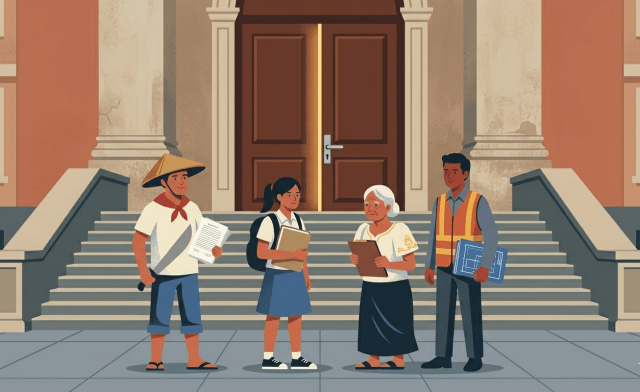
Why Philippine Local Governance Still Struggles to Turn Voice into Influence
By Karl Garcia
Across the Philippines, participation has become one of the most celebrated principles of governance. Barangay assemblies, local development councils, civil society representation, public consultations, and participatory planning mechanisms are now deeply embedded in the country’s decentralization framework.
On paper, the architecture of inclusion is extensive.
Yet a recent baseline study by the Philippine Institute for Development Studies (PIDS) highlights a persistent problem: the Philippine system has become increasingly effective at involving citizens in governance processes, but far less effective at giving them meaningful influence over decisions.
That distinction—between participation and power—lies at the heart of the country’s democratic challenge.
Participation Is Not the Same as Influence
The Philippines’ decentralized governance system, established through the 1991 Local Government Code, formally requires citizen and civil society organization (CSO) involvement in local decision-making.
Most local government units comply. Meetings are held. Consultations occur. CSOs occupy designated seats in local development councils.
But participation often remains procedural rather than consequential.
Citizens may be present in governance spaces, yet key decisions on priorities, budgets, and implementation frequently remain concentrated within executive offices, political coalitions, and technical planning bodies.
The result is a system that accommodates participation without substantially redistributing authority.
Where the System Falls Short
The PIDS framework identifies three dimensions of participation: space, engagement, and results.
Space Exists, but Within Limits
Many LGUs have successfully created formal channels for participation. However, access to the room is not the same as influence inside it.
Control over budgets, technical expertise, administrative procedures, and political networks continues to shape who ultimately determines outcomes.
Participation is permitted, but often within boundaries set by existing power structures.
Consultation Often Replaces Co-Decision
In many cases, stakeholder engagement occurs after priorities have already been defined.
Citizens and CSOs are invited to comment on proposals rather than help shape them from the outset. Participation becomes a process of consultation rather than negotiation.
Public input is heard, but not necessarily incorporated into agenda-setting itself.
Results Remain the Weakest Link
The most significant finding is that participation frequently has little measurable effect on final decisions.
Even active and organized CSOs often struggle to influence development priorities, budget allocations, or implementation strategies.
Participation is present.
Power remains largely unchanged.
Why This Happens
The problem is not simply a lack of political will.
Local governments operate under pressure to deliver projects, meet compliance requirements, maintain political coalitions, and manage limited administrative capacity. These incentives naturally favor actors who already control resources and institutions.
CSOs contribute local knowledge, advocacy, and community legitimacy, but often possess limited leverage within formal decision-making structures.
As a result, participation becomes something to be managed rather than negotiated.
The system broadens consultation while preserving predictability and control.
The Limits of Consultation Democracy
This creates a paradox.
Participatory systems can appear successful even when they have little effect on how power is exercised. Attendance rises, consultations increase, and representation improves, while underlying decision-making patterns remain largely intact.
A process may look democratic without substantially democratizing authority.
This is why many citizens experience governance as something they can comment on but rarely shape.
The issue is not the absence of participation.
It is the weak conversion of participation into influence.
Should the Philippines Adopt Swiss-Style Direct Democracy?
This raises a broader question: does the Philippines need stronger forms of direct democracy?
The appeal is understandable. Switzerland is often cited as a model because citizens can initiate constitutional amendments, challenge legislation through referendums, and directly approve major policy decisions.
Its strength, however, is not constant voting. It is the existence of institutional mechanisms that convert citizen preferences into binding political outcomes.
Participation is not merely advisory.
It carries consequences.
By contrast, most Philippine participatory mechanisms remain consultative. Citizens are frequently invited to provide input, but rarely possess reliable tools to compel policy reconsideration or directly alter outcomes.
The gap is not participation itself.
It is institutional leverage.
Why Wholesale Adoption Would Be Risky
Importing Swiss-style direct democracy wholesale would not automatically solve the problem.
Direct democracy requires strong civic education, trusted information ecosystems, administrative capacity, and safeguards against manipulation. Without these foundations, referendums can become vulnerable to misinformation, polarization, and elite influence.
Direct democracy does not eliminate power disparities. It can simply relocate them.
Well-funded interests may dominate campaigns, shape public narratives, and influence outcomes through superior resources.
The challenge is therefore not copying another country’s institutions but adapting democratic mechanisms to local realities.
A More Practical Democratic Evolution
The Philippines may be better served by strengthening the link between participation and decision-making rather than pursuing full-scale direct democracy.
Several reforms stand out.
First, participation must have fiscal consequences. Public input becomes meaningful when it can influence budget allocations, investment priorities, and project implementation.
Second, agenda-setting should be shared. Citizens and CSOs should help define priorities before plans are drafted, not merely react to proposals after decisions have largely been made.
Third, transparency must extend beyond attendance records. Governments should demonstrate how public recommendations affected final decisions and explain why certain proposals were adopted or rejected.
Fourth, people’s initiative and referendum mechanisms should become more accessible while retaining safeguards against abuse.
Finally, local participation should be strengthened in areas where citizens can see tangible results, such as community infrastructure, environmental management, and local development priorities.
The Unfinished Project of Decentralization
Three decades after the Local Government Code, participation has become routine in Philippine governance.
The next challenge is making it consequential.
Decentralization was never meant to be only about transferring authority from Manila to local governments. It was also meant to democratize authority within local governments themselves.
That project remains incomplete.
The Philippines does not necessarily need to become Switzerland. But it does need institutions that transform citizen participation from consultation into influence.
Because democracy is not measured by how often people are asked for their opinion.
It is measured by whether that opinion can meaningfully shape the decision.


The LGUs are mostly captured by dynasts and the peoples’ adoration of them. The shortcoming seems to me not to be of laws, but of peoples’ lack of a sense of power. Or their pragmatic reading that their lives will be shit if they cross the powerful. But then that doesn’t matter either because all local politicians have the management moxie of a carabao. They’re barely competent. The good governance initiative among mayors is the upside. There are a few who get it, and perhaps that will expand. It’s the best approach. Improve competence under existing laws. No need to imagine that a different structure will result in competence. It won’t.
Thanks Joe,expansion of competence is the key.
that reminds me of benhur abalos, supposedly a competent dilg chief who resigned in 2024 to pursue senate seat and lost. his previous job is now taken over by jonvic remulla. lately, president bong marcos has said he wants benhur abalos to take more active part in the government. though as losing candidate, abalos is under a year’s ban from taking up public office, but that did not stop abalos from giving informal and private assistant to government, sans the accoutrements of public office.
leni robredo is also the same, she may not have office in malakanyang, but her political influence, work ethics, and appeal to the masses are widely sought, still.
there are people who are neither noisy nor boisterous in the service of the government, they may not be feted and celebrated as influencers, but they are dependable, can hold their own, upheld our country and keep our country functional and running, when politicians bicker among themselves, trading barbs and innuendos, unable to see each other eye to eye.
Excellent excellent point. Competence and dignity. May there be many many more.
Too much appearance of devolved or direct democracy without guardrails against rule by “mob pressure” is also a bad thing.
Take for example the Bagong Pilipinas Presidential Scholars program President Marcos Jr. announced in May 2026. The scholarship’s stated goal was to relieve young learners and their families of some of the financial burden of the not-so-free “free” public school system: five deserving students from each barangay’s graduating senior high school class, plus five incoming 4th-year college students — ten per barangay — would each receive a ₱20,000 incentive, for ₱200,000 disbursed to every barangay nationwide.
Via Facebook: Bongbong Marcos delivering tablets and school supplies to students in San Juan City, Metro Manila, in support of Bagong Pilipinas Presidential Scholars rollout. (June 11, 2026)
(Note the bashers and accusations of corruption in the comments.)
In a textbook example of the Philippine execution problem, the ₱200,000 is where the program runs into trouble. The money released by the President moved from governors to mayors to barangay captains for distribution. The eligibility criteria sounded reasonable on paper, but no strict, binding rubric was ever issued — “requirements” were left to each LGU’s interpretation only after the captain already had the cash in hand.
Via Facebook: Bagong Pilipinas Presidential Scholars program requirements and eligibility.
A week and a half ago I started hearing grumbling among Filipinos I know, following them attending barangay assembly meetings. Complaining is not so unusual, but I had a feeling their griping had to do with ayuda since even when barangay assemblies are made “mandatory” by the captain, attendance tends to be thin.
The complaints I heard were variations of:
When I questioned them on their deservedness according to the announced criterion, most of the complainers didn’t actually know the program’s rules — they just knew it involved money they felt entitled to a share of. Amusingly, the complainers of course had students who were academic dead-lasters.
Here’s a sample of the complaints. None of these barangays appears to have followed the Presidential directive as written — each LGU improvised its own rule once the money landed:
That’s not a good way to run a national program — doing so not only hands corruption a wide-open door, but basically opens the door for possible corruption. But perhaps the most damning failure IMHO aren’t the captains who played favorites; it’s the ones who didn’t. Faced with no clear rubric and an angry barangay assembly, it appears some captains simply put the question of who should receive the money to a vote or a raffle, splitting the ₱200,000 equally regardless of merit. I guess that’s “democratic participation” in the loosest sense — a program scholarship meant to celebrate and reward the deserving few, leveled down to an equal share for everyone the moment the crowd got a say in it, rule by a mob of undeserveds shouting down the deserved who likely tend to be more quietly hard working in the first place.
Madison would have called such behavior a “faction;” to Tocqueville, an example of the tyranny of the majority in its mildest and most familiar form — no violence, just a crowd of ill-informed citizens driven into a frenzy voting themselves an equal share of someone else’s earned distinction.
Thanks Joey.
OT from MLQ3, not about local politics but national (long read) https://www.thediarist.ph/a-must-lookback-lessons-from-legislators-behaving-badly
fun facts: ABS-CBN actor Paolo Avelino is the great-grandson of Jose Avelino.
Fernando Lopez of ABS-CBN (and Meralco back then) was Marcos Sr.’s VP from 1965-1969.
not really fun: they became enemies later so Marcos Sr. closed ABS and jailed Fernando’s son “Kapitan” Geny Lopez (who rebuilt ABS after 1986)
not fun at all: let us not for once think that the Roman Senate was always dignified. Julius Caesar was actually stabbed to death in its halls.
but also interesting is that the Roman Senate survived over a hundred years under the Goths after the Western Roman Empire had ended.