From Overcrowded Jails to Smarter Justice: Why the Philippines Must Expand Community-Based Sentencing
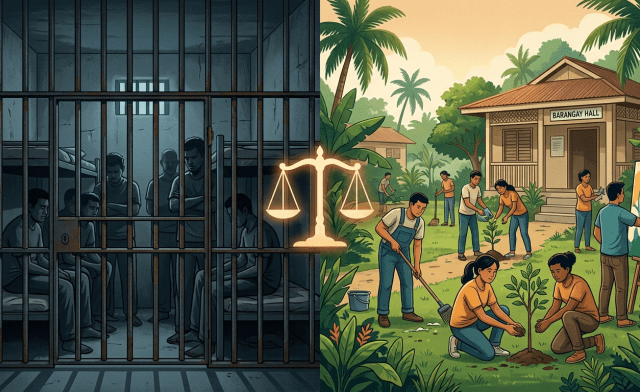
Justice Should Be Measured by Public Safety, Not Prison Population
By Karl M. Garcia
The Philippines has long struggled with a pattern of reactive governance.
Rather than anticipating problems and investing in prevention, we often wait for crises before responding with sweeping enforcement measures. When a problem becomes highly visible, the instinct is to tighten rules, increase arrests, or expand restrictions. Later, when the unintended consequences become apparent, government is forced into another cycle of correction.
We have seen this before.
Campaigns such as Oplan Tambay and Oplan Tokhang reflected an enforcement-heavy approach to public order. Thousands were arrested, many for relatively minor violations. Jails became even more overcrowded, while reports emerged of detainees dying inside congested detention facilities. Whatever one’s views of those campaigns, they exposed an institutional reality: the country’s correctional system was never designed to absorb incarceration on such a scale.
Today, another tragedy risks producing another reactive response. Following the country’s first widely publicized school shooting, some schools have begun prohibiting even children’s safety scissors. One naturally wonders where such thinking ends. If every object that could potentially be misused becomes contraband, do pencils, pens, rulers, and other ordinary classroom tools eventually follow?
This illustrates the difference between proactive, reactive, and corrective governance.
Proactive governance prevents problems before they occur. Reactive governance responds only after a crisis has erupted. Corrective governance attempts to repair the unintended consequences of earlier decisions.
The Philippine justice system increasingly finds itself trapped between reaction and correction.
Instead of asking how to incarcerate more people, we should ask how to prevent crime, resolve cases faster, rehabilitate offenders more effectively, and reserve detention for those who truly threaten public safety.
When Delay Becomes Punishment
Much of the congestion inside Philippine jails consists not of convicted criminals but of detainees awaiting trial.
Court proceedings often take months or even years. During that time, individuals remain deprived of their liberty despite not yet having been found guilty. Administrative delay becomes punishment in itself.
This weakens one of the most fundamental principles of justice: punishment should follow conviction—not precede it.
Meanwhile, overcrowded facilities strain correctional personnel, increase operating costs, worsen living conditions, complicate rehabilitation, and reduce the system’s ability to focus on genuinely dangerous offenders.
The correctional system ends up absorbing inefficiencies created elsewhere in the justice process.
Community-Based Sentencing Is Smarter Justice
Community-based sentencing is often misunderstood as being soft on crime.
It is not.
It is about matching the sanction to the offender.
Violent criminals, organized crime groups, repeat dangerous offenders, terrorists, sexual offenders, and individuals who present serious threats to society should continue to be incarcerated.
But many first-time and lower-risk non-violent offenders can often be held accountable through structured alternatives such as supervised community service, probation, counseling, drug treatment, restitution, restorative justice, vocational training, education, and regular reporting requirements.
These are not acts of leniency.
They are different forms of accountability designed to reduce repeat offending while allowing offenders to remain productive members of society.
Justice should be proportional.
Not every crime requires prison.
Community Service Requires Community Institutions
Expanding community-based sentencing requires more than changing laws. It requires building institutions capable of supervising offenders outside prison walls.
Courts should determine eligibility and impose community-based sentences.
Probation officers should supervise compliance, monitor attendance, and report violations to the courts.
Local Government Units should coordinate meaningful community service projects through their social welfare, environment, engineering, health, agriculture, disaster management, and other local offices.
The Department of Social Welfare and Development can provide social interventions, family services, counseling, and rehabilitation support, particularly for vulnerable individuals, indigent offenders, and juveniles.
Barangays should assist in monitoring participation, identifying community projects, and facilitating restorative justice where appropriate.
Schools, public hospitals, environmental programs, accredited non-government organizations, faith-based institutions, and training centers can provide structured placements that benefit both offenders and the communities they serve.
Police should not manage community service programs.
Their primary responsibility is law enforcement and public safety. They should become involved only when offenders violate court orders or present security concerns.
Community corrections should remain exactly that—community-based.
Decongesting Jails Is More Than Building More
Building additional correctional facilities will sometimes be necessary.
But construction alone cannot solve institutional congestion.
The Philippines must also improve inmate distribution.
Convicted prisoners should be transferred promptly to appropriate correctional institutions according to their security classification, allowing city and municipal jails to function primarily as temporary detention facilities rather than long-term holding centers.
At the same time, digital case management, additional judges, prosecutors, public defenders, and streamlined court procedures can significantly reduce unnecessary detention.
The solution is not simply more jail cells.
It is fewer unnecessary occupants.
Juvenile Justice Shows the Same Principle
The debate over juvenile crime reflects the same challenge.
Calls for harsher punishment often overlook a more important question: what intervention best protects society over the long term?
If overcrowded adult detention facilities already struggle to rehabilitate offenders, relying more heavily on incarceration for young offenders risks reproducing the same failures.
Diversion programs, education, family intervention, counseling, closely supervised community service, and rehabilitation recognize that accountability can take different forms depending on age, maturity, and risk.
Protecting society sometimes means incarceration.
At other times, it means preventing a child from becoming a lifelong offender.
From Reactive to Proactive Justice
Every society must decide whether it wishes to govern proactively, reactively, or correctively.
Reactive governments respond after tragedy strikes.
Corrective governments repair the consequences of earlier policies.
Proactive governments invest in institutions that reduce the likelihood of those tragedies occurring in the first place.
The same philosophy should guide criminal justice.
Police remain indispensable.
Courts remain indispensable.
Jails remain indispensable.
But none of these institutions should become substitutes for strong families, effective schools, mental health services, social workers, community organizations, efficient courts, and rehabilitation programs that prevent crime before it occurs.
A nation cannot arrest its way out of every social problem.
Nor can it imprison its way toward lasting public safety.
Justice as Proportion, Not Expansion
The future of Philippine justice should not be measured by how many jails we build or how many people we incarcerate.
It should be measured by how effectively we distinguish between those who genuinely require detention and those who can safely be held accountable within the community.
Smarter justice means reserving incarceration for those who pose real threats while expanding credible, well-supervised alternatives for appropriate offenders.
Doing so will reduce overcrowding, strengthen rehabilitation, conserve public resources, and allow correctional institutions to focus on their primary mission.
The strongest justice system is not the one that imprisons the most people.
It is the one that prevents crime, protects rights, delivers timely justice, rehabilitates offenders where possible, and reserves imprisonment for when it is truly necessary.
That is not a softer justice system.
It is a smarter one.


Positively brilliant. The injustice of delay. The power and potential of the Barangay as a center of justice and punishment/rehab. Get this to Rep. De Lima. She knows prisons and justice, and will grasp the concept of pushing the broad ACTIONS of justice to the barangays to enliven a sense of justice as a positive social value, and get away from policing and prisons as sticks forever pounded on Filipino backs.
Thanks Joe, will try mentioning her on the twitter post comments.
I had to namedrop you.
Rep. De Lima and I are close in a distant way, thanks to Will. She invited me to visit her in jail but I did not want to risk being “outed”. I wrote the forward to her second e-book, which she published while incarcerated. She is totally focused on no non-sense and well-being of the Philippines. Sort of a female Trillanes but different personality and path.
Yes, Joe thanks for sharing or refreshibg my memory about the foreword dedication.
And continuing my theme of dropping off OT positive information, even if it is from PR news, this article shows the existence of processed ag products in the Philippines (coconut oil), and it illustrates the challenges (covid, high listing fees, and other headwinds.)
https://manilastandard.net/business/314758340/coconut-oil-manufacturer-expands-premium-products.html
I appeeciate the good news
This should help Manila Bay a lot. South Korea assistance. https://www.pna.gov.ph/articles/1278214
Thanks JA! I incorporated it to one of my articles.
A lesser known fact is that more than 2/3 of detainees awaiting trial (persons deprived of liberty or PDLs) are detained under alleged drug offenses. I only found that out due to a friend’s father being detained during the Duterte Drug War. Nearly 10 years later he is still sitting in Mandaue Jail while my friend and two elder siblings have in the meantime all gotten married and had kids themselves. Supposedly the father’s case will finally go on trial sometime later this year.
Then there is also the burden on families of needing to bring food, basic toiletries, and other personal hygiene items to their detained family member. The stigma of children whose parent is detained feel at school.
There should be diversion programs for low level offenses to clear out the prisons. Humans make mistakes. People should be given a chance to show they are capable of reform before being locked up and the key thrown away.
I’ve commented here that the suffering like to see others suffer. So there is little outrage at the horrors of the jail system. The absence of compassion is worth a doctoral study. Social psychology.
The Cycle of Cruelty
When Suffering Becomes a License to Make Others Suffer
By Karl Garcia
One of the more uncomfortable realities in Philippine society is that not all suffering produces compassion. Sometimes it produces resentment. Sometimes it produces indifference. And, in its darkest form, it produces a desire for others to endure the same pain.
This mentality appears in many forms.
A worker who was exploited tells younger employees that they should “pay their dues” instead of demanding fair treatment.
A student who endured hazing or relentless bullying insists that the next batch should experience the same because “we survived it.”
Parents who grew up under harsh discipline repeat the same violence toward their children, believing hardship builds character.
Officials trapped in inefficient bureaucracies sometimes become gatekeepers who make others suffer through the same delays they once experienced.
The underlying logic is simple: I suffered, so you should too.
This is not justice. It is the normalization of trauma.
Psychologists sometimes describe this as the intergenerational transmission of trauma or the cycle of abuse. Pain that is never processed can be reproduced rather than resolved. Victims are not destined to become victimizers, but unresolved hurt can increase the risk of harmful behavior if it is reinforced by culture, institutions, or social acceptance.
The same dynamic can appear in more extreme ways.
Someone who experiences years of humiliation, isolation, or bullying may direct their anger not at those responsible but at innocent people. History shows that some perpetrators of mass violence or random attacks had experienced rejection or abuse, although most people who are bullied never become violent. Bullying alone does not explain such crimes, nor does it excuse them. Violence emerges from a complex interaction of individual, social, and sometimes mental health factors.
This distinction matters because simplistic narratives can stigmatize victims rather than encourage prevention.
Social media has also amplified this cycle.
People who were once publicly shamed often become enthusiastic participants in online pile-ons. Individuals who complain about toxic behavior sometimes engage in harassment when they find themselves on the majority side. Outrage becomes contagious, and empathy becomes conditional.
In the Philippines, there is also a cultural thread captured by phrases such as “kami nga noon” (“we had it harder before”). Instead of asking how society can improve, hardship is treated as an inheritance that must be passed down.
This mindset slows progress.
Every generation should strive to make life better than it was before—not preserve unnecessary suffering as a tradition.
The healthier alternative is not to erase resilience but to redefine it.
True resilience is not proving that others can survive the same pain we did. It is using our own experience to ensure fewer people have to endure it.
A teacher who was once humiliated can create a classroom built on respect.
A manager who experienced exploitation can build a fair workplace.
A parent who grew up with violence can raise children without fear.
A public servant who once suffered from bureaucratic neglect can simplify public services.
Breaking the cycle requires seeing suffering not as a credential for inflicting pain, but as a reason to prevent it.
A compassionate society is not one without hardship. It is one that refuses to treat hardship as something that must be endlessly replicated.
The measure of a nation’s moral progress is not whether every generation can say, “We survived.” It is whether the next generation can honestly say, “Because of those who came before us, we no longer have to suffer in the same way.”
That nails it. The national government can take the lead in the Philippines by recasting its prisons as humanitarian, not barbarian.
Again, dropping off-topic positives all over the place. Bounty is a masterwork of modern corporate development. This may be a PR shine piece, but also lays out their thinking and even use of AI to scan chickens to calculate weight. Hey, Chooks is a great quick meal. Good to know that healthy chickens are in the food chain.
https://insiderph.com/beyond-poultry-building-a-broader-food-ecosystem
Thanks Joe.
I will read it later.
Thanks Joe I scheduled it for July 13th.
I will move it tomorrow July 1.
Exactly!