The Cycle of Cruelty
When Suffering Becomes a License to Make Others Suffer
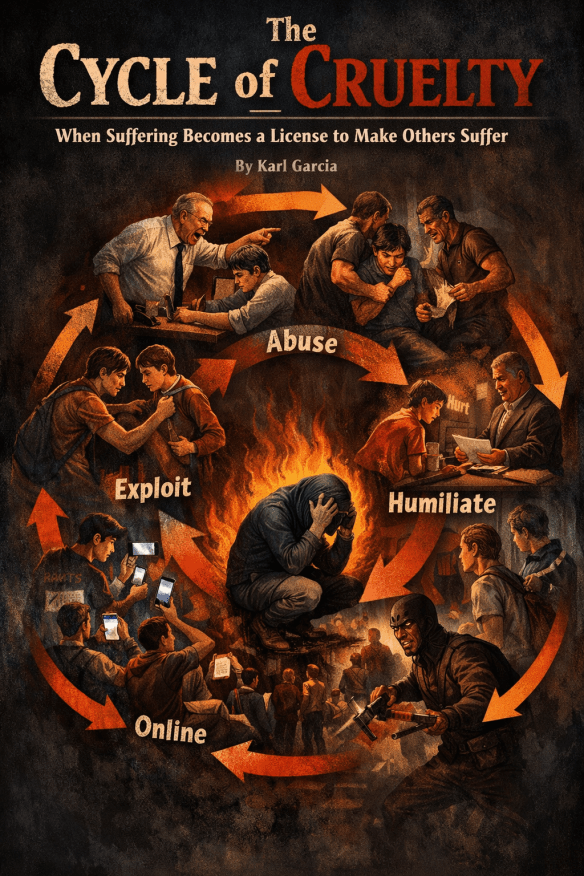
By Karl Garcia
One of the more uncomfortable realities in Philippine society is that not all suffering produces compassion. Sometimes it produces resentment. Sometimes it produces indifference. And, in its darkest form, it produces a desire for others to endure the same pain.
This mentality appears in many forms.
A worker who was exploited tells younger employees that they should “pay their dues” instead of demanding fair treatment.
A student who endured hazing or relentless bullying insists that the next batch should experience the same because “we survived it.”
Parents who grew up under harsh discipline repeat the same violence toward their children, believing hardship builds character.
Officials trapped in inefficient bureaucracies sometimes become gatekeepers who make others suffer through the same delays they once experienced.
The underlying logic is simple: I suffered, so you should too.
This is not justice. It is the normalization of trauma.
Psychologists sometimes describe this as the intergenerational transmission of trauma or the cycle of abuse. Pain that is never processed can be reproduced rather than resolved. Victims are not destined to become victimizers, but unresolved hurt can increase the risk of harmful behavior if it is reinforced by culture, institutions, or social acceptance.
The same dynamic can appear in more extreme ways.
Someone who experiences years of humiliation, isolation, or bullying may direct their anger not at those responsible but at innocent people. History shows that some perpetrators of mass violence or random attacks had experienced rejection or abuse, although most people who are bullied never become violent. Bullying alone does not explain such crimes, nor does it excuse them. Violence emerges from a complex interaction of individual, social, and sometimes mental health factors.
This distinction matters because simplistic narratives can stigmatize victims rather than encourage prevention.
Social media has also amplified this cycle.
People who were once publicly shamed often become enthusiastic participants in online pile-ons. Individuals who complain about toxic behavior sometimes engage in harassment when they find themselves on the majority side. Outrage becomes contagious, and empathy becomes conditional.
In the Philippines, there is also a cultural thread captured by phrases such as “kami nga noon” (“we had it harder before”). Instead of asking how society can improve, hardship is treated as an inheritance that must be passed down.
This mindset slows progress.
Every generation should strive to make life better than it was before—not preserve unnecessary suffering as a tradition.
The healthier alternative is not to erase resilience but to redefine it.
True resilience is not proving that others can survive the same pain we did. It is using our own experience to ensure fewer people have to endure it.
A teacher who was once humiliated can create a classroom built on respect.
A manager who experienced exploitation can build a fair workplace.
A parent who grew up with violence can raise children without fear.
A public servant who once suffered from bureaucratic neglect can simplify public services.
Breaking the cycle requires seeing suffering not as a credential for inflicting pain, but as a reason to prevent it.
A compassionate society is not one without hardship. It is one that refuses to treat hardship as something that must be endlessly replicated.
The measure of a nation’s moral progress is not whether every generation can say, “We survived.” It is whether the next generation can honestly say, “Because of those who came before us, we no longer have to suffer in the same way.”


 The Society of Honor by Joe America
The Ateneo basketball coaches, who appear to have been engaged in a type of hazing when two student athletes drowned, should, as a part of the reconciliation, be made to read this article and discuss why hazing is a stupid form of bonding.
The Supreme Court should address why speed is important to justice, or, rather, why the lack of it is cruel and backward.
And every voter should be required to write an essay as to why voting to punish someone is a ridiculous vote, so we don’t get any more incompetent, CRUEL, dictator wanna bes like Duterte. They should vote for a way OUT of their suffering, not bring on more of the stuff.
Off topic. As I am inclined to do, I am sowing the seeds of positive energy by providing information that counters a negative view of the Philippines. This article provides an upbeat view of the BPO industry to counter the hair pulling about a possible AI collapse. It notes that the nation ADDED 60,000 BPO jobs in 2025. And it does acknowledge that challenging changes are required to keep this going.
https://www.sunstar.com.ph/cebu/ai-raises-cebus-it-bpm-growth-prospects
If I may share. I had a more than one day exchange with someone in tge maritime league who was lamenting our lack of home grown ship yards and lamenting our being ofws in our own soil because of MNCs? We blew our chance for industrialization?
I tried to answer wih an answer that is AI assisted and he was not impressed, oh well.
The shipyards on Cebu are expanding, and Subic will become a major ship service port. True, it’s small steps but in the right direction. Unfortunately there is a shortage of steel plating right now. The Philippines I believe is the third or fourth biggest ship building country in the world if my creaky memory serves me well.
that’s something to look forward too, shipbuilding. and I really hope something comes out of it, compared to the cebu city medical center that has been unfinished, still work in progress for ten yrs now.
Yes, that is very good news. Hope the hospital gets finished soon.
a ten story hospital, cebu medical center, still unfinished after 10yrs, been though tough storms and disastrous typhoons, its structures are already summat compromised if not, eroded. nakatiwangwang and almost abandoned. will it ever get finished? I think, it needs a miracle and a massive injection of money. but most importantly, a building inspector ought to check it for soundness. whether it is better to demolish or pull it down.
Yes it is fourth maybe by tonnage, that s lots of imported steel.
Joe, hate to sound nitpicky but I still maintain that positivity without context ultimately is harmful. Especially if it only elicits a “wow” from the Filipino reader who then simply moves on because it does not affect him, his family, his town, his province, and barely affects his country. The “fourth biggest shipbuilder” that the Philippines government loves to repeat may be technically true, but when the report deliberately does not provide something to compare to it becomes disingenuous. Besides the value of most of what is built goes to the foreign shipbuilder, otherwise “fourth largest” would’ve translated to more national wealth.
The bottom line is the Philippines is actually at the top of the pack of shipbuilders fighting for less than 7% of scraps leftover from the top 3, and after losing Hanjin (nearly half of the gross tonnage) risks falling steeply the next time the OECD gets around to making an updated list.
https://claude.ai/share/3e07a437-c9ef-469b-b262-ba6f3fec2051
Well, who is the audience? Elite intellectuals, the common man, or influencers. I write to the common man and political influencers and seek to instill ideas that can help the Philippines in some way. My context is that I read relentless criticisms of the Philippines and Filipinos that, taken alone, and always justified as righteous in the interest of getting the nation off its stupid ass, leave one discouraged about the nation. Yet I believe that the nation is at the cusp of emerging as a significant player in Asia, for its ability to get along with everyone and the economic tailwinds coming from Japan, the US, South Korea, Europe, Australia, Canada, and OFWs. Wealth is growing. It is less a provincial backwater than it was 20 years ago when I arrived, but I read the same old negative tropes. Hey, reality check. The Philippines has a ship building industry and it’s growing, building ferries for Europe and military craft for AFP and who knows what else. This is good. This should be supported by political influencers. More. Good start, good direction. Get out there and write laws for the gipper!
Now here’s a positive that is stirring debate. The nation’s investment fund is making money! But is spending it wise?
https://www.businesstimes.com.sg/international/asean/early-payout-philippines-maharlika-investment-fund-raises-eyebrows-over-its-true-nature
Context matters more than big numbers.
I’m not particularly an investment expert but I am decent at math and the Maharlika numbers did not seem right. So I checked.
Return on Assets (ROA) of Maharlika Investment Corporation (MIC) vs S&P 500 Index vs PSEi Index:
Year over year, 2024, 2025, 2026 (annualized year to date), 3 year long term historical average (LTHA):
MIC — 2.11% (2024), 1.84% (2025), 1.94% (2026), ~2.0% (LTHA)
S&P 500— 25.02% (2024), 17.88% (2025), 10.21% (2026), ~10.5% (LTHA)
PSEi — 6.2% (2024), 5.53% (2025), 7.3% (2026), ~6.5% (LTHA)
A ₱1.376 billion dividend seems huge but it is not. The MIC dividend yield is 1.07% relative to assets. Comparatively even in the most conservative industries in the Philippines (e.g. banking and financials) have a dividend yield from 20-30%.
The funds could’ve been invested in American and European indexes (logically), or in the PSEi Index (patriotically) and would’ve earned much more ROA for the Philippine taxpayer. What are we even doing here?
This is my point about the difference between acknowledging good happenings as a trend over time versus cheerleading and boosterism of cherry picked data points, which is what press releases are.
I would much rather that energy be invested not in cheerleading squads to make the spectators in the stands feel good, but to teach people who to be an active participant in the team sport that is a national citizenry.
Well, investing is the job of politicians and businessmen, cheerleading is a chosen aspect of my job of influencing minds to counterbalance the relentless negativity that inspires critics and voters alike.
San Miguel Corporation is, in my view, a Philippine company that does things right. Even their PR “news” is shaped to state positively how they are helping the Philippines develop. They’ve been diversifying into infrastructure and have a growing, impressive list of achievements.
https://bilyonaryo.com/2026/07/01/nearly-every-peso-earned-ramon-angs-san-miguel-put-p1-43t-back-into-the-philippine-economy/business/
As for the “sovereign” investment fund, I’ve said from the getgo that it’s a dumb idea. But the fact that it is earning money, and not squandering Land Bank’s and other’s seed money, is a good thing. At least it surprised me. So yay yay sis boom bah!
Well, you’re closer to my dad’s age but clearly you have more energy and patience than I have so more power to you haha.
My interest is in helping the Philippines through Filipinos met during my travels who made an impact on me and vice versa. Admittedly their number is few, perhaps compared to your more national view. I do think one needs to address the local concerns first in order to build up to the national level; after all a nation is made up of her multitude of communities.
our economic status has summat changed:
https://www.abs-cbn.com/news/business/2026/7/1/philippines-now-an-upper-middle-income-country-2222
That is good news in terms of the status and title that the Philippines now occupies, but I wonder if the economic strategy of China (devaluing currency, export oriented) made more sense as compared to the Philippines (maintaining currency strength, import oriented). China’s economy depends on others paying China for stuff, so money flows in; the Philippine economy depends on OFWs and BPO workers to generate household income to buy stuff, so money flows out and constantly needs to be replaced.
Yes indeed, the numbers confirm what can be seen, growing wealth, broadening. OFWs are key, and the BPO industry, and those big glorious air conditioned malls.
https://x.com/radarph_media/status/2072506889745621336 some nuance to that classification:
Unfortunately your fellow Maritime League member is right on this point. During Garcia’s time of “Filipino First” the Philippines did have nascent homegrown shipyards (even if those shipyards were funded by American investments). IIRC those shipyards were privatized into the hands of Marcosian cronies and when the enterprises failed, were bought over by foreign investors who use the Philippine shipyards to build mostly build bulk cargo carriers. I visit Cebu often enough, and Balamban over the mountain range from Cebu City is one of my favorite spots, so I’ve talked to a few titos who used to work in the shipyard when it was still owned and operated by the Philippines. I explored a bit more with Claude to fill in information that happened before my time (before 1998).
Thanks Joey.
I am continuing to dig and recalibrate my knowledge on this. Revising an article, I aleady scheduled.
sometimes, I find it hard to believe why no basketbolista question coach’s way of handling things that resulted in probable hazing. why do basketbolista play victim and not opt out? they have the skills and talent, if ateneo coach found them not amenable or agreeable to the extreme type of bonding that compromised personal safety, why go along! I reckon blind obedience to coach does not make good team spirit. different if they want to be like teacher’s pet to coach.
if sacked for standing up to nasty coach’s demands, other basketball clubs will immediately swoop up good and promising basketbolistas for they already have aptitude for the game. there will be other opportunities, other coaches and other teams eager to embraced such such talents.
why suffer, why not walk out, why be kapit tuko, good leaders starts by being rebels that think differently, act differently, for a cause like personal safety. for basketbolistas strategies matter, not just blind obedience to coach.
Good questions, I asked my self too. But I just thought of my dad and his Military Academy experience, he did not opt out some others go AWOL I have a contemporary who just escaped because he had a hard time being a son of a former graduate.
are you familiar with the case of the son of General Andres Ramos (I quote from memory) who died of hazing at PMA sometime in the early 1980s if I am not mistaken? Seems they picked on him because of his father. P.S. here is the Claude summary:
I replied yesterday, but my reply got lost because ourbinternet went haywire. Anyways I knlw of similar cases but not exactly that case.
The theme of A Few Good Men, still the classic on that, cuts through many such cases. I just dug out a very big issue in Switzerland during the 1990s via Claude, because I was reminded of it now:
I still recall that travel guide books for Switzerland warned against making jokes about the Swiss military as it could bring you a jail sentence.
Of course Swiss self-defense is exemplary and historically intertwined with its democracy and independence all the way back the Wilhelm Tell legend.
I also asked Claude about German fraternities as Rizal had some friends among them in his Heidelberg days:
re old-boy networks, the Swiss still had or even have that because of military service and especially reserve training.
Swiss business elites have been known to network informally during the reserve trainings that happen every few years.
Because the Swiss neither started nor lost a war (except against Napoleon) their military culture was reformed much later.
that is probly the problem with the military: they are sworn to duty, and die doing it. that is why, some airline companies dont hire ex military pilots kasi, self preservation is not likely in their psyche. they must reach their goal, arrive at their destination, even if it meant crashing the airplane!
The Ateneo basketball program is in shambles. Some players have already transferred. The coaches are stained. Quite a tragedy in the name of team building.
thanks, joeam. ateneo is trying to create super athletes, invincible! kaso, basketball is not like water polo, basketball is played on land in stadiums, not at riptide with a coach who can barely read or recognize a rip current. even professional swimmers avoid rip current. one moment the feet touches the sand, the next moment, the sand is no longer there, just a bottomless swathe with very strong current underneath that sweep away both sand and swimmers on its path, all out to sea, many drowned when caught by a rip, unable to get back to shore.
if in the beach, and you see a smooth darker blue patch of water where there should have been rugged blue waves, darker blue because of its depth, be assured that you are mostly likely looking at a rip, so dont swim near it. if you do, chances are, you will get suck out further to sea, to drown or die of exposure.
It depends on swimming ability. Rip tides are rivers outbound from the beach created ad hoc by big waves as they roll in and collide. Once carried out, you can swim sideways and ride the currents that are inbound going to the beach. I had this experience at California’s Zuma beach. I blinked and suddenly I was a half mile from shore and all the people on the beach were small like ants. I declined help from the lifeguard boat that was beside me in a flash. I just swam to the friendly currents and rode back in.
porbida, joeam! most filipinos are not superhuman swimmer like you! most cannot even dog paddle, let alone manage a rip.
Which is an irony of the nth dimension, so many beaches, so much water.
I agree! My wife is after the change of environment she has her own free style version and floating. Me too before I know how to swim well but my injuries made me improvise.
Abuse is a human phenomenon connected with power.
In the Philippine context, and more broadly thinking about what I have observed in Indonesia and Malaysia, I think the understated “key” to understanding the cycle of abuse is that women are often both the primary victims as well as becoming the enablers of multi-generational abuse. The prime example are mother-in-laws and aunties-in-law. The extended family become the enforcers of the cycle.
There is also the Philippine idea of cultural harmony — pakikisama — that creates a suffocating pressure to maintain outward harmony. Coming to think about it many cases of people going maoy in the province seem to me to be a temporary insanity from being unable to deal with pressure.
Recently I was shocked but not shocked to find out a “lolo” I’m familiar with offended again: he takes advantage of being a “friendly lolo” to hipo young, underage, neighborhood girls who he first shares food or candies with. This time he targeted the daughter of the neighborhood maoy, who promptly beat up the old lecher. The parents of the young girl were instead counseled over batarisan by the captain and let go of the matter. Apparently the lolo used to be a kagawad. Cycles cannot continue unless it is perpetuated.
I am surprised people did not do a lorena bobbit on the old lolo, haha.
Back in the 1990s there was also a case here in Los Angeles of a Filipina “war bride” who chopped off the sausage of her unfaithful American husband, haha.
As for the lolo… the neighbors just try to avoid him. Though he is a former kagawad, he’s barely richer than his neighbors. He simply has consistent income from SSS and his private pension, which happens to be more than his destitute neighbors. He is known for being “generous.” The saddest part is that parents are willing to chance their children being molested just to receive some food or a few hundred pesos from the lolo. My wish is that one day no Filipino would have to be forced into that situation. Though my personal contributions may have been small I hope it was effective for who I had helped.
joey, pakikisama is only up to a point. there are times when filipinos opt out of pakikisama and join other subculture that stand on its own feet, away from the influences of toxic pakikisama. I think, I am an example, and I say this with regret, kasi, I miss the old kinship, their silly and stupid quirkiness that are both amusing and oh so deeply infuriating! they wore me out, and I left.
I was supposed to pay back what I owed, the whole village that supposedly fed me and clothed me. when I refused to forever pay back, kasi I have already paid more than than I have received, and dont want overdo it and call a stop, it was both a shock and invigorating! shock to them, I buck away from tradition, invigorating to me that I dont need to carry the whole village!
so I was given hand me downs, old school uniforms and used books. but then, I work my butt off and care for those that give me hand outs, I help care for their old matriarch, feeding her, giving her punas day in and day out, taking her out for walks; being duty bound until the old matriarch left this planet.
and when I hit big time, the whole village expected me to be selfless, with continuous gifts and vouchers for them on anniversaries and birthdays, etc, the way I was given hand outs. I humor them but only for a short while. when gossips started that I am walang utang na luob at walang pakikisama, I address the issue. matagal ko nang bayad ang ano mang utang na luob. didnt I care for the old matriarch in exchanged for the handouts? ah, they did not see it that way. they thought I would be selfless at habang buhay ko silang pagbabayaran. no sireee! those handouts, the used school uniforms and old books cost only a few thousands pesos over the years, compared to the personalized care I give to the old matriarch, at one stage being on her beck and call, until she departed this life. I think, it was a fair exchange, period.
In the time I’ve been visiting Cebu I have also seen Sugbuanons push back against pakikisama that pressures unli utang na loob, even in informal settlements throughout the metro area. In the province however pakikisama, or using the appearance of pakikisama as a reason seems to still be common.
I wish an engineer ate friend who works in the Middle East is as strong as you are. She is now in her 40s and due to being used as a cash cow by her own family, she kept on delaying getting married to the point her former fiancé left the relationship, never had kids, and still gets money requests from her useless relatives every week who are throwing handa with lechon for the neighbors to show how “rich” they are. Before I had ever visited the Philippines, Fil-Am elders explained to me that utang na loob was a two-way street. I wonder when that relational dynamic started shifting for some people into “me, myself, and I,” if Marcos Sr. pushing out many Third Republic middle class had anything to do with it or if it was a development in the 1990s.
here’s an AI overview of the development of me, myself and I in the philippines. I hope it answer some of your questions.
The “me, myself, and I” mindset (a focus on the individual rather than the group) largely developed in the Philippines during the American colonial period (1898–1946) and accelerated rapidly in the early 2000s. [1, 2]
Historically, the native culture was collectivistic. This means people put the needs of the family and community first. The core idea was Kapwa (shared identity). It teaches that the self is found in others. [1, 2, 3, 4, 5]
Here is how this shift happened:
1. American Public Education (Early 1900s)
2. Economic Changes (1970s–1990s)
3. Social Media and the Internet (2000s to Present)
4. Urbanization and Migration (Present Day)
City life creates more independence. It makes it harder to maintain the old, tight-knit community lifestyle of province and villages.
Thanks KB!
I have heard from the older generation that back in the days every barangay (or even smaller in the sitio or purok) there would be someone known as the community attention seeker, who like the neighborhood maoy would have their antics tolerated as long as it didn’t get too out of hand.
I did first visit the Philippines around the time in the late 1990s when some middle class Filipinos got access to the internet. With zero-rating, first for Facebook then other social media apps, perhaps algorithmic shaping caused the world to appear to each user as their own personalized space, or e-barangay, where they could become the main character, but without the community mechanism to stop out of hand bad behavior.
There still seem to be some collectivistic behavior though… like the roving bands of Pinoy trolls who appear out of nowhere to fling invectives at targets before disappearing.
those pinoy trolls you speak of probly work in bpo industries! they become quite busy during election and rake in money, some filipino trolls are even outsourced and paid for by foreign countries to interfere with elections there, that way, foreign countries can summat wash their hands of electioneering!
and dont worry too much about your ate engineer, kasi if she is a true filipino, she is a hoarder at heart! and would have a stash of secret money for her own use, in case she needs urgent medical attention and needs to go to hospital in a hurry. pity about the long time boyfriend, he did not really have a chance of marrying her. once married kasi, dynamics could change and he could made demands on her like maybe supporting him financially if he is out or work.
women like her seemingly have eyes behind their backs, look at the late queen elizabeth II, she married price philip but did not make him a king, same with queen margerethe of denmark, she too did not make her prince consort, prince henrick a king. pity about the late princess grace of monaco though, she spend 6million (her dowry) to marry prince rainier and died a near pauper, apparently. economists said princess grace made poor investment, and died with only about ten thousand US dollars to her name, the only personal property she had was a humble and rundown two bedroom cottage in ireland, bequeathed to prince albert, her son and heir. her expensive jewels and equally expensive designer gowns all belong to the principality of monaco!
Thanks k. That makes sense as far as it goes. But I think it’s missing the role poverty plays in forcing a self-interest form of thinking. And colonialism is cruel and forces self-survival. Every man and woman for themselves.
Or families with 10 kids, that’s a factor. No one cares about you but you.
that’s what they said: charity begins at home, you have got to help yourself first before you can help others.
and like what that philosopher said that poverty is not really the problem, the problem is that one never had enough!
Well put.
Is cruelty and a Cycle of Cruelty a problem in the Philippines? If yes, how bad is it?
On a scale of one to ten, ten cruel, it’s a seven. Under Duterte it was a nine. Lack of humanitarian and science-based justice is a huge problem, along with punishment of others as a mainstream theme in voting and social engagements. Rote education is a bit of cruelty, too, now that I think about it, as it inspires an inability to conceptualize.
ah, joeam, if I am to be cruel, utterly, utterly cruel, I will pass a law that compels rallys without permit to compensate those inconvenienced by their action: the suffering commuters and the hapless public. like what happened on wednesday 1st july, the INC rally in support of marcoleta who did not declare in his soce the 75million donation he had recieved last election.
Thanks, Joe. Wow, a 7 for cruelty. I’m glad I don’t live there. Too much cruelty for my taste. My formal schooling – kindergarten to 4 year college degree was entirely in the Philippines. So I must have an inability to conceptualize inspired by that educational system. I’m surprised I made it to old age and am now a grandfather of 4!
What say my Filipino-educated colleagues here at TSOH? Also too cruel and unable to conceptualize?
Gemini synopsis.
When discussing a “lack of conceptual or critical thinking” among Filipinos, academic and sociological literature often points not to a lack of inherent intelligence, but rather to systemic issues in the local education system and certain cultural communication norms.Several key references and studies contextualize this discussion:
Language and Abstract Thought: In his essay The Filipino Mental Make-up and Science, sociologist Raul Pertierra (referencing earlier works by scholars like Agustin Sotto) noted that the average Filipino’s difficulty with highly abstract concepts is often linked to the educational medium. Because many students struggle with expressing themselves fluently in a second language (English) and their native languages lack a deep-rooted tradition in scientific/abstract terminology, sustained engagement in purely abstract, logical reasoning is hindered.
International Assessments (PISA): The OECD PISA report on Creative Thinking highlighted that Filipino 15-year-olds scored significantly below the global average. Education advocates like Philippine Business for Education attribute these low scores not to an intellectual deficit, but to a “learning crisis” where rote memorization is favored over imagination and problem-solving.
Pedagogy and Rote Learning: Research—including a scoping review on critical thinking published in the Normallights Journal—suggests that the deficiency in critical thinking skills is heavily rooted in a pedagogy that emphasizes rote memorization over the active scrutiny of information.
Social Factors and “Smart Shaming”: The tendency to discourage questioning or intellectual debate within family or social settings—often referred to as “smart shaming”—is a frequently discussed phenomenon in Philippine online forums and sociological reflections. It discourages independent, analytical thinking in favor of social harmony.
The “Diskarte” Phenomenon: Conversely, researchers also note that the Filipino cognitive style relies less on rigid conceptualization and more on “ma-diskarte” (street-smart improvisation and adaptability) to solve immediate practical problems, favoring practical application over theoretical framing.
Thanks for the Gemini Synopsis, Joe. No JoeAm synopsis? That might be more helpful. I have access to Gemini myself.
I hope to get feedback from fellow Pinoys in the forum who like myself got their education in Philippine schools.
I presume you got your education in the US.
My synopsis is that rote public education and regimented behavior (punishment if you sing a jazz version of the Philippine national anthem) constrain imagination and creativity. It’s cruel when science says it doesn’t work, but it is continued. It handicaps kids (they can’t compete well for jobs) and the economy (lousy business plans and follow-the-rules, not sense, red tape). You were likely freed from such bindings when you went to the US. Private schools here do better.
I’ve written a lot about education over the years criticizing rote education. Here is an example.
“Private schools here do better.” – JoeAm
Firstly, I don’t think the Gemini synopsis limits the inadequacy of the education system to the public schools only. But you can correct me on that. I just see no mention of it.
If you look at the performance of the country’s leaders who came from private schools, I don’t think you will find good results from the standpoint of nation building. They can be just as corrupt if not more so than those that came from through the public school system.
I don’t want to limit the discussion on the deficiencies we have to our inability to conceptualize. I want to rope in the subject of cruelty. Are Philippine private school products less cruel? I suspect not.
That’s a different query. You have gemini and can ask if private schools do better at teaching critical thinking than public schools. My son’s private school specifically emphasized critical thinking. His senior year curriculum had a class Theory of Knowledge. His classroom size was 20 versus public schools, what, 45? The matter of why well educated public servants are corrupt is a good question. I suspect it is because their critical thinking leads them to understand that government salaries will not get them the wealth they desire, and cheating is an accepted way of life here. You should explore that. I’d be interested in what you discover.
“I suspect it is because their critical thinking leads them to understand that government salaries will not get them the wealth they desire, and cheating is an accepted way of life here. You should explore that. I’d be interested in what you discover.” – JoeAm
Ah, so you acknowledge that Filipino products of the private school system do develop critical thinking. You just don’t like how they use it. If the public school system succeeded in teaching critical thinking, is there reason to believe that our application of that skill would be any better? I am skeptical.
Now with respect to cheating, our schools (public/private) do not teach that, nor does our Catholic religion which dominates the lives of millions of Filipinos. So we must have learned cheating somewhere else. I don’t know where, but I agree with you – cheating is an accepted way of life in the Philippines.
Cheating is a survival instinct
Karl,
If cheating is survival instinct, then cruelty in the Philippines is here to stay? Is that a reasonable conclusion?
This group is called “Society of Honor.” Isn’t it ironic that we should conclude that cheating is survival instinct?
Honor is a cultural variable.
Not saying it is good I am saying you have to unlearn it ASAP by values and critical thinking.
But it atarts as a survivsl instinct even as young ones until soneone tells you that it is wrong.
So you agree with my assessment that well educated politicians go corrupt logically, to satisfy their need for wealth.
Are private schools less cruel? Is 45 kids in an un-air conditioned classroom equal to 20 kids in an air conditioned classroom? Is being ignored more cruel than having one’s thoughts heard? Is bad education more cruel than good education?
“Is 45 kids in an un-air conditioned classroom equal to 20 kids in an air conditioned classroom?” – JoeAm
My favorite teacher, José Rizal, left us Filipinos a model on which to pattern our schools. It was the school he established in Dapitan.
Air conditioning had nothing to do with it. During the period of American tutelage in the Philippines, buildings were not air-conditioned. Instead, buildings were designed for the tropics including high ceilings and windows that could be opened to create cross ventilation. In his school, Rizal probably did a lot of teaching under the shade of trees.
Totally disagree. Classroom conditions matter. So does access to schools (transportation) and teaching skills. Private schools create a better learning environment. Can a kid arise from public schools and succeed like Rizal? Sure. There are 20.8 million public school students and 2.6 million private school students.