Beyond Lowest Bid: Why the Philippines Needs Procurement Reform to Build National Capability
Why Defense Procurement Deserves Its Own Law—and Why Public Procurement Must Become a Strategic Instrument of National Development
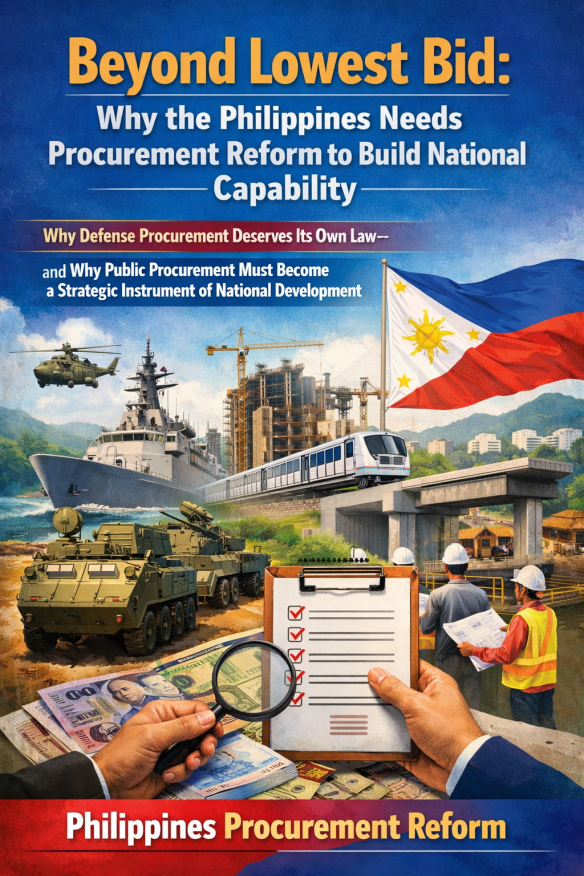
By Karl M. Garcia
Every government procurement system exists to answer a deceptively simple question: How should public money be spent?
For decades, the Philippines has answered that question primarily through the lens of accountability. Public procurement has been designed to prevent corruption, ensure transparency, promote competition, and obtain value for money. These objectives remain indispensable. Every peso entrusted to government must be spent honestly, efficiently, and in accordance with the law.
Yet procurement should answer a second question that is just as important:
What capabilities will the nation possess after the contract is completed?
That distinction separates governments that merely spend public funds from governments that invest in national development.
Procurement is often viewed as an administrative function—a process of preparing bid documents, evaluating proposals, and awarding contracts. In reality, it is one of the most powerful economic instruments available to the state.
Every year, the Philippine government spends hundreds of billions of pesos constructing roads, bridges, ports, airports, hospitals, schools, digital infrastructure, flood-control systems, energy facilities, disaster response assets, and military equipment. Collectively, these purchases represent one of the largest sources of demand in the national economy.
The question is whether these expenditures simply buy assets—or whether they also create industries, develop technologies, strengthen institutions, and expand the country’s productive capacity.
The world’s most successful economies understood long ago that procurement is not merely an accounting exercise. It is industrial policy in action.
Governments in East Asia, Europe, and North America have repeatedly used public purchasing to accelerate technological development, nurture domestic suppliers, improve engineering capabilities, and help local firms become globally competitive. Government contracts created demand that encouraged private investment, innovation, workforce development, and research.
Infrastructure projects became opportunities to train engineers.
Transportation projects strengthened domestic manufacturing.
Defense contracts accelerated advances in aerospace, electronics, telecommunications, and advanced materials.
Public procurement became a tool for building national capability.
The Philippines has yet to fully embrace that philosophy.
Instead, our procurement framework remains overwhelmingly focused on minimizing risk.
This approach is understandable.
The country’s procurement laws were crafted during a period when corruption represented the greatest public concern. Strong safeguards against collusion, favoritism, and abuse were—and remain—necessary. Transparency and accountability must never be weakened.
However, a procurement system designed solely to prevent failure can unintentionally discourage success.
One example is the widespread requirement for bidders to demonstrate a “similar completed contract” before they are allowed to compete for many government projects.
The rationale appears reasonable. Companies that have successfully completed comparable projects are presumed to present lower implementation risks.
In practice, however, the requirement often reinforces incumbency.
Companies that have previously won government contracts continue winning because they already possess the required project history. Meanwhile, newer firms with experienced engineers, strong financial resources, modern equipment, internationally certified management systems, and innovative technologies are frequently excluded—not because they lack capability, but because they have never been given the opportunity to undertake a similar government project.
Every successful company had a first major contract.
If procurement rules require previous government experience before companies can compete, many future national champions will never emerge.
This illustrates a broader problem.
Qualification and competition serve different purposes.
Qualification determines whether a company possesses the financial, technical, legal, and organizational capacity to undertake public work.
Competition determines which qualified company offers the best overall proposal.
When these two objectives become conflated, procurement begins rewarding historical incumbency rather than present capability.
Fortunately, government already possesses numerous mechanisms for determining whether firms are qualified.
Companies register with PhilGEPS, maintain tax compliance, obtain licenses from professional regulators, demonstrate financial capacity, satisfy legal requirements, and meet industry standards. These systems exist precisely to ensure that only competent and legitimate firms participate in public procurement.
Rather than relying excessively on previous contracts, the Philippines should adopt a comprehensive contractor classification framework that evaluates firms according to measurable indicators such as capitalization, financial strength, technical personnel, equipment holdings, quality management systems, regulatory compliance, safety records, project management capability, and organizational maturity.
Once firms are properly classified, they should be allowed to compete for projects appropriate to their capability tier.
Risk should then be managed after contract award through performance bonds, milestone inspections, independent quality assurance, warranties, liquidated damages, and rigorous contract administration—not by unnecessarily restricting competition before bidding even begins.
Equally important, procurement should evolve from simply seeking the lowest compliant price toward selecting the best overall value.
Lowest price does not always produce the greatest public benefit.
A contractor offering superior quality, greater durability, lower maintenance costs, better environmental performance, or stronger local economic impact may ultimately provide significantly greater value over the life of a project.
Modern procurement increasingly evaluates life-cycle costs rather than acquisition costs alone.
It considers reliability instead of merely purchase price.
It measures resilience rather than simply construction cost.
It recognizes that the cheapest option today may become the most expensive option tomorrow.
This philosophy becomes even more important in strategic industries.
Government procurement should deliberately strengthen sectors that are essential to long-term national development.
Projects involving renewable energy should cultivate domestic engineering expertise.
Digital infrastructure should expand the country’s software and cybersecurity capabilities.
Hospital construction should encourage medical technology development and local manufacturing.
Transportation projects should strengthen domestic suppliers of construction materials, signaling systems, and industrial equipment.
Disaster resilience projects should stimulate innovation in climate adaptation technologies.
Procurement should leave behind more than completed facilities.
It should leave behind stronger industries.
No sector illustrates this principle more clearly than defense.
Military acquisition is fundamentally different from ordinary government purchasing.
Buying office furniture, school supplies, or administrative equipment is primarily a commercial transaction.
Buying frigates, fighter aircraft, missile systems, radar networks, satellites, cyber defense platforms, and unmanned systems is an investment in national security that shapes strategic capability for decades.
Defense acquisition involves far more than purchasing hardware.
Every major weapons system requires continuous maintenance, software upgrades, logistics support, spare parts, training, infrastructure, systems integration, and technical expertise throughout its operational life.
Strategic considerations—including alliance commitments, interoperability, export controls, supply-chain security, technological sovereignty, and geopolitical risk—often matter as much as price.
These realities cannot always be evaluated using procurement rules originally designed for ordinary commercial purchases.
The lowest acquisition cost may produce the highest life-cycle expense.
The fastest delivery may provide the weakest logistical support.
The cheapest bidder may not deliver the strongest long-term defense capability.
For this reason, the Philippines should seriously consider enacting a Defense Procurement and Industrial Development Act that recognizes the unique strategic nature of military acquisition while preserving transparency, competition, and accountability.
Such legislation should evaluate projects according to life-cycle value rather than initial acquisition price alone.
It should encourage meaningful technology transfer, local maintenance capability, domestic systems integration, workforce development, research partnerships with universities, and industrial participation wherever practical.
Many countries require foreign defense suppliers to invest in local industries through offset programs, joint ventures, technology partnerships, and local production arrangements. These policies do not eliminate dependence on foreign technology overnight, but they ensure that every acquisition strengthens domestic capability rather than merely importing finished equipment.
The Philippines should pursue the same objective.
Professionalization should form another pillar of reform.
Defense acquisition has become one of the world’s most technically demanding professions.
Successful procurement requires expertise in systems engineering, logistics, project management, finance, international law, industrial economics, cybersecurity, and operational analysis.
The country should establish a permanent professional acquisition corps whose members develop specialized careers in defense procurement instead of relying on rotating assignments that dissipate institutional knowledge.
Defense modernization should never exist in isolation from economic modernization.
Every naval acquisition should strengthen Philippine shipbuilding.
Every radar purchase should expand domestic expertise in electronics and systems integration.
Every investment in unmanned systems should cultivate local capabilities in artificial intelligence, robotics, software engineering, sensors, and autonomous technologies.
Strategic autonomy does not require manufacturing every weapon domestically.
No country—not even the world’s largest powers—is completely self-sufficient.
Strategic autonomy instead means ensuring that every acquisition leaves the Republic more knowledgeable, more capable, and more resilient than before.
Ultimately, procurement reform is about redefining how government views public spending.
Every contract should produce multiple returns on investment.
A railway should leave behind better engineers.
A bridge should strengthen local construction capability.
A digital project should develop Philippine software expertise.
A hospital should expand domestic medical technology.
A defense acquisition should create not only stronger armed forces, but also stronger universities, more competitive industries, better scientists, skilled technicians, and more capable public institutions.
The Philippines has spent decades treating procurement primarily as a mechanism for preventing corruption.
That mission remains essential.
But integrity and development are not competing objectives.
A modern procurement system can—and must—deliver both.
The countries that will lead the twenty-first century are not simply those that spend the most public money.
They are those that learn the most from every public investment they make.
The Philippines should aspire to do the same.
Every peso spent by government should solve today’s problems while expanding tomorrow’s possibilities.
When procurement consistently leaves behind stronger industries, deeper technological expertise, more innovative companies, and more capable institutions, it ceases to be merely an administrative process.
It becomes one of the most powerful instruments of nation-building.





I think that one of President Marcos’ greatest strengths is that he thinks in terms of progress rather than risk avoidance. PEZA understands, so does BOI with its green lane to accelerate strategic investments. So does PPP as it manages hundreds of projects. I’ve just dropped off links in the previous articles that illustrate this. I doubt that we can expect the President or agency heads to be philosophical about it, or deeply conceptual, or to do other than what common sense suggests to them. They have budgets and rules for spending.
Defense procurement under Teodoro is aggressive, drones and missiles, and boats and planes. Leveraging alliances. I think they represent strategic sense in a nation with a small defense budget.
I don’t know if procedural rules need to be changed that much. The risk aversion part. I think management needs to be professionalized so agency heads work smarter, and work together. They heed to understand highest and best use as a discipline, and interconnectivity. Mark Villar (when he was at DPWH) should not build flyovers smack in the middle of a long planned train route, costing 7 billion pesos to get around it.
I remember that DPWH DOTR mismatch or miscoordination it delayed LRT 1 extention as if Right of way.was not a prennial delayimg problem.
Off topic but related to prior BPO discussions, here’s an interesting snapshot of a smaller BPO pursuing a well-defined growth strategy. It operates in the Philippines but serves mainly Canadian clients. It has listed publicly to gain capital and reputation. The article introduces the term KPO or Knowledge Process Outsourcing as it deploys AI backed services.
https://mb.com.ph/2026/07/15/philippines-founded-bpo-asiatel-lists-on-canadian-exchange
Karl,
Thanks for the essay. Does the New Government Procurement Act (NGPA / RA 12009) play any part in this complicated subject?
Welcome and thanks. In short technology can not solvee everthing. The new law paved the way for technology to be taken full advsntage of. But the contract experience is still a sticky spider web that can only make you ecape by tying yourself to a spider. Our Billionaires artnet woth Foreign partners but they end up as glorified sub conractors and with limited tech and knowleege transfer and I would be more than happy to be proven wrong. i hope I am wrong here.
Thanks, Karl. I had a hard time making the connection between the New Government Procurement Act and the overall theme of your essay. So I hope you don’t mind that I enlisted the help of Gemini. Here is what he said. I believe the key phrase is “Zero Technology Transfer. ” Let me know if you agree w/ Gemini’s assessment of your position:
>>The connection Karl is making between a Procurement Act and ending up as a “glorified subcontractor” is not immediately obvious because it lies in how Joint Ventures (JVs) and technical qualifications are structured under Philippine bidding rules.
To win a multi-billion-peso government contract (like building a subway, a digital network, or high-tech defense systems), a bidder must prove they have completed a “similar project” of a massive scale in the past.
No Philippine company has the track record to build a subway or code a national cryptographic ledger on its own. Under both the old and new procurement acts, the law allows—and practically forces—local companies to form a Joint Venture (JV) with a highly experienced foreign partner to qualify to bid.
The “glorified subcontractor” trap happens within these JVs through three specific mechanisms: 1. The Division of Labor (Brain vs. Brawn)
In a typical JV bidding for a complex Philippine project, the actual agreement (the JV contract) divides the work:
On paper, they are “co-equal partners” in a Joint Venture. In reality, the local billionaire’s company is acting as a “glorified subcontractor”—doing the heavy lifting and manual labor, while the foreign company controls the actual technical value. 2. Zero “Technology Transfer”
A truly strategic procurement law in a developing nation doesn’t just buy a product; it buys the capability to make that product.
For instance, when South Korea or China hired foreign train makers decades ago, their procurement contracts legally mandated Technology Transfer—the foreign firms had to physically train local engineers and share their blueprints so that the next train could be built locally.
Karl’s critique is that Philippine procurement rules have historically focused so heavily on immediate delivery and lowest price that they fail to mandate or enforce genuine technology and knowledge transfer. The foreign partner does the technical work, leaves when the contract is done, and the Philippine partner is left none the wiser on how to build it independently next time. 3. The “Shell Partner” Loophole
To protect domestic industries, Philippine law often mandates that JVs must have 60% to 75% Filipino ownership.
To bypass this, a foreign giant will team up with a local conglomerate. The local partner puts up the majority of the money (the 60%) to satisfy the legal requirement, but because they don’t have the technical know-how, they hand 100% of the technical execution over to the foreign partner.
The local partner is essentially a financial shell that acts as a front to win the bid. They get a cut of the profits, but they don’t actually learn how to build the technology. Why Karl is Skeptical of RA 12009 Solving This
Even though the New Government Procurement Act (RA 12009) introduces great concepts like “Direct Procurement for Science and Technology” and favors “domestic products” in bidding, Karl’s point is that the law alone cannot force a local billionaire to learn how to build high-tech systems.
If local conglomerates are content with just getting rich by pouring concrete and laying pipes for foreign tech giants, the procurement system will continue to cycle public money into foreign hands. Karl’s “hope to be proven wrong” is a hope that Filipino companies will use these new legal frameworks to actively demand, absorb, and master the actual technology, rather than just being the local muscle for a foreign brain.<<
Precisely!
I note that you were skeptical (from your “I hope I am wrong here”) about the success of implementing such a procurement program that thinks past just getting the just getting the lowest bid, but actually learning from your purchase so much so that next time you need to purchase less from foreign countries because you have added to your own expertise.
This is where leadership is necessary, and the buck stops with the fellow in Malacañang.
Thanks again for your essay. I hope it generates some imaginative and vigorous discussion either here or in any other forum that you may be in.
Let me close this post with an excerpt from the Gemini summary:
>>For instance, when South Korea or China hired foreign train makers decades ago, their procurement contracts legally mandated Technology Transfer—the foreign firms had to physically train local engineers and share their blueprints so that the next train could be built locally.<<
p.s. Another possible buzzword for this topic of Procurement Reform in addition to “Zero Technology Transfer” would be “glorified sub-contractors.”
I’m curious as to how San Miguel Corporation got approved to build their first expressway, or train system, or the new Manila airport coming online soon. I know the latter was self-initiated by SBC. They’d not built anything similar before.
Good question, Joe. Gemini can give you an answer (hopefully a right answer). I checked and long story short, SMC can get approval and the project is underway. I got a peek into the New Manila International Airport project…thanks to Gemini and YouTube, even took a motorcycle and drone “ride” to the location. Looks like a super expensive engineering challenge as the area to be built on is mostly underwater! The “tour guide” on a motorcycle with camera took me through inhabited areas that were nice and dry, but he said that during storm season it is waist deep underwater. I have read up a bit on these parts of Bulacan years ago, but had forgotten about them. Many folk, our guide said, have had to raise the level of their homes by a few feet.
The project does not solve the problem Karl has pointed out to us. After the airport is completed, the Philippines still will not know how to build a similar airport. There will be no technology transfer, even to San Miguel Corp. San Miguel Corp. is a glorified subcontractor (but with deep pockets!).
But at least Bulacan will have an International Airport and all the benefits and challenges that come with something like that.
Interesting. San Miguel is not a subcontractor as I read further. They are the owner. The money. They hired the global marine infrastructure company Boskalis to do the groundwork. Maybe that’s how they got approval, by lining up experienced companies to do the construction work. There were costly delays when redevelopment projects in Manila Bay were halted. But structures are going up now and the airport is expected to open in 2028 as originally planned. Here’s the status on construction, per Gemini.
Passenger Terminal Building (PTB): Structural construction on the massive passenger terminal and the logistics center officially kicked off, marking the shift from ground preparation to vertical building.
First Runway: The first runway is undergoing sand surcharging—a critical geotechnical process to settle and stabilize the marine soil—and remains perfectly on track to be fully ready.
Logistics Center: Initially delayed by supply chain bottlenecks, vertical development is being prioritized to finish the logistics facility.
Connecting Infrastructure: Construction continues on the Northern Access Link Expressway (NALEX), the dedicated tollway network that will connect the airport directly to Metro Manila and Central Luzon.
Here is what I gathered.
Building an Airport Is Not the Same as Building Capability
San Miguel Corporation’s successful development of the New Manila International Airport demonstrates an important truth: a company does not necessarily need prior experience in a specific sector to execute a world-class project. What it needs is the ability to assemble the right expertise.
While San Miguel had extensive experience in infrastructure, it had no history of building or operating a major international airport. To bridge that gap, it engaged globally recognized engineering, design, and construction firms. This arrangement is neither unusual nor improper; it is standard practice in major infrastructure projects around the world.
However, there is a common misconception that Philippine laws requiring 60-40 ownership automatically compel foreign firms to enter into joint ventures and transfer technology. The 60-40 rule applies primarily to ownership restrictions in certain industries and does not mandate that every foreign engineering or consultancy firm become an equity partner. Many participate legally as contractors, consultants, or technical advisers.
The more important question is not whether San Miguel complied with the law—it did. The question is whether the Philippines is maximizing the opportunity presented by projects of this scale.
Unlike several East Asian economies that embedded technology transfer, local content requirements, and workforce development into their industrial policies, the Philippines has generally focused on completing infrastructure rather than systematically building domestic capability. As a result, foreign expertise is often imported for individual projects without creating enduring institutional knowledge.
The New Manila International Airport may become one of the country’s most significant infrastructure achievements. Yet its greatest legacy should not simply be a new gateway for travelers. It should be the development of Filipino engineers, managers, and institutions capable of designing and building the next generation of airports themselves.
Building infrastructure is an accomplishment. Building national capability is a strategy.
As I suspected then. But indeed the contractors leave and no Filipino company gets qualified, by law. I see the error of this. I would say, though, that SBC is pre-qualified to build anything, and its officers know how to do subcontracting at the highest level. but, yes, it’s too bad Filipino construction firms were restrained by laws from learning anything.
The Philippines lacking the full domestic capability to execute megaprojects on her own was always there, even during the Commonwealth and Third Republic. It wasn’t apparent before, probably because the megaprojects back then were few. Previous megaprojects had a lot of US engineering help and financing, but I think I should point out that domestic engineering companies were a lot more “involved” in previous eras as somewhat “junior project members” rather than the trend that started in the mid-1960s “Edifice Complex” of buying foreign expertise while the domestic partner was the local coordinator (navigating Philippine laws, regulations, and the political sphere). The 1970s saw most projects being bespoke which also contributes to less interoperability between let’s say, rail systems.
The root issues are: lack of a domestic heavy-industrial base, specialized engineering firms, and until recently, lack of capital markets that could scale. Philippine conglomerates can now handle the capital side, so that’s an improvement, solving 1/3 of the capability gap.
Anyway the topic of building national capacity was the actual (alluded to) purpose of my deep exploration into a “Philippine auto industry,” which Irineo graciously helped to write in his excellent article digesting my research.
Building national capability *
Thanks for the needed input. A big portion of my recent writing came from Joeyisms or Nguyenisms.
Manolo Quezon posted this on Facebook about Pier 7 in Manila some days ago (he has been into AI-colorized fotos of the American and Commonwealth period for some weeks now, the results are quite impressive really):
going back to “venerable” Spanish colonial era traditions, I guess. The Manila-Dagupan railway was built by the British, and if one is to believe the Heneral Luna movie the British continued to supervise its operation. The first international telegraph to the Philippines was built in 1880 (Dagupan to HK) by a British company as well.
I would have to check my brother’s PhD about German companies in the late 19th to early 20th century Philippines (one that remained BTW is Zuellig) when I visit him again but he did meticulous research on the Hapag-Lloyd timetables, so that German company was one of many FOREIGN companies Spaniards (and ilustrados) relied on to come and go to Manila (see Rizal’s itineraries) while IIRC the official ships were only for the governor and those like him and were rare.
Jacobo Zobel BTW was one of two enterpreneurs who built the Manila tranvia (steam-operated) in 1882, so I guess another habit already present in those days was to let private entities build public stuff. I would say senyorito habits now and then, let others take care of the details. Some other stuff quickly from memory: a British enterpreneur taught the hacienderos in Negros how to process sugar, and the abaca trade relied on a Boston trading house..
thanks for mentioning that again, leveling up always means you build capacity/capability step by step. The example Gemini/CV gave about trains is something I lamented when it came to the LRT and at the latest with the MRT3 project, and even more when the new wagons took (a) long to come and (b) were delayed in use.
The more spare parts (capacity) and capability to repair some things yourself you have the better of course. I recall how Munich had real issues (electrical system) with its new wagon series (C1 IIRC was the name) from Siemens so they had to be sent back for fixing (but at least only at home) and it got tight with them having to fix I think what are called B1 wagon from the early 1980s, nearly vintage (“sunset” in software), but they still managed that tight spot.
the year to date stats for the attachments of the automotive article look quite interesting BTW.
P.S. re capacity and capability, the Germanic tribes that took over for instance the Rhineland after the Romans left had neither with regards to Roman aqueducts, with Cologne no longer having fresh mountain water supply after a while as they let the 80+ km aqueduct to the city rot. I guess the Byzantines after they were sacked by the Venetians at the latest might still have had the capacity but no longer the capability to make “Greek fire”, their old weapon.
P.P.S. I originally specialized in microchip design but never practiced it, all we learned from was the declassified blueprint of the Intel 4004 microprocessor among others. I don’t know what is left of the capability to produce microchips in Germany especially in Munich which was once a major hub, I came a bit too late to get a job in that industry here. Is still having silicon wafer production in Burghausen (Wacker Chemie) capacity or capability?
a modern and an ancient example of capacity/capability:
https://x.com/HistContent/status/2077511975681093688
https://www.sueddeutsche.de/muenchen/wolfratshausen/muenchen-sylvensteinspeicher-wasserstand-isar-trockenheit-zufluss-li.3516061
(translated from German by Claude)
Less Water for the Isar: Reserve in the Sylvenstein Reservoir Will Last Another 45 Days
the reservoir is essential to both mitigating flooding during snowmelt and autumn storms as well as keeping the river level adequate in summer..
..the Isar being a quite unpredictable Alpine stream by nature and Munich used to be more subject to its vagaries but also dependent on it for a lot including the supply of wood from upstream, all those typical Alpine houses or even the huge Oktoberfest tents depend on that.
I did see MLQ3’s AI-enhanced colorized photos. Quite interesting!
I’ll note that while Pier 7, which was destroyed in WWII, was designed by Tomas Bautista Mapua, Mapua was working under the direction of the Bureau of Public Works which at the time was run mostly by Americans in the Insular Government. The Bureau of Public Works is the predecessor of today’s DPWH. Mapua was an early pensionado, who under the Philippine Commission’s Pensionado Act (1903) received his architecture education at Cornell University in New York. Aside from that IIRC the actual engineering, construction methods, heavy machinery, concrete (aside from a small amount sourced from the Rizal Cement Corporation), rebar steel, and structural steel were all sourced abroad (mostly from the US). So even at that time when the Philippines was starting to modernize the actual technical know-how was not domestic. In the Pier 7 project the main Philippine contribution was labor… not that different from what happened in let’s say, CCLEX (finished 2022). A lot of this information is buried quite deeply in archives and hard to find nowadays but there is a dedicated community of Filipino archivists who regularly share this stuff on Facebook. What little the public knows though amounts of the nationalist narrative of “100% Filipino capability” that was lost (Marcos Sr. is blamed here by them).
Yes, an exploration might be to look into what capacity vs capability existed during the Third Republic and the so-called Marcosian “Golden Age” (1965-1986). In terms of actual technical know-how, industrial and infrastructure capability, it was the same story as Pier 7… imported materials, imported technology, imported machinery. The important difference was that during the Third Republic to early Marcos Sr. era the Philippines still retained a lot of capability in Expertise (which I detailed a few replies down) through competent engineers, trained project administrators/managers, and integration experts. The later brain drain was a real thing, and its bigger effect to national development was a real thing…
I have been reading a lot of publications on Vietnam’s Đổi Mới (“Renovation”) which started in 1986 and initially was modeled off of Deng Xiaoping’s Gaige Kaifang (“Reform and Opening Up”) and Mikhail Gorbachev’s Perestroika (“Restructuring”). Interesting in less than a decade in 1992 when Vietnam and South Korea resumed diplomatic ties it seemed a lot of Vietnamese academics and political actors had their eyes opened to the South Korean economic miracle and how “far ahead” South Korea was — Vietnam and Korea were historical rivals within the Sinosphere’s Fengjian system. While Vietnam didn’t immediately adopt the South Korean model a lot of academic and industrial exchange took place and elements of the South Korean model were what powers Vietnam’s current economic rise. The policy of Đổi Mới 2.0 makes those adapted integrations official and is the current industrial policy. In 1986 after EDSA the Vietnamese GDP per capita was 1/3 that of the Philippines despite the turmoil of overthrowing Marcos Sr. Something to think about…
This is great! Hopefully someone will read the material and realize that it’s not about building one-off stuff but about building a system-of-systems, of which a supply chain is a form of. Filipinos really excel at singular objectives but at least some need to be developed to utilize systems thinking.
Germany still has Infineon, Elmos, and Bosch as semiconductor design firms — focusing mostly on microcontrollers and automotive applications. Intel, AMD, TSMC, Qualcomm, Micron also have R&D centers in Germany. In terms of chip fabs there are many in Dresden’s Silicon Saxony. AFAIK Germany is the only EU country that retains substantial semiconductor capabilities (by far).
it is also an example of what can be started with what is ALREADY THERE, that might explain the curiosity in whatever circles are downloading it.
sometimes not being able to do something is just due to thinking one can’t or not even thinking of possible ways. The mindset of “let’s just sit back and hire some British/American/Japanese/Korean/Chinese contractors” is already one part of the problem.
Politics usually takes the path of least resistance — probably more so in Philippine politics where the Institution of State is weak and fragmented.
At some point people who are exposed to more modern infrastructure, economies, and governance start complaining: “why can’t we have that stuff too?” They don’t actually think about “what are the steps needed to get what we want,” that is the job of government policy and planning.
Bypassing the hard decision making by just doing OFW, BPO, or Build-Operate-Transfer (BOT) works in the near-term to increase capacity but it doesn’t build capability. The longer the hard decisions are kicked down the road to the next administration or the next Congress, the harder it is to catch up, requiring an even harder political decision. It can become a vicious cycle.
I think a problem in the Philippines is that each instance of increasing the democratic franchise was more about getting votes to consolidate then-incumbent political power than enfranchising a well-informed electorate. Of course there can be the inverse problem, which is a relatively informed electorate becomes degraded over time by the reduction of economic opportunity and/or educational opportunity, becoming a captured electorate such as what partially happened in the US, UK, France, some areas of Canada, and I think, probably some areas of Germany as well.
People want “stuff.”
So in order to preserve political electability there is a move to “delivering stuff.” Note I differentiate delivery, not building. In the Philippine case delivering takes many forms; in Philippine infrastructure it takes the form of the privately-funded BOT mechanism. In theory the state eventually “owns” the infrastructure and thus the capacity without making effort to build capability. In practice by the time one gets to the Transfer part of BOT the infrastructure is likely outdated, insufficient, or even dilapitated — private entities act in the private interest, usually to open up new economic opportunity, not in the public interest. So in this framing, it’s a bad thing that private Philippine conglomerates are building major infrastructure and handling megaprojects, both which are public goods.
It goes back to the ability to make hard decisions.
In order to build a ship beyond the simplicity of a bulk carrier, which is the main type of ship built in the Philippines, one needs to:
Items #4-5 are the most important to set the foundations. If one is able to manufacture naval steel plate, one would be able to manufacture structural steel for infrastructure and large buildings, and one would be able to manufacture automotive steel plate, in descending order of complexity. This is the difference between capability and capacity. The lacking and the mismatch is why Philippine megaprojects have the Philippine contribution mainly be in labor (and recently, financial funding rather than full reliance on ODA).
The ability to sequence and see the bigger picture was the whole point of my automotive research, even if on-surface it looks like “why should the Philippines build cars in the first place when the Philippines should build bigger things?” One cannot build bigger things without building small and medium things first. There was a reason why post-War Japanese re-industrialization policy focused heavily on automotive, why South Korean industrialization policy focused heavily on automotive, and why Vietnam is now placing a big bet on automotive within Đổi Mới 2.0. It’s not really about building cars — it’s about building capability.
Meanwhile the Philippine shipbuilding industry which is much boosted in government and nationalist narratives then reproduced wholesale by the news media does not own its own engineering, does not own its own naval steel suppliers, does not operate or know how to replicate its own shipyards. What Filipino naval engineers exist work under a foreign shipbuilder who operates the shipyard that is manned by Filipino labor. Knowledge is the most valuable piece of the supply chain’s value.
The average Filipino voter just wants stuff. It is the job of the government to deliver that stuff while building the capability to have more capacity (delivery).
this reminds me of what Ninotchka Rosca once told me personally (about some FOB FilAms in the early 90s but also Filipinos back home in general) that “Filipinos usually want instant gratification”. I guess the more people drift towards that the more they are in danger.
I am NOT an advocate of living like the Amish people, but when I see how Bavarians still do take interest in how stuff gets made, harkening back to the era when their ancestors maybe just 3-4 generations ago ploughed the fields, put up houses with brick and mortar and finished them on the outside with the abundant wood of the forests over here, applying the right mentality to building airports or underground trains, it is a world of difference.
An Ilocano high school batchmate who migrated to the USA and once visited here compared the folks here to “Midwesterners”.
Not quite wrong as THE American cultural import that stuck with Bavarians was country music. “Country Road” is practically a mainstay song of every Oktoberfest. There is something wow about how they build up the “tents” which are actually large wooden structures.
I liked lingering and watching in the era when they hadn’t closed stuff yet for security reasons.
The PNoy administration experienced personally how hard it was to explain anything to the middle class that wanted everything at once. OK I get it like I get that I shouldn’t communicate too technically when I am talking to end users, even with key business users in my job.
But the middle class commentariat that should have been like responsible key business users acted like end end users. They didn’t get instant gratification and then voted someone who promised it but didn’t deliver. That at least is the impression one does get with some.
though one has to be careful to avoid sweeping generalizations.
the polemic that many East Germans wanted to “work (little) like under Honecker (communist leader) but live (well) like under (Chancellor Helmut) Kohl” is of course too much. And fortunately as you mentioned there IS a culture of building things in places like (Silicon) Saxony for example.
Politics gave a lot of very industrious East Germans too little perspectives. Some of their best moved to the West for decades, I know one whom I worked with in Munich who has now built a house in his old hometown in Saxony-Anhalt state. A lot were part of the Monday morning and Friday afternoon traffic jams on the incoming and the outgoing Autobahn to Munich for decades, working in boomtown and going back home on weekends.
The frustration of many Filipinos taking hours to get to work and back just in Metro Manila is often similar, I guess.
P.S. recalling now a convo with a bit of mentor here in Bavaria over 15 years ago who told ME when I was telling him about my Pinoy barkada here in the early days and myself: “the path of least resistance is the path most of you guys took”. Well most people I guess do.
P.P.S. part of the issues we have nowadays in this world might be due to socmed etc. making the path of least resistance a habit for most.
The 1225 Song Chinese account by Zhao Rugua, Zhu Fan Zhi (A Description of Barbarian Nations, Records of Foreign People), already described the inhabitants of Ma-i (Luzon near present day Manila) as running multi-island credit networks to facilitate the trade of luxury goods which they bought using commodities (beeswax, shells, jute, etc.) rather than based on agricultural surplus. What agriculture existed was the kaingin slash-and-burn system planted with root crops. Zhao observed the inhabitants of Pisheye (identified by William Henry Scott as somewhere in the Visayas) having a similar type of subsistence farming. What industry existed related directly to subsistence (e.g. boiling seawater to make salt probably similar to Boholano asín tibuók or weaving cotton for clothes). So what industry and trade existed was in the service of getting luxury goods elsewhere, e.g. China, Japan, Champa, Đại Việt, Majapahit, and Srivijaya.
Later the Spanish who were used to European-style grid agriculture didn’t understand the kaingin system, so that’s probably where Filipino “indolence” came from, which Rizal refuted in his essay Sobre la indolencia de los filipinos (On the Indolence of the Filipinos. Btw the lola I shared a story about previously growing her root crops “randomly” is probably using an inherently understood version of kaingin as no one taught her that.
Over in present-day Vietnam the former Champa also ran on a similar subsistence agriculture-luxury goods import economy except much more organized as the Chams became a powerful, though now largely forgotten thalassocratic empire (but is being re-discovered by Vietnamese archaeologists) which militarily and culturally rivaled the Đại Việt, Majapahit, and Srivijaya for over 1,600 years. The Champa organizational skill was mainly due to the adoption of Mandala Model as detailed by O.W. Wolters in History, Culture and Region in Southeast Asian Perspectives. In the mandala system the chieftain’s legitimacy ran on the continuance of luxury good flowing out through the feasting which brought loyalty. Wealth was derived from ability to wield manpower not capital as we understand wealth now…
So part of the “difficulty” in the Philippine industrialization problem is whatever problem exists is structural to the base culture rather than characterological. The Philippines is quite literally running on an entirely different operating system, so to speak. Chinese Filipinos, who are so “successful in business,” are in a way a translation layer between the Philippine operating system and the outside world, acting as bridging agents (but I digress). Middle class and elite Filipinos are unknowingly running a different (Westernized) operating system, while being disappointed that the country overall won’t just “upgrade,” while also largely not putting in the effort to make a transition happen.
Going back to the subsistence-plus-luxury trade model, the Philippines now has three “blockers:”
The blockers are made worse in the absence of an agricultural revolution to increase land productivity. The Singapore model, the favorite of the commentariat within the middle class, of alternatives like finance and shipping won’t work also since the Philippines is a large, dispersed archipelago. In the Philippines there is a large reliance on finance to drive profits rather than investing in tangible things to increase capability, which I previously pointed out in my automotive research.
In the case of Bavarian industry, their farmer forebears were quite literally building fixed capital needed for increasing agricultural efficiencies — houses, barns, drained fields. The acts of doing those things themselves are a form of habit-building. The habit of building things can then transfer to airports and underground metros. The operating system is entirely different from the Philippines which prior to the Spanish had an economy of transferable relational wealth which Spanish rule interrupted creating the conditions for proto-dynasties in the principalía.
Something interesting to think about is how the OFW economy is a modern version of the pre-Spanish economy: export the commodity (labor), then use the remitted proceeds to import luxury (finished) goods, rather than building a domestic industrial base that would allow the same labor to build something at home. A big question is whether the current or a future administration and congress has the political capital and willpower to force a conversion. If things are left up to private interests, only the private interest will be served primarily, while the public interest is left hoping for scraps and goodwill.
Some of the oldest documents in my (incomplete, but that doesn’t matter as legally they are practicall useless anyhow) collection of abaca land stuff from our clan show people “proving their ownership” by having testimonies of neighbors that they “tilled the land for 30+ years”.
Probably a fiction for those poor most probably remontado uphill people of Tiwi the hacienderos “bought land” from. Actually the frequent changes in land titling law (no land area, just “vecinos del norte, sur” etc. initialy, then land area in solares by around 1890, the US Torrens titling, then some titles “secured” during Japanese occupation, then TCTs) make things a huge mess over there in addition.
The Mandanas system is essentially the same arrangement between national and LGU in the Philippines haha.
in most of Luzon’s central plain I gather that land reform made plots to small to be viable, so the owners often sold to property developers, making what used to be Luzon’s rice bowl an almost totally built up area.
IIRC that area was made into a rice bowl by friar estates whose lands were up for sale (to richer Filipinos of course) in the early 1900s.
there is none of the “oppressor” stigma attached to land/capital over here that is attached to it in the Philippines no thanks to UP teachings.
But then again there is a long history of how land titling was taken care of meticulously over here, not that any system is totally fair of course.
“the datu took care of the ginhawa (well-being) of his bayan” I had some chat convos with Xiao Chua quite a while ago where I asked him if it is a valid reading of Pantayong Pananaw if trapos give the poor ayuda, isn’t that ginhawa? I don’t remember his exact answer though.
anyhow I am more of a European with some Filipino background especially by now, looking progressively less at Filipino matters.
hey, I am not even clicking on notifications about the Sara Duterte impeachment trial now, so I have no idea if Filipinos even want it differently.
AFAIK abaca was not grown at scale until the early 1800s, previously being used for indigenous textiles and woven goods. The scaling of abaca after it became a cash crop also followed Spanish-style grid agriculture.
Something I found interesting the first time I visited the Ifugao rice terraces was the “2,000-3,000 year old” claim which was still common in the early 2000s as the radiocarbon dating wasn’t done by Prof. Stephen Acabado’s Ifugao Archaeological Project until 2009. That “ancientness” was the basis of the common claim probably going back to when you were in school that the Philippines possessed high-organization and wide-scale agricultural practice prior to the Spanish (some claims going further to blame the Spanish for “destroying” native ingenuity). The later PNAS genetic study showed that the Ifugao were not part of the original cohort of Austronesian migrants from Taiwan, having come much earlier (8,000 years ago as opposed to the main migration from Taiwan 4,000-5,000 years ago) from somewhere in modern Southern China. Well rice terraces are a technology indigenous to the area of Vietnam to Southern China, so the Ifugao must have somehow carried the cultural memory of the rice terrace technology within their culture over 8,000 years only to emerge later when due to Spanish pressure the formerly lowland-dwelling Ifugao moved up-mountain. Underneath the Ifugao rice terraces in the lower archeological layers there is evidence of root crops rather than wet-rice cultivation.
There have been hints in studies on how the paradigm of root crops and kaingin swidden agriculture and paradigm of wet-rice agriculture are a categorical exclusion that explains modern DE behavior.
Rice being grown above ground in fixed paddies that must be maintained, along with being able to be stored for long duration, able to be weighed and measured, as well being able to be transported is something that can be naturally taxed. Wet-rice cultivation also requires a lot of manual labor, which was why rice production was controlled by datus who had the alipin class work their fields. Junker and Wolters both write about this in their findings, and Scott later estimated the alipin to be about 1/3 of a typical barangay’s population. As a prestige food rice was grown in a labor-intensive cultivation process, taxed, hoarded, then burned off in feasts (Junker) to buy relational debt loyalty. I think the distinction aside from the Philippines not having widespread rice cultivation pre-Spanish is that unlike in mainland SEA and mainland Asia, even though rice was also treated as a proto-currency it was consumed as a prestige good rather than being stored or compounded into something more valuable.
Root crops like kamote, gabi and others grown in the swidden are bulky, perishable, are different sizes not conducive to becoming a standard unit, and are grown underground in swidden that moves by the next season when a family prepares kaingin on a new plot nearby. A datu could walk the barangay and not be able to tax swidden crops since he quite literally could not “see” it. Basically root crops structurally couldn’t be integrated into the tithing network that powered Junker’s Raiding, Trading, and Feasting as root crops are not tribute-friendly due to the previously mentioned properties. Root crops and swidden were a categorical exclusion that avoids the prestige-goods (tax) trade circuit even if almost every non-elite family still ate from it. What the authority can’t see, the authority can’t tax in order to fund services, the funding which must be sourced elsewhere.
When I lived in Japan I often visited the countryside which was accessible by train from Tokyo and Aichi, where I learned from a Japanese friend about shogun Tokugawa Ieyasu’s predecessor the daimyō Toyotomi Hideyoshi’s cadastral survey of his han (fief) in 1582 that standardized the Japanese measure of rice into the Chinese-derived koku. Crucially Hideyoshi mandated that non-rice agricultural product (root crops, fruits, legumes) to be converted into a rice-equivalent measure that could also be measured in koku for taxation purposes. Being able to count non-rice productive output ensured there would not be a categorical exclusion. Hideyoshi’s kokudaka system allowed the 1873 Meiji land reform to immediately and accurately assess taxes throughout Japan as the economy was legible. In the Philippines there is an opaque economy even now. Hideyoshi, Tokugawa, and the Meiji had a conversion problem which is imminently solvable, rather than a visibility problem which cannot be solved until the structure is made legible.
I suppose the friar estates around Manila which later became the Luzon Rice Bowl was an attempt to close the categorical exclusion by employing European irrigation methods to expand wet-rice and sugarcane cultivation. But by only conducting cadastral surveys on highly productive lowland river plains, people were still able to “opt out,” going back to kaingin-based swidden agriculture. There was no comprehensive land survey. In a way the friar estates inadvertently scaled up the datu system rather than reforming it.
Where I’m getting at probably starts to make sense by now — CARP, which was the biggest chance for structural transformation also did not conduct a comprehensive land survey, instead focusing on handing out land in its redistribution scheme… Unlike the post-WWII land reform in Taiwan, Japan, and South Korea that was included comprehensive land surveys before redistribution to the most productive tenants, CARP awarded parcel sizes based on a tenant-plus-number-of-children formula, while also letting the former landowners first choose the better land to retain. National smallholder farm size has been falling since the 1980s, sometimes by more than half, even where CARP redistributed land. Because smallholders could not sustain their families even at a subsistence level, many chose to sell their parcels to developers, gradually erasing the Rice Bowl. It’s actually sad thinking about Pampanga, Tarlac, and Nueva Ecija, where even in the late 1990s I still saw extensive green farmlands now turn into urban and retail developments.
CARP’s Certificate of Land Ownership (CLOA) should have theoretically made the system legible, converting outside categories instead into formal, taxable, categorical inclusions but in practice the effect was the opposite. In the modern time families who slipped back into categorical exclusion can’t go back to kaingin-based swidden subsistence agriculture. One can see the relocation of rural Filipinos into urban informal settlements working in the informal sector as the modern expression of the pre-Spanish exclusion just outside the view of the datu. Root crops for subsistence just got replaced with a operating a sari-sari store, driving a tricycle or jeepney route, or working as a labandera. The Rice Bowl became the Subdivision Bowl, and in doing so those within the categorical exclusion just moved into the cities. Rural Filipinos no longer able to work their land were not converted into a skilled workforce for Philippine industry.
In Raiding, Trading, and Feasting the feast was a discretionary gift a datu needed to keep performing, which meant the datu needed to organize labor in his rice paddies to earn the means (rice) to pay for the feasts. Mandanas-Garcia is indeed like a “reverse mandala system” where the NTA is a constitutional entitlement the center of the mandala (the government) can’t withhold, while the LGU does not necessarily need to “work to earn” the means to give the new interpretation of feasting — ayuda. I guess never having an actual mandala system previously means that the responsibilities of the parties in a mandala system isn’t respected.
Durable change requires structural change that creates categorical inclusion, converting the population into formal participation, which needs institutions that are capable of sustaining that conversion. Otherwise a large part of the population will organize itself in a way that stays just outside of the datu’s, now government’s purview while still coming to collect the benefits the authority can grant. The Philippine pattern from pre-colonial, friar estate, hacienda, CARP, and now the NTA distribution formula is one of redistributing only the slice of the population that has agreed to be counted — formal workers.
“But indeed the contractors leave and no Filipino company gets qualified, by law. I see the error of this. I would say, though, that SBC is pre-qualified to build anything, and its officers know how to do subcontracting at the highest level. but, yes, it’s too bad Filipino construction firms were restrained by laws from learning anything.” – JoeAm
I don’t this is accurate, Joe. I think, under current Phil. Laws, foreign contractors are not required “technology transfer” to local engineers, etc. And we don’t demand it because technology transfer raises the cost of the contract, and we want cheaper! Hehehe
For the most part as I understand it from Karl’s essay, we are happy being the “glorified sub-contractor.” SMC probably doesn’t mind not learning how to build an international airport on previously submerged earth. They probably do not intend to build another one after this Bulacan project. And if they do, then they will likely just hire the same builders to do it.
“Yet its greatest legacy should not simply be a new gateway for travelers. It should be the development of Filipino engineers, managers, and institutions capable of designing and building the next generation of airports themselves.” – Karl G.
Too late for this project. I believe that the leadership for such an ambitious goal should come from the national government, i.e. in the point in time Marcos, Jr. SMC is not in the business of building airports. This is likely a single project. They likely are also not in the business of owning building firms. They just own the project and hire the builders. They may be in the future.
Apparently we need not reinvent the wheel. Countries like Singapore, Japan, South Korea, Indonesia, etc. already do it. Remember we had an article recently about our embassies in foreign countries. Malacañang should put them to work on this sort of thing. Marcos, Jr. should take the lead in developing the strategy of national capability.
Karl you already said as much, but I think it’s important to reiterate the difference between capacity vs <capability. My experience in large multi-national enterprises comes in handy here…
The capacity is ”how much”: the resources (funding, materials, financial space, physical assets, and labor that is needed to build and operate a (mega)project.
The capability is the ”how well”: the private and institutional knowledge, engineering expertise, governance structures, and regulatory frameworks that are required to turn capacity into domestically replicable, reliable, long-term assets.
Infrastructure development has three main self-reinforcing pillars for capacity vs. capability:
In short: the Philippines has increasing capacity, with ample room to grow in capability.
Darn it, I hand coded the html tags and made an error somewhere so the formatting is off. Well, there’s the gist.
“San Miguel is not a subcontractor as I read further.” – JoeAm
Yes, they are the owners of the project, 100%. They did not have to deal with the 60/40 Filipino ownership stuff because they have sufficient moolah to finance the whole thing!
But the effect is likely even identical to the problem Karl brings to our attention: No technology transfer to the local market (government or private).
Karl points out that in the short term, it is an acceptable strategy. For the long term, however, he suggests that the Philippines should develop for itself the know-how for such projects so that they are not dependent on foreign countries for such knowledge.
That position can be debatable.
I like this sort of arrangement, i.e. SMC owning the project by virtue of its 100% financing. For one, the Filipino people can be sure it is not a ghost project! Secondly, the Filipino people do not have to care if there are delays and cost overruns. It will all be on SMC’s dime. Thirdly, the Filipino people do not have to worry about “kurakot” by politicians. That too will be on SMC’s dime.
Of course SMC needs to recover its investment and make a profit. They will do it by charging the public for use of the airport. That is okay. Even if the government owned the airport they would charge the public for its use. The question is how much. That will be figured out. If it is too much, the public can use another airport.
Yes I think the pros outweigh the cons in this adventure.
Does the project fit into Karl’s vision of an integrated Philippines? Probably not…but it is a step in the right direction, just like your bright new Tacloban airport. The problem of an integrated Philippines is not the responsibility of Ramon Ang. It is the responsibility of the President of the Philippines.
I totally agree with you.
Sorry for the glorified sub contractor comment. It is not accurate or may be a sweeping generalization.
Karl,
I like the “glorified sub-contractor” term, and so did Gemini. Note it is applied in Joint Venture cases, not Owner-Contractor cases which is what we have with SMC and the New Manila International Airport.
Thank you CV and Gemini . 🙂