Beyond the Scoreboard: How Rivalries, Champions, and Institutions Built Philippine Sports—and Why the Future Depends on More Than Talent

By Karl M. Garcia
Sport has always been about more than winning.
A championship lasts a season. A record may stand for years. A medal can inspire an entire generation. Yet the true legacy of sport lies elsewhere—in the institutions that nurture athletes, the rivalries that capture the public imagination, and the culture that transforms individual achievement into a shared national identity.
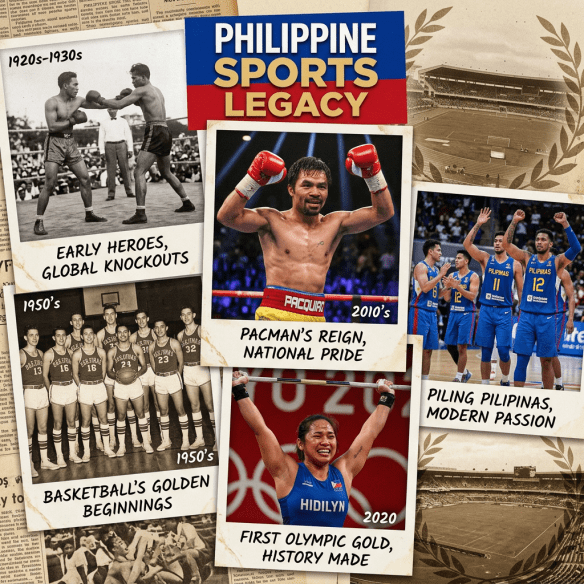
The history of Philippine sports is often told through unforgettable victories. Filipinos remember the impossible shots of basketball legends, the knockouts of world champions, the perfect routines that captivated Olympic judges, and the long-awaited moment when the Philippine flag finally rose at the top of the Olympic podium. These moments matter because they remind a nation of what is possible.
But no champion emerges from isolation.
Behind every great athlete stands a network of coaches, schools, clubs, leagues, families, local governments, sponsors, sports scientists, physicians, volunteers, and institutions that quietly shape excellence over many years. Talent may be natural, but sustained success is almost always organized.
This distinction is becoming increasingly important for the Philippines. As international competition intensifies and sports become more scientific, data-driven, and professionalized, countries can no longer depend solely on exceptional individuals. They must build systems capable of producing excellence consistently across generations.
The Philippines has already shown that it possesses world-class talent. The greater challenge now is ensuring that such talent is no longer exceptional, but expected.
That requires looking beyond the scoreboard.
Rivalries That Built a Sporting Nation
Great sporting cultures are often built upon great rivalries.
Rivalries give ordinary games extraordinary significance. They create stories that transcend individual athletes, drawing entire communities into shared experiences that endure for decades. Every successful sporting nation possesses rivalries that define generations: clubs, schools, cities, or nations whose contests become part of cultural memory.
The Philippines is no exception.
Long before professional basketball became a commercial entertainment industry, the Manila Industrial and Commercial Athletic Association (MICAA) provided one of the country’s first truly competitive national stages. Established in the 1930s and revitalized after World War II, MICAA brought together corporate-sponsored teams whose players developed into some of the country’s finest athletes.
Basketball was becoming more than recreation. It was becoming part of Filipino identity.
The emergence of the Philippine Basketball Association (PBA) in 1975 represented a turning point. As Asia’s first professional basketball league, it demonstrated that the Philippines possessed both the audience and the organizational capacity to sustain professional sport.
Then came one of the greatest rivalries in Asian basketball history.
Crispa and Toyota were more than basketball teams. They represented competing cultures, companies, communities, and styles of play. Their games were not simply contests between athletes but national events that united millions of viewers across social classes.
Every matchup carried emotional weight.
Fans debated lineups in offices, classrooms, jeepneys, and neighborhood basketball courts. Children imitated their favorite players. Entire families organized weekends around televised games.
The rivalry elevated everyone.
Players trained harder because expectations were higher. Coaches innovated because tactical superiority mattered. Broadcasters improved because audiences demanded better coverage. Sponsors invested because public interest continued growing.
Competition produced quality.
Perhaps even more importantly, it produced aspiration.
Young athletes could see a pathway from barangay courts to professional arenas. Basketball became not merely a pastime but a dream that appeared attainable through discipline and hard work.
This pattern would later repeat itself across many other sports.
Schools as Factories of Excellence
If rivalries ignite passion, educational institutions sustain it.
The Philippines possesses one of Asia’s richest traditions of collegiate sports, where universities have served as training grounds not only for athletes but also for coaches, referees, sports administrators, journalists, physicians, and future leaders.
The University Athletic Association of the Philippines (UAAP) and the National Collegiate Athletic Association (NCAA) have become institutions whose influence extends far beyond campus boundaries.
Generations of Filipinos have inherited school loyalties that persist throughout their lives.
Ateneo versus La Salle.
University of Santo Tomas versus Far Eastern University.
San Beda versus Letran.
Mapúa versus Jose Rizal University.
These rivalries are about identity as much as competition.
They create traditions that connect alumni across generations while providing young athletes with environments that balance education and elite competition. The result is not merely better players but more complete individuals capable of contributing to society long after their athletic careers end.
Many of the country’s greatest basketball players first learned to perform under pressure in collegiate arenas.
The same is increasingly true in volleyball, football, swimming, athletics, fencing, taekwondo, and numerous Olympic disciplines.
University sports also encourage innovation.
Sports medicine programs improve athlete care.
Research strengthens coaching methods.
Academic institutions contribute expertise in nutrition, psychology, biomechanics, and performance analysis.
Athletes become beneficiaries of knowledge, not merely physical training.
This integration between education and sport represents one of the country’s greatest competitive advantages.
Heroes Beyond Basketball
Basketball may dominate headlines, but Philippine sporting excellence has always extended far beyond a single game.
For decades, boxing has occupied a unique place in the Filipino imagination.
It is a sport requiring little equipment but immense discipline, making it accessible to athletes from modest backgrounds. Countless young Filipinos discovered that determination and skill could overcome economic hardship inside the boxing ring.
The rise of multiple world champions transformed boxing into one of the country’s greatest sporting strengths. International victories generated pride that transcended regional, linguistic, and political differences.
For a few moments after every championship fight, millions of Filipinos celebrated together.
Billiards produced another remarkable chapter.
Often underestimated internationally, Filipino cue artists demonstrated extraordinary creativity, precision, and composure under pressure. Their achievements established the Philippines as one of the world’s respected billiards nations.
Bowling likewise enjoyed decades of international success.
Filipino bowlers consistently competed against—and defeated—the world’s best, proving that excellence could emerge in sports receiving relatively modest public attention.
Golf gradually evolved from an elite pastime into a globally competitive discipline.
Filipino golfers increasingly entered international tours, demonstrating that proper development systems could produce champions capable of competing against the world’s finest professionals.
Tennis, once viewed as a niche sport, has begun attracting renewed national attention through a new generation of internationally competitive athletes.
These examples reveal an important truth.
The Philippines has never lacked talent.
Its challenge has always been sustaining development across generations.
The Long Road to Olympic Glory
For nearly a century, the Olympics represented both hope and heartbreak for the Philippines.
The country produced remarkable athletes who reached the world’s greatest sporting stage, often despite limited resources compared with competitors from wealthier nations.
Olympic medals were celebrated not only because they were rare but because they reflected extraordinary perseverance.
Every medal carried stories of sacrifice.
Athletes trained despite financial uncertainty.
Families supported dreams with limited means.
Coaches worked with constrained resources.
Communities rallied around competitors representing an entire nation.
Then history changed.
When the Philippines finally captured its first Olympic gold medal, the victory represented far more than an individual accomplishment.
It symbolized decades of persistence.
It rewarded generations who had come close.
It demonstrated that Filipino athletes could stand atop the world’s highest podium.
Rather than ending a national quest, that moment began a new era.
Subsequent Olympic successes confirmed that the breakthrough was not accidental.
It reflected gradual improvements in coaching, institutional support, sports science, and athlete preparation.
Success had become reproducible.
That distinction matters enormously.
One champion may be extraordinary.
Multiple champions suggest the emergence of a system.
A New Golden Generation
Recent years have witnessed one of the most remarkable periods in Philippine sporting history.
Athletes across multiple disciplines have achieved international success simultaneously, something rarely seen in previous generations.
Hidilyn Diaz transformed Philippine sporting history through Olympic gold while inspiring countless young weightlifters.
Carlos Yulo demonstrated that Filipino gymnasts could compete among the world’s elite through technical brilliance and relentless discipline.
Alex Eala has shown that Philippine tennis can produce athletes capable of competing on the sport’s biggest stages.
Yuka Saso proved that golfers with Philippine roots can conquer major championships.
Nesthy Petecio, Carlo Paalam, and Eumir Marcial reaffirmed the country’s enduring boxing tradition through Olympic success.
Each athlete followed a different path.
Different sports.
Different coaches.
Different backgrounds.
Different challenges.
Yet all reveal the same lesson: when talent meets sustained support, extraordinary achievements become possible.
Their victories have also broadened public understanding of Philippine sport.
Children today are increasingly likely to dream not only of becoming basketball stars but also gymnasts, golfers, weightlifters, tennis players, swimmers, fencers, skateboarders, cyclists, and track-and-field athletes.
This diversification strengthens the entire sporting ecosystem.
A New Era of Competition
Sport itself is evolving.
Esports has emerged as one of the fastest-growing competitive industries in the world.
The Philippines has become one of Southeast Asia’s strongest esports communities, producing internationally respected teams, coaches, analysts, broadcasters, and tournament organizers.
Unlike many traditional sports, esports combines athletic reflexes with digital literacy, strategic thinking, teamwork, communication, and technological infrastructure.
Its growth reflects broader economic transformation.
Professional gaming creates careers extending beyond players themselves.
Software developers, event managers, broadcasters, graphic designers, psychologists, nutritionists, data analysts, and marketers increasingly participate in the expanding sports economy.
Professional wrestling has similarly developed passionate Filipino audiences through local promotions that combine athletic performance with storytelling and entertainment.
Together, these developments demonstrate that the definition of sport continues expanding.
Future sporting economies will reward adaptability as much as physical excellence.
Institutions Win Championships
The greatest lesson from Philippine sporting history is surprisingly simple.
Talent begins stories.
Institutions continue them.
Countries that consistently produce champions rarely depend upon luck.
They invest systematically in youth development.
They train coaches.
They improve facilities.
They support sports science.
They strengthen local competitions.
They reward excellence while ensuring opportunities remain accessible.
Champions become predictable outcomes of capable systems rather than miraculous exceptions.
The Philippines already possesses many essential foundations.
Dedicated families.
Passionate communities.
Strong collegiate traditions.
Professional leagues.
Olympic momentum.
Growing private-sector support.
An increasingly sophisticated understanding of sports science.
The next step is integration.
National sports policy should connect grassroots programs with schools, universities, professional clubs, local governments, national sports associations, private sponsors, healthcare providers, and research institutions into one coherent development pathway.
Every barangay court, municipal sports center, school gymnasium, university laboratory, and national training facility should become part of a continuous system that allows talent to progress without unnecessary barriers.
The objective is not merely producing elite athletes.
Sport contributes to healthier populations, stronger communities, improved educational outcomes, tourism, employment, innovation, and international prestige.
Its returns extend far beyond medals.
Beyond the Scoreboard
The future of Philippine sport will not be decided solely by the next championship game or the next Olympic cycle.
It will be determined by whether the country continues building institutions capable of discovering, nurturing, protecting, and developing talent wherever it exists.
Every child who plays on a barangay basketball court, swims in a public pool, runs on a school track, practices gymnastics in a modest training hall, or competes in an esports tournament carries possibilities that cannot yet be measured.
Some will become champions.
Most will not.
But all can become healthier, more disciplined, more confident, and more connected citizens because of sport.
That may be sport’s greatest contribution to nation-building.
Medals inspire.
Championships unite.
Rivalries entertain.
But institutions create generations.
The Philippines has already proven that it can produce world-class athletes capable of standing alongside the best in the world. The challenge now is to ensure that these achievements become the beginning of a tradition rather than isolated moments of brilliance.
When that happens, Philippine sports will no longer depend on discovering once-in-a-generation talents. It will become a nation that develops excellence as a matter of course—where every victory reflects not only the brilliance of an individual champion, but also the strength of the institutions, communities, and people who made that triumph possible.
In the end, that is the true measure of a sporting nation: not how loudly it celebrates its champions, but how consistently it creates them.


Thanks for the article, Karl. I love sports.
“The history of Philippine sports is often told through unforgettable victories.”
I was born in 1952 and started going to school in 1957. Sports was not a big deal in the Philippines then, at least not in my circle which was in the Metro Manila area. Not sure what sports was like in the provinces.
It was hard to find a decent field, or even an available basketball court…or even a half-court. Of the few that you could find, they were usually dominated by older boys, or men. We just had to play marbles (holen), or habulan, or patintero. I remember the small private school I went to in San Juan, Rizal (Erap Estrada’s hometown), had only one basketball court and it was almost exclusively for the high school boys….not even the high school girls. Sports for girls was not encouraged. Mothers said “they might get muscles” meaning it was not considered feminine.
I remember, however, we had a field where we played a form of rugby…at least that is what we called it. We made up the rules…just get the ball to the other end of the field. No passing, no strategy except to give the ball to the biggest boy on the team and have him push and push until he got into the other end of the field. It was unsupervised by any adult.
We also had a big enough field in the school to play what we called “soccer” but it was like baseball except we used a volleyball and kicked it. Like baseball, there was a “diamond” with four bases. I think here in the US it is called “kickball.”
But by the time I was 5th grade, I think the school built two more basketball courts and that was my first experience of the game…first during P.E, then on week-ends with a few friends we would play half-court basketball using my rubber volleyball which my father bought for me (I asked for it, one of the few things I ever asked for from my parents) for fourteen pesos at Cherry Foodarama on Shaw Blvd. in Mandaluyong…hehehe
High School at the Ateneo de Manila was different, but still “kulang” by my standards.
I don’t want to make this post too long, but my feeling is that our Philippine culture is not a sports culture with isolated exceptions. I was old enough to be interested in the MICAA basketball league. The top contenders were YCO Paints, Ysmael Steel, and Yutivo Motors. Usually it would be either YCO or Ysmael…they were the predecessors of the later Crispa-Toyota rivalry. Yutivo was an “also-ran”….won a few here and there, but never at the finals.
At that time the Philippines dominated basketball in Asia because basically sent professional players to an amateurs only tournament. On paper, our players were employees of the companies they played for like YCO, not professional basketball players. The deck was stacked against our opponents.
At the Olympics, people used to laugh at how the Philippine contingent had more “officials” than athletes! Hahaha But that was back then.
I have a lot more stories I can tell about my experiences but I don’t want to hog the conversation. Maybe others can share their experiences.
thanks for this. Your view as a historical window is interesting. I am 13 years younger but lived in the Philippines exactly aged 3-17 from 1968-1982.
A lot of the stuff you mentioned then sounds familiar and I agree that the Philippines especially before was not that sports-minded.
– first of all, basketball and stuff like that still was “para sa mga astig” (for the tough guys) back in the days of my 1970s youth. Carlos Yulo would have been bullied in your youth or in my youth at the very least called “bakla” or “bakling” – unfortunately.
– not enough facilities, yes, a lot of the boys from UP Balara went up to the basketball court near our place in UP Diliman Area I to play.
– officials being given too much importance, also true, there was a discussion remarkable especially by the standards of the Marcos dictatorship on how sports officials back then allegedly stifled the full potential of track and field talent Lydia de Vega due to their big Pinoy egos.
– sure, the dictatorship like all dictatorships encouraged “strong youth” and there was “Alay Lakad” but I remember how the people in UP Diliman admired and were shocked at how my German grandmother walked all the way from Area I where we lived to the UP Post Office of yore.
– Ateneo pool was a place we had access to as my mother taught German and French at the “ADMU Department of Spanish and Modern Languages”. All of us were there on Sundays. My father didn’t want me to go there alone ever because “maraming bakla diyan sa Ateneo” haha.
– I also at times got swimming courses at UP Pool which was between Catholic and Protestant churches back then. A wacko showed his private part to us kids once when we were getting out of class. So is it “puro bakla sa Ateneo, pero sa UP naman daming manyakis”? The man looked like a type from UP Balara though who had had too much gin. We just waited until he went on yelling rude stuff at women in a car and walked home.
– Advanced swimming class at UP Pool with the Japanese trainer of the UP Swimming team was crazy as he pushed us to our limits. I liked it. Don’t know if the story I remember that the UP team was great while he trained them but reverted to eating and hanging out beside the pool after he left is true, maybe a bit.
– never had the eye-hand coordination to be good at ball sports though unlike my brother and sister. They grew up more in Germany though and were at some point part of the Fortuna Bonn basketball youth team. My brother had some training playing with the boys from Balara previous to Germany as well and was a good center in his time in that team inspite of being 5 foot 9 which is “small” in Germany.
– my father was shocked at how my sister did lots of sports in Germany, probably the old values about girls you mentioned. In the 1970s I recall that basketball was considered as for boys while volleyball was for girls. Even now that the mostly very tall volleyball women of for instance Ateneo and La Salle are national sensations and of course have muscles, I never hear of Filipina basketball players.
– my father did it seems learn some fencing, maybe his father or he himself were going for the old ilustrado mold. He was an avid fan of Muhammad Ali as well. Fortunately he did not name me Bogart and my brother Ali, a corny thing Filipinos who are fans of someone do at times haha.
– there were also some people who played pelota in front of the UP Swimming pool of old, you mentioned pelota in the pickleball thread I recall
– Nowadays it seems the tree-lined central part of UP is a place where many artistas go to jog, and there is also an avid subculture of cyclists that includes the likes of “Mr. Pure Energy” Gary Valenciano. He is enviably slim for being a few years older than me but he worked hard at it.
– sports teachers at UP Elementary sucked. They just asked us to play and told me to “watch and learn” the rules of basketball. They watched us and ate merienda. If some people need help to learn math (which I don’t) I am not someone who learns any sport by watching. Did better in Germany where the sports teacher explained stuff. We did satirize him a bit in our graduation paper for how he avidly joined us in playing. The fact that a lot of “handball” team players were in the class (handball is a game played a lot in Germany, Poland and other European countries) made the game even crazier but it was fun. Living near the Hardtberg where the West German defense ministry was meant we had a lot of sports-heavy military kids in our school. None of them had the attitude problems of Pinoy bullies though, even as one reminded me of the Soviet opponent of Rocky Balboa in Rocky IV and became a “Sportsoldat” (sports soldier).
– our father did take my brother and myself to the Rocky I-III movies in the Philippines. I guess the lesson in grit and determination was the point.
– Hidilyn Diaz is the closest to a German Sportsoldat as she was partly trained by being in the military. She did train herself as well in Malaysia once IIRC with own means as official support seemed insufficient. I though “is this Lydia de Vega on replay” when I read that in passing.
– back to “women shouldn’t have muscles”. Maybe that was a middle class thing, because our maids could lift the buckets of water from the fire hydrant in front of Chef Nora Daza’s house at the border of UP that the Balara kids had opened easily. Our labandera wrested my bicycle from a thief in our garage and the rest of the story I think I already told here. My yaya helped us lift a piano my brother and me struggled with when we were in Germany already.
Very unsorted stuff as it is just after breakfast and I will turn on my work PC in a few minutes. I do get the vibe that the more affluent classes today in the Philippines are more sports- and health-minded than our generations were. As Joey mentioned they even eat yoghurt nowadays.
P.S. some of the sports-minded kids at UP Elementary liked the East German sports shows (dubbed of course) shown on morning TV. Weird we had exactly that. The sports coaches from the German Democratic Republic explained a lot of things almost scientifically.
P.P.S. I gather there was a lot of interest in the World Cup from Pinoys this year. In 1994 some Fil-Ams sneered at soccer as “only for Latinos” even if the World Cup also was in the USA back then. My brother (avid Bayern München soccer fan ever since, and someone who will likely know how games decades ago played just like his son also does) and me noted how the US national team then played soccer like basketball, athletic and way too fair for rough Euro standards.
Thanks for your “kuwento,” Irineo. I took two semesters of German at the Ateneo in Loyola Heights, and I believe my teacher was Frau Salazar! That was when I was a sophomore which would bet the school year 1972-73. She was a blond German lady married to a Filipino. She told me that at their home, she spoke to the kids in German and her husband spoke to them in French. Your mother, perhaps?
In any case, back to Karl’s topic…I think he may be romanticizing the sports situation in the Philippines a bit. Yes in the more affluent areas one can probably find some talented athletes in whatever sport, but I think that for the most part you will see that sports is not really in our blood with tiny exceptions maybe in boxing AND maybe in basketball as I understand we do produce some really tall Pinoys nowadays.
Back in my day, the center of the Philippine National Basketball team (I believe Fernandez was his last name, and I can’t believe I forget his first name), was only 6’4. That won’t cut it in international play. I remember Robert Jaworski was only 6’…the center on his Toyota teams before Fernandez was “Big Boy” Reynoso who I believe was only about 6’2. Atoy Co who was the star for Crispa was maybe 6’1. Boggs Adornado also of Crispa was maybe 6’0. Manuel Paner who hailed from Cebu I believe, was also one of the centers of our National Team and he was probably only 6’2.
In basketball, I recall that our national teams (basketball) took pride in being able to get away with dirty tactics, i.e. not getting caught by the referees. Back then the sport had only two referees. Bad form and of course bad example for us kids.
I can tell stories of my experiences as a Varsity Football player for the Ateneo University College team and my high school experience as a member of the Varsity Track and Field team. Again they will show how little importance Philippine society (and even the Ateneo de Manila) gave to those sports. But I want to hear more from Karl and others on this topic.
yes as she was the only teacher of German at Ateneo for quite a while, and our father spoke French to us at home as my parents studied in Paris.
I can’t tell as I am not in the present Philippines and whether the change I think I see is real on the ground or not.
re basketball, I recall a game at Araneta shown on TV where cops had to come in because of a fight between players. Gilas versus Australia fight some years ago made me think, OK, I have seen this movie somewhere.
it is never in the blood but it can be something in the culture at a certain time.
at least among the middle class upwards I am noticing (of course it is from afar so I don’t know if it is just for show to look cool or for real) people are way more health-conscious, but maybe bad experiences with the results of bad health habits were lessons people learned.
A whole lot of Filipinos are incredibly athletic, smaller than most but quick and with good eye-hand coordination. Missing is the institution that organizes competitions and training that encourages (pays for) development of the best of the best. 20:years ago I recognized this when I had a beach property in Mindanao and watched the poor kids doing backflips and twists along the sand and sticking landings in the ocean. How many could be Carlos Yulo under proper coaching? Alex Eala had her family’s support to go to Spain to train. She says the Philippines needs more tennis facilities. I’d add, and baseball parks and track fields. And well paid coaches, where the LGUs could pitch in. The talent is there. The coaching and financial support are not.
How to do this? Require that each city, of which there are 149, have one baseball park (3 fields), one tennis complex (3 or more courts), and one track field (synthetic track), each with three (free) coaches and one equipment check out facility. Require the cities to form leagues and compete. Make it a big deal.
“A whole lot of Filipinos are incredibly athletic, smaller than most but quick and with good eye-hand coordination.” – JoeAm
Don’t forget that the Philippines has a major nutrition deficiency problem including but not limited to children of school age. The government needs to prioritize and I would say that this is a higher priority than sports.
But I am all for being able to walk and chew gum at the same time. Develop a sound sports program for the country (“Mens sana in corpore sano” or A healthy mind in a healthy body).
I understand Marcos, Jr. has injected more pesos into the School-based Feeding Program, and that Congress is working on something too. But we all know how government is. Still, it is a step further in what already exists to address the problem.
Thanks for the comments CV and Joe.
@CV,
Thanks for your reminiscing and nostalgia.
“Every child who plays on a barangay basketball court, swims in a public pool, runs on a school track, practices gymnastics in a modest training hall, or competes in an esports tournament carries possibilities that cannot yet be measured.
“Some will become champions.
“Most will not.
“But all can become healthier, more disciplined, more confident, and more connected citizens because of sport.
“That may be sport’s greatest contribution to nation-building.” – Karl G.
I’m all for this and I agree with JoeAm that the country should make sure that there are enough facilities for most of the countries citizens, especially the kids, to take advantage of should they feel like it.
Since there wasn’t much discussion here, I called on good ol’ reliable Gemini to fill me in on what is going on in the Philippines in the sports area. It turns out it is much much different from back in my day. There is a lot more going on and a lot more interest in sports thanks especially to the technology that makes it easy to access sports events. Apparently even in far off rural areas, local governments have some sort of facility(ies) available to the public for various sports, especially of course Basketball.
With Gemini I explored what is going on in football, volleyball, baseball/softball, tennis/pickleball. I asked about different areas of the country, different social classes, etc. etc. We talked about the pro-leagues, semi-pro leagues, and school leagues. I like what Gemini had to report.
With respect to international competition, we are doing much more than we ever did. Other countries, however, are working harder and spending more so we can expect only moderate success there. But I don’t care about that. I care more about the average kid who just wants a safe place to play the game either in a team sport or individual sport.
The title of Karl’s essay is “Beyond the Scoreboard…” Heck, I would guestimate that 90% of the time I played in sports there was no scoreboard! We kept score in our heads! And boy did we have fun.
My wife has moved from chronically malnourished to a fitness and health advocate with two main drivers of change: (1) money, and (2) enlightenment. She also goes nuts when her friends and family adhere to simplistic ideas like that Sara Duterte, like her father, will get rid of the drug pushers. Social media is a source of both enlightenment and bad ideas. Chronic malnourishment last year went up a tick to something like 23.3% after a decade of decline. What is the Marcos government trying to do about it? Per Gemini:
The Marcos government is tackling chronic malnutrition and child stunting through a multi-agency strategy. Core initiatives include a nationwide school feeding program, a targeted electronic food stamp initiative, and a multisectoral nutrition project focused on the most vulnerable provinces.The administration’s primary efforts to combat chronic malnutrition feature:
Expanded School-Based Feeding Program (SBFP): Backed by nutrition reforms and funded with ₱28.66 billion, this program provides meals to all Kindergarten and Grade 1 learners, while prioritizing severely wasted and wasted students in Grades 2–6. Supplies are sourced directly from local farmers.
“Walang Gutom 2027” Food Stamp Program: Institutionalized under Executive Order No. 44, this flagship DSWD initiative provides ₱3,000 in monthly food credits via an Electronic Benefit Transfer (EBT) card to vulnerable and food-poor households.
Philippine Multisectoral Nutrition Project (PMNP): A ₱10-billion project funded by the World Bank, aiming to reduce childhood stunting in 34 identified priority areas (including the provinces of Cebu, Negros Oriental, and Leyte). It coordinates the DOH, DSWD, and local government units to deliver early childhood nutrition services.
Philippine Plan of Action for Nutrition (PPAN) 2023-2028: The government’s core blueprint. With a budget of ₱592.7 billion, it targets the “triple burden” of malnutrition (undernutrition, overnutrition, and micronutrient deficiency) by integrating interventions across agriculture, health, and social protection.
A lot is being spent. Corruption and red tape need to be cut out of the way so economic gains improve. Giving out food is a rote solution. Making people richer is a wholesome solution.
“A lot is being spent. Corruption and red tape need to be cut out of the way so economic gains improve. Giving out food is a rote solution. Making people richer is a wholesome solution.” – JoeAm
For sure. A quote from my favorite teacher Rizal on making people richer: “I do not mean to say that our liberty will be secured at the sword’s point, for the sword plays but little part in modern affairs, but that we must secure it by making ourselves worthy of it, by exalting the intelligence and the dignity of the individual, by loving justice, right and greatness, even to the extent of dying for them….” – Padre Florentino, El Filibusterismo
We Filipinos must make ourselves richer. Choosing and supporting the right leaders is an important element in that process.
“suffer and work” is the most important part of that speech of Padre Florentino to the dying Simoun at the end of El Fili, and probably summarizes best what was meant..
I think end of the Noli and Fili as a trilogy was Rizal in Dapitan, working on a proto-version of Leni Robredo’s Angat Buhay.
Noli was Rizal reflecting on naive reformism, Fili was Rizal reflecting on naive “burn all the rotten stuff down then rebuild” (a bit like some Pinoys say “let’s leave the car at the roadside and set a match to it” when their car doesn’t work) and Dapitan were his own lessons from his own reflections. What we never got, unfortunately, was a Rizal with even more life experience. That life was cut short too early.
“What we never got, unfortunately, was a Rizal with even more life experience. That life was cut short too early.” – Irineo
I used to think that too, until I stumbled into his friend and contemporary, Trinidad H. Pardo de Tavera. I see him as similar to Rizal, except he did not have the martyr complex if I may call it that.
Historian Resil B. Mojares of University of San Carlos in Cebu City wrote about him in his book Brains of a Nation. I really enjoyed his account of the man. T.H. had ideas similar to Rizal’s. Rizal wanted us to make ourselves worthy of the liberties we wanted while still under Spain. T.H. thought the same, but under the US as a State. He must have agreed w/ Rizal that at the turn of the 19th century, we were not yet prepared for self-rule.
But the new breed of leaders led by Osmeña and Quezon opposed him, and T.H. lost the political battle. He accepted his political defeat but continued to serve our country in private life until his passing in the 1920s. I suspect Rizal would have met the same fate. Remember, if he survived to see the dawn of the American Era, he would not have been a martyr. We would see him in a different light.
Food for thought.
well, things always failed to some extent at some point in the chain of events I guess..
What if Osmena had been a better salesman of promises like Quezon was? Osmena was against parity while Roxas was in 1946.
I recall what you wrote about parity some weeks ago. Joey and me are discussing paths of least resistance in the other thread.
was parity once more the spoiled Filipino elite (well, “us”) choosing instant gratification, the path of least resistance?
Is that the reason why Japan overtook the Philippines after WW2, Korea later, and soon Vietnam will also?
We who migrate I guess think we are choosing the path of least resistance until life abroad teaches us otherwise, for better or for worse?
Hmm as always, “it’s complicated (in the Philippines).”
Parity would’ve been a way for “starter” Philippine industry and infrastructure to be built by someone else (US), and it was at the time. The Philippines Filipinized too early, wasting both the benefits of parity (someone else building something and receiving some benefit from it) while also failing to execute nationalized industry since when the Bell Trade Act and Laurel-Langley Agreement expired Marcos Sr. handed what was built by others (US) to his cronies who had no incentive to innovate since the Philippines was still under the ISI regime (which had started under Quirino and Magsaysay. When the Philippines liberalized its market, what was left of domestic industrial and infrastructure capacity collapsed since imported alternatives were better and cheaper.
The other part of the “where it went wrong” is that the Philippines never implemented comprehensive land reform, despite what the “C” in much-to-late CARP stands for. Japan, South Korea, and Vietnam all implemented land reform which redirected agrarian land to more productive uses and tenants (alongside with mechanization). This allowed increased food security through agricultural surplus, the export of which funded industrialization, in industry supplied with a skilled labor force educated in concurrently built higher educational institutions as formerly rural tenant farmer children were able to move beyond being a status of semi-serfdom.
I sometimes use the example of a DE Filipino family who keeps on relying on ayuda from the mayor, governor, national government, church, or NGO rather than seeking a way to escape their condition because to put it uncharitably they aren’t suffering “enough” or have a higher threshold for pain. Some of this behavior also has to do with simply “not knowing any better,” which is where the government can come in to educate and open up eyes to opportunities even if it might not be a white collar office worker. OFW remittance and BPO internal remittance just made the problem worse. That’s not to say that government officials going around the world trying to get ODA and financial “investment” is also fully good — that is another form of ayuda.
Land reform is hard too, especially as the Inquirer notes that approximately 76% to 83% of House members and senators, respectively, are either from political dynasties or oligarch families. If they fully implemented land reform to serve the national interest they would essentially be voting against their own interests.
Land reform in post-War Japan and South Korea happened because the US mandated it during the military administration of each respective country prior to handover back to the local authorities so in a way the Japanese and South Koreans didn’t need to make the “hard decision.” Land reform in Vietnam happened under the one-party-state-directed 1993 Land Law, which enabled quasi-private ownership to the most productive tenants using renewable and inheritable 20-year land certificates, following the disastrous Mao-style collectivization efforts in 1981 and the softened perestroika-style state-owned-land push in 1988. So there is an argument that doing land reform in a raucous democratic society is harder to do than doing land reform by fiat.
there is the take I have read that the dollar rate due to parity made it impossible for the Philippines to produce goods as cheaply as Japan while making imported goods from the USA cheaper. Maybe, maybe not.
Anyhow coulda shoulda woulda and WHAT IF is a game one can play endlessly. Karl looking forward is the best shift we have had here.
“was parity once more the spoiled Filipino elite (well, “us”) choosing instant gratification, the path of least resistance?” – Irineo
Americans are famous for “instant gratification.” Yet it is a wealthy country and “puede na” is not a value. So my take is that it is not so much instant gratification as aversion to hard work. We avoid the hard work if we can and are perfectly happy with “puede na.”
“We who migrate I guess think we are choosing the path of least resistance until life abroad teaches us otherwise, for better or for worse?” – Irineo
I know Filipinos who came to the US and then returned to the Philippines because they preferred the more laid back work lifestyle there. I chose immigrating to the US not so much for instant gratification but for better chance of success if you work for it. Thankfully I have to say it worked.
My wife and I can actually afford to retire here in the US, yes even in expensive Bay Area, California. I remember when we landed in 1981 we had $800 to our names. We can likely choose to retire in the Philippines like JoeAm if we wanted to. But we likely won’t.
I knew a Filipino who was very wealthy here in San Francisco. He chose to retire in the Philippines because he needed 24/7 caregiving and he liked it in the Philippines because you could have the same caregiver 24/7. Here in the US you had to deal with shifts.
On the subject of Parity, didn’t the Parity Agreements have expiration dates? Who put them there…the Americans or the Filipinos? If they were to the advantage of the Americans, why put an expiration date?