The Capability Republic
Building a Nation that Compounds
Integrating Energy, Water, Food, People, Coastlines, Compute, and Champions under PAGTANAW 2050
A White Paper on Philippine Grand Strategy, 2026–2050
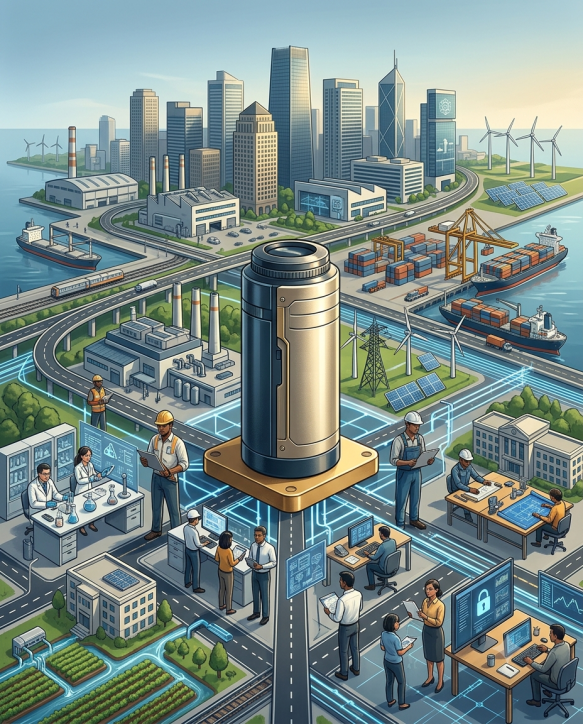
By Karl M. Garcia
Author’s Note
This paper is an independent policy proposal and strategic framework authored by Karl M. Garcia.
It draws upon publicly available Government of the Philippines frameworks—including AmBisyon Natin 2040, PAGTANAW 2050, the Philippine Development Plan 2023–2028, the National Security Strategy, the National Innovation Agenda and Strategy Document (NIASD), the Maritime Industry Development Plan (MIDP), the Maharlika Investment Fund Act, the E-Governance Act, RA 12064 (Philippine Maritime Zones Act), and RA 12065 (Philippine Archipelagic Sea Lanes Act)—as reference points for national direction.
Unless otherwise indicated, the concepts collectively described as the Capability Republic Framework, including the Energy Abundance Strategy, National Water Security Strategy, Human Capability Strategy 2040, National Food Security Strategy 2050, Pax Silica 2040, Philippine Global Champions Strategy 2040, National Continuity Act, National Capability Scorecard, and related recommendations are original policy proposals intended to stimulate discussion on long-term national development.
This paper does not represent the official position of the Government of the Philippines or any public or private institution.
Its central argument is simple:
The Philippines’ greatest competitive advantage in the twenty-first century will not be any single administration, policy, or corporation, but its ability to systematically build, preserve, and compound capabilities across generations.
Executive Summary
The twenty-first century will not be defined solely by wealth, territory, or population.
It will be defined by capabilities.
The nations that prosper will increasingly be those capable of:
- Generating abundant energy.
- Securing water resources.
- Feeding their populations.
- Developing human capital.
- Leveraging geography.
- Harnessing artificial intelligence.
- Producing globally competitive enterprises.
- Protecting sovereignty.
- Preserving institutions across generations.
The Philippines enters this century with considerable advantages.
It is an archipelagic nation situated at the center of the Indo-Pacific. It possesses a young population, abundant renewable energy potential, one of the world’s largest maritime labor forces, and growing pools of public and private capital.
Yet history demonstrates that advantages alone do not guarantee prosperity.
Capabilities do.
This paper proposes the Capability Republic Framework as a unifying philosophy for Philippine development.
It integrates ten strategic systems:
- Energy Abundance
- Water Security
- Food Security
- Human Capital
- Maritime and Coastal Capability
- Compute and Artificial Intelligence
- Global Champions
- Health Security
- National Security and Defense
- Institutional Continuity and Patient Capital
Together, these systems form a single proposition:
Nations are not transformed by plans. They are transformed by their accumulated capacity to specify, execute, verify, learn, and continue.
I. Introduction: The Future Does Not Vote
Democracies possess many strengths.
They promote accountability, protect liberties, and enable peaceful transfers of power.
They also possess an inherent weakness:
The future does not vote.
Political systems frequently optimize for election cycles, while national development requires generational thinking.
Universities require decades.
Power systems require decades.
Semiconductor ecosystems require decades.
Military modernization requires decades.
Global champions require decades.
The Philippines has never lacked plans.
It has often lacked continuity.
Over the years, the Republic has adopted ambitious frameworks including AmBisyon Natin 2040, PAGTANAW 2050, the Philippine Development Plan, and the National Security Strategy.
Collectively, these initiatives provide strategic direction.
What remains absent is a unifying philosophy capable of connecting them across administrations.
This paper proposes that philosophy.
It is called the Capability Republic.
II. The Capability Republic Framework
The Capability Republic proposes that national development should be measured not solely by GDP growth, but by the Republic’s ability to solve increasingly complex problems over time.
The Capability Equation
Capability = Specification × Execution × Verification × Learning × Continuity
The equation is intentionally multiplicative.
Weakness in one capability eventually constrains all others.
A nation with abundant energy but poor governance will underperform.
A nation with strong institutions but inadequate food systems will remain vulnerable.
Capabilities compound only when they are exercised continuously across generations.
The Ten Strategic Systems
Foundation Layer
- Energy
- Water
- Food
Human Layer
- Human Capital
- Health Security
Strategic Layer
- Maritime Capability
- National Security
Economic Layer
- Compute
- Global Champions
Governance Layer
- Institutional Continuity
Together, these systems produce resilience.
III. System One: Energy Abundance
Energy Abundance Strategy (2026–2050)
Energy is civilization’s master resource.
Without electricity:
- AI cannot compute.
- Industries cannot manufacture.
- Hospitals cannot operate.
- Water systems cannot function.
This paper proposes an Energy Abundance Strategy focused on:
- Renewable energy
- Nuclear and SMRs
- Offshore wind
- Battery storage
- Smart grids
- Hydrogen
- Regional interconnections
Strategic Objective
By 2050, electricity should no longer be a constraint.
It should be a national advantage.
IV. System Two: Water Security
National Water Security Strategy
Water is increasingly becoming a strategic capability.
Without water:
- Cities cannot grow.
- Agriculture cannot survive.
- Data centers cannot cool.
- Industries cannot operate.
This proposal recommends:
- Desalination
- Wastewater reuse
- Watershed rehabilitation
- Smart metering
- Flood management
- Aquifer protection
The objective is straightforward:
Water security must become a permanent feature of Philippine statecraft.
V. System Three: Feeding the Republic
National Food Security Strategy 2050
Food security is national security.
History repeatedly demonstrates that hungry nations become unstable nations.
The Philippines should aspire to become Southeast Asia’s leader in tropical agriculture and food innovation.
Priority areas include:
- Precision agriculture
- Agricultural biotechnology
- Aquaculture
- Cold chain infrastructure
- Climate-resilient crops
- Vertical farming
- Irrigation modernization
- Strategic food reserves
Mindanao, long described as the nation’s food basket, should become the center of a Mindanao Food Security and Agro-Industrial Corridor.
Strategic Objective
By 2050, the Philippines should substantially reduce food vulnerability while becoming a leading exporter of selected high-value agricultural products.
VI. System Four: Human Capability
Human Capability Strategy 2040
The Republic’s greatest resource is neither beneath its seas nor within its mountains.
It is its people.
Every capability ultimately rests upon human capability.
Without people:
- There are no engineers.
- There are no teachers.
- There are no scientists.
- There are no entrepreneurs.
This strategy proposes investments in:
- Early childhood education
- STEM education
- Technical-vocational education
- AI literacy
- Lifelong learning
- Scholarships
- Leadership development
- Public sector professionalization
- Overseas Filipino talent repatriation
Targets
- One million STEM graduates.
- Top 30 global education rankings.
- World-class Philippine universities.
- Reverse brain drain by 2040.
VII. System Five: Coastlines into Capability
Philippine Coastal Circular Economy Strategy
The Philippines possesses more than 36,000 kilometers of coastline.
Historically, coastlines were viewed as borders.
Increasingly, they should be viewed as platforms.
Its seas represent:
- Fisheries
- Renewable energy
- Logistics
- Tourism
- Maritime industries
- Ocean science
This proposal complements existing initiatives such as RA 12064 and the Maritime Industry Development Plan.
Potential applications include:
- Offshore wind
- Marine biotechnology
- Autonomous vessels
- Oceanographic research
- Blue economy investments
Future generations may regard Philippine coastlines as the Republic’s greatest strategic asset.
VIII. System Six: Compute into Competitiveness
Pax Silica 2040
Artificial intelligence is becoming a strategic resource.
Compute increasingly resembles electricity in the twentieth century.
Pax Silica 2040 proposes the development of Philippine capability clusters centered around:
- Subic
- Clark
- New Clark City
- Metro Manila
- Cebu
Priority sectors include:
- Artificial intelligence
- Semiconductors
- Cybersecurity
- Data centers
- Cloud infrastructure
- Enterprise software
Strategic Objective
Transform the Philippines from a consumer of technology into a producer of capability.
IX. System Seven: Champions that Scale
Philippine Global Champions Strategy 2040
Great nations frequently export companies alongside products.
Samsung helped define South Korea.
TSMC strengthened Taiwan.
ASML elevated the Netherlands.
The Philippines must ask:
Which Philippine enterprises will define the Republic’s reputation by 2050?
Potential sectors include:
- AI
- Biotechnology
- Aerospace
- Space technologies
- Maritime technologies
- Renewable energy
- Agritech
The objective is not to build larger corporations.
It is to build indispensable ones.
X. System Eight: Health Security
National Health Capability Strategy
COVID-19 demonstrated a fundamental truth:
Public health is national security.
This proposal recommends:
- Strengthening Universal Health Care
- Pharmaceutical manufacturing
- Biotechnology investments
- Pandemic preparedness
- Regional specialty hospitals
- Medical research institutes
By 2050, the Philippines should aspire to become a regional center for tropical medicine and healthcare innovation.
XI. System Nine: Security and Sovereignty
National Security Capability Strategy
Prosperity requires protection.
Strategic priorities include:
- AFP modernization
- Maritime domain awareness
- Cybersecurity
- Space surveillance
- Defense industries
- Strategic reserves
- Integrated deterrence
This proposal complements—not replaces—the National Security Strategy and existing modernization programs.
A Republic incapable of protecting its sovereignty cannot preserve its capabilities.
XII. System Ten: Preserving Capability
Institutional Continuity and Patient Capital
Capabilities require time.
Political systems frequently struggle to provide it.
This paper therefore proposes exploring:
- A National Continuity Act
- A National Strategy Registry
- A PAGTANAW 2050 Implementation Council
- A National Capability Scorecard
- Twenty-Five-Year Department Plans
- A Philippine Global Champions Fund
The greatest advantage of patient capital is not money.
It is time.
XIII. The Capability Republic by 2050
By 2050, the Philippines could become:
- An energy-abundant nation.
- A leader in water innovation.
- A food-secure archipelago.
- A center of human capital development.
- A leading maritime nation.
- An AI and semiconductor hub.
- A producer of global champions.
- A healthcare innovator.
- A secure and sovereign Republic.
- A nation that remembers how to build.
Most importantly, it could become a nation that compounds.
XIV. Conclusion: Building a Republic That Endures
The history of civilization can be understood through the systems it mastered.
The Romans mastered roads.
The British mastered steam.
The Americans mastered electricity.
The twentieth century mastered petroleum.
The twenty-first century will belong to nations that master capabilities.
For the Philippines, those capabilities are increasingly clear:
- Energy
- Water
- Food
- People
- Coastlines
- Compute
- Champions
- Health
- Security
- Continuity
Capabilities are among the few national assets that appreciate with use.
The more a nation exercises them, the more capable it becomes.
The Capability Republic is ultimately an argument about time.
Some nations optimize for the next election.
Others optimize for the next generation.
History suggests that the latter tend to prevail.
One day, future Filipinos may conclude that the defining achievement of this era was not a particular administration, corporation, or infrastructure project.
It was the decision to build a Republic capable of enduring.
A Republic powered by abundant energy.
Sustained by secure water.
Fed by resilient food systems.
Strengthened by educated citizens.
Connected by its coastlines.
Modernized by compute.
Represented by global champions.
Protected by strong institutions and secure borders.
And preserved by a political culture that remembered how to build.
Because the greatest nations are not remembered for what they inherited.
They are remembered for what they repeatedly proved they could become.
That is the aspiration of the Capability Republic:
A Republic that remembers.
A Republic that learns.
A Republic that compounds.
And ultimately—
A Republic that builds.


Guys I accidentally deleted the post and I just re-published it. Unfortunately I also deleted the comments. Please commebt again.
Check the trash. If you can restore the original post from there the comments will also be recovered.
it is weird – the old comments are still there but not visible anymore, so I am copying your two most important ones here:
1) Sharing this here:
Two routes through the Capability Republic
https://claude.ai/public/artifacts/91922494-3da1-48ef-a48c-55f65343d8cd
I’ve done an industrial and policy sequencing using both the traditional Development State Model (Japan, South Korea, Taiwan) and the Development Bargain Model (China, Vietnam, Indonesia, African states). I find the Development Bargain to be most interesting, and more Philippine thinkers should read the work of Dercon, Woolcock, Levy.
A bit busy here today, so I may have more to say later.
2) One thing to note is that the more traditional Development State Model works best when there is a national political consensus, which prefers an authoritarian phase or at the very least dominance by the party with the vision and will to execute: For post-War Japan that was the American military Far Eastern Commission which built the initial institutions; for South Korea, the Park-Chun military dictatorship; for Taiwan, the Kuomintang’s 71-year dominance. Japan was later able to carry forward the Development State Model despite having a vibrant democracy because the initial institutions had been built, while South Korea and Taiwan had largely completed heavy-industrial transformation by the time the respective countries exited their authoritarian phases.
After 1986 the Philippines jumped immediately to the Neoliberal Model, which is more suited to (and proved to be a failure in the West) already developed nations, despite still being in the process of (at the time, as is now) rebuilding institutions. Compound the weak institutions to weak parties with shifting coalitions and well, both the Development State Model and the Neoliberal Model don’t seem to work as the state is not consistent long enough for change to take root. Whatever positive change has been largely organic and ad-hoc, not following any firm framework.
I believe there to be a need to first build up institutions that have a degree of autonomy in order for there to be a consensus which will last multiple administrations and congresses.
Thanks for this.
This was my response to Joey earlier today, July 21st:
>>Very good blueprints from you and Karl, Joey. Thanks! I kicked them around quite extensively with Gemini these past two days! Lots of fun, i.e. I could disagree & argue w/ Gemini and it argued with me and corrected me, and vice versa. I was able to bring in the thoughts of Nicolas Roosevelt and compare your and Karl’s blueprints with those of the US at the turn of the last century.
In the end Gemini and I came to the conclusion that JoeAm’s approach (success in pockets that can be emulated by other pockets that see a good thing, as opposed to trying to change the whole country in one fell swoop) is the most realistic.
Although I probably could have, we did not bother to look into the works of those authors you recommended. Baka next time na lang.<<
The Development State Model requires a domestic credit-allocation lever attached to a planning council that has real teeth (not simply existing as an advisory body). See Robert Wade’s governed market (Governing the Market; which studied the Taiwanese case) and Alice Amsden’s reciprocal control (Asia’s Next Giant; which studied the South Korean case). For the credit-allocation lever, it wasn’t until the Central Bank of the Philippines was created in 1949 a few years into the Third Republic. NEC since its founding in 1935 in the Commonwealth era never gained actual execution and enforcement capability; unlike in industrializing South Korea where the Economic Planning Board had “super-ministry” status and the legal autonomy to executive on Five-Year Development Plans. I will note that CBP’s successor national bank, BSP, is one of the most well-run institutions in the Philippines and is afforded with a large degree of autonomy to set monetary policy (the credit-allocation lever). BSP is an institution that other Philippine institutions should probably be modeled after.
As for pockets of progress (PEZA) which may be emulated in the creation of additional pockets, check out my sequencing and linkage analysis again:
https://claude.ai/public/artifacts/91922494-3da1-48ef-a48c-55f65343d8cd
Pilot enclaves which have larger degrees of governance flexibilities, built off of ODA and FDI, are a strategy within the Development Bargain Model as it insulates the enclaved activity from elite interference while being pursued by elites who are starting to “buy into” the development bargain on the gamble that the bargain would bring them (along with the country) towards more benefits. If the “experiment” that runs inside the enclave doesn’t work out the projects just won’t be scaled up. The enclave can then be repurposed towards a new “experiment.”
my answer re 2) by Joey: the closest thing the Philippines had to a development state model was the Commonwealth under Quezon who was both extremely popular, had a still unitary Nacionalista Party behind him (the split into Nacionalistas and Liberals was in 1946) and American backing. But also it seems pretty much the consensus of a very homogenous elite and voting population (at that time the maybe 30% literate Filipinos who could vote)
The Third Republic I guess still ran on what the Commonwealth had built. Marcos tried to at last PERFORM the development state model but failed to do so, also discrediting it among Filipino liberals who went straight for neoliberalism and NOT a development bargain model. I still have to read on that though.
Re consensus probably the tragedy of the Commonwealth was that the consensus was not established enough to survive WW2 and 1946.
If one takes a heterodox view (outside of Philippine nationalist orthodoxy) informed by the numerous Filipinologists like Alfred McCoy (Anarchy of Families) and Paul Hutchcroft (Booty Capitalism) then the preconditions of Philippine oligarchic entrenchment — the fusion of family dynasties, politics, and business — happened when the Spanish (purposely or not) selected a few number of principalía to be elevated during the mid-19th century economic liberalization and transition to export agriculture. John Leddy Phelan describes the mechanism in Hispanization of the Philippines, which is that Spain governed indirectly through local intermediaries (e.g. cabezas de barangay, later gobernadorcillos). However the Spanish “innovation” was built upon prior, pre-colonial datu-centric architecture — one can use the analogy of hardware here.
So by the time we get to Malolos the ilustrado lawyers trained in Enlightenment-era European law drafted a constitution that was explicitly written to appear alike to international liberalism in order to demonstrate to the US and other Western powers that that Filipinos were capable of rights-based self-governance that merited support for independence. Mabini famously argued against the focus on form over function. One can see this as the start of the Philippine state, dominated by oligarchic clans, as having a preference for isomorphic mimicry — where governments adopt the outward forms and structures of functional systems (i.e. passing Western-style laws and creating new agencies around en vogue international standards) without actually practicing any of the actual capability or function (Looking Like a State; Lant Pritchett, Michael Woolcock, Matt Andrews). Isomorphic mimicry is an explanation as to why some developing countries get stuck in ”capability traps” despite passing “policy reform,” receiving large amounts of international aid, and appearing to have the form of institutions.
In this isomorphic mimicry frame the Commonwealth was also the first full-effort performance of Developmental State, not an actual implementation of the model. The Commonwealth had the institutional forms (i.e. planning council via NEC, Tenancy law for land reform, an expansion of suffrage, etc.) which was orchestrated more to prove to the US that the Philippines was “ready” enacted ahead of, and in lieu of, the actual underlying institutions that would be instruments for a directed development policy.
Here we may see a pattern:
Underlying the Philippine state is the same oligarchic hardware, put in place under the Spanish-sponsored principalía, going through 5 republics and one commonwealth where the institutional software is updated while the hardware was not. One may notice that the Philippines is quick to adopt “new vocabulary” (e.g. international standards, social justice terminology, etc.) layering each progressive update on top without changing the underlying systems.
>>Here we may see a pattern:
Underlying the Philippine state is the same oligarchic hardware, put in place under the Spanish-sponsored principalía, going through 5 republics and one commonwealth where the institutional software is updated while the hardware was not. One may notice that the Philippines is quick to adopt “new vocabulary” (e.g. international standards, social justice terminology, etc.) layering each progressive update on top without changing the underlying systems. << – Joey N.
Well said, Joey. Unfortunately, that is what I see in both works from Karl’s Capability Republic to your Development State vs. Development Bargain. Both simply fall into the trap of isomorphic mimicry – using modern terminology (“new vocabulary”) w/o actually changing the underlying system which is the problem.
When it comes to the Philippines the situation is often: “it’s complicated,” made somewhat more complicated by the dynasty-oligarchic layer.
Stuff often happens organically in a way that bypasses the existing framework and is only “made official” by a law or decree much later on. OFW, BPO, the seafarer pipeline all started outside of the system, only to be acknowledged later. Filipinos, as you know, are infamous for the “bypass,” which in a negative reading means obstinance to authority structures but also in a positive interpretation highlights Filipino ingenuity. There are often two sides to every story.
So yes, the underlying dynasty-oligarchic hardware may prefer isomorphic mimicry which is in a way them attempting to be acknowledged for being “on trend” while not really doing the work to change the system fundamentals or framework — because change would disfavor their tendency towards rent-seeking behavior IF they also don’t change, which they won’t because they don’t have any incentive to do so, having captured the main extraction levers.
Which brings us back to PEZA which in many ways is a “bypass” — PEZA bypasses LGU red tape, overlapping regulatory jurisdictions, and provides exemptions to Constitutional ownership constraints while remaining Constitutionally-compliant as PEZA exists in defined and limited areas. Being enclaved PEZA also insulates the activity within from political meddling which creates the stability and consistency desired by foreign investors. That is a good thing.
On FDI, Marcos Jr. is on track to achieve a number similar to Duterte. Duterte’s FDI attraction was actually twice as much as PNoy, though we must acknowledge that PNoy had to spend a good amount of his presidency to stabilize the economy left to him. If Pax Silica and other investments push through, even at the low end of pledges, Marcos Jr. would’ve possibly attracted the highest amount of FDI ever for the Philippines through Pax Silica.
One can argue all day about isomorphic mimicry being bad (a lot of development economists agree that it is bad), but at the end of the day the reason the mimicry exists in the first time is lack of incentive for change. So incentives must be provided and seen. For this reason PEZA and M4GG successes are important. Demonstrate success to activate the innate Filipino penchant for envy-driven competition so that the country can be reformed outward from enclaves that show the benefits of success.
‘When it comes to the Philippines the situation is often: “it’s complicated,”…’ – Joey N.
Are you quoting Trump? That is how he responded to his failure to “repeal and replace Obamacare on the first day of my presidency.” Just curious, hehehe
“So incentives must be provided and seen.” – Joey N.
Provided by who? The elite? I think the problem is the elite have no incentive to provide incentives. They are content with the way things are, or at least not discontented enough to do something about it. It is complicated.
There are a lot of examples in other countries in our ASEAN region plus possibly Taiwan and So. Korea for elite Filipinos to be “inspired” to imitate for the sake of Inang Bayan. But since when do our leaders care about Inang Bayan in the first place? Again, it is complicated.
But thanks for the introduction to the term “isomorphic mimicry.” Learn something new everyday.
Oh, and speaking of “it’s complicated,” while your idea of Development State vs. Development Bargain is simple enough, I think your presentation was a bit too complicated, at least for me. You had great ideas and I suspected that, so I enlisted the help of Gemini to understand what you were saying. Gemini was a big help simplifying the complexities of your presentation….including the phrase “isomorphic mimicry!”
But how many readers would do what I did vs. just shrug their shoulders and move on to another essay or topic? Just my suggestion for what it is worth.
Not all elites are exclusively rent-seekers. Many of the M4GG mayors are from big dynasties. They have simply realized that progress means that progress for their constituents means they will also get more rich, which is the operative basis of Dercon’s “Development Bargain” Model.
As for the incentives I’m referring to more on the incentive of envy, which I pointed out is a human trait, one that Filipinos take to the next level of competativeness. In any given area the Philippines can be seen as local dynasties competing for prominence and prestige, of which one of the basic ways they display it is through pageantry and fiestas; under what I’m saying the competition will move into prowess at making their cities (and citizens) richer, which will also make themselves richer. M4GG municipalities and cities are already showing some of this progress.
Under an ideal timeline the Philippines would’ve already taken the Developmental State model that South Korea and Taiwan took. In fact it is very fair to say that the early Marcos Sr. presidency attempted exactly that. The “Marcos technocrat” was a real thing throughout the Marcos Sr. presidency and they attempted to emulate the East Asian countries but without having the power of the South Korean Economic Planning Board, the Japanese MITI and Economic Planning Board, or the Taiwanese Council for Economic Planning and Development.
I would also place caution on the middle class and elite tendency to look at “finished solutions” then asking “why can’t we have that here,” rather than asking the correct question which is “what is stopping us from having that here?” Once the correct question is asked one will quickly realize the dynasty-oligarchic hardware prevents direct emulation. Continuing to want to copy results without understanding the equation is exactly why the Philippines continues to fail at wholesale transformation. If one wants to copy those countries one needs to dismantle the dynasty-oligarchic layer first, which won’t happen as the same people who must vote to dismantle the system benefit from such a system, and are overwhelmingly and popularly voted into Congress and the Presidency over and over again for decades. Enclaved “experiments” are a way to experiment with “new hardware.”
Thanks, I was an essayist at one time, and writing is one area where I can put my degree (English) to use. The ideas aren’t so complicated though. I have a tendency to add in-line explanations on new concepts.
Thanks for the thoughts, Joey. Personally, I think your visions overlook the factors that made you say earlier “it’s complicated.” But maybe others have ideas that can add to a discussion on Karl’s “Capability Republic” and your suggestion on the two models Development State and Development Bargain. Note I am trying to prime the pump here. hehehe
I’m not overlooking; I tend to be a realist.
Just be clear though, I write about both economic development models to contrast them. The educated middle class and technocrats have often historically favored the Developmental State model — even if they didn’t know the exact term.
One can analogize that the Developmental State model, requiring strong state-led coordinated action, is like the legend of the Gordian Knot. Indeed one can see how many Filipinos in the middle class commentariat apparently did not read the entire legend and focused the exquisite solution part (the cutting of the knot), totally forgetting that according to the legend Alexander the Great used his sword to cut the knot. Alexander is the state, while the sword is the tool whereby the state-led action of knot-cutting is done.
The Development Bargain is a newer model that resulted from studying why some states which did not follow the developmentalism path of the Developmental State model nonetheless achieved a great measure of success. The Development Bargain, unlike the Developmental State, is a heterodox model — it seeks to explain elite-driven (as opposed to state-driven) development in states without strong political systems or strong institutions. Instead of structured plans like traditional development models the Development Bargain identifies ad-hoc enclaved successes achieved by localized elites who have according to Dercon have “gambled on development” and replicates it across the economy.
Hmm….based on your explanations so far, I see more of an academic speaking than a realist. But that is just my opinion.
By the way, what is your alternative that works within the existing system then? So that I understand your view.
“By the way, what is your alternative that works within the existing system then? So that I understand your view.” – Joey
My recipe is the same as Rizal’s: “Through hard work and study, learn the civic virtues and make ourselves worthy of the liberties that we seek.”
How do you propose this to be done?
“How do you propose this to be done?” – Joey N.
Each Filipino will have to engage in the hard work and study to learn the civic virtues AND make themselves worthy (or deserving) of the liberties we seek.
What you’re suggesting has never happened outside of rhetoric even up to this day in the oldest constitutional democracy in the world (the United States) nor the country with the oldest constitutional framework (the UK). So good luck Philippines.
“What you’re suggesting has never happened outside of rhetoric even up to this day in the oldest constitutional democracy in the world (the United States) nor the country with the oldest constitutional framework (the UK). So good luck Philippines.” – Joey N.
Ah, so you trivialize our national hero as simply a source of empty rhetoric? Honestly, I think a lot of Filipinos are with you in that line of thinking.
But I don’t buy it as empty rhetoric. In fact, I would dare say that not just the US and UK but every country in the G7 built a stable, prosperous society with a population grounded in hard work, literacy, and intergenerational civic ethics. The top-down systems didn’t create the character of those peoples—the character of those peoples created and sustained the systems.
And I believe that has happened in many other nations that are not in the G7. Notably South Korea, Taiwan and even Ukraine come to mind.
If I trivialized Rizal I wouldn’t have gone through the trouble of reading his writings and the body of work around it in the original Spanish where I could. I think, based on what we know about Rizal, that Rizal had immense humility and would’ve rejected blind worship of leaders along with an iconization that displaced ideas.
Where do we suppose those people received their character? Where did civics come from? And in intergenerational transfer, who was the initial emulated person(s) and how did they gain their ideas? People are not born with character or even ideas. Those things are taught not primarily through memorization and recitation but by people recognizing the benefits of emulating character, civics, hard work, and so on. Now what do we suppose happens in a society where many people have no clue at all about those things since no one ever taught them and they had few public figures acting as mirrors? It had to start somewhere. And it starts with more action, starting by those who want change.
“If I trivialized Rizal I wouldn’t have gone through the trouble of reading his writings and the body of work around it in the original Spanish where I could.” – Joey N.
Then I am sure you read what he said when I used him to articulate MY recipe for a solution that works within the current system. I guess Rizal agrees with me, eh? But you dismiss our recipe as never having happened in human history. I pointed out to you the error of that conclusion, naming specific countries where it has happened. You didn’t address it in your response.
“I think, based on what we know about Rizal, that Rizal had immense humility and would’ve rejected blind worship of leaders along with an iconization that displaced ideas.” – Joey N.
Yes definitely. Rizal had that famous advice that his countrymen “follow your own torch” and especially not to just follow someone just because he wears a brown robe. As you know, he was referring to the brown robed Friars. You will recall he even mockingly referred to some of us Filipinos who would follow a carabao if you put a brown robe on him….hehehe
As a result, I do not have a blind worship of Rizal or any iconization of him. But I do admire him tremendously both as a person AND his insight into the Filipino.
“Where do we suppose those people received their character? “ – Joey N.
Now that is a very good question. I can tell you where I received mine, and I am sure you and other members of this TSOH can tell all of us where they received theirs. And I am confident we all will have slightly if not drastically different stories of where we received our character.
I think the bulk of our character learning is done in the home, starting at a very early age, perhaps even before we start walking. A good home environment is an advantage. But regardless of home environment, what is important is that we learn it some how, some way. No excuses.
“Now what do we suppose happens in a society where many people have no clue at all about those things since no one ever taught them and they had few public figures acting as mirrors? It had to start somewhere. And it starts with more action, starting by those who want change.” – Joey N.
Yup…totally agree with you on that. Like I said, no excuses.
Incidentally, I saw in your response to JoeAm that you said: “My view on the subject of Filipino deservedness is that my own view is all Filipinos deserve better, without precondition.” That is laudable, but I don’t believe it is what Rizal was talking about when he said “make ourselves worthy of the liberties that we seek.” In his original Spanish (to refresh your memory), he used the Spanish reflexive verb “hacerse.” So it is not for another person to make a Filipino worthy, but rather the challenge is for the Filipino himself to make himself worthy of the liberties that he seeks. When I was studying Rizal, that phrase did bother me because I thought, like you, that everyone was deserving of liberties. I declared the Filipino as worthy. So I dug deeper and looked at the Spanish original to learn what Rizal really meant. What I learned was that it was not for me to declare a Filipino as worthy, but for the Filipino himself to make himself worthy.
It is an interesting point. If we take militaristic loyalty to the Constitution as the ideal standard for citizens, we can see that the US leadership has abandoned it, and half the population has lost it, or completely perverted it. The Philippines has had such a jumbled history that leadership has failed to inspire consistent loyalty to the Constitution even though rote education has tried to order it. Marcos perverted it. Duterte, too. Yet Filipinos are proud of their country. Maybe it’s insecure bluster. But citizens are generally loyal to the idea of a nation, if not the ideals in the Constitution. I agree it’s impossible to get to where CV wants OTHERS to go. I’m not sure he can even get himself there.
Not all people who voted for Trump did so out of loyalty to MAGA. Many genuinely believed, falsely, that the MAGA promises would bring about an improvement in their family’s personal economic conditions. I don’t think we should write them off, and many have snapped back in the opposite direction. As for Trump’s base: MAGA has been a consistent ~36% of Americans for a decade — the latest Fox News poll (Fox’s polling operation is gold standard) shows that only 24% of Americans now support Trump’s agenda. His base is starting to have the bottom fall out. That is why Trump is attempting to blatantly steal the midterm election.
My view on the subject of Filipino deservedness is that my own view is all Filipinos deserve better, without precondition. Too often I find the conversation in and around the Philippines to be about copying results without fundamentally understanding “how to get there.” This is why the Philippines government and oligarchs both have a tendency towards buying bespoke results rather than being interested in figuring out how to replicate success. PEZA, BCDA, and M4GG are bright spots that are somewhat insulated by dynastic politics. Quite worth emulating and replicating as (partially thus far but potentially fully) domestic examples of success rather than continual self-flagellation.
The Republican representatives obey Trump. Their constituents are largely ineffective at changing this. Filipinos do deserve better but half vote against themselves, a function of fractionalized liberals too weak to educate them.
Yes. Here in the US there is a surge of the “Democratic Socialists” (who had been taken over by communists in 2016) due to liberal Democratic ineffectiveness in “fighting” Trump. As someone who left the Republican Party (officially in 2008) I find it highly ironic that the strongest and most reasonable voices in the US today are the ex-Republican “Never Trumpers” who have maintained their principles to the Constitution while retaining the Republican ability to punch hard.
I believe most people, Filipinos included, vote against their own interests because emotionalism and a fallback to bias is the human default in the absence of champions who can clearly vocalize a unifying better way. The good news is in times of crisis unlikely champions rise up, as they are in the US presently. I believe that in the Philippines the aggregate efforts of the Marcos Jr. administration around the PEZA investments and the M4GG mayors is a good starting point to develop a new cohort of Philippine champions.
Thanks.
I restored the post from trash but the comments don’t properly link to the post anymore, so here is Joe’s most important response: (Joey’s two most important posts I already restored)
What a terrific compilation of action steps. Exciting actually because it is spot on. I have several different thoughts.
-“The future doesn’t vote”, so it throws wrenches (storms, plagues, China) into the engines of progress, and competition. And, unfortunately, Filipinos often vote stupidly so corruption is inspired rather than squelched. Corruption, systemic handcuffs (money sent to incompetent LGUs), and insane red tape (senseless amalgamation of laws) slow progress to a trudge.
-The Philippines is clearly starting to work on a lot of the suggested actions, including all kinds of renewable energy, desalinization, defense, and Pax Silica as a digital foundation. This needs to be accelerated. But why does it take six permits for me to install solar panels at my home when one should do?
-Food security is one part better domestic agribusiness (not farms) and stable logistics. Getting to agribusiness runs against the mom and pop farmer mentality of the nation; it’s almost hopeless. Logistics are 8 on a scale of 1 to 10, pretty good, because the oligarchs are good at retail.
-If all the corrupt billions were transferred to good use, with this paper as a plan, the nation would absolutely blossom.
– Human capital: the nation needs to build careers into its workplaces to inspire its workers and bring OFWs home. It needs to pay top government officials First World wages and point the populace up. Stop beating them down or holding them in resilience mode. Inspire, don’t command.
Put this article in brass and nail it to the Palace front door.
Many thanks Irineo.
This post that Irineo recovered was from JoeAm. I remember his “nail it to the Palace front door.”
This was my response to JoeAm’s post:
>>“What a terrific compilation of action steps.” – JoeAm
I agree…like a great recipe or a good technical manual.
Question remains: Do we have a qualified cook? Do we have a qualified mechanic?
I deliberately use the word “qualified” because the challenges Karl’s good recipe or good technical manual face is extraordinarily difficult. It would be like a cook not having a decent kitchen, or a mechanic not having a decent shop with proper tools, etc.
A qualified leader (like cook or mechanic) must have the quality of being able to make do with the poor facilities he is gifted with.
That is where I admire the Ukranians. Zelensky did not have the excellent fighting force he has today when the Russians first attacked. But under his leadership, he was able to both hold off Putin AND build the Ukranian military into the lethal fighting force it has become.
Can the Filipino who picks up Karl’s “compilation of action steps” off the Palace front door be that qualified leader?<<
JoeAm’s response to this post of mine was to the effect that Zelensky has his challenges too, but he has the qualities of a good leader to deal with them. JoeAm said that we don’t have such a leader yet and we have to wait “until the planets line up.”
Thanks CV for your recollection.