The Capability Republic
Building a Nation that Compounds
Integrating Energy, Water, Food, People, Coastlines, Compute, and Champions under PAGTANAW 2050
A White Paper on Philippine Grand Strategy, 2026–2050
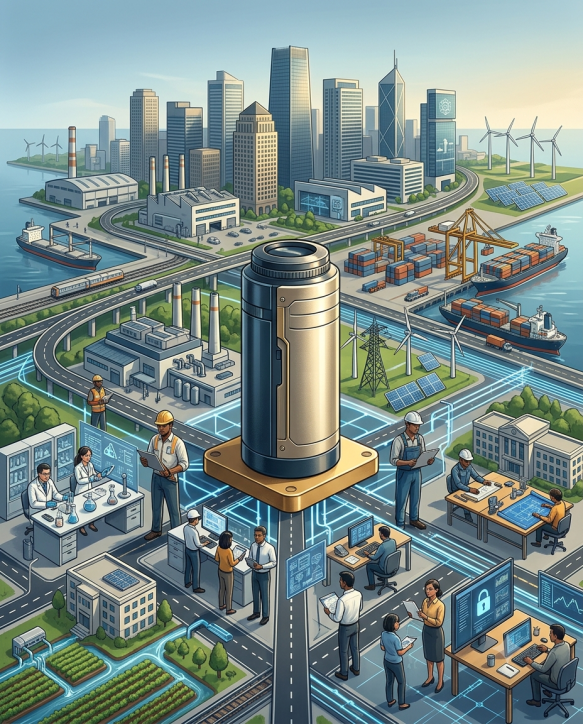
By Karl M. Garcia
Author’s Note
This paper is an independent policy proposal and strategic framework authored by Karl M. Garcia.
It draws upon publicly available Government of the Philippines frameworks—including AmBisyon Natin 2040, PAGTANAW 2050, the Philippine Development Plan 2023–2028, the National Security Strategy, the National Innovation Agenda and Strategy Document (NIASD), the Maritime Industry Development Plan (MIDP), the Maharlika Investment Fund Act, the E-Governance Act, RA 12064 (Philippine Maritime Zones Act), and RA 12065 (Philippine Archipelagic Sea Lanes Act)—as reference points for national direction.
Unless otherwise indicated, the concepts collectively described as the Capability Republic Framework, including the Energy Abundance Strategy, National Water Security Strategy, Human Capability Strategy 2040, National Food Security Strategy 2050, Pax Silica 2040, Philippine Global Champions Strategy 2040, National Continuity Act, National Capability Scorecard, and related recommendations are original policy proposals intended to stimulate discussion on long-term national development.
This paper does not represent the official position of the Government of the Philippines or any public or private institution.
Its central argument is simple:
The Philippines’ greatest competitive advantage in the twenty-first century will not be any single administration, policy, or corporation, but its ability to systematically build, preserve, and compound capabilities across generations.
Executive Summary
The twenty-first century will not be defined solely by wealth, territory, or population.
It will be defined by capabilities.
The nations that prosper will increasingly be those capable of:
- Generating abundant energy.
- Securing water resources.
- Feeding their populations.
- Developing human capital.
- Leveraging geography.
- Harnessing artificial intelligence.
- Producing globally competitive enterprises.
- Protecting sovereignty.
- Preserving institutions across generations.
The Philippines enters this century with considerable advantages.
It is an archipelagic nation situated at the center of the Indo-Pacific. It possesses a young population, abundant renewable energy potential, one of the world’s largest maritime labor forces, and growing pools of public and private capital.
Yet history demonstrates that advantages alone do not guarantee prosperity.
Capabilities do.
This paper proposes the Capability Republic Framework as a unifying philosophy for Philippine development.
It integrates ten strategic systems:
- Energy Abundance
- Water Security
- Food Security
- Human Capital
- Maritime and Coastal Capability
- Compute and Artificial Intelligence
- Global Champions
- Health Security
- National Security and Defense
- Institutional Continuity and Patient Capital
Together, these systems form a single proposition:
Nations are not transformed by plans. They are transformed by their accumulated capacity to specify, execute, verify, learn, and continue.
I. Introduction: The Future Does Not Vote
Democracies possess many strengths.
They promote accountability, protect liberties, and enable peaceful transfers of power.
They also possess an inherent weakness:
The future does not vote.
Political systems frequently optimize for election cycles, while national development requires generational thinking.
Universities require decades.
Power systems require decades.
Semiconductor ecosystems require decades.
Military modernization requires decades.
Global champions require decades.
The Philippines has never lacked plans.
It has often lacked continuity.
Over the years, the Republic has adopted ambitious frameworks including AmBisyon Natin 2040, PAGTANAW 2050, the Philippine Development Plan, and the National Security Strategy.
Collectively, these initiatives provide strategic direction.
What remains absent is a unifying philosophy capable of connecting them across administrations.
This paper proposes that philosophy.
It is called the Capability Republic.
II. The Capability Republic Framework
The Capability Republic proposes that national development should be measured not solely by GDP growth, but by the Republic’s ability to solve increasingly complex problems over time.
The Capability Equation
Capability = Specification × Execution × Verification × Learning × Continuity
The equation is intentionally multiplicative.
Weakness in one capability eventually constrains all others.
A nation with abundant energy but poor governance will underperform.
A nation with strong institutions but inadequate food systems will remain vulnerable.
Capabilities compound only when they are exercised continuously across generations.
The Ten Strategic Systems
Foundation Layer
- Energy
- Water
- Food
Human Layer
- Human Capital
- Health Security
Strategic Layer
- Maritime Capability
- National Security
Economic Layer
- Compute
- Global Champions
Governance Layer
- Institutional Continuity
Together, these systems produce resilience.
III. System One: Energy Abundance
Energy Abundance Strategy (2026–2050)
Energy is civilization’s master resource.
Without electricity:
- AI cannot compute.
- Industries cannot manufacture.
- Hospitals cannot operate.
- Water systems cannot function.
This paper proposes an Energy Abundance Strategy focused on:
- Renewable energy
- Nuclear and SMRs
- Offshore wind
- Battery storage
- Smart grids
- Hydrogen
- Regional interconnections
Strategic Objective
By 2050, electricity should no longer be a constraint.
It should be a national advantage.
IV. System Two: Water Security
National Water Security Strategy
Water is increasingly becoming a strategic capability.
Without water:
- Cities cannot grow.
- Agriculture cannot survive.
- Data centers cannot cool.
- Industries cannot operate.
This proposal recommends:
- Desalination
- Wastewater reuse
- Watershed rehabilitation
- Smart metering
- Flood management
- Aquifer protection
The objective is straightforward:
Water security must become a permanent feature of Philippine statecraft.
V. System Three: Feeding the Republic
National Food Security Strategy 2050
Food security is national security.
History repeatedly demonstrates that hungry nations become unstable nations.
The Philippines should aspire to become Southeast Asia’s leader in tropical agriculture and food innovation.
Priority areas include:
- Precision agriculture
- Agricultural biotechnology
- Aquaculture
- Cold chain infrastructure
- Climate-resilient crops
- Vertical farming
- Irrigation modernization
- Strategic food reserves
Mindanao, long described as the nation’s food basket, should become the center of a Mindanao Food Security and Agro-Industrial Corridor.
Strategic Objective
By 2050, the Philippines should substantially reduce food vulnerability while becoming a leading exporter of selected high-value agricultural products.
VI. System Four: Human Capability
Human Capability Strategy 2040
The Republic’s greatest resource is neither beneath its seas nor within its mountains.
It is its people.
Every capability ultimately rests upon human capability.
Without people:
- There are no engineers.
- There are no teachers.
- There are no scientists.
- There are no entrepreneurs.
This strategy proposes investments in:
- Early childhood education
- STEM education
- Technical-vocational education
- AI literacy
- Lifelong learning
- Scholarships
- Leadership development
- Public sector professionalization
- Overseas Filipino talent repatriation
Targets
- One million STEM graduates.
- Top 30 global education rankings.
- World-class Philippine universities.
- Reverse brain drain by 2040.
VII. System Five: Coastlines into Capability
Philippine Coastal Circular Economy Strategy
The Philippines possesses more than 36,000 kilometers of coastline.
Historically, coastlines were viewed as borders.
Increasingly, they should be viewed as platforms.
Its seas represent:
- Fisheries
- Renewable energy
- Logistics
- Tourism
- Maritime industries
- Ocean science
This proposal complements existing initiatives such as RA 12064 and the Maritime Industry Development Plan.
Potential applications include:
- Offshore wind
- Marine biotechnology
- Autonomous vessels
- Oceanographic research
- Blue economy investments
Future generations may regard Philippine coastlines as the Republic’s greatest strategic asset.
VIII. System Six: Compute into Competitiveness
Pax Silica 2040
Artificial intelligence is becoming a strategic resource.
Compute increasingly resembles electricity in the twentieth century.
Pax Silica 2040 proposes the development of Philippine capability clusters centered around:
- Subic
- Clark
- New Clark City
- Metro Manila
- Cebu
Priority sectors include:
- Artificial intelligence
- Semiconductors
- Cybersecurity
- Data centers
- Cloud infrastructure
- Enterprise software
Strategic Objective
Transform the Philippines from a consumer of technology into a producer of capability.
IX. System Seven: Champions that Scale
Philippine Global Champions Strategy 2040
Great nations frequently export companies alongside products.
Samsung helped define South Korea.
TSMC strengthened Taiwan.
ASML elevated the Netherlands.
The Philippines must ask:
Which Philippine enterprises will define the Republic’s reputation by 2050?
Potential sectors include:
- AI
- Biotechnology
- Aerospace
- Space technologies
- Maritime technologies
- Renewable energy
- Agritech
The objective is not to build larger corporations.
It is to build indispensable ones.
X. System Eight: Health Security
National Health Capability Strategy
COVID-19 demonstrated a fundamental truth:
Public health is national security.
This proposal recommends:
- Strengthening Universal Health Care
- Pharmaceutical manufacturing
- Biotechnology investments
- Pandemic preparedness
- Regional specialty hospitals
- Medical research institutes
By 2050, the Philippines should aspire to become a regional center for tropical medicine and healthcare innovation.
XI. System Nine: Security and Sovereignty
National Security Capability Strategy
Prosperity requires protection.
Strategic priorities include:
- AFP modernization
- Maritime domain awareness
- Cybersecurity
- Space surveillance
- Defense industries
- Strategic reserves
- Integrated deterrence
This proposal complements—not replaces—the National Security Strategy and existing modernization programs.
A Republic incapable of protecting its sovereignty cannot preserve its capabilities.
XII. System Ten: Preserving Capability
Institutional Continuity and Patient Capital
Capabilities require time.
Political systems frequently struggle to provide it.
This paper therefore proposes exploring:
- A National Continuity Act
- A National Strategy Registry
- A PAGTANAW 2050 Implementation Council
- A National Capability Scorecard
- Twenty-Five-Year Department Plans
- A Philippine Global Champions Fund
The greatest advantage of patient capital is not money.
It is time.
XIII. The Capability Republic by 2050
By 2050, the Philippines could become:
- An energy-abundant nation.
- A leader in water innovation.
- A food-secure archipelago.
- A center of human capital development.
- A leading maritime nation.
- An AI and semiconductor hub.
- A producer of global champions.
- A healthcare innovator.
- A secure and sovereign Republic.
- A nation that remembers how to build.
Most importantly, it could become a nation that compounds.
XIV. Conclusion: Building a Republic That Endures
The history of civilization can be understood through the systems it mastered.
The Romans mastered roads.
The British mastered steam.
The Americans mastered electricity.
The twentieth century mastered petroleum.
The twenty-first century will belong to nations that master capabilities.
For the Philippines, those capabilities are increasingly clear:
- Energy
- Water
- Food
- People
- Coastlines
- Compute
- Champions
- Health
- Security
- Continuity
Capabilities are among the few national assets that appreciate with use.
The more a nation exercises them, the more capable it becomes.
The Capability Republic is ultimately an argument about time.
Some nations optimize for the next election.
Others optimize for the next generation.
History suggests that the latter tend to prevail.
One day, future Filipinos may conclude that the defining achievement of this era was not a particular administration, corporation, or infrastructure project.
It was the decision to build a Republic capable of enduring.
A Republic powered by abundant energy.
Sustained by secure water.
Fed by resilient food systems.
Strengthened by educated citizens.
Connected by its coastlines.
Modernized by compute.
Represented by global champions.
Protected by strong institutions and secure borders.
And preserved by a political culture that remembered how to build.
Because the greatest nations are not remembered for what they inherited.
They are remembered for what they repeatedly proved they could become.
That is the aspiration of the Capability Republic:
A Republic that remembers.
A Republic that learns.
A Republic that compounds.
And ultimately—
A Republic that builds.


 The Society of Honor by Joe America
What a terrific compilation of action steps. Exciting actually because it is spot on. I have several different thoughts.
-“The future doesn’t vote”, so it throws wrenches (storms, plagues, China) into the engines of progress, and competition. And, unfortunately, Filipinos often vote stupidly so corruption is inspired rather than squelched. Corruption, systemic handcuffs (money sent to incompetent LGUs), and insane red tape (senseless amalgamation of laws) slow progress to a trudge.
-The Philippines is clearly starting to work on a lot of the suggested actions, including all kinds of renewable energy, desalinization, defense, and Pax Silica as a digital foundation. This needs to be accelerated. But why does it take six permits for me to install solar panels at my home when one should do?
-Food security is one part better domestic agribusiness (not farms) and stable logistics. Getting to agribusiness runs against the mom and pop farmer mentality of the nation; it’s almost hopeless. Logistics are 8 on a scale of 1 to 10, pretty good, because the oligarchs are good at retail.
-If all the corrupt billions were transferred to good use, with this paper as a plan, the nation would absolutely blossom.
– Human capital: the nation needs to build careers into its workplaces to inspire its workers and bring OFWs home. It needs to pay top government officials First World wages and point the populace up. Stop beating them down or holding them in resilience mode. Inspire, don’t command.
Put this article in brass and nail it to the Palace front door.
Many thanks Joe.
I guess if the deal breakers the party poopers te show stoppers the hecklers and bashers can be transformed to an anti-monkey wrench game changer then we have a ball game.
Some of the monkey memes on FB reflect a building rage against China.
It is also building rage against Robin Padilla.
As for China, I hope that rage builds and wont go pfft afterwards.
“What a terrific compilation of action steps.” – JoeAm
I agree…like a great recipe or a good technical manual.
Question remains: Do we have a qualified cook? Do we have a qualified mechanic?
I deliberately use the word “qualified” because the challenges Karl’s good “recipe” or good “technical manual” face are extraordinarily difficult. It would be like a cook not having a decent kitchen, or a mechanic not having a decent shop with proper tools, etc.
A qualified leader (like a qualified cook or mechanic) must have the quality of being able to make do with the poor facilities he is gifted with and still succeed. “Puede na” is not good enough.
That is where I admire the Ukranians. Zelensky did not have the excellent fighting force he has today when the Russians first attacked. But under his leadership, he was able to both hold off Putin AND build the Ukranian military into the lethal fighting force it has become. I understand NATO and the Pentagon are taking notes from the Ukrainian military on how to fight in modern warfare.
Can the Filipino who picks up Karl’s “compilation of action steps” off the Palace front door be that qualified leader?
“That is the 64 question.” (humorous but serious expression we had back in our college days in Manila)
Even President Zelenskyy has had trouble with corruption and malcontents. But he has the charisma, brains, strength, and needed power to build a war machine, with the considerable aid from other nations. The Philippines has top people with the brains, but maybe not the strength, to pull it off. But surprises are where you find them. Would a President have the power to pull off dramatic change? Iffy. Maybe so, maybe not. We need the planets to align properly.
Sharing this here:
Two routes through the Capability Republic
https://claude.ai/public/artifacts/91922494-3da1-48ef-a48c-55f65343d8cd
I’ve done an industrial and policy sequencing using both the traditional Development State Model (Japan, South Korea, Taiwan) and the Development Bargain Model (China, Vietnam, Indonesia, African states). I find the Development Bargain to be most interesting, and more Philippine thinkers should read the work of Dercon, Woolcock, Levy.
A bit busy here today, so I may have more to say later.
One thing to note is that the more traditional Development State Model works best when there is a national political consensus, which prefers an authoritarian phase or at the very least dominance by the party with the vision and will to execute: For post-War Japan that was the American military Far Eastern Commission which built the initial institutions; for South Korea, the Park-Chun military dictatorship; for Taiwan, the Kuomintang’s 71-year dominance. Japan was later able to carry forward the Development State Model despite having a vibrant democracy because the initial institutions had been built, while South Korea and Taiwan had largely completed heavy-industrial transformation by the time the respective countries exited their authoritarian phases.
After 1986 the Philippines jumped immediately to the Neoliberal Model, which is more suited to (and proved to be a failure in the West) already developed nations, despite still being in the process of (at the time, as is now) rebuilding institutions. Compound the weak institutions to weak parties with shifting coalitions and well, both the Development State Model and the Neoliberal Model don’t seem to work as the state is not consistent long enough for change to take root. Whatever positive change has been largely organic and ad-hoc, not following any firm framework.
I believe there to be a need to first build up institutions that have a degree of autonomy in order for there to be a consensus which will last multiple administrations and congresses.
Thanks, Joey….I wonder if we will have a robust discussion on your ideas…or just a “nod and agree.” hehehe
Feel free to add your thoughts. I’ll answer later when I’m home.
Sure, but do I have to agree with you all the time? That would cramp my “snide remarks” style. Just kidding (in case it is not obvious)…. 🙂
If you participate in serious good faith discussion, I’ll engage. That’s all.