From SONA to Results
Why the Philippines Needs a People’s Governance Scorecard
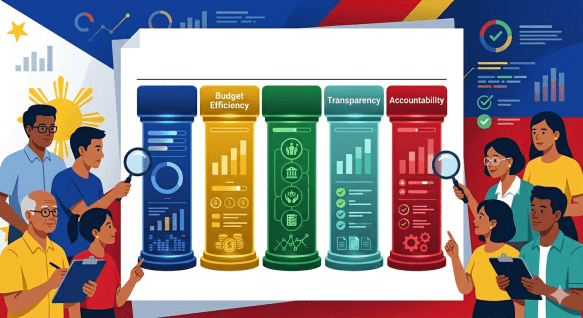
By Karl M. Garcia
Every July, millions of Filipinos watch the State of the Nation Address (SONA). New priorities are announced, ambitious targets are unveiled, and agencies receive marching orders for the coming year.
Yet after the applause fades, one question remains:
Who keeps score?
The Philippines has no shortage of plans. It has Philippine Development Plans, agency strategic plans, annual budgets, flagship infrastructure programs, digital transformation roadmaps, and countless policy commitments. What it lacks is an integrated system that links presidential priorities to agency execution and, ultimately, to measurable public outcomes.
The problem is not planning.
It is implementation.
Nor is it simply a lack of accountability.
It is the absence of a common framework that allows government to manage performance while enabling citizens to independently verify results.
The solution is not another reporting requirement. It is a two-level governance architecture:
- Government OKRs for execution.
- A People’s Governance Scorecard for public accountability.
Together, they transform the SONA from a political speech into an annual performance contract between the government and the Filipino people.
Level One: Government OKRs
Inside government, each major SONA priority becomes a national Objective.
Each Objective is translated into measurable Key Results assigned to departments, agencies, and local governments.
For example:
Objective: Improve Food Security
Key Results:
- Reduce food inflation.
- Increase palay productivity.
- Expand irrigation coverage.
- Raise average farmer income.
- Reduce post-harvest losses.
Every department aligns its own OKRs with these national objectives.
The Department of Agriculture focuses on production.
The Department of Public Works and Highways builds farm-to-market roads.
The Department of Trade and Industry strengthens agricultural value chains.
The Department of Science and Technology supports innovation.
Instead of agencies working in parallel, they work toward shared national outcomes.
Quarterly reviews allow adjustments before problems become crises.
Government uses OKRs to manage.
Level Two: The People’s Governance Scorecard
Management inside government is only half the equation.
Citizens also deserve an independent way to determine whether government commitments are producing tangible improvements.
This is the role of the People’s Governance Scorecard.
Unlike internal OKRs, which help agencies execute strategy, the scorecard evaluates performance from the perspective of the public.
It asks not whether government completed activities, but whether those activities improved people’s lives.
Seven Pillars of the Scorecard
The People’s Governance Scorecard would evaluate government using seven complementary dimensions.
1. Promise Fulfillment Index
Did the administration deliver the commitments made in the previous SONA?
Promises would be classified as:
- Completed
- On Track
- Delayed
- Partially Completed
- Not Started
- Abandoned
Major national commitments would carry greater weight than routine administrative announcements.
2. Budget-to-Outcome Efficiency
Government should be measured not only by how much it spends but by what those expenditures accomplish.
A project that exhausts its budget but fails to deliver intended outcomes should not automatically be considered successful.
Efficiency should matter as much as expenditure.
3. National Outcome Dashboard
Government should receive credit when citizens experience real improvements.
Indicators would include:
- Economic performance
- Employment
- Poverty reduction
- Inflation
- Healthcare
- Education
- Public safety
- Infrastructure
- Environmental resilience
The emphasis shifts from counting projects to measuring impact.
4. Transparency and Verifiability Index
Every significant claim in the SONA should be independently assessed.
- Green: Fully verifiable.
- Yellow: Partially supported.
- Red: Unsupported or unverifiable.
A government confident in its performance should welcome transparent verification.
5. Failure Recognition Index
Good governance requires honesty.
The scorecard should assess whether leaders acknowledge implementation problems, explain setbacks, and present credible corrective actions.
Recognizing failure should be treated as evidence of institutional maturity rather than political weakness.
6. Citizen Experience Index
Statistics do not always reflect daily life.
Independent surveys should measure whether Filipinos actually experience improvements in transport, healthcare, education, safety, employment, and government services.
Economic growth matters.
So does lived experience.
7. Regional Equity Score
National averages often hide regional disparities.
The scorecard should assess whether development reaches provinces, municipalities, and geographically isolated communities—not only major metropolitan areas.
Growth should be inclusive, not concentrated.
From Outputs to Outcomes
One of the strengths of the OKR approach is that it discourages governments from confusing activity with achievement.
Traditional reporting asks:
- How many schools were built?
- How many roads were completed?
- How many permits were issued?
An OKR-based scorecard asks:
- Did literacy improve?
- Did logistics costs decline?
- Did travel times decrease?
- Did citizens become healthier?
- Did household incomes rise?
The distinction is critical.
Outputs describe what government does.
Outcomes describe what government achieves.
Citizens ultimately care about outcomes.
Accounting for Reality
Not every result is fully under government control.
Typhoons, global recessions, commodity price shocks, pandemics, and geopolitical crises can affect performance.
The scorecard should therefore include an External Shock Adjustment, evaluating Philippine performance relative to peer countries facing similar circumstances.
Likewise, long-term reforms such as education, judicial modernization, research and development, and agricultural transformation should be assessed through milestone indicators rather than immediate outcomes alone.
Compared to What?
Perhaps the most overlooked question in governance evaluation is:
Compared to what?
An administration may celebrate reducing poverty by one percentage point.
But if neighboring ASEAN countries reduced poverty by four percentage points over the same period, was performance truly exceptional?
The scorecard should therefore include a Comparative Performance Benchmark, measuring Philippine performance against comparable countries, not merely against its own past.
This prevents governments from claiming success based solely on favorable global trends.
An Independent Governance Observatory
For the scorecard to be credible, it cannot be controlled by the executive branch.
A National Governance Performance Observatory could bring together universities, think tanks, civil society organizations, professional associations, business groups, media organizations, and oversight institutions.
Its role would not be to oppose government but to provide an objective, evidence-based assessment of national performance.
Congress could reinforce this framework by requiring agencies to publish annual OKR reports aligned with SONA commitments, including measurable targets, responsible agencies, budgets, implementation timelines, and outcome indicators.
Technology Makes It Possible
Modern digital tools make continuous accountability feasible.
Open-data portals, procurement databases, audit reports, geospatial information systems, satellite imagery, artificial intelligence, and citizen reporting platforms can power a public dashboard that tracks government commitments in near real time.
Instead of waiting for the next SONA, every Filipino could monitor implementation throughout the year.
From Governance to Statecraft
A People’s Governance Scorecard is more than a management tool.
It is an institution of democratic accountability.
Government OKRs help agencies execute strategy.
The People’s Governance Scorecard helps citizens evaluate results.
Together, they shift the focus of governance away from speeches, announcements, and ribbon-cuttings toward measurable improvements in national well-being.
In doing so, they reinforce a broader principle of statecraft: governments should not merely govern for today but build institutions capable of learning, adapting, and earning public trust over generations.
Because the true measure of a State of the Nation Address is not the eloquence of its rhetoric.
It is whether, one year later, the state of the nation has measurably improved.


I think that putting the People’s Governance Scorecard in place is like expecting grade school kids to write doctoral theses. People are too busy to engage on that level of sophistication. The ideals are ideal but it would be a waste of resources to try to implement it. I’d recommend simplicity at the point of influence. Re-define what political parties are. Force them to unify and have enduring, non-personality based processes. Like American primaries and conventions. Make politics work for the people, and make parties keep the scorecards.
Thanks for that Joe.
Dropping Sona related links.
https://verafiles.org/articles/from-one-sona-to-the-next-lessons-for-an-impatient-democracy
I used to argue with K Santiago a lot when Aquino was president. Whacknut idealistic principles. This piece is more elaborate and moderate. She gets it right. The Left’s attacks on President Marcos undermine an appreciation of sense and stability, which Marcos provides, in favor of radical destabilization. I’m amazed the President’s satisfaction ratings are so low. Voters are babies, expecting him to cure their every woe.
Yes I remember. Her mom commented on my people power article if not here maybe on fb meta.
https://www.philstar.com/headlines/2026/07/27/2545130/we-do-not-yield-marcos-vows-uphold-2016-arbitral-ruling-sona
https://www.rappler.com/philippines/list-marcos-priority-legislation-abandoned-ledac/#cxrecs_s
Well, Marcos dumped the nonsense positions and took up sense. Good for him.
That makes it good for us.
Interesting side note. Turkey is big in construction work globally, is already building in the Philippines, and sees excellent opportunities for growth here in several areas. Including Pax Silica.
https://business.inquirer.net/602626/from-agri-turkey-keen-on-expanding-to-ph-infra
Welcome news
The most compelling parts of President Ferdinand Marcos Jr.’s 2026 SONA were those that moved beyond reporting accomplishments and directly addressed governance, accountability, and economic reforms.
From a Capability-State Perspective
The most consequential aspect of the 2026 SONA may not be any individual programme but its underlying shift in emphasis:
The central question after the SONA is therefore not what was promised, but whether the government can build institutions capable of delivering these commitments. Anti-corruption campaigns require functioning investigative institutions; tax reforms require legislative support; and defending sovereignty requires sustained investments in national capability and public trust.
If there is one line that captures the political significance of the 2026 SONA, it is the President’s assertion that he serves neither family nor friends, but the Filipino people. The enduring importance of that statement will ultimately be judged not by its rhetoric, but by the actions that follow.
Yes. Beyond the headline announcements, several parts of the 2026 SONA may prove more consequential if implemented.
What Was Not Said May Also Matter
From a capability-state perspective, there were notable omissions:
The Most Important Underlying Theme
The strongest theme running through the speech was not infrastructure or economics—it was state capability.
Many of the announcements can be grouped into four ideas:
If these are pursued consistently, the legacy of the 2026 SONA may be less about any single programme and more about whether it marks a transition from a project-based state to a capability-building state. The enduring test will be whether the promises on accountability, sovereignty, and service delivery become institutional practices that outlast the present administration.
I’ve been thinking a lot over the last nearly 30 years where the middle class and non-governing elites have gotten things wrong when it comes to approaching the issue of good governance. While idealism may inform, it is a fact that pragmatism is by far more effective over time. The metric of pragmatism may be why the oligarchs are starting to sponsor infrastructure in the inadequacy of public goods delivery.
I’ve concluded early on that the middle class, being largely metropolitan and Western-facing, simply just don’t understand (or don’t want to understand) the realities on the ground. I saw some of those realities the moment I stepped outside of the Batangas compound in 1998 and found myself talking to informal settlers. Yet it seems the middle class and elites not in politics don’t see “that Philippines,” since they themselves are in “another Philippines.” The first is the Philippines as is, the second is the Philippines as a Western simulacrum. There is not one Philippines but two — one operates on indigenous software, the other on imported software. Both run on the same fundamental hardware. How often does one think about what hardware underpins the systems they move around in and use daily?
I am also a big proponent of how culture must be respected. Yes, all Filipinos share aspects of culture such as food, pageantry, the barong, the terno, the salakot. Even when importing ideas from abroad the underlying culture must be respected, and perhaps the metropolitan nature of many middle class and elites allows them to live in another world where they do not need to acknowledge that basic fact.
On culture: there are some who over-romanticize Filipino “culture,” while others disparage the former as backwards and needing replacement with a new Westernized Filipino “culture.” I think both are wrong and do not respect the actual culture. Much has been said about all the bad habits of Filipinos as a reason why the country did not develop as far and as fast as peers — but every aspect of culture has a bad side and a good side. Perhaps there is too much emphasis on the aspects of cultural traits which are not conducive to progress, while trying to push through foreign concepts wholesale without first adapting it to the positive aspects of cultural traits. Whatever the solutions are, it must respect the culture, which is the hardware beneath which enables the software running on top.
I’ve been writing a long time about redirecting cultural traits to emphasize the positive, such as competitive envy, what counts as prestige currency as rice and luxury goods did prior to the Spanish, and how the very same cultural trait could be leveraged towards productive outcomes.
Below is an analysis based on my prior writings. Hope all enjoy.
Make the carrot
visible
https://claude.ai/public/artifacts/b7fe1c9a-703f-47f2-98d5-c02ef6981ae8
Will read later Joey.
Thanks Joey, though I can’t really tell what is effective in a system I don’t know that well (yes Filipino LGUs are something I never experienced) there is I think one highlight that is extremely important to understanding the proposal, so I am quoting it:
also these points:
– Utang na loob: a felt debt of gratitude for a favor received
Captured as loyalty bought with ayuda funded by a diverted contract
Redirected as loyalty earned by a mayor who can point to a seal and a fund he actually delivered
– Kapwa: a shared sense of identity with one’s own in-group
Captured as shielding a patron from scrutiny because he’s “one of us”
Redirected as the same shared identity extended to a province’s collective standing in a public ranking
– Pakikisama: smooth relations — getting along, not rocking the boat
Captured as looking away from a colleague’s graft to preserve harmony
Redirected as a collegial-but-competitive culture at the League of Mayors, where rank is compared without anyone being denounced
– Hiya: a socially calibrated sense of propriety
Captured as failure gets hidden rather than disclosed, because disclosure is shameful
Redirected as Garcia’s own proposed Failure Recognition Index — reward the honest admission, and hiya starts working for transparency instead of against it
It could work, but I guess Karl (as well as maybe Giancarlo who has firsthand LGU knowledge) could say more about the nitty-gritty, this is culture and not the nuts and bolts of industrial policy which are like IT (somewhat) more predictable.
Perhaps the exterior specifics of the current LGU system isn’t as important as how patronage politics closer to the local level operates remarkably similarly to the prehistoric barangay and pre-colonial trade network as described by William Henry Scott and Laura Lee Junker — minus the ability for Filipinos to literally “walk away” when their local datu failed to meet the performance contingency of loyalty. The reducción removed that performance contingency by gathering people into villages which later became towns and cities. Most Philippine policy is metropolitan-focused, metropole-based could even be an argument, while not seeking to deal with the underlying mechanics at a lower level closer to the barangay.
When I look at Indonesia and Malaysia for inspiration it appears both respected their underlying culture (some elements of which are shared with the Philippines) while building their post-independence countries rather than attempting to import or copy wholesale concepts from abroad. Where stuff was imported or copied Indonesia and Malaysia adapted those concepts to fit the societal sensibilities on the ground. Indonesia and Malaysia redirected the existing cultural traits towards more productive ends, even if their efforts are not fully successful yet. Respecting and leveraging the positive side of existing cultural characteristics seems to have more chance of success (owing to adaptation) as opposed to full replacement. In any systems design, it makes more sense to replace components one by one rather than take a gamble on replacing the whole thing.
I see what you are trying to do in theory – incentivize the culture in a positive way – but practically I can’t tell if it will work as I did not grow up in “that Philippines” of the “two Philippines” you mentioned. UP Diliman for all its nationalism (and its calling the Ateneo/Makati crowd “elitists” for decades on end) is part of the Westernized Philippines, even as the “real Philippines” (don’t like that term, both Philippines are real, they just grew apart over 500 years) was just behind our house where UP Balara started, even the barangay captain office there is in the hands of a dynasty from what I know. People like Karl and Giancarlo who might have more up close knowledge of that Philippines from whatever experience might be able to say if the incentives you propose are workable.
Good thoughts, Irineo. Thanks!
Your thinking seems in line with mine on this subject, especially on that term “real Philippines” which you said you don’t like. Another term I didn’t quite like from back in the day was “authentic”…as in “find your authentic self” or “the authentic Filipino” etc. etc.
Thanks Joey!