THE PHILIPPINE CAPABILITY ARCHITECTURE
By Karl M. Garcia
Abstract
The twenty-first century presents the Philippines with an unprecedented convergence of geopolitical competition, technological transformation, climate disruption, demographic transition, economic restructuring, and institutional challenges. Situated at the crossroads of the Indo-Pacific, the Republic confronts an era of persistent strategic competition in which national resilience increasingly depends upon capabilities extending well beyond conventional understandings of national power.
This paper advances the Philippine Capability Architecture (PCA) as a grand strategy for national development from 2026 to 2100. It proposes the development of a Capability State—a Republic deliberately organized around the creation, protection, integration, and transmission of national capabilities across generations. Sovereignty is understood not merely as a legal entitlement but as an operational capability sustained through institutions, scientific advancement, democratic resilience, infrastructure, human development, and strategic foresight.
The Philippine Capability Architecture rests upon four enduring propositions. First, nations do not inherit capability—they deliberately build it. Second, capabilities compound across generations but may likewise be rapidly destroyed through institutional decay and strategic complacency. Third, sovereignty without capability remains vulnerable, while capability without institutions remains unsustainable. Finally, nation-building constitutes an intergenerational covenant requiring stewardship over both inherited and future capabilities.
The enduring strategic question confronting the Republic is therefore not what it possesses today, but what it deliberately becomes capable of by the year 2100.
I. Introduction: From Nation Building to Capability Building
The Philippines has frequently approached national development through fragmented institutions, short-term political cycles, and sectoral policymaking. Infrastructure is frequently separated from education. Economic policy remains disconnected from national security. Maritime development exists independently from industrial policy. Democratic governance is too often divorced from strategic foresight.
The strategic challenges confronting the Republic no longer permit such fragmentation.
The Philippines is fundamentally an archipelagic civilization connected by water. Its prosperity depends upon maritime commerce. Its sovereignty extends across one of the world’s most strategically significant maritime domains. Its future competitiveness will increasingly depend upon technological capabilities, institutional excellence, and its capacity to continuously learn and adapt.
The central proposition of this paper is therefore straightforward yet demanding: modernization alone is insufficient. The Republic must become a Capability State.
A Capability State deliberately cultivates the capacities required to govern effectively, defend sovereignty, innovate responsibly, preserve institutional excellence, and transmit opportunities across generations. Its success is measured not merely by economic growth or governmental programs but by what society collectively becomes capable of creating, sustaining, protecting, and improving over time.
Nation-building must therefore become capability-building.
II. The Twenty-First Century Strategic Environment
The contemporary strategic environment is increasingly characterized by managed instability—a condition wherein competition persists below the threshold of conventional conflict while imposing continuous political, economic, technological, informational, and maritime pressures upon states.
Future crises may emerge not through declarations of war but through disruptions to critical infrastructure, cyberattacks against financial systems, supply chain disruptions, maritime coercion, information warfare, technological dependencies, or climate-induced emergencies.
Consequently, national security can no longer be compartmentalized.
Maritime security influences economic security. Energy security affects national resilience. Educational excellence contributes directly to technological competitiveness. Institutional integrity determines the effectiveness of public policy.
The Philippines must therefore abandon narrow understandings of modernization and embrace multidimensional understandings of strategic resilience.
III. The Doctrine of Capability Stewardship
The Philippine Capability Architecture rests upon the Doctrine of Capability Stewardship.
Every generation inherits both the achievements and failures of previous generations. Likewise, no generation exclusively owns the Republic it temporarily governs. Nations are inherited from history and borrowed from the future.
Capability therefore imposes obligations across time.
Every generation possesses four strategic responsibilities:
- To preserve what remains valuable.
- To improve what has been inherited.
- To create what does not yet exist.
- To transmit stronger capabilities to future generations.
Capability without stewardship produces waste. Stewardship without capability produces stagnation. Sustainable nation-building requires both.
The Republic must therefore be understood not merely as territory, government, or economy. It is a living architecture of accumulated capabilities continuously preserved, expanded, and transmitted across generations.
IV. The Capability State
The Capability State represents the institutional expression of Philippine Grand Strategy 2100.
Its organizing principle is simple: every major national policy should contribute simultaneously toward capability formation and capability preservation.
The strategic measure of public investment should therefore become:
- Does it strengthen national capabilities?
- Can it endure across generations?
- Does it increase strategic autonomy?
- Does it improve institutional resilience?
- Will future Filipinos inherit stronger capabilities because of it?
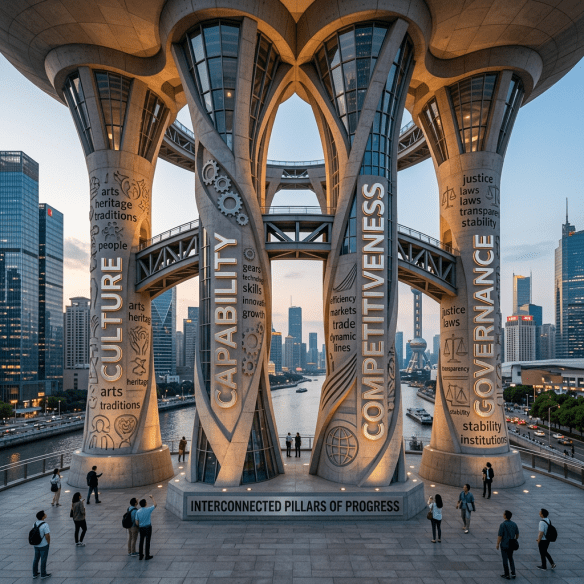
Capability formation consequently extends beyond individual sectors. It encompasses the deliberate integration of governance, education, infrastructure, science and technology, democratic institutions, economic competitiveness, national security, and cultural development.
The Republic must increasingly organize itself not merely around programs but around capabilities.
V. Archipelagic Sovereignty
Archipelagic sovereignty extends beyond territorial integrity and legal recognition. It encompasses the practical capacity of the Republic to exercise legitimate authority throughout its maritime domain continuously across generations.
Sovereignty simultaneously constitutes:
- Legal capability.
- Institutional capability.
- Maritime capability.
- Economic capability.
- Technological capability.
- Democratic capability.
- Strategic capability.
International law remains indispensable. Yet legal victories do not operationalize themselves. Sovereignty without capability remains vulnerable, while capability without institutions remains unsustainable.
The Philippines must therefore invest continuously in maritime domain awareness, resilient logistics networks, strategic infrastructure, scientific research, maritime industries, disaster resilience, and institutional excellence.
For archipelagic nations, sovereignty is exercised daily rather than merely proclaimed periodically.
VI. Capability Sovereignty and Strategic Resilience
The experiences of Türkiye, Ukraine, Iran, South Korea, and contemporary strategic competition collectively illustrate that national resilience increasingly derives from accumulated capabilities rather than isolated acquisitions.
Türkiye demonstrates capability sovereignty—the institutional capacity to sustain and improve strategically important technologies domestically.
Ukraine illustrates adaptive innovation and the strategic value of distributed capabilities.
Iran demonstrates strategic endurance and the importance of indigenous sustainment capabilities.
South Korea exemplifies strategic patience and intergenerational capability building.
Collectively, they suggest seven enduring pillars of strategic resilience:
- Capability Sovereignty
- Adaptive Innovation
- Strategic Endurance
- Distributed Deterrence
- Multidimensional Resilience
- Strategic Patience
- Capability Culture
Modernization must therefore become more than procurement. It must become nation-building.
VII. The Twelve Pillars of National Capability
The Philippine Capability Architecture rests upon twelve mutually reinforcing pillars:
- Democratic Capability
- Human Capability
- Economic Capability
- Maritime Capability
- Scientific and Technological Capability
- Energy Capability
- Strategic Infrastructure Capability
- Food and Agricultural Capability
- Environmental and Climate Capability
- National Security Capability
- Institutional Capability
- Strategic Foresight Capability
Capability formation is systemic rather than sectoral. Weaknesses within one pillar diminish the effectiveness of the entire architecture.
Capabilities are cumulative and compounding across generations. Capability destruction is likewise cumulative whenever institutional weaknesses remain unaddressed.
VIII. Culture, Trust, and Capability Formation
Culture constitutes society’s informal strategic infrastructure.
Nations ultimately become what they repeatedly reward, tolerate, preserve, and transmit.
The Philippines possesses enduring cultural strengths including bayanihan, adaptability, resilience, entrepreneurial spirit, and strong community relationships. Yet these strengths must be reinforced through institutions that consistently reward excellence, competence, accountability, integrity, innovation, and public service.
Trust functions as a strategic multiplier.
High-trust societies benefit from stronger institutions, greater innovation, improved governance, and enhanced democratic resilience. Conversely, corruption, policy discontinuity, regulatory uncertainty, and institutional fragmentation function as capability destroyers.
Capability formation is therefore inseparable from cultural formation.
IX. Multipolarity and Philippine Statecraft
The twenty-first century is witnessing the emergence of complex multipolarity rather than simple geopolitical bipolarity.
The Philippines need not become captive to simplistic narratives of East versus West. Strategic autonomy requires neither isolation nor unquestioning alignment. Rather, it demands strategic literacy.
Philippine statecraft must therefore embrace:
- Strategic partnerships without strategic dependence.
- Economic openness without economic vulnerability.
- Democratic resilience without ideological rigidity.
- National competitiveness without strategic complacency.
- Sovereignty without isolation.
The future belongs not merely to powerful nations but to adaptable ones.
X. The Learning Republic
Human capability remains the Republic’s greatest strategic resource.
The Philippines cannot become a Capability State without simultaneously becoming a Learning State.
Capability formation must encompass an integrated national learning ecosystem extending from early childhood education to lifelong learning, advanced scientific research, artificial intelligence, innovation ecosystems, technical education, and strategic industries.
Institutions capable of continuous learning become institutions capable of continuous adaptation.
National competitiveness ultimately depends less upon what institutions presently know than upon their capacity to continuously learn, innovate, and improve.
XI. Strategic Infrastructure and the Archipelagic Logistics Network
Infrastructure constitutes strategic capability rather than merely physical construction.
The Philippine Archipelagic Logistics Network should integrate:
- Strategic ports.
- Maritime transportation systems.
- Digital infrastructure.
- Energy networks.
- Climate-resilient infrastructure.
- Strategic mobility corridors.
- National redundancy systems.
Infrastructure investments must increasingly account for climate projections, demographic transitions, technological developments, and strategic risks extending well beyond contemporary political cycles.
Resilience frequently constitutes the most valuable form of efficiency.
XII. Strategic Foresight and PAGTANAW 2100
Institutions incapable of anticipating future challenges inevitably become reactive institutions.
Strategic foresight must therefore become strategic infrastructure.
PAGTANAW 2100 should institutionalize national capabilities in:
- Futures studies.
- Strategic planning.
- Scenario analysis.
- Horizon scanning.
- National capability assessments.
- Strategic risk management.
- Intergenerational policy evaluation.
The future cannot be predicted with certainty. It can, however, be anticipated intelligently.
XIII. Whole-of-Nation Governance
Whole-of-Nation Governance requires institutional integration among government, academia, industry, civil society, and local communities.
Public office must ultimately be understood as stewardship over inherited and future capabilities rather than merely the administration of present resources.
Strategic priorities include:
- Institutional continuity.
- Capability-oriented budgeting.
- Evidence-based policymaking.
- Democratic resilience.
- Capability-based governance metrics.
- Interagency strategic integration.
Nation-building is fundamentally collaborative rather than bureaucratic.
XIV. Implementation Framework (2026–2100)
Phase I: Capability Foundations (2026–2040)
Strategic priorities include:
- Institutional reforms.
- National capability mapping.
- Educational transformation.
- Maritime capability development.
- Strategic infrastructure modernization.
- National resilience programs.
Phase II: Capability Transformation (2040–2070)
Strategic priorities include:
- Strategic industries development.
- Scientific leadership initiatives.
- Energy transformation.
- Technological competitiveness.
- Advanced logistics integration.
- National innovation ecosystems.
Phase III: Capability Leadership (2070–2100)
The Republic should aspire toward becoming:
- A globally competitive maritime nation.
- A resilient capability state.
- A regional innovation leader.
- A high-trust democracy.
- A strategically autonomous middle power.
- An intergenerational learning society.
XV. Measuring National Capability
The Philippine Capability Index should supplement traditional economic indicators by measuring:
- Institutional resilience.
- Democratic capability.
- Human development.
- Scientific competitiveness.
- Strategic autonomy.
- Maritime capability.
- Innovation capacity.
- Climate resilience.
- Social trust.
- Intergenerational capability transmission.
National success should ultimately be measured by whether future generations inherit stronger capabilities than those entrusted to the present generation.
Conclusion: Building the Intergenerational Republic
The Philippine Capability Architecture advances a simple yet demanding proposition: nations do not inherit capability—they deliberately build, protect, integrate, and transmit it across generations.
The Philippines stands at a strategic inflection point in its national development. Managed instability, technological transformation, climate disruption, and geopolitical competition will likely define the century confronting future generations of Filipinos. The appropriate response is neither strategic complacency nor perpetual crisis management.
It is capability.
Archipelagic sovereignty must become more than a legal proposition. Democracy must become more than electoral participation. Infrastructure must become more than physical construction. Economic development must become more than aggregate growth. National development itself must become more than the pursuit of present prosperity.
They must become components of an integrated grand strategy of national capability.
The Republic represents an intergenerational covenant among the living, the dead, and generations yet unborn. Nation-building is therefore neither the project of a single administration nor the achievement of a single generation. It is the continuous work of cultivating the capabilities that enable future Filipinos to flourish.
The enduring strategic question confronting the Philippines is not what it possesses today, but what it deliberately becomes capable of by the year 2100.
For maritime nations, geography is destiny only if left unmanaged. For strategic nations, geography becomes opportunity when transformed into capability.
The measure of success in the year 2100 will therefore not simply be whether the Philippines has become wealthier or more technologically advanced, but whether future Filipinos inherit a Republic that is more capable, more resilient, more innovative, more trustworthy, and more just than the one entrusted to us today.
That is the enduring promise of the Philippine Capability Architecture and the true challenge of archipelagic statecraft in the twenty-first century—a Republic that learns continuously, builds patiently, innovates intelligently, governs wisely, and endures across generations.



Wow, Karl….after 5 Top Institutional Failures you give us this?! I think I need a couple of Red Horse beers for attitude adjustment before going on to this architecture stuff…hehehe
Seriously, however, I think it would be helpful if we had a few government technocrats in our forum to contribute their ideas on something like this.
For now Red Horse would suffice 🙂
My notes, as I read.
(1) The Philippines is a weak nation in a sense that even the educated and powerful have not given themselves to the Constitution and its ideals. Self dealing is the deep state. Capability can’t arise from corruption.
(2) Maritime strength is a concept that is handled tactically and piecemeal. There are no signs that, strategically, the Philippines is hell bent at being a maritime power.
(3) I think Filipino leaders do learn in a rote or resilient way, but they don’t know how to think forward … to learn forward … so they can get ahead of others. Section XII shows how to do this.
(4) The concepts presented here are elegant and comprehensive. The missing piece is how to get anyone in power to actually DO these things. Self dealing fractures even the “good” political players. There is no unity, no body to implement big ideas. A President might be able to, but, like Aquino, they get bogged down in the pragmatics of operating a nation. There is no great visionary with power. Maybe the Senate could write a master law, not an Amendment to the Constitution, but a “New Rules” document that would mandate big ideas and a passion to make them work, in the real world. Not likely when they see trees, not forest.
Thanks for inspiring me to think this morning.
My pleasure, always a pleasure.
so you are the opposite of The Greek in The Wire who says “business, always business” when they ask him at the airport?
Well, you are certainly not Greek, and luckily you are also not Nolan’s Odysseus who is actually General Jason Bourne transposed to the past haha.
Joe’s point 3 is most important “I think Filipino leaders do learn in a rote or resilient way, but they don’t know how to think forward … to learn forward”
Many Filipinos in fact have learned to think beyond 3-6 months (iykyk) to six year Presidential terms which is already an advancement.
Also “The Philippines is a weak nation in a sense that even the educated and powerful [have no guiding ideals]. Self dealing is the deep state.”
A nice common set of ideals might be 1/3 Xiao Chua’s version of Pantayong Pananaw, 1/3 Jay Tarriela and 1/3 Leni Robredo.
That mix would have to be popularized to the extent that people like Sen Erwin Tulfo understand it and live by it I guess.
And so most people buy into ideals, The Development Bargain Joey mentioned would have to fit – as in “lahat tayo yayaman sa pag-unlad ng bayan”.
P.S. it just occurred to me that my populist summary of Dev Bargain sounds like Napoleon III’s alleged “enrich yourselves” quote..
P.P.S. my father allegedly compared that to what Marcos Sr. was encouraging the early 1970s Filipino nouveaux riche to do.. a Dev Bargain went wrong?
(so are we back to Square One, meaning the Philippines lacks unity and ideals to do the Dev State but can’t do the Dev Bargain either? Ewan.. McGregor haha)
Business or pleasure
Early Marcos Sr. did make a serious attempt at the Developmental State with technocrat-led 5-year plans and the Export Processing Zone Authority (which later became PEZA). The problem was that attempt was part of a two-track system, the larger corruption-enabling part which Prof. Kunio Yoshihara called ersatz capitalism in his 1988 study The Rise of Ersatz Capitalism in South-East Asia and Prof. Paul D. Hutchcroft described as booty capitalism in his 1998 book Booty Capitalism: The Politics of Banking in the Philippines
. The resulting “inferior duplicate” of the Developmental State, according to Prof. Yoshihara, is (paraphrased) the result of “internal political blockades” favoring crony capitalism and favored-group affirmative action policies constraining the capacity of the state. Essentially the Marcos Sr. economy devolved into extractive incoherence, existing mainly to direct money through loyalty networks rather than successful performers. Which isn’t the first time the Philippines got to that stage due to the underlying dynasty-oligarchic hardware never having been replaced. The political compromises needed to keep the early Fifth Republic together actually entrenched dynasty-oligarchic interests; a few dominant national dynasties of big names we all know fracturing into over a thousand localized dynasties running LGUs, while new oligarchs rose up to capture the privatization of Marcos crony assets.
Probably the best answer is some scaled down form of Dercon’s Development Bargain framework. Identify where the development bargain already exists in an ad-hoc state or can be “jump started” off of existing building blocks, bounded into areas that have clear performance metrics, where the area is just outside of risk of extractive capture. PEZA, BCDA, M4GG localities are examples of these areas. So the tough part is to demonstrate the success of the enclave where it can become repeatable. An enclave-and-bargain expansion strategy, which is the aim of the sequencing I dropped in the previous post.
“Probably the best answer is some scaled down form of Dercon’s Development Bargain framework.” – Joey
I agree. I am a big fan of “start small, think tall.” We aren’t back at square one…that was probably more like where we were in 1946. You might say we are now in square three, while we should be in square ten or twenty!
Given that pace of progress, I think in the macro sense we have to agree with Joey – “Good luck, Philippines.” Our problems will outpace our solutions, especially the population problem and secondarily perhaps our depleting of natural resources problem.
The problem w/ “start small, think tall” in the Philippines is that we are likely to find that nobody is thinking tall, except maybe people here in TSOH or people in similar cyber forums. The next best thing to having a nation that has achieved a high level of capability is to talk about one, amen? When I was in college in business school, we had one professor who had this motto: “If you cannot be good, at least look good.”
My sarcasm of “Good luck Philippines” was in response to you bringing up Rizal’s words without Rizal’s advice of connected action.
So please do not take my words out of context and conflate what I said with something else. My question still stands: Who will teach the Filipino the values of hard work and study in order to learn the civic virtues by which to be worthy of liberties? I’d argue the Filipinos best placed to do so are members of the diaspora who have learned new, better ways of doing things and should take those practices home. How would you propose someone who does not know or perhaps not even know where to start looking begin to teach themselves? People are taught; and the act of teaching requires teachers.
The population is still growing but at a much slower rate that may crest soon before decelerating. Population growth is not the problem. The problem is lack of enough opportunities for the current and future population. The Philippines does not really have a resources problem either. The Philippines lacks certain resources, mainly fuel and energy, and the inability to exploit available resources in order to trade for resources which are lacking.
I do not agree with this general statement. The Philippines has plenty of people who “think tall,” the multitude of excellent government, academic, and NGO policy papers proves this. The problem rather is that the Philippines lacks enough leaders who “act.” M4GG is a grouping of leaders who act. In order to have emulation one must first cultivate exemplars.
‘My sarcasm of “Good luck Philippines” was in response to you bringing up Rizal’s words without Rizal’s advice of connected action.’ – Joey N.
I know, and I meant it in the same sarcastic vein.
“My question still stands: Who will teach the Filipino the values of hard work and study in order to learn the civic virtues by which to be worthy of liberties?” – Joey N.
And my answer still stands. Tell me which of my words in answer to that question in my last post that you cannot comprehend. I will expound further, maybe try simpler language.
“I’d argue the Filipinos best placed to do so are members of the diaspora who have learned new, better ways of doing things and should take those practices home. “ – Joey N.
I don’t think that would work. What works for Filipinos in the USA, does not necessarily work in the Philippine environment. You argued that point a few months ago when I brought up the example of Estonia and their X-Road project. Also, in the early part of the 20th Century, the US tried to teach us what worked for them and saw no reason why it should not work for us. Big mistake on their part.
“Population growth is not the problem.” – Joey N.
I know…which is why the word growth is not in my statement. I said “population problem.” When I left Manila in 1980, it was severely congested and polluted. Forty five years later, it is much much worse.
Cebu City was nice in the 70s. I remember I could get from one end of the city to the other in a car or taxi in 10 minutes! Not true anymore, I am told, not for a long time. How long before Clark and Subic are the same way, if not already there?
“The Philippines does not really have a resources problem either. The Philippines lacks certain resources, mainly fuel and energy, and the inability to exploit available resources in order to trade for resources which are lacking.” – Joey N.
I was of course talking about “natural resources.” I’m having a difficult time with your responses. When I say “population problem” you insert the word “growth.” When I say “natural resources” you omit the word “natural.”
I’ll be brief: When I was a kid in the 60s, our schools talked about our abundant forests and fish in the oceans. By the time I was in college they were already talking about our oceans and lakes being over fished (think dynamite fishing) and our forests denuded by both legal and illegal logging.
For your edification, check out what we did with fishing in Laguna de Bay, once a major supplier of fish to metro Manila.
‘The Philippines has plenty of people who “think tall,” the multitude of excellent government, academic, and NGO policy papers proves this.’ – Joey N.
I have a higher standard for what I consider thinking. To me, if your thinking only goes as far as producing a paper that you know will just sit on a shelf, then you are not thinking hard enough. Yes I know we have plenty of that. In the 70s, my mother worked for the Eastern Regional Office for Public Administration. I was in college then and she told me that they had plenty of studies on shelves with regard to how improve the Philippines and they just sat there. That is not the “think tall” that I am talking about.
CV, it seems like it was a mistake to give you engagement. Every time Joe cautions you, you behave for a while then go back to your elitist condescension despite not having any basis of knowledge or current information. Have a great one.
“…then go back to your elitist condescension despite not having any basis of knowledge or current information.” – Joey N.
You don’t realize that your sentence above is a condescending statement.
Meanwhile, I guess I won’t get that report on fishing in Laguna de Bay. We also won’t get to discuss all those works and authors that you name dropped in connection with Development State and Development Bargain. Not enough “engagement.”
You have a great one too!
Gemini summary:
Laguna de Bay has transitioned from a rich open-water capture fishery supporting native species to a heavily industrialized aquaculture zone plagued by pollution, overstocking, and invasive species. Current remediation efforts focus on zoning enforcement, invasive species removal, and targeted dredging to balance ecological health and livelihoods.
Thanks, Joe. Here is a longer Gemini report:
>>Laguna de Bay—the largest lake in the Philippines—is perhaps the single best (and saddest) local example of ecological collapse driven by overexploitation, pollution, and severe mismanagement.
Historically, it was the primary breadbasket for freshwater fish feeding Metro Manila and surrounding provinces. Today, fishing in the lake is in a state of severe distress.1. Dwindling Catch & Disappearing Native Species
Open-water fishing catch levels in the lake have collapsed—dropping by more than 60% since the 1980s.
2. Heavy Pollution & Massive Fish Kills
The lake sits right at the edge of sprawling urban and industrial development. Rivers running through Metro Manila, Rizal, and Laguna dump raw domestic sewage, agricultural runoff, and industrial waste directly into the basin.
3. Siltation: The Lake Is Choking in Mud
Decades of deforestation in the surrounding watershed mountains (like the Sierra Madre) sent millions of tons of topsoil washing into the lake.
Because the lake has no deep outlet, it has become extremely shallow—averaging only around 2 to 2.5 meters deep today. The water is perpetually murky, preventing sunlight from reaching the lakebed, which disrupts the bottom of the food chain.4. The Fish Pen Wars: Big Business vs. Small Fishermen
Starting in the 1970s, the government introduced bamboo fish pens to farm bangus (milkfish) and tilapia. While it initially boosted aquaculture yields, it quickly spiraled out of control:
Governments have repeatedly ordered the dismantling of illegal fish pens to clear navigation lanes and restore access for small fishers, but enforcement remains a constant tug-of-war.
Gemini said “saddest”? LOL
I had a fisherman good friend at the edge of Gingoog Bay a few years back, pretty much fished dry next to shore. He used illegal small webbing fishnet to get his daily catches. seven kids. “Do they want me to become a thief?” he asked.
Dept of Ag and fisheries built a guardhouse nearby to police things but it was never staffed.
The tide pools on my property produced thousands of fingerlings that boatmen would scoop up to sell to fish farms so the meat had a hard time replenishing and growing in the bay.
Poverty sucks.
“Do they want me to become a thief?” he asked.” – JoeAm
In a sense, he already is a thief. In the Philippines, we do not consider stealing from the government, or stealing from Laguna de Bay which is a public resource that is apparently subject to regulation (hence “illegal small webbing fish net”) as stealing. Perhaps that is how our politicians justify their plundering of the public treasury. It is an example of Moral Failure.
True.
Yes. If dead or heavily polluted rivers can be revived, lakes can be too. In some ways, lakes are harder because they are closed or semi-closed systems. Pollution accumulates and water does not flush out as quickly as in rivers.
The Philippines has already shown that restoration is possible. Pasig River, once declared biologically dead in many stretches, has seen improvements through wastewater management, relocation programmes, rehabilitation efforts, and stricter regulation. The lesson is that ecological death is often reversible if the causes are addressed.
Several Philippine lakes could benefit from the same approach, including Laguna de Bay, Taal Lake, and Lake Lanao.
The challenge is that lake rehabilitation requires more than simply cleaning the water. It involves:
Treating sewage before it reaches the lake.
Preventing industrial and agricultural runoff.
Restoring wetlands that naturally filter pollutants.
Removing invasive species when necessary.
Controlling fish-cage density and aquaculture practices.
Reforesting watersheds to reduce erosion and sedimentation.
Continuous scientific monitoring of water quality.
Active participation from local communities and LGUs.
A “dead lake” can recover if its watershed recovers. The lake is only as healthy as the rivers, streams, forests, and communities surrounding it.
For the Philippines, lake rehabilitation could become part of a broader “Learning Republic” and Blue Economy agenda. Healthy lakes provide:
Food security through sustainable fisheries.
Flood mitigation.
Tourism and recreation.
Clean water supplies.
Biodiversity conservation.
Climate resilience and carbon sequestration in wetlands.
The question is therefore not whether lakes can be revived—they can. The more difficult question is whether society is willing to sustain the decades-long commitment required to restore them. Ecological restoration is less a technological problem than a governance and capability problem. If dead rivers can live again, dead lakes can as well, provided we are willing to restore not only the water itself but the systems that sustain it.
“Pasig River, once declared biologically dead in many stretches, has seen improvements through wastewater management, relocation programmes, rehabilitation efforts, and stricter regulation. “ – Karl G.
Karl, I like your point about what it takes to bring back a river or a lake. But I think a better example than the Pasig would be Lee Kuan Yew’s river in Singapore which once was also biologically dead and not just in “many stretches” but I believe it was the entire river. It took Singapore 10 years to clean it up and install measures to keep it clean. It is a better example than the sad story of the Pasig River’s “…improvements through wastewater management, relocation programmes, rehabilitation efforts, and stricter regulation.”
Conflicts with your other comment about disliking comparatives. Keeping up with the Singaporeans.
“Conflicts with your other comment about disliking comparatives. Keeping up with the Singaporeans.” – JoeAm
Actually I love comparatives, so if I said I disliked them, I was mistaken. I have a feeling someone else said that.
I just think that the Pasig River story is not a good example for Karl’s point about a restoring a biologically dead body of water. In the Philippines, we are so used to mediocrity that we set our standards pretty low. I am totally guilty of that. Possibly the difference in my case is that I am aware of it when I do so…which is all the time.
One thing I appreciate here in the States is often bumping into cases where people set high standards and then pursue them…and I am even talking about government at times, believe it or not. It reminds me not to settle for low standards, especially super low standards.
Each LGU is somewhere between 1 and 10 on competence, 10 high. Most are 2 to 5. A few are 6 to 9. In the US, that flips. Cities are run well.
Well not SG but check this out.
The River That Returned: What Iloilo Achieved and What Pasig Has Dreamed Of for Generations
By Karl M. Garcia
Every city has a relationship with its rivers.
Some build their civilizations around them. Others turn away from them. A few are fortunate enough to rediscover them.
For generations, the Pasig River has occupied a unique place in the Filipino imagination. It was once the commercial artery of Manila, connecting communities, carrying trade, and shaping the nation’s history. The Spanish built around it. The Americans developed beside it. Filipinos wrote poems and songs about it.
Then, slowly, it disappeared—not physically, but in the public consciousness.
By the late twentieth century, the Pasig had become synonymous with pollution, congestion, and urban decline. What was once a source of life became, in the eyes of many, a problem to be managed. Rehabilitation efforts came and went. Master plans were drafted. Agencies were created. Billions of pesos were spent. Yet the dream of restoring the Pasig River remained frustratingly out of reach.
Meanwhile, nearly 500 kilometers south, another city was writing a different story.
Iloilo did not merely clean a river. It changed the way an entire community thought about one.
Today, the Iloilo River stands as one of the most successful examples of urban environmental rehabilitation in the Philippines. Its esplanade is filled with joggers before sunrise and families after sunset. Businesses have emerged along its banks. Property values have increased. More importantly, residents have reclaimed a sense of ownership over a place that had once been neglected.
In many ways, the Iloilo River became what the Pasig River has dreamed of becoming for generations.
This is not to diminish the efforts being undertaken in Metro Manila. Comparing the two rivers is inherently unfair.
The Pasig River stretches across the country’s largest metropolitan area, linking numerous local governments and carrying the environmental burden of more than a century of industrialization, population growth, and inadequate urban planning. It serves millions of people every day. It has absorbed the consequences of decisions made over generations.
The Iloilo River, while not without challenges, operates on an entirely different scale.
That distinction matters.
The question, therefore, is not why Pasig failed while Iloilo succeeded. The more useful question is this: What can the Philippines learn from Iloilo’s experience?
The first lesson is that environmental rehabilitation is ultimately a governance challenge.
Successful projects are rarely the result of a single administration. They are the product of institutional continuity. Iloilo’s river revival took years of planning, enforcement, and political commitment. Different leaders inherited the project and chose to continue it rather than reinvent it.
This remains one of the Philippines’ greatest development challenges.
The country does not suffer from a shortage of ideas. It suffers from a shortage of continuity.
Too often, projects begin with enthusiasm and end with elections. Policies are treated as political achievements rather than public institutions. Rivers, however, do not operate on election cycles. Neither do ecosystems.
The second lesson is that people protect what they value.
For decades, Filipinos saw many urban waterways as little more than drainage canals. Once a river becomes invisible in the public imagination, neglect follows naturally.
Iloilo reversed this relationship.
The river was transformed into a public space. Walkways were constructed. Landscaping improved accessibility. Families began visiting. Businesses invested nearby. The river ceased being a forgotten boundary and became a shared asset.
That shift in perception changed everything.
Urban planners often speak of infrastructure in terms of roads, bridges, and buildings. Yet public spaces may be among the most important infrastructure investments a city can make. They create social capital. They foster civic pride. They remind citizens that development is not merely about moving people efficiently—it is also about giving them places worth living in.
The third lesson is that scale matters.
Restoring an eleven-kilometer river in a growing regional city is fundamentally different from restoring a twenty-seven-kilometer river in one of the most densely populated urban areas in Southeast Asia.
Pasig’s challenges are immense.
Informal settlements, industrial discharge, fragmented governance, flood management concerns, and the demands of a metropolitan population create a level of complexity that few cities in the world have successfully managed. The rehabilitation of the Pasig River is not simply an environmental project; it is an exercise in metropolitan transformation.
If Iloilo restored a river, Metro Manila is attempting to restore an ecosystem.
That reality should not discourage policymakers. If anything, it should encourage greater ambition.
The success of Iloilo demonstrates that rehabilitation is possible. It proves that Filipinos are capable of sustaining long-term environmental projects when institutions, communities, and political leaders work toward a common objective.
The implications extend beyond Iloilo and Manila.
Imagine a Philippines where rivers are viewed not as liabilities but as strategic assets.
Imagine the Marikina River lined with public spaces and flood-resilient communities. Imagine the Pampanga River supporting ecotourism and sustainable agriculture. Imagine the Agusan River becoming a centerpiece of Mindanao’s environmental and economic development.
These are not impossible visions.
Iloilo has already demonstrated the model.
Ultimately, the story of the Iloilo River is not about water.
It is about patience.
It is about a city deciding that decline was not inevitable. It is about leaders who understood that the benefits of rehabilitation would likely be enjoyed by future administrations rather than their own. It is about citizens who learned to see a river not as a problem to avoid, but as a legacy to preserve.
The Pasig River’s story is still being written.
Perhaps one day, future generations will walk along its banks and find it difficult to believe that it was ever considered biologically dead. Perhaps they will take river ferries to work, gather in waterfront parks, and speak of the Pasig with the same affection that previous generations once did.
If that day comes, the Philippines may look back at Iloilo and recognize it for what it truly was:
Not merely a successful river rehabilitation project, but proof that cities can return to the waters that first gave them life.
And perhaps that is the greatest lesson of all.
Rivers are remarkably patient.
They wait for civilizations to remember them.
Thanks for your report on the Iloilo river, Karl. I feel it is a better story than LKY’s river in Singapore to make your point about restoration of biologically dead (or dying) bodies of water in the Philippines. I was not aware of the plight of the Iloilo River.
I looked deeper into the Iloilo River Rehabilitation Project and note that it was also an excellent example of “mini-integration” between the national government and the local Iloilo government. I know that you have this vision of the entire archipelago having an integrated system of government.
So what do you think – will other areas of the Philippines feel “envy” or “sense of competition” and aspire to clean up their rivers too (Pasig River, Agusan River, Pampanga River, Marikina River)? I think that is part of Joey’s Development Bargain philosophy.
So long as it drives them to do better.
“So long as it drives them to do better.” – Karl
Yeah, and not just isomorphic mimicry.
Gemini:
Naga City Mayor Leni Robredo is leading comprehensive rehabilitation and flood-control initiatives for the Naga River and major local waterways like Sagop Creek, partnering with national programs such as the DPWH Oplan Kontra Baha to clear blockages, dredge channels, and build retention ponds.
And this, where another good governance mayor is in charge:
Key Cleanup and Rehabilitation EffortsAI Technology Pilots:
The MMDA and Pasig City launched autonomous electric cleanup vessels (Clearbot) in Barangay Pinagbuhatan to clear floating garbage and water hyacinths.
Bayanihan sa Esteros: Local and national agencies coordinate routine manual and mechanical clearing operations along the intersecting riverbanks and tributaries.
Private Sector Dredging: Major private initiatives, such as those by San Miguel Corporation, have extracted millions of metric tons of accumulated silt and solid waste from the Pasig-Marikina river system to mitigate severe urban flooding.
“Key Cleanup and Rehabilitation EffortsAI Technology Pilots:…” – JoeAm
This is the “start small” part. The “think tall” part is making sure the re-pollution and silt build up of the river fixed or placed under some semblance of control. Otherwise it is an uphill battle of clean up only for the river to get all clogged up again.
“Naga City Mayor Leni Robredo is leading comprehensive rehabilitation and flood-control initiatives for the Naga River and major local waterways like Sagop Creek, partnering with national programs such as the DPWH Oplan Kontra Baha to clear blockages, dredge channels, and build retention ponds.” – Gemini
That is the good news. The bad news is that the Naga River is more than just Naga City. This is where Karl’s view on the necessity of INTEGRATION comes in. This Gemini report can help elaborate my point:
>>Geographically and hydrologically, the Naga River system extends beyond Naga City’s administrative borders.
The river system’s reach stretches past municipal boundaries in three major ways:1. Its Headwaters (Mount Isarog)
The Naga River originates as mountain streams high on the slopes of Mount Isarog. Its upper catchments collect runoff from neighboring upland municipalities like Pili, Ocampo, and Calabanga before cascading down into the Naga plain.2. Its Outlet (The Bicol River Basin)
The Naga River is actually a major tributary of the much larger Bicol River. It winds through Naga City and empties into the main trunk of the Bicol River near the city’s southwestern boundary. Because the Bicol River drains water from across the entire province of Camarines Sur and parts of Albay, what happens upstream in other towns directly impacts the Naga River. 3. The Backflow & Basin Effect
Because the elevation of the riverbed where the Naga River meets the Bicol River is near sea level, heavy rains in surrounding towns flood into the Bicol River Basin, causing water to back up into the Naga River. Why local interventions hit a wall
This geographic reality is precisely why urban planners often caution that a single city cannot fix its river alone.
While Mayor Leni Robredo’s LGU can clear local creeks, build retention ponds, and manage city waste, Naga City sits in a natural basin. If neighboring towns along the slopes of Mount Isarog or upriver in the Bicol River Basin do not manage their own runoff, agricultural silt, and solid waste, that debris eventually flows downstream into Naga.
To achieve long-term flood relief, city-level projects must ultimately integrate into a regional, basin-wide management strategy across the entire province.<<
Gemini:
_______________
A developmental state is a governing model where the government heavily and directly intervenes in macro and microeconomic planning to build new industries and drive rapid growth. A development bargain is an implicit political agreement among a country’s elite to shift from protecting narrow privileges to collectively “gambling” on national economic growth.
The Developmental State
The concept of the developmental state was coined by scholar Chalmers Johnson to explain post-war East Asian economic miracles like Japan, South Korea, and Taiwan.
Active Intervention: The government does not just fix market failures; it actively guides the market, promotes strategic industries, and implements industrial policies.
Skilled Bureaucracy: It relies on a professional, merit-based civil service capable of long-term economic planning rather than short-term political patronage.
Public-Private Cooperation: The state works closely with major private industries to coordinate investments, manage risks, and boost national competitiveness.
The Development Bargain
Popularized by economist Stefan Dercon in his book Gambling on Development, a development bargain is an unwritten, practical consensus among powerful political and economic elites.
Shared Vision: Powerful groups agree to pursue national economic growth and stability rather than just fighting over or draining state resources.
A Mutual Gamble: Elites risk giving up old, exclusive rent-seeking behaviors in the hope that a larger, growing economy will benefit everyone involved, including themselves.
Political Foundation: Countries often struggle to grow not from a lack of technical aid or money, but because their leaders lack an internal political bargain focused on development.
_______________
These seem to be academic theories that you pan as sitting on a shelf, useless. I believe President Marcos is pursuing the development state within the limits of democracy, binding laws that inhibit growth, finances, corruption, and lack of skilled managers of state functions. I think the Philippines is not at all pursuing the development bargain, and the biggest weakness is the lack of a political foundation, namely the inability of liberal parties to structure a strong, cohesive, unified political campaign.
Unrelated note. Europe backs Philippine maritime efforts (economic, not defense): https://www.pna.gov.ph/articles/1280200
Thanks for the link, Joe. Have you visited whitehouse.gov? If you want to learn what a great president we have, #47, check out whitehouse.gov.
Thanks Joe for the Gemini recap of Joey’s contribution of Development State vs. Development Bargain.
He suggested the country take the Development Bargain route. Joey also introduced the term “isomorphic mimicry.” It is something that has gone on in our history & politics going back to the Spanish era.
I shrug, all futile until liberal parties unite. That’s the “how to” step.
“I shrug, …” – JoeAm
If you look around, I think you will see a lot of shrugging by my kababayans. Nothing like a cold refreshing drink in hot weather like that.
Yes. tuba and coke under the mango tree. Always a laugh there.
I am totally unqualified in that area, but looking at the definitions I have seen so far, could the Philippines be at least partly already pursuing a mix of Development State (Marcos Jr. is I think following a mix of his father’s technocratic approach and that of PNoy) and Development Bargain (major oligarchs especially the likes of Ramon Ang are seeing their self-interest and national interest coincide, see NAIA3 improvement etc.) and “muddling through”..
The present topic at hand is Pax Silica and it would be great if that pushes through, of course there are naysayers but I believe the ecological and other concerns can be addressed, again I don’t go as deep as I used to into news over there (we have enough craziness OVER HERE now to deal with) but I do see the occasional article or video on my feed, look more at Pax Silica stuff than Inday Sara impeachment.
What Joey has written about envy or competition as a factor in development is true for Filipinos. The way Cebu is proud of every time they outdo Manila is a major example, and Iloilo claiming its special place even if it isn’t as big as Cebu, or GenSan somehow marketing itself as the civilized alternative to Davao (haha that is my interpretation, Davao is still badlands in my book) – or the competition between Elyu and Siargao for top surfing spot, or the silent rise of Panglao on Bohol (my impression is that it tries to fill the niche “not as expensive as El Nido but not as crowded as Boracay”) among others – or even the friendly rivalry between Albay and CamSur as well as their respective capitals within the Bikol region, these all drive the Philippines UPWARDS.
Oh, that fits better. Still ad hoc, not structured. The oligarchs indeed meld with civic interests, and vice versa.
My second companion analysis to Karl’s article, The Only Route Open, seeks to provide examples and explain how an ad hoc localized strategy (PEZA, BCDA) that is later linked into a structure (Luzon Economic Corridor) may actually be respecting the underlying Philippine culture that existed before colonialization and was corrupted by the principalía system. Specifically, I cited Subic Bay case (Hanjin collapsing) as not a complete failure but a chance to run a different experiment within the same enclaved space (Hyundai).
“Still ad hoc, not structured.” – JoeAm
Don’t forget Karl’s word: “Integrated.” I like it, although I think it will not happen in my lifetime.
Well, no worries. The entire world will not happen in our lifetime. Don’t weep about the unfinished work of wayward earth colonies. The earth has billions of years left before the sun collapses. The Philippines may rule earth in a thousand years. Be happy.
Oh yeah…”happy fools!” hehehe
😀😀😀🍺🍺
“What Joey has written about envy or competition as a factor in development is true for the Filipinos. “ – Irineo
We hope to build a nation on that kind of motivation? I think that just shows how low our standards have become. I prefer motivators like sense of duty, responsibility, civic pride. Envy or competition for me smacks to much of “Keeping up with the Joneses.”
“The Philippines cannot become a Capability State without simultaneously becoming a Learning State.” – Karl Garcia
And I am sure you will agree with me that we as a State have a lot to learn.
Lee Kuan Yew described us as “soft and forgiving.” The Spanish back in the Spanish era described us as “servile and supine.” Not very flattering, but if we look at those descriptions objectively, I think we see a people that is not very good at learning….and I’m not talking about just book learning, but learning from actual experiences in the real world.
“(3) I think Filipino leaders do learn in a rote or resilient way, but they don’t know how to think forward … to learn forward … so they can get ahead of others. Section XII shows how to do this.” – JoeAm
Should we Filipinos memorize Section XII? hehehe
(Sorry, I’m trying to be funny.)
Yes, madami pa tayong kakaining bigas.
@Joey one of the automotive PDFs has now passed the one thousand downloads mark: (these are year to date stats meaning from January 1 until today)
for all readers just ICYMI this is the context to those PDFs (article by me based on detailed analysis and planning content by Joey contained in the PDFs which one can download there):
It is among the Top 10 read articles year to date even if I have also marked the 3 other articles (all by Karl) which occupy 3rd, 4th and 6th place among the Top 10
As for the rest of the top 10:
– A Short Analysis of “Bato sa Buhangin” is an “evergreen” by the late Edgar Lores
– The Social Significance of Aldub was written by Will Villanueva at the height of Aldub
– Community-based progress, the Barangay Rules is a classic by Karl
– Why I respect President Aquino is a milestone article by Joe from 2013
– Return the ill-gotten wealth first, Bongbong is by Andrew Lim from 2015
For sure we have seen better days in terms of being a mainstream site even until 2022 but we continue to hold our own even in the age of Tiktok etc.
This article by Karl is closely related to the difference between Development State and Development Bargain.
for further reference again the Development State vs Development Bargain analysis by Joey followed by his original quote:
https://claude.ai/public/artifacts/91922494-3da1-48ef-a48c-55f65343d8cd
Thanks for this, Irineo.
That is an encouraging sign. I hope the article you wrote on my analysis helps someone.
I’ve been spending some time building a framework around my comments on Philippine development going back to the start of my time here. Personally I am in favor of Dercon’s Development Bargain model and found his book Gambling on Development to be highly revelatory. Dercon is a development economist who has actually worked in the developing countries he studied and formed his model around, unlike some academics who study from afar. I’ve had a chance to watch development theory in practice as a younger man when I used to have more time to volunteer in the NGO world.
Still, the Development Bargain requires elite buy-in and elite coalition building which after thought might not be suitable at the present moment oweing to the fractious nature of Philippine elite competition. What I’ve tentatively called the Enclave-and-Bargain-Expansion which is my attempt to explain how enclaved (e.g. PEZA) successes in the Philippines can be linked together into economic corridors and thus expand outward.
One may understand the Enclave-and-Bargain-Expansion as a localized distillation of the Development Bargain within and contained to special enclaves which have more consistent rules being insulated from elite manuevering, whether that be a special economic zone, a government-corporation controlled entity (e.g. BCDA), or one of the M4GG cities where elite and technocratic leaders have formed a voluntary coalition outside of but alongside the main system. If one thinks about it, this “explanation” (which I will not call a model as I am not a development economist) appears to work well with the underlying Austronesian Philippine culture, and the pre-colonial barangay trade networks worked in a remarkably similar way: semiautonomous localities implicitly linked together into an larger cultural-trade system.
Linked below are two additional pieces of comparative analysis based on Karl’s two articles — the first a sequencing analysis and the second an Atlantic-style narrative journalism piece, both built around my thoughts on the subject.
Charting the Capability State
https://claude.ai/public/artifacts/a14eef65-bbb3-4c7c-bd2f-de10d7d10ab3
The Only Route Open: Sequencing the Philippine Capability State
https://claude.ai/public/artifacts/1c9dc7ac-14e3-4f5c-a5bb-38d5fae5a8da
I’ve gone through Charting the Capability State and I must say that is an uplifting, professional piece. If the Marcos Government deployed AI in this manner, as a conversation addressing reality, the agencies, and the nation, would leap to life. The best thinking is informed thinking and that’s where AI, fed data and guidance, can do things better and faster than humans. Bravo!
The strength of AI is in the ability to correlate data and identify patterns for the purpose of analysis. In that way, at least to me, AI is simply an analysis tool similar to Excel or Google Sheets where I am already familiar with the data then am using the tool to correlate and identify patterns within the data. AI is also good at weaving a narrative around provided data (in this case my commentary that Claude fact checked using reliable sources). But accurate outputs assume the user is already coming with existing knowledge; in my case having read the actual literature and field studies. Most people use AI as a confirmation bias machine to try to win arguments and that doesn’t add to the person’s overall knowledge.
My own thoughts on Philippine development are informed by spending a lot of time with poor Filipinos and seeing how government interaction affected their daily lives. I think it’s also useful I have spent a lot of time working in Japan, South Korea, while being able to contrast that experience with NGO and personal engagements in Indonesia and Malaysia (two Austronesian countries) as well as having the benefit of closeness to the Vietnamese Cham community (another Austronesian culture).
I think for too long there is a vocal (mostly middle class, some elite) cohort in the Philippines that demands an overnight transformation into a Singapore-, then Japanese-, then South Korean-style country without respecting the underlying culture. Some even go as far as imply Filipino culture is defective somehow — a form of self-hate. Eventually that sentiment trickles down to regular Filipinos who are led to believe their own culture and country sucks, with all being hopeless.
The better direction is to understand and respect the culture, which may have positive and negative sides of any cultural habit, then elevate the positive side without excessive paternalistic boosterism. When people who don’t know how to do something learn how to do it, they begin to recognize their own innate agency — because humans do not lack agency, it is only a matter of degree and how to increase that degree.
My tentative framework about Enclave-and-Bargain-Expansion with its competitive envy is premised on leveraging Philippine cultural tendencies, highlighting the positive aspects to build, with actionable items eventually building confidence (and riches à la Francis).
That makes excellent sense.
Marcos wants full AI utilization for national dev’t, legislation https://share.google/uCDOZbMFIsQyZ2JKd
That is terrific news. I tell you, the Philippines can blossom in the AI era. Here’s a specific example, Sagility expansion in the Philippines.
https://manilastandard.net/business/314769815/sagility-opens-new-delivery-center-in-tagbilaran-to-hire-1500-employees.html
Sagility is a specialized, tech-enabled healthcare operations and business process management (BPM) company. It provides member engagement, claims processing, clinical management, and payment integrity services for major U.S. health plans and providers, operating globally with over 47,000 employees across the U.S., India, the Philippines, Jamaica, and Colombia.
Nice! I once worked for one like these the one hired by Athem about 2 decades ago.
Infrastructure notes. We lived on the coast of Luzon north of Olongapo 2008 to 2011. Our route to Manila was by this expressway, new at that time and as good as US interstates. It was largely empty back then, through empty fields, often flooded, between Subic and Clark. Now it seems to be just what the economic doctor ordered.
https://manilastandard.net/business/314769861/sctex-drives-biz-expansion-across-central-luzon.html
Last month I passed SCTEX going to Tarlac and boy I was impressed.
Karl, can you please help edit/correct two typos that may change the wording?
1. “like some academics who study from afar” -> “unlike some academics who study from afar”
2. “oweing to the fractuous nature of Philippine elite competition” -> “oweing to the fractious nature of Philippine elite competition”
corrected both..
Thanks Irineo!
Sorry Joey, I was not able to act on it. Thanks, Irimeo!
No worries Karl!
If I look at the Top 5 Institutional failures of the Philippines, BCDA at the very least circumnavigates No 5 and No 1.
The land belongs to just one entity AND because of that legal issues are avoided. Makati BTW (mostly Ayala-owned) and Ortigas (mostly Ortigas-owned) bypass these issues as well. There is a lot I think corner EDSA and Ortigas though that has just a deep hole for decades due to unclarified ownership..
It would actually be way better for business (and general development) if the Philippines could fix the issues of justice system and land use quickly – that is something that cannot be solved in a decentralized manner, unfortunately.
and by no means should any President come to power (especially ONE particular person in 2028) who might willfully stifle regional growth.
Yes, though with this adaptation of the Development Bargain into the Enclave-and-Bargain-Expansion of localized experiments within enclaves may be in fact be respecting the underlying Philippine culture that existed before the Spanish and the logic of which by my observation still runs the relationship dynamic between dynasties and most Filipinos (the masa). My idea before of creating industrial clusters via national legislation then linking up each cluster with infrastructure was a proto-version of this line of thought.
I do wonder if the tendency of the BC to clamor for an instant transformation into Singapore (or South Korea, or Japan, and now China for DDS) is both a recognition that somehow Filipinos could “never achieve” in terms of economic development what the US had and therefore they consciously or subconsciously “set a lower bar.” The lower bar may have created a point of disappointment and demoralization when that bar “passed by” the Philippines. Possibly this is due to the disconnect of the BC between understanding the cultural hardware of the Philippines with the institutional software, each which is entirely distinct from the other, while the dynasty-oligarchic layer and the masa understand both quite intuitively. Any solution needs to respect and work with (at least initially) with what exists presently.
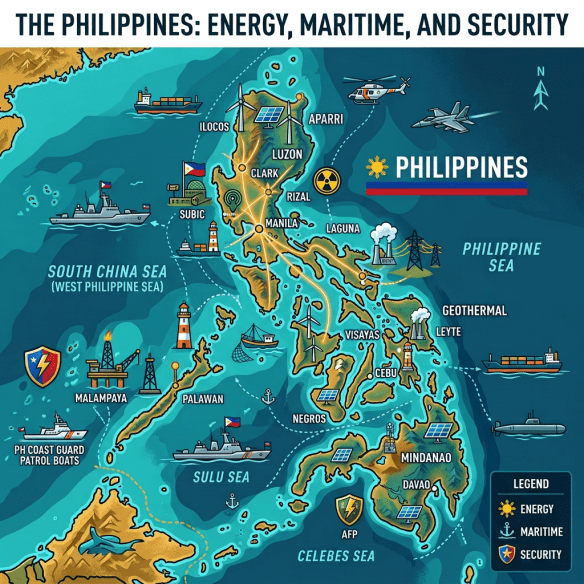
Karl, after the effects of Red Horse wore off, I saw that the Cagayan area in the north east of Luzon on your map was mis-labeled “Albay.”
Good Catch! Darn AI was inebriated!
Corrected it.