FROM STRATEGIC LEARNING TO RESILIENT SOVEREIGNTY
A Philippine Doctrine of Capability, Strategic Autonomy and Mega-Systems


By Karl M. Garcia
Introduction: The Real Strategic Question
The Philippines does not lack assets.
It has geography, a vast maritime domain, natural resources, agricultural potential, a large workforce, universities, ports, cities, entrepreneurial capacity, a substantial domestic market and a strategic position in the Indo-Pacific.
What it lacks is capability integration.
A mineral deposit is an asset; mineral processing is capability.
A coastline is an asset; persistent maritime-domain awareness is capability.
A university graduate is potential; an engineer working within a productive industrial ecosystem is capability.
A port is infrastructure; a port connected to logistics, manufacturing, energy, ship repair, digital systems and markets is strategic capability.
The central task of Philippine development should therefore be:
Convert assets into capabilities, and capabilities into interconnected national systems.
This leads to a simple doctrine:
Learn from everyone. Copy no one. Build Philippine capability.
The objective is not autarky. It is resilient sovereignty—the practical ability to see, understand, decide, produce, protect, move, recover, adapt and choose.
That is strategic autonomy through managed interdependence.
I. CAPABILITY IS NATIONAL POWER
National power should not be measured simply by what a country owns or purchases, but by what it can actually do.
The strategic progression is:
Resources → Processing → Manufacturing → Engineering → Design → Innovation
And:
Importer → Operator → Maintainer → Adapter → Engineer → Designer → Innovator
This applies equally to semiconductors, shipbuilding, agriculture, energy, digital infrastructure, defense, water systems and advanced manufacturing.
Foreign investment and technology acquisition should therefore leave behind more than factories and imported equipment.
They should create:
Skills + suppliers + engineering + R&D + domestic firms + intellectual property.
Otherwise, sophisticated technology can become sophisticated dependency.
The ultimate test is simple:
Can Filipinos increasingly operate, maintain, modify, improve, design and eventually create what the country strategically needs?
II. LEARN FROM EVERYONE, COPY NO ONE
No single country provides the Philippine model.
Japan, South Korea and Taiwan offer lessons in industrial upgrading.
Singapore demonstrates the importance of logistics, planning and state capacity.
China demonstrates the potential of infrastructure, industrial scale and long-term investment.
India offers lessons in strategic autonomy.
The United States demonstrates the power of innovation ecosystems, capital and alliances.
Australia offers lessons in resource development and maritime strategy.
The Gulf states demonstrate how infrastructure and capital can reshape economic geography.
The Philippine question should not be:
“Which country should we copy?”
It should be:
“What capability did they build, what institutional arrangements made it possible, and how can we adapt the lesson to Philippine conditions?”
The same principle applies to strategic thinkers.
Clausewitz, Sun Tzu, Nye, Porter, Hirschman, Schumpeter, Perez, Romer, Deming, Rumelt, North, Ostrom and Sen offer different pieces of the puzzle.
No single theory is sufficient.
The Philippine doctrine must therefore be synthetic rather than ideological.
III. STRATEGIC CHOICE AND THE CHANGING CHARACTER OF CONFLICT
Strategic autonomy also requires diplomatic flexibility.
Palmerston’s famous 1848 formulation—that Britain had neither perpetual allies nor eternal enemies, but enduring interests—has often been attributed to Henry Kissinger. The documented origin is Palmerston; Kissinger later echoed and discussed similar principles.
The Philippine lesson is not cynicism.
It is strategic flexibility anchored in enduring national interests.
Those interests include:
Sovereignty + territorial integrity + economic prosperity + maritime security + food and energy security + resilience + strategic choice.
Alliances matter.
Partnerships matter.
Trust matters.
But national strategy cannot be outsourced to friendship.
At the same time, contemporary competition cannot be understood purely through conventional military power.
The work of Mary Kaldor on new forms of organized conflict, Rupert Smith’s concept of “war amongst the people,” and the writings of Russian General Valery Gerasimov all highlight different aspects of a broader reality: competition can operate simultaneously through military, political, economic, informational, cyber and civilian domains.
The expression “Gerasimov Doctrine” should be used cautiously; it is more accurate to discuss Gerasimov’s writings and Russia’s broader approach rather than assume a formally adopted doctrine bearing that name.
For the Philippines, strategic competition may involve:
Disinformation → cyber disruption → economic pressure → coercive maritime activity → legal and political pressure → infrastructure vulnerability → military signaling.
The response therefore must be integrated:
Maritime awareness + cybersecurity + diplomacy + economic resilience + information resilience + law enforcement + civil defense + military deterrence.
IV. RESILIENT SOVEREIGNTY
Sovereignty is more than legal jurisdiction.
A state exercises meaningful sovereignty when it possesses enough practical capability to make choices.
Resilient sovereignty means the ability to:
See → Understand → Decide → Produce → Protect → Move → Recover → Adapt → Choose.
This does not require complete self-sufficiency.
It requires sufficient domestic capability and sufficient alternatives so that dependence does not become vulnerability.
The objective is therefore not artificial equidistance among major powers.
It is:
Strategic choice.
V. FROM MEGA-PROJECTS TO MEGA-SYSTEMS
The Philippines should think at larger scale, but it should stop confusing physical size with strategic importance.
The strategic value of infrastructure comes from the systems it enables.
Ports should connect to cities, industries, farms, energy systems, universities and digital networks.
Railways should connect production to markets.
Energy infrastructure should connect generation to manufacturing.
Universities should connect to laboratories and industry.
Digital infrastructure should connect businesses, government and research.
The objective is not necessarily the largest individual project.
It is:
The greatest system effect per peso.
A mega-project is a physical object.
A mega-system is a network of mutually reinforcing capabilities.
VI. THE LUZON ECONOMIC CORRIDOR AND INDUSTRIAL TRANSFORMATION
The Luzon Economic Corridor provides a practical foundation for this approach, linking Subic Bay, Clark, Manila and Batangas through coordinated investment in transport, clean energy, semiconductor supply chains, agribusiness and related infrastructure.
Its strategic importance lies not merely in individual projects but in the possibility of creating an integrated economic geography.
The proposed Pax Silica hub in New Clark City should likewise be evaluated not simply as an industrial location but as a capability-building platform.
It should progressively move the Philippines from:
Assembly → Testing → Packaging → Components → Equipment → Engineering → Design → R&D → Intellectual Property.
Its success should therefore be measured by Philippine capability created—not merely by foreign capital invested.
The objective is:
Industrial ecosystem formation, not industrial enclave formation.
VII. AGRICULTURE, CIRCULARITY AND RESOURCE SECURITY
Agriculture should be treated not only as food production but as an industrial platform.
Abacá, piña, banana fiber, coconut coir, bamboo and other biomass can support:
Textiles + composites + packaging + construction + filtration + marine products + industrial materials.
Agricultural policy can therefore become industrial policy.
The same principle applies to waste.
The traditional model is:
Extract → Manufacture → Consume → Dispose
A more resilient model is:
Extract → Manufacture → Use → Recover → Process → Remanufacture → Reuse
A Philippine Planetary Refinery concept could recover value from plastics, textiles, agricultural residues, construction waste, electronic waste and industrial by-products.
Circularity should not become recycling for its own sake.
It should be pursued where it:
Reduces resource dependence + creates competitive industries + improves resilience + makes economic sense.
VIII. THE PHILIPPINES AS A MARITIME SYSTEM
For an archipelagic country, the sea is not a boundary.
It is the country’s:
Highway + food system + resource base + energy frontier + industrial platform + security domain + connection to the world.
The maritime system must allow the country to:
See → Understand → Protect → Operate → Sustain → Restore.
Maritime Domain Awareness should integrate appropriate information from defense, the coast guard, fisheries, science, ports, shipping and law enforcement.
This is essential not only for conventional defense but also for gray-zone competition, illegal activity, environmental protection and the exercise of sovereign rights.
A country that cannot see what is occurring in its maritime domain cannot fully exercise sovereignty over it.
IX. THE MARITIME ECONOMIC NETWORK
The archipelago should function as one maritime economic network:
Farm → Consolidation → Processing → Cold Chain → Regional Port → Domestic Shipping → Gateway Port → Industrial Zone → Global Market
Luzon, Visayas and Mindanao should not function as isolated economic islands.
Mindanao, in particular, can be developed as a network of complementary maritime-industrial nodes:
Davao — logistics and services
General Santos — agriculture, fisheries and food processing
Cagayan de Oro — manufacturing and logistics
Iligan — industry, energy and agro-processing
Zamboanga — western Mindanao and ASEAN-facing trade
Surigao — minerals and maritime logistics
The objective is not competition among cities.
It is a Mindanao Economic Network.
X. TRANSFORMATIVE INFRASTRUCTURE
Proposals such as the Quezon Canal or future Mindanao canal and maritime-connectivity concepts should neither be dismissed because they are ambitious nor approved because they are ambitious.
They should be compared against alternatives.
The question is not:
“Is this a mega-project?”
It is:
“Does this create greater strategic and economic value than the alternatives?”
Every transformative project should therefore undergo staged feasibility assessment, economic analysis, environmental review, financing evaluation and implementation planning.
Ambition should be welcomed.
But ambition must be disciplined by evidence.
XI. HUMAN CAPITAL IS STRATEGIC INFRASTRUCTURE
No mega-system works without people.
A shipyard without naval architects cannot become a strategic shipbuilding industry.
A semiconductor ecosystem without engineers cannot scale.
A digital economy without cybersecurity professionals cannot remain resilient.
An advanced manufacturing industry without technicians cannot compete.
The Philippines therefore needs workforce planning synchronized with industrial strategy.
The progression should be:
Education → Skills → Research → Industry → Experience → Engineering → Innovation
And the state must build the institutions that connect those stages.
XII. FROM “KAYA NG PINOY” TO A CAPABLE PHILIPPINES
The Philippines already demonstrates extraordinary individual capability.
Filipino engineers, seafarers, nurses, architects, programmers, scientists, technicians, entrepreneurs, pilots, soldiers and skilled workers compete globally.
The question is not:
“Are Filipinos capable?”
The question is:
“Can the Philippines organize Filipino capability at scale?”
An engineer working abroad represents individual capability.
A Philippine engineering ecosystem capable of designing, manufacturing, certifying, exporting and continuously improving complex systems represents national capability.
A Filipino naval architect is capability.
A Philippine maritime-industrial ecosystem capable of designing ships, producing components, maintaining fleets and generating intellectual property is national capability.
This is the difference between:
Capable Filipinos
and
a capable Philippines.
XIII. “KAYA NATIN ’TO” MUST NOT MEAN “BAHALA NA”
Filipino optimism is valuable, but it must not become an excuse for improvisation without preparation.
“Kaya natin ’to” should not mean:
Bahala na.
Real capability is technical and repetitive.
It requires:
Standards + specifications + procurement + laboratories + testing + certification + financing + apprenticeships + universities + factories + supply chains + maintenance + competent institutions.
The slogan says:
Kaya.
Capability asks:
How?
Who will build it?
Who will operate it?
Who will maintain it?
Who will train the next generation?
Can we manufacture replacement parts?
Can we improve what we acquired?
Can the system survive a change of administration?
Can we eventually export what we develop?
That is the pathway from Filipino ingenuity to national capability.
XIV. EDUCATION AND SCIENCE AS NATIONAL CAPABILITY INFRASTRUCTURE
Education is not simply a social-service expenditure.
It is the foundation of national capability.
The Philippine Constitution gives education the highest budgetary priority, and the national education-sector allocation has grown substantially.
But expenditure is an input.
Capability is the outcome.
The relevant questions are therefore:
Are learning outcomes improving?
Are graduates acquiring useful skills?
Are laboratories adequate?
Are universities producing research?
Are technical graduates employable?
Are science and engineering graduates finding productive opportunities at home?
Is education synchronized with industrial strategy?
Education produces capability potential.
Science creates knowledge and technology.
Industry creates productive scale.
Infrastructure creates connectivity.
Finance creates investable scale.
Government creates coordination, rules and strategic direction.
Only when these systems reinforce one another does capability compound.
XV. DOST AND THE RESEARCH-TO-INDUSTRY PIPELINE
The same principle applies to the Department of Science and Technology.
DOST’s institutional evolution—from the National Science Development Board to the National Science and Technology Authority and eventually a Cabinet-level department—reflects the country’s long-standing recognition that science and technology are components of national development.
Its role extends beyond laboratory research.
It encompasses scientific services, research councils, research institutes, scholarships, technology development, commercialization and critical national services such as weather and geohazard monitoring.
Therefore, the question should not simply be:
“How much does the Philippines spend on DOST?”
It should be:
“How effectively does the national system turn knowledge into capability?”
The desired pipeline is:
Education → Research → Technology → Prototype → Certification → Commercialization → Manufacturing → Export
R&D funding without industry can create research islands.
Industry without domestic R&D can create technological dependence.
The objective is a functioning research-to-industry pipeline.
XVI. PLANNING IS ALSO NATIONAL CAPABILITY
A modern state needs an institutional capacity to think ahead.
The Philippines has recently reorganized its economic-planning architecture. Under Republic Act No. 12145, the Economy, Planning and Development Act, NEDA was reorganized into the Department of Economy, Planning and Development (DEPDev) and the NEDA Board into the Economy and Development Council.
The institutional names may change.
The underlying national requirement does not.
The country still needs:
Economic analysis + development planning + investment programming + project evaluation + monitoring + policy coordination + long-term strategy.
Planning is often invisible.
A bridge can be photographed.
A road can be inaugurated.
But the most valuable planning decision may be the project that government wisely decides not to build.
Therefore:
Planning capacity is institutional infrastructure.
Statistics are infrastructure.
Research institutions are infrastructure.
Regulatory capacity is infrastructure.
Professional civil service is infrastructure.
Project evaluation is infrastructure.
Strategic planning is infrastructure.
XVII. MISSION ACCUMULATION AND INSTITUTIONAL DESIGN
The Philippine problem is not necessarily that government has too many agencies.
Sometimes it is that existing institutions have accumulated too many unrelated missions.
A new national problem appears.
Government asks:
“Which existing agency can handle it?”
The answer is often:
“Give it another mandate.”
Over time, institutions become compressed under layers of responsibilities requiring different expertise, incentives and accountability systems.
This creates mission accumulation.
The solution is not automatically to create more agencies.
Nor is it automatically to merge agencies.
The real question is:
What institutional architecture best matches the capabilities the country needs?
Government should therefore be designed around functions, competencies and outcomes—not simply organizational charts.
XVIII. INFRASTRUCTURE AND INDUSTRIAL POLICY ARE NATIONAL SECURITY
Ports, energy systems, telecommunications, shipyards, industrial zones, transportation corridors and digital networks are simultaneously economic and strategic assets.
A country capable of building and repairing ships has greater maritime resilience.
A country with multiple logistics routes is harder to paralyze.
A country with resilient energy infrastructure can withstand disruption.
A country capable of producing critical technologies is less vulnerable to coercion.
A country with resilient information systems is harder to destabilize.
Therefore:
Economic resilience is national security.
And:
Industrial policy is increasingly a security policy.
XIX. GOVERNANCE: FROM MASTER PLANS TO EXECUTION
The Philippines does not lack plans.
Its deeper problem is fragmentation.
Ports, roads, railways, energy, water, industrial zones, land use, environmental policy, defense and regional development are often planned separately even though citizens and businesses experience them as one system.
The country therefore needs stronger national strategy integration capable of aligning:
Plans + budgets + infrastructure + industrial policy + maritime policy + defense + environment + regional development + human capital + information resilience.
Every major strategy should follow:
Vision → Diagnosis → Priorities → Capability Targets → Spatial Strategy → Infrastructure → Projects → Financing → Implementation → Measurement → Evaluation → Adaptation
The objective is not to produce another master plan.
It is to build an execution system.
XX. MODULARITY AND THE OFF-RAMP
Mega-systems should be built modularly.
A maritime economic corridor, for example, could progressively integrate:
Port + rail + road + dry port + cold chain + shipyard + digital platform.
The system does not have to be completed simultaneously.
Each module should demonstrate value and strengthen the next.
Every major project should also have an off-ramp.
At every stage government should ask:
Is the problem still real?
Are the assumptions still valid?
Is the project still affordable?
Has a better alternative emerged?
Is the expected capability actually materializing?
If not, the project should be modified, delayed or stopped.
That is not failure.
That is disciplined governance.
XXI. THE SIX PILLARS OF RESILIENT SOVEREIGNTY
The national capability architecture can be organized around six mutually reinforcing pillars:
1. Institutional Resilience
Competent, accountable and continuous government.
2. Economic and Industrial Resilience
Manufacturing, food security, logistics, diversified trade and domestic productive capacity.
3. Technological Resilience
AI, digital infrastructure, cybersecurity, engineering, science and R&D.
4. Strategic and Maritime Resilience
Maritime-domain awareness, defense, law enforcement, shipping, shipbuilding and maritime industry.
5. Human Resilience
Education, technical skills, employment, entrepreneurship and social capacity.
6. Environmental and Humanitarian Resilience
Water security, disaster preparedness, climate adaptation and circular resource management.
Together they constitute a national capability architecture.
XXII. THE PHILIPPINE MEGA-SYSTEM PORTFOLIO
Rather than searching for one national mega-project, the Philippines should build a portfolio of interconnected systems.
Industrial Network
Pax Silica + Luzon Economic Corridor + regional manufacturing.
Maritime Network
Ports + domestic shipping + Ro-Ro + shipyards + logistics.
Agro-Industrial Network
Farms + processing + cold chains + warehouses + ports.
Water Network
Flood control + reservoirs + irrigation + recycling + appropriate desalination.
Energy Network
Generation + transmission + storage + renewable energy + industrial power.
Digital Network
Telecommunications + data centers + cloud + AI + cybersecurity.
Urban Network
Mass transit + housing + smart systems + climate resilience.
The objective is system effect, not project accumulation.
XXIII. THE NATIONAL STRATEGIC OPERATING SYSTEM
Every major national initiative should answer six questions:
- What problem are we solving?
- What capability are we creating?
- What industries and institutions does it connect?
- What vulnerability does it reduce?
- How will success be measured?
- How will the capability be maintained and improved?
This changes the development mindset:
Project completion → Capability creation
Budget utilization → Strategic outcomes
Technology acquisition → Domestic competence
Waste disposal → Resource recovery
Infrastructure → Economic linkages
Foreign investment → Capability transfer
Military modernization → Integrated resilience
Master plans → Execution systems
XXIV. CONCLUSION: THE REAL MEGA-PROJECT IS THE PHILIPPINES
The Philippines does not need to become a great power.
It needs to become a capable power.
A country capable of protecting its maritime domain.
Capable of producing more of what it strategically needs.
Capable of transforming resources into higher-value products.
Capable of operating and maintaining advanced technology.
Capable of recovering value from waste.
Capable of moving food, people and goods efficiently across its islands.
Capable of surviving disasters and recovering from disruption.
Capable of resisting coercion below the threshold of war.
Capable of maintaining alliances while adapting to changing circumstances.
Capable of anchoring foreign policy in enduring national interests.
And, most importantly:
Capable of making choices.
That is the deepest meaning of sovereignty.
The Philippines already possesses many of the ingredients:
People. Geography. Maritime territory. Resources. Agriculture. Cities. Ports. Universities. Entrepreneurial energy. Strategic location.
The strategic task is to connect them.
Connect farms to industry.
Connect industry to ports.
Connect ports to markets.
Connect universities to industry.
Connect science to production.
Connect technology to Filipino capability.
Connect waste to resource recovery.
Connect energy to manufacturing.
Connect infrastructure to economic geography.
Connect the islands through the maritime domain.
Connect economic resilience to national security.
Connect diplomacy to enduring national interests.
Connect defense to the realities of contemporary conflict.
And connect all of them through institutions capable of planning, financing, executing, measuring and continuously improving.
The Philippine doctrine can therefore be reduced to ten principles:
LEARN FROM EVERYONE.
COPY NO ONE.
ANCHOR POLICY IN ENDURING NATIONAL INTERESTS.
UNDERSTAND THE CHANGING CHARACTER OF CONFLICT.
THINK AT MEGA-SCALE.
BUILD MODULARLY.
INTEGRATE SYSTEMS.
DEVELOP PHILIPPINE CAPABILITY.
MAXIMIZE TRANSFORMATION PER PESO.
BUILD A STATE CAPABLE OF CAPABILITY.
This is what “Kaya ng Pinoy” should ultimately mean.
Not that Filipinos can somehow improvise their way through every problem.
But that the Philippines can deliberately build the institutions, industries, infrastructure, knowledge, technology, workforce and systems that allow Filipino capability to compound across generations.
The slogan says: Kaya.
National strategy asks: How?
Institutions provide the pathway.
Capability provides the answer.
And sovereignty provides the purpose.
The objective is not to build the world’s biggest canal, city, industrial park, port or infrastructure project.
It is to build something more consequential:
A Philippines capable of choosing its future rather than merely reacting to it.
That is resilient sovereignty.
That is strategic autonomy.
That is the Philippine mega-system.
And ultimately:


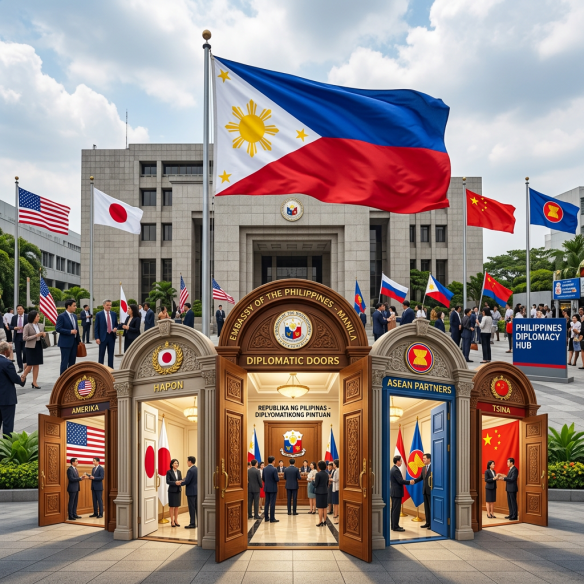
Thanks, Karl. I look forward to reading your latest essay. I noticed “Embassy of the Philippines – Manila.”
I would ask a question, but then I’ve been too Socratic lately. So I’ll humbly leave it as a statement.
Let us try that approach.
I agree… Here is another statement: In the interest of accuracy, I don’t believe that the Philippines has an embassy in Manila.
it took me some looking to find that error in one of the graphics, wow.
My question to you, are you looking at the trees or do you also see the forest?
“it took me some looking to find that error in one of the graphics, wow.
“My question to you, are you looking at the trees or do you also see the forest?” – Irineo
Thanks for the question, Irineo.
In this particular case, I was looking at the trees, specifically the graphics. These AI generated graphics can be impressive. I believe it is good to take the time to appreciate, and possibly see the messages in them that are related to the essay itself.
A few essays ago, I caught another error (and I say this humbly) which was on a map of the Philippines which had mislabeled the Cagayan area as Albay. I remember as a child, specifically in 4th grade, I was fascinated with the map of the Philippines as a result was familiar with all the provinces and where they were. Also, I know the feeling when someone inadvertently mislabels one’s hometown. I am not from Cagayan, but I can imagine how someone from there would feel if it was labeled “Albay” on a map of the Philippines.
So I was looking at the trees for as I explained to Karl, I would have to read the essay later and check out the forest.
But in relation to previous essays in SOH, do I see the forest? I would say yes, but my view of the forest may not be the same as others’ views. So it may be possible that the forest that I see is not exactly the same as the forest another sees. But close is good enough for the sake of good discussion.
These words of Rizal probably best express the point I humbly try to make (here he is speaking to Fr. Pastells, SJ from his exile in Dapitan:
”I look upon human judgment as a statue in a studio: a class of students or sculptors surrounds it, each observing it from a different angle; to one it seems to be facing right, to another facing left, to another in front, and to another behind; one sees its head tilted up, another sees it lowered, and each believes that he alone is right because he describes what he sees. But to see the statue as it really is, one would have to place his eyes at exactly the same height, distance, and angle as the others, possess the same curvature of the retina, and have the same artistic sense.”
I trust you will agree that these are insightful words from a Filipino that we can all be proud of. He is speaking in defense of intellectual tolerance, freedom of thought, and humility: no single person possesses the absolute, objective viewpoint because every human mind is bounded by its own vantage point.
Very cool, eh?
oh, that shows again that Rizal gave things a lot of thought.
He would have like this essay of mine I am sure:
what I am implying is that we all know the Philippines based on what parts of the country we have seen and lived in.
Also to some extent by what groups of people from the country we have interacted with.
which is why it is important to exchange points of view even if they differ. Many in-groups in the Philippines are quite limited in perspective.
This blog with its combination of people with extremely different perspectives of the Philippines gets quite close to a 360 degree IMAX 5D view haha.
the question is also with what goal one checks out the forest. In Munich it would depend on one’s role:
– a gardener from the Gartenamt (Bureau of Gardening) would have a database of all trees, their species, age and health history
– a planner in the Gartenamt would be looking at the Bestand (inventory) to see if the city is still as green as it should be
– city hall wouldd want to know if the goal of three trees near (whatever that means) every house is fulfilled, and other clearly defined goals
so one could ask at what level we are looking at stuff over here – at many levels for sure.
one could go really philosophical in the sense an Ilokana ex of mine defined philosophy as “iti apay iti apay” – the why of the why.
I now wonder if her claim that she had an English railway engineer based in Dagupan among her ancestors was true or not.
Her being very eager about the plays of Shakespeare – which she said was family tradition – was real, just like her being a Marcos loyalist.
one could ask now what is the why of the why of TSOH.
are we all just people lost in the woods who somehow met at a tree trunk?
tell me.
“which is why it is important to exchange points of view even if they differ. Many in-groups in the Philippines are quite limited in perspective. This blog with its combination of people with extremely different perspectives of the Philippines gets quite close to a 360 degree IMAX 5D view haha.” – Irineo
You are preaching to the choir, my good man. When Obama was elected, I first learned of this concept of “Team of Rivals” based on the book. Although the buck stopped with Obama, he did not want to surround himself with yes-men because he was confident in his leadership abilities and did not want to be insulated from reality which is what tends to happen if you surround yourself with yes-men. Trump is too incompetent as POTUS to realize that.
I believe TSOH would benefit from a healthy mix of rivals.
“one could ask now what is the why of the why of TSOH.
“are we all just people lost in the woods who somehow met at a tree trunk?
tell me.” – Irineo
I cannot tell you honestly “because it would get me killed.”
Hehehe
Let me humbly tell you where I got that line in quotes. I am quoting from a negro witness in a courtroom scene in a movie I watched a few months ago. The scene is in the Jim Crow south in a courtroom and this black young man is on the witness stand testifying in favor of the defendant. The prosecuting attorney tries to discredit him as a witness because it had been proven that earlier at some point he had lied I think to the police. The prosecuting attorney asked him “Why did you lie?!” It was more of a rhetorical question.
The black man answered “Because if I told the truth I would have been killed!”
Basically everyone in the courtroom, including the judge and jury, knew that to be true. At least that is how the movie portrayed it in the faces of the people in the courtroom.
So forgive me if I evade you question at this time, something I did when asked about my feelings w/ regard to Sara Duterte.
Anyways…time to get back to the forest and the trees.
BTW, I found another possible anomaly in one of the graphics, the one after the “Embassy of the Philippines – Manila” graphic. Another tree!
Irineo and my self played with Daang Matuwid to our own brand of daang makulit, so it takes one to know one CV.
Thanks Man.
Karl, many thanks – I can see some of your major ideas forming from the previous essay to this one. That is a natural process which happens if one writes stuff and discusses it with others. Further comments on specific key concepts to follow.
here we go:
KOREK! this elaboration is very nice:
I would add, the Bavarian Oktoberfest shows how a local tradition can be made into an efficient mega-event, building tons of capabilities on the side:
1. hotels and accomodation, public transport, gastronomy – in fact every business that booms when get tons of outside guests
2. security, emergency service and crowd control (the upgrade of the CCTV system this year with AI-based early warning shows how they keep in step)
3. building temporary facilities that host thousands (utilized as well for the Adele concert pop-up arena two years ago)
4. world-class event marketing from the city (utilized also for the Taylor Swift Eras concert here as well as the recent BTS Arirang concert)
5. finding the right mix of tradition and modernity in both image and reality (otherwise Oktoberfest would be just another big fairground)
I will gladly show Filipino local politicians who want to learn more the details if they come this year and pay my first beer. Joke lang
seriously, to stay with the Oktoberfest example, festivals like the Ibalong in Albay do their thing pretty well alreadyy, probably not yet scaled in such a way that they can accomodate crowds coming from Bikol International Airport, and not yet marketed that way. But the next competitor is Kaogma in CamSur, with a certain CamSur dynasty behind the scenes, and Joey’s idea of localities trying to outdo each other would already start with the big “fiestas”.
unseriously, I will just have grilled chicken at the expense of whoever comes to Munich to learn from me how the Oktoberfest developed capability, and other capabilities here like university – tech industry collaboration, industrial parks old and new. I LOVE the pork roast here, they can have it, I MAY NOT.
I would also add Joe’s classic about Mindanao development to the mix while we are at it: (Berlin is to Munich as Manila is to Davao in some ways BTW)
heto maganda rin:
my additional example: Filipinos playing at gigs abroad goes back to even the members of the Juan de La Cruz band of the 1970s earning their early spurs in Japan. Filipino groups performing at Japan’s famous Summer Sonic festival like BINI and SB19 will this week are a more coordinated capability.
At present the Creative Industries Act has NOT YET built true Filipino capability at industrial level yet, and DOT getting both PPop groups on the boat as official Tourism Ambassadors is good PR but not much more yet.
It is just like DOT having Eala, Obiena, BINI, SB19 and some others on a PR campaign featuring excellent Filipinos is good PR but of course not capability building. Unless you take the removal of the franchise which forced ABS to build new business lines (BINI and Batang Quiapo were their top earners last year) as capability building by attempted sabotage. Anyhow this is just an aside stuff like the article below (shameless self-promo) are more important:
from my Germany-centric perspective, I only have one more thing to add: (apply whatever lessons apply sa Pilipinas)
Germany was able to rebuild its industry after WW2 because it had the capability. The Germanic TRIBES OF YORE that inherited Roman aqueducts like the almost 100 km long one that provided fresh water to Cologne did not have the capability even to fix/maintain it
Thanks for this Irineo.
Welcome.
Notes as I read.
On a scale of 1 to 10 in deploying concepts such as these, I’d say the nation os about 7, doing most of the things mentioned. The nation is a barge in a canal, confined by corruption, incompetent agencies and LGUs, uninformed voters, and limited financial resources. President Marcos understands the ideas. but he’s just a barge captain. He can’t turn the thing around in a canal.
don’t give that to the likes of Senator Bato or other PNP folks at his level, they would get it totally wrong haha.
But yes, I have learned a lot about planning and implementation the past few years and good roadmaps and milestones are indeed paramount.
my decades in German (and European) industry have shown me to what extent competence developed in careers is a component of capability as a whole.
my exposure to Indian IT people gives me the impression they know how to develop both competence (individual) and capability (team).
Excellent points.
Many thanks Joe.
“On a scale of 1 to 10 in deploying concepts such as these, I’d say the nation os about 7, doing most of the things mentioned. The nation is a barge in a canal, confined by corruption, incompetent agencies and LGUs, uninformed voters, and limited financial resources. President Marcos understands the ideas. but he’s just a barge captain. He can’t turn the thing around in a canal.” – JoeAm
Thanks for your notes, JoeAm, which I read with great interest.
A few humble comments without questions, Socratic or otherwise. I hope you don’t mind:
I would place the nation at about a 4 or at best a 5 giving it the benefits of some doubts being a lay person with respect to the nitty gritty of economics/politics/international relations, etc. as respects nation building, or in Karl’s terms building national integration and capability.
I also would not describe the Philippines as a barge. Barges are powerless, usually pulled or pushed by tugboats. But look at Karl’s description of the Philippines:
“It has geography, a vast maritime domain, natural resources, agricultural potential, a large workforce, universities, ports, cities, entrepreneurial capacity, a substantial domestic market and a strategic position in the Indo-Pacific.”
That is no barge!
Incidentally, as a child in the late 50s and early 60s I used to watch and see barges in the Pasig River as we drove over the Jones Bridge. It never occurred to me what they should do should they need to turn around, although the Pasig River was quite wide around there and certainly not a canal.
Also, I don’t see the president of the Philippines as simply the captain of a powerless barge. I believe he wields much more power than that with respect to the direction the country should take. It is in his job description.
Opposing views welcome.
Oh, you are fair in your assessment. If I wax poetic, it is merely for amusement and a general impression, not for factual accuracy. Somewhere between 4 to 7, I suppose, depending on where one is looking from, and what one is looking at. There’s certainly room for improvement. I do think a 4 would reflect deterioration or stagnancy, and that for sure is not the case. Corruption interferes with progress, it does not stop it. There’s a lot of building going on, and some level of competence in most agencies.
Yes, President Marcos is more than the barge captain as he is responsible for the vehicle and the barriers. But he is not a dunce like Dela Rosa, Go, Padilla, and Sara Duterte. He understands concepts, and Karl’s writings could indeed inform him. The dunces are not smart enough to comprehend multi-dimensional thinking. Marcos, to my everlasting surprise, is.
Thanks for the thoughtful observations.
bahala na, here goes nothing!
why is that chinese nepo eunuch topping the billing sa article about philippines capabilities? and why is that chinese writing did not have english or filipino translation contrary to what fda philippines said there there should be equivalent translation, else such products have no place in our society.
are there no filipinos good enough to top the bill? the philippines does not lack assets and yet a chinese is given place of prominence at nauuna pa. I really must be missing something! ah, like what ex justice associate carpio said to teresa lazaro, our foreign sec that china’s permission is not needed when resupplying our hulking presence sa ayungin shoal.
I believe the current DFA Secretary is weak compared to Teddy Bear Locsin who would not concede at all to any taint upon Philippine sovereignty. Maybe she’s good at managing OFW populations. Sec Teodoro must certainly not like her “secret” agreement with China on the Sierra Madre that says the Philippines will merely supply the old ship, not develop it, and will notify China of visits.
hear! hear!
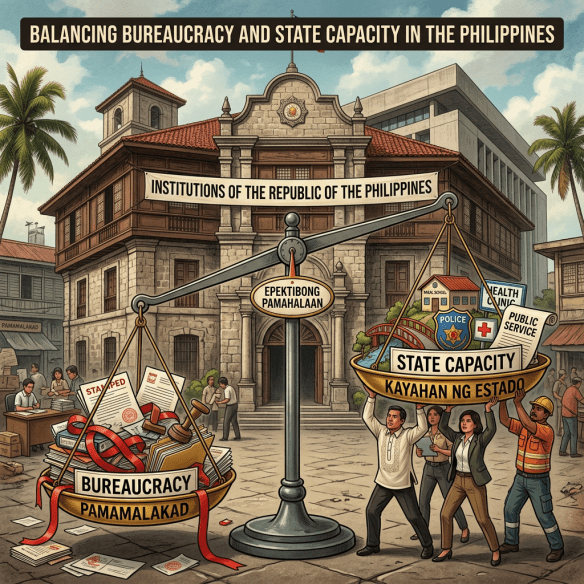
I hope you get a response to your questions, Kasambahay. In the graphic with the scale where bureaucracy outweighs State Capability, you will see that the Filipino people are pictured as tipping the scale in favor of the bureaucracy. Looks like a Freudian slip to me. The Filipino people should be looking for balance.
That is the ideal our current situation is we have a bloated bureacracy.
If you start notcing my typos, you would be wasting your time, they would reccur one way or the other.
aba, karlG, typos are fine, it’s the creepy AI that is summat leading us toward, its visuals are scary.
Pasensya na sa inyo.
LOL, yes, some AI drawings are indeed creepy.
Bayaan mo na. Wala akong maisagot
sagot is not needed po, but thanks anyway. I just need an opening gambit so the future generation of pinoys who happen to chance on this blog can say, commenters here did not just take things lying down and let things be, that they did voice opinion when they see something not really conducive to filipinos psyche. they may laugh at the crudeness and ridicule my effort, but it is there nevertheless, I dont always agree where this chinese inspired AI is taking me, us.
Ok thanks for that
This manta should probably be made more effective by being:
Learn from success. Copy the best lessons that can be adapted to the Philippines. Capability is the ability to repeat success on one’s own.
Too often in the Philippines there is no distinction between capability and capacity. If one buys a bespoke nuclear power plant such as the BNPP, engineered and built by another, that may increase capacity but does not necessarily increase capability.
Of course there is an argument that capacity is much needed now and capability can be figured out later; reality often dictates increasing capacity first before capability.
In the Philippines natural talent, which is innate exceptionalism in an area, is also confused for capability. A talented Filipino may become exceptionally capable as opposed to being trained to be more capable than an untrained peer. Capability, as opposed to natural talent, is built by engineering a deliberate pipeline to develop the desired capability. I find that when talent is confused for the be-all of capability, the belief that one may eventually become capable enough to contribute more-than-the-average-person through personal and collective effort is depressed.
To go back to my example of the BNPP as the capacity component, crony corruption in the BNPP project aside, I wonder how many in the Philippines remember that at one time the Philippines had a whole nuclear engineer and nuclear technician training pipeline with the Philippine Nuclear Research Institute (PNRI) in partnership with the UP Diliman College of Engineering in order to build capability.
In 1973 when the BNPP project was unveiled in response to the global oil crisis due to the OPEC embargo, UP Diliman set up in parallel with PNRI the nuclear engineering and technical program which was one of the earliest in Southeast Asia. The aim of the nuclear engineering program was to build capability in graduated nuclear engineers and nuclear technicians to initially man the Westinghouse-built BNPP. The more long term goal was to increase Philippine capability in nuclear energy so that the Philippines could build a domestic nuclear energy industry that weaned off brittle dependencies on imported fuel from the Middle East in the case of future externally caused energy crises.
From 1973 to 1979 the UP Diliman nuclear engineering program had already graduated at least 3 batches of nuclear engineers and nuclear technicians. The New York Three Mile Island nuclear power plant “disaster,” gave considerable arguments to the growing global Green movement (which we now know had links at that time with USSR agitprop, something that remains in the US Greens but not Euro Greens). Almost immediately both BNPP construction, which was already experiencing budget overruns, and the UP Diliman nuclear engineering programs were halted. A year later in 1980 Marcos Sr. signed the letter of instruction directive to restart BNPP construction, but the UP Diliman program which was meant to build capability never fully recovered — 1979 was the last batch of incoming Philippine nuclear engineering students.
By 1984 when the BNPP was completed, the UP Diliman nuclear engineering program had graduated AFAIK less than 5 batches of engineers and technicians. The overthrow of Marcos Sr. following the events of EDSA in February 1986, the Chernobyl disaster later in April of that same year, and the anti-nuclear energy hysteria that followed sealed the fate of both the BNPP’s fully paid for capacity and the capability pipeline that had already graduated 5 batches of nuclear engineers. Those nuclear engineers and technicians went on to scatter across the world working in the nuclear industry, mainly in the US but also in Europe.
The graduated engineers and technicians, trained in a Philippine university program and paid for by the Filipino taxpayer, never were able to train the next generation of Philippine capability, instead dispersing their capability elsewhere. Capability enhancement and retention are critical components of skills upgrading.
I actually visited the PAEC (Philippine Atomic Energy Commission) research reactor (which I considered to be PAEGG because it was egg-shaped) together with fellow UP grade school kids along Commonwealth (similar area as INC and AIT, the latter was Asian Institute of Tourism, also connected to UP so I used their pool at times, small but clean and pleasant) but didn’t know about that training program in detail, of course those who lectured to us knew a lot.
Weird but yes, the egg was at some point no longer along Commonwealth. But let’s also remember that the Filipino reflex of repudiating everything a previous President started played a role back in 1986. There is a reason why Karl is “makulit” (in a good way) about continuity of plans.
I also remember how TMI was received by the high school and university crowd, I was already in 2nd year high when it happened.
I recall telling my father – who I recall as being quite fascinated with the natural futbol (the Latin American spelling is intentional) talent of Brazilians – that possibly Germany didn’t have as much natural talent but it was trained and organized to also have good results – in soccer. The time when Bayern Munich and other Euro teams would get the best natural talent of Latin America and Africa for their academies was yet a long way off.
Of course I know by now that postwar Germany still had the likes of Franz Beckenbauer (whose game was seen as almost “Latin”) growing up playing in the streets of working-class Munich and thus building his exceptional talent in a natural way. I also got to see how Brazil improved its natural talent by more system at some point in the 1990s. Or even how Greece did a one-time ramp-up at the Euro 2002 by hiring Otto Rehhagel and suddenly the Greeks played soccer like Germans from the 1980s as Rehhagel taught them old school systems – it was enough to make the Portuguese cry when they lost against them, I was at the lawn of the Expo 98 grounds in Lisbon when not even Nelly Furtado singing the hymn of that championship could give the Portuguese enough “Forca”. At that time Lisbon definitely still had kids growing up in the poor Alfama district playing street soccer. And Luis Figo was where Cristiano Ronaldo is now, seen as “too old”.
when I look at how Bavaria (not saying it is the non plus ultra, I have often been accused of that, it just happens to be the example I know best) managed becoming part of the modern era (from having been mocked as a bunch of peasant hicks by “the Prussians”, the old Bavarian term for anyone North of the Main river) by training both extreme talent as well as the average people you also need to staff entire industries.
Thus it was not just Munich Polytechnic and Munich Ludwig-Maximillians-University (which also had a nuclear research reactor, also egg-shaped, in Garching, now Garching is where industry and university collaborate to seed startups etc) but also polytechnic colleges across the state of Bavaria. I know a few sons of farmers in the Munich IT industry who learned their trade at such colleges like the one in Rosenheim.
Thanks for commenting on Joey’s post, Irineo. I actually picked out the same paragraph which I thought brought out a very important point and is related to Karl’s essay:
>>In the Philippines natural talent, which is innate exceptionalism in an area, is also confused for capability. A talented Filipino may become exceptionally capable as opposed to being trained to be more capable than an untrained peer. Capability, as opposed to natural talent, is built by engineering a deliberate pipeline to develop the desired capability. I find that when talent is confused for the be-all of capability, the belief that one may eventually become capable enough to contribute more-than-the-average-person through personal and collective effort is depressed. – Joey N.<<
Joey criticizes the Filipino tendency to rely too heavily on natural talent. He argues that talent should be developed—and that even people of ordinary or mediocre ability can be trained to become more capable. At scale, such improvement can contribute to the elusive goal of national capability, not merely physical capacity, as Karl reminds us. Good stuff!
Your comparison to what Germany and Brazil did with respect to their football programs is helpful.
Here is my humble opinion on Joey’s point: Yes it would do our country good to have a good pipeline (training places including schools but not limited to schools) that makes talented Filipinos even better, and then not so talented Filipinos also better than they were before the training pipeline.
But the dream cannot end there. Competent and capable graduates need jobs, and hopefully the answer is not to go overseas. The country needs to provide a pipeline of jobs to hire them in the Philippines.
Philippine employment runs at 95% of available workers (unemployment in the 5% range). The problem is that jobs do not pay well. The gap is huge vs overseas pay scales. So OFWs are an industry employing about 2.1 million people sending money to the Philippines. One cannot order higher pay domestically without bankrupting the businesses that generate jobs. The nation needs manufacturing which provides 5 support jobs for every manufacturing job. Pax Silica may jump start this. It’s amazing how much opposition there is to the idea of making the Philippines a modern manufacturing center. It’s an endless cycle of small thinking. Small thinking that is taught in schools.
“Philippine employment runs at 95% of available workers (unemployment in the 5% range).” – JoeAm
Unfortunately, that 95% rate includes cigarette vendors who sell cigarettes by the stick at traffic stops. They form part of the underemployed.
“The nation needs manufacturing which provides 5 support jobs for every manufacturing job. Pax Silica may jump start this. It’s amazing how much opposition there is to the idea of making the Philippines a modern manufacturing center. It’s an endless cycle of small thinking. Small thinking that is taught in schools.” – JoeAm
I did some research into the issue of objections to Pax Silica and it looks like the opposition is more than just “small thinking.” I believe Kasambahay brought in his objection referring to the issue of dumping of toxic electronic waste under the guise of urban mining. Those are serious issues.
I know that beggars cannot be choosers; but in the case of poisoning the homeland, I think we have to use what talents we have to avoid that option. The Philippines may be poor, but it need not stoop to begging at the cost of a poisoned environment….at least not yet.
That is my humble opinion on the subject.
Dumping is x country exporting e-waste to ph because ph imported e-waste. Urban mining is like mining from landfills, dumps, junkshops, kalakal etc.
If the Philippines cannot manage waste it should just give up and sell itself to Singapore whose leaders would do Pax Silica in a heartbeat, deploying discipline to do it right. You can’t demand a better health care system then criticize the fastest means to get there. It’s nonsense. Make the fastest way WORK, don’t give up because of hobgoblins in the mind.
You can’t demand OFWs be brought home, while rejecting the jobs that can bring them home. It’s nonsense.
“You can’t demand OFWs be brought home, while rejecting the jobs that can bring them home. It’s nonsense.” – JoeAm
Totally agree. But I think the topic is not rejecting jobs, but making sure we are not importing toxic waste into the country. We have enough domestic waste (toxic and otherwise). I’m glad we have watchdogs in the Philippines to watch out for this.
SHRINK THE DUMP
From Waste to Material
A Philippine Strategy for Circular Industry, Alternative Fuels and Infrastructure Multiplication
By Karl M. Garcia | August 2026
Executive Summary
The Philippines does not have separate waste, energy, water, construction and industrial problems.
It has a systems problem.
We dispose of materials while importing others. We demolish buildings while extracting new aggregates. We generate agricultural residues while importing industrial feedstocks. We send combustible residuals to disposal while cement plants continue to depend heavily on fossil fuels. We develop data centers while power, water, cooling and fiber are often planned separately.
The solution is not simply better garbage collection.
It is to treat waste and existing material stocks as resources and industrial feedstocks.
The national objective should therefore be:
SHRINK THE DUMP.
The strategy is:
Necessary extraction + maximum recovery + minimum disposal + continuous restoration.
This means connecting waste recovery, construction materials, alternative fuels, manufacturing, energy, water, digital infrastructure and land rehabilitation into regional Resource and Digital Industrial Hubs.
1. FROM DISPOSAL TO RESOURCE
The Philippines already possesses a vast above-ground resource inventory:
Much of this material has already been extracted, processed and transported.
Burying it means losing both its material value and the energy invested in producing it.
The question should therefore change from:
to:
2. FROM WASTE TO MATERIAL
Wood-plastic composites (WPC) illustrate the opportunity.
Recovered plastics can be combined with wood fibers or agricultural residues to produce boards, decking, furniture, fencing and other products.
But WPC should not be the endpoint.
The Philippines could develop a broader hybrid-material industry using combinations of:
Potential products include:
decking + benches + pallets + fencing + panels + furniture components + agricultural products + selected construction materials.
The principle is simple:
DESIGN MATERIALS AROUND THE RESOURCES WE ACTUALLY HAVE.
The country already has agricultural residues, plastic waste, construction demand and infrastructure requirements.
The opportunity is to connect them.
3. CONSTRUCTION AND DEMOLITION AS AN URBAN MINE
A demolished building should not automatically become landfill material.
The hierarchy should be:
REUSE → RECOVER → RECYCLE → BENEFICIAL USE → DISPOSE
Concrete can potentially become recycled aggregate.
Asphalt can return to pavement systems.
Steel can be recovered.
Masonry can become processed aggregate.
Suitable soil and rock can become engineered fill.
But circularity must be based on engineering, not slogans.
The process must be:
segregation → testing → processing → certification → application → monitoring.
The principle is:
RIGHT MATERIAL → RIGHT SPECIFICATION → RIGHT LOCATION → RIGHT APPLICATION
4. THE CIRCULAR QUARRY
Quarrying will remain necessary for a growing country.
The objective should not be to eliminate virgin extraction regardless of economic or engineering realities.
Instead, the conventional model:
Extract → Crush → Sell → Extract Again
can evolve toward:
Extract where necessary → supply construction → receive suitable recovered materials → process secondary aggregates → progressively rehabilitate.
A quarry can therefore become both a source of virgin materials and part of the country’s material-recovery and landscape-restoration system.
Rehabilitation should begin during the operating life of the quarry rather than being postponed entirely until closure.
5. CEMENT KILNS AND ALTERNATIVE FUELS
The same resource principle applies to cement manufacturing.
Cement kilns require reliable, high-temperature thermal energy. Coal has historically been used because it provides relatively consistent and controllable fuel characteristics.
But a cement kiln does not inherently require coal.
Properly engineered alternative fuels, including suitable RDF/SRF, can replace a substantial portion of fossil fuel and, under appropriate technical conditions, potentially all of it.
However, this distinction is critical:
MIXED GARBAGE IS NOT THE SAME AS ENGINEERED ALTERNATIVE FUEL.
RDF/SRF must be appropriately:
segregated → processed → dried where necessary → shredded → blended → tested → stored → controlled-fed.
The real challenge is therefore not whether waste can burn.
It is whether a reliable fuel can be produced with sufficiently consistent:
This explains why coal may remain in the fuel mix even where very high alternative-fuel substitution is technically possible.
The sensible strategy is progressive substitution, with conventional fuel retained as a reliability reserve until alternative-fuel supply becomes dependable.
The objective is not an arbitrary 100% mandate.
It is to make fossil fuel progressively unnecessary without making cement production unreliable.
6. WASTE-TO-FUEL SHOULD NOT COMPETE WITH RECYCLING
Not every plastic should be burned.
Not every waste stream should become RDF.
The hierarchy should be:
Reduce → Reuse → Recycle → Recover Materials → Produce Engineered Fuel from Appropriate Residuals → Final Disposal
The highest-value use should normally come first.
Alternative fuel is particularly useful for residual material that cannot reasonably or economically be recovered as a material.
This makes cement-kiln co-processing potentially complementary to recycling.
7. LANDFILLS AND LEGACY WASTE
Not every old landfill should be excavated.
Some should be safely capped and monitored.
Others may justify recovery and reclamation.
The decision should compare:
recoverable materials + reclaimed land + avoided liabilities
against:
excavation + processing + transport + remediation + residual disposal.
The national sequence should be:
MAP → CHARACTERIZE → RANK → TEST → RECOVER WHERE JUSTIFIED → REMEDIATE → RECLAIM
Selected legacy disposal sites could therefore become urban-mining and land-reclamation opportunities.
8. FROM RECYCLING CENTERS TO RESOURCE REFINERIES
The country needs more than collection and sorting.
A regional resource facility should be capable of:
receiving → inspecting → sorting → crushing → screening → separating → testing → grading → storing → dispatching.
It could process construction debris, plastics, metals, agricultural residues and appropriate combustible residuals.
The outputs become secondary raw materials and engineered fuels.
This transforms waste management into an upstream industry for:
construction + manufacturing + infrastructure + energy.
9. REGIONAL RESOURCE AND DIGITAL INDUSTRIAL HUBS
Because the Philippines is an archipelago, material recovery must be regional.
Low-value, high-volume materials cannot economically travel indefinitely.
Regional hubs could combine selected elements of:
Energy
Renewables + grid + storage.
Water
Recycling + rainwater storage + desalination where justified.
Materials
Construction recovery + plastics + biomass + secondary aggregates.
Alternative fuels
RDF/SRF production for appropriate industrial users.
Manufacturing
Composites + construction products + advanced manufacturing.
Digital infrastructure
Data centers + AI computing + fiber + network redundancy.
Logistics
Ports + roads + rail where available + intermodal systems.
The principle is:
INTEGRATE WHERE INTEGRATION CREATES VALUE.
10. DATA CENTERS AS INDUSTRIAL ANCHORS
Data centers can become more than real-estate projects.
They are high-value customers requiring continuous:
electricity + fiber + cooling + water + reliability.
This creates an opportunity to use data centers as anchors for broader digital-industrial ecosystems.
The progression could be:
Reliable Power
↓
Data Centers + AI Compute
↓
Cloud + AI Services
↓
Advanced Digital Services
↓
Electronics + Semiconductor Activities
↓
Advanced Manufacturing
The goal is to move from merely hosting digital infrastructure toward building a domestic digital-industrial economy.
11. WATER, ENERGY AND COOLING
Energy and water should increasingly be planned together.
Renewable electricity can support desalination where justified.
Treated wastewater can support appropriate industrial and cooling applications.
Rainwater can provide additional non-potable supplies.
A hierarchy can therefore be:
Freshwater → essential uses
Recycled water → appropriate industrial and cooling uses
Rainwater → storage and suitable non-potable uses
Seawater → desalination where justified
AI and high-density computing also make cooling strategic infrastructure.
Efficient cooling, liquid cooling, thermal storage and alternative water sources can improve both resource efficiency and digital competitiveness.
12. FROM WASTE TO INDUSTRY
The real objective is not to build better recycling programs.
It is to build industries around recovered resources.
Examples include:
Recovered plastics + wood residues → WPC
Coconut fiber → composites and engineered products
Bamboo → engineered boards and construction products
Rice residues → fillers, silica and other industrial applications
Concrete → recycled aggregate
Asphalt → reclaimed pavement
Residual combustible waste → engineered RDF/SRF
Each creates potential markets for materials that otherwise have little value.
The cycle becomes:
collection → processing → manufacturing → demand → better collection → less disposal.
13. THE GREAT REPAIR
Circularity should ultimately connect to landscape rehabilitation.
Recovered construction materials can potentially support:
The objective is not to recreate every mountain exactly as it was.
It is to transform degraded land into stable, safe and productive landscapes.
This is where circularity becomes regeneration.
14. A NATIONAL MATERIALS REGISTRY
Circular industry requires information.
The Philippines should develop a National Materials Registry covering major:
A digital Philippine Materials Exchange could connect:
Generator → Aggregator → Processor → Manufacturer → Buyer
and:
Material Surplus → Rehabilitation Site
Government should increasingly know:
What is extracted?
What is consumed?
What is demolished?
What is recovered?
What is manufactured?
What is burned as engineered fuel?
What is buried?
15. THE ARCHIPELAGIC MODEL
The Philippines should not build one enormous national recycling facility.
It should build a network of regional nodes.
Luzon
Large industrial and digital hubs linked to major economic corridors.
Visayas
Island-scale hubs integrating materials, water, energy, logistics and manufacturing.
Mindanao
Agricultural, industrial, energy and resource-recovery hubs.
Smaller islands
Modular systems for local waste, water, energy and resource recovery.
The architecture should be national.
The technology mix should be local.
THE CIRCULAR ECONOMY MUST BE ARCHIPELAGIC BY DESIGN.
16. PILOT FIRST, SCALE SECOND
The Philippines should not begin with a giant national megaproject.
It should demonstrate the model.
A pilot hub could combine selected elements such as:
renewable energy + storage + water recycling + construction recovery + composite manufacturing + RDF/SRF + digital infrastructure + logistics.
The pilot should measure:
cost + reliability + material recovery + water efficiency + environmental performance + industrial output.
Then:
PROVE → MEASURE → IMPROVE → SCALE
17. MEASURE CAPABILITY, NOT PROJECTS
Success should not be measured simply by the number of recycling centers, landfills, factories or infrastructure projects constructed.
Measure:
Waste
How much less is disposed?
Materials
How much virgin extraction is displaced?
Industry
How much recovered material becomes Philippine-made products?
Energy
How much fossil fuel is displaced by reliable alternative sources and fuels?
Water
How much water is reused or newly secured?
Digital
How much computing and connectivity capacity exists?
Land
How much degraded land is rehabilitated?
Resilience
How many alternative sources and routes exist?
The ultimate metric is:
MORE NATIONAL CAPABILITY PER UNIT OF RESOURCE CONSUMED.
CONCLUSION
The Philippines does not need another generation of disconnected infrastructure projects.
It needs infrastructure that compounds.
Energy should connect to water.
Water should connect to industry.
Waste should connect to materials.
Residual waste should connect, where appropriate, to alternative fuels.
Materials should connect to manufacturing.
Manufacturing should connect to exports.
Power should connect to computing.
Computing should connect to AI and higher-value services.
Recovered construction materials should connect cities to infrastructure and landscape rehabilitation.
Agricultural residues should connect farms to materials industries.
Quarries should connect extraction with recovery and restoration.
The strategic shift is:
from disposal to recovery
from waste to material
from waste management to industrial development
from coal dependence to increasing alternative-fuel substitution
from demolition to material harvesting
from conventional quarries to circular resource sites
from isolated data centers to digital-industrial anchors
from infrastructure consumption to infrastructure multiplication
from environmental liabilities to productive assets
The Philippines cannot eliminate every waste stream.
It cannot eliminate all extraction.
It cannot immediately replace all coal.
It cannot make every discarded material economically recyclable.
But it can change the direction of development.
It can make dumps smaller.
It can recover more of what has already been extracted.
It can build industries around recovered materials.
It can progressively substitute properly engineered alternative fuels for fossil fuels.
It can rehabilitate degraded landscapes.
And it can distribute these capabilities throughout the archipelago.
The national objective is therefore not simply:
ZERO WASTE.
It is:
NECESSARY EXTRACTION + MAXIMUM RECOVERY + MINIMUM DISPOSAL + CONTINUOUS RESTORATION
And the proposition is simple:
SHRINK THE DUMP.
BUILD THE INDUSTRY.
REPAIR THE LANDSCAPE.
I forgot e-waste
Yes. This strengthens the paper because e-waste is not merely another waste stream—it is an urban mine for critical minerals and strategic materials. I would insert it as a distinct section after construction materials and before alternative fuels.
9. E-WASTE: THE URBAN MINE FOR CRITICAL MINERALS
The resource-recovery strategy should extend beyond plastics, construction debris and agricultural residues.
The Philippines is also accumulating another valuable material stock:
E-WASTE.
Discarded phones, computers, servers, telecommunications equipment, circuit boards, batteries, motors, power electronics and other electronic products contain metals and materials that may have strategic value.
These can include:
copper;
aluminum;
nickel;
cobalt;
lithium;
manganese;
tin;
silver;
gold;
palladium; and
selected rare-earth elements.
Not every device contains economically recoverable quantities of every material. Recovery economics depend on concentration, technology, collection volume, processing costs and market prices.
But the strategic principle is important:
> A discarded electronic device should be treated as a potential secondary mineral resource before it is treated as waste.
This creates another form of urban mining:
imported electronics → use → collection → dismantling → material recovery → refining → manufacturing
rather than:
imported electronics → disposal → lost strategic materials.
From E-Waste to Critical-Mineral Security
Critical minerals have become increasingly important to modern industry.
They are required for:
electronics + telecommunications + batteries + electric vehicles + renewable energy + motors + magnets + defense systems + advanced manufacturing.
The Philippines already possesses conventional mineral resources, but it should also recognize the above-ground mineral inventory contained in its growing stock of discarded electronics.
This does not mean the country can become self-sufficient in rare earths simply by recycling phones and computers.
It means that secondary recovery should become part of national resource security.
A mature system could include:
collection → secure data destruction → dismantling → sorting → component recovery → metallurgical processing → refining → certified secondary materials
The most valuable components could be recovered first.
Lower-value residuals could proceed to other appropriate treatment pathways.
Hazardous components must be handled under appropriate environmental and occupational controls.
E-Waste and the Digital-Industrial Hub
This creates an especially interesting connection with the proposed Resource and Digital Industrial Hub.
The same ecosystem that hosts:
data centers + telecommunications infrastructure + electronics manufacturing
can also support:
electronics refurbishment + e-waste collection + component recovery + metals processing + critical-mineral recovery.
Data centers themselves will eventually generate substantial quantities of retired servers, storage devices, networking equipment, batteries, cables and power electronics.
These should not simply become another waste stream.
They can become a predictable source of secondary materials.
The concept therefore becomes:
DIGITAL INFRASTRUCTURE → DIGITAL WASTE → MATERIAL RECOVERY → NEW INDUSTRIAL INPUTS
Rare Earths Require a Special Strategy
Rare-earth recovery deserves particular caution.
Rare earths are not necessarily present in economically recoverable concentrations in ordinary household electronics, and extraction and separation can be technically difficult.
The Philippine strategy should therefore avoid promising a “rare-earth recycling revolution” without demonstrated economics.
Instead, the objective should be to develop capabilities in:
collection + concentration + pre-processing + metallurgical research + separation technology + recovery of economically viable critical minerals.
The country can begin with materials where recovery is commercially attractive and progressively develop more sophisticated capabilities.
From Waste Policy to Resource Security
This changes the meaning of recycling.
Recycling is not simply about reducing landfill volume.
It can become part of:
industrial policy + mineral security + supply-chain resilience + national security.
The strategic hierarchy becomes:
RECOVER WHAT WE CAN BEFORE WE IMPORT OR EXTRACT MORE.
This principle applies equally to:
concrete → aggregates
plastic → polymers
wood residues → composites
agricultural residues → industrial feedstocks
e-waste → metals and critical minerals
residual waste → engineered fuel
The Philippines should increasingly think of its waste stream as an above-ground resource inventory.
—
Where it fits in the abridged paper
I would make the sequence:
8. From Recycling Centers to Resource Refineries
9. E-Waste: The Urban Mine for Critical Minerals
10. Cement Kilns and Alternative Fuels
11. Waste-to-Fuel Should Not Compete With Recycling
12. Landfills and Legacy Waste
…and renumber the remaining sections.
This also improves the central thesis: the “dump” is not just full of garbage; it contains materials, energy and minerals that the Philippines has already paid to extract or import.
Well, if you embrace Pax Silica, it’s a non-issue.
“Well, if you embrace Pax Silica, it’s a non-issue.” – JoeAm
Exactly. The point of liking or not liking the principles of Pax Silica was never an issue. The issue was making sure that we do not forget the lesson of the toxic waste left behind when the Americans left Subic Bay. I’m happy to see Filipinos using their critical thinking (despite our rote-learning school system).
more on pax silica:
https://tribune.net.ph/2026/08/11/pax-silicas-real-test-diligence
we are probly not good in ewaste management, the waste left after all the minerals have been taken out, the waste waste nobody wants to talk about, the forever chemicals that could pollute both soil and water, the immediate air people breathe just as toxic. though toxins in the air can dissipate with air movement. but those in the soil got absorbed and those in the water could end up in our food chain, making us sickly.
I am reminded tuloy of what happened in vietnam after defoliant agent orange left lasting legacy, how the vietnamese bear the brunt of a massively poisoned environment with generations of vietnamese suffering ill health. today though agent orange is nearly forgotten.
in case pax silica slips out of our hands and the investment goes elsewhere like maybe to singapore and malaysia, where they are not so burdened with inordinate questions posed by filipinos, there is still possibility we may end up with the waste waste.
Good post, Kasambahay. So sad that the Philippines catches itself a bit unprepared for an opportunity such as Pax Silica. I’m talking about the power needs, possibly the water needs. These are things that were there since a long time ago. So now they have to scramble which can lead to mistakes made because of rushing.
And then there is that horrible caveat you have that even if we lose the bulk of Pax Silica, we may still end up with the toxic waste!
Vietnam, Malaysia, and Indonesia are still actively lobbying the US to re-designate the primary manufacturing hub to one of those three countries. Before Marcos Jr. and Amb. JM Romualdez successfully argued earlier this year to the US that the Philippines should take the primary position within Pax Silica manufacturing activities, all paid for by the US and allies, the Philippines had a much lower position of simple assembly and testing. That “all paid for” includes building the chip fabs, electricity generation, logistics networks, and other necessary infrastructure. Japan, South Korea, and Taiwan had to pay their own way , including sending generations of engineers to work in Silicon Valley to bring back knowledge, over many decades, while the Philippines has a big opportunity within grasp.
Due diligence is a good thing and should be done, but I find that in the Philippines “Pinoy due diligence” is just another way of saying “doing nothing.” Perhaps Filipinos will soon say “at least we’re better than those Africans,” just like they used to say of the Taiwanese, South Koreans, Indonesia, Malaysia, Thailand, and now Vietnam. I suspect eventually Africans will pass the Philippines by as well if the country’s leaders and thinkers maintain a regressive attitude. Perhaps by then the saying will be “at least we’re better than those penguins in Antarctica!”
**Due diligence is a good thing and should be done, but I find that in the Philippines “Pinoy due diligence” is just another way of saying “doing nothing.” Perhaps Filipinos will soon say “at least we’re better than those Africans,” just like they used to say of the Taiwanese, South Koreans, Indonesia, Malaysia, Thailand, and now Vietnam. I suspect eventually Africans will pass the Philippines by as well if the country’s leaders and thinkers maintain a regressive attitude. Perhaps by then the saying will be “at least we’re better than those penguins in Antarctica!”** – Joey N.
I must humbly say that I appreciate your sharing your true sentiments about us Filipinos, Joey. I appreciate honesty.
No, I just despise smart asses like you who hold back Filipinos. And I especially despise smug diaspora Filipinos who criticize from afar while knowing nothing.
@Joey, I know you read long documents. What about this transhipment scam stuff?
https://mb.com.ph/2026/08/14/trump-administration-flags-philippines-as-weak-link-in-china-tariff-evasion-network
Chatgpt
I checked the Manila Bulletin report and, more importantly, the underlying White House document. The headline is attention-grabbing, but the underlying finding needs to be framed carefully.
The White House’s August 2026 report, “The Great Transshipment Scam,” places the Philippines in Tier 3 of a “Shadow Transshipment Network.” This does not mean Washington has determined that the Philippine government or Philippine exporters are systematically helping China evade U.S. tariffs. Rather, the report identifies the Philippines as a potentially vulnerable node that Chinese-linked exporters could exploit.
What Washington is actually saying
The report identifies three broad categories:
Tier 1: major economies and trading platforms where transshipment risk exists within large legitimate trade flows.
Tier 2: countries with substantial economic integration with China.
Tier 3: smaller economies that may possess particular “weak-link advantages”—such as inexpensive labor, free zones, port access, bonded warehousing, niche assembly, preferential U.S. access, or weaker customs enforcement.
The Philippines is in Tier 3, alongside countries including Cambodia, Laos, Myanmar, Sri Lanka and others. It is also identified as part of the “Southeast Asian Microhubs” functional group, associated with light assembly, export-processing zones, relabeling and re-export.
That distinction is important.
The issue is not simply “Chinese goods passing through Philippine ports.” Legitimate transshipment is normal international commerce. The problem is when Chinese-origin goods undergo insufficient transformation, are falsely relabeled or accompanied by fraudulent documentation so that they can enter the United States claiming another country of origin.
The White House report itself acknowledges that the decline in China’s direct share of U.S. imports and the rise in imports from third countries does not prove that all of the displaced Chinese trade represents illegal transshipment. It calls for further investigation.
Why the Philippines is vulnerable
This is where the report should be taken seriously.
The Philippines has several characteristics that can make it attractive for origin-shifting or tariff-arbitrage schemes:
1. Large Chinese import flows and supply-chain connections
2. Major ports and container infrastructure
3. Export-processing and economic zones
4. Lower-cost manufacturing and assembly
5. A large electronics and semiconductor industry
6. Numerous trading and logistics intermediaries
7. An enormous archipelago with many ports and maritime entry points
8. Customs-enforcement capacity that is improving but still uneven
The danger is therefore not that the Philippines becomes a giant manufacturing substitute for China overnight. It is that small amounts of processing can be used to disguise the real origin of goods.
That distinction matters enormously for Philippine policy.
The opportunity hidden inside the accusation
There is actually a constructive way for Manila to respond.
Instead of simply saying “the United States is unfairly accusing us,” the Philippines could say:
> “We will make the Philippines one of the most transparent and traceable trading jurisdictions in Southeast Asia.”
That would turn a vulnerability into an industrial-policy advantage.
The government could establish much stronger country-of-origin verification, particularly for goods destined for the United States.
That means connecting:
Bureau of Customs → PEZA → Philippine Ports Authority → shipping lines → exporters → manufacturers → bills of materials → invoices → beneficial ownership → container movements.
The objective should be to establish whether a product genuinely underwent substantial transformation in the Philippines, rather than merely receiving a new label, package or invoice.
The White House report itself distinguishes between production-side nodes and logistics-side nodes. Production-side investigations should examine factory capacity, local value added, inputs, labor and equipment. Logistics-side investigations should examine ports, bonded warehouses, free zones, bills of lading, container routing, dwell times, invoices and documentation.
That provides Manila with a remarkably useful enforcement blueprint.
This is bigger than tariffs
There is also a strategic dimension.
The report argues that ports, industrial parks, free zones, bonded warehouses and logistics platforms can serve both legitimate commerce and illicit rerouting. It warns that increasing dependence on Chinese inputs, logistics and capital can give Beijing additional commercial leverage.
For the Philippines, this connects directly to a larger national question:
What kind of trading nation do we want to be?
The Philippines should not attempt economic autarky. Nor should it treat Chinese investment and trade as inherently illegitimate.
The objective should be transparent economic openness.
We should welcome Chinese, American, Japanese, Korean, European and other investment—but require the same standards for:
beneficial ownership;
country of origin;
customs documentation;
local value added;
transfer pricing;
bonded warehouses;
free zones;
transshipment;
re-export;
sanctions compliance; and
supply-chain traceability.
Singapore provides an interesting contrast. Although Singapore was also placed in the White House’s Tier 3, its government immediately emphasized that companies must accurately declare the true country of origin and comply with its trade laws. Singapore has also demonstrated willingness to prosecute alleged false-origin declarations.
That is a useful lesson for Manila: being identified as a transshipment-risk jurisdiction is not the same thing as being a transshipment offender. What matters is the credibility of the enforcement system.
My assessment
I would therefore frame the Manila Bulletin story this way:
The United States has not accused the Philippines of being China’s tariff-evasion accomplice. It has identified the Philippines as a jurisdiction whose infrastructure, geography and trade ecosystem could make it vulnerable to exploitation by China-linked exporters.
That is a serious warning—but it is also an opportunity.
The Philippines should respond not defensively but institutionally:
> If the Philippines wants to be a trusted alternative manufacturing and logistics hub to China, it must become exceptionally good at proving where things are actually made.
In the emerging U.S.-China trade environment, traceability becomes an economic asset.
And this fits very closely with the broader Philippine strategy we have been developing around ports, maritime domain awareness, customs modernization, industrial policy and institutional continuity: the same digital infrastructure that helps monitor our maritime domain can also help monitor the movement and provenance of goods.
The ultimate goal should be simple:
Make the Philippines difficult to use for tariff evasion—and easy to trust for legitimate trade.
No problem Karl. I read quite fast so done.
Interesting point is the development of the Detective Border AI-assisted customs software — this will probably outlive the Trump admin and seems to be a good thing.
As for the Philippines, the Philippines is actually only mentioned twice in the entire 25-page, very dense document. Within the report’s tiered system the Philippines is in Tier 3 (the lowest) with regard to alleged illegal transshipment enablement. No where does the report accuse Tier 3 countries’ governments as directly being responsible for illegal transshipment activities; rather the report highlights Chinese criminal elements working with the Chinese government, or the Chinese government directly, assisted by local facilitators in each country. This is actually how most illegal e-waste ends up in the Philippines informal e-waste recycling centers. Chinese criminal networks are the coordinators, but they need local fixers to facilitate. The report itself does not prescribe any further penalties, but rather mainly focuses on the creation of (AI-assisted) customs detection systems.
Again, many thanks.
Singapore is already the secondary Pax Silica location (a carryover from Pax Silica’s predecessor, Biden’s Minerals Security Partnership and CHIPS4 Alliance). In the Biden initiative Vietnam was identified as the PRIMARY manufacturing hub with the Philippines being much lower on the ladder of partners.
Earlier this year Marcos Jr. and Amb. Jose Manuel Romualdez convince the Trump administration that given the long-standing US-PH alliance and the crucial location of the Philippines in the First Island Chain, that the Philippines should be the primary Pax Silica manufacturing hub and regional coordinating hub. So Trump passed over Vietnam for the Philippines after being convinced of doing so by Marcos Jr. and the ambassador, even though Vietnam absolutely has a large headstart compared to the Philippines with a strong local manufacturing and energy base. I wonder if Filipinos will listen to groups with varied interests sending their representatives out to write op-eds and hold banners, then squander an opportunity again. I hope not! From everything I’ve seen, Marcos Jr. is very insistent on seeing Pax Silica through.
Note sure why WordPress is truncating the URL:
https://joeam.com/2026/08/07/the-lina-law-land-rights-and-the-homelessness-paradox/#comment-509330text
Thanks for the background and framing. Excellent.
“If the Philippines cannot manage waste it should just give up and sell itself to Singapore who would do Pax Silica in a heartbeat,…” – JoeAm
I believe that Singapore is part of Pax Silica….but I don’t think they are accepting e-waste from other countries. So I humbly admit that I do not know what you mean by Singapore would “do Pax Silica in a heartbeat.”
“You can’t demand a better health care system then criticize the fastest means to get there. It’s nonsense.” – JoeAm
Again, humbly, I believe that you CAN criticize the fastest means to get there. In our Philippine schools we memorized and learned the lesson “Don’t be pennywise and pound foolish.” That was an invitation for us to think…kinda like “Look before you leap” another motto we had to memorize.
“Make the fastest way WORK, don’t give up because of hobgoblins in the mind.” – JoeAm
Another lesson we had to memorize in elementary school in the Philippines was “Haste makes waste.” Another was “There is more than one way to skin a cat.” BTW, we learned this in English because back in the 50s, 60s, and even 70s, English was the medium of instruction, at least in the Manila area…and a lot of our curricula was based on the American system. Colonial mentality, I guess.
Meanwhile, on the subject of waste management, I just got news from relatives in Luzon that they have been battered with rains for the past few days. My sister in New Zealand said she saw videos of rivers of garbage overflowing into streets, rivers, and coastal communities. And mind you, that is probably not concentrated toxic waste.
SHRINK THE DUMP
A Philippine Strategy for Waste Recovery, Circular Industry and Regenerative Development
By Karl M. Garcia | August 2026
Executive Summary
The Philippines should stop thinking of waste primarily as something to collect, transport and dispose of.
It should be treated as a national resource—and disposal should be treated as the last resort.
The country generates enormous quantities of plastics, agricultural residues, wood waste, construction debris, wastewater and other materials. It also possesses closed and legacy dumps and landfills containing materials that may have economic, environmental or land-reclamation value.
At the same time, the Philippines remains dependent on imported raw materials and manufactured products.
This creates a strategic opportunity:
«Why import waste or raw materials when we can recover, refine and manufacture from materials already present in the Philippines?»
The objective should not be an unrealistic promise of absolute zero waste.
The more practical national goal is:
Shrink the Dump.
That means continuously reducing:
– the number of dumps;
– the volume of waste buried;
– the land committed to disposal;
– the environmental risks of disposal sites.
At the same time, the country should continuously expand:
– reuse;
– repair;
– recycling;
– remanufacturing;
– material recovery;
– landfill mining where justified;
– domestic manufacturing from recovered materials.
The strategic progression is:
disposal → recovery → refining → manufacturing → regeneration.
The Philippines does not need to achieve a mythical state in which nothing is ever discarded.
It needs to build a system in which less and less material has to be discarded in the first place.
—
1. The Waste Problem Is Also a Resource Problem
The conventional system is:
extract → manufacture → consume → discard → landfill.
This is a linear economy.
It wastes not only materials but also:
– energy invested in producing them;
– land used for disposal;
– economic value;
– employment opportunities;
– potential industrial feedstocks.
The alternative is:
recover → refine → manufacture → reuse → regenerate.
Waste management should therefore become part of industrial policy, not merely environmental regulation.
—
2. Rain Makes Philippine Disposal More Dangerous
The Philippine setting makes disposal particularly consequential.
As a tropical archipelago, the country experiences intense rainfall, typhoons, monsoons and flooding.
Rainwater moving through waste can generate leachate and mobilize pollutants. Heavy rainfall can also move plastics and other materials from poorly managed disposal sites into drainage systems, rivers and eventually coastal waters.
In a rainy country:
«A dumpsite is not simply a pile of waste. It can be a continuing pollution pathway.»
Reducing disposal is therefore also a strategy for:
– water protection;
– flood resilience;
– coastal protection;
– public health;
– environmental rehabilitation.
Shrinking the dump is not merely a waste-management objective.
It is water policy, land policy and environmental policy.
—
3. Replace “Zero Waste” With “Shrink the Dump”
Zero waste is an admirable aspiration, but it is not always a practical policy endpoint.
Some materials will remain:
– contaminated;
– hazardous;
– technically difficult to recover;
– uneconomic to recycle.
Instead of promising that waste will eventually disappear, government should establish a measurable national trajectory:
Shrink the Dump.
Measure and reduce:
– number of active disposal sites;
– tonnes disposed;
– volume buried;
– land committed to disposal;
– environmental risks from legacy sites.
At the same time, increase:
– reuse;
– repair;
– recycling;
– remanufacturing;
– material recovery;
– advanced processing.
The operational principle becomes:
«Not zero waste, but zero unnecessary disposal.»
This is more realistic, more measurable and potentially more durable as public policy.
—
4. Mine the Philippines’ Existing Material Base
The Philippines already possesses a vast above-ground resource inventory.
Agricultural resources
– coconut;
– bamboo;
– rice residues;
– corn residues;
– sugarcane residues;
– banana and pineapple fibers;
– abaca;
– forestry residues.
Urban resources
– plastics;
– metals;
– glass;
– electronics;
– appliances;
– vehicles.
Construction resources
– concrete;
– steel;
– timber;
– glass;
– bricks;
– fixtures.
Legacy resources
– materials already buried in closed dumps and landfills.
The first resource frontier should therefore not always be another mine.
It should often be:
«The materials we have already extracted, consumed and discarded.»
—
5. Landfill Mining
Closed dumps should be mapped, characterized and classified.
Not every landfill should be excavated.
Some should remain safely capped and monitored.
Others may justify:
– material recovery;
– remediation;
– methane management;
– land reclamation.
A national system should therefore follow:
map → characterize → rank → test → mine where justified → remediate → reclaim.
The economic value of a site should include:
recoverable materials + reclaimed land + avoided environmental liabilities
against:
excavation + processing + transport + remediation + residual disposal costs.
Landfill mining should become part of a broader urban-mining strategy.
—
6. Make the “Unrecyclable” Recyclable
“Unrecyclable” should not always be treated as a permanent category.
A material may simply be unrecyclable because:
– collection is inadequate;
– sorting is expensive;
– it is contaminated;
– it contains multiple materials;
– technology is unavailable;
– no viable market exists.
Government, universities and industry should therefore invest in technologies for:
– multilayer packaging;
– flexible plastics;
– mixed plastics;
– contaminated plastics;
– textiles;
– composite materials;
– difficult construction waste.
The objective is:
«Expand the boundary of practical recyclability.»
But recycling should occur only where environmental and economic benefits justify it.
—
7. WPC, Engineered Wood and Biomaterials
One important opportunity is wood-plastic composite (WPC) technology.
Instead of:
wood residues + plastic waste → disposal
the system becomes:
wood residues + recovered plastics → engineered products.
Potential products include:
– decking;
– furniture;
– fencing;
– pallets;
– landscaping products;
– construction profiles;
– architectural components.
Likewise, sawdust, wood residues and agricultural fibers can become:
– particleboard;
– MDF;
– fiberboard;
– engineered lumber;
– composite panels.
The objective is to create a domestic manufacturing industry from materials that might otherwise have little value.
—
8. Coconut and Bamboo as Industrial Platforms
The Philippines should treat coconut and bamboo as industrial feedstocks, not merely agricultural commodities.
Coconut
husk → coir → fiber → board → composite
shell → activated carbon and other products
coconut wood → engineered lumber → furniture and construction products
Bamboo
bamboo → treatment → engineered board → furniture → construction → composites
The objective is to capture more value within the Philippines.
—
9. Construction Waste as a Material Mine
Construction and demolition should increasingly be treated as material-recovery operations.
Separate:
– concrete;
– steel;
– timber;
– glass;
– bricks;
– fixtures;
– reusable components.
Buildings should increasingly be considered material banks.
The preferred sequence becomes:
deconstruct → recover → process → reuse → recycle.
—
10. Regional Materials Refineries
Because the Philippines is an archipelago, materials should not be transported unnecessarily over long distances.
The country should develop regional materials-refining and manufacturing hubs using locally available feedstocks.
A regional facility might process:
– municipal recyclables;
– agricultural residues;
– sawdust;
– bamboo;
– coconut fiber;
– plastics;
– construction waste;
– landfill-mined materials.
It could produce:
– recycled polymers;
– WPC;
– engineered boards;
– recovered metals;
– aggregates;
– glass products;
– biomass-derived materials.
The principle is:
«Move low-value feedstock as little as possible; move higher-value products instead.»
—
11. Why Import Waste If We Can Do All of These?
This should become an explicit national policy question:
«Why should the Philippines import waste from other countries when it has enormous quantities of its own materials requiring recovery, recycling and conversion?»
There may be legitimate cases where specialized industries require additional feedstock.
But the hierarchy should be:
1. Recover Philippine waste
↓
2. Use Philippine agricultural and forestry residues
↓
3. Mine urban and construction materials
↓
4. Mine suitable legacy dumps
↓
5. Develop advanced recycling
↓
6. Manufacture in the Philippines
↓
7. Export higher-value products
Only after domestic resources are substantially mobilized should additional imported feedstock be considered.
The principle should be:
«Import technology, equipment, expertise and investment before importing other countries’ waste.»
Where imports are justified, they should be clean, specified and traceable industrial feedstocks—not mixed municipal garbage or hazardous waste disguised as recyclables.
—
12. From Waste Importer to Materials Powerhouse
The ambition should not be:
«How much foreign waste can we process?»
It should be:
«How much value can we create from materials that would otherwise be discarded?»
The Philippines could develop industries producing:
– recycled polymers;
– WPC;
– engineered wood;
– bamboo composites;
– agricultural-fiber boards;
– recycled aggregates;
– recovered metals;
– refurbished products;
– remanufactured components.
The competitive advantage should be high-value manufacturing, not waste handling.
—
13. Government as Market Maker
Government does not need to own every recycling or materials factory.
Its role should be to create the conditions for industry to grow through:
– standards;
– testing;
– certification;
– R&D;
– infrastructure;
– financing;
– extended producer responsibility;
– procurement;
– appropriate regulation.
Government procurement can create early markets for certified:
– WPC;
– recycled polymers;
– engineered wood;
– agricultural-fiber boards;
– recycled construction materials.
Circular products must nevertheless meet genuine engineering, safety and performance standards.
—
14. A National Materials Registry
The country needs a digital map of its material economy.
It should identify:
– active dumps;
– closed dumps;
– landfills;
– plastic flows;
– agricultural residues;
– forestry residues;
– construction waste;
– wastewater resources;
– industrial by-products;
– existing processing facilities.
A National Legacy Materials Registry could identify which disposal sites are suitable for:
– mining;
– remediation;
– reclamation;
– containment;
– ecological restoration.
A Philippine Materials Exchange could then connect:
generator → aggregator → processor → manufacturer → buyer.
—
15. Circularity Must Become Regenerative
Circularity alone is not enough.
An economy can recycle materials while still:
– degrading soil;
– destroying watersheds;
– overharvesting forests;
– damaging fisheries;
– depleting groundwater.
The next step is regenerative development.
Agricultural residues should be allocated intelligently between:
– soil restoration;
– compost;
– biochar;
– industrial materials;
– energy.
Forestry should emphasize sustainable production and higher material efficiency.
Coastal and marine systems should be managed so that economic activity does not undermine ecosystem regeneration.
The objective is:
«Leave the resource base stronger, not weaker.»
—
16. The National “Shrink the Dump” Architecture
The strategy is not one giant recycling facility.
It is a distributed national system composed of:
Biological Refineries
Coconut, bamboo, agricultural and forestry residues.
Materials Refineries
Plastics, fibers, wood and composites.
Urban Refineries
Buildings, electronics, appliances and vehicles.
Construction Refineries
Concrete, steel, glass and timber.
Water Refineries
Wastewater, nutrients and energy.
Legacy-Site Recovery
Closed dumps and landfills assessed for mining, remediation or reclamation.
Manufacturing Networks
Factories that convert recovered feedstocks into marketable products.
Together they create a national circular-materials system whose central performance test is simple:
«Is the dump getting smaller?»
—
17. Implementation Road Map
Phase 1 — Map
Create a national inventory of:
– waste;
– biomass;
– construction materials;
– industrial residues;
– closed dumps.
Phase 2 — Demonstrate
Launch pilots in:
– landfill mining;
– WPC;
– engineered wood;
– bamboo composites;
– coconut materials;
– advanced plastics recycling;
– construction recovery.
Phase 3 — Industrialize
Scale technologies that demonstrate:
– environmental benefit;
– technical reliability;
– competitive economics;
– reliable markets.
Phase 4 — Integrate
Connect regional facilities through:
– digital material exchanges;
– standardized feedstocks;
– logistics systems;
– national material accounting.
Phase 5 — Regenerate
Link circular industry with:
– agriculture;
– forestry;
– watersheds;
– coastal ecosystems;
– low-carbon energy.
—
18. Measure Success Differently
The Philippines should not rely on recycling rate alone.
A national scorecard should measure:
Disposal
– number of active dumps;
– tonnes buried;
– disposal volume;
– disposal footprint.
Recovery
– tonnes recovered;
– material categories recovered;
– legacy materials recovered.
Industry
– recycled-material production;
– WPC output;
– engineered-wood output;
– biomass-product output.
Economy
– investment;
– jobs;
– domestic value added;
– exports;
– value generated per tonne.
Environment
– dumps rehabilitated;
– leachate risks reduced;
– contaminated sites addressed;
– land reclaimed.
The ultimate indicator is straightforward:
Are we burying less material every year?
—
Conclusion
The Philippines should stop asking only:
«”How do we dispose of our waste?”»
It should ask:
«”What can this material become?”»
And equally important:
«”Why import waste when we have so much of our own material to recover, refine and manufacture?”»
The country already possesses a massive, underutilized material inventory in its:
– cities;
– farms;
– factories;
– buildings;
– construction sites;
– waste streams;
– closed dumps;
– landfills.
The opportunity is to transform these materials into:
feedstocks → refined materials → manufactured products → jobs → exports.
At the same time, the Philippines can progressively reduce:
dumps → buried waste → pollution → environmental liabilities.
The objective is not an unrealistic promise that every molecule of waste will disappear.
It is something more practical and measurable:
SHRINK THE DUMP.
This creates a clearer national proposition than “zero waste”:
Less disposal.
More recovery.
More domestic manufacturing.
Less dependence on imported raw materials.
More high-value Philippine products.
More reclaimed land.
More resilient ecosystems.
The ultimate measure of success is not whether the Philippines can claim zero waste.
It is whether, year after year, the dumps become fewer, smaller and less necessary.
Shrink the Dump. Build the Industry. Restore the Resource Base.
Chatgpt reply to query
Yes. That is an important point for the waste paper because landfills and dumps are not isolated from the Philippine water cycle.
In a country with frequent downpours and prolonged rainy periods, rainfall can infiltrate waste, generate leachate, and mobilize dissolved or suspended contaminants. Where dumps are poorly engineered, inadequately capped, or located near waterways and groundwater, contaminated runoff and leachate can enter rivers, streams, drainage systems, wetlands, coastal waters, and potentially groundwater.
The argument can therefore be sharpened:
> Our problem is not merely the amount of waste we generate. It is where we allow that waste to remain, especially in a wet tropical country. Continuous rain and intense downpours turn poorly managed dumps into potential sources of water pollution. Rainwater percolating through waste produces leachate; surface runoff can carry plastics, organic matter, sediments and other contaminants into drainage networks and rivers. In an archipelago where communities and ecosystems are closely connected to waterways, every unmanaged dump is potentially part of a larger water-pollution system.
This makes “shrink the dump” a more realistic national objective than simply declaring “zero waste.” The goal should be to continuously reduce the volume, number and environmental footprint of dumps and landfills, while recovering materials and energy from waste before final disposal. The less material we bury, and the fewer places where we bury it, the fewer potential sources of leachate and runoff pollution we create.
That also strengthens your broader thesis: waste policy in the Philippines is simultaneously a water-quality policy.
Waste is a chronic Filipino problem. It has nothing to do with the Pax Silica program. The point on Singapore is that any nation with confidence and commitment would deal with waste, water, energy, farmers, or whatever objections arise, and DO Pax Silica. Not run around screaming the sky is falling.
How do you propose the Philippines fund improved health care?
Your view is likely don’t do Pax Silica until the Philippines manages its waste properly. Mine would be use Pax Silica to pioneer modern waste treatment processes. You deploy the reasoning of a Luddite, I deploy the reasoning of an entrepreneur.
Per usual, Philippine op-eds often have an interested party behind the author. See the following:
Pax Silica & New Clark City: Strategic Infrastructure & Media Backlash Analysis
1. Resource & Infrastructure Commitments
2. Deconstructing the Media Backlash & Strategic Framing
3. Key Critiques & Intersecting Interests
Key Op-Ed Writers & Intersecting Interests Against Pax Silica
The coordinated media pushback against New Clark City’s Pax Silica hub highlights a mix of legitimate local concerns and strategic positioning from entrenched domestic interest groups:
Basically the TL;DR version is: Certain interests are upset they won’t get “free money” from Pax Silica, since Pax Silica will operate within a rules-based enclave under the authority of BCDA, but also that outright saying they are greedy and/or selfish bastards doesn’t look great, so they need to frame their opposition in terms of monetary compensation, farmer’s rights, social justice, environmentalism, and equity for communities outside of the jurisdiction of BCDA. But at the end of the day, the opposed interests are just simply greedy and/or selfish bastards who want something without doing any hard work. Particularly for the monied and LGU concerns, they could’ve attracted FDI a long time ago, but chose not to.
May I place here another iteration or revision of what I presented earlier.
FROM BUYING TO BUILDING
.
.
Beyond Empty Bins and the Philippine Industrial Lesson
By Karl M. Garcia | August 2026
Executive Summary
The strategic lesson behind the Center for Strategic and International Studies’ “Empty Bins” analysis is straightforward:
A country may possess sophisticated aircraft, ships, missiles, drones and surveillance systems yet discover during a prolonged crisis that ammunition, spare parts, fuel, electronics and other essentials are being consumed faster than they can be replaced.
The deeper vulnerability is therefore not the empty bin.
It is the inability to refill it.
For the Philippines, however, the lesson should not be interpreted as a call for autarky or an attempt to replicate the enormous military-industrial complexes of major powers.
Our objective should be strategic optionality: strong alliances, diversified suppliers, adequate reserves, domestic maintenance and repair, selective manufacturing, technology transfer and, ultimately, Philippine engineering and design capability.
The Philippines already possesses fragments of this capability.
Our experience sustaining aging C-130 aircraft, progressively upgrading the former Peacock-class patrol vessels that became the Jacinto class, participating in Halter/Trinity-derived patrol-boat construction, and developing local fiberglass boatbuilding all provide lessons.
Some are successes.
Some are incomplete.
And some are failures.
That is precisely why they are useful.
The principle should be:
Learn from others. Copy no one. Build our own.
1. Beyond the Empty Bin
The Empty Bins argument is fundamentally about replenishment.
Advanced military systems are expensive and difficult to replace quickly. A prolonged conflict can consume precision weapons, interceptors, spare parts and specialized equipment much faster than peacetime production can replenish them.
But the concept extends beyond ammunition.
A country can have:
empty fuel tanks,
empty warehouses,
unavailable spare parts,
idle shipyards,
broken communications,
or
insufficient repair capacity.
All can become strategic vulnerabilities.
The real measure of resilience is therefore not what a country owns on Day One.
It is what it can still:
produce, repair, maintain, transport, power, adapt and replace on Day 100.
2. The Philippines Should Not Pursue Autarky
There is a danger in interpreting industrial resilience as self-sufficiency.
The Philippines does not have the industrial depth to independently produce every aircraft engine, radar, semiconductor, missile component or specialized material required by a modern military.
Nor should it try.
Our defense strategy should continue to rely on alliances, foreign suppliers, technology partnerships and international trade.
The goal is not to eliminate dependence.
It is to prevent dangerous dependence.
That means:
This is strategic optionality.
3. Industrial Capacity Must Come Before a Military-Industrial Complex
The Philippines should also be careful about imagining that a military-industrial complex can simply be created through defense procurement.
Major defense industries historically grew on top of broad civilian industrial bases.
Steel.
Machine tools.
Chemicals.
Electronics.
Shipbuilding.
Aerospace.
Automotive manufacturing.
Energy.
Precision engineering.
Digital technology.
The sequence should therefore be:
Industrial capacity → industrial capability → defense-industrial capability.
The objective is not to build a huge Philippine arms industry first.
It is to build the industrial foundations that can support one later.
4. Learn From Others. Copy No One.
The Philippines should study the United States, Japan, South Korea, Germany, China, Singapore and Ukraine.
But we should not simply copy their models.
Their circumstances are different.
The United States possesses extraordinary capital and industrial depth.
Japan and South Korea developed under distinctive security arrangements and benefited from access to large international markets.
China combined foreign investment, technology acquisition, state policy and enormous manufacturing scale.
Ukraine demonstrates the importance of engineering culture, technical education, distributed innovation and rapid adaptation.
The Philippines should extract the principles, not imitate the institutions blindly.
The rule should be:
5. Our Own History Already Provides the Lessons
The Philippines does not begin at zero.
We have repeatedly demonstrated the ability to sustain, upgrade and locally support foreign-origin equipment.
Three examples are particularly useful:
C-130 sustainment,
Jacinto-class modernization,
and
Halter/Trinity patrol-boat construction.
But there is also a darker historical lesson:
the Marcelo Fiberglass Corporation patrol-boat contract.
Together, these cases show that industrial capability is not a single thing.
It includes:
procurement, financing, engineering, construction, maintenance, management, governance, quality control and delivery.
6. C-130: Sustainment Is Capability
The Philippines has repeatedly had to extend the useful lives of its C-130 transport aircraft rather than immediately replace every aging platform.
Through maintenance, structural work, refurbishment and upgrades, some aircraft have remained useful well beyond their original expected service periods.
This is not the same as possessing an independent C-130 industrial base.
The Philippines remains dependent on foreign supply chains and expertise for many critical components and services.
But the lesson is important:
When replacement is expensive or unavailable, the ability to keep existing platforms operational can preserve national capability.
7. Peacock/Jacinto: Modernization Is a Process
The former Royal Navy Peacock-class patrol vessels offer another important lesson.
Three vessels transferred from the Hong Kong Squadron entered Philippine service in the late 1990s as the Jacinto class.
Rather than simply operating them unchanged until retirement, the Philippines progressively modernized them.
The modernization took multiple phases over many years, involving different aspects of combat systems, navigation, communications and engineering.
The lesson is not that the Jacintos became equivalent to new frigates.
They did not.
The lesson is that:
old platform + maintenance + successive upgrades + accumulated experience = extended capability.
Industrial capability often develops in exactly this way.
It is rarely a single dramatic leap.
It is accumulated experience.
8. Halter/Trinity: From Procurement Toward Local Construction
The Jose Andrada-class patrol craft provide another useful example.
The program originated with foreign construction associated with Halter Marine/Trinity-Equitable, but subsequent vessels involved Philippine participation and local construction, including work associated with AG&P in Batangas.
That illustrates a potential industrial ladder:
foreign design
→ foreign construction
→ Philippine participation
→ Philippine construction
→ Philippine maintenance
→ Philippine modification
→ Philippine co-design
→ Philippine design
The objective should not be:
Buy foreign forever.
It should be:
9. The Marcelo Fiberglass Case: A Warning From Philippine History
The Marcelo Fiberglass Corporation case is an especially important cautionary example.
Supreme Court records document a June 1982 contract between the Republic, through the Philippine Navy, and Marcelo Fiberglass Corporation for 55 units of 16.46-meter fiberglass high-speed boats, initially priced at ₱7.2 million per boat, subject to specified adjustments. The contract was subsequently amended.
The historical record became part of litigation involving the Presidential Commission on Good Government and allegations concerning the acquisition of the contract and payments made under it.
The Supreme Court records state that the Republic alleged that substantial advances had been paid while no boats had been delivered. A related 1988 Supreme Court decision records a contract value of approximately ₱425.7 million, including spare parts, and describes payments made to Marcelo Fiberglass Corporation.
This is important, but it needs to be described accurately.
It would be misleading simply to say:
The case was much more complicated, involving contractual, financial, political and legal issues.
The proper industrial lesson is:
A successful industrial program requires:
sound procurement → financing → engineering → project management → quality control → supply chains → delivery → maintenance.
The Marcelo experience demonstrates what happens when a procurement program fails to translate contractual ambition into delivered capability.
It should therefore be remembered not simply as a scandal or historical curiosity, but as a case study in what industrial policy must guard against.
10. The More Recent FRP Experience: Failure Is Data
More recent Philippine attempts to procure fiberglass-reinforced plastic boats have also experienced procurement and delivery difficulties.
But again, the conclusion should not be that FRP technology is inherently unsuitable.
The lesson is broader:
One successful boat is not an industry.
An actual industrial base requires:
design capability,
materials supply,
molds and tooling,
engines and systems,
skilled workers,
quality assurance,
certification,
project management,
supplier networks,
maintenance,
and
after-sales support.
The Philippines should therefore treat unsuccessful programs as industrial data.
We should ask:
What failed?
Was it financing?
Procurement design?
Supplier qualification?
Project management?
Technology?
Quality control?
Supply chains?
Or institutional oversight?
Only by answering those questions can the next program become better.
11. From Buying Drones to Building a Drone Industry
Drones provide perhaps the clearest opportunity to apply these lessons today.
The Philippines is increasingly acquiring and operating unmanned systems.
But the strategic question is no longer simply:
How many drones can the AFP buy?
It is:
A drone assembled locally is not necessarily a Philippine drone.
If its:
flight controller,
processor,
sensors,
battery,
motor,
communications equipment
and
software
are all imported, local assembly provides only partial resilience.
The long-term value chain should therefore move toward:
design → software → electronics → sensors → communications → propulsion → batteries → airframes → payloads → testing → maintenance → repair → modification → production → replenishment.
Not everything must be localized.
But critical vulnerabilities should be identified and progressively reduced.
12. The Real Drone Test Is Replenishment
The question is not:
How many drones do we own?
It is:
How many can we replace after losses?
That requires a distributed industrial network.
Clark can contribute aerospace and systems integration.
Cavite can support UAV manufacturing.
Subic can support maritime unmanned systems, maintenance and logistics.
Tarlac can contribute engineering and prototyping.
Aurora can become a Pacific-facing technology and logistics node.
Cebu and Iloilo can contribute electronics, software and robotics.
The objective is not one enormous factory.
We need a network, not merely factories.
13. From Shipbuilding to Ship Design
The same principle applies to the maritime sector.
The Philippines has major shipyards and a world-class maritime workforce.
But the more difficult question is:
Construction is not design.
A shipbuilder asks:
How do we build this vessel?
A naval architect asks:
What should this vessel be?
That requires accumulated knowledge in:
This is the knowledge layer the Philippines must deepen.
14. The Naval-Architecture Workforce Multiplier
We cannot create thirty years of experience simply by producing more graduates.
We need a professional pyramid.
Senior naval architects
↓
Associate and junior naval architects
↓
Marine and structural engineers
↓
Systems engineers
↓
Digital designers and CAD specialists
↓
Technicians and apprentices
Senior professionals provide engineering judgment, review and accountability.
A much larger technical workforce handles specialized tasks.
This multiplies the productivity of scarce senior expertise without lowering professional standards.
15. The Diaspora Is Part of the Industrial Strategy
The Philippines already possesses an enormous global technical diaspora.
Among Filipinos working abroad are:
engineers, naval architects, maritime professionals, software specialists, technicians and managers.
The country should create mechanisms for them to contribute through:
The objective is not necessarily to bring everyone home.
It is to make Filipino expertise accessible to Philippine institutions.
16. Foreign Experts Are Not the Enemy
The Philippines should also recruit foreign experts where genuine capability gaps exist.
There is nothing inherently unsovereign about this.
The critical issue is knowledge transfer.
A foreign expert who completes a project and leaves has delivered output.
A foreign expert who establishes a Filipino team, documents processes, trains engineers and develops successors has built capability.
Therefore:
Filipino-first does not mean Filipino-only.
It means using international expertise to accelerate Filipino capability.
17. Hyundai and Hanwha: A Current Model of Specialization
The Philippines’ recent Korean naval acquisitions provide another useful illustration.
HD Hyundai Heavy Industries is the shipbuilder responsible for major Philippine Navy programs, including the two Jose Rizal-class frigates and the newer Miguel Malvar-class frigates and offshore patrol vessels. HD HHI’s own announcement states that it has delivered two frigates and two 3,200-ton-class corvettes to the Philippine Navy and is building six offshore patrol vessels.
But the combat-management system is a separate industrial layer.
Hanwha Systems supplies its Naval Shield combat-management system and tactical data links for Philippine Navy vessels being built by HD HHI. In December 2025, Hanwha announced another CMS/TDL contract for two additional Philippine Navy frigates.
This is actually a useful lesson for Philippine industrial policy.
A modern warship is not one product from one company.
It is an industrial ecosystem.
One company may design and build the hull.
Another supplies the combat-management system.
Others supply:
radars,
engines,
communications,
weapons,
electrical systems,
sensors,
software,
maintenance,
and
logistics.
The Philippine objective should therefore not be to immediately reproduce the entire ship.
It should be to progressively occupy more layers of the value chain.
18. Government Procurement Should Create Learning
Every major acquisition should answer two questions:
What capability do we receive today?
and:
What Philippine capability do we create for tomorrow?
Where practical, contracts should include:
This does not mean sacrificing military capability simply to satisfy local-content targets.
Operational effectiveness comes first.
But when two solutions provide comparable capability, the one that creates greater Philippine industrial learning should receive serious consideration.
19. Build Dual-Use Industry
The best industrial investments should have civilian markets.
Drones can support:
defense, agriculture, disaster response and surveying.
Ship design can support:
commercial shipping, ferries, fishing, offshore energy and government vessels.
Electronics can support:
telecommunications, manufacturing, transportation and defense.
Robotics can support:
factories, logistics, agriculture and defense.
Batteries can support:
transportation, energy storage and unmanned systems.
This is how the defense requirement becomes an industrial-development opportunity.
20. The Philippine Industrial Ladder
The country should deliberately climb:
BUY
Foreign equipment.
MAINTAIN
Domestic sustainment.
REPAIR
Local technical capability.
ASSEMBLE
Manufacturing experience.
MODIFY
Adapt foreign systems.
CO-DESIGN
Participate in engineering.
DESIGN
Develop Philippine intellectual capability.
MANUFACTURE
Produce systems and components.
REPLENISH
Replace losses during crisis.
EXPORT
Sell Philippine-designed products.
This is the real transition:
From consumer to operator to maintainer to producer to designer.
21. The Hundred-Day Test
Imagine a regional crisis.
On Day One, the Philippines has ships, aircraft, drones, fuel and ammunition.
Now imagine Day 100.
Can we:
repair damaged vessels?
replace lost drones?
maintain aircraft?
produce spare parts?
secure fuel?
repair electronics?
maintain communications?
modify foreign systems?
increase industrial output?
If the answer is no, then we possess equipment but lack sufficient strategic resilience.
Conclusion: From Buying to Building
The Empty Bins lesson should not push the Philippines toward autarky.
It should push us toward capability accumulation.
Our own history shows the way.
The C-130 experience demonstrates sustainment.
The Jacinto-class experience demonstrates phased modernization.
The Halter/Trinity patrol boats demonstrate how foreign procurement can become local industrial learning.
The Marcelo Fiberglass case demonstrates the danger of confusing a domestic contract with actual industrial capability.
The more recent FRP experience reminds us that procurement, quality control, management and supply chains matter as much as manufacturing technology.
The drone opportunity offers a path toward distributed advanced manufacturing.
The shipbuilding industry offers an opportunity to progress from construction toward naval architecture and design.
And the HD Hyundai–Hanwha model demonstrates how modern defense capability is assembled from multiple specialized industrial layers rather than a single factory.
The Philippine strategy should therefore be neither isolation nor permanent dependence.
It should be:
alliances + trade + FDI + technology transfer + Filipino expertise + domestic industrialization.
We should learn from others.
We should work with foreign companies.
We should recruit foreign specialists where necessary.
We should bring home the diaspora’s expertise.
But we should progressively turn imported knowledge into Philippine capability.
The objective is not to manufacture everything.
It is to ensure that, for critical capabilities, we can increasingly:
maintain → repair → modify → build → design → replenish.
That is strategic optionality.
And the guiding principle should remain:
LEARN FROM OTHERS. COPY NO ONE. BUILD OUR OWN.
Because the real strategic asset is not merely the ship, aircraft, drone or missile in inventory.
It is the industrial ecosystem capable of keeping that capability alive.
The question is not simply what the Philippines can buy on Day One.
It is what the Philippines can still produce, repair, power, transport, adapt and replace on Day 100.
That is the journey:
**FROM BUYING TO BUILDING.**
I think this refinement is getting closer Karl.
Important to note: Both the PN Jacinto-class and PAF C-130 modernization efforts involved almost zero domestic Philippine capability that enabled those modernization efforts — the Jacinto modernization was entirely designed and executed by British and European defense contractors, while the C-130 modernization was entirely designed and executed by American defense contractors (including the new Rolls-Royce turboprop engines). I looked at where the misconception that these two efforts included domestic Philippine capability and could only find government press releases which were technically not lying that it was a Philippine refurbishment capability, but also did not fully acknowledge that the efforts were the result of foreign, bought capability.
More learning and capacity and capability building to go. Dami pa kakainin na bigas. Muchas Gracias.
My short summary of the South Korean auto industry, which Irineo saved but I cannot find at the moment, and the industrial capacity built by that state project directly contributed to forming the basis to many aspects of the modern South Korean advanced defense industry (not just in land vehicles, but also naval ships, fighter planes, armaments, etc.). The South Korean execution timeline took about 50 years of consistent state direction. On any journey, need to start walking first.
here: https://joeam.com/2025/11/10/oh-my-its-incredible-the-senators-who-betrayed-leila-de-lima-and-enabled-duterte-ejks/#comment-503994
Thanks Irineo! I think it’s a damn shame that too often Filipino policy is guided by trying to replicate the envied end-results of others, rather than considering the required steps needed to get to the end-result. Inevitably, execution that does not have these considerations often becomes a scramble and a Mickey Mouse effort in the end. Frustrating.
I remember the Korean experience from your account well enough, I think.
They stayed the course even if was not a straight path, we followed the yellow brick road and still got lost because the bread crumbs got eaten by the animals and we ended at the house of the wicked witch of the east.
🤣🤣🤣
Need your thoughts on another thought experiment.
SWALLOWING PRIDE
Toyota, BYD and the Strategy of Survival
There is an important lesson in the unlikely partnership between Toyota and BYD that goes far beyond automobiles.
It is a lesson about strategic humility.
In 2020, Toyota and China’s BYD established a joint venture to research and develop battery-electric vehicles. The arrangement brought together two very different strengths: Toyota’s decades of experience in engineering, manufacturing, quality control and vehicle safety, and BYD’s rapidly developed capabilities in batteries, electric drivetrains and affordable electric vehicles.
For Toyota, this was more than another corporate partnership.
It represented an uncomfortable strategic reality.
Sometimes survival requires an institution to learn from the very competitor it once believed it could outperform.
The danger of past success
Toyota became one of the world’s greatest automobile manufacturers by developing systems that competitors struggled to replicate.
Its Toyota Production System became a global benchmark. Its emphasis on quality, reliability, continuous improvement and manufacturing discipline transformed the automobile industry.
Its Prius helped establish hybrid vehicles as a commercially viable alternative to conventional internal-combustion cars.
Success, however, creates a dangerous temptation.
An organization can begin to confuse the system that made it successful yesterday with the system that will make it successful tomorrow.
The electric-vehicle revolution changed the competitive equation.
The automobile was increasingly becoming not simply a mechanical machine but a combination of battery technology, power electronics, software, sensors, semiconductors and digital services.
China developed an enormous ecosystem around these technologies.
BYD was particularly important because it was not merely an automobile manufacturer. It had deep capabilities in batteries and electronics and increasingly integrated much of the vehicle’s technology within its own industrial ecosystem.
Toyota therefore faced a strategic choice.
It could protect its institutional pride and attempt to reproduce everything internally.
Or it could learn.
Toyota chose to learn.
The competitor becomes the teacher
The Toyota-BYD partnership is significant precisely because it challenges conventional thinking about competition.
Normally, companies protect their technological advantages from competitors.
But when an industry is undergoing structural transformation, the question changes.
The issue is no longer:
“How do we protect what we already know?”
It becomes:
“What do we need to learn before the market changes faster than we can?”
That requires humility.
Toyota did not abandon its own strengths. It brought its engineering discipline, quality standards and safety expertise to the relationship.
BYD brought capabilities in battery-electric technology and China’s increasingly sophisticated EV ecosystem.
The combination illustrates a powerful principle:
Swallow your pride—not your standards.
There is a profound difference between surrendering technological independence and deliberately acquiring knowledge from someone who is ahead of you.
The first is dependency.
The second is strategy.
China became a laboratory
The deeper Toyota story is what happened afterward.
China became not simply a market for Toyota but an increasingly important environment for developing vehicles for the Chinese market.
Toyota’s localization strategy increasingly involved Chinese engineers, suppliers, technologies and development capabilities. Its newer electric vehicles demonstrate a willingness to use China’s competitive ecosystem rather than simply export Japanese-developed products into China.
This reflects a broader transformation in global manufacturing.
For decades, multinational corporations often followed a relatively simple model:
Design in the advanced economy. Manufacture abroad. Sell globally.
China increasingly disrupted that model.
The country developed not merely factories but industrial ecosystems.
Battery manufacturers, electronics companies, software developers, component suppliers, automakers and research institutions became geographically and economically interconnected.
The result was speed.
And speed became a competitive advantage.
The lesson for Toyota was not necessarily that everything Chinese was superior.
The lesson was that China had developed capabilities that Toyota could not afford to ignore.
That distinction is critical.
Strategic intelligence means identifying where another country is better and learning from it without abandoning one’s own identity.
The real meaning of technological sovereignty
This has an important implication for countries like the Philippines.
We frequently speak about technological sovereignty as though sovereignty means producing everything domestically.
It does not.
No modern country produces everything it needs.
Even the world’s most technologically advanced economies depend on international supply chains, foreign technologies, imported components, research partnerships and global markets.
The real question is:
What must we master ourselves, what can we acquire, what should we partner for, and what should we learn?
That is a much more sophisticated definition of sovereignty.
A country that insists on making everything itself may actually become less competitive.
A country that intelligently imports technology, attracts foreign investment, establishes joint ventures, develops local suppliers and deliberately transfers knowledge can progressively build domestic capability.
The objective should not be autarky.
It should be capability accumulation.
Turkey offers another lesson
Turkey’s defense-industrial development provides an instructive comparison.
Turkey did not become increasingly capable by deciding that it had to manufacture every component from the beginning.
It used foreign relationships, licensing, partnerships, technology acquisition and domestic investment to build industrial capability.
Over time, it developed increasingly indigenous platforms and systems.
One particularly important lesson is that indigenous capability is not simply about producing a physical platform.
It is about developing the industrial and technological ecosystem behind the platform—engineering, electronics, software, sensors, command systems, manufacturing, maintenance and eventually intellectual property.
This is how learning becomes sovereignty.
The Philippine problem
The Philippines has repeatedly fallen into the opposite trap.
We often oscillate between two extremes.
The first is unrealistic self-reliance:
«We should manufacture everything ourselves.»
The second is passive dependence:
«We can simply buy whatever we need from abroad.»
Neither is a development strategy.
The better approach is strategic learning.
Suppose the Philippines wants to build a stronger shipbuilding industry.
The question should not initially be:
“Can we build an entire modern warship from scratch?”
The better questions are:
What parts can Filipino companies already produce?
What components must initially be imported?
Which foreign companies can become partners?
What technology can be licensed?
What skills can Filipino engineers acquire?
Which systems should eventually be localized?
How do we build a domestic supplier base?
How do we ensure that the next generation of vessels contains more Philippine engineering and Philippine value-added than the previous one?
That is how industrial capability grows.
Pride can become an industrial tax
There is another lesson here.
National pride is valuable.
But pride without strategy can become an industrial tax.
If a country refuses foreign technology because accepting it feels humiliating, it may spend decades reinventing technologies that others have already mastered.
If a company refuses to learn from a competitor because doing so would acknowledge the competitor’s superiority, it may lose the market.
If a government refuses to change a failed program because admitting failure is politically embarrassing, taxpayers eventually pay the price.
The alternative is institutional humility.
Measure. Learn. Adapt. Improve.
This is essentially the logic of Kaizen applied at the national level.
Learn faster than the environment changes
The most important competitive advantage in the twenty-first century may not be the possession of a particular technology.
Technology changes too quickly.
It may instead be the ability of an institution or country to learn faster than its environment changes.
That requires institutions capable of identifying weaknesses, importing knowledge, testing alternatives, measuring results and continuously improving.
Toyota’s own philosophy of continuous improvement provides an interesting irony.
The company became famous for Kaizen—continuous improvement.
The Toyota-BYD relationship can be viewed as Kaizen applied beyond the factory floor.
When the competitive environment changed, Toyota did not simply improve yesterday’s system.
It sought knowledge from outside the organization.
That is perhaps the hardest form of continuous improvement.
It requires admitting:
Someone else may know something that we do not.
The strategic lesson
The Toyota-BYD story should therefore not be interpreted simply as a story about Japanese and Chinese automobiles.
It is a story about survival in an era of technological disruption.
The strongest institutions are not necessarily those that know everything.
They are those that know what they do not know.
They know when to build.
They know when to buy.
They know when to partner.
They know when to copy legitimate best practices.
They know when to localize.
And, most importantly, they know when to swallow their pride.
For the Philippines, this could become a central principle of industrial policy:
«Do not pursue autarky. Pursue capability.»
Partner with countries that are ahead.
Attract companies that possess technologies we lack.
Require meaningful skills development and supplier participation.
Build Filipino engineering capacity.
Create domestic intellectual property.
Measure local value-added.
Then move progressively from buyer → assembler → supplier → developer → innovator.
That is how dependence can be transformed into capability.
The ultimate goal is not to avoid learning from others.
It is to learn so effectively that we eventually become the country others want to learn from.
Toyota’s willingness to work with BYD offers a powerful reminder:
Strategic survival sometimes begins with swallowing pride.
But the purpose of swallowing pride should never be permanent dependence.
It should be learning, adaptation and eventual strength.
I would not say that the Toyota-BYD partnership is a global one — rather the partnership (which is a joint venture) is part of Toyota’s “With China, For China” hyper-localized (e.g. tailored to a single market, China) regional strategy to remain in the China market. In this respect Toyota’s JV with BYD is not unique to Toyota; other non-Chinese auto manufacturers operating within the China market are also forced to follow the new Chinese localization rules (effective January 1, 2026) which mandate 50/50 JVs with a China-side partner for the New Energy Vehicle (NEV) vehicle class.
It is not technically illegal for non-China manufacturers to disregard the localization rules and still be able to sell to Chinese customers, but doing so would incur heavy import tariffs. So in this particular JV, Toyota is providing the vehicle platform and engineering, while BYD is providing the battery platform and engineering. These NEVs won’t be sold outside of China as they are China-specific, and besides would likewise incur heavy import tariffs in other markets (like the US or European countries).
Chinese battery manufacturers locked in the domestic Chinese market as well due an informal system known in the industry as the “White List System” where from 2015-2019 China implicitly steered consumer subsidies towards a list of vehicles with higher China-based localized content, making those cars cheaper and thus favoring Chinese cars in the China domestic market. A lot of Chinese battery and auto companies are also effectively majority owned by the Chinese equivalent of LGUs as part of municipal or provincial investment strategies. For a CCP party member assigned as a municipal or provincial executive, proving the ability to make money is the main way party officials rise in the CCP nowadays.
So in short, the resultant vehicles from the Toyota-BYD JV are strictly for the China market and won’t be sold overseas. Toyota is utilizing batteries from other non-tariff listed companies such as Panasonic, LG, SK, Samsung, Yuasa, and so on. The main advantage of Chinese batteries are a much lower cost, due to cheaper labor and heavy state subsidies.
Thanks, I needed that.
Yo, Karl. OT. Update on waste to energy.
https://www.manilatimes.net/2026/08/16/news/national/waste-to-energy-system-up-in-18-months-marcos/2406276
Thanks Joe. I was reading another twist or another angle a few monutes ago saying wte wont solve floods, so I adjjusted my article for tomorrow by synthesizing two articles once more.
Yes. I fact-checked this more narrowly, and I would strengthen but also qualify the Filipino-contribution claim.
The evidence supports saying that Filipino personnel have developed and exercised meaningful operator, maintenance, repair, engineering and sustainment capabilities for the C-130 and Jacinto fleets. It does not support claiming that the Philippines independently overhauled or redesigned these platforms at the level of the original manufacturers.
For the C-130, U.S. Air Force records document maintenance exchanges between U.S. technicians and Philippine Air Force counterparts, including work on flight controls, landing gear and radar systems. The U.S. also funded a dedicated propeller maintenance-and-repair back shop intended to give the PAF equipment and technical know-how for C-130 propeller repair. The 2023 recommissioning of C-130Ts also demonstrates the continuing development of Philippine maintenance capability, although the extensive structural maintenance of one aircraft was performed in Portugal, so we should not overstate the domestic work.
For the Jacinto class, the Filipino contribution is actually more concrete on the ship-maintenance side. The Phase 2 marine-engineering upgrade for the first two ships was awarded to Philippine company F.F. Cruz Marine Corporation, with the work on BRP Emilio Jacinto and BRP Apolinario Mabini completed by July 2011. The three-phase modernization itself was a mixture of foreign technology and Philippine implementation: Phase 1 involved QinetiQ and foreign systems, while later marine-engineering work was undertaken locally.
I would therefore replace the earlier sections with these more defensible versions:
—
6. The C-130 Lesson: Filipino Sustainment Matters
The Philippine C-130 experience provides an important—although necessarily qualified—example of how a country can preserve useful capability through sustainment.
The Philippines has operated C-130 Hercules aircraft for decades. Keeping such aircraft flying has required a combination of Philippine Air Force personnel, local maintenance infrastructure, foreign technical assistance, imported parts and overseas depot-level work.
This should not be described as an independent Philippine C-130 overhaul capability. That would overstate the evidence.
But neither should the Filipino contribution be dismissed.
The Philippine Air Force has its own C-130 maintenance personnel and has progressively developed its maintenance and repair infrastructure. U.S. Air Force personnel have conducted maintenance exchanges with Philippine counterparts, including training and troubleshooting involving flight controls, landing gear and radar systems.
More recently, the United States supported the establishment of a dedicated C-130 propeller maintenance-and-repair back shop for the Philippine Air Force, specifically intended to provide equipment and technical know-how that would allow the PAF to repair C-130 propellers locally.
At the same time, the limits of Philippine capability are equally instructive.
For example, C-130T aircraft 5040 underwent extensive structural maintenance in Portugal before returning to the Philippines in 2023. Philippine personnel subsequently continued the aircraft’s operation and sustainment, while the government explicitly emphasized the need to further develop indigenous maintenance and repair capabilities.
That is the more accurate story.
It is not:
“The Philippines can overhaul C-130s independently.”
Nor is it:
“The Philippines merely operates American aircraft.”
It is somewhere between the two:
The Philippines has accumulated meaningful C-130 operating and maintenance expertise, but remains dependent on foreign sources for some higher-level maintenance, specialized equipment, parts and technical support.
That is precisely why the C-130 experience is relevant to Beyond Empty Bins.
The lesson is that sustainment capability can be built incrementally.
A country does not have to begin by manufacturing the aircraft.
It can begin by developing:
trained technicians → maintenance facilities → specialized repair capability → engineering knowledge → component repair → deeper overhaul capability.
Each step reduces vulnerability.
—
7. The Jacinto Lesson: Filipino Shipyard Capability Is Real—But It Was Built Incrementally
The Jacinto-class patrol vessels provide an even clearer example.
The three former Royal Navy Peacock-class vessels entered Philippine Navy service in 1997. They were already mature platforms, but the Philippines progressively upgraded them rather than simply operating them unchanged.
The modernization unfolded over three broad phases.
Phase 1: Combat Systems
The first phase, awarded to British defense contractor QinetiQ, upgraded command-and-control, surveillance, fire control, navigation and weapons systems. It included the integration of a 25mm Bushmaster gun, electro-optical tracking, radar and navigation equipment. The work was completed in the mid-2000s.
Phase 2: Marine Engineering
This is where the Philippine industrial contribution becomes particularly important.
The second phase addressed:
hull repairs,
propulsion,
machinery,
electrical systems,
auxiliary systems,
control and monitoring systems,
and related shipboard infrastructure.
After three unsuccessful bidding attempts, F.F. Cruz Marine Corporation, a Philippine company, won the fourth bidding process in 2006. The first two ships—BRP Emilio Jacinto and BRP Apolinario Mabini—underwent the marine-engineering upgrade locally and were completed by July 2011.
This is a significant point.
The Philippines was not merely operating the ships.
A Philippine shipyard was performing substantial work on their marine engineering systems.
That is genuine industrial capability.
It is not complete ship-design sovereignty, but it is far more than simple ownership.
Phase 3: Combat-System Alignment
The third phase again brought in substantial foreign technology and expertise, including newer combat-management, electro-optical and radar systems. The Philippine Navy subsequently continued upgrading individual vessels, including BRP Emilio Jacinto.
The resulting pattern is extremely instructive:
foreign platform
→ Philippine operation
→ Philippine maintenance
→ foreign technology upgrade
→ Philippine shipyard engineering
→ further foreign technology integration
→ continued Philippine sustainment
This is exactly how capability accumulates.
—
8. The Important Distinction: Integration Is Not Independence
The Jacinto experience also teaches us not to exaggerate.
The Philippines did not independently redesign the Peacock-class vessel.
Many of the sophisticated combat-system components came from foreign suppliers.
The first major combat-system upgrade involved QinetiQ and foreign equipment.
Later upgrades likewise incorporated foreign systems and technology.
But Philippine engineers, shipyard workers, technicians and naval personnel were able to operate, maintain, modify and integrate these systems into an existing platform.
That is a valuable capability in itself.
The progression should therefore not be viewed as:
foreign → Philippine
as though there were only two states.
It is a continuum:
Operate
↓
Maintain
↓
Repair
↓
Integrate
↓
Modify
↓
Co-design
↓
Design
The Philippines has already climbed several steps.
The task is to climb further.
—
9. The Three Examples Tell a Larger Story
The C-130 and Jacinto experiences should therefore be placed alongside the Halter/Trinity and fiberglass cases.
They illustrate four different aspects of Philippine industrial development.
C-130
Sustainment and maintenance capability
The Philippines has developed meaningful operational and maintenance expertise but remains dependent on foreign support for some higher-level work.
Jacinto
Local shipyard engineering and progressive modernization
Philippine companies have performed substantial marine-engineering work while foreign suppliers provided sophisticated combat systems.
Halter/Trinity
Foreign procurement as a pathway toward local construction
Foreign-origin patrol craft provided opportunities for Philippine shipbuilding participation and learning.
Marcelo Fiberglass and later FRP programs
The warning
A domestic contract or local factory does not automatically create a reliable industrial base.
Together, these examples give us a much more realistic Philippine industrial ladder:
> Buy → operate → maintain → repair → integrate → modify → build → co-design → design → replenish.
The Philippines is already somewhere on this ladder.
The challenge is to move upward deliberately.
—
A Better Formulation for the Whole Paper
I would consequently change the central claim from:
> “The Philippines has already demonstrated that it can sustain and upgrade these systems.”
to:
> “The Philippines has demonstrated that it can develop meaningful sustainment, repair, integration and upgrade capabilities around foreign-origin systems—but these capabilities remain partial and dependent on international supply chains and expertise.”
That is more defensible and, in my view, actually makes the essay stronger.
It avoids the two extremes:
false self-congratulation on one side, and
unnecessary pessimism on the other.
The Philippine experience shows that industrial capability is not binary.
It grows through accumulated experience.
And that brings us back to the central lesson:
Learn from others. Copy no one. Build our own.
The objective is not to wake up tomorrow with a Philippine Lockheed Martin, Hyundai Heavy Industries or Hanwha Systems.
The objective is to make sure that each generation of foreign acquisition leaves behind more Philippine knowledge, more Filipino engineers, more local repair capacity, more domestic suppliers and more design competence than the generation before it.
That is how an industrial base is actually built.
Yes. I found specific evidence that corrects the earlier wording: the Filipino contribution was not limited to AG&P in Batangas. There was also a substantial Philippine Navy Naval Shipyard contribution in Cavite City.
A 2016 Maritime Review account by a former Philippine Navy Naval Shipbuilding Facility commander states that the Navy, working with U.S. technical-assistance personnel and engineers, undertook the co-production of 21 78-foot aluminum-hull patrol gunboats derived from the Halter Marine design. It describes the sequence as:
First 12: built in the United States
Next group: built by Atlantic Gulf & Pacific (AG&P), Batangas
Last vessel: built at the Philippine Navy Naval Shipyard in Cavite City.
There is also a separate historical account indicating that the 1993 order for 11 additional boats contemplated four being built in the United States as knock-down kits, with the remainder assembled/completed at a Philippine shipyard with assistance from the foreign builder.
So I would definitely add Cavite to the paper—and make the Filipino contribution stronger, while avoiding the claim that the Philippines independently designed the boats.
Revised section for the paper
8. The Halter Marine Lesson: From Foreign Design to Philippine Co-Production
The Halter Marine 78-foot patrol boats, which became the backbone of the Philippine Navy’s Jose Andrada class, provide perhaps one of the clearest early examples of how foreign procurement could be turned into Philippine industrial learning.
The initial boats were built in the United States by Halter Marine/Trinity-Equitable. The Philippine Navy subsequently acquired additional vessels under arrangements that progressively involved Philippine construction.
But the Philippine contribution was greater than simply providing a site for assembly.
A former commander of the Philippine Navy Naval Shipbuilding Facility documented that the Navy, working with U.S. technical-assistance personnel and engineers, undertook the co-production of 21 78-foot aluminum-hull patrol gunboats based on the Halter Marine design. The sequence was particularly significant:
12 boats were built in the United States;
the next group was built at AG&P in Batangas;
and
the final boat was built at the Philippine Navy Naval Shipyard in Cavite City.
That is a much more interesting industrial story than simply saying that the Philippines “bought Halter patrol boats.”
It shows a progression from:
foreign manufacture
→ Philippine shipyard participation
→ commercial Philippine shipyard construction
→ Philippine Navy shipyard construction.
And it involved Filipino naval personnel and shipyard workers working alongside American technical assistance.
This is exactly the kind of capability transfer through doing that the Philippines should seek today.
But We Must Be Precise
This does not mean that the Philippine Navy independently designed the Halter patrol boat.
The basic design originated with Halter Marine, and foreign technical assistance remained an important part of the program. Contemporary reporting identifies the 78-foot patrol craft as a Halter Marine design.
The achievement was different.
Filipino personnel gained experience in building the design.
That distinction matters.
There is a hierarchy of industrial capability:
operate
→ maintain
→ repair
→ build under license/technical assistance
→ modify
→ co-design
→ independently design.
The Halter program moved the Philippines upward on that ladder.
And the fact that the Philippine Navy’s own shipyard in Cavite ultimately built one of the vessels is particularly important. It demonstrates that the Navy was not merely a customer; it was also attempting to preserve and develop an institutional shipbuilding capability.
This Is the Lesson We Should Recover
The Philippine objective today should not be to immediately design a frigate from scratch.
It should be to recreate this learning process at a much higher technological level.
For a modern vessel, that might mean:
foreign design
→ Philippine construction
→ Filipino engineering participation
→ local systems integration
→ local maintenance
→ Philippine modifications
→ Philippine co-design
→ Philippine design.
The Halter experience shows that industrial capability can be learned progressively.
It also reinforces the central principle of this paper:
> Learn from others. Copy no one. Build our own.
The objective is not to reject foreign designs.
It is to make sure that every generation of foreign acquisition leaves behind more Philippine capability than the generation before it.
That is how buying eventually becomes building—and how building eventually becomes design capability.
Absolutely. Türkiye is one of the better comparative cases for the Philippine argument, provided we describe it accurately. The important lesson is not Turkish autarky. It is progressive localization built on foreign technology, existing commercial shipbuilding, domestic electronics and systems engineering, and eventually indigenous combat-system architecture.
I would insert the following section into the final paper, preferably after the Jacinto/Halter discussion and before the drone/ship-design sections:
—
X. The Turkish Lesson: Learn the System, Not the Ship
If the Philippines wants a contemporary example of how to move from foreign dependence toward greater maritime industrial capability, Türkiye is particularly worth studying.
But the lesson should be understood correctly.
Türkiye did not begin by declaring that it would manufacture every component of every warship domestically.
Nor did it wait until it possessed a completely indigenous industrial ecosystem before building sophisticated naval vessels.
It progressively developed capability.
And one of the most important early steps was not the ship itself.
It was the combat-management system.
GENESIS: Start With the Brain
Türkiye’s GENESIS program is especially instructive.
The Turkish Navy needed to modernize its American-built Perry-class/G-class frigates. Rather than treating the ships as permanently dependent on their original foreign combat-management architecture, Türkiye embarked on developing its own combat-management capability.
The program began with the modernization of eight G-class frigates and was assigned to HAVELSAN in 2004. The GENESIS system was successfully completed in 2012 and incorporated Turkish-developed hardware and software, system integration, testing, training and life-cycle support.
This is strategically significant.
Türkiye did not need to build a new frigate first in order to begin acquiring sovereign naval technology.
It started with something arguably more important:
control of the combat system.
A combat-management system is effectively the brain of a modern warship. It brings together sensors, tracks, communications, weapons and tactical information.
Once a country develops competence in that layer, it acquires knowledge that can subsequently be transferred to multiple platforms.
GENESIS eventually became part of the technological foundation for Türkiye’s indigenous naval programs. The Turkish defense industry itself describes the program as having created knowledge, technology and infrastructure for developing, producing and supporting national combat-management systems.
That is a powerful lesson for the Philippines.
We should not ask only:
“Can we build a Philippine warship?”
We should also ask:
“Can we build the Philippine system that makes a warship intelligent?”
—
XI. From GENESIS to MİLGEM
Türkiye then moved from modernization toward indigenous ship design through MİLGEM, its National Ship program.
The progression is important.
Türkiye already had experience building warships, including vessels developed through cooperation with Germany. The country therefore did not start from a blank sheet of paper. It accumulated shipbuilding, engineering and systems-integration experience before moving further toward indigenous design.
MİLGEM then brought these capabilities together.
The Turkish program combined:
naval requirements
ship design
shipbuilding
combat systems
electronics
weapons
systems integration
domestic suppliers
foreign-derived knowledge
into a progressively more indigenous ecosystem.
STM describes MİLGEM as the first Turkish project in which a sophisticated surface combatant was designed and integrated domestically using national facilities with support from domestic industry. It now reports approximately 70 percent domestic content by value and about 80 percent by item count for the Ada-class program.
The later Istanbul-class frigate represents another step. Turkish sources report an indigenous-content rate around 80 percent for the first ship, with a large network of domestic suppliers participating in the program.
That is not autarky.
It is progressive industrial localization.
—
XII. Türkiye Did Not Have to Choose Between Ship Recycling and Shipbuilding
There is another interesting aspect of the Turkish case.
Türkiye possesses a major ship-recycling industry centered around Aliağa. The International Maritime Organization identifies Türkiye among the world’s five largest ship-recycling countries, alongside Bangladesh, China, India and Pakistan. Those five account for more than 90 percent of global ship recycling by tonnage.
This is relevant because it illustrates an important industrial principle:
industrial capability is rarely created in neat categories.
Ship recycling generates knowledge and infrastructure involving:
steel;
heavy machinery;
marine equipment;
dismantling;
fabrication;
logistics;
environmental management;
shipyard labor;
supply chains.
Shipbuilding requires many related competencies.
Türkiye did not say:
“We are a ship-recycling country, therefore we cannot become a shipbuilding country.”
Nor did it attempt to destroy its existing commercial maritime ecosystem and rebuild everything from scratch.
It progressively moved up the value chain.
That is precisely the kind of thinking the Philippines should adopt.
—
XIII. The Turkish Model Was Not Autarky
This distinction is essential.
Türkiye still imports major technologies, components and systems.
Its defense industry remains integrated with international markets and supply chains.
Its ships have incorporated foreign-origin technologies and weapons.
Its industrialization therefore should not be described as complete self-sufficiency.
The better description is:
selective sovereignty.
Türkiye sought domestic control over areas that were strategically important and where domestic industry could realistically develop an advantage.
That included:
combat-management systems,
electronics,
communications,
radars,
electronic warfare,
missiles,
ship design,
and progressively greater portions of the vessel itself.
At the same time, Türkiye continued to use international technology and industrial relationships.
This is a much more realistic model for the Philippines.
—
XIV. The Philippines Should Copy the Logic—Not the Program
The Philippines should not attempt to copy MİLGEM ship-for-ship.
Our strategic geography, economy, industrial base, threat environment and alliance structure are different.
But we can copy the logic.
Türkiye’s progression can be simplified as:
foreign platforms
↓
local maintenance
↓
local modernization
↓
indigenous combat-management system
↓
systems integration
↓
local ship design
↓
domestic production
↓
multiple domestic shipyards
↓
exports
The Philippines should develop its own version of that progression.
For example:
foreign patrol vessel
↓
Philippine maintenance
↓
Philippine modification
↓
Philippine combat-management architecture
↓
Philippine sensors and communications integration
↓
Philippine co-design
↓
Philippine vessel design
↓
Philippine production
↓
Philippine export.
That is far more realistic than announcing a grand objective of complete defense autarky.
—
XV. The First Philippine “National Ship” May Not Be a Ship
This may be the most important lesson.
The Philippines tends to think in terms of platforms.
We ask:
What aircraft should we buy?
What frigate should we buy?
What drone should we buy?
What patrol boat should we buy?
But Türkiye’s experience suggests another question:
> What technologies sit between the platform and the operator that we should learn to control first?
For the Philippine Navy, that could mean:
combat-management systems,
data links,
sensor fusion,
electro-optical systems,
electronic warfare,
communications,
navigation,
autonomous systems,
and mission software.
These technologies can then be applied across multiple platforms.
The result is much more valuable than owning one locally assembled vessel whose most important systems remain foreign.
—
XVI. From Platforms to Architectures
This is the deeper transformation the Philippines needs.
We should stop thinking:
> “How do we manufacture a Philippine ship?”
and begin thinking:
> “How do we create a Philippine maritime systems architecture?”
A ship is a platform.
The architecture is everything that makes the platform useful.
It includes:
sensors → communications → data → command → decision → weapons → logistics → maintenance.
Control more of that architecture and the country becomes progressively more capable.
Türkiye’s GENESIS program is therefore particularly relevant because it began building competence in the digital and command layer while existing ships remained foreign-origin platforms.
That is a much smarter starting point for a country like the Philippines than trying to manufacture everything simultaneously.
—
XVII. The Philippine Opportunity
The Philippines already has pieces of the puzzle.
We have:
shipyards;
ship repair;
maritime universities;
marine engineers;
electronics and software talent;
DOST research institutions;
a large maritime diaspora;
commercial shipbuilding;
a growing drone ecosystem;
defense electronics experience;
and an enormous civilian maritime economy.
What we lack is the deliberate system that connects these capabilities.
That is where industrial policy should concentrate.
Not simply:
“Buy Filipino.”
And not:
“Make everything Filipino.”
But:
“Every major acquisition should create more Philippine capability.”
—
XVIII. Learn From Türkiye, But Do Not Become Türkiye
Türkiye is therefore a particularly useful case study precisely because it demonstrates a middle path.
Not:
complete dependence.
Not:
complete autarky.
But:
international integration + domestic capability + selective technological sovereignty.
The Philippines should do the same.
We should continue using the advantages provided by the alliance with the United States and relationships with Japan, South Korea, Australia, Europe and other partners.
We should welcome foreign capital and technology.
We should encourage companies such as HD Hyundai and Hanwha to participate where their expertise can accelerate Philippine industrial development.
But the transaction should not end when the equipment is delivered.
The question should always be:
> What did the Philippines learn?
> What can Filipino engineers now do?
> What can Philippine companies now manufacture?
> What can Philippine shipyards now repair or modify?
> What systems can we now integrate?
> What dependency have we reduced?
That is how foreign investment becomes industrialization rather than permanent dependence.
—
XIX. The Formula
The Philippine model can therefore be reduced to a simple formula:
Buy.
Acquire what we cannot yet produce.
Operate.
Develop Filipino expertise in using it.
Maintain.
Build domestic sustainment.
Modernize.
Integrate new technologies.
Learn.
Bring Filipino engineers into the process.
Localize.
Produce selected components and systems.
Design.
Develop Philippine engineering authority.
Build.
Construct increasingly sophisticated platforms.
Export.
Compete internationally.
Replenish.
Develop the capacity to replace what is lost.
This is not autarky.
It is strategic resilience.
—
XX. Learn From Others. Copy No One.
This should become one of the central principles of Philippine industrial policy.
From the United States:
learn systems integration, logistics and sustainment.
From Ukraine:
learn rapid innovation and distributed production.
From Japan:
learn long-term industrial discipline.
From South Korea:
learn industrial scaling and technology absorption.
From Singapore:
learn how a small state uses international partnerships strategically.
From Türkiye:
learn how foreign-origin platforms can become the foundation for indigenous systems, ship design and progressively deeper industrial capability.
From our own C-130 experience:
learn sustainment.
From Jacinto:
learn phased modernization.
From Halter Marine:
learn co-production and technology-assisted local construction.
From the Marcelo Fiberglass episode:
learn that contracts do not automatically create industrial capability.
And from all of them:
> Learn from others. Copy no one. Build our own.
The goal is not to become another Türkiye, South Korea or United States.
The goal is to become a more capable Philippines.
—
XXI. Beyond Empty Bins
This brings the argument back to where it began.
The strategic problem is not merely that a magazine can become empty.
It is that a country may discover, after months of crisis, that it does not possess the industrial system necessary to refill it.
For the Philippines, the answer is neither panic nor autarky.
It is capability accumulation.
The country should use foreign acquisition as a learning opportunity.
Use foreign investment to build factories.
Use technology transfer to build engineers.
Use government procurement to create markets.
Use commercial industry to support defense.
Use defense requirements to stimulate civilian industry.
Use the diaspora to recover expertise.
Use alliances to buy time.
And use that time to build capability.
That is the Turkish lesson worth remembering.
Türkiye did not need to manufacture everything before it could build something important.
It began by mastering selected layers of the system.
GENESIS was one such layer.
Then came MİLGEM.
Then increasingly indigenous ships, systems, weapons and suppliers.
The Philippines can follow the same logic of progression, while developing its own priorities and institutions.
The objective is ultimately simple:
Do not merely buy the platform.
Learn the system.
Do not merely assemble the ship.
Learn to design it.
Do not merely maintain the fleet.
Learn to sustain it.
Do not merely count today’s inventory.
Build tomorrow’s replenishment capacity.
That is the real meaning of Beyond Empty Bins.
A resilient Philippines will not be the country that makes everything.
It will be the country that knows what it must be able to make, repair, modify, replace and replenish—and deliberately builds those capabilities over time.
And the guiding principle should remain:
**Learn from others. Copy no one. Build our own.**
I think what I said still stands Karl. The advanced components of both modernization projects were engineered and executed by foreign defense contractors with no tech transfer that I know of. While the Filipino work was in much lower knowledge work such as in the second phase you mentioned. My personal opinion but Philippine media and press releases often over state the Filipino contribution. That’s not the same as saying that Filipino contributions should not be acknowledged, but in life I’ve found that those who constantly tout their own competency (to the point of borderline exaggeration) have little capacity to learn and throw. Probably, the more sensible way to go is to think “while we must depend on others’ expertise at present, how do we get to learning the advanced capability we are currently buying from others.”
Yes and I did not asked what you said to sit down hehe it was outstanding, it must go inside.
Oh no, I’m not discounting your research effort either Karl hehe. What I’m saying is that in terms of official press releases in the Philippines oftentimes it is an activity of performing competence rather than learning competence. Whenever I research myself I run into that issue as well and need to consider Philippine media sources with greater scrutiny.
Understood and no reason to dispute.
I grew up in the Marcos Sr. era and am not surprised at all..
..in fact I initially was VERY skeptical about PNoy doing good things at all as I considered Philippine sources dubious by default, now I know they have gotten a bit better but there still is a tendency to well, highlight some stuff more and some stuff less.
Well highlighting stuff that makes one look good and downplaying stuff that makes one look less good is definitionally a press release. I imagine that during the Marcos Sr. times press releases bordered upon straight up propaganda. Nowadays even during the Duterte presidency press releases aren’t really propaganda, but I do find that there are too few Filipino journalists who are willing to do the hard work of investigative news gathering and they’d rather just take with full credulity then re-word official government or corporate press releases and call it a day’s work. So journalism is really the problem it seems why it’s hard to sift through what’s credible and what’s not in the Philippines. Well, DE’s don’t really read newspapers anyway, but official talking points do get filtered through the system through memes and word of mouth. Everyone becomes government or corporate spokesperson lol.
Before getting to that last section, my observation was “these are whacknut political pundits”, not economists or great thinkers. Hacking at trees, or lighting fires in the trees that social media nincompoops fan. in other words, “this is why Filipinos can’t have nice things”.
Before getting to that last section, my observation was “these are whacknut political pundits”, not economists or great thinkers. They are hacking at trees, or lighting fires in the trees that social media nincompoops fan. in other words, “this is why Filipinos can’t have nice things”.
Fascinating. Before getting to that last section, my observation was “these are whacknut political pundits”, not economists or great thinkers. They are hacking at trees, or lighting fires in the trees that social media nincompoops fan. in other words, “this is why Filipinos can’t have nice things”.
Yes, and is a major reason of my anti-Filipino elite attitude. Always wanting something for free, even at the expense of the Filipino! I hope more PEZA zones are created, BCDA property that is not used for AFP bases follow the Pax Silica model, and that the government coordinates FDI to M4GG municipalities. I think that’s the only way to break dynasty patronage.
“Your view is likely don’t do Pax Silica until the Philippines manages its waste properly.” – JoeAm
Actually no. I embrace the concept of Pax Silica. But I admire those who alert us to look into a possible loophole that would cause toxic materials to at first leak into our environment if not flood our environment further down the road.
Remember, we accepted the economic benefits of the US Naval Base at Subic for decades, but after they left we found out that part of the agreement did not include who would be responsible for toxic nuclear waste left behind. We got left holding the very very expensive bag.
Here in my dear Silicon Valley a company called Fairchild manufactured silicon chips in the 70s. Chip manufacturing gave the impression that it was a clean process. Its toxic waste was effectively hidden from the public. I think in the 80s, Fairchild went out of business. They could not sell their land because it was found out to be contaminated with toxic waste. That caused the government to do more investigation into the toxic poisoning of the environment by chip manufacturers and of course a lot more guilty parties were found.
Because the cost of clean up was so large, I recall that the government (I think Federal) set up a Super Fund to take care of the funding. Am not sure how it worked, but I believe that the objective was to clean up the poison first and figure out the financial responsibility later.
IIRC, in our forum we have criticized the Filipino for not being forward thinking enough. In this case, we MAY have a case of forward thinking by Filipinos.
Just my humble opinion based on my own experiences over the years.
“You deploy the reasoning of a Luddite, I deploy the reasoning of an entrepreneur.” – JoeAm
Ah, I suspect Joey would consider that a snide remark if it came from me. Incidentally, Fairchild was probably an entrepreneur AND pioneer in a new field of manufacturing – silicon chips for computers.
Oh I would not say your remarks here are snide; I would not even say your arguments are disingenuous; I’ll simply and charitably say your arguments are woefully uninformed.
The two examples you cite happened before modern environmental laws. In fact the Fairchild case prompted the US Congress to pass the 1980 Comprehensive Environmental Response, Compensation, and Liability Act (CERCLA) in light of the 1972 Clean Water Act’s inadequacies with regard to subsurface (underground) chemical pollution into aquifers. CERCLA provides for strong regulation that is rigorously enforced.
Similarly, in the Philippines the 1990 Toxic Substances and Hazardous and Nuclear Wastes Control Act provides equivalent legal basis for regulation. The Act is in fact rigorously enforced against foreign companies found to engage in activities illegal under the law. The enforcement gap is with domestic Philippine companies which use political power and corporate patronage to have regulators and lawmakers look the other way.
“The two examples you cite happened before modern environmental laws.” – Joey N.
Yes…but the US Navy and Fairchild are not stupid. They KNEW before these modern environmental laws were created that they were introducing toxic waste into the environment.
“Similarly, in the Philippines the 1990 Toxic Substances and Hazardous and Nuclear Wastes Control Act provides equivalent legal basis for regulation. The Act is in fact rigorously enforced against foreign companies found to engage in activities illegal under the law.” – Joey N.
I would love to read up on this assertion of yours about rigorous enforcement against foreign companies. What I have seen so far do not agree with this assessment of yours. So at this point and on this matter, I am “woefully uninformed.”
The enforcement gap is with domestic Philippine companies which use political power and corporate patronage to have regulators and lawmakers look the other way.” – Joey N.
So that is my point: if domestic Philippine companies import these discarded electronic parts and components (made easier because of Pax Silica), we can expect poor enforcement of environmental laws. Not a good thing, in my humble opinion.
Incorrect on both points. Conflation on second.
“Incorrect on both points. Conflation on second.” – Joey N.
Easy to research this on the internet, especially with AI available. I’ve done it.
I’m sure many admire your assured confidence.
Well, if you embrace the concept of Pax Silica, then you are working constructively on a subordinate issue. That’s fine. Solve it without slowing the effort. Write it into agreements. Enforce them.
“Well, if you embrace the concept of Pax Silica, then you are working constructively on a subordinate issue. That’s fine. Solve it without slowing the effort. Write it into agreements. Enforce them.” – JoeAm
Now you’re talking, JoeAm! Exactly, do the work, mind the details, etc. etc. It is also called “due diligence.” We often tout THINKING in this blog. When Pinoys are doing it, praise it if it is praiseworthy.
Now you’re talking, JoeAm! Exactly, do the work, mind the details, etc. etc. It is also called “due diligence.” We often tout THINKING in this blog. When Pinoys are doing it, praise it if it is praiseworthy.
That is my humble opinion.
“Waste is a chronic Filipino problem. It has nothing to do with the Pax Silica program.” – JoeAm
Apparently yes, waste is a chronic Filipino problem. Which is why certain factions in the Philippines want to make sure that importation of foreign e-waste (or potential e-waste) stays out of the Pax Silica program.
“How do you propose the Philippines fund improved health care?” – JoeAm
I don’t know, but as with any project (like your priority for building a Fortress Philippines by beefing up the military), I am sure our Congress can find a way. Joey focuses his argument on income tax. There are a lot more taxes the government can look at other than just income tax. A lot of critical thinking is required.
Having a good health care system, in my humble opinion, is not an option. It is a requirement, especially if we are going to continue talking about State Capability.
This is completely wrong and based on a coordinated campaign by interested parties who have veiled motives. Pax Silica which is confined to the BCDA property wholly owned by the Government of the Philippines, like PEZA operations, must by law and negotiated contract reflecting the law contain their activities within the special enclaved zone, including waste. Simplified, those interests want to extract money (for themselves) for free, while recognizing admitting as such is unpopular, so they send out op-ed writers to wrap their demands in social justice, environmentalism, indigenous rights, and equity. It doesn’t take that much effort to figure out who the backers of the effort are, and what are the interests of those backers:
https://joeam.com/2026/08/12/from-strategic-learning-to-resilient-sovereignty/#comment-509459
CV, you are evading Joe’s direct question again. I complain a lot also, based on my direct observation of the suffering of ordinary Filipinos, but my complaints always pair constructive criticism with practical and possible solutions. Emphasis on practical and possible.
Making a consequence-free judgement, especially morally framed, then demanding someone else solve the issue raised is definitionally a luxury belief. Something that afflicts many Pink “Starbucks wokesters” (as Irineo describes them) during Leni Robredo’s presidential campaign who expected pure emotionalism would effectuate radical change rather than the necessary hard work needed, as well as more affluent members of the Filipino diaspora who from the safety of distance are able to morally criticize and demand perfection.
Let’s focus on the possible and the practical.
I have already pointed out that the real PIT paid and collected in the Philippines is very low (2.5%–3.5% for Philippines, compared to 11%-13% in Spain) mainly due to the large informal sector where Filipinos work in menial jobs out of desperation and secondarily due to a large percentage of formal workers who earn under the TRAIN threshold. VAT and Sin Tax pay for some healthcare related items (e.g. hospital and clinic maintenance), but let’s think of this problem another way: If many Filipinos are poor and lack personal economic independence, the overall collected VAT and Sin Tax would also be insufficient too fund anything at scale, much less the maintenance of hospitals and clinics.
The simplest solution is to create more, regularized, jobs which may be accessed a simple PIT. The obvious way to do that with a large undereducated population is through the parallel track of industrialization and technical training needed to staff industry. There is not much critical thinking to be done; there is no need to reinvent the wheel; this has been done many times before, and the result of following through is successful economic development which can pay for public goods.
I recall reading about a decade ago a biography of US Supreme Court Justice Oliver Wendell Holmes Jr. (Oliver Wendell Holmes: A Life in War, Law, and Ideas, Stephen Budiansky, 2019). Justice Wendell Holmes Jr. was a contemporary and colleague of the more historically remembered US Supreme Court Justice Louis Brandeis.
Anyway, in the SCOTUS case Compania General De Tabacos De Filipinas v. Collector of Internal Revenue (1927), the corporation in question (known popularly as La Tabacalera) sued the Insular IRS, the petitioner (La Tabacalera) arguing that the Philippine Collector of Internal Revenue of the Insular Government had no right to access taxes on tobacco the company farmed on Philippine plantations, bought from Filipino smallholders, stored in Philippine warehouses, and sold in the Philippines to Filipino consumers because the original contract was signed in Paris. The case was ruled in La Tabacalera’s favor with the majority reasoning “the Philippine government lacked jurisdiction to tax them under prevailing due process doctrines” (of the Philippine Organic Act and the Jones Act).
Justice Oliver Wendell Holmes Jr., joined by Justice Louis Brandeis, issued a firey dissent written by Wendell Holmes Jr., writing:
Before citizens entered into social contracts to voluntarily pay taxes to fund the public services they expect the government to fulfill, the norm was political patronage, public corruption and crony capture.
Justice Oliver Wendell Holmes Jr.’s famous quote is carved onto the exterior facade of the US Internal Revenue Service building.
The tax collection system is indeed weak. Property taxes should be higher and they should be collected. Day laborers pay no income taxes. Their employers should but this is a great unmonitored field. Industrialization, as Joey points out, is the great gold nugget of opportunity. I ask the question because it seems to me that criticism without an understanding of feasibility is just noise. The Philippines is a real country with a huge poverty problem. Pointing at all the problems does what, exactly? It’s what foreigners here do. Stand on their pedestals and make noise. They have no solutions either.
“I ask the question because it seems to me that criticism without an understanding of feasibility is just noise. The Philippines is a real country with a huge poverty problem. Pointing at all the problems does what, exactly? It’s what foreigners here do. Stand on their pedestals and make noise. They have no solutions either.” – JoeAm
Well, that may be a bit harsh. BTW, I believe that this group of people who have the time to “shoot the breeze” and point out all the problems and make noise and have no solutions are what is called the COFFEE SHOP CROWD. We literally have them here in my area, and they are usually the Manongs generally from Ilocos region. McDonald’s is a favorite venue because they can order the senior coffee for about a dollar and get free re-fills.
As to “no solutions” we can see that Karl Garcia has I think given us solutions on how to get to State Capability…but I am not sure how doable they are. I know one of his timetables went to the year 2050, and another one went to 2100. I don’t expect to be around by then.
Foreigners may hang around and talk about the problems but not about solutions. We Filipinos tend to hang around and laugh about the problems and not have any doable solutions either. I trust you have noticed that. I believe it is called “resilience.”
Just sharing my humble thoughts.
I already explained (to answer KB’s concerns) in a previous comment that most of the anti-Pax Silica arguments are disingenuous and thinly veiled opinion pieces pushing certain interests:
1. The “environmentalists” who are oligarch and LGU interests upset they can’t get a free piece of the pie as the activity is in a BCDA area which they cannot reach into legally.
2. The “anti-imperialists” which are far-left fronts coming from an anti-American (but curiously pro-China) angle.
3. The intellectuals who want perfect-everything, immediately, or nothing-at-all.
I will note that nearly all of the arguments eventually get to emphasizing “social justice” language and the need for “fair equity” with regard to “the Filipino people.” For what? Why should underperforming LGU executives get anything? They should’ve attracted FDI to their own jurisdictions rather than running every child, aunt, uncle, grandchild to expand their dynasty territory.
Note sure why WordPress is truncating the URL:
https://joeam.com/2026/08/07/the-lina-law-land-rights-and-the-homelessness-paradox/#comment-509330text
This is partially the reason why nuclear energy never took off in the Philippines, though specifically the blanket Soviet agitprop equating peaceful nuclear energy with atomic weapons, laundered by the global “environmentalism” movement, was extremely effective. We know the Soviets seeded this narrative through the tranches of KGB files released (from non-Russian branches in the Eastern Bloc, including East Germany) following the collapse of the USSR. It was even super effective in the US, the originator of nuclear energy, where the US Green Party still holds campist “Second World” aligned views to this day, even openly cavorting with Putin’s Russia (in fairness the Euro Green parties moderated and are closer to social democrats now). France, Germany, and Japan were the only countries which resisted the Soviet agitprop with regard to nuclear energy, though sadly Germany (and now Japan after the Fukushima Incident) eventually fell for this propaganda. The Philippines of course engaged in nuclear energy at the BNPP initially as an isomorphic mimicry exercise as part of Marcos Sr.’s Edifice Complex, but post-EDSA the anti-nuclear sentiment in the Philippines was entirely irrational (and remains so to this day). Just simply amazing that the Russians equated the (Russian, badly designed) Chernobyl nuclear facility disaster (Chernobyl had no containment structure and was “soft-topped”) with the Three Mile Island incident (where well-designed US reactors contained the meltdown with little leakage).
I think that speaking on a median of a distributive population there is latent talent in any country. So European sports talent wouldn’t necessarily have “less talent” than let’s say a Latin American or African country when it comes to sports talent. The big difference seems to be that in poorer countries kids don’t have material ways (e.g. toys, games) to entertain themselves so they entertain themselves by playing street football or street baseball. 20 years ago I could probably say that pinoy kids would absolutely win at tumbang preso if that game were to be an Olympics event. Nowadays kids are addicted to mobile devices before they even start kinder, not so much… Still have a lot of kids in poor areas like provinces in Mindanao who are great at street basketball, though their height deficit probably can’t get them to the pro leagues.
Talent is great and should be celebrated, but it’s more productive to cultivate general competency. Perhaps it’s a bad analogy but during my days growing up in “the hood,” I pointed out to gangster kuyas (who were highly intelligent, a couple on a genius level, but used their intelligence for criminality) that it didn’t matter how smart they were because the “dumb police” could collectivize their (perhaps) lower intelligence and still toss criminals in jail anyway. Well, most of them ended up in prison some way or another.
Something that fascinates me aside from Germany’s excellent polytechnic universities — the focus on trade schools and the associated meister programs that pipeline high schoolers who may not be suitable for academic study into the skilled trades. The meister system is an example of taking completely average German kids and creating competent capability out of them.
Seems like South Korea which is a highly industrialized country sees that it still has much to learn and ample room to grow — the Philippines, which is categorically not a highly industrialized country, should probably take note. But of course, such a meister program would need the prerequisite of having industrial jobs for graduating tradesmen to go into…
NYT: The High School Pipeline to South Korea’s Chip-Making Fortunes
https://archive.is/20260629095851/https://www.nytimes.com/2026/06/26/business/korea-chip-high-school.html
Karl and others: This is somewhat off topic but I believe it is related to the overall subject of developing State Capability. I believe that a key element to achieving State Capability is the area of health care.
A cyber acquaintance of mine, a Filipino who lives in Las Vegas, NV, has been vacationing in Madrid for the last couple of weeks. He is retired and in his 80s. He recently reported to us via email that he had a medical incident:
>>A Long Read: A Medical Emergency at the 27th Floor of the Riu Hotel During a Solar Eclipse — Starring T N.
I am in awe and deeply appreciative of the Madrid emergency medical service, their 112—the equivalent of 911 in the United States.
What began as an unforgettable day photographing the solar eclipse from the 27th floor of the Riu Hotel suddenly became a medical emergency.
The 112 team was headed by Dra. Carmen B., a young 41-year-old physician, accompanied by five technicians—José S., José, Sonja P., Ana I., and another member of the team.
José handled the EKG and blood pressure monitoring. Ana took the blood samples and sent them to a separate van, where I believe the blood work was analyzed twice. Dra. Carmen handled the IV, my medications and medical history, and prepared the six-page medical report.
Most impressive was the way they handled the emergency.
Unlike in the United States, where EMTs generally transport a patient to the hospital emergency room while tests and treatment continue in the ambulance, the Madrid team took time to stabilize me at the scene first. After that, I spent more than an hour in the ambulance while they continued monitoring me and conducting tests.
I was never rushed or made to feel that I was being hurried through the process.
Dra. Carmen even stayed with us and helped my wife until we were safely boarded in a taxi to take us home.
And then came the part that amazed me most:
There was no charge.
No bill. No insurance information. They did not even ask for my telephone number or email.
Just emergency medical care—free.<<
In our cyber group, a retired Filipino doctor in the Philippines often reports to us of how dire the health care system is in the homeland. He uses such adjectives as “4th World.” Recently he was discussing the law in the Philippines that requires hospitals/doctors to treat emergency cases without demanding payment up front. Needless to say, the law, he says, is seldom followed.
My humble suggestion to Karl is to consider the health care equation in your essays when it comes to building State Capability…note, just a suggestion. I know it may not be your field.
Fourth world is harsh. Maybe 2 1/2 world depending on whether public or private. Third world public, second world private. There are one or two first world hospitals, well equipped and competent in complex treatments. Private hospitals try to make money, so staff are underpayed. Capable nurses leave for better overseas work. The challenges are enormous. Where do you cut spending to fund health care? Education? Defense? Transportation? Fifteen percent of the budget goes to debt interest. Do you borrow more?
Well, for me I’d trim policing, free prisoners, trim LGU allocations and demand they start doing more tax generation (property taxes). Fix the military pension boondoggle. End the LTO nonsense in many areas. And look for other sources of money, poorly spent today.
But, yes, health care infrastructure is weak, today.
A few more day or weels for this I included heathcare in my tourism essay
PHILIPPINE TOURISM
From Visitor Arrivals to a National Tourism Ecosystem
By Karl M. Garcia
Introduction
There is perhaps no sector more misunderstood in national development than tourism.
Too often, tourism is reduced to beaches, resorts, airports, festivals, hotel rooms and advertising campaigns. Governments celebrate visitor arrivals and launch tourism slogans as though a successful tourism economy could be created primarily through marketing.
The evidence suggests something more fundamental.
The Philippines already has a large tourism economy. According to the Philippine Statistics Authority’s latest Tourism Satellite Account, tourism directly generated ₱2.27 trillion, equivalent to 8.1 percent of Philippine GDP, in 2025. Tourism industries employed approximately 7.70 million people, or 15.7 percent of total employment. Domestic tourism expenditure reached ₱3.26 trillion. Yet inbound tourism expenditure fell 6.4 percent to ₱698.46 billion.
These numbers demonstrate both the importance of tourism and the next challenge.
The question is no longer simply:
How do we attract more tourists?
It should increasingly be:
How do we make every visitor generate more value for the Philippine economy—and how do we make tourism strengthen the rest of the economy at the same time?
Tourism should therefore be understood not merely as an industry but as an economic ecosystem.
A slogan may persuade someone to visit once. Only a well-functioning country convinces that visitor to return, invest, study, retire, receive medical treatment, purchase Philippine products, recommend the destination, or eventually become a long-term customer and partner of the country.
Visitors remember far more than advertisements.
They remember airports, roads, ferries, public spaces, cleanliness, safety, digital connectivity, restaurants, hospitals, universities, cultural institutions, shopping, local products and—above all—the quality of their interaction with Filipino people.
Marketing amplifies what already exists.
It cannot permanently compensate for weak infrastructure, fragmented governance, poor mobility, environmental degradation or underdeveloped industries.
The strategic objective should therefore be to build a tourism ecosystem so compelling that visitors themselves become ambassadors for the Philippines.
Tourism Is an Export Industry
A tourist is never simply a tourist.
A visitor simultaneously participates in dozens of industries.
They board an airline, pass through an airport, use transport services, stay in hotels, eat in restaurants, purchase agricultural products, drink Philippine coffee, visit museums, hire guides, buy handicrafts, attend conferences, use telecommunications and digital payments, and interact with local communities.
Tourism therefore connects:
The PSA’s Tourism Satellite Account itself recognizes tourism-related spending across accommodation, food and beverage, transport, travel agencies and reservations, entertainment and recreation, shopping and other services.
This is why tourism can function as a form of trade promotion.
A visitor who discovers Philippine coffee may continue purchasing Philippine beans after returning home.
A traveler who discovers Filipino cuisine may seek Filipino food products abroad.
A conference participant may discover Philippine investment opportunities.
A foreign student may later become a researcher, entrepreneur or investor.
A medical visitor may establish a continuing relationship with a Philippine healthcare institution.
A retiree may become a long-term resident.
Tourism therefore creates commercial relationships that can extend well beyond the original trip.
The visitor does not simply consume the Philippines.
The visitor can become part of the country’s wider economic network.
The Unexpected Tourism Asset: The Philippine Mall
One of the most interesting examples of tourism as an ecosystem is the Philippine mall.
For decades, tourism was associated primarily with extraordinary destinations: beaches, mountains, heritage sites and natural wonders.
But the Philippines has developed another type of attraction that deserves greater strategic attention.
The modern Philippine mall is an urban experience.
Major malls combine retail, restaurants, entertainment, cinemas, events, public gathering spaces and services.
This is particularly significant because Philippine malls evolved into highly integrated social and commercial environments rather than remaining purely shopping facilities.
They can contain:
The important point is not that malls should replace traditional tourist attractions.
They should not.
The point is that everyday Filipino life itself can become part of the visitor experience.
A foreign visitor does not experience only Boracay, Palawan or Banaue.
They also experience how Filipinos eat, shop, socialize, celebrate, entertain themselves and interact with one another.
A major mall can therefore function as a window into contemporary Philippine society.
This is best understood not as “mall tourism” in the conventional sense, but as everyday-life tourism.
The concept should be developed carefully. The objective should not be to manufacture artificial tourist attractions inside malls. Their value lies precisely in the fact that they are already embedded in Filipino urban life.
The opportunity is to make that experience more visible, more culturally meaningful and more connected to Philippine products and creative industries.
From Mall Experience to Urban Cultural Diplomacy
The mall can also become a platform for cultural diplomacy.
Countries traditionally introduce themselves through museums, monuments, architecture, cuisine, festivals and performing arts.
The Philippines can add another dimension:
the experience of Filipino community life.
A well-designed urban destination can expose visitors to regional cuisines, Filipino designers, artists, musicians, entrepreneurs, craftspeople and small businesses.
Local products can be presented alongside the stories of the communities that created them.
Regional food can be connected to its agricultural origins.
Crafts can be connected to indigenous and local traditions.
Fashion can be connected to Filipino designers.
Technology companies can be connected to Filipino innovation.
In this sense, the mall can become a marketplace of national identity.
But the principle must remain authenticity.
The objective is not to turn Filipino life into a theme park.
It is to recognize that contemporary Filipino life is itself part of the country’s cultural capital.
Tourism as Community Development
This broader understanding explains why successful tourism economies generally combine tourism with other national capabilities.
Thailand has developed strong links among tourism, wellness, hospitality and healthcare.
Japan demonstrates how heritage, craftsmanship, food, cleanliness and quality can reinforce one another.
South Korea has connected tourism with entertainment, beauty, fashion, technology and consumer brands.
Singapore has made infrastructure, connectivity, security and institutional efficiency part of the visitor experience.
Italy connects tourism with food, fashion, luxury manufacturing, design and craftsmanship.
Indonesia demonstrates the possibilities—and challenges—of distributing tourism across an archipelagic geography.
India illustrates how healthcare, pharmaceuticals, education and medical expertise can become part of an international services economy.
The lesson for the Philippines is not to copy any one of these countries.
It is to understand the underlying principle:
Tourism becomes more powerful when it is connected to national capabilities.
Every Community as a Tourism and Export Platform
Reducing Philippine tourism to beaches asks too little of what the country can become.
The Philippines possesses opportunities in:
Every province possesses distinctive capabilities.
Every island has a story.
Every municipality has something potentially valuable to contribute.
The objective should not merely be to attract visitors.
It should be to expand participation in economic development.
The One Town, One Product program is an important foundation. Institutionalized through Republic Act No. 11960, OTOP Philippines is explicitly intended to leverage local strengths, develop MSMEs, improve products and connect local enterprises to markets.
The next step is to connect OTOP more deliberately with tourism.
Instead of asking only:
What product can this municipality sell?
we should also ask:
What capability can this municipality become known for?
One community may become a specialty coffee center.
Another may specialize in cacao.
Another may develop premium seafood or sustainable aquaculture.
Another may specialize in bamboo products.
Another may develop textiles.
Another may become a center for furniture.
Another may specialize in marine technology.
Another may develop educational programs.
Another may become a healthcare center.
Tourism then becomes the platform through which these capabilities are experienced.
Coffee-producing communities can offer farm-to-cup experiences.
Cacao-producing communities can develop chocolate tourism.
Fishing communities can demonstrate sustainable aquaculture.
Furniture centers can showcase Filipino craftsmanship.
Maritime communities can demonstrate shipbuilding and marine engineering.
Creative districts can connect artists directly with visitors.
Tourism consequently becomes trade promotion, industrial policy, education, innovation and regional development operating together.
Agricultural Tourism: From Farm Visit to Export Platform
Agricultural tourism deserves particular attention.
The conventional model is simple: tourists visit a farm, take photographs, eat local food and return home.
The strategic model should go much further.
A farm should become a living showroom for Philippine agricultural capability.
Visitors should be able to see:
This turns tourism into a form of product discovery.
A visitor who encounters a high-quality Philippine product at its source is more likely to understand its value and potentially become a future customer.
Agritourism can therefore help move Philippine agriculture from commodity production toward experience-based branding and higher-value exports.
The Next Frontier: A Philippine Plant-Based Bioeconomy
The agricultural tourism opportunity becomes even more compelling when connected to a broader industrial strategy.
The Philippines is already a global leader in abaca.
According to Philippine government and DOST sources, the country supplies roughly 85 percent or more of global abaca fiber requirements, although the exact percentage varies by source and year.
Abaca demonstrates what is possible when a Philippine biological resource becomes an industrial material.
Its applications include cordage, specialty paper, textiles, handicrafts and composites, among others.
But abaca should not be the end of the story.
It should be the beginning.
The global economy is increasingly searching for renewable materials, sustainable packaging, natural fibers, biomaterials and lower-carbon alternatives to fossil-based products.
The Philippines possesses a substantial portfolio of potential biological resources.
These include:
The strategic objective should not simply be to produce more raw materials.
It should be to build processing, manufacturing, research and export industries around them.
Beyond Abaca
Bamboo
Bamboo has significant potential in engineered construction materials, furniture, flooring, panels, textiles, packaging, activated carbon and other products.
But bamboo should not automatically be described as a universal substitute for steel or as a mature industrial solution in every application.
Its value depends upon species, treatment, engineering standards, processing technology and sustainable cultivation.
The opportunity is therefore to develop a Philippine engineered-bamboo industry, rather than simply expanding bamboo plantations.
The Department of Trade and Industry already identifies bamboo as one of the industries for which the Philippines has developed an industry cluster roadmap.
Seaweed
Seaweed is another important Philippine resource, particularly in coastal communities.
However, the commonly repeated claim that the Philippines is the world’s second-largest seaweed producer is outdated.
Recent Philippine government and fisheries data place the country at approximately fourth globally in seaweed production, behind China, Indonesia and South Korea.
The Philippines nevertheless remains a major producer of carrageenan-bearing seaweeds and a significant participant in the global carrageenan value chain.
The opportunity is to move further downstream—from farming and dried seaweed toward higher-value food ingredients, biotechnology, cosmetics, pharmaceuticals, biomaterials and other applications.
The government is already investing in biotechnology, including seaweed bioreactors intended to produce healthier planting materials and improve productivity.
Coconut
The coconut industry illustrates the importance of full-value-chain thinking.
Beyond coconut oil and copra, husks can produce coir fiber and other materials, while shells can be processed into charcoal and activated carbon.
The strategic opportunity lies in turning coconut biomass into a wider portfolio of food, materials, chemicals and industrial products rather than treating copra as the dominant economic endpoint.
Banana Fiber
Banana production produces substantial agricultural residues.
The pseudostem contains usable fiber that can be processed into paper, textiles, handicrafts and potentially composite materials.
The opportunity is not simply waste reduction.
It is the creation of a second revenue stream from agricultural residues.
Pili
Pili offers a different model.
Rather than competing primarily as a commodity, the Philippines can position pili as a premium Philippine-origin food product.
Potential markets include premium confectionery, nut products, specialty foods, cosmetic oils and other high-value applications.
The objective should be quality, branding, traceability and international market development.
Rattan
The Philippines has a long tradition of rattan furniture and craftsmanship.
The challenge is to combine sustainable supply, modern design, efficient manufacturing and international branding.
The goal should not be nostalgia.
It should be a modern Philippine furniture industry built around sustainable materials and design.
Sugarcane Bagasse
Bagasse can serve as a feedstock for molded packaging, paper products, food-service materials and bioenergy.
Its greatest strategic value comes from integrating it into industrial clusters located near sugar-producing areas.
Natural Oils and Dyes
Crops such as ylang-ylang, turmeric, ginger, lemongrass, citronella, vetiver and annatto can support specialty markets in cosmetics, fragrances, food ingredients, wellness products and natural dyes.
Again, the key is not simply cultivation.
It is extraction, processing, certification, formulation, branding and export.
From Agriculture to Industrial Bioeconomy
The Philippines should therefore think in terms of biological value chains.
The chain should run:
farm → processing → research → manufacturing → branding → logistics → tourism → export.
Tourism can provide the consumer-facing component.
Agriculture provides the biological feedstock.
Science provides the knowledge.
Manufacturing captures value.
Logistics connects producers to markets.
Branding creates recognition.
Tourism allows consumers to experience the origin story.
Exports take the resulting products to the world.
This is a far more powerful model than simply exporting raw agricultural commodities.
Regional Bioindustrial Clusters
The country’s geography provides a natural basis for regional specialization.
Bicol has strong foundations in abaca, coconut and pili.
The Visayas have opportunities in coconut, sugarcane, bamboo, food processing and sustainable materials.
Mindanao possesses major opportunities in seaweed, banana, coconut, cacao, coffee and other tropical products.
Palawan has opportunities in sustainable aquaculture, seaweed and nature-based industries, subject to strict ecological safeguards.
Luzon can support processing, design, research, logistics and higher-value manufacturing.
The principle should be:
grow where the resource is, process where the economics make sense, and export through efficient logistics.
Regional specialization can reduce transport costs, strengthen local supply chains and create employment outside Metro Manila.
Medical Tourism: The Missing Strategic Pillar
Perhaps no sector better demonstrates tourism as an ecosystem than healthcare.
The Philippines should be cautious about claiming that it can simply replicate India’s medical-tourism model or immediately compete with Thailand and Singapore.
Those countries built their reputations over decades.
But their experience provides an important lesson:
medical tourism is the result of healthcare capability—not a substitute for it.
India’s medical-tourism ecosystem is supported by medical education, pharmaceutical manufacturing, specialized hospitals, scientific research and a large healthcare workforce.
Thailand combines healthcare with hospitality and wellness.
Singapore competes heavily on institutional quality, advanced medicine and trust.
Malaysia combines quality with relative affordability.
The Philippines should build its own model.
Its advantages include an English-capable healthcare workforce, a strong tradition of nursing and healthcare services, private hospitals with sophisticated capabilities, hospitality skills, and internationally attractive destinations.
But these advantages need to be connected.
Medical tourism requires:
The Department of Tourism itself now recognizes medical and wellness tourism as part of the broader tourism ecosystem, including in destinations such as Makati.
The strategic opportunity is therefore broader than medical treatment alone.
The Philippines could integrate:
medical care + rehabilitation + wellness + preventive care + retirement + hospitality + education.
Patients should not merely receive treatment.
Where clinically appropriate, they should be able to access a complete continuum of care—from consultation and treatment to rehabilitation and recovery.
Healthcare as a National Capability
Healthcare tourism should also be connected to industrial policy.
A country that wants medical tourists must develop the capabilities that make advanced healthcare possible.
That means:
Artificial intelligence can become a major force multiplier.
It can assist with medical imaging, clinical documentation, research, administrative processes, data analysis and decision support.
But AI should not be presented as a replacement for physicians, nurses or other healthcare professionals.
The competitive advantage of the Philippines will ultimately depend on combining technology with human expertise, clinical judgment, communication and compassion.
The strategic goal should be larger than reversing the country’s dependence on overseas employment.
The Philippines should seek to become a regional center for healthcare education, digital medicine, biomedical innovation and selected medical and wellness services.
Tourism and the Philippine Bioeconomy Should Meet
The most interesting possibility is where these two strategies converge.
Imagine a tourism circuit where a visitor:
That is more than tourism.
It is industrial storytelling.
The visitor is no longer simply consuming scenery.
They are experiencing Philippine capability.
This can create a virtuous cycle:
tourism creates demand → demand supports local enterprise → local enterprise creates manufacturing → manufacturing creates jobs → jobs strengthen communities → communities become better tourism destinations.
A Tourism Economy That Builds the Nation
Tourism policy should therefore measure more than visitor arrivals.
It should ask:
The objective should be value per visitor, not simply volume of visitors.
Every airport should become a gateway to Philippine innovation.
Every hotel should showcase Philippine products.
Every convention center should promote local industries.
Every hospital capable of international care should become a potential regional center of excellence.
Every major mall can showcase Filipino creativity and enterprise.
Every tourism circuit should strengthen a regional economy.
Every visitor should leave with a deeper appreciation not only for Philippine beauty but also for Philippine capability.
The Tourism Infrastructure Problem
There is another important lesson.
Tourism policy cannot be separated from infrastructure policy.
A beautiful destination becomes commercially weak if visitors cannot reach it conveniently.
An attractive city becomes less competitive if traffic consumes hours.
A world-class hospital becomes less attractive if airport transfers are unreliable.
A tourism destination loses value if waste management is poor.
An island economy suffers when electricity, water, telecommunications and logistics are unreliable.
Tourism therefore provides another reason to build national infrastructure properly.
Airports, seaports, roads, ferries, public transportation, telecommunications, water systems, waste management and digital payment infrastructure are not merely tourism infrastructure.
They are national economic infrastructure.
Tourism simply exposes their quality to the outside world.
From Tourism Destinations to Tourism Systems
The Philippines should stop thinking primarily in terms of isolated tourist destinations.
It should develop tourism systems and circuits.
For example:
farm → town → cultural site → manufacturing cluster → food destination → port → island destination
could become a single economic circuit.
This creates greater visitor spending and distributes economic activity.
It also reduces dependence on one attraction.
If a destination consists only of a beach, the economic model is fragile.
If it contains agriculture, culture, food, manufacturing, education, healthcare, nature and entertainment, it becomes much more resilient.
The goal is not simply to make tourists stay longer.
It is to give them more reasons to participate in the local economy.
The Philippines as an Experience Economy
The Philippines’ greatest tourism asset may ultimately be neither its beaches nor its resorts.
It may be its people.
Filipino hospitality is already an internationally recognized strength, but hospitality should not mean merely being friendly.
It should mean competence delivered with warmth.
The visitor should encounter:
Hospitality becomes much more powerful when it is supported by institutional competence.
The Philippines should therefore seek to combine:
Filipino warmth + Philippine capability.
Conclusion: Building the Philippines People Want to Experience
The Philippines does not need another tourism slogan nearly as much as it needs a stronger national tourism ecosystem.
One in which transportation, healthcare, education, agriculture, manufacturing, technology, culture, retail and local enterprise reinforce one another.
Tourism can preserve heritage.
It can strengthen industry.
It can expand exports.
It can improve healthcare.
It can attract investment.
It can create skilled employment.
It can revitalize rural communities.
It can help transform local products into global brands.
Most importantly, it can help ensure that prosperity reaches places often overlooked by conventional development.
The Philippines does not require a single economic miracle.
It requires thousands of capable communities, each discovering and developing its own comparative advantage.
Sometimes that advantage is coffee.
Sometimes it is cacao.
Sometimes it is abaca.
Sometimes it is seaweed.
Sometimes it is culture.
Sometimes it is craftsmanship.
Sometimes it is advanced healthcare.
Sometimes it is engineering.
Sometimes it is knowledge.
And sometimes it is a place once considered ordinary—a mall where millions of Filipinos gather every day and where visitors encounter contemporary Filipino life.
The deeper lesson is that tourism should not sit at the edge of national development.
It should be connected to the center of it.
Tourism strengthens trade.
Trade accelerates industry.
Industry empowers communities.
Agriculture supplies value chains.
Science creates new products.
Healthcare builds human capability.
Technology expands productivity.
Culture creates connection.
And local enterprise gives development a human face.
The Philippines should aspire to build a tourism economy in which every visitor becomes more than a customer.
A visitor can become a repeat customer.
A student.
An investor.
A patient.
A retiree.
A business partner.
A consumer of Philippine products.
Or simply an ambassador who tells others:
You should experience the Philippines.
That is the real objective.
Not merely to bring people to the Philippines.
But to build a Philippines that people want to remember, return to, invest in, heal in, learn from, buy from and proudly recommend to the world.
And perhaps that is the most important transformation of all:
Tourism should not merely showcase Philippine development.
Tourism should help create it.
Thanks for the sneak preview into the subject of Tourism.
“A few more day or weeks for this I included heathcare in my tourism essay…medical tourism is the result of healthcare capability…” – Karl G.
Thing to note: The Philippines does not have health care capability yet. It has capacity, but not capability. I humbly submit that our people need is for the health care system to prioritize getting to capability level before pursuing medical tourism. I hope that makes sense. Maybe not…opposing views welcome.
Manny Pangilianan and Ayala are formidable people to take the lead in Healthcare
The answer is simple. Spain has a socialized healthcare system paid by the Spanish taxpayer, while the Philippines has a largely private healthcare system with anti-denial laws for those who cannot pay (or are unwilling to pay) yet the the Zero-Balance Bill rarely pays fair compensation for medical services (especially at private hospitals and clinics).
A selection of countries with socialized healthcare versus personal income tax paid, and the Philippines:
Healthcare, which is expensive, needs to be paid somehow. When only 15-20% of Filipinos are paying income taxes (mostly middle class workers or those working in formal sectors), how would healthcare get paid? Yes, the wildly popular Zero-Balance Bill (ZBB) law passed under Duterte to enable the provision of the Constitution “to protect and promote the right of health of the people” de jure mandates “free” healthcare, but the de facto reality is healthcare is not free even in countries with large socialized healthcare systems.
People do not like to pay taxes, which is why Americans have not pushed for more socialized healthcare outside of Medicare for the elderly or Medicaid for children in poverty, both programs which originated from a recognizance that Americans don’t like to see the elderly or the very young die. Likewise, most Filipinos also do not like to pay taxes. Duterte’s rise was fueled by middle class resentment against paying taxes yet not receiving “enough” personal benefits. TRAIN was one of the most dangerous threats against Duterte, not the so-called “War on Drugs,” when he pushed for that law’s passage and nearly caused a revolt of the informal sector (until they realized they could largely skirt by not paying taxes).
“Healthcare, which is expensive, needs to be paid somehow.” – Joey N.
I agree. Joey gave a list of countries that have figured out how to pay for universal health care (UK, Spain, Australia). Karl’s essays constantly remind us of what we have. Here is one of his reminders:
“The Philippines possesses considerable capacities. Our greatest challenge has rarely been their absolute absence. Rather, it has been our inconsistent ability …” – Karl G. “The Unfinished Philippines: The Republic Beyond Horizons and the Architecture of National Becoming,” July 31, 2026.
I humbly submit that when faced with a challenge, like health care (or national defense which JoeAm recently suggested), the nation should not succumb to fatalistic excuses on why we cannot do it…unless we don’t believe in what Karl said above.
Opposing views welcome.
Ooops, looks like I accidentally truncated Karl’s words. Here is the complete quote:
“The Philippines possesses considerable capacities. Our greatest challenge has rarely been their absolute absence. Rather, it has been our inconsistent ability to transform capacity into sustainable national capability. Capabilities are therefore the true infrastructure of nations.” – Karl G.
I replied to my last comment with the (fairly obvious) reason why the Philippines does not have “all the nice things,” including “free” healthcare — followed by the also obvious solution, which is industrialization at all costs. Anyone (generally, mainly the op-eds which do no disclose their political and ideological sponsors, not you CV specifically) who is against Philippine industrialization is arguing for keeping the Philippines down for another century.
With the ongoing Medicare For All (M4A) debate in the US, context also matters. The US is the prior in widespread healthcare coverage, healthcare in the US depended on private pay, charitable societies, and worker’s union pooled funds (fraternal benefit societies). Upon entry into WWII in 1942 the US faced a severe worker shortage as working age men went to war. The 1942 Stabilization Act temporarily froze wages nationally to prevent a bidding war for the remaining workers — in response US businesses started offering benefits (retirement pensions, health insurance, and so on) as a way to attract workers. Thus the US healthcare system was founded under private market movement and remains so to this day being closely tied to employment. Later Medicare (for the elderly) and Medicaid (for the very poor) came about as a societal recognizance that Americans did not want the elderly to die destitute or for young children to die of preventable childhood illness, but both programs are solving the margins as everyone else was expected to be gainfully employed to contribute to society.
The far leftists in the US are currently using M4A as a moral cudgel to “enter” (i.e. Entryism, French Turn, etc.) into more mainstream politics by attempting to move the Overton Window as every American can agree that healthcare is a public good while inserting their deeply held extremist beliefs alongside (open borders, ban prisons even for murderers, align with Russia/China, etc.). The far leftists, who are a largely affluent and decadent privileged class, presently causing disruption in the Democratic Party never seem to be able to explain exactly how M4A would be funded other than “seizing the means of production” from “capitalists.”
Predatory practices by private healthcare aside, the answer why M4A cannot be done is simple: Americans also do not like to pay taxes, especially if they cannot personally see the direct benefits of their taxes.
The fact that across all working Filipinos (both formal and informal sectors) the average real PIT accessed stands at 2.5-3.5% is the reason why there is no “free” socialized healthcare in the Philippines, among other public services. The government is forced to borrow or beg for development aid for major non-healthcare public goods as is.
What’s the solution? Create more formal sector jobs, through industrialization and the service jobs required to support industrial workers, both types of workers are of the formal type of work that can easily be assessed PIT in order to fund public services like healthcare.