It’s Raining Again
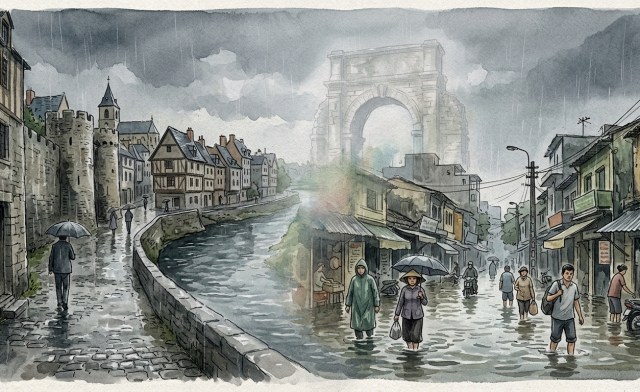
It’s raining again in Europe and in the Philippines. Over here, we are happy that there is finally a cool down from the summer heat wave, and hope that our rivers fill up again soon. In the Philippines, I see on social media that the floods are back, again all the way up to Quezon City, which I know didn’t flood before.
In my head, the song “It’s Raining Again”, the hit in late 1982 just a bit after when we moved to Germany, is playing since I woke up this morning. That song about sadness returning. The same sadness I had when I wrote Rising Waters in the Philippines last year – or What is home? back in late 2020.
Of course Karl is right that the Philippines is not always starting from scratch and one could also ask about whether European countries have done enough to deal with the effects of global warming that are getting clearer every year there is a heat wave like the one we just had, which might soon be the new normal.
Intra muros et extra muros
Intra muros in Latin literally means within the walls while extra muros is outside. The people within city walls of Munich in the 19th century were not affected by floods, while the day laborers and other poor living “extra muros” in places like Au (literally: flood plains) across the river were affected by regular floods.
BGC definitely has no issues with flooding as it has huge underground water detention tanks, something Tokyo also has – and Munich. Over here they are called “underground sewerage cathedrals” by some and one can even check them out in a guided tour. They are part of a system that protects the entire town.
There is of course policy that creates systems, and my article Making Science serve the Country was about one major effort at systematizing climate resilience in the Philippines with the help of science, something that is way more than just theory, yet of course my knowledge is from afar and therefore still theoretical.
What comes next?
That is why I would like to leave the discussion mainly to those who are in the Philippines or often go there, as I already wrote in “What is Home” that “those who hold out in places called home in the Philippines are all the more to be respected, as caring for home means not just taking care of the nation in the abstract” .
I also repeat the implied question of my article last year: “The Philippines will hopefully figure out its own way that fits its unique culture, modifying it as needed for modern challenges. It can thrive – or languish.” and ask: is the Philippines figuring out something for those both intra and extra muros?
(the editorial image was generated using Google Gemini’s Nano Banana 2 model)


Thanks for this. Irineo.
I turmed what I am working on with waste and flood as Joey puts it into a spaghetti, so many subtopics involved.
I will eat the sauce first and see what comes out after a few days.
welcome – the algorithm just showed me this on X: https://x.com/radarph_media/status/2091415483765395608
Thanks.
I was not able to publish this, I punlished the spaghetti version.
KAYA NG PINOY: FROM GOOD IDEAS TO NATIONAL CAPABILITYFelino Palafox, the Parañaque Spillway, and the Filipino Capacity to Build What We Have Long ImaginedBy Karl M. Garcia
For all my talk about capability—about institutions, technology, industrial policy, human capital, infrastructure, defense, maritime power, manufacturing, artificial intelligence, and the countless systems that a modern nation must build—perhaps it is time to go back to some very old slogans.
Yes, the Filipino can.
Kaya ng Pinoy.
And another familiar line:
Kaya natin ’to.
Then there is the old Filipino saying:
“Pag gusto, may paraan. Kung ayaw, maraming dahilan.”
These phrases are sometimes dismissed as advertising slogans, motivational lines, or expressions of Filipino optimism.
Perhaps we have underestimated them.
Because capability begins with a very simple proposition:
We must first believe that something can be done before we organize ourselves to do it.
But belief alone is not capability.
And perhaps there is no better way to understand that distinction than through one of the Philippines’ longest-running infrastructure stories: the Parañaque Spillway.
A concept dating back to the flood-control planning of the 1970s.
A project associated with the planning generation of architect and urban planner Felino “Jun” Palafox Jr.
A solution reconsidered after Ondoy.
A project redesigned from an open floodway into a largely underground system.
A proposal that has survived administrations, studies, changing technologies and decades of delay.
And now, finally, a project that is closer to implementation than it has ever been.
The story is bigger than one spillway.
It is a story about the Philippines itself.
Can we turn Filipino ideas into Filipino capability?
Can we take something that somebody proposed fifty years ago, determine whether it is still technically sound, update it for today’s realities, solve its social and environmental problems, finance it properly—and finally build it?
That is the journey from “Kaya ng Pinoy” to a capable Philippines. From “Kaya” to Capability
For years, Filipinos have demonstrated extraordinary individual capability.
Our engineers work around the world.
Our seafarers operate sophisticated ships.
Our nurses and medical professionals work in some of the world’s most demanding health systems.
Our architects, designers, programmers, technicians, scientists, entrepreneurs, soldiers, pilots and skilled workers routinely prove that Filipinos can compete internationally.
The question is therefore not whether the Filipino is capable.
The question is whether the Philippines is capable of organizing Filipino capability at scale.
That is a very different problem.
A talented engineer working overseas is individual capability.
A Philippine engineering industry capable of designing, manufacturing, certifying, exporting and continuously improving complex systems is national capability.
A brilliant naval architect is individual capability.
A Philippine maritime-industrial ecosystem capable of producing ships, developing designs, maintaining fleets, building components and generating intellectual property is national capability.
A Filipino programmer working for a foreign company is capability.
A Philippine technology ecosystem capable of creating globally competitive software, AI systems, semiconductor services and technology companies is national capability.
A Filipino soldier who can operate sophisticated equipment is capability.
An armed force supported by domestic maintenance, logistics, training, electronics, munitions, shipbuilding, aerospace and defense industries is strategic capability.
This is the distinction I keep returning to.
We do not merely need capable Filipinos. We need a capable Philippines. The Palafox Lesson
Few Filipino professionals illustrate the difference between ideas and implementation better than Felino Palafox.
Palafox’s career stretches across architecture, urban planning, environmental planning, transportation, infrastructure and regional development.
He belongs to a generation of Filipino planners who thought about cities not simply as collections of buildings but as interconnected systems.
And the Parañaque Spillway is one of the clearest examples.
It is important to get the history right.
Palafox was not the sole architect of the original Parañaque Spillway.
Rather, he was part of the planning generation involved in the Metro Manila flood-control and development work of the 1970s. In 1976, he served as team leader of the development-planning component of the World Bank-supported Metro Manila Transport, Floods and Development Planning Project.
That planning work included the Parañaque Spillway and the dredging of Laguna Lake.
The idea therefore predates the current political generation by decades.
And Palafox did not simply walk away from it.
After the devastating floods of Ondoy in 2009, he again advocated the spillway and broader flood-control measures.
The concept evolved.
The city had changed.
The technology had changed.
The engineering solution had to change.
But the underlying problem remained.
Laguna Lake needed better flood-management connectivity with Manila Bay.
That is planning at its best:
Not worshipping the original design.
Preserving the strategic objective while adapting the solution. A Plan That Refused to Die
The Parañaque Spillway is remarkable because it demonstrates both the power and weakness of Philippine planning.
The idea survived.
The implementation did not.
There were studies.
There were proposals.
There were legislative initiatives.
There were presidential announcements.
There were renewed efforts after major floods.
But the project remained unfinished.
And this is where our national development problem becomes painfully familiar.
We do not necessarily lack ideas.
We often lack continuity between idea and execution.
A government commissions a study.
Another government revises it.
A third government changes the priority.
A fourth government discovers the same problem.
A fifth government commissions another study.
Meanwhile, the flood continues.
This is why the Parañaque Spillway is not merely an engineering project.
It is a test of whether the Philippines can finally develop institutional memory.
A country should not have to rediscover the same solutions every generation.
Good ideas should be inherited.
Bad ideas should be discarded.
Promising ideas should be improved.
And projects that remain strategically valid should survive political transitions. From Open Channel to Tunnel
The original concept emerged when Metro Manila was dramatically less dense.
Today, an enormous open floodway cutting through heavily urbanized areas would involve massive social disruption.
So the solution evolved.
The modern proposal incorporates a substantial underground tunnel system.
That evolution is significant.
It shows that a decades-old plan does not have to be frozen in time.
The objective can remain while the engineering changes.
This is precisely how capability develops.
A country does not simply copy a 1970s solution in 2026.
It learns.
It adapts.
It uses better engineering.
It considers environmental consequences.
It applies modern construction technology.
It integrates social safeguards.
It updates cost estimates.
It reassesses hydrology.
It incorporates climate change.
It redesigns.
Capability is not the ability to preserve an old plan.
It is the ability to improve a plan without losing sight of its purpose. “Kaya Natin ’To” Should Not Mean “Bahala Na”
There is also a danger in interpreting Filipino optimism incorrectly.
“Kaya natin ’to” should never become an excuse for improvisation without preparation.
It should not mean:
Bahala na.
It should not mean:
“We’ll figure it out somehow.”
It should not mean ignoring engineering, budgets, regulations, maintenance, training, logistics, institutional capacity or risk.
Real capability is much less romantic.
It is repetitive.
It is technical.
It involves standards, specifications, procurement rules, laboratories, testing facilities, certification, financing, apprenticeships, universities, factories, supply chains, databases, maintenance systems and competent bureaucracies.
It involves thousands of people doing apparently ordinary things correctly, repeatedly and for many years.
The slogan says:
Kaya.
Capability asks:
How?
Who will do it?
With what technology?
With what money?
Under what standards?
Who will maintain it?
Who will train the next generation?
What happens when the original project champion leaves?
Can the system survive a change of administration?
Can we manufacture the replacement parts?
Can we improve it?
Can we do it again?
That is where national capability begins. “Pag Gusto, May Paraan”
The second slogan may be even more important:
Pag gusto, may paraan.
If we genuinely want something, we find a way.
This does not mean that every project is feasible.
Some ideas are bad.
Some are too expensive.
Some are technically premature.
Some should be rejected.
A serious country does not confuse determination with recklessness.
But it also distinguishes between:
“This cannot be done.”
and
“We have not yet built the capability to do it.”
Those are not the same thing.
When a country lacks shipyards, it cannot suddenly become a major shipbuilding nation.
But that does not mean shipbuilding is permanently beyond its reach.
It means beginning with design capability, training, tooling, suppliers, classification, financing, apprenticeships, modular construction, maintenance and progressively more sophisticated production.
When a country lacks advanced aerospace capability, it cannot simply announce that it will become a space power tomorrow.
But it can begin with satellites.
Ground stations.
Remote sensing.
Electronics.
Systems engineering.
Research.
Testing.
Then increasingly sophisticated indigenous systems.
Capability is accumulated.
You do not jump from zero to world-class.
You build the staircase. The Spillway as a Capability Staircase
The Parañaque Spillway itself can be understood this way.
The Philippines did not simply wake up one morning with the ability to construct a massive underground flood-management system.
There had to be:
Hydrological studies.
Urban planning.
Geotechnical investigation.
Environmental assessment.
Engineering design.
International cooperation.
Financing.
Procurement.
Right-of-way planning.
Construction expertise.
Tunnel technology.
Pump and drainage systems.
Operations and maintenance.
Emergency management.
And community engagement.
The project therefore becomes more than infrastructure.
It becomes a capability-building exercise.
If done properly, Filipino engineers, contractors, planners, environmental scientists, project managers and construction workers should emerge from the project with capabilities that can be applied elsewhere.
That is how major infrastructure should work.
Build the project—and build the national capability that the project requires. “Kung Ayaw, Maraming Dahilan”
The second half of the saying is uncomfortable:
Kung ayaw, maraming dahilan.
If we do not want to do something, there will always be reasons why it cannot be done.
We lack money.
We lack engineers.
We lack technology.
We lack land.
We lack investors.
We lack markets.
We lack institutions.
We lack skilled workers.
We lack experience.
Some of these objections are legitimate.
But each legitimate constraint should lead to another question:
What capability would remove the constraint?
If we lack naval architects, build a naval architecture workforce multiplier.
If we lack technicians, create apprenticeships and certification pathways.
If we lack manufacturing capacity, develop industrial clusters.
If we lack capital, create appropriate financing mechanisms.
If we lack technology, use technology transfer strategically and require local absorption.
If we lack research capacity, connect universities to industry and government missions.
If we lack markets, aggregate government demand and pursue exports.
If agencies are fragmented, integrate strategy, budgeting and execution.
If projects fail because institutions change every administration, build institutions that outlive political leaders.
The point is not to deny constraints.
The point is to stop treating constraints as the end of the conversation.
A constraint should become a design problem. The Filipino Does Not Lack Ingenuity
There is a strange contradiction in how we sometimes see ourselves.
We celebrate Filipino ingenuity.
We tell stories of the Filipino who succeeds abroad despite enormous obstacles.
We praise resilience.
We admire resourcefulness.
We say:
Kaya ng Pinoy.
And yet, when we discuss national projects, we sometimes behave as if Filipinos suddenly become incapable.
We assume sophisticated technologies must always come from somewhere else.
That major systems must always be imported.
That Filipino companies cannot move up the value chain.
That government cannot manage complex projects.
That our universities cannot produce world-class research.
That our industries cannot become globally competitive.
That our young people must leave before they can achieve their potential.
This is not humility.
Sometimes it becomes a form of national self-doubt.
We should neither overestimate ourselves nor underestimate ourselves.
The correct attitude is:
We can do it—but we must build the capability to do it properly. Palafox Abroad, the Filipino at Home
Palafox’s career also demonstrates the global reach of Filipino professional capability.
Palafox Associates has worked on projects in more than 40 countries.
The firm’s work encompasses architecture, urban planning, environmental planning, urban design and development advisory.
Its portfolio includes major Philippine developments and plans such as Rockwell Center, Clark, Pampanga Megalopolis, Metro Davao, Metro Ilocos, La Mesa Ecopark and various urban and regional plans, alongside international work in Asia and the Middle East.
The significance goes beyond one architect.
It demonstrates that Filipino expertise is marketable internationally.
Filipinos are capable of working on complex urban systems abroad.
Our engineers build infrastructure abroad.
Our maritime professionals operate foreign fleets.
Our technology workers develop global systems.
Our medical professionals strengthen foreign health systems.
Our architects and designers participate in international projects.
The problem is therefore not a lack of Filipino talent.
It is that too much Filipino capability is accumulated somewhere else. We Should Not Stop Filipinos From Leaving
This does not mean that migration is failure.
It is not.
Filipinos should be free to study, work, travel and succeed anywhere in the world.
The objective should not be to prevent Filipinos from leaving.
The objective should be to make the Philippines increasingly capable of giving talented Filipinos reasons to:
stay, return, invest, teach, mentor, build and create.
That requires ecosystems.
Factories.
Laboratories.
Shipyards.
Technology parks.
Research centers.
Startups.
Industrial clusters.
Defense industries.
Creative industries.
Data centers.
Energy systems.
Modern farms.
Smart ports.
Universities connected to industry.
Financial institutions capable of supporting long-term investment.
And government institutions capable of coordinating all of it.
The objective is not merely to create jobs.
It is to create capability ecosystems. From Resilience to Capability
Filipinos are famous for resilience.
But resilience alone is not enough.
A resilient people survives a typhoon.
A capable country builds infrastructure that reduces the damage from the next typhoon.
A resilient farmer survives a bad harvest.
A capable agricultural system provides irrigation, storage, logistics, financing, technology and markets that reduce the farmer’s vulnerability.
A resilient worker finds another job after displacement.
A capable economy creates new industries and continuously retrains its workforce.
A resilient country responds to a crisis.
A capable country prepares before the crisis arrives.
This is why I increasingly prefer the word capability.
Resilience tells us:
We can survive.
Capability tells us:
We can shape the outcome.
The Parañaque Spillway represents precisely this transition.
Flooding should not simply be something Filipinos endure with resilience.
We should build systems that make flooding less destructive. The “Kaya” Test
Perhaps every major Philippine proposal should eventually pass a simple test.
Not:
Can we afford this today?
Not:
Has another country already done this?
Not:
Is this politically popular?
But:Can we build the capability to do this?
If yes, the next question is:
What is the pathway?
What capabilities must exist in five years?
What must exist in ten?
What industries must be developed?
What skills must be produced?
What institutions must be created?
What technologies must be acquired, absorbed and eventually improved?
What financing mechanisms are required?
What domestic demand can support the industry while it develops?
What partnerships can accelerate learning?
What should initially be imported—and what should eventually be localized?
That is how a slogan becomes a national strategy. From Mega-Projects to Mega-Systems
This is also why I have argued that the Philippines should stop thinking only in terms of individual mega-projects.
The question should not simply be:
Can we build a tunnel?
It should be:
Can we build the national system that makes tunnels, ports, railways, ships, power plants, data centers, industrial parks, water systems and other complex infrastructure increasingly normal?
The Parañaque Spillway should therefore be connected to a larger flood-management architecture.
Laguna Lake management.
Pasig River rehabilitation.
Watershed protection.
Drainage modernization.
Wetland protection.
Rainwater retention.
Land-use planning.
Coastal management.
Climate adaptation.
Infrastructure resilience.
The spillway cannot solve every problem.
But it can become one component of an integrated system.
That is the difference between a mega-project and a mega-system. The Architecture of Waiting
There is a phrase that might describe much of Philippine development:
the architecture of waiting.
We wait for the railway.
We wait for the flood control.
We wait for the airport.
We wait for the port.
We wait for the bridge.
We wait for the new city.
We wait for the master plan.
Then another administration arrives.
Another study begins.
Another consultant is hired.
Another ribbon-cutting is promised.
And the original problem remains.
The Parañaque Spillway is a particularly powerful example because its history spans generations.
But we have similar stories throughout the country.
Plans are produced.
Projects are announced.
Studies are completed.
And then institutional momentum disappears.
The solution is not simply to produce better plans.
It is to build institutions that remember. The Unfinished Palafox
Palafox’s career contains another important lesson.
His work includes completed buildings and developments, but also master plans, conceptual projects and proposals whose realization depends on governments, developers, investors and other institutions.
That is not necessarily a failure of the planner.
A master planner does not control the entire political and financial environment required to implement a plan.
But it highlights an important truth:
A plan is not an achievement merely because it is beautifully presented.
The real test begins after the consultants leave.
Does zoning change?
Does the budget follow?
Does infrastructure align?
Does industry locate there?
Are transport connections built?
Are environmental protections enforced?
Is housing provided?
Does the next administration continue?
Does the private sector invest?
Does the public benefit?
A master plan is a beginning.
Implementation is the achievement. The Palafox Paradox
There is something almost poetic about Palafox’s career.
A Filipino planner could help envision cities and major developments abroad while continuing to advocate solutions to Philippine problems that have remained unresolved for decades.
That is the paradox.
The Philippines has never lacked Filipinos capable of imagining the future.
We have lacked the institutional machinery to consistently turn those visions into reality.
And this is why the Palafox story should not be reduced to personality.
The important question is not:
“Was Palafox right about everything?”
Of course not.
No planner is.
Nor should the question be:
“Did Palafox design this particular project?”
The better question is:
What can the Philippines learn from a career spent thinking about the country at the scale of cities, regions and systems?
The answer is continuity.
Integration.
Long-term thinking.
Adaptation.
Professionalism.
And the recognition that today’s infrastructure decisions shape the country decades from now. The Spillway Must Also Pass the Capability Test
None of this means the Parañaque Spillway should be built simply because it is old.
Age does not make an infrastructure proposal correct.
The project must pass contemporary technical scrutiny.
Hydrology.
Geology.
Climate projections.
Sedimentation.
Land subsidence.
Environmental impacts.
Construction risk.
Operating costs.
Maintenance requirements.
Social displacement.
Right-of-way.
Cost-benefit analysis.
Alternative flood-control options.
These must be examined transparently.
Communities in Muntinlupa, Parañaque, Las Piñas and Bacoor cannot simply be told:
“This plan is fifty years old, therefore you must move.”
That would be unacceptable.
A capable state must be able to build infrastructure and protect citizens affected by it.
Compensation must be fair.
Relocation must be humane.
Livelihoods must be protected.
Communities must be heard.
Environmental safeguards must be credible.
And the benefits must be demonstrated.
That is what capability looks like in practice.
Not merely the ability to pour concrete.
The ability to reconcile competing interests and still deliver a functioning system. The Country Should Learn From Its Own Plans
Perhaps the most important change we need is a national mechanism for strategic learning.
Every major plan should leave behind more than a report.
It should leave behind:
trained professionals;
datasets;
engineering standards;
institutional knowledge;
local suppliers;
research programs;
technology partnerships;
procurement templates;
project-management expertise;
and a pipeline of successor projects.
If the Parañaque Spillway is built, the country should ask:
What did Filipino engineers learn?
What technologies were transferred?
Which local firms developed new capabilities?
How many specialists were trained?
What components can now be manufactured locally?
What other flood-control projects can use the same expertise?
Can Philippine companies export the knowledge?
Can our universities build research programs around it?
Can the next tunnel be designed more efficiently?
That is how one project becomes ten.
And ten become an industry.
And an industry becomes national capability. From Slogan to National Character
There is nothing wrong with optimism.
In fact, national development probably requires a certain amount of stubborn optimism.
Every great industrial transformation begins with somebody saying:
We can do this.
But the statement cannot end there.
It must become:
We can do this.
Then:
Here is the plan.
Then:
Here is the institution.
Then:
Here are the people.
Then:
Here is the money.
Then:
Here is the technology.
Then:
Here are the standards.
Then:
Here is the first prototype.
Then:
Here is the factory.
Then:
Here is the second generation.
Then:
Here is the export.
And eventually:
We no longer have to ask whether we can do it. We are already doing it.
That is the journey from “Kaya ng Pinoy” to Philippine capability. Kaya Natin ’To
So perhaps after all the policy papers, frameworks, strategies, road maps and institutional proposals, we can return to something much simpler.
Kaya ng Pinoy.
Yes.
But let us not use that phrase merely to make ourselves feel good.
Let it become a commitment.
Kaya natin ’to.
But let us prove it with engineering.
With education.
With science.
With factories.
With entrepreneurs.
With competent government.
With disciplined procurement.
With research.
With apprenticeships.
With technology transfer.
With infrastructure.
With institutions.
With patience.
With continuity.
And with the willingness to learn from failure rather than use failure as an excuse to stop trying.
Because perhaps the real meaning of:
“Pag gusto, may paraan.”
is not that everything is possible.
It is that when something is genuinely important, we search for a way forward instead of searching first for a reason to give up.
And perhaps that is what capability ultimately means.
Not believing that Filipinos are magically capable of everything.
Not pretending that there are no obstacles.
Not confusing optimism with competence.
But believing enough in ourselves to begin—and being disciplined enough to build everything necessary to finish. The Filipino Can. Now Let Us Build.
The Parañaque Spillway began as an idea in another era.
It survived because some people continued to believe that the underlying problem deserved a solution.
But belief alone did not build it.
Neither did planning.
Neither did expertise.
Neither did presidential announcements.
Neither did congressional resolutions.
Neither did studies.
Implementation will.
And that is perhaps the most important lesson.
The Philippines should not be ashamed of its unfinished ideas.
Some deserve to be abandoned.
But others deserve to be remembered, reexamined and completed.
We should look at the old plans of Filipino architects, engineers, economists, scientists, military thinkers and urban planners and ask:
Does this still make sense?
If it does, update it.
If it can be improved, improve it.
If it is still strategically important, fund it.
If it requires capabilities we do not yet possess, build those capabilities.
If it requires foreign technology, acquire it—but learn from it.
If it requires foreign capital, use it—but build domestic capacity alongside it.
If it requires ten or twenty years, create institutions that can sustain it for ten or twenty years.
And if it requires several presidents to complete, so be it.
The Philippines should not have to restart every time the presidency changes.
That is not governance.
That is national amnesia.
The real objective is something larger.
We want a Philippines that can remember what it has learned.
A Philippines that can turn plans into programs.
Programs into projects.
Projects into industries.
Industries into ecosystems.
And ecosystems into enduring national capability.
That is how we move from:
Kaya ng Pinoy
to
Kaya natin ’to
to the most important statement of all:
Ginagawa na natin.
We are already doing it.
We are already building.
We are already learning.
We are already improving.
We are already becoming capable.
Because the Filipino can.
But the future will not be built by slogans alone.
The Filipino can.
Now let us build the capability to prove it.
just asked Claude for a status summary a year after the flood control issues exploded and got this:
kitakits on this in yet one year from now?
**The people within city walls of Munich in the 19th century were not affected by floods, while the day laborers and other poor living “extra muros” in places like Au (literally: flood plains) across the river were affected by regular floods.** – Irineo
My father, who was born in Manila in 1919, said that before WW2, the Americans cleaned out the drainage systems in the city every year before the rainy season. He said Manila did not flood then. Then the Japanese came and took over. They did not clean out the drainage systems yearly. By the second rainy season, Manila flooded.
He was quite pro-American so his memories may have been biased. 🙂
But the point, in my humble opinion is – you have to maintain your drainage systems regularly.
from the link I put into my article https://www.hiddenhydrology.org/underground-munich/ one can see details of how Munich used to be:
people just emptied their chamberpots (arenola) out into the street back then in most of Europe, and animals were slaughtered in the streets, their rests left to rot in public places. Of course that caused diseases like cholera but most certainly contributed to floods. There is also this interesting note:
so even in now modern Europe (Munich is now one of the cleanest cities there is) they waited until the elites were affected to do something..
there is also the radar ph link I already posted in my first comment here: https://x.com/radarph_media/status/2091415483765395608
Dr. Mahar Lagmay is not just a kababata from UP Diliman, he is also the one “starring” in my article I also linked above:
so yes, you are right that cleaning the drains is a major factor – but they have to EXIST as well to handle the flow in the first place.
1920s Manila was more spacious than Metro Manila of the 1970s and now Metro Manila has barely any open spaces left, things are so different now.
“things are so different now.” – Irineo
Absolutely—but the principle that systems need regular maintenance still holds. My modest point is that in the Philippines, we have too often prioritized new construction over sustained and regular preventive maintenance and too often to the neglect of any preventive maintenance at all. That was my observation all the years that I lived there.
that is for sure one major issue in the Philippines that I have observed as well, Karl also has written about that.. but the flood control stuff is way more complex and the list I would give now is probably incomplete:
1. Check out pre-WW2 maps of Manila versus post-WW2 ones and behold how many esteros that used to exist are now built over. Guess where the water goes? The entire Quezon Boulevard in Quiapo is a former estero and I know its underpass to Recto was often flooded in the rainy season. As Dr. Lagmay correctly said in the radar.ph link “Daanan talaga siya ng tubig pero nilapatan natin ng kalye.”
2. Check out old pictures of esteros in Manila (totally clean water) versus the trash-clogged remaining esteros of today.
3. Dr. Lagmay mentioned “concrete encroachment” which seals areas where water could formerly run off. Think of the area shown in the map below now full of malls, that used to be talahiban before and it turned into a bit of a lagoon in the rainy season – I know as I went to high school in Philippine Science, 1978-1982. Natural areas for water retention are BTW called “polders” by the Dutch, the masters of flood control for good reason.
4. substandard flood control projects due to corruption – or even ghost projects as found out last year
5. also from the radar ph link that I posted:
6. and this is one reason why especially Camanava (Caloocan, Malabon, Navotas, Valenzuela) tend to be flooded a lot these days
(excessive groundwater extraction is simply the population of the megacity pulling water out of the ground, and soil compaction can be due to buildings)
(BTW there are sometimes issues between new and old buildings here in Munich. Newer buildings are built with an underground casing that keeps out groundwater. If their neighbors are older buildings in a low-lying area near the river that can mean their cellars get wetter than before)
Yes, I was aware of all the estero problems and their disappearing even while growing up in Metro Manila. It was talked about even then.
Even here in nearby affluent Menlo Park, an old timer told me about how developers built homes in a low lying area that would catch excess water during strong rains. He said that is why whenever we get a good rain storm the place regularly floods. When he told me that I was reminded of how we did that in Manila.
On coming here to US, I am amazed at how they keep many of the canals and free so that water can flow properly. In the summer months they are dry, but during rainstorms the become rushing rivers.
yes, even then.. and the old way in the Philippines is to somehow “remedyo” everything until it is no longer possible to.
The present flood issues are the result of half a century or more of systematic neglect and wrong decisions – not easy to solve at all.
Nearly 40 years on from the 1987 Constitution’s devolution mandate and the 1991 LGC enabling law, it seems increasingly clear that while both were written with the best of intentions by those who endured the trauma of Martial Law, the common Philippine reactionary response to crisis has its downsides. The sibyl prophetess warned Aeneas, as written by Virgil in The Aeneid: “Facilis descensus Averno” (“The descent to the Underworld is easy.”). The Early Enlightenment English naturalist John Ray wrote a collection of aphoristic proverbs which included the more common English version: “The road to hell is paved with good intentions”.
Something I heard often early in my time in the Philippines from AB acquaintances around Metro Manila, many Big Four educated, was some variation of “it’s the American’s fault” that the US didn’t build Manila to withstand future, unforeseen problems. If memory serves, the original 1905 American plan was to support up to 1,000,000 Manileños (the population of Manila then was somewhere just under 250,000). This American sewerage and waterworks system was architected by a prominent American sanitation engineer, Desmond Fitzgerald, and Fitzgerald deliberately over-engineered for future expansion. Fitzgerald’s Sewerage and Waterworks plan, the agency that later became the Metropolitan Water District (MWD), incorporated passive gravity-assisted water engineering wherever possible, with water supplied from the new reservoir damming projects completed by the end of 1908. Of course, we all know that Manila rapidly grew to 1,000,000 inhabitants by the establishment of the Commonwealth in 1939.
Sometimes the example of the Western Roman Empire’s collapse is used where the “barbarians” not knowing how to replicate or in some cases even maintain Roman aqueducts. Well the population of Rome and other major Roman cities emptied following the collapse, strangling the tax base needed to maintain sewer and waterworks, while in the Philippines case there is a more modern phenomenon of hyper-urbanization without adequate supporting infrastructure .
Back to the LGC’s devolution though: local devolution is not always a good thing, especially when local fragmentation leaves local executives constructing pumping stations that just pump floodwaters onto the next LGU’s territory (“not my problem anymore”), or where sometimes as I’ve observed, better built street-level drainage often abruptly ends at the border of a better-run LGU to leave the problem to the less-resourced LGU. Then there is the case of sanitation and water engineering, which are really megaproject-level pieces of infrastructure, are not taken care of by an agency that has enough centralized authority to coordinate across watersheds which span across multiple LGU borders. Piecemeal solutions when implemented serve up piecemeal results…
Connected to local devolution was the rise of post-1987 local dynasties, which have only increased their political grip since. It’s been a while since we’ve brought up the issue of certain LGU executives attracting informal settlers towards their LGU, drawing the rural destitute into a urban patron-client dependency. Informal settlements along riverbanks serve as reliable voter banks for the local patron when election time rolls around, showered with election ayuda, but also conveniently blamed for their settlement refuse clogging up rivers when flooding disaster strikes because the LGU executive had mismanaged or pocketed nationally distributed flood control funds, only for the executive to become the generous patron distributing emergency aid and relief goods in plastic bags with the executive’s name. Sewers, underground flood tunnels, and catchment basins are beneath the ground and thus are invisible for purposes of performance of competence. A massive ribbon cutting ceremony for a development aid funded pumping station is much more politically useful…
Before devolution, there was the pre-DPWH Bureau of Public Works and a National Irrigation Administration both with broad and centralized powers over water engineering and water infrastructure. The Bureau of Flood Control and Drainage used to manage entire catchment basins before 1987, treating river corridors as cohesive hydrological units, before the bureau was disbanded in favor of disconnected Project Management Offices and breaking up coherent management over single watersheds. The National Flood Control Committee which originated in the Commonwealth era Flood Control Commission, was also a casualty of devolution, its former role of engineering and managing dikes, flood control infrastructure, and having the final say on zoning over floodplains broken up between DPWH and oversight by not necessarily expert Senate-led Blue Ribbon Committees. Instead of bringing back National Waterworks and Sewerage Authority (NAWASA), the Marcos Sr. era successor MWSS was privatized, while both Local Water Utilities Administration (LWUA) and Rural Waterworks Development Corporation (RWDC) incredibly had a large degree of “oversight by the locals” introduced along with a share of budgets. I can go on but we get the point. Devolution, for all its merits, is a problem where it can’t achieve results at scale and across LGU borders. Rivers, watersheds, catchment basins, and floodwaters don’t respect the petty borders of LGU executives.
Then there is just simple Filipino resistance to imposed change, which Reynaldo Ileto wrote about in the chapter “Cholera and the Origins of the American Sanitary Order in the Philippines.” of Imperial Medicine and Indigenous Societies (1988) with Ileto arguing that the American effort to introduce quarantine and sanitation to the Philippines during the 1902-1904 cholera epidemic was (paraphrased) “an extension of the Philippine-American War,” which the Americans “used the sanitation regime to expand US colonial authority” through “germ warfare” and “using the respected position of doctors as a pacifier,” and that the reason why so few Filipinos returned from quarantine of a disease which at that time did not yet have a cure was because the Americans were poisoning the water to kill Filipinos. The hysteria led to some concealing their dying and dead underneath silongs, of course one of the primary ways cholera entered the water supply was via rain runoff of infected diarrhea… Which is all of course preposterous outside of the nationalist framing. I recall reading somewhere that while the American colonial health officials observed a marked decrease in cholera and water-borne disease after sanitation measures, nationalist doctors insisted that the heavy monsoon rain near the end of the epidemic and what we understand today as herd immunity were the real reasons not by-then proven sanitation methods.
An interesting Journal of History essay I found:
Torres, Cristina E. “Health and Sanitation During the American Period.” The Journal of History, vol. 48, Philippine National Historical Society, 2002.
thanks for this overview. What is particularly damning is LGUs just pumping their water to the next town – I would’t be surprised if they do the same with garbage, maybe I just don’t know about that yet. I originally planned a water management article as part two of a series on Metro Manila: (we were in a slump that year, 2023, so I was not very inspired to continue)
In any case, I also saw how the MMC (Metro Manila Commission) was made into the weaker MMDA as one culprit for Metro Manila traffic. As someone whose minor in University was Operations Research, I am a sucker for stuff that has to do with directed flows in graphs – that stuff can be used to model traffic, water supply, electric supply, internet bandwidth, sewage and drainage. BTW I once met a Filipina scientist in Munich whose work was combinatorial optimization (one of the applications of operations research) for the Singapore MRT, taking in real time passenger data as well as trip data from electronic tickets to plan for new lines or improve schedules – another example of how the best from the Philippines are utilized elsewhere.
Forgot to add in my comment that from my reading it seems like the the Spirit of the 1987 Constitution always intended for local devolution mandate to be implemented alongside the anti-dynasty mandate. Of course only the former was passed with the 1991 LGC enabling law, conveniently devolving power and state funds to the political dynasties who must now neuter their own power by passing an anti-dynasty law. Not going to happen anytime soon.
Oh they do that too… sometimes purposely, sometimes as an unintentional consequence of “my responsibility stops at the LGU border…” Which is why it’s a shame that what national agencies still exist after devolution don’t really have national power. One can see the limitations on the national government’s efforts to construct a coherent national strategy in many areas (or even a provincial governor’s efforts) in Exhibit A: right-of-way battles and Exhibit B: zoning battles.
Transport constraints and traffic congestion is also another area in the Philippines that suffers from heavy fragmentation. Even in Metro Manila routes are not fully centrally planned, which leads to inconsistent and overlapping schedules. Rail transit is often down due to under maintainance or inefficient maintainance. It’s annoying to get off, wait, then change public transport types multiple times. The transfer points themselves are heavy bottlenecks. Anyone who can afford a motorcycle/scooter or a small car just prefers that to be able to go from Point A to Point B “faster,” even with sitting in heavy traffic. I still have a joke that it would take me faster to just get off and walk to my destination then still need to wait for a friend at our meetup. Which turned out to be true more than a few times.
Actually I had just made a pitch presentation to the investors of the AI startup I’m involved with now where combinatorial optimization featured prominently in my pitch deck a few weeks ago. The startup is in the area of using AI to streamline supply chain optimization and resource management, which as you know has many similar concepts shared with ERP. I know 100% there are many smart Filipino engineers and statisticians who know all these concepts. The problem is on the political side (and it’s not as simple as getting the money to do something).
Which loops back to my earlier point about the elite performance of competence. I think it is unfair to say that only the Philippines has instances where elite prestige is the main driver of elite action, such as pertains to water engineering, flood control, and urban sanitation — Roman waterworks weren’t done out of altruistic reasons but rather as a way to show how powerful the Roman elite patron was. The American colonial administration was informed by Industrial Revolution sanitation practices which combined controlling water, defense against floods, and carriage of waste in sewers as a form of prestige to “civilize” the “less civilized” by bringing sanitation to them (the literal “unwashed masses”).
So why does elite prestige not become a driver of making a better Philippines? I’m sure there are many theories out there, but my personal theory is that the Philippine elite, especially those with political dynasties controlling “territory” and “revenue” (aka LGUs), simply don’t need to seek prestige through what the ancient practice of evergetism (i.e. doing good works) when they can have other avenues of prestige gathering such as staging fiestas, parades, competing with neighboring executives, putting their names on everything not nailed down, distributing relief goods and ayuda, or when they really are pressed just act out the performance of doing good works. Their constituents who may lack the educational and financial independence opportunities to exercise inner agency just simply don’t yet know how to demand accountability. But when people’s education and financial independence rises now they have something to protect and will likely demand more accountability. It’s probably going to be a long road.
..and the Filipino elite (Commonwealth and Third Republic) institution-building was performed to show that “we can sit at the same table as the ‘white man'”, similar to the ilustrado motivations shown in El Fili where Isagani fever dreams of a modern Philippines (we know that the ilustrado dream forgot to take the masses with it on the journey at some point, maybe not yet in Quezon’s time) https://www.kapitbisig.com/philippines/el-filibusterismo-the-reign-of-greed-by-dr-jose-rizal-a-complete-english-version-chapter-24-dreams-english-version-of-el-filibusterismo_820.html/page/0/5
IIRC a common interpretation of the El Fili Isagani is the character is a stand-in for Rizal’s own struggle with youthful idealism. Have you read Benedict Arnold’s Under Three Flags: Anarchism and the Anti-Colonial Imagination (2005)? Three Flags, which is a bit heterodox, argues that Isagani (an idealistic native bourgeoisie) and Simoun (an elite cosplaying as a peoples’ revolutionary) are two sides of Rizal’s struggle with his consciousness informed by the rise of nihilistic global anarchism in the late 19th century that Rizal undoubtedly had encountered during his time in Europe. In this reading Isagani is the ultimate idealist, who sabotaged Simoun’s anarchic revolution (by throwing the lamp-bomb into the river), with Isagani’s beliefs of gradualism and legalism along the lines of elite mimicry as a means of achieving equality (reflecting the Propaganda ideology) ultimately unable to effectuate orderly change due to his bourgeoisie attachment to the elite class (in Paulita), leaving the door open for rule by clan anarchy of native elites claiming to be representatives of the masa, something Alfred McCoy wrote about in An Anarchy of Families (1993).
A mimetic elite is still a form of elite prestige gathering though. In the absence of a performance requirement, we end up with BGC the “Manhattan of Asia” or even more frivolously Venice Grand Mall’s working replica of Venetian canals and gondolas. Both monuments to elite prestige have substantial informal settlements just around the corner, just as Ayala Alabang in Muntinlupa is next to New Bilibid which is next to more informal settlements outside of the main view.
I’m not sure how to solve the problem of how Philippine elites gather prestige. Restricting elites entirely from avenues to prestige might be counter-productive. Prestige gathering is not inherently bad as many instances of societal progress are the result of elite patronage for the purpose of gathering prestige — societal benefit was just a positive byproduct of this prestige gathering. Perhaps the real problem is in the Philippines there are still too many avenues for Filipino elites to gather prestige that they don’t feel much need as of yet to find prestige in public evergetism (i.e. doing good works), though there are some signs of that paradigm is at its limits. One way I see the old prestige gathering is close to its limits is through elite-technocratic alliances like M4GG that have an expressed goal of demonstrating competent performance rather than the usual performance of competence. M4GG only grew throughout 2025 and into 2026. So there is still hope.
well, this might be feeling main character, but the specific quote of Isagani I mentioned sounded like he had read TSOH.
industrialization and a strong navy? “He leido recientemente los articulos del señores Salazar y Garcia”.
haha, now 1-2-3, waiting for the comment saying TSOH is academic and elitist. By “you know who”.
The Katipunan certainly seemed to take the wrong conclusion from the Simoun character… You know what? In my estimation a lot of the Philippines’ problems through 5 republics and a commonwealth seem to also trace back to too many thinkers misunderstanding Rizal, and essentially formulating responses that amount to out of context quotations of Rizal. Like Bible quoters, except with Rizal 😂
Paulo Alcazaren on X: “If the 1941 Frost-Arellano Master Plan for Quezon City was followed, then all the city’s major waterways would have had wide green easements of 20-50 meters. This would take care of any floods. Disregard maser plans and you can guess what happens next. #weneedurbanplanning https://t.co/IfDvB1dCZH” / X
Mahar Lagmay on X: “Hi @pinoyurbanist, I saw your post about the 1941 Master Plan for Quezon City and its provision for numerous green spaces and easements. It inspired this short video clip about the connection between urban planning, green spaces, and flood management. https://t.co/karjaLBsL7” / X
https://x.com/nababaha/status/2094460319380992300/video/1