Water, Water Everywhere, but Nowhere to Drink: The Philippines’ Water Crisis in the Age of Super El Niño
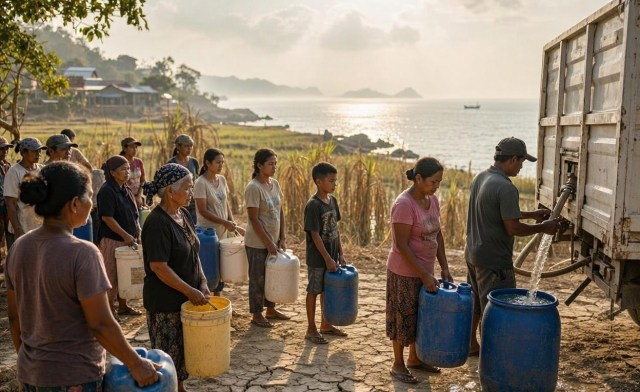
How extreme heat, prolonged drought, dwindling reservoirs, groundwater depletion, inefficient water management and decades of infrastructure neglect expose the country’s persistent failure to turn its abundant water resources into reliable water security
By Karl M. Garcia
Introduction: A country surrounded by water, yet struggling to secure it
There is an enduring irony in the Philippine experience: an archipelago surrounded by water, crossed by thousands of rivers and streams, blessed with extensive watersheds and regularly drenched by monsoon rains and tropical cyclones, yet repeatedly struggling to provide its population with a reliable supply of clean, safe and affordable water.
Water is everywhere, but dependable water is increasingly nowhere.
The problem becomes especially alarming when an exceptionally strong El Niño develops, bringing prolonged heat, below-normal rainfall, declining reservoir levels, agricultural losses, reduced hydropower generation and mounting pressure on already strained water systems. A so-called Super El Niño does not create the Philippines’ water crisis from nothing. It exposes and magnifies vulnerabilities that have existed for decades.
The country has long experienced recurring water interruptions, inadequate distribution networks, polluted rivers, deteriorating watersheds, groundwater overextraction, saltwater intrusion, fragmented institutional responsibilities and insufficient investment in water storage and treatment infrastructure.
These are not merely environmental problems. They are failures of economic planning, public administration, infrastructure development and national security.
A drought may be triggered by climate variability, but the severity of its consequences is often determined by how well—or how poorly—a country has prepared.
1. Super El Niño: The warning is no longer theoretical
As of November 2026, the warning has become particularly serious.
DOST-PAGASA confirmed on November 4 that a Very Strong El Niño is already present in the tropical Pacific, with the phenomenon expected to persist into the first half of 2027 and potentially peak toward the end of 2026. The agency warned of below-normal rainfall, drought and dry spells in several parts of the country. PAGASA +1
The distinction matters. While the expression Super El Niño is commonly used to describe an exceptionally intense event, PAGASA’s current official classification is Very Strong El Niño.
The consequences are already emerging:
- Five provinces experienced meteorological drought in October 2026.
- Eleven provinces experienced dry spells.
- Another ten experienced dry conditions.
- Agricultural damage attributed to El Niño had reportedly exceeded ₱8.57 billion by October.
- More than 356,000 Filipinos had already been affected, according to reported government figures. PAGASA +1
The danger is not simply that the country will experience hotter days. It is the cumulative effect of heat and prolonged rainfall deficits on interconnected systems.
Agriculture requires irrigation. Power generation depends partly on water availability. Industries need reliable water for manufacturing and cooling. Hospitals, schools and households require uninterrupted supplies. Even local governments need water to maintain sanitation, firefighting and other essential services.
When water becomes scarce, the consequences cascade throughout the economy.
And unlike a temporary inconvenience, a prolonged drought can undermine food production, raise prices, reduce farm incomes, threaten livelihoods and increase poverty.
The Philippines should therefore treat the approaching drought not as an isolated weather event but as a national resilience test.
2. The real problem: Water scarcity existed long before El Niño
It would be misleading to blame the country’s water difficulties entirely on climate change or El Niño.
The Philippines has long struggled with the management and distribution of its water resources.
A Philippine Institute for Development Studies (PIDS) study published in 2026 provides a revealing picture. It estimates that approximately 12.4 million Filipinos still lack access to safe water. Fewer than half of households have piped connections at home, while 332 municipalities are considered water-less.
Across 532 water districts, annual demand reportedly exceeds effective supply by an average of 3.6 million cubic meters.
Yet the same study estimates that the Philippines has approximately 226 billion cubic meters of water resources annually, consisting of about 206 billion cubic meters of surface water and 20 billion cubic meters of groundwater. Philippine Institute for Development Studies +1
This apparent contradiction is central to the national water crisis.
The country is not simply running out of water. It is struggling to capture, store, treat, distribute and protect the water it already has.
Consider the difference between having water resources and having water security.
A river may flow through a province, but that does not mean every municipality has the infrastructure to draw from it, treat it and deliver it safely to households.
A reservoir may contain billions of liters, but without adequate distribution networks, treatment facilities and properly maintained pipelines, its benefits remain limited.
Rain may fall abundantly during the wet season, but without sufficient storage and groundwater recharge, much of that water eventually flows into the sea.
The problem is therefore as much institutional and infrastructural as it is climatic.
3. Too much rain during the wet season, too little water during the dry season
One of the country’s most persistent planning failures is its inability to adequately reconcile two seemingly contradictory problems: flooding and drought.
The Philippines regularly experiences destructive flooding during monsoon seasons and tropical cyclones. Rivers overflow, communities are submerged, agricultural land is damaged and millions of cubic meters of freshwater rush toward the ocean.
Then, months later, communities face water shortages.
This raises an obvious question: Why can a country that experiences so much flooding not capture more of that water for use during prolonged dry periods?
The answer involves inadequate reservoirs, limited rainwater harvesting, insufficient small-scale water impounding facilities, degraded watersheds, poor drainage integration and the absence of comprehensive basin-wide water management.
Flood control and water security are too often treated as separate infrastructure concerns.
They should be integrated.
Floodwater, where safely captured and managed, can become a resource for irrigation, municipal supply, groundwater recharge and industrial use.
This does not mean indiscriminately impounding floodwater. Sedimentation, contamination, downstream ecological requirements, land rights and dam safety must all be considered.
But the principle is straightforward: Water that cannot be safely stored or allowed to replenish natural systems during periods of abundance becomes water that cannot be relied upon during periods of scarcity.
The country needs to move beyond the traditional cycle of responding to floods when they occur and distributing emergency water when drought arrives.
It must manage water across seasons, watersheds and entire river basins.
4. The reservoir problem: Angat cannot carry the entire burden
The dependence of Metro Manila on the Angat-Ipo-La Mesa water system illustrates the vulnerability of concentrating water supply around a limited number of major sources.
Angat Dam in Bulacan remains a critical source of Metro Manila’s water, supplying domestic requirements as well as supporting irrigation and other demands.
When rainfall declines, the competition among these requirements becomes more complicated.
Water reserved for household consumption must be balanced against agricultural needs, environmental flows and other competing uses.
In May 2026, the Climate Change Commission reported that Angat’s water elevation had fallen to 177.41 meters, compared with its normal water level of 210 meters. Other major Luzon reservoirs, including Pantabangan, Magat, San Roque and Ambuklao, were also experiencing declining levels. Philippine Information Agency
However, it is important not to equate every decline in reservoir levels with an imminent metropolitan water collapse. Reservoir management, operating rules, alternative sources, demand and rainfall recovery all influence actual supply.
The larger concern is structural dependence.
Metro Manila’s growing population and economic activity require a more diversified and resilient water supply system.
The proposed and developing alternatives to dependence on Angat—including the Kaliwa Dam project, additional surface-water sources, groundwater management and water recycling—must be assessed within a comprehensive strategy.
But infrastructure must not become an excuse to disregard environmental and social consequences.
Large dams can provide important storage, but they can also affect watersheds, ecosystems, indigenous communities and downstream populations.
The objective should not simply be to construct more dams. It should be to build a diversified water system that combines appropriately located reservoirs, smaller impounding facilities, watershed rehabilitation, rainwater harvesting, groundwater recharge, water reuse and efficient distribution.
5. Groundwater: The hidden reserve being depleted
When surface water becomes unreliable, communities and businesses increasingly turn to groundwater.
Deep wells provide an apparent solution. They can supply households, commercial establishments, farms and industries even when rivers and reservoirs decline.
But groundwater is not an unlimited emergency reserve.
Aquifers are replenished through rainfall infiltration and other natural processes. When extraction consistently exceeds replenishment, water tables decline.
The consequences can be severe, particularly in densely populated and coastal areas.
Excessive groundwater extraction can cause:
- Declining water tables and deeper, more expensive pumping.
- Saltwater intrusion into coastal aquifers.
- Land subsidence in vulnerable locations.
- Deteriorating groundwater quality.
- Reduced availability for households, agriculture and future generations.
Saltwater intrusion deserves particular attention in coastal cities and municipalities.
As freshwater pressure within an aquifer declines, seawater can move inland and contaminate wells. A community may still have water physically available beneath its feet, but that water may no longer be suitable for drinking or agriculture without treatment.
This is especially concerning in an archipelago with extensive coastal settlements.
Groundwater extraction must therefore be monitored, metered and regulated. Permits should reflect actual aquifer conditions, cumulative extraction and the needs of surrounding communities.
The country cannot afford to solve one water crisis by quietly creating another beneath the ground.
6. Deforestation and watershed degradation: Destroying nature’s water infrastructure
A functioning watershed is one of the most important components of national water security.
Forests, wetlands, rivers, lakes and natural recharge areas regulate the movement of water through the environment.
Healthy watersheds help reduce erosion, retain moisture, moderate runoff and support groundwater recharge.
When forests are cleared, slopes destabilized and river systems degraded, the consequences extend far beyond the immediate location of environmental destruction.
Soil erosion increases. Reservoirs accumulate sediment. Rivers become more vulnerable to flash flooding. Natural water retention declines.
Deforestation and land conversion can therefore undermine both flood management and drought resilience.
This is particularly important in major watersheds that supply urban centers and agricultural communities.
The protection of watersheds should be considered infrastructure investment, not merely environmental conservation.
A rehabilitated watershed provides services that would otherwise require expensive engineered systems.
Yet environmental protection frequently loses out to short-term commercial interests, poorly planned land conversion, illegal logging, destructive quarrying and other activities that compromise natural water systems.
Reforestation alone is insufficient if it consists of poorly chosen monoculture plantations or projects that fail to restore natural ecological functions.
Watershed rehabilitation requires appropriate native vegetation, protection of riverbanks, restoration of wetlands, control of erosion and meaningful participation by communities living within the watershed.
The country must recognize that destroying its natural water infrastructure is equivalent to dismantling its own long-term water supply system.
7. Water pollution: Abundance does not mean usability
Another contradiction is that freshwater resources can exist in abundance while becoming increasingly unusable because of contamination.
Rivers receive untreated or inadequately treated sewage, industrial effluents, agricultural runoff, plastics and other forms of waste.
Groundwater can be contaminated by poorly managed septic systems, leaking waste facilities, industrial activities and agricultural chemicals.
Lakes and waterways suffer from nutrient pollution, sedimentation and deteriorating water quality.
The result is a shrinking supply of water that can be safely used without expensive treatment.
This is particularly problematic during drought.
Reduced river flows can concentrate pollutants, while higher temperatures can worsen certain water-quality problems. Lower water levels can also affect aquatic ecosystems and the ability of waterways to assimilate pollutants.
The country cannot talk seriously about water security without addressing wastewater management.
Sewage treatment facilities, industrial wastewater compliance, septic-system maintenance and river rehabilitation must become central components of water policy.
It is economically irrational to spend billions developing new sources of freshwater while allowing existing sources to become contaminated.
Water conservation must include protecting the quality of water, not simply reducing consumption.
8. Agriculture: When water insecurity becomes food insecurity
Agriculture is among the sectors most exposed to El Niño.
The Philippines remains heavily dependent on rainfall and irrigation for agricultural production. Prolonged dry spells can reduce rice yields, damage high-value crops, affect livestock and fisheries, and increase production costs.
The consequences extend beyond farmers.
When harvests decline, food prices come under pressure. Rice, vegetables, corn and other commodities can become more expensive, affecting low-income households disproportionately.
This creates a dangerous combination: farmers earn less because they produce less, while consumers pay more because food becomes scarcer.
The agricultural water challenge is also a question of efficiency.
The PIDS assessment indicates that approximately 83–85% of the country’s available water resources are used for agriculture. Philippine Institute for Development Studies
Such a substantial share makes the efficiency of irrigation systems particularly important.
Traditional irrigation networks can lose considerable amounts of water through seepage, leakage, evaporation and poor management. Some agricultural areas still lack dependable irrigation, while others experience inefficient allocation.
The government should accelerate investments in:
- Modernized irrigation canals and distribution systems.
- Drip and precision irrigation where economically and agronomically appropriate.
- Solar-powered irrigation systems with sustainable groundwater safeguards.
- Small farm reservoirs and rainwater collection.
- Drought-resistant and climate-adapted crop varieties.
- Soil-moisture monitoring and precision agriculture.
- Improved forecasting and agricultural water allocation.
Rice production, for example, cannot be approached exclusively through expanding irrigated acreage. It must also involve improving water productivity—producing more agricultural output with less water.
The challenge is to ensure that farmers are not left carrying the burden of a climate crisis they have little capacity to control.
9. The urban water crisis: Leaks, waste and inefficient distribution
Another uncomfortable reality is that water shortages do not always mean the country has insufficient raw water.
Sometimes, the problem is what happens after the water has already been collected and treated.
Ageing pipelines, illegal connections, inadequate metering, leaking distribution networks and poor maintenance can result in enormous losses.
The OECD’s 2026 assessment of Philippine water and sanitation regulation highlights the importance of non-revenue water management, reliable metering and modern information systems. It notes that Metro Manila’s non-revenue water rate, which was approximately 63% in 1997, had declined to around 16% in 2022 following investments and operational improvements. OECD
That progress demonstrates what sustained investment and better management can accomplish.
But the lesson must be extended nationwide.
Water utilities should be required to establish measurable targets for reducing distribution losses, improving pressure management, replacing deteriorating pipes and expanding reliable metering.
Digital monitoring systems can identify leaks, track consumption and help utilities respond before small problems become major disruptions.
Water utilities should also be evaluated not simply on the volume of water delivered but on the reliability, affordability and quality of their services.
A country facing drought cannot afford to lose treated water through preventable system inefficiencies.
10. The governance problem: Too many agencies, too little coordination
Perhaps the most persistent obstacle to Philippine water security is institutional fragmentation.
Water management involves numerous national agencies, local governments, water districts, private utilities and regulatory bodies.
Their responsibilities encompass water supply, irrigation, watersheds, sanitation, pollution control, flood management, hydropower, infrastructure development and environmental protection.
These functions are interconnected, yet planning and implementation are frequently fragmented.
A PIDS study highlights the involvement of approximately 30 public-sector agencies in different aspects of water governance. It identifies overlapping responsibilities and weak coordination as factors contributing to delays in investment and service expansion. Philippine Institute for Development Studies +1
The problem is not necessarily the number of agencies alone. Specialized institutions are necessary. The problem is the absence of sufficiently integrated planning, accountability, information-sharing and implementation.
Water does not recognize administrative boundaries.
A watershed may extend across several provinces and municipalities. A river system may supply communities governed by different local governments. Groundwater extraction in one location can affect neighboring communities.
Yet local development plans, infrastructure priorities and environmental enforcement are not always coordinated at the scale required by natural water systems.
The country needs a stronger national water governance framework.
This should include:
1. Integrated national water planning. Establish a comprehensive framework linking water supply, irrigation, sanitation, watershed protection, groundwater management and flood control.
2. Clear institutional accountability. Define agency responsibilities, eliminate unnecessary duplication and establish measurable performance indicators.
3. Basin-level management. Strengthen coordination among local governments and national agencies sharing the same watersheds and river systems.
4. Reliable water information. Develop a centralized, accessible database covering reservoir levels, groundwater extraction, water quality, utility performance, demand and supply forecasts.
5. Long-term infrastructure financing. Move beyond politically convenient projects and prioritize investments according to actual water-security requirements.
6. Local government capacity. Provide municipalities with technical assistance, financing and trained personnel to develop effective water-security plans.
The country has repeatedly demonstrated its capacity to formulate plans. What it needs is greater consistency in implementing them.
11. Rainwater harvesting: Capturing what the country keeps allowing to escape
Rainwater harvesting is one of the most practical ways to supplement conventional water supply.
Homes, commercial establishments, schools, factories, government buildings and agricultural facilities can capture rainwater from rooftops and other suitable surfaces.
Collected water can be stored for cleaning, irrigation, toilet flushing and other non-potable uses. With appropriate treatment and safeguards, certain systems can also supply potable water.
The advantage is decentralization.
Instead of relying entirely on large reservoirs and centralized utilities, communities can develop supplementary sources that reduce pressure on existing networks.
Schools and public buildings could serve as demonstration sites.
New subdivisions and commercial developments should incorporate rainwater collection and stormwater management into their designs.
Industrial facilities can integrate rainwater storage into their water-efficiency programs.
Local governments can provide incentives and technical standards for household installations.
However, rainwater harvesting must be properly designed. Storage capacity, roof materials, filtration, first-flush diversion, mosquito control and regular maintenance all matter.
A rainwater tank is not a substitute for a functioning municipal water system, but thousands of properly maintained systems can collectively contribute to water resilience.
The same principle applies to small water impounding projects in agricultural communities.
Not every solution needs to be a multibillion-peso dam.
12. Desalination: An opportunity, but not a universal solution
For an archipelago, desalination naturally deserves consideration.
The Philippines has an extensive coastline and numerous island communities where conventional freshwater sources are limited or unreliable.
Modern desalination technologies, particularly reverse osmosis, can convert seawater into freshwater.
They can be useful for coastal municipalities, island communities, tourism facilities and industrial operations that have limited access to conventional supplies.
But desalination is not a magic solution.
It requires substantial energy, specialized equipment, regular maintenance and responsible management of concentrated brine.
The costs can also be prohibitive for low-income communities unless carefully designed financing and operating arrangements are established.
There is nevertheless an opportunity to combine desalination with renewable energy, particularly solar and wind power.
Hybrid systems could provide more resilient water supplies to remote islands and coastal settlements, reducing dependence on water transported from distant locations.
Desalination should therefore form part of a diversified national water strategy, rather than become an excuse to neglect cheaper and more environmentally sustainable measures such as watershed rehabilitation, leakage reduction and wastewater recycling.
13. Wastewater recycling: Why are we throwing away water we have already used?
One of the most overlooked opportunities in Philippine water management is the recovery and reuse of wastewater.
Municipal sewage, treated industrial effluent and other suitable wastewater streams can be processed for non-potable applications.
Reclaimed water can be used for:
- Industrial cooling and manufacturing.
- Irrigation and landscaping.
- Construction activities.
- Toilet flushing in commercial buildings.
- Certain agricultural applications, subject to appropriate safety standards.
- Groundwater recharge where treatment and regulatory safeguards permit.
Advanced treatment technologies can also produce high-quality reclaimed water for applications that demand stringent standards.
The important distinction is that wastewater recycling requires proper treatment, monitoring and quality assurance. Untreated sewage must never be casually redirected into agricultural or domestic use.
Countries facing serious water constraints have demonstrated that wastewater need not be viewed exclusively as a disposal problem.
It can become another source of usable water.
The Philippines should encourage large industrial estates, commercial centers, hotels and major property developments to adopt water recycling systems.
This would reduce demand on freshwater sources while also lowering the volume of wastewater discharged into rivers and coastal waters.
The circular economy principle applies to water just as it applies to plastics, metals and other materials: resources should be recovered and reused rather than discarded after a single use.
14. The economic consequences: Water is an essential input to national development
Water security is not merely a social welfare concern.
It is an economic competitiveness issue.
Manufacturing, semiconductor production, food processing, mining, construction, tourism, energy generation and other industries require dependable water supplies.
Investors consider the reliability of infrastructure when deciding where to establish operations.
A location experiencing recurring water interruptions faces additional costs for storage, treatment, alternative sourcing and operational contingencies.
Agricultural uncertainty can also affect food-processing industries and supply chains.
The impact is particularly significant for small businesses, which may lack the financial resources to install private water storage or treatment systems.
A large corporation can invest in alternative water sources. A small restaurant, laundry business, neighborhood food manufacturer or agricultural enterprise may have considerably fewer options.
Water insecurity therefore creates unequal economic burdens.
It also raises a question of national development priorities.
The Philippines wants to attract more manufacturing investment, expand industrial production, develop economic zones and strengthen its agricultural base.
But industrialization cannot proceed sustainably without reliable water and energy infrastructure.
Water should be treated as a strategic economic resource, alongside electricity, transportation, telecommunications and logistics.
15. Climate change makes the problem more complicated
El Niño is a naturally occurring climate phenomenon associated with changes in Pacific Ocean temperatures and atmospheric circulation.
It is important not to attribute every drought or extreme weather event directly to climate change.
However, climate change is altering the broader conditions under which these natural climate variations occur.
Rising temperatures increase evaporation and atmospheric moisture demand. Heat can intensify agricultural water requirements and increase household consumption.
Rainfall patterns can become more difficult to predict, while extreme rainfall events can produce flooding without necessarily replenishing groundwater or providing reliable long-term storage.
This distinction is important.
A country can experience intense rainfall and flooding while remaining vulnerable to water shortages.
A few days of torrential rain do not automatically compensate for months of inadequate rainfall.
Nor does a major typhoon necessarily replenish a watershed effectively if much of the rainfall becomes destructive runoff, carries sediment into reservoirs or overwhelms drainage systems.
The national response must therefore account for both extremes: too much water at the wrong time and too little water when it is needed.
Climate resilience requires infrastructure designed for changing hydrological conditions, not merely historical averages.
16. Water security is also a matter of national security
Water shortages can affect food security, public health, social stability and economic productivity.
Prolonged drought can displace livelihoods, increase rural poverty and intensify competition among agricultural, industrial and domestic users.
In remote islands and geographically isolated communities, water scarcity can become particularly acute.
Hospitals need water for sanitation and medical operations. Schools need it for basic hygiene. Communities need it for drinking and cooking. Fire services need dependable supplies during periods of extreme heat.
Water disruptions can also expose inequalities between wealthy communities that can afford private storage and poorer households that depend entirely on public distribution.
This raises an important question of social justice: Should access to water depend on a household’s ability to purchase expensive storage tanks, private wells or delivered water?
Access to safe and sufficient water must remain a fundamental public priority.
The government should also establish contingency plans for critical facilities, including hospitals, evacuation centers, public schools and food-production areas.
Water security must be integrated into disaster preparedness and national resilience planning.
17. What the Philippines should do: From emergency response to permanent water security
The country must stop treating every El Niño as an unexpected disaster.
El Niño is a recurring climate phenomenon. Its timing and intensity vary, but its potential consequences are well understood. The Philippines has experienced major drought episodes before, including the devastating 1997–1998 and 2015–2016 events.
Each episode should have provided lessons for improving preparedness.
Yet water shortages, emergency rationing, agricultural losses and declining reservoir levels continue to expose structural weaknesses.
The country needs a long-term water-security program built around several priorities.
First, diversify water sources. Reduce excessive dependence on individual reservoirs and develop appropriately distributed surface-water storage, groundwater recharge, rainwater harvesting, wastewater recycling and desalination where economically viable.
Second, protect natural water systems. Rehabilitate watersheds, protect forests, restore wetlands, prevent destructive land conversion and enforce environmental regulations.
Third, modernize water infrastructure. Replace ageing pipelines, reduce non-revenue water, improve distribution networks, modernize irrigation and develop additional storage capacity.
Fourth, improve agricultural water efficiency. Invest in modern irrigation, drought-resistant crops, soil-moisture monitoring and better water allocation.
Fifth, institutionalize integrated water governance. Strengthen coordination among national agencies, local governments, water districts and private utilities, with clearly defined responsibilities and accountability.
Sixth, invest in climate intelligence. Improve rainfall forecasting, reservoir monitoring, groundwater assessment and early-warning systems. Water authorities should be able to anticipate shortages months before they become emergencies.
Seventh, establish permanent drought contingency plans. These should identify priority users, emergency sources, conservation thresholds, distribution arrangements and support for vulnerable communities.
Eighth, make water conservation a national responsibility. Households, businesses, industries, schools and government institutions must participate. But conservation campaigns must be accompanied by improvements in public infrastructure rather than shifting the entire burden onto consumers.
The government should also consider a national water-security investment program extending beyond electoral cycles, with transparent targets and annual public reporting.
Water infrastructure takes years to develop. Watersheds take decades to recover. Institutional reform cannot be postponed until the next drought.
Conclusion: Water, water everywhere, but nowhere to drink
The coming Super El Niño—or, more precisely, the Very Strong El Niño identified by PAGASA—should serve as a wake-up call.
But the warning is bigger than the weather.
The Philippines is an archipelago with enormous natural water resources, yet millions of its citizens continue to face inadequate access to safe water. Its rivers and lakes are threatened by pollution. Its watersheds are under pressure. Its groundwater reserves face increasing extraction. Its agricultural sector remains vulnerable to prolonged dry spells. Its water utilities and local governments struggle with infrastructure and institutional limitations.
The country cannot control the Pacific Ocean’s temperature. It cannot dictate when the monsoon arrives or prevent every drought.
But it can control how much water it captures, how efficiently it distributes that water, how responsibly it manages its aquifers and how effectively it protects the ecosystems that sustain its supply.
It can build reservoirs without destroying watersheds, modernize irrigation without wasting freshwater, recycle wastewater, harvest rainwater and develop alternative sources for communities beyond the reach of conventional distribution networks.
Most importantly, it can stop treating water security as a temporary emergency issue and start recognizing it as a permanent national development priority.
There is something profoundly wrong with a country that experiences devastating floods during the rainy season and water shortages during the dry season, yet has not sufficiently integrated flood management, water storage, watershed protection and distribution into one coherent national strategy.
The problem is not simply that there is too little water.
It is that the country has failed to manage what it has.
And when the next drought arrives, the consequences will not be measured only in declining reservoir levels or hectares of damaged crops. They will be measured in lost livelihoods, higher food prices, interrupted businesses, deteriorating public health and households forced to pay more for something that should never have been beyond their reach.
Water is not an infinite resource merely because the Philippines is surrounded by it.
Nor is rainfall a substitute for responsible planning.
A country cannot build a secure future on water that it cannot reliably capture, protect, distribute and replenish.
The real national challenge is not simply surviving Super El Niño. It is finally building a water-secure Philippines that will not have to rediscover the same lessons every time the rain stops falling.
References and further reading
- PAGASA – Very Strong El Niño Is Present in the Tropical Pacific (November 4, 2026).
- PIDS – Water Districts Fall Behind as Demand Exceeds Supply.
- PIDS – Water Governance and Institutional Complexity.
- OECD – Strengthening Economic Regulation of Water and Sanitation Services in the Philippines.
- Philippine Journal of Science – Challenges of Water Governance in the Philippines.
- Climate Change Commission – Local Climate Change Action Plans and Water Security.
- Philippine Statistics Authority – Access to Water and Sanitation.
Editorial note: The strongest argument in this essay is that the Philippines’ water crisis is not exclusively a scarcity problem. It is a problem of water governance, infrastructure, distribution, environmental degradation and preparedness. This distinction prevents the discussion from becoming another article blaming climate change for failures that existed long before the present El Niño.
I can also help track PAGASA’s El Niño advisories and incorporate significant developments into a future update of this essay.
💧
Monitor El Niño and Philippine water security
Tap to set up


