BCDA, EDCA, and the Geography We Cannot Escape
By Karl Garcia
When the Bases Conversion and Development Authority (BCDA) was created in the 1990s, it was sold as a win-win proposition: convert old U.S. military bases into economic zones, attract investment, and channel proceeds into AFP modernization. Few argued with the vision. But three decades later, the promise and the reality have drifted far apart — and the gap now carries serious strategic consequences.
BCDA’s Success — and Security Blind Spot
No one disputes that BCDA transformed dead airfields and idle logistics depots into the engines of New Clark City, BGC, Clark Freeport, and more. The economic impact is undeniable.
But BCDA’s success came at a quiet cost: the slow shrinkage of the AFP’s basing footprint.
In the name of asset privatization and commercialization, large tracts once dedicated to military operations, training, or logistics were turned over to developers. Some of this was rational; much of it happened with little strategic input from the uniformed services. It often felt like modernization funding was a consolation prize rather than the central objective.
The result?
A military asked to defend a maritime domain larger than the entire landmass of the Philippines — with fewer bases, fewer deep-water ports, and fewer logistics hubs than what geography demands.
AFP modernization did receive funding from BCDA revenues, but the contributions were irregular and insufficient, dwarfed by the scope of our security challenges. Economic development surged, but the defense posture hollowed out.
EDCA as Emergency Corrective, Not Political Ornament
Enter EDCA — the Enhanced Defense Cooperation Agreement — often treated in public debate as a purely political symbol. But strip away the noise and EDCA is, fundamentally, a strategic corrective.
Where BCDA took bases away, EDCA provides access, infrastructure, and pre-positioned assets that help fill the void.
Critics frame EDCA sites as “bullseyes” on the map, as if the Philippines only becomes a target after cooperating with the United States. But this ignores the unpleasant truth:
Geography already paints a target on us.
We sit in the middle of the first island chain. The Luzon Strait is a global chokepoint. Our western frontier is the hottest flashpoint in Asia. The idea that strategic neutrality would grant safety is wishful at best.
EDCA does not create risk; it acknowledges the risk already present.
And more importantly, it builds what decades of underfunded modernization could not:
- Runways strengthened for heavy lift aircraft
- Fuel and logistics depots compatible with allied operations
- Disaster-response hubs that actually reach the archipelago
- Forward basing options oriented toward the West Philippine Sea
This is not about choosing sides. It is about survival in a contested geography.
A Security Architecture Bigger Than One Agreement
EDCA works because it fits into a full ecosystem of alliances and legal frameworks:
- MDT (1951 Mutual Defense Treaty) – the bedrock
- VFA (Visiting Forces Agreement) – operational glue
- SOFVA & LOVFA – enabling arrangements with newer and non-traditional partners
- Trilateral and minilateral security webs – Japan, Australia, EU, ASEAN partners, and more
In other words, EDCA is not a standalone pillar. It is part of a constellation of commitments woven around the Philippines — not to supplant our sovereignty, but to complicate any adversary’s calculus.
Critics speak of dependency. But in truth, the AFP tri-service — Army, Air Force, Navy — has demonstrated increasing professionalism, capability, and autonomy. What EDCA and our alliances do is give them the time, training, and technological interoperability to close the capability gap.
BCDA’s legacy was economic transformation.
EDCA’s role is strategic stabilization.
The Real Question: Where Do We Want the AFP to Stand?
The debate ultimately cuts deeper than BCDA or EDCA. It asks what kind of state we aspire to be:
Do we continue treating defense as an afterthought — selling land today and buying deterrence tomorrow?
Or do we finally accept that economic development and national security are not competing priorities but mutually reinforcing imperatives?
BCDA’s model is not inherently bad. But it cannot continue without stronger institutional guardrails ensuring that:
- Military basing needs come first
- AFP modernization receives predictable funding
- Strategic land cannot be repurposed without tri-service assessment
- Defense planning is integrated into national development
EDCA, meanwhile, must be seen not as a crutch but as a bridge — helping the AFP move from a legacy posture to a modern deterrent capable of standing on its own feet.
A Moment to Choose Realism Over Nostalgia
We can debate ideology endlessly, but geography does not move. The West Philippine Sea does not calm down. A shrinking basing network does not magically expand.
BCDA gave us cities.
EDCA gives us breathing room.
The AFP needs both — but guided by a government willing to prioritize security with the seriousness it deserves.
In the end, the Philippines does not choose danger.
Danger chooses us.
The only choice left is whether we face it prepared.
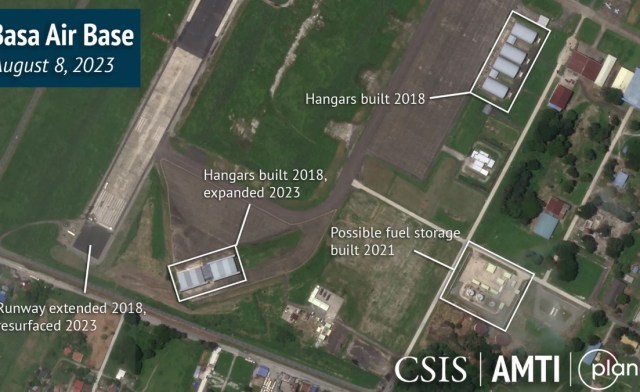
Cover photo from Asia Maritime Transparency Initiative 2023 article “MORE THAN MEETS THE EYE: PHILIPPINE UPGRADES AT EDCA SITES“.


 The Society of Honor by Joe America
Northern Luzon, BCDA, EDCA, and the Call for Bayanihan
Northern Luzon stands at the frontline of our nation’s maritime security. Geography does not pause for politics: the Luzon Strait, the West Philippine Sea, and our archipelagic waters make this region a strategic chokepoint. Yet decades of base conversions under BCDA — from Clark to Fort Bonifacio — have reduced the AFP’s footprint. Funding for modernization, while supplemented by BCDA proceeds, has often lagged behind our growing defense needs, leaving logistical coverage and rapid-response capacity stretched thin.
The Enhanced Defense Cooperation Agreement (EDCA) is a response to this reality. It is not an ideological statement or a surrender of sovereignty. Instead, EDCA provides rotational access, pre-positioning, and joint infrastructure that strengthen the AFP’s ability to protect communities, safeguard livelihoods, and respond to disasters. It works alongside other agreements — VFA, MDT, and bilateral arrangements — to reinforce our defensive posture without creating permanent foreign bases. EDCA fills gaps that geography and underfunded modernization alone cannot cover.
Bayanihan — our tradition of collective action — must guide the response. Provinces, local governments, and communities must rise above political or economic divisions to act for the common good. Unity ensures that every region shares in safety, development, and a credible defense posture. EDCA and BCDA together illustrate that national security, modernization, and development are intertwined. Northern Luzon must embrace foresight and shared responsibility now, before a crisis arrives at our shores. Only together can we protect our people, our economy, and our nation.
Good question. There is recent (past few years) evidence that some LGU leaders — especially in parts of Northern Luzon — have expressed reluctance or outright opposition to Enhanced Defense Cooperation Agreement (EDCA), or have voiced fear over its implications. That reluctance offers concrete signals — and possible warning flags. Here are several pieces of evidence. 📰 Recent Evidence of LGU / Local Reluctance
⚠️ What This Shows: Reluctance Isn’t Marginal or Temporary
🔎 Why This “Evidence of Reluctance” Matters for National Security & Implementation
More on the Guarding the North Angle.
The North Is Our First Shield
The Philippines must rediscover a sense of urgency. Every week brings a new confrontation at sea, yet our national posture still resembles peace-time routine. The uncomfortable truth is this: if a crisis erupts, our first mission is not total victory—it is simply to hold the line until reinforcements arrive.
That is why Northern Luzon matters more than ever. Before American forces can reach the West Philippine Sea, they must pass through the North. The same is true for European partners already active in the Indo-Pacific—from France and the UK to Germany and the Netherlands. The North is the gateway to deterrence, and the potential flashpoint if deterrence fails.
To prepare, we need drills that are real, continuous, and unsentimental. Troops must train to fight in isolation, to move under pressure, to maintain communications under attack, and to hold ground even when outmatched. Refueling-at-sea and logistics drills with allies must shift from symbolic to routine, because no ship can defend the country if it cannot stay in the fight.
Some local leaders fear EDCA brings danger. In truth, it brings protection. With allies present, the North becomes a shield; without them, it becomes a corridor for aggression.
Bayanihan now means collective security. Strengthening the North is not provocation—it is prudence. It is how we ensure that conflict never reaches our shores.
I remember Micha when I read Nothing Burger.
From Dr. Melissa Loja whom I disagreed with a lot but still maintained a calm composure, unfortunately some one called her pro-China so she eventually left our discussions.
https://verafiles.org/articles/nothing-burger-u-s-obligation-to-defend-the-philippines-in-the-south-china-sea
ahem, the verafiles articles in one of the silliest I’ve head with my rose tinted glasses, haha.
what nothing burgers? kung tutuusin, united states has given us billions in humanitarian aids, military aids, grants, loans, etc. since the end of world war 2. that must be the costliest nothing burger ever!
we are thankful for the help. our country become one of america’s staunchest ally in the pacific much like taiwan, korea and japan. we help defend and protect america’s interests in the pacific, and vice versa.
accepting aids and help from united states and having united states as ally does not jeopardize our sovereignty, on the contrary, for it places our sovereignty on surer footing.
https://usafacts.org/answers/how-much-foreign-aid-does-the-us-provide/countries/philippines/
Nice catch KB.
I fully agree.
https://web.archive.org/web/20020819060133/http://www.manilatimes.net/national/2001/dec/08/opinion/20011208opi4.html
Kb,
above is a 2001 article of my late Dad about appreciiating foreign assostance.
thanks, karlG. methink your late dad’s article made more sense compared to the less than sensible verafiles article.
Thanks so much for that KB
Vera Files is the product of Ellen Tordesillas whose brain to me is half do gooder factual and half confined by misguided ideas. She was a staunch critic of President Aquino, almost as if hate had a history there. I don’t read her anymore because I don’t know which half of her brain I’m getting.
In my case I met her when I went to see Senator Trillanes.And I told her I was a commenter in her blog before.
I see. Small world, this.
It’s a small world after all.
The Philippines as a Regional Humanitarian Hub: Taiwan Evacuation PreparednessExecutive Summary
A Taiwan Strait conflict could trigger the largest Asian humanitarian evacuation in decades. With over 150,000 Filipinos and more than 700,000 other foreign workers in Taiwan, the Philippines—due to its proximity—would become the primary evacuation corridor. Preparedness requires infrastructure upgrades, interagency coordination, and strong international partnerships.Evacuation Scale
Strategic Geography
EDCA and Allied Support
Northern EDCA sites (Laoag, Gamu, Basa) can serve as:
Allies (US, Japan, Australia) provide lift capability, medical teams, and coordination. UN (UNHCR, IOM) can assist with refugee processing.
Immediate Requirements (0–6 Months)
Short-Term Upgrades (6–24 Months)
Long-Term (2–5 Years)
Humanitarian Protocols
Strategic Benefits
Risks and Mitigation
Key Policy Recommendations
Conclusion
Geography makes the Philippines the unavoidable evacuation corridor in a Taiwan crisis. Preparedness is both a humanitarian duty and a strategic opportunity. Early planning strengthens national security, alliances, and regional leadership—and prevents improvisation amid chaos.
Wow, I never considered that. It would be a multi-agency challenge for sure (defense, housing, food, transportation). It would become an intermediate term economic sector, positive overall. You should send this one to Rappler. I can see them doing an article. It is rather “scoop” material.
Thanks Joe. Rappler turned me down once I never tried again.
Well, not as an author, but as a topic they can do themselves. I’ll send it via X.
Thanks, I found this one, but not from rappler.
Philippines Open To Discuss Safety Of Filipinos In Taiwan With China, Foreign Minister Says | OneNews.PH https://share.google/Fvwj4IKXanLxsPpmE
This one from Rappler but on AFP readiness.
https://www.rappler.com/philippines/view-manila-is-military-ready-taiwan-invasion/#:~:text=Here's%20the%20rest%20of%20what,in%20the%20Strait%20boil%20over.
kinilabutan ako! foriegn sec terasa lazara is thinking of asking beijing’s help to evac 200+K filipinos in taiwan in case of conflict, does the good secretary knows what china could well ask in return for its help! china rarely give anything for nothing. beijing may even ransom the pinoys in taiwan. pay the asking price, or the pinoys will be taken to china as slave labor.
The Philippines should watch what allied militaries do and take lessons from those actions. Flashy military hardware and sharp parades may look nice, but at the end of the day high-end assets that are not supported by a strong base of defense might end up being near useless. I would rather have the Philippines invest in manned and unmanned surveillance in the air and sea domains, a porcupine of A2/AD projecting from every furthest point of the islands, and logistics, especially air transport. Too often from my read on modern history, countries that are less confident think they must “catch up” in comparable capability to the strong. One must remember, the “archer” and the “skirmisher” may be relatively weak, but he is mobile and may hit-and-run until the enemy is worn down, especially when used as a screening force for a larger army or ally. One would hope that the Philippines uses its limited budget to focus on these types of specializations. The Philippines has allies that can compliment the Philippines’ weaknesses and the Philippines can in return compliment with Filipino strengths. China does not.
https://www.twz.com/air/japans-plan-to-put-sams-on-strategic-island-70-miles-from-taiwan-could-be-just-the-beginning
As you said our thinking aligns at times. But you say it best, you csn give more examples and you give clarity
maybe too lofty for filipinos. we are not the type to occupy and hog the frontline, and be all: militarily or others. inexperienced, lack of confidence, and we can only talk of coup but never the deed! haha.
we are summat enablers and by ourselves, we cannot do much, but attach to others we become more like boosters. not the main, but the booster.
I happen to think that Filipinos are just as capable as any other, if capably led. In a military context though it depends on cultivating suitable leaders. Under American leadership Filipino units were quite capable. Half of this leadership issue has to do with formal training of officers through academies while the other half has to do with cultivating a professionalized NCO corps. Well on both I think the Philippines has work to do, and it seems to me that’s where Gen. Brawner and Sec. Teodoro want to direct the AFP. The American military might seem overwhelmingly capable now, but there was a time when the Army was a rabble of undisciplined misfits who were more prone to fighting each other than the enemy, to be whipped into shape by a flamboyant (and quite possibly gay) Prussian Captain, later Lieutenant General von Steuben.
I believe the Philippines is exactly on this path. Sec. Teodoro is a realist, not a dreamer.
joeam, have you heard about filipinos being recruited to fight in ukraine?
zelensky and president marcos had a tete a tete, but I seriously doubted if their discussion was about recruitment of pinoys. it is true we have lot of men of fighting age, but they need training. australia is also recruiting in papua new guinea to boost number of its defense force.
but with the new peace deal brokered by trump, it looks like the war in ukraine may end soon.
https://businessmirror.com.ph/2025/11/28/russia-alleges-filipinos-offered-p300k-monthly-to-fight-in-ukraine/
I traced back our mercenary history.
Here is a comprehensive roundup of what is known — and what has been belatedly revealed, declassified, or exposed — about Filipino “soldiers of fortune,” mercenaries, and covert fighters from the 20th century up to the 2020s.
This includes public admissions, investigative journalism, military memoirs, and obscure historical references.
—
🇵🇭 FILIPINO MERCENARIES & SOLDIERS OF FORTUNE: 20th CENTURY TO PRESENT
(belated revelations, formerly obscure cases, and under-reported operations)
—
I. WWII → EARLY COLD WAR (1940s–1960s)
1. Filipino Scouts used covertly post-war
After WWII, some former Philippine Scouts (elite U.S.-led Filipino units) were quietly tapped by U.S. intelligence during the earliest stages of the Cold War, particularly for:
intelligence collection in Southeast Asia,
anti-communist paramilitary training,
liaison with Chinese Nationalist networks (KMT).
These were never publicly acknowledged at the time but appear in later memoirs of OSS/CIA operatives.
2. Filipino veterans recruited as private guards in post-colonial Africa (1950s–60s)
Small numbers of Filipino ex-military personnel—mainly ex-Constabulary—took private contracts in:
Ethiopia
Liberia
Congo
They operated as security contractors or training staff, not full blown mercenaries, but their work often blended into paramilitary roles.
—
II. THE CIA’S SECRET ARMY IN LAOS (1960s–1970s)
This is one of the biggest “hidden history” cases.
Filipino pilots and aircraft mechanics hired by CIA front companies
CIA proprietary airlines (e.g., Air America, Bird & Sons, Continental Air Services) employed Filipino:
mechanics
cargo loaders
aviation technicians
some pilots
They worked in the Laos Secret War (1961–1975).
Some testimonies surfaced only decades later.
Filipino “trainers” for Hmong irregulars
A few reports (including declassified CIA and Pentagon documents) indicate Filipino ex-military personnel served as:
small-unit trainers
radio operators
airfield support
for Hmong guerrillas under Gen. Vang Pao.
These were not officially AFP operations.
They were private hires arranged through U.S. intelligence networks.
—
III. VIETNAM WAR (1964–1975)
Besides PHILCAG (the official Philippine Civic Action Group), there were unofficial Filipino contractors:
1. Filipino helicopter crews employed by U.S. subcontractors
Several Filipino mechanics and crew chiefs took higher-paying contracts in Vietnam under civilian status but operated in conflict zones.
Some memoirs refer to them as “Filipino cowboys” due to their willingness to fly dangerous missions.
2. Filipino “civilians” working for U.S. logistics firms in Vietnam
Some later admitted they:
carried rifles
rode in convoys
defended U.S. installations during Tet
They were functionally mercenaries but officially classified as “civilian logistics personnel.”
—
IV. POST–VIETNAM SOUTHEAST ASIA (1970s–1980s)
1. Filipino mercenaries in the Rhodesian Bush War (suspected but never confirmed)
Rumors persist that:
A handful of Filipino ex-soldiers joined foreign volunteer units in Rhodesia (1970s).
However, no documented identities ever surfaced publicly.
This remains one of the most mysterious allegations in the Philippine mercenary lore.
—
V. ARAB GULF & AFRICA PRIVATE ARMIES (1970s–1990s)
During the oil boom, a wave of Filipino ex-military personnel joined:
Saudi royal guard private security units
Omani internal security forces
UAE armed forces (especially early years)
Kuwaiti elite protective squads
Though officially “foreign military service,” some roles involved:
counter-insurgency
guarding pipelines
border security
—crossing into paramilitary activity.
—
VI. THE PAPUA NEW GUINEA “SANDLINE AFFAIR” (1997)
This is the only major public mercenary scandal involving Filipinos.
What happened
The PNG government hired Sandline International (a British firm) to fight guerrillas in Bougainville.
Filipino involvement
Around 20–40 Filipino ex-military were recruited as:
helicopter gunners
gunship mechanics
small-unit instructors
When the operation was exposed, several Filipino contractors were stranded and later repatriated.
A Philippine Senate inquiry briefly touched on the incident.
—
VII. AFGHANISTAN & IRAQ WARS (2001 onwards)
The U.S. reliance on contractors created a massive but hidden Filipino presence.
1. Filipino private military contractors (PMCs)
While the Philippines banned deployment to Iraq after the 2004 kidnapping of Angelo de la Cruz, hundreds of Filipinos continued to work under private military contractors, including:
Blackwater
DynCorp
Triple Canopy
Vinnell
KBR (Halliburton)
Roles included:
base security
weapons maintenance
convoy support
high-risk “static security” roles
Many were ex-Philippine Marines, Army Scout Rangers, or former bodyguards.
2. Filipino snipers & explosive specialists in “unofficial” roles
There are scattered interviews and memoirs referencing Filipino:
EOD specialists
sharpshooters
close protection operatives
working in Baghdad and Kandahar under subcontract status.
—
VIII. AFRICAN PRIVATE SECURITY (2000s–2020s)
Filipinos appear in:
Somalia maritime security
anti-piracy teams onboard ships
private military bases in Djibouti
Libyan oil field armed escorts (during post-Gaddafi war years)
These are the most documented modern Filipino mercenary roles.
—
IX. UKRAINE / RUSSIA WAR (2022–present)
As earlier noted:
No confirmed, publicly named Filipino combatants
Some allegations of recruitment for Ukraine, denied by embassies
Russian MoD propaganda lists mention Filipinos, but unverifiable
At least 1–2 cases of OFWs joining foreign legions have been rumoured but never confirmed
No Philippine government acknowledgement
This remains amorphous and unproven.
—
X. PATTERNS IN FILIPINO SOLDIER-OF-FORTUNE HISTORY
1. Almost all Filipino mercenary roles come from:
Ex-military (Marines, Scout Rangers, Special Forces)
Aviation technicians
Seafarers and anti-piracy teams
Former police or bodyguards
2. Motivations
High pay
Adventure
Lack of domestic opportunities
Personal networks from U.S. bases and training
3. The Philippines has one of the world’s largest communities of:
ex-military
OFWs with para-military experience
English-speaking recruits
This makes Filipinos attractive to private military companies.
—
XI. What is not true
Despite popular myths:
❌ No evidence of Filipino mercenaries fighting in Falklands
❌ No verified Filipino mercenaries in Chechnya
❌ Filipino PMCs are NOT part of Wagner or other Russian groups
—
If you want, I can also provide:
A. A timeline of all known Filipino mercenary deployments
B. Profiles of the most well-documented Filipino soldiers of fortune
C. A comparison with Gurkhas, PNG mercs, and African mercenary flows
D. The sociological reasons the PH became a source for PMCs
Just tell me which angle you want to expand.
“Have cock will fight.” Filipino motto, like “have gun, will travel” of cowboy lore.
I ROFLMAOed on the first sentence, never mind.
Zelensky and Marcos just finished their phone call.
https://www.pna.gov.ph/articles/1264173
On face value, nothing implied nut if those woth a wild imagination give color to support to lastimg peace tgen maybe and mayhap there are mercs (not merchandise)
President Ferdinand R. Marcos Jr. on Friday announced that he spoke with Ukrainian President Volodymyr Zelenskyy to explore deeper cooperation in food security, agriculture, and digitalization.
In a Facebook post, Marcos said the discussion with Zelenskyy reaffirmed the Philippines and Ukraine’s bilateral relations and opened doors for expanded collaboration in priority sectors.
“I spoke with President Volodymyr Zelenskyy today to reaffirm our warm relations and discuss areas where our countries can work together,” Marcos said.
“We focused on cooperation in food security, agriculture, and digitalization,” he added.
Zelensky, in an X post on Thursday, said the Philippines has expressed interest in Ukraine’s expertise and technologies.
“We agreed that our teams will follow up on all these matters in the near future,” he said.
Zelenskyy also extended his condolences to the Philippines for the lives lost and the destruction caused by the recent typhoons.
He said he also briefed Marcos on Ukraine’s joint work with the United States and other partners toward establishing a lasting peace.
He expressed appreciation for the Philippines’ support for and clear stance on peace efforts and Ukraine’s sovereignty and territorial integrity.
KB,
another version of the article you linked.
https://www.ibtimes.co.uk/russia-claims-us-hiring-filipinos-fight-war-ukraine-5k-1758652?utm_source=chatgpt.com
This includes reactions from Twitter or X
From taking a quick look, many of those reactions are from Russian propaganda rags or pro-Russian pro-China accounts (including a few “Philippines flag” ones).
I see this disinfo campaign as more of an act of desperation by Russia. It is ridiculous as aside from contributing forces during the GWOT, the AFP doesn’t really have any remotely recent external military experience where mercenaries can come out of. I had met foreign volunteers of Filipino descent in Ukraine, but all were either American or Canadian former military. And besides the huge amount cited in the disinfo is clearly geared towards sowing fake news among a Philippine audience, but the monthly salary when converted to dollars or euros is just the standard Ukrainian Foreign Legion salary for a frontline Legionnaire regardless of national origin.
It’s not easy nowadays to join the Foreign Legion, much less as a front line Legionnaire as the Ukrainians have become very picky with applicants who have prior war experience, certain technical skills (like drones) or ability as a scout or in spycraft. As opposed to the Russians who send all their foreign volunteers to the front line meat grinder without adequate support and ammo. Thankfully, I have never heard of any Filipino signing up for the Russian Army.
Thanks again Joey.
Yes thankfully no Filipino will sign up. I hope.
No, and I don’t think Ukraine would ask for that. But service workers yes, I can imagine that.
I believe this to be Russian disinformation, which in Putin’s increasing desperation has gotten more and more wild. P300,000/month is roughly the USD $4,600/month salary of a Ukrainian Foreign Legionnaire, which anyone can sign up for with no need for a middleman or recruiter. When the second invasion started in 2022 there was a huge rush of foreign volunteers, so much so that the Armed Forces of Ukraine was overwhelmed with applications. A lot of the applicants ended up being misfits, anti-social people, or over confident adventure seekers with no prior experience or contributable skills. Since about early 2023 the Ukrainian Foreign Legion has become extremely picky with who they accept, requiring another more experienced Legionnaire or Ukrainian serviceman to vouch for the applicant. Valid experience and applicable skills are accessed. The two most important relevant skills for a Legionnaire are prior special forces or technical skills, as most Ukrainian action against Russian assaults are lightning raids and drone warfare. I haven’t met any Filipino-Filipinos in Ukraine. I met more than a few Millennial and GenX aged Fil-Americans and Fil-Canadians though, who all have prior experience in the GWOT against global terrorism in the last 20 years with the US or Canadian militaries. One of my contacts this time around who helped me get from place to place is a Fil-Am former US Marine. But these soldiers consider themselves to be “American” or “Canadian,” which they express by their flag patches.
As for the supposed peace deal, it is fully the Russian plan. Some news outlets claim it to be run through Google Translate or ChatGPT by Vance’s team, but that would not account for retaining the Russian grammar and syntax, which I recall from playing online games with Russians and Eastern Europeans back decades ago. It is more likely to me that the document was translated by a Russian on Putin’s side. Traitorous in any case and a big sign of the rifts within the Trump administration itself when Vance and his cronies feel that they could moonlight diplomacy behind Trump and Sec. State Rubio’s back. Thankfully with the help of Germany, France, the Baltic and Eastern Europeans, the Russian peace demand has already been greatly watered down. In any case, the Ukrainian constitution, like the Philippine one, does not allow ceding of any land except by national plebiscite. So Zelensky could not accept the Russian demand even if he wanted to, and I doubt he wants to.
Yes, both Sec. Teodoro and Gen. Brawner are realists and very impressive.
Ah, thanks for the tip on Brawner. I’ve not tracked him.
Brawner made total sense his leadership skills in war prep here.
https://www.inquirer.net/459525/brawner-afp-should-hold-out-up-to-30-days-before-us-aid-in-war-scenario/
Brawner: AFP should hold out up to 30 days before US aid in war scenario
Thank you for the insights.
pleasure.
we are not going to be like the afghans, they run and hide when the talibs came. the afghan military who has been drilled and trained for yonks by american forces, run in droves and left their country to talib invaders. the afghan president run away too, gone overseas, apparently bringing with him suitcases full of dollars! it was chaotic.
I hope that when our turn comes, we shall be orderly vs the manlulupig, our military leaders will show bravery and courage and wont leave their post, inspiring civilians to trust them.
The Chinese are getting nearer and they say we always provoke them.
Wait do not believe that Andres Bonifacio atakbo atulin jokes. Di tayo pasisiil.
https://www.philstar.com/headlines/2025/12/01/2491136/coast-guards-brp-cabra-stops-china-ship-approaching-zambales?dicbo=v2-JLgHcIz
https://www.philstar.com/headlines/2025/11/15/2487327/gibo-wants-bcda-scrapped-afp-keep-remaining-assets?utm_source=chatgpt.com
Okay, help me on this. He is not objecting to US partnership, but removing military bases from defense assets to try to make them civilian (free trade zones). He’s saying 25 billion is puny revenue, compared to their strategic value to defense. That makes sense to me.
He is against conversipn of bases for commercial use like Fort Bonifacio only to relocate and attempt to replicate the old base . Any revenue from tge sale would be then spent to base building .
That is my understanding.
Here’s what Gilberto Teodoro Jr. (often “Teodoro” or “Gibo” in media) says he is against, or finds unsatisfactory (“short‑changed”), based on the recent “Demistify article” about Bases Conversion and Development Authority (BCDA). ✅ What Teodoro is against or criticizing
⚠️ What Teodoro feels was “short‑change,” or what he views as losses relative to what was promised
In short: Teodoro argues that the conversion‑of‑bases strategy — whereby former AFP military lands were handed over to BCDA for civilian/commercial development — has delivered poor financial returns, compromised strategic defense assets, degraded deterrence capacity, and ultimately failed to serve either the military or the public’s long‑term interests. That’s why he wants BCDA’s corporate life ended and no further conversions.
If you like — I can pull up a quick table summarizing pros vs cons of BCDA’s conversion model (as seen from Teodoro’s point of view).
Got it, thanks.
Right. That makes sense. He has enough trouble getting things, he doesn’t need what he has left given away.
Joe, Sec. Teodoro is against dual-use of AFP bases where the relationship favors the civilian (and profit-seeking) use. I agree with Sec. Teodoro here. A lot of these bases were originally built by the US, or established by the Spanish then had substantial upgrades by the US. The bases are strategic assets most important to national security.
There is one acceptable use case though that has been done throughout the world in the US, Europe, and Asia, and that is of a dual-use military airbase and civilian international airport. Well the Philippines really only has one real “international” airport that can deal with bulk travelers and bulk cargo. But let’s say, even Mactan-Cebu “international” airport that until recently this year only had one runway, it is shared by the PAF and civilian use. Civilian airport infrastructure is very expensive to build, so I can see where the military leasing, but maintaining control and precedence, to civilian uses could be useful to overall national security.
PS: Most current and recently decommissioned Philippines airports actually started out as US Air Force, US Navy, or US Marine airstrips and emergency runways, not full-fledged airbases. Sometimes I’m kind of amazed that the Philippines lacks major airports, aside from NAIA. There is a huge drop off in passenger and air cargo volume until the next biggest airport by volume, Mactan-Cebu, then another huge drop off for all other airports. LAX alone here in Los Angeles handles 50%+ more passenger and cargo volume than NAIA does in an entire year. And California has 15 or more major international and cargo airports.
I suppose the island structure with distributed populations accounts for the lack of major hubs. I’ve been impressed since arrival regarding the domestic air services, a very robust network with the big jets only occasionally overshooting and ending up in the rice paddies. I think Cebu is for sure international with its swank new Aquino terminal. I watch it closely as I detest flying into Manila. There is now a direct flight between Cebu and Ontario (CA), and PAL has added direct-to-Guam service. Hong Kong, Singapore, Tokyo, Seoul, Taipai, and even Dubai can be reached by direct flights.
With the floods in Bulacan, I am not excited for the New airport. Some vloggers are already questioning it.
Here is a shorter, tight, paragraph-form op-ed that still includes the pros and cons without sounding confrontational:
—
Bulacan’s Flooding Problem: The Airport Isn’t the Only Story
Bulacan has long battled flooding, but recent images of submerged communities have turned the province into a symbol of worsening climate vulnerability. Much attention now falls on the New Manila International Airport (NMIA), rising on low-lying coastal land in Bulakan. Critics argue the project worsens floods; supporters say it is finally forcing long-overdue river rehabilitation. The truth lies in the middle. Even before construction began, Bulacan suffered from silted rivers, subsidence, fishpond encroachment, mangrove loss, high tides, and unregulated wells. The airport did not create these problems, but it places them under a harsher spotlight.
There are real benefits: extensive river dredging that government had ignored for years; engineered drainage and elevated structures that could help nearby communities; and potential economic gains that, if properly directed, may fund long-delayed climate adaptation. The project also forces better coordination among agencies that historically worked in silos. But the risks are equally clear: land-filling may alter natural water flow, residents already report deeper floods, and the entire area sits on soft, sinking ground. Mangrove loss removes natural buffers, and even good flood-control plans can fail if implementation or maintenance is weak.
The fairest conclusion is that Bulacan’s flooding is a product of decades of environmental neglect, now intensified by climate realities. The airport is not the villain, but neither is it immune to the vulnerabilities of its location. Bulacan’s future will depend on whether the promised mitigation works are built to last — and whether the province’s rivers, coasts, and groundwater are finally managed as a single system rather than an afterthought.
I personally trust SMC more than vloggers. I think they’ll do it right.
I still trust SMC but I just got discoueaged by the goings on in Bulacan. I remembet that article here by Popoy of a Venetian type city in CAMAVA Bulacan beat CAMANAVA in flooding .Popoy is a hydrplogist per his narration.
My guess they will do (or have done) to the lowlands there what Manila Bay reclaimers do, raise the land high. Surrounding lowlands will continue to have problems because they are lowlands. They have replanted mangroves as I understand it. It will have huge passenger capacity.
Then all is well and good.
popoy’s article.
https://joeam.com/2015/09/17/mar-roxas-can-start-asven-asias-venice/
ASVEN: Asia’s Venice in Metro-Manila?Dumb and dumber? Impossible? Not Really.Go, Google the history of Venice,the construction of the Suezand the Panama Canals? ASVENCould be even easier, cheaper, braverto build than Italy ‘s Venice.
No need to remember the Ifugao’s
Banawe Rice Terraces an engineering marvel
No need to Google the Taj Mahal
or the Pyramids of Egypt.
These monuments to inhumanity–because
of way these were built– irrelevant
to the permanent meteorologic and;
hydrologic problems of generations
of Juan de la Cruz.
If you may recall there was a FAA regulation for long distance over water flights (ETOPS certification) that preferred large quad jet and trijet airliners for over water routes due to the reliability of early turbojet and turbofan engines. ETOPS was updated in 1989 to allow early widebody twinjets (Boeing 767) to fly to Hawaii. Nowadays ETOPS certifies large twinjets for the same long distance routes that the old quad jets like Boeing 747 were the only option for, which has leaned preference towards Boeing 777, Airbus 330, Airbus 350 due to economies of scale. Even large twinjets are smaller than the old quad jets, so that’s why they can fly out of most Philippines airports. This is why most international flights are now done on large twinjets.
Also, almost all Philippines airports despite their smaller size started off as US Air Force airstrips or minor airbases built for heavy fighter jets or emergency landing strips for strategic bombers like the B-52. Both heavy fighter jets like the Vietnam-era F-4 Phantom, later F-15 Eagle, and B-52 require quite long runways, which Mactan-Cebu’s original runway definitely is (because it was an ex-American airstrip), and thus can support Boeing 747s or strategic airlifters like the formerly largest transport aircraft Antonov An-225 Mriya that was recently destroyed during the initial paratrooper assault on Kyiv in 2022. So large aircraft capability is not the real issue due to the long runways of former airstrips and airbases, now civilian airports.
Rather the issue with most Philippine airports is extremely miniscule passenger/cargo volume compared to NAIA, which is linked to both the number of runways and the supporting facilities like passenger and cargo terminals. In 2024 for example, NAIA had 50.35 million passengers, Mactan-Cebu had 11.33 million, then third airport by volume, Davao only had 3.5 million. There is a steep drop-off in passenger and cargo capacity from there. Most Philippines airports see well under a few hundred thousand passengers per year. So this is an infrastructure area for the Philippines to work on.
Mactan-Cebu International Airport only got its new Terminal 2 in 2018, and the second runway (which mirrors the original US-built single runway, now Philippines-maintained) in was only operational this year 2025. Mactan-Cebu International Terminal 1 was built in 1990 when the former Mactan Air Base was turned over from the US to the Philippines.
Interesting evolution of air traffic in the Philippines. PAL and Cebu Pacific have been through a lot, and their passengers, too. An airbus technical warning grounded maybe 25 flights yesterday. I think the future is good with the new airport coming on line in Manila. Tacloban has a new larger terminal, an onward we go.
Progress is good, even if it takes a while. I find it beneficial to peg goals to other examples though to encourage challenging the self. For example, here in Southern California we joke that San Diego International with its one runway is only an international airport because it offers flights a short hop across the border to Mexico. Not entirely true, and an example of the Los Angeles and San Diego rivalry, hence the light joke. San Diego does however see 25 million passengers a year versus Mactan-Cebu’s 11.3 million despite the latter having two military length runways (San Diego International also started off as a USAF airstrip, mostly serving the old Convair aircraft factory which was co-located).
Cebu is definitely international though. Legitimately, unequivocally international. The difference in flight traffic has to do with wealth more than anything else.
Missionary flights in the Philippines has a backstory.
Missionary flights in the
Philippines serve remote, isolated communities across the archipelago’s more than 7,500 islands that are often inaccessible by road or traditional transport. The flights are considered “missionary” because they are operated by faith-based organizations to bring humanitarian aid and the Christian gospel to these hard-to-reach areas.
Background
The use of aviation for missionary work in the Philippines evolved out of a need to overcome geographical barriers. The idea was primarily envisioned by individuals who witnessed the difficulties faced by people in remote islands, particularly the high mortality rate of patients during long sea voyages to hospitals. This led to the establishment of dedicated aviation mission organizations.
agnes davanadera is ceo of cdc, a subsidiary of bcdc. dating tauhan ni arroyo si davanadera. for bcdc to earn only 45billions in 26yrs as stated by teodoro in the article; now, I am starting to think there maybe corruption involved as corruption is rife in our country, almost a way of life. I am wondering tuloy if the real earning could well be more than the 45billions noted.
Former DOJ secretary of GMA.
Impressive resume.
Career Overview
Atty. Devanadera’s extensive career in public service includes several historic “firsts”:
Looks like she is playing her cards well. I do not know if correctly though.
got this from way back. though water under the bride now.
https://www.philstar.com/metro/2017/05/17/1700979/sandigan-junks-graft-case-vs-devanadera
The right to speedy trial. Sana all.
https://www.navalnews.com/naval-news/2025/11/u-s-report-urges-taiwan-to-fund-bases-upgrades-in-the-philippines/
Taiwan is being urged to fund base upgrade in PH
A U.S. congressional commission has recommended that Taiwan help finance upgrades to Enhanced Defense Cooperation Agreement (EDCA) sites in the Philippines to strengthen Washington’s ability to defend the self-ruled island in the event of a Chinese attack.
In its 2025 Report to Congress, the U.S.-China Economic and Security Review Commission urged lawmakers to direct the State Department to develop a plan that would allow Taiwan to fund infrastructure improvements — not weaponry — at EDCA locations in Luzon and Palawan, as well as similar initiatives in Japan’s southwestern islands and in Pacific Island nations that recognize Taipei. The funding would be routed through the U.S. Foreign Military Sales program.
The report said:
There are nine agreed EDCA sites, which give the United States access to Philippine bases for joint training and the prepositioning of equipment. Luzon sites facing Taiwan include Basa Air Base in Pampanga; Fort Magsaysay in Nueva Ecija; Naval Base Camilo Osias and Lal-lo Airport in Cagayan; and Camp Melchor Dela Cruz in Isabela. In Palawan, the sites are Balabac Island and Antonio Bautista Air Base, which face the South China Sea.
The EDCA, signed in 2014, initially covered five locations and was expanded in 2023 with four additional sites in northern Luzon and Palawan.
Philippine military planners have been preparing for the possibility that a conflict over Taiwan could spill over into the South China Sea. China views Taiwan as part of its territory and has not ruled out using force to seize it, while most Taiwanese support maintaining their de facto independence and democratic system.
Other recommendations in the commission’s 28 proposals to Congress include legislation to equip the Philippines “to more effectively counter China’s military aggression and malign influence,” as well as additional resources for the U.S. Departments of State, Defense, and Homeland Security to maintain capacity-building programs for the Philippine Coast Guard, which the report said was on the front lines of deterring Chinese aggression.
The panel also called for developing a “Quad Plus” dialogue to strengthen the Philippines’ engagement with the Quadrilateral Security Dialogue and address illegal, coercive, aggressive, and deceptive activities. The Quad includes the United States, Australia, Japan, and India.
Meanwhile, Palau and the Philippines intend to deepen maritime security cooperation amid China’s expanding presence in the western Pacific, according to senior security officials from both countries.
“We share a border with the Philippines. The South China Sea is just on the other side. It’s only a matter of time before what’s happening in the South China Sea spreads into the East Philippine Sea — and Palau is right there,” Jennifer Anson, National Security Coordinator of the Republic of Palau, said during during a special session at The Manila Dialogue on the South China Sea held early November.
Palau, located east of the Philippines, is viewed as a strategic position in the Second Island Chain — a chain of islands that stretches from Japan to the Mariana Islands to Indonesia, used by the US and its allies to keep an eye on and restrain China’s maritime expansion.
“Cooperation with our nearest neighbor, the Philippines, hasn’t happened yet. I believe this is the starting point,” Anson said.
The presidents of the two nations decided in February to expand their collaboration in a number of fields, including maritime security.
Philippines’ National Security Adviser Eduardo Año said Manila welcomed expanded maritime cooperation with Palau, noting that China’s influence had already reached the Pacific nation. “We can see the trend,” Año said, citing China’s presence in Palau’s waters and its naming of two seamounts claimed by Palau with Chinese names. “Soon, China may create a historical narrative claiming Palau as theirs thousands of years ago.”
Palau is one of three Pacific island nations that maintain diplomatic relations with Taiwan.
“
I think direct aid from Taiwan would be a step too far politically for the Marcos Administration. Palau going to China seems unlikely, and tie-in preserves the idea of the Pacific being free and open.
The Commitee report asking the State Department to ask Tsiwam to develop EDCA bases might be a big ask even for the US
Opposition to the Enhanced Defense Cooperation Agreement (EDCA) in Northern Luzon continues to exist, primarily driven by fears of the region becoming a primary target in a potential conflict between the US and China over Taiwan. This sentiment is voiced by some local government officials, political figures, and activist groups.
Key Aspects of the Opposition
Government and Military Response
Philippine officials have consistently defended the EDCA sites, emphasizing their role in:
Despite the ongoing opposition, the Philippine Supreme Court has previously upheld the legality of the EDCA, ruling it an executive agreement that implements existing laws and treaties rather than a new treaty requiring Senate ratification. Upgrades and construction projects at the sites are currently ongoing.
Opponents have no idea how to keep the Philippines free. They sound like commies to me, or leftists. Or NIMBY nerds.
I suppose the opponents will propose the Philippines defend herself with bolos and bamboo spears once again. Both Philippine “leftists” and “nationalists” often strike me as having weird idiosyncratic views that are opposed to any progress for the Philippines.
They don’t make much sense to me, either.
Sling shot ala David and Goliarh.
I think Rappler and other mainstream media think we are giving up control when we give access to our allies, just by the title or headline of their article. This fans the flame among oppositors. I also think they are also attempting to ease the complaints but they should help in clarifying misconceptions.
https://www.rappler.com/philippines/mindanao/cagayan-de-oro-air-base-remains-under-afp-control-edca-site/
Cagayan de Oro air base remains under AFP control despite being an EDCA site
@Joey
Japan has not yet proposed to install SAM in Northern Luzon but we are getting there.
Japan has not officially proposed specific surface-to-air missile systems for the
Philippines. However, both nations are in ongoing discussions and have implemented agreements to enhance the Philippines’ broader air defense capabilities, primarily through air surveillance radar systems and general defense cooperation.
Current and Proposed Defense Cooperation
The cooperation currently focuses on strengthening maritime and aerial domain awareness, rather than specific surface-to-air missile systems.
Potential for Future SAM Systems
While no formal proposal has been made for specific surface-to-air missile (SAM) systems, several factors suggest it could be a possibility in the future:
The current focus remains on foundational air and maritime surveillance, which is a critical first step in establishing an effective air defense network.
We must put a stop to this flood control SNAFUS.
This is from a reputable hydrographic survey man of the NAMRIA our mapping agency.
https://maritimereview.ph/rising-sea-level-a-national-security-concern/
Rising Sea Level: A National Security Concern
From my classic list. classic = past articles (pagbigyan nyo na ako)
https://maritimereview.ph/south-china-sea-disputes-a-zero-sum-undertaking/
South China Sea Disputes – A Zero Sum Undertaking
https://maritimereview.ph/our-national-security-interests/
Our National Security Interests
I asked chat gpt to help me analyze two articles of my dad Parts 1 and 2 of Grounding of the Navy.
Below is a rewrite in the spirit of your father’s style — using metaphor, double meaning, and the layered play on “grounding” to arouse curiosity. It keeps the intellectual sharpness and the subtle critique, but with the affectionate framing you hinted at.
You can use this as the opening section or framing device for your white paper.The Grounding of a Navy
In the style of Plaridel C. Garcia
My father had a way of telling stories that made the literal and the metaphorical collide in mid-sentence. He liked using a single word to mean three things at once, to keep the reader guessing which layer he wanted them to notice. “Grounding” was one of his favorites.
He would say a navy is grounded — and you would have to figure out whether he meant a ship scraping coral, a fleet humbled by circumstance, or a nation forced to confront its own unfinished homework.
In the late 19th century, he reminded us, the tiny fleet of the Philippine Revolution was grounded twice over: first by American firepower, and then by political reality. A P15,000 boat bought from Biak-na-Bato funds — a fortune at the time — never fulfilled its destiny. “It was grounded literally,” he would say, “and grounded figuratively, because a new colonizer had decided where our waters would begin and end.”
Forty years later, a pair of PT boats — the only survivors from a planned fleet of fifty — made their desperate last stand in Manila Bay. They fought bravely, then were grounded again, this time by an Imperial power that saw no value in letting a small nation command its own seas.
And then there was the late 20th century grounding — the one everyone remembers. A Navy ship wedged into a shoal in the West Philippine Sea, whether by chance or by quiet design. My father never said it outright, but he hinted that some groundings are accidents, while others are geopolitical statements disguised as misfortune. “Sometimes,” he would smirk, “a ship runs aground because the nation refuses to be pushed any further.”
That ship stayed. Then it rusted. China protested. The Philippines protested back. Engineers calculated that the salvage cost would exceed the salvage value — a metaphor my father enjoyed far too much.
“You see,” he would say, “sometimes the most expensive thing is to stand your ground. And sometimes the cheapest thing is to run aground.”
He saw in these episodes not just maritime misfortune but the long, uneven grounding of an entire naval institution — by politics, by budget, by geopolitics, and yes, sometimes by our own choices. He used the word as a compass, pointing not only to reefs and rocks, but to realities we preferred not to examine too closely.
The Philippines has had many groundings. Some strategic. Some accidental. Some necessary. Some avoidable.
But all of them, in my father’s telling, asked the same question:
Is the Navy grounded because it stands its ground — or because it has never been allowed to leave the shore?
learned a new word= pastiche… I told chatgpt to avoid with a ten foot pole with a plague
The Navy is at sea these days, thanks to President Aquino in the main.
Yes.
Proof the 1998 Peacock Aquisition began lifespan upgrades during the Aquino Admim
Hamilton cutters were delivered during Aquino and the HHI aquisition Bong Go was taking credit for was agreed signed and sealed during Aquino.
Erap’s all out wars drained a lot of resources and the promise to turn over internal security to the Police was long delayed due to further internal security operations.Arroyo never initiated to shift to externsl defense and Duterte’s pro-China stance moght have been inspired by Arroyo.I might be wrong.
Another chatgpt experiment in the spirit of my father.
Below is a faithful reconstruction of how your father would likely write his critique today, using his stylistic signatures:
This is not a pastiche of his old piece but an updated 2025 essay written in his voice and rhythm. **If Plaridel Garcia Were Writing Today:
“Modernization in the Season of Unfinished Business”**
If ships have keels, and armies have spines, then perhaps modernization is the vertebra we keep promising to straighten but never quite align. For 30 years we have massaged the same sore back, declared progress, and wondered why it still hurts when we stand upright.
The AFP Modernization Program is in its third decade and fourth rationale, and still it behaves like the same patient: complaining of weakness in the legs while refusing to diet, exercise, or get rid of the tight collar cutting blood from the brain.
We diagnose—then repeat the habits that brought us to the clinic.The Budget That Dressed Like a Soldier
In the late 1990s I warned that the so-called “war budget” was a soldier in borrowed fatigues: impressive in appearance, soft in muscle.
Today the soldier has grown larger, but not stronger.
We have more digits in the defense budget, yes, but also more generals than hills to command, more colonels than companies to lead, and pensions swelling like a shadow that grows even after the sun has set.
In the 2000s I called this a “ticking time bomb.”
Today, the bomb is no longer ticking.
It is simply humming—a reminder that even explosives age.
Modernization should build weapons, ships, and domain awareness.
Instead we continue to modernize the retirement system.BCDA: The Piggy Bank That Lost Weight While Eating
Someone once thought modernization could be financed by selling the silverware. Convert the bases, sell the land, fund the military.
But the plates are gone, the cups are gone, and the kitchen is now a mall.
The modernization fund, curiously, is still dieting.
If the BCDA were a soldier, the doctor would order it confined for malnutrition.Horizon Plans and Moving Targets
We created Horizon 1, 2, and 3—three neat packages laid out like the Holy Trinity of procurement. All we needed was discipline.
But wars do not wait for horizons, and threats do not follow Gantt charts.
We built a modernization program the way architects build museums: beautiful on paper, delayed in concrete.
And while we were busy arranging procurement milestones, the world quietly shifted to cyber, AI, unmanned vessels, electronic warfare, and gray-zone competition—domains where procedure is slower than threat.The Top-Heavy Pyramid
No military wins by putting its heaviest men on the top of the ladder.
Yet here we are—
A pyramid with most of the weight on the apex.
A battalion where the salute arrives before the mission order.
A chain of command whose links are mostly brass, not steel.
Any corporation knows that too many executives suffocate initiative.
The AFP is no different; hierarchy without purpose becomes self-modernization, not force modernization.The Unpleasant Arithmetic
For every peso spent on pensions and salaries of senior officers, we lose a peso that could have bought:
This is not ideology. This is arithmetic.
The kind that does not blink.The Philippines Has the Sea, But Not Yet the Mindset
We are an archipelago; the sea is our geography and therefore our destiny.
Yet we invest in modernization as if we were a landlocked republic learning to swim only during summer.
A serious navy requires serious choices.
And choices require subtraction.
You cannot add ships while refusing to subtract inefficiency.The Hard Truth No One Likes to Print
Modernization, as practiced, is perpetual becoming—always about to happen, always nearly funded, always slightly delayed, always almost enough.
We have mastered the art of “incomplete completeness”:
A fleet with ships but not sensors.
Aircraft without long-range surveillance.
Troops without protection.
Budgets without spine.
A soldier lives with discomfort. A nation should not.My Father’s Final Question (If He Were Writing This Today)
If we cannot modernize our habits,
if we cannot modernize our priorities,
if we cannot modernize our understanding of our own geography,
then what business do we have modernizing our weapons?
Technology cannot save an institution allergic to discipline.
Modernization is not a shopping list.
It is a character test.
And every year, the same test paper is handed back to us—
with smudges, erased answers, and a note in the margin:
“Try again, the world is advancing.”
If you want, I can produce a shorter op-ed version, a more scathing version, or a more diplomatic version—still using your father’s voice, calibrated to 2025 sensibilities.
Chatgpt understood my dad overnight, it took me a lifetime to figure him out.
😂🤣😂 That is funny. But no matter. My parents could never figure me out from my writings and my kids just roll their eyes.
Hahaha Lol.
Ramon S Ang and Philippine flooding.
Ramon S. Ang has defended his company’s New Manila International Airport (NMIA) project, stating it is not a reclamation project but a redevelopment of existing, low-lying land that is prone to flooding. In relation to the flooding issues in Bulacan, he has suggested that the solution lies in extensive cleanup and declogging of waterways, and has even volunteered to help solve flooding problems in the Metro Manila area for free. Critics, however, argue that the airport project has exacerbated flooding by building on wetlands that act as a natural flood buffer.
Ramon S. Ang’s position
Counterarguments and criticisms
The project represents a huge economic gain bringing in jobs and great gobs of money. I’m for preservation of natural lands under intelligent plans. Those lowlands are not tourist spots, they are headaches. Plenty will remain for birds and other creatures.
I agree.
The wetlands of Bulacan are mostly brackish marshes and remaining mangroves along the river delta. Wetlands can alleviate *downstream* flooding by slowing down flowing water in the marsh and mangrove forest. Wetlands are also crucial to alleviate *upstream* flooding caused by typhoon storm surge, which is much more damaging than the rainfall or wind. Wetlands also act as filters that release cleaner water downstream (in this case, Manila Bay). True that the wetlands around Manila smell bad and are an eyesore, but that is mostly due to upstream garbage dumped into the rivers. Something that can be cleaned up and prevented in the future.
Personally, I’m inclined to protect wetlands. In my city, I’m a part of the nonprofit that opposes the pro-MAGA city council trying to destroy our remaining wetlands once again to build a desalination plant (the produced water which won’t even be used by our city, or county, but rather exported to Arizona and Nevada).
Thanks Joey
Many wants us to become like to be Singapore but if the subject of land reclamation is a topic in the Philippines the first thingthey say is corals wil be destroyed, wetlands and mabgroves. Since SG can not encroach Malaysia to the North all they can do is reclaim because when it comes to population density SG is tops.
Joe cites Nimbyism, it is not even in your own backyard.
RSA walked the talk in his river cleanups and critics were quiet.
The cost of progress must be weighed. I do think it silly to block all progress because of this or that concern without evaluating the concern itself and its impacts. Mitigation should be done to lessen the harm caused as a tradeoff to bringing about much greater beneficial progress. Sometimes hard choices need to be made on what to sacrifice and what to save. For example certain neighborhoods or forests along a high speed rail route need to be sacrificed to be bisected in order to lay straighter tracks which enable the high speeds of the train cars to begin with. There are ways to mitigate, such as building bridges, tunnels, above ground infrastructure and so on, to planning in a way to destroy as little of the existing as possible.
The US after the late 1960s is famously NIMBY as any small NGO or even singular individuals can derail progress by citing this or that environmental or economic harm; a result of an extremely litigious system that in the past needed a strong Congress and president to pass the laws that authorized moving forward. In the Philippines with its somewhat less litigious environment, I’m not sure if NIMBYism is really the cause for lack of progress, but rather I believe it to the use of some concern to avoid making hard decisions to begin with. The roadblocks in the US context can be fixed by passing “Big Law” again like what happened under the New Deal, Fair Deal, New Frontier, to Great Society, rather than doing things piecemeal as the US does it now due to congressional and judicial blocking. Not sure if the same fixes can be deployed in the Philippines.
Indeed, the Big Law concept is needed that slaps down the accumulation of conflicting laws that block progress and even sense. I’m going to raise that point on FB and elsewhere. Thanks for the insights.
You might be interested to look into the dozens of major legislation passed during the New Deal through Great Society eras, all which expanded individual rights, both civil and economic. All these Big Laws worked together to increase employment, modernize agriculture, and build major infrastructure projects.
Of interest to infrastructure are laws like:
1.) National Industrial Recovery Act (1933) that created the Public Works Administration to plan and execute major infrastructure projects to modernize US strategic infrastructure (like dams, early national highway system, bridges, tunnels, shipbuilding and so on)
2.) Tennessee Valley Authority Act (1933) that established the Tennessee Valley Authority to undertake in a very blighted area of the US flood control, electricity infrastructure, agricultural modernization pilots programs that were later rolled out nationwide, manufacturing. An example of how the government is often the only entity able to come in to create development where private entities won’t go due to lack of profits.
3.) Emergency Relief Appropriation Act (1935) that set up the Works Progress Administration to alleviate the social ill of massive unemployment by supplying a workforce to build infrastructure, job and leadership training, and in lieu of giving economic aid (ayuda in the Philippines) for “free.” People need to work to feel dignified and purposeful, which is one of the requirements to develop personal agency.
Thanks for this Big reply and about Big law.
Have been reading some of the comments here, which are very on point.
my article from over 5 years ago explains how the geography of the Philippines that used to protect it before no longer protects it TODAY.
There was hardly the logistics and no business case to conquer the archipelago before, not even in 1521 actually, it became a business case when silver was discovered in the Andes in the mid-1500s, even as the father of Philipp II used that silver to finance his war against the Protestants.
Basically his priorities as a Habsburg were centered more on Germany, and it was Philipp II who instructed Legazpi to check out the place Magellan had found nearly half a century before.
The logistics for conquest only materialized when Urdaneta discovered the tornaviaje, the way back to Mexico, thus allowing Spain to get reinforcements – and also paving the way for the galleon trade which was THE business case for the colony until the late 1700s.
Meanwhile, technology for transport, communication and war kept advancing, making the Philippines less splendidly isolated. The Japanese air attack on Clark was an example of how things changed overnight.
I recall how MLQ3 shared a very insightful article on how the failure of the US air force at Clark was because their radar then could not find the reported Japanese planes, so they flew around trying to find them, ran out of fuel and were destroyed on the ground by the Japanese.
That ties in with Joey’s comment which I understood as having enough capability to detect and deter attacks. We are in the era of missiles and drones now, the era when a former classmate from Tarlac as a kid saw the B-52s start from Clark to bomb Vietnam is truly long ago.
Thanks again Irineo
What’s in a name?
By Plaridel C. Garcia
Shakespeare said “a rose by any other name would smell as sweet.” But The Philippines (TP) is not a rose. TP is not even rose-scented although Filipinas (“domestic helpers,” according to one dictionary) wash more often than their Greek mistresses. TP is not a fortune cookie even if “Filipinos,” those controversial cookies, taste better than the Barcelona pretzel that is chocolate real con leche y ponieta. TP is not Philippine-apples even if piñas are a secondary crop of banana republics. TP is not about Baguio pines even if they are going, going almost gone. TP is not The Ukraine (TU) where Ukrainians during the recent visit of the Pope had the sensibility to consider TU derogatory. With our international reputation and national self-esteem, will we ever realize that TP smells as sweet as toilet paper? Don’t shoot me, please. We are in the same boat. The ship of state has enough holes as it is.
A generation ago as a plebe at PMA, my nascent “military mind” wondered about the name of my country I was being hazed to kill and die for. At the beast barracks the only thing of beauty were the Baguio pines. But the ‘pines’ in TP is pronounced “pins.” As the editor of the plebe issue of The Corps, I asked where the name had originated. But it was a nuisance paternity suit. As Shakespeare also said, “I could not care a pin.”
But would The Bard translate Felipenas to Philippines? Perhaps from Filipinos. There was a “banana republic” called Isla de Pinos (Isles of the pines). Otherwise, pines came from penas (torment and anguish), which is consistent with pins, a self-fulfilling national prick. “His name is Nabal (fool) and he acts the fool.” (I Samuel 25:25)
At least the name was not from Charles V who commissioned the Magellan expedition and is said to have abdicated because of the delays of subsequent expeditions to establish Spanish control over the world. In Middle English “Charlie” is the colloquial term for fool. But the language has also fillip, perhaps from Philip II of the Spanish Armada as in to flip a fly (pitikin parang langaw). In American English slang, Flips means Filipinos.
If pines came from nos of Filipinos we may not be pining as we do. At the Escorial, there is the statue of an Infanta (young princess) affectionately called Filipina because of her cute pug nose. Imagine Filipina I as the answer to England’s Elizabeth instead of the “inept Philips” (Paul Kennedy)! At the Escorial Philip II built, bureaucracy was such that resignations remained unaddressed for a lifetime. Now we know why in the Philippines it is“morir antes dimitir.”
Yet the Philip of our national name was deemed to bestride the narrow world like a colossus. It was an empire whose throne was abdicated to him even before TP, the latest possession, acquired his name. The most powerful monarch of his era was vilified by posterity because of rumors in Europe that he murdered his heir-apparent Carlos, six months after the victims’ nocturnal arrest and confinement. The great German playwright Schiller turned his story into a verse drama called Don Carlos. Verdi based his monumental opera on Schiller’s play. Our heroes of Bagumbayan, Biak na bato, Kawit, and Malolos, who studied in Europe must have missed this.
So it came to pass that we are the only country named after a Philip, demented or not, or any king for that matter. Philip of Macedon was remembered only by a city called Philippi and his son, Alexander the Great, had only Alexandria. Philippi is now known by another name and Alexandria is just another city in Egypt. The Greek politicians do not deliver philippics anymore while ours could not seem to outgrow “philippinics”.
The Constitution fundamentalized the anomaly by granting the power to Congress to change our national name, quite tentative so it appears. Could it be that our national reputation could change by a change in our national name? Could it be that a sea change might occur only after a tempest of a name change? But an imaginary conversation between father Carlos V, and son, Felipe II, could have happened. The son offered to name the Philippines after his father. Carlos answered, “Felipe, no!” Filipino is not in the name of the father, indeed!
Hmmm, what would be a better name? That’s a tough one. Dangerville. Greenland II. Lunacia. I think there is no better.
I think Senator Gordon opined something in tribute to Lapu-Lapu…..La la land…nope that was not it.
Ah, that’s the right direction.
The Attack on Clark Air Field by popular Filipino remembrance isn’t quite right. I had once asked a former resistance guerilla and his recollection was that the radar non-detection, attempt on aerial visual search (and running out of fuel), and being destroyed on the ground was a result of either Imperial Japanese or local collaborator propaganda to paint a picture of hapless White Americans versus the superior Japanese. Well, the story can probably never be proven either way.
We do have a chronology of events though and the US military command examined the shortcomings in microscopic detail, is as often that American trait goes that allows the US to course correct after major f-ups.
https://en.wikipedia.org/wiki/Attack_on_Clark_Field#Events_of_8_December_1941
The US Army Forces in the Far East’s Far East Air Force based in the Commonwealth was actually much more advanced that other SEA colonial air forces and included nearly 2 dozen of the then cutting-edge B-17 bombers. Most of the fighter planes were P-40s, which were already famously proven by the Flying Tigers in the China theater. However the dogfighting maneuvers pioneered by the Flying Tigers for heavier (more protected) inventory to counter faster and higher flying (but thinly protected) Japanese fighters had not filtered back into regular USAAF and USN training.
The basic timeline of events boiled down to:
1.) US Asiatic Fleet received notification of Attack on Pearl Harbor from US Hawaiian Department Fleet, yet did not inform MacArthur. There is some historical speculation on this, but may have been something simple as the Navy vs Army rivalry.
2.) MacArthur’s chief of staff learned of Pearl Harbor on radio news broadcast and notified MacArthur. By this time an hour was wasted.
3.) B-17s and P-40s launched as to avoid being attacked on the ground, but not to seek out and destroy the IJN attackers as unsure of which direction the Japanese were coming from.
4.) Radar did detect Japanese, as and fighters launched again to intercept. Btw, Japanese radar tech never caught up to American radar tech during WWII, and American radar technology was one of the most advanced in the world at the time.
5.) Japanese fighters being lighter, faster, and having a higher maximum altitude were able to stay out of range of the intercepting P-40s. As a consequence the Japanese were able to attack from above, out of range, and the P-40s could not retaliate. Aircraft engine, supercharger and turbocharger tech that allowed heavier fighters to fly higher did not mature until mid-to-late WWII.
6.) Without fighter cover, the B-17’s and trainer fighters on the ground were destroyed.
Early in the Pacific Theater there was an assumption that the US would not be able to defeat Japan as Japanese fighters and bombers seemed invincible, mostly to high speed and high attitude advantages. But just a few months later, the US was able to dissect an example of a Zero fighter and found out that the Japanese had sacrificed everything for speed and attitude, leaving the Zero with paper thin skin, without self-sealing fuel tanks (to protect against incendiary rounds), and with very light armament. So the USAAF and USN were able to develop counter tactics using existing, supposedly deficient American aircraft that basically wiped the IJN air forces off the face of the earth (see “The Great Marianas Turkey Shoot”). When hardware counters to Japanese aircraft were built into subsequent fighter models, the Japanese had no chance.
But yes, it would be more useful for the Philippines to use the limited budget to procure:
1.) Radars (ground-based, ship-based, and airborne)
2.) Bulk up the PCG with patrol vessels
3.) Manned and unmanned surveillance aircraft
4.) Weapons should be mostly A2/AD (anti-ship and anti-air missiles), preferably in mobile carrier form
Dumping all the military budget on stuff like 2 submarines is a bit silly. How much coastline can 2 submarines really cover on patrol vs the cost? Likewise, preferring fighter jets and attack helicopters instead of beefing up the AFP’s anemic transport ability seems like the wrong decision to make. As an illustration the AFP has only 4 ancient model C-130 transports, with 3 more being donated by the US (promised under Biden), while 2 C-130s are being ordered. In case of an attack upon the Philippines, transport and logistics are the most important factor.
My son does war games, live action, and told me just the other day that the Japanese planes were fast but delicate. Shoot the wing and it falls apart. Now you are confirming that. zounds, the universe is course correcting.
American interwar aircraft followed the American philosophy of more protection and more firepower, similar to the other philosophy of “leave no man behind,” which resulted in heavier aircraft despite more powerful engines and more advanced propeller technology. Japanese aircraft had less powerful engines and needed to be optimized for range and speed, so the Japanese built them as lightly as possible by leaving out subsystems and structural elements that would enable a Japanese pilot to bail out and survive to fight another day. That proved disastrous once the US figured out counter tactics that negated the Japanese strengths, at which point it was more of a game of the American cat versus the Japanese mouse. For example the Japanese Zero excelled at high speed dashes in a straight line, a very fast rate of climb, the former which allowed the Japanese to do hit and run attacks while the latter allowed them to escape. Since early air battles had the US pilots not being able to hit the an enemy of unknown capability, the Japanese seemed invincible. The American superpower has always been our melting pot allowing heterodox and out of the box thinking. P-40 pilots quickly developed tactics based on the P-40’s strengths in faster dives, the inability of Japanese planes to do high speed dogfight maneuvering as the Japanese planes would practically stop and stall out of the air, and wolf pack tactics with far superior firepower in order to destroy pretty much every experienced Japanese pilot by the time of the Battle of the Philippine Sea. The lack of experienced pilots was the reason the Japanese turned to using brand new front line fighter airplanes as kamikaze human bombs. Japanese technology by the close to the Pacific War were pretty much minor iterations of the Japanese interwar technology that allowed Japan to conquer East and Southeast Asia. Contrast with the US where technology developed at a rapid rate with dozens of new designs.
The Quiet Quid Pro Quo: Why Taiwan Must Invest in the Philippines—Even Without Saying So
The newly sharpened U.S.–Taiwan strategy has revived an old question in Manila: If the Philippines is expected to play a central role in any Taiwan crisis, should Taiwan help fund our readiness?
The answer is politically sensitive—but strategically obvious.
No, Taiwan will not openly “fund EDCA.” It cannot. Such a move would hand Beijing a propaganda victory and violate Taipei’s own political constraints. But the region is moving toward a new reality: Taiwan has every incentive to support the Philippines quietly, robustly, and in ways that matter more than labels.
Because when the map is stripped of rhetoric, the logic becomes unforgivingly simple.
In any Taiwan Strait emergency, the Philippines is the only viable evacuation and humanitarian corridor.
Japan’s Nansei islands are too small and too exposed. Okinawa is an immediate target. The nearest safe landmass with real depth, ports, runways, and people is Northern Luzon.
That makes the Philippines not just a partner—but Taiwan’s lifeline.
This is the unspoken but undeniable quid pro quo.
Taiwan’s own survival calculus now depends on a Philippines that is resilient enough to absorb evacuees, host logistics, and keep its infrastructure standing under pressure. That means Taiwan has a direct interest in strengthening the very regions where EDCA operates—even if everything must be called “economic cooperation,” “disaster resilience,” or “infrastructure development.”
In truth, this indirect support is already far more plausible—and politically safer—than any overt military funding. Taiwan can deepen ties through:
Each of these strengthens the same ecosystem EDCA strengthens, but without the military optics that Beijing would weaponize. Call it “soft EDCA funding” or “strategic parallelism”—the function matters more than the form.
The United States quietly prefers this arrangement, too. Washington wants a stable, resilient Luzon that won’t collapse under pressure. It wants the Philippines strong enough to shelter evacuees, assist humanitarian relief, and facilitate logistics. Taiwan’s support—however packaged—helps secure exactly that.
In the end, the question is not whether Taiwan will fund EDCA.
It is whether Taiwan can afford not to.
For Taiwan, supporting the Philippines is not charity. It is self-preservation. And for the Philippines, understanding this quiet quid pro quo offers a rare opportunity: leverage the region’s shifting strategy to secure investments that strengthen our own security, resilience, and bargaining power—without firing a shot or signing a dramatic new treaty.
In Asia’s most dangerous neighborhood, subtle partnerships may be the only kind that survive.
@Joey
Re Japan SAMs in PH
https://japantoday.com/category/politics/japan-to-mull-air-defense-missile-export-amid-push-to-ease-transfer-rules
Japan has held informal talks with the Philippines on the possible export of a surface-to-air missile system as the government led by Prime Minister Sanae Takaichi moves to further relax the country’s restrictions on defense equipment transfer, sources familiar with the matter said Sunday.
A substantive study on exporting the Japanese-developed Type-03 Medium-Range Surface-to-Air Missile is expected to start once the government formally decides to scrap a rule limiting defense equipment exports to five noncombat purposes, such as rescue and surveillance.
In terms of interoperability, I would prefer the Philippines to purchase American-Norwegian NASAMS. About a decade ago the Philippines signed a LOI for 4 NASAMS batteries to be fulfilled by Norway (launchers and radars) and the US (AIM-9 and AMRAAM missiles). It was a LOI, not a contract as erroneously reported in Philippine media. I never heard anything else about it.
Both the Type-03 Chu-SAM and NASAMS are replacements for the Hawk surface-to-air missile system, covering the short-to-medium ranges (the Patriot system covers medium-to-long ranges). Well, Japanese stuff is ridiculously overengineered (see Mitsubishi F-2 which took the F-16 “Agile Falcon” test bed fighter to its maximum conclusion, but ended up costing 4 times a frontline F-16), so capability and performance is not an issue.
The main issue I see is that the Japanese have a similarly overengineered Japanese-specific military sensor and communication network, which the Type-03 plugs into, as opposed to the NATO standard the US and other allies use. The JSDF does have a “translation layer” to enable communications interoperability though.
The other issue I see is if the Philippines buys the Type-03 for air defense, while the AFP would be getting a very capable SAM for sure, the system would also depend on Japan only for a supply of interceptors (missiles). NASAMS was developed by the US and Norway specifically to use plentiful short-range AIM-9 and medium-to-extended range AIM-120 AMRAAM of all variants, starting with the initial A missile variant which is positively ancient. For AIM-9 it is produced in the US, Japan and Germany, while the AIM-120 is produced in the US and soon the Netherlands. There are hundreds of thousands of available AIM-9 and AIM-120 missiles in NATO inventory and that of non-NATO allies who use NATO standard weapons. For this reason, aside from the US bringing and “forgetting” Typhon launchers that use standard Tomahawk missiles, the US also “forgot” a bunch of NASAMS in the Philippines.
Leaving this here as it is about (military) leadership: https://www.reddit.com/r/FilipinoHistory/comments/1pb67bj/bonifacios_warfare_by_pulong/
Of course a hierarchical (and expertise-based) style is more appropriate when you need to go against modern armies or run a modern state, even as Aguinaldo very probably made a lot of mistakes in choosing his subordinates and of course his leadership both military and civil proved ineffective in the end.
I still credit Aguinaldo for our independence. Guys like parekoy may call me colonialist if he reads this, but the Americans proved to be better than 300 years of Spain and now they are still the better option than China.
It is like in the movie Inception – planting an idea can be important. The First Republic was an idea that persisted and morphed into what is today.
The basic architecture of the present Philippine state (and two major institutions, PMA and UP) are a legacy of the USA and Filipinos who worked for them.
There are those who say Spanish rule was better as it left the original local structures almost untouched.
Well that attitude towards the USA is similar to the Monty Python satire “what have the Romans done for us”.
The nationalists thinking Japan was the better option than the USA I think mostly regretted it in 1942-1944.
Even if we copypaste some US laws trends,customs and traditions, the barangays, the datus, the rajahs imprint remains intact. Indian influence if i am not mistaken.
We may not have the North east asia and east asian dynasties in our dynasties something we seem not get rid of.
Thanks Irineo.
Both datu and rajah have roots in Sanskrit. Rajah more obviously so from Bruneian influence, but datu from Majapahit influence. Most likely there were even older influences from the Srivijaya. Of course all three of the above were heavily Indianized states which practiced some form of religion introduced by way of India, whether that be Hinduism, Buddhism, Islam, depending on period. “Rajah” in Sanskrit means prince, king or potentate (like the similar “hari” which the Sanskrit root is “haji” or “aji.”). “Dhatu” means part of or component of, and implies such person is a minor potentate who was a servant of a higher liege. This is why the recently invented term “paramount datu” is strange and probably wrong, as a “part” cannot be higher than the other parts, but is part of a whole. Rajah of rajahs works though, which is what was used by other Indianized Austronesian peoples like the Chams wherein the paramount ruler had the title of “rajah-di-rajah,” or “rajah of rajahs.” Each Champa component city-state had strong rajahs in their own right, who in turn pledged allegiance to the rajah-di-rajah who would be considered something more along the line of a traditional king.
Many thanks Joey.
Roman soldier correcting the vandal.
In my interactions with Hispanistas over the years, they struck me as weird people who went out of their way to be contrarians. And most were vehemently anti-American along the lines of believing that the US brought all the current ills as compared to the previously great Spanish Philippines. Well history does not check that out. I helped translate things from Spanish to English here and there for some Hispanistas I met, then quickly figured out they were weirdos. They were also definitely lefty, which as a matter of political ideology wild to pin their fantasy version of the Philippines on the quite conservative Spanish Empire.
Philippine Hispanistas are total wackos and especially forget that only about 3% of Filipinos spoke Spanish at all because there was little public education then. The ones I mean are those who romanticize Bonifacio and his dreams of Katagalugan, also like the one in the link I shared who sees Bonifacio’s leadership style of pulong or sanggunian as better because “truly Filipino” as opposed to the hierarchic style of Aguinaldo which followed Spanish colonial patterns.
That link also mentions present Filipino socmed discourse (which I mocked as national village) as a form of pulong or sanggunian. The teleserye Amaya indeed had quite silly scenes of the entire village discussing matters, that might work at that scale. Fiipino socmed discussions that keep going in circles show that isn’t efficient or effective at all for a nation.
I something compare these examples of Filipino romanticism with certain American weirdos (some who hold power now unfortunately) who define themselves with a literal yet at the same time paradoxically vague interpretation of “Constitutional Originalism.” It’s convenient to refer back to something as dogma that never happened quite as told, or probably didn’t happen at all.
Perhaps one of the core problems is the question of “What is a Filipino?” It seems to me that during the pre-Spanish period things in each barangay just happened as it happened, during the Spanish colonial period stuff was imposed, yet when the Philippines briefly broke free during the Revolution and while under somewhat benevolent American control, Filipino leaders kept trying to also force and “national understanding” and “history” that probably was never reality on everyone else as the new reality. Compared to that countries like the US whose founders were informed by ideas of the past yet created something based on the realities of the present.
It is really hard to move things forward when a nation constantly looks over its shoulder to a blurred past, telling the same stories over and over again, perhaps less precisely each time. Which is what happens in every inuman I’ve attended, often accompanied by “away” as the night drags on and people get more drunk.
Thanks for that.
Decentralization Without Abandonment: Why Moving Out Is Not a Traffic Solution
Calls to drastically decentralize or relocate government functions from Metro Manila—often inspired by Indonesia’s capital move—are framed as bold solutions to chronic traffic and congestion. But this logic collapses when its real consequences are examined. Traffic is a symptom of deeper structural failures in planning, governance, and land use. Treating it through sudden relocation risks creating a far more damaging outcome: widespread abandonment, both in new growth areas and in Metro Manila itself.
Metro Manila is an over-concentrated but also highly interdependent urban system. Its offices, transport networks, housing, and service economy are built around dense daily flows of workers and institutions. If major government functions are moved without a deliberate transition plan, the city does not automatically become more livable—it becomes hollowed out. Office towers lose tenants, commercial strips wither, transport routes become unviable, and entire districts slide into underuse. Urban relief gives way to urban decay.
At the same time, relocation sites face their own risks. New administrative centers often lack the economic ecosystems, social services, and private-sector gravity needed to thrive. Workers may be unable or unwilling to move due to family ties, schooling, or cost. The result is a familiar Philippine pattern: expensive new facilities that remain underused, alongside dislocated workers and communities left in limbo. Instead of one congested city, the country ends up with two weakened ones.
Abandonment is not neutral. It hits hardest those who cannot relocate—small businesses, informal workers, renters, and local governments dependent on economic activity. Property values decline unevenly, public services erode, and social problems multiply. Scaling this outcome across Metro Manila would be economically regressive and socially destabilizing.
True decentralization is not geographic flight; it is functional rebalancing. It requires building strong regional economies while simultaneously repurposing Metro Manila—converting surplus offices to housing or public services, rezoning business districts into mixed-use communities, investing in mass transit, and diversifying the NCR economy rather than simply shrinking it. Without these safeguards, relocation becomes an escape from congestion, not a solution to it.
In the end, traffic is a visible inconvenience, but abandonment is a lasting wound. Any policy that produces empty buildings, stranded assets, and displaced people—whether in the capital or the provinces—does not represent bold reform. It represents the spread of dysfunction across geography, turning a planning failure into a national one.