American Policies and Philippine Transformation: From Colony to Sovereignty
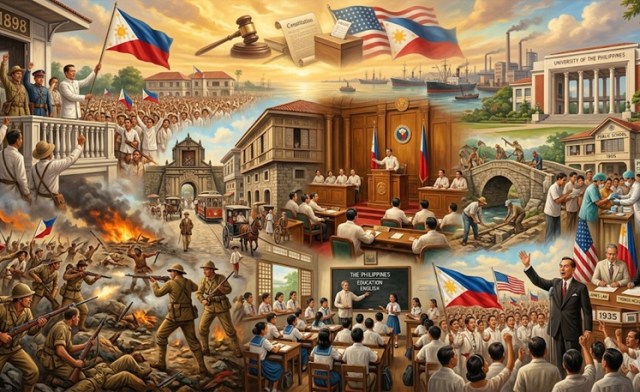
By Karl Garcia
The Philippines’ encounter with the United States, beginning in 1898 after the Treaty of Paris, represented a pivotal chapter in the archipelago’s political, economic, and social history. Following the Spanish-American War, the United States acquired the Philippines from Spain, igniting a period of American colonization that lasted until 1946. This period was characterized by a deliberate and incremental transfer of power to Filipinos, mediated through a series of laws and policies designed to balance U.S. strategic and economic interests with the cultivation of self-governance. Landmark legislation such as the Philippine Organic Act (1902), the Jones Law (1916), and the Tydings-McDuffie Act (1934) laid the foundations for Filipino political participation, economic development, and eventual independence, while also introducing cultural, social, and institutional transformations that endure to this day.
This essay provides a comprehensive analysis of these policies, examining their historical context, practical implementation, societal impact, and enduring legacy. It also situates the Philippine experience within broader U.S. colonial strategies, offering a comparative perspective with other territories such as Puerto Rico and Guam.
I. Historical Background: From Spanish to American Rule
The Philippines emerged from over three centuries of Spanish colonial rule in 1898, a period that had imposed centralized governance, Catholic institutions, and a rigid land tenure system. Filipino revolutionary movements had already begun asserting independence aspirations, most notably through the Philippine Revolution (1896–1898) and the declaration of independence under Emilio Aguinaldo on June 12, 1898.
The subsequent Treaty of Paris ceded the Philippines to the United States for $20 million, triggering the Philippine-American War (1899–1902). This conflict set the stage for American policies aimed at pacification, state-building, and the gradual introduction of democratic principles. Unlike Spain, the United States emphasized civil governance, education, public health, and economic modernization, though always within a framework that protected U.S. interests.
II. The Philippine Organic Act (1902): Laying the Foundation
The Philippine Organic Act of 1902, also called the Philippine Bill of 1902, was the first major legislative framework for civil governance under U.S. rule. The Act established a dual system of governance:
- Executive Power: Administered by a U.S.-appointed Governor-General.
- Legislative Power: Shared between the Philippine Commission (appointed) and the newly created Philippine Assembly (elected by Filipinos).
Key Provisions:
- Guaranteed basic civil liberties, including freedom of speech, religion, and assembly.
- Mandated the establishment of public schools, introducing English as the primary language of instruction.
- Introduced public health measures, such as campaigns against cholera, malaria, and smallpox.
- Outlined the legal framework for courts, local governments, and civil service.
Impact:
The Organic Act marked a transition from military to civilian rule, introducing Filipinos to U.S.-style institutions and governance practices. While political power remained limited, it provided a platform for Filipino political leadership, initiating the gradual process of political socialization and civic education.
Case Study: The creation of the Philippine Assembly in 1907 allowed Filipinos to legislate on local issues such as taxation, infrastructure, and education. Leaders like Sergio Osmeña and Manuel Quezon emerged as early advocates for independence, using the Assembly to cultivate nationalist sentiment.
III. The Jones Law (Philippine Autonomy Act, 1916): The Path to Self-Governance
The Jones Law of 1916 represented a significant expansion of Filipino participation in governance and a formal recognition of eventual independence as a U.S. policy goal. The law introduced a bicameral legislature, consisting of a Senate and House of Representatives, entirely elected by Filipinos.
Key Provisions:
- Declared that the U.S. would grant independence once a stable government was established.
- Expanded civil liberties and suffrage, allowing broader participation in elections.
- Created greater Filipino representation in executive functions, though the Governor-General remained U.S.-appointed.
Impact:
- Politically, the Jones Law nurtured the emergence of modern political parties and elite leadership capable of self-governance.
- Legislatively, Filipinos gained authority over domestic policies, including education, infrastructure, and taxation.
- Socially, the law encouraged civic engagement and heightened national consciousness.
Case Study: Under the Jones Law, the Nacionalista Party consolidated political influence, championing independence and advocating for Filipino-led reforms in education, agriculture, and municipal governance.
IV. The Tydings-McDuffie Act (Philippine Independence Act, 1934): The Roadmap to Independence
The Tydings-McDuffie Act, also known as the Philippine Independence Act of 1934, formalized the plan for Philippine independence through a ten-year Commonwealth period. This legislation was the culmination of decades of incremental U.S. policy aimed at preparing the Philippines for sovereignty.
Key Provisions:
- Established the Commonwealth of the Philippines (1935–1946), with an elected President and legislature.
- Required the drafting of a Philippine Constitution, ratified in 1935.
- Allowed the U.S. to retain control over foreign affairs, military bases, and trade during the transitional period.
- Imposed strict immigration quotas, limiting Filipino migration to the U.S. to 50 persons per year.
Impact:
The Tydings-McDuffie Act provided the legal framework for self-rule while maintaining U.S. strategic and economic interests. Politically, it enabled Filipinos to exercise executive, legislative, and judicial powers; socially, it fostered national identity and institutional development; economically, it maintained dependency in trade and investment.
Case Study: The Commonwealth government implemented social reforms, including public works, national defense preparations, and economic planning, while preparing for eventual independence. Leaders such as Manuel L. Quezon and Sergio Osmeña played critical roles in institutionalizing governance structures.
V. Economic Policies and Trade Legislation
Beyond governance, U.S. legislation deeply affected the Philippine economy. Early policies focused on infrastructure development, education, and public health, while post-Commonwealth acts reinforced economic dependence.
Key Policies:
- Bell Trade Act (1946):
- Required parity rights for U.S. citizens and corporations in resource exploitation.
- Limited economic sovereignty, fostering dependency in key sectors such as mining, agriculture, and trade.
- Land and Agricultural Policies:
- Introduced U.S.-style land titling and tenancy reforms, though implementation favored large landowners.
- Education and Labor:
- Public schooling created an English-speaking bureaucracy and professional class.
- Labor policies introduced U.S.-style wage systems and labor protections, but also maintained restrictions to benefit American businesses.
Impact:
These policies modernized infrastructure and human capital but created structural dependence on U.S. markets and investment, limiting the Philippines’ post-independence economic flexibility.
VI. Social and Cultural Transformations
American colonization profoundly reshaped Filipino society:
- Education:
- English replaced Spanish as the medium of instruction.
- Public schools were established nationwide, dramatically increasing literacy.
- Public Health:
- Campaigns against infectious diseases improved life expectancy.
- Modern hospitals and sanitation systems were introduced.
- Cultural Impact:
- Western legal, civic, and political concepts were ingrained.
- American values, including secularism, democratic ideals, and individual rights, became part of Filipino identity.
Case Study: The establishment of the University of the Philippines in 1908 symbolized both an educational and cultural shift, producing graduates who would become national leaders in politics, law, and academia.
VII. Filipino Responses and Nationalist Movements
Filipino leaders actively navigated the balance between American oversight and the quest for independence:
- Manuel Quezon: Advocated for Filipino self-governance and led the drafting of the 1935 Constitution.
- Sergio Osmeña: Championed legislative reforms and fiscal responsibility under the Jones Law.
- Commonwealth Leaders: Implemented public works, defense preparations, and social welfare policies in anticipation of full sovereignty.
While some sectors welcomed American reforms, nationalist critiques highlighted economic restrictions, trade dependency, and limitations on foreign policy as constraints to genuine independence.
VIII. Comparative Context: Other U.S. Colonies
The Philippine experience mirrored, yet diverged from, that of other U.S. territories:
- Puerto Rico: Granted U.S. citizenship in 1917 but lacked a clear timetable for independence.
- Guam: Remained a strategic military outpost with limited self-governance.
- Philippines: Unique in receiving a legal roadmap to full sovereignty, including a constitution and transitional self-rule, reflecting its size, population, and economic potential.
IX. Legacy and Long-Term Impact
American policies left an enduring imprint on the Philippines:
- Political Institutions:
- Bicameral legislature, civil service systems, and constitutional government persisted post-independence.
- Education and Culture:
- English language proficiency became a defining feature of Filipino society.
- Civic participation and democratic norms were institutionalized.
- Economic Dependency:
- Trade, investment, and resource extraction remained oriented toward the U.S., shaping post-independence economic strategy.
- National Identity:
- American reforms catalyzed the rise of a nationalist consciousness, integrating Western ideals with local traditions.
X. Conclusion
The American colonial period in the Philippines was a complex interplay of control, reform, and preparation for independence. Through the Philippine Organic Act, Jones Law, Tydings-McDuffie Act, and related policies, the U.S. introduced political structures, education, infrastructure, and social reforms while maintaining strategic and economic influence. Filipino leaders skillfully navigated these constraints, gradually building institutions capable of self-rule.
By the time the Philippines achieved formal independence on July 4, 1946, it had inherited a hybrid system: politically modernized, culturally bilingual, and socially restructured, yet economically constrained by dependency. American policies thus created both opportunities and limitations, leaving a legacy that continues to shape Philippine governance, society, and national identity.


The US is like an adoptive parent who doesn’t think his kid has the chops to be a competent adult. The undercurrent of racism adds to the picture. Daddy is white and junior is brown so we’ll only allow 50 to migrate to the US eact year. That’s the US fly in the ointment. The Filipino fly is the enduring backbiting and corruption in the Philippines that proved the point for American racists. “They can’t govern themselves.” The hilarious modern irony is that Americans can’t govern themselves either. LOL
Part 2 should look at post WWII, and why the enemy Japan was treated better by the US than the ally Philippines.
I hope this answers your question, joeam, why united states treated japan better than philippines post world war 2.
AI Overview
The United States prioritized the rapid economic and institutional rebuilding of its former enemy, Japan, over its loyal ally, the Philippines, due to Cold War geopolitical strategy, the need to secure a strategic Pacific ally, and the differing legal statuses of the two territories following the war.
1. The Cold War and the “Reverse Course”
The onset of the Cold War and the outbreak of the Korean War caused the U.S. to completely shift its post-war strategy in Asia.
2. Status: Independent Nation vs. Defeated Adversary
The legal and political relationship the U.S. had with both countries dictated how assistance was administered.
3. Economic Integration
U.S. leadership believed that a prosperous and stable Japan was necessary for the economic health of the entire Asia-Pacific region. As a result, the U.S. actively fostered Japanese industrial growth, opened its markets to Japanese goods, and provided heavy financial backing. The Philippines, structurally bound as an agricultural exporter to the U.S. and recovering from catastrophic wartime devastation (particularly in Manila), did not receive the same level of heavy industrial or export-driven investment.
Ah, perfect, k. Thanks. Point 2 is interesting to the max. The US could not control the Philippines as it could Japan. The independence of the Philippines was a barrier. I get the sense that Philippine leaders wanted handouts from the US and were not able to present a proactive path to industrialization the US could join. That’s just speculation on my part based on a belief that corruption and self dealing have been the “deep state” of the Philippines for a century now.
your speculation is probly spot on, corruption has long been entrenched in the filipino psyche specially among those in power. they first helped themselves, their families and relatives. the nation comes a very far second, if ever.
incidentally, my funny bone is haywiring! I have heard long ago that president bong marcos’s grandfather was rumored to be big time japanese collaborator during world war 2. and was quartered by the ilocanos as punishment.
so, I was not really surprised when on his most recent visit to japan just this may 2026, president bong marcos was given the highest honor by the emperor himself! hello, old friend! nice to meet you finally, haha.
https://www.philstar.com/headlines/2026/05/27/2530915/marcos-first-lady-receive-honors-emperor-naruhito-empress-masako-tokyo
I think Japan understands they can be a main “player” in the Philippines, thus the transfer of old ships, participation in military drills, digging the subway, and gaining minerals and labor. It is a natural partnership in this era.
Related. https://mb.com.ph/2026/05/28/ayala-expands-japan-ties-with-mitsubishi-mufg-kddi-for-smart-cities-digital-ecosystems
And this. https://www.pna.gov.ph/articles/1276090
And the Marcos initiative: https://www.abs-cbn.com/news/business/2026/5/28/japan-may-see-ph-as-important-ai-hub-analyst-1541
And on the defense front: https://globalnation.inquirer.net/325158/marcos-becomes-4th-ph-leader-to-speak-before-japan-diet#
thanks joeam, there is indeed much to look forward to.
forgive me, joeam, coz I am having much fun joyfully connecting dots where none exist!
you see, being descendant of a one time japanese world war 2 collaborator is apparently proving to be very fruitful, and president bong marcos has hit the jackpot.
somebody pls stop me! else I go on the collaborator trail and do more damage!
https://www.abs-cbn.com/news/business/2026/5/28/japanese-businesses-commit-3-4-b-investment-during-marcos-roundtable-0825
“I get the sense that Philippine leaders wanted handouts from the US and were not able to present a proactive path to industrialization the US could join.”
This is basically what happened. Though some US monies (and later Japanese reparations) did go towards light industrialization that was largely abandoned in the 1970s-1980s, becoming rusted hulks by the time I visited the Philippines for the first time. Cavite used to be littered with rusted out old factories, now cleared and developed, like Tondo which used to be a quite poor area until the 2000s but is now gentrified and very trendy.
Karl Garcia wrote: **By the time the Philippines achieved formal independence on July 4, 1946, it had inherited a hybrid system: politically modernized, culturally bilingual, and socially restructured, yet economically constrained by dependency. American policies thus created both opportunities and limitations, leaving a legacy that continues to shape Philippine governance, society, and national identity.**
I believe the Philippines had great opportunity for nation building considering its special relationship with the largest & possibly wealthiest consumer society in the world after WW2. It was also the most technically advanced. A mature and moral leadership would have taken full advantage of such a special relationship….but alas it was not to be. I believe we have only ourselves to blame.
Our colonial masters Spain had these racist descriptions of us: “Servile and supine race”….”half-devil, half-child.” The question I have for us: Did we prove them wrong?
I engaged Gemini in a discussion of various points from Karl’s essay. I got some very interesting responses. The advantage of discussing points from Karl’s essays with a chatbot like Gemini is that it tends to stay on topic. It is also a wealth of information….like for example, I just learned that the Bell Trade Act (1946) and the subsequent Laurel-Langley Agreement had an expiration date of July 3, 1974. I also learned from Gemini what specific natural resources and public utilities the Americans could exploit under the Act…AND I was able to discuss options the Philippine leadership had in 1946 considering the situation of the country and the world for that matter since it was post WW2.
I hope some members of TSOH take up Karl’s essay. We might learn a few things.
Thanks, CV.
karlG, could you pls release the beast! my reply to cv’s comment below about rent free american military bases in our country is held in moderation. I am afraid that if I say nothing, my reply will go into the neither region and be gone forever much to the amusement of the maligno in cyberspace. thanks.
back from vacation.. your comment in moderation was the first thing I saw so I released it.
P.S. quick note for all readers: these are the top downloads from March 1st to today.
P.P.S. these are the most viewed articles from March 1st until today.
Bato sa Buhangin is an Edgar Lores classic that always finds readers across the years BTW..
..I am pleasantly surprised though that the Industriepolitik article HAS many readers over time.
That two entertainment related articles have attracted many people is NOT surprising to me.
thank you.
this new US policy is going to affect wannabee filipinos green card holders in estados unidos. filipinos on temporary visa already in estados unidos may have to return to philippines in order for them to apply for green card, as there is already super mega backlog of green card applicants in estados unidos. embassies here in our country have the facilities to process them. the same applies to foreign nationals as they too are asked to return to their own country.
if 100 thousand to 200 thousands filipinos did return, I can only imagine what that can do to our already burdened system.
https://www.gmanetwork.com/news/pinoyabroad/dispatch/988736/us-green-card-policy-filipinos-ambassador/story/
In his conclusion, Karl says: **The American colonial period in the Philippines was a complex interplay of control, reform, and preparation for independence. Through the Philippine Organic Act, Jones Law, Tydings-McDuffie Act, and related policies, the U.S. introduced political structures, education, infrastructure, and social reforms while maintaining strategic and economic influence. Filipino leaders skillfully navigated these constraints, gradually building institutions capable of self-rule.**
The Bell Trade Act (1946) and the Military Bases Agreement (1947) are not mentioned. These were critical pieces that were overly generous with respect to Parity Rights granted Americans in the Philippines as well as the “rent free” agreement with regard to American Military Bases. Our Philippine leadership was intimately involved in the crafting of these agreements. We easily gave away the store so to speak. Some Filipinos became fabulously wealthy, but it doomed most of the country to what it eventually became (Sick Man of Asia).
this is about the rent free military base agreement between united states and the philippines, both the long past and the present current agreement in the face of china’s aggression in the south pacific:
AI Overview
The rent-free agreement for U.S. military bases in the Philippines (established via the 1947 Military Bases Agreement) was incredibly useful for both nations, primarily as a cornerstone of Cold War security and regional stability. However, the arrangement deeply compromised Philippine sovereignty and caused ongoing political friction.
The Pros: How It Was Useful
The Cons: Why It Was Controversial
The End of Permanent Bases & Modern Re-engagement
Because of these sovereignty and political friction issues, the Philippine Senate famously rejected a new base treaty in 1991, leading to the full departure of permanent U.S. troops in 1992.
However, faced with rising regional tensions and territorial disputes in the South China Sea, the alliance adapted. The U.S. and the Philippines signed the Enhanced Defense Cooperation Agreement (EDCA) in 2014. Instead of permanent, rent-free sovereign bases, EDCA grants the U.S. military rotational access and the right to build facilities at specific Philippine military sites, making the current use-case highly tailored to rapid disaster response and regional deterrence.
I recall two major issues when the Philippine leadership was debating the military bases issue. These are not mentioned in the AI overview:
Last I checked from a Filipino back in the Islands, prostitution is still rampant in Angeles City, probably even more so than when Clark Field was still an air base.
There is a saying: “in remembrance lies the secret of redemption.” We don’t remember the mistakes made by our leadership when we finally got what we were asking for – Independence. We also don’t remember the horrors of the Marcos years. It is no surprise that the “Philippine transformation” is sorely in need of redemption.
I am not really interested in prostitution, nor of the long dead makoy. though makoy’s son, president bong marcos, is doing well in his current japan visit. he was warmly received there and almost treated like a hero. and we are gaining a very good friend in japan too. japan is investing bigger bucks in philippines, bigger than china, both economic and military.
My opinion so long as there is no denial, if prostitution is never denied as something clean and innocent and dignified work. As for Marcos with today’s bashing and constant reminders I firmly believe that Martial law is one of the constant subjects.
Prostitution is a stage in life for women who were not afforded a kind and generous home life, or lack skills for another profession. They can be sweet or nasty, just like men who face no condemnation for having mistresses or a philandering lifestyle, or buying the services of a prostitute.
Thanks for that
Pertaining to prior discussions, Steel Asia bringing OFWs back to operate steel plant. https://www.philstar.com/business/2026/05/28/2530934/steelasia-taps-returning-ofws-new-plant
Nice
Even better, as I have just learned, is the success of the two former US bases Subic and Clark as Free Trade Zones. I did a little more research on the impact of this success and found that other Free Trade Zones are also experiencing a good degree of success notably the Bataan Freeport (a failure under Marcos, Sr.’s term), Cagayan Freeport in No. Luzon, and Poro Point Free port in La Union. Taken together, these zones generate a lot of direct employment (as much as 2 million) AND of course indirect employment which reports say could be another 6 to 8 million. If I were a fresh college graduate and single, I would consider these places, at least to start, if I can’t find anything in my area of the country.
I don’t think President Marcos has any inclination to impose martial law. He is being as normal and forthright in presidenting as was Aquino, and will leave office in 2028 knowing he did his best, which was quite good, and reconstructed the family name as best he could. Then there’s that whacknut Imee who didn’t help a bit.
imee is dds royalty and has become sara’s parrot, haha. and to think that daddy once thought her brilliant!
“I am not really interested in prostitution, nor of the long dead makoy.” – Kasambahay
Actually my sentence was vague when I said “as negotiated by Marcos, Sr.” I was referring to the rents that Marcos, Sr. I recall praising him for that when he negotiated it. I was still living in the Philippines when that happened. Prior to that I did not realize that the US paid no rent for occupying the bases. You may have thought I was referring to the thefts of the rent as being “negotiated by Marcos, Sr.” I noticed that after I had posted my comment and was re-reading it. I think my English teachers would have “dinged” me for that and given my composition a C- instead of a C, hehehe
As to your not being interested in prostitution, I just wanted to point out that those who were against the presence of the bases WERE VERY MUCH INTERESTED in the prostitution issue and voiced it a lot. I wasn’t following the debate that much but I do recall the issue of prostitution. It did not merit a mention in the AI overview.
I did some research and it was referred to by our Senators (notably Tañada, Ramos-Shahani, and Diokno) as a social cost of having the bases stay.
As to not being interested in the long dead Makoy, I would say that he was instrumental in the latter life of the Military Bases Agreement. He was probably the most impactful player in the “Philippine Transformation from colony to sovereignty,” the subject of Karl’s essay.
https://www.academia.edu/7558083/Postcolonial_Fissures_and_the_Contingent_Nation_An_Antinationalist_Critique_of_Philippine_Historiography FYI this is an interesting if somewhat “contrarian” view as most Philippine historiography (interpretation of history) is somehow nationalistic.