The Philippines’ Forever Wars: Bloodlines, Broken Institutions, and an Unfinished Peace
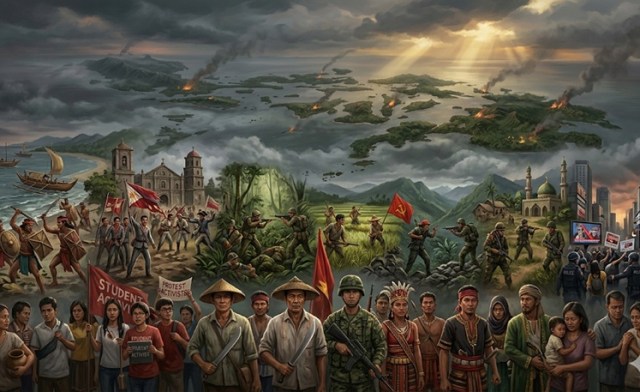
By Karl Garcia
I. Introduction — a nation where conflict never fully disappears
The Philippines is often described as a peaceful democracy interrupted by occasional unrest. But history suggests something deeper and more uncomfortable: the country has rarely experienced complete internal peace.
Different eras carried different names for conflict—raids, revolts, guerrilla wars, separatism, insurgency, clan feuds, political violence, terrorism, criminal syndicates. Yet beneath these changing labels, similar structural forces endured: weak institutions, uneven state presence, land inequality, fragmented identities, and geography that complicates control.
The result is a recurring national condition: not permanent total war, but recurring incomplete peace.
This does not mean Filipinos are naturally violent. It means the state inherited unresolved fractures across centuries and has never fully solved them.
II. Pre-colonial roots — warfare before the nation existed
Before Philippines existed as a nation-state, the islands were composed of barangays, sultanates, maritime polities, and upland communities with separate political systems.
There was no central authority capable of monopolizing force across the archipelago. Power was local, fluid, and negotiated through kinship, tribute, alliances, and arms.
Conflict included raiding, territorial rivalry, slave-taking, succession disputes, and maritime competition. Peace existed, but it was local rather than national.
This matters because later colonial and republican governments attempted to unify a territory whose political traditions were historically decentralized.
III. Spanish rule — revolt as a recurring condition
Under Spain, internal resistance became a normal feature of governance. Uprisings such as the Dagohoy Rebellion and Tamblot Uprising reflected opposition to tribute, forced labor, land disputes, abusive officials, and religious intrusion.
Most revolts were local rather than national. They were pragmatic responses to immediate burdens more than ideological projects.
Only later did anti-colonial resistance evolve into broader nationalism, culminating in the Philippine Revolution.
The lesson was enduring: where authority lacks legitimacy, rebellion becomes political language.
IV. American conquest — the first modern guerrilla war
Following Spanish defeat, the Philippine–American War became one of Asia’s earliest modern anti-colonial guerrilla wars.
The United States encountered many of the same problems Spain had faced: fragmented loyalties, difficult terrain, and local resistance to outside rule.
Military victories did not automatically translate into political legitimacy. That gap between battlefield control and durable governance would recur repeatedly in later Philippine conflicts.
V. Hukbalahap — social grievance becomes organized insurgency
During World War II, the Hukbalahap emerged as a resistance force. After the war, it transformed into an anti-government rebellion rooted in agrarian inequality, peasant exploitation, and state neglect.
This marked a transition from episodic revolt to sustained ideological insurgency.
The formula was powerful: combine real social grievance, disciplined organization, rural sanctuaries, and political narrative.
That formula would later reappear elsewhere.
VI. Cold War Philippines — two simultaneous wars
A. Communist insurgency
The New People’s Army became one of the world’s longest-running communist insurgencies.
Its durability cannot be explained by ideology alone. It survived because structural problems survived: land conflict, corruption, local abuse, poverty, and weak access to justice.
At the same time, many Filipinos experienced the insurgency through extortion, assassinations, intimidation, recruitment, indoctrination, and fear. Sympathy for grievances often collapsed under violent methods.
Understanding causes does not require excusing conduct.
B. Moro separatist conflict
In Mindanao, armed struggle took a different form. Groups such as the Moro National Liberation Front and Moro Islamic Liberation Front fought over autonomy, identity, historical sovereignty, and land displacement.
Events such as the Jabidah Massacre deepened alienation.
Unlike a single war with a clean ending, this conflict evolved through negotiations, splinter groups, ceasefires, autonomy agreements, and renewed violence.
VII. The hidden wars — violence beyond headlines
Even when major insurgencies weaken, smaller conflicts persist.
1. Rido
Clan feuds in Mindanao can last generations, fueled by revenge, honor, land, and political rivalry.
2. Warlordism
In some areas, private armies and dynastic power structures challenge the state’s monopoly on force.
3. Criminalized armed networks
Kidnap-for-ransom groups, smugglers, illegal protection rackets, and extremist-criminal hybrids thrive where institutions are thin.
These are not always national crises, but together they create chronic instability.
VIII. Why the cycle persists
Geography
An archipelago of thousands of islands, mountain ranges, forests, and remote settlements makes governance expensive and uneven.
Land inequality
From friar estates to haciendas to modern concentration, agrarian conflict repeatedly generated unrest.
Weak institutions
When justice is delayed, corruption visible, and enforcement selective, citizens rely on patrons, clans, or armed actors.
Elite democracy
Formal elections coexist with dynastic concentration of power, reducing public trust in peaceful change.
Fragmented identity
Regional, ethnolinguistic, class, and religious divisions often overlap with political conflict.
IX. After 1986 — democracy did not end conflict
The People Power Revolution restored democratic institutions and political freedoms.
But regime change did not automatically solve land disputes, insurgent networks, clan feuds, patronage systems, or local coercion.
Democracy changed the arena of conflict, but not all its causes.
X. Present condition — no total war, no total peace
Today the Philippines is more stable than many earlier eras, yet conflict remains embedded in pockets of national life.
Communist remnants persist. Extremist cells emerge. Political violence survives locally. Organized crime adapts. Disinformation creates new battlegrounds.
This is not civil war, but it is not full peace either.
It is a condition of permanent low-intensity conflict.
XI. Representation and the party-list paradox
The party-list system was intended to give voice to workers, farmers, indigenous peoples, women, and other underrepresented sectors.
Yet many citizens now believe it has been captured by elites, proxies, narrow interest groups, or ideological machinery far removed from the marginalized.
That frustration is real.
But abolishing party-list representation entirely may silence genuine sectoral voices while leaving traditional district patronage untouched.
The wiser path may be reform:
- stricter qualification standards
- funding transparency
- anti-dynasty safeguards
- proof of sectoral legitimacy
- tighter anti-gaming rules
Institutional distortion should invite correction, not surrender.
XII. Bloodlines, memory, and civic adulthood
Filipinos often see brother-versus-brother, friend-versus-friend, or family betrayal in teleseryes and movies. It resonates because it reflects a real national experience.
Across decades of insurgency, counterinsurgency, separatism, and political violence, many families were divided by history.
One sibling joined the military. Another entered activism. Another sympathized with rebels. Another remained silent to survive.
Childhood friends became soldiers, policemen, organizers, politicians, or armed cadres on opposing sides.
In some towns, a soldier pursued a cousin. A mayor negotiated with a relative in the hills. A barangay captain reported on neighbors while protecting kin.
Philippine internal wars were often not strangers fighting strangers. They were communities fighting within themselves.
This reality demands moral maturity. One can understand why some joined rebellion without excusing killings or extortion. One can defend the state while criticizing state abuses. One can seek peace without erasing memory.
That is civic adulthood.
XIII. The military-industrial question
Some critics argue that war persists because conflict benefits defense spending and procurement interests.
There is no credible evidence that the Philippine state intentionally creates wars to justify weapons purchases. Such claims exceed available proof.
Yet incentives still matter. Procurement systems, bureaucratic interests, and security politics deserve scrutiny. Conflicts can be prolonged by dysfunction even without conspiracy.
XIV. Conclusion — the long unfinished war
From pre-colonial raids to colonial revolts, from the Huk rebellion to the New People’s Army, from Moro separatism to the Marawi siege, the Philippines has rarely known uninterrupted internal peace.
Not because Filipinos are destined for violence.
But because structural problems—geography, land inequality, elite capture, weak institutions, and fragmented identity—have repeatedly outlived governments, ideologies, and generations.
Until those foundations are repaired, conflict may continue to change names while preserving the same roots.
War, in the Philippines, is often not an event that begins and ends.
It is a condition waiting to return.


I’m not sure the Philippines is unique at waging endless wars, both within and with other nations. Humans don’t have the ability to find solutions peacefully, it seems to me. I look at the hard left always agitating, agitating, agitating. Grinding grinding. Losers unable to operate peacefully within the peaceful system of democracy. Or Russia, or Israel, or the US. The Philippines today seems more mature than most if you ignore DDS, heh heh.
Heh heh and Imee if not officially DDS as of yet.
poor imee, she has to backtrack recently, having used her senate privilege speech to spread fake news, and had to withdraw her silly chacha video! eating her sour curds and whey!
at saka, if cayetano has delikadesa, he should just resign being senate president instead of just waiting for the minority to come up with the number. and the funny thing about the senate blue ribbon committee is made up of senators who are apparently facing grafts and malversion of funds.
Kung hindi sila nahihiya ang tibay ng sikmura nila
they have each other’s shoulders to cry crocodile tears on! some are already on hold departure order, or immigration watch, and cannot leave the country. but they can still hide. and if they have a number of fake passports, who knows!
yeah, like china, it has a forever war with taiwan, north korea has a forever war with the south korea. as well, we have an apparent forever war with china who is forever stealing our territories and forever harassing our coastguard who are forever hitting back time and again.
chinese militia disguised as chinese fisherfolks are forever harboring in the west phil sea, apparently china pay them big bucks not to fish but to harass and intimidate. and those that water cannoned our coastguard are treated like heroes and congratulated by xi for defending chinese territory!
Mean humans at work.
I think, we have a robust justice system and our prisons are near capacity! prisoners are jampacked like sardines. too robust sometimes, we have court backlogs galore: measures and counter measures. and convicted drug mule mary jane veloso is still in kalabosh, not yet free, despite asking for presidential pardon in the media, belatedly asking president marcos like he is an afterthought. and naturally, she is still jailbird.
and we got the big fishes too, but they got out on bail like the late enrile. and now, we are also going after bigger fishes like zaldy co, if we can get him along with atong ang who is also hiding, bato in hiding too. people are wondering tuloy if dilg chief jonvic remulla is properly doing his job! the bigger fishes are escaping under his watch!
the biggest fish of them all, duterte, is languishing in the hague and is facing justice. he was surrendered by freedom loving filipinos. the grand daddy of them all, the one time tatay of the nation, cannot be expected to face justice in philippines whose law and order he did not respect because he is apparently above our law, has now met his match in the hauge!
The jail conditions are horrid for sure. The President should do a mass pardon of trivial cases and clean them up. Buy a condo building under construction and fit it out for executive jail suites for senators, agency heads, LGU crooks and the like. No need for PNP to be mean humans.
AI Overview
President Ferdinand Marcos Jr. has granted executive clemency to hundreds of prisoners, which facilitated their release or sentence reduction alongside the application of the Good Conduct Time Allowance (GCTA) Law. Specific quantities are administered and tracked periodically by the Board of Pardons and Parole and the Bureau of Corrections.
Notable Releases and Clemency Actions:
While clemency and GCTA work in tandem to reduce time served, they are technically separate mechanisms: GCTA is a statutory reduction calculated for good behavior, whereas executive clemency is a discretionary presidential power used to forgive, commute, or extinguish penalties.
AI Overview
Philippine President Ferdinand Marcos Jr. regularly grants executive clemency and commutations to qualified Persons Deprived of Liberty (PDLs). These grants typically prioritize elderly, ailing, and disabled inmates who have been thoroughly screened by the Board of Pardons and Parole (BPP). [1, 2, 3]
The standard process and current initiatives regarding pardons for elderly inmates include:
Executive Clemency Guidelines
Recent Mass Releases
While individual presidential clemency grants are announced periodically, the administration also oversees mass releases of qualified inmates—including the elderly—who have served their sentences or successfully completed parole requirements. For example, the BuCor and the BPP have facilitated simultaneous culminating programs discharging hundreds of PDLs across multiple facilities like the New Bilibid Prison (NBP) and Correctional Institution for Women (CIW) to ensure a smooth transition back into society. [1, 2]
For detailed information on current applications, you can review the official guidelines and eligibility criteria on the Board of Pardons and Parole website.
porbida, there must be a gremlin in cyberspace, the AI overview entries I thought were lost, resurfaced twice as seen above. since AI will not apologize, I will. hence, my apologies for the double entries. sorry po.
Poltergeist in the AI chips, undoubtedly. Or Portuguese, as my wife calls them. (Sometimes AI posts include more than 2 links which dumps them into moderation until they get manually approved. The duplication was because I was moving fast on a slow day.)
got it! thanks for the explanation.
ahem, apparently being jailed is not like going on vacation and as such, there will be no luxury suites but a cell with bed, electric fan, washroom and maybe t.v. like the cell in camp crame that once housed inmate leila delima, now I think, occupied by inmate alice guo, the ex mayor of bamban tarlac and a fake fillipino. prisoners are allowed medical furlough, visits are limited and they are allowed leave on compassionate ground like attending funeral of close family members.
as regards clemency, president marcos has given clemency to long term prisoners, the elderly and those with disabilities, been let go before the completion of their sentences due to good behavior. I am saying this because the attachments I tried to attached have gotten lost somewhere.
BIR is going old school Capone style so they say that they will atick to bug fish and writeoff small fish tax deficiencies
senator mark villar (of all people!) is proposing a threshold of 360K annual income limit where people can then be taxed.
though what is not to be written off is the tax liabilities of congressman leandro leviste (loren legarda’s son) which apparently could total 120 millions! as regard his past solar investments.
some are now saying that because her son is being hounded for apparent tax evasion? loren legarda is siding with the likes of bato, bong go, imee marcos, robin padilla et al at the senate to form duterte leaning majority, and will extract her ounce of flesh from those that do not think her son is the greatest crime fighter in the philippines!
Original crocodile tears crying lady.
by the way, methink imee is big time dds! walks like one, bleats like one, reasons like one, she can only be dds, nothing more, nothing less. no need really to make it official, she is beyond officiating, po.
Methinks so too
https://www.inquirer.net/476045/survey-1-in-3-filipinos-in-davao-region-oppose-defending-wps/
The Dutertes rebuilt power from being has-beens in a generation after being given responsibility by Cory. The Dutertes brainwashed a generation of Davaoeños, got others to go along to get along, then cowed the rest into obeisance. The myth of inevitability around the Duterte’s power is not inevitable; it was manufactured across 4 decades, and so it can be dismantled. The scions having all of the uncouth nature of the patriarch with none of the genuine charm and charisma of the old man may be the family’s undoing.
you nearly knock me down, joey! duterte’s genuine charm and charisma, por dyos, por santo, I was not sold on that as well as many others and we thought he was vulgarity personified. we never fist pumped with him, ever. that he eats with his kamay maybe because he was too lazy to use cutleries let alone tell the difference between a ladle and a spoon. that he sleeps under the kulambo when he already have insect screens installed in his air conditioned house. now about of his house in dabaw, I heard that his wife honeylet had apparently sold it. maybe because duterte is not expected to be home anytime as prison is going to be his forever home.
and what it is with people with charm and charisma? many of them ended up in prison like the uberly charismatic pastor quiboloy, or dead, like the highly charismatic charlie kirk! and despite all his charm and charisma, duterte cannot charm his way out of the hague and expunge his crime against humanity.
as for his children, pardon me! they have the charisma of a weather balloon, full of air. bato, though not duterte’s offspring, has the charisma of a celery! and bong go who was duterte’s forever shadow, is next to be summoned by ICC, presumably after bato.
We are not sold on Duterte’s charm and charisma — just like we are not sold on the same for Trump — because we are informed individuals. Others who are less informed, especially if they are susceptible to propaganda and demagoguery, do find that style of populist leader to be charming and charismatic. In any case I think by now it is definitely proven once again that telling the affected people the truth is not enough once they develop a parasocial or quasi-religious relationship with the populist leader.
Vice often puts virtue into a terrible position — pain is the only teacher.
ah, duterte is beyond pain. he had admitted of being a fentanyl user, and already waived his attendance at the 1st day of the trial. methink, he couldnt be bothered to attend. well, he can waived all his attendances and at the same time, deny the witnesses their day in court, also deny the families of victims the chance to read their pitiful victim statement to the world, and further deny the media their much awaited trial coverage. he can accomplish all that and at the same time, save himself the skulduggery of the trial by changing his plea of not guilty to GUILTY!
plead guilty and there will be no trial. it will go straight to sentencing. all the preparations, the voluminous documents, the trauma, the stress and the counseling, all gone to waste. duterte has pulled a silencer on them. I wish!
LOL truly, literature is your calling.
literature ties me like a nut.
Re forever wars, Ninotchka Rosca’s novel “State of War” is about exactly that.
https://www.academia.edu/66147349/Historical_Amnesia_Colonial_Trauma_and_Self_Immolation_in_Ninotchka_Roscas_State_of_War and this is an interesting article about the novel
Karl,
From your essay:
**V. Hukbalahap — social grievance becomes organized insurgency
During World War II, the Hukbalahap emerged as a resistance force. After the war, it transformed into an anti-government rebellion rooted in agrarian inequality, peasant exploitation, and state neglect.
This marked a transition from episodic revolt to sustained ideological insurgency.
The formula was powerful: combine real social grievance, disciplined organization, rural sanctuaries, and political narrative.
That formula would later reappear elsewhere.**
Growing up in the Philippines in the 50s to 70s I heard about Luis Taruc and his eventual return to the fold of the government. I only recently learned what a patriot he was with regard his stand against the Parity Rights issue at the time of independence in 1946 and the devious and illegal means then Pres. Roxas took to neutralize his vote (and that of his 8 other colleagues in Congress) against the Parity Rights agreement. I don’t believe the underhanded means taken by Roxas is taught in our history classes in schools.
In the interest of time, I’ll just paste a Gemini report on it:
>>The unseating of Luis Taruc and his colleagues in 1946 is one of the most glaring examples of political maneuvering in modern Philippine history. It directly short-circuited the democratic process to appease American economic interests, and it became the definitive catalyst that pushed the Hukbalahap away from parliamentary politics and back into a full-scale armed insurgency.
Here is a refresher on exactly how that legislative heist went down.The Stakes: The Bell Trade Act and Parity Rights
In 1946, the Philippines was transitioning to full independence, but the country was completely devastated by World War II. The United States offered a much-needed $800 million rehabilitation fund, but it came with a massive catch: the Bell Trade Act.
The most offensive clause to Filipino nationalists was the Parity Amendment. It required the Philippines to amend its 1935 Constitution to grant U.S. citizens and corporations equal rights with Filipinos to exploit the country’s natural resources and operate public utilities.
To pass a constitutional amendment, President Manuel Roxas needed a three-fourths majority vote in both houses of the Philippine Congress. The Obstacle: The Democratic Alliance
In the April 1946 elections, a center-left coalition called the Democratic Alliance (DA)—which was aligned with the peasant movement and included Hukbalahap leaders—won several seats in Central Luzon.
Six DA congressmen were elected, including Luis Taruc (Pampanga) and Dr. Jesus Lava (Bulacan). Together with three sympathetic, anti-parity senators from the Nacionalista Party, they formed a stubborn voting bloc. They were vehemently opposed to selling out Philippine sovereignty for aid money.
With them in office, Roxas did not have the three-fourths majority required to pass the Parity Amendment.The Maneuver: Manufacturing the Purge
To solve his numbers problem, Roxas and his allies in the Liberal Party-dominated Congress took a ruthless shortcut.
Before the legislature formally convened to vote on the amendment, Congress passed a resolution refusing to seat nine elected representatives (the six DA congressmen and three Nacionalista senators).
Because of this engineered purge, the Parity Amendment squeaked through Congress on July 2, 1946, and was later ratified in a national plebiscite in 1947. The Fallout: From Ballots Back to Bullets
This total disregard for the will of the people had catastrophic consequences for Philippine stability.
Taruc and his peers had genuinely attempted to transition from wartime guerrilla resistance to peaceful, parliamentary democracy. By unseating them, the Roxas administration sent a loud, clear message to the rural peasantry: The system is rigged, the elite will always protect their interests, and the ballot box is a dead end.
Realizing they had been disenfranchised by political theater, Taruc and Lava left Manila, retreated back to their rural sanctuaries in Central Luzon, and officially revived the Hukbalahap—this time transforming it from an anti-Japanese resistance unit into the Hukbong Mapagpalaya ng Bayan (People’s Liberation Army), fully dedicated to overthrowing the government.<<
Thanks for that