The 1987 Philippine Constitution: Historical Foundations, Structure, and Implications
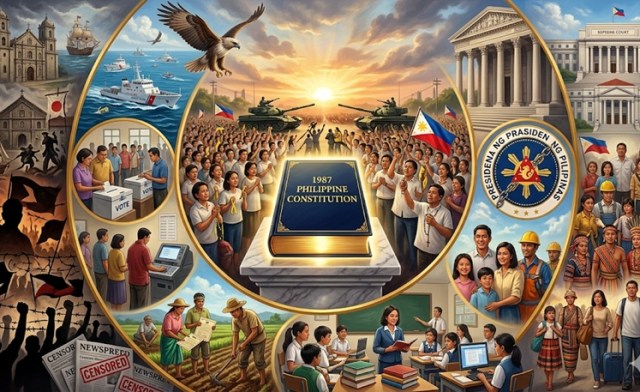
By Karl Garcia
The 1987 Constitution of the Philippines stands as a pivotal document in the nation’s political and social history. Enacted after the People Power Revolution of 1986, which ended the authoritarian rule of Ferdinand Marcos, it is both a response to the abuses of martial law and a blueprint for democratic governance. Its creation reflects centuries of historical struggle—from colonial subjugation under Spain and the United States to the nationalist movements of the 20th century. This essay examines the Constitution article by article, highlighting historical context, key provisions, and illustrative examples, serving as a mini-thesis on Philippine constitutional evolution.
Historical Context of the 1987 Constitution
The constitutional history of the Philippines traces back to the Malolos Constitution of 1899, the 1935 Commonwealth Constitution, and the 1973 Constitution during Marcos’ martial law. Each reflects the nation’s prevailing political, social, and economic conditions:
- Malolos Constitution (1899): Asia’s first republican constitution emphasized civil liberties and the separation of powers, but it was curtailed by the Philippine-American War.
- 1935 Constitution: Modeled after the U.S., it introduced a presidential system with checks and balances, guiding the transition to independence in 1946.
- 1973 Constitution: Drafted under Marcos, it allowed for concentrated executive power and parliamentary forms, ultimately facilitating authoritarian rule.
The 1987 Constitution was crafted by the Constitutional Commission of 1986, composed of scholars, former officials, and civil society leaders. It was informed by historical abuses, the demand for social justice, and the need for a government accountable to its citizens. Its guiding principles include sovereignty, democracy, social justice, and human rights.
Article-by-Article Analysis
Article I: National Territory
Article I defines the Philippines’ territorial boundaries, including islands, waters, airspace, and submarine areas.
- Historical Example: The ongoing Spratly Islands dispute demonstrates the constitutional protection of territorial integrity.
- Implication: It safeguards sovereignty, recalling infringements during Spanish, American, and Japanese occupations.
Article II: Declaration of Principles and State Policies
Article II lays out the philosophical and political framework: democracy, social justice, national sovereignty, and human rights.
- Key Provisions:
- The Philippines is a democratic and republican state.
- Emphasis on social justice and self-reliance.
- Commitment to independent foreign policy.
- Historical Example: Land reform policies were emphasized to redress inequalities from Spanish haciendas and Marcos’ crony capitalism.
Article III: Bill of Rights
Guarantees fundamental freedoms: liberty, due process, and protection against arbitrary arrest or torture.
- Historical Context: Marcos’ martial law (1972-1981) saw widespread human rights abuses. Article III directly addresses these violations.
- Key Cases:
- Javellana v. Executive Secretary (1986): Judicial review of governmental acts protecting civil liberties.
- Oposa v. Factoran (1993): Established environmental rights as part of human rights.
Article IV: Citizenship
Defines Filipino citizenship via jus sanguinis and naturalization.
- Historical Note: American colonial rule complicated nationality laws; the Constitution now ensures citizenship for children of Filipinos abroad.
Article V: Suffrage
Guarantees voting rights for qualified citizens.
- Historical Example: Post-Marcos elections emphasized electoral integrity and participatory democracy.
- Contemporary Relevance: Automated elections, overseas voting, and accessibility issues.
Article VI: Legislative Department
Establishes a bicameral Congress: Senate and House of Representatives.
- Historical Context: Prevents legislative dominance by the executive, correcting Marcos-era abuses.
- Examples: Legislative oversight of post-Marcos reforms; economic and digital governance legislation.
Article VII: Executive Department
Defines the powers and term limits of the President and Vice President.
- Historical Significance: Term limits prevent indefinite rule.
- Example: Anti-dynasty provisions (Article II, Section 26) aim to limit familial consolidation of power.
Article VIII: Judicial Department
Creates the Supreme Court and lower courts, ensuring judicial independence.
- Historical Example: Martial law undermined judicial independence; Article VIII restores it.
- Landmark Case: Javellana v. Executive Secretary (1986) confirmed the judiciary’s role in upholding constitutional governance.
Article IX: Constitutional Commissions
Establishes independent commissions: Civil Service, Elections, and Audit.
- Purpose: Ensure accountability, meritocracy, and electoral integrity.
- Example: COMELEC reforms rely on Article IX to prevent electoral fraud.
Article X: Local Government
Promotes decentralization and local autonomy.
- Historical Example: The Local Government Code of 1991 operationalized Article X, granting provinces and cities more control over development and resources.
Article XI: Accountability of Public Officers
Codifies ethics, transparency, and accountability.
- Historical Note: Martial law-era corruption informed these provisions.
- Key Institution: The Ombudsman prosecutes erring officials.
Article XII: National Economy and Patrimony
Regulates ownership, economic policy, and resource exploitation.
- Historical Context: Corrects colonial-era and crony capitalist economic inequalities.
- Examples: Mining Act disputes and agrarian reform programs rely on this framework.
Article XIII: Social Justice and Human Rights
Focuses on labor rights, agrarian reform, cooperatives, health, and housing.
- Historical Example: Post-Marcos labor movements and CARP programs are grounded here.
Article XIV: Education, Science, and Culture
Guarantees accessible education and promotes culture and scientific development.
- Historical Context: Colonial education favored elites; Article XIV democratizes learning.
- Example: K-12 reforms and CHED programs.
Article XV: The Family
Recognizes the family as the foundation of society.
- Historical Note: Reflects Filipino cultural values and Catholic influence.
- Legal Examples: Family law, inheritance, and domestic relations laws.
Article XVI: General Provisions
Covers governance principles, elections, civil service, and national language.
- Historical Note: Consolidates essential governance frameworks.
Article XVII: Amendments or Revisions
Details constitutional amendment procedures.
- Historical Example: The Constitution itself replaced the 1973 Marcos Constitution, reflecting adaptability.
- Mechanisms: People’s initiative, Constituent Assembly, Constitutional Convention.
Summary Table of Key Articles
| Article | Key Focus | Historical Context / Example |
|---|---|---|
| I | National Territory | Spratly Islands dispute; colonial infringements |
| II | Principles & State Policies | Land reform; post-Marcos social justice |
| III | Bill of Rights | Martial law abuses; Javellana v. Exec. Sec. |
| IV | Citizenship | Jus sanguinis; diaspora inclusion |
| V | Suffrage | Electoral reforms; overseas voting |
| VI | Legislative Dept. | Bicameral Congress; post-Marcos oversight |
| VII | Executive Dept. | Presidential term limits; anti-dynasty |
| VIII | Judicial Dept. | Judicial independence; landmark rulings |
| IX | Constitutional Commissions | COMELEC, Civil Service, Audit |
| X | Local Government | Local autonomy; Local Government Code |
| XI | Accountability | Ombudsman; anti-corruption |
| XII | National Economy | Filipino ownership; CARP; Mining Act |
| XIII | Social Justice | Labor rights; health and housing programs |
| XIV | Education & Culture | K-12; CHED; democratized education |
| XV | Family | Filipino cultural values; legal protection |
| XVI | General Provisions | Governance and civil service standards |
| XVII | Amendments | Flexibility; people’s initiative |
Conclusion
The 1987 Philippine Constitution is a living testament to the country’s struggle for democracy, human rights, and social justice. It addresses historical abuses, consolidates democratic institutions, and promotes equitable development. From territorial integrity to judicial independence and social justice, it reflects a deliberate attempt to prevent authoritarianism, ensure accountability, and empower citizens. Its relevance today depends on faithful implementation, civic engagement, and historical awareness, ensuring that the lessons of the past guide the nation’s democratic journey.
References & Annotations
- Philippine Constitution of 1987, Official Gazette, https://www.officialgazette.gov.ph/constitutions/
- Cruz, Isagani A. Philippine Constitutional Law, Vol. 1. Rex Bookstore, 1993.
- Tadem, Eduardo C. Democracy and Governance in the Philippines, Ateneo de Manila University Press, 2003.
- Javellana v. Executive Secretary, G.R. No. L-63999, Supreme Court of the Philippines, 1986.
- Oposa v. Factoran, G.R. No. 101083, Supreme Court of the Philippines, 1993.
- Aguilar, Filomeno V. Political Development and Constitutional Reform in the Philippines, 1997.
- Official records of the 1986 Constitutional Commission Proceedings, Manila, 1986.


our 1987 constitution is no longer in its original form having been diluted and amended to suit the realities of our time and maybe even pose few security risks. as regard section 12 that pertains to our economy, here’s an overview of AI
AI Overview
President Ferdinand Marcos Jr. has pushed for constitutional amendments (Charter Change) to lift restrictive foreign ownership limits in public utilities, education, and advertising, and has implemented laws reclassifying certain economic sectors to bypass the 1987 Constitution’s strict equity caps.
The 1987 Constitution limits foreign ownership to 40% in restricted sectors (such as public utilities, land ownership, and mass media). Marcos has navigated and challenged these restrictions through the following actions:
These moves have faced legal pushback from nationalist groups and progressive lawmakers, who argue that loosening these economic boundaries violates the constitutional mandate for state control over the country’s national patrimony.
The Imee fake newe of chacha went no where fast.
imee became the victim of her own fake news and had to backtracked on national media, serves her right for using senate privilege speech to spread fake news to malign the president. the dds royalty is now senator marites summat. what her father once thought as the brain of the family is now the liability of the family. and for the record, president marcos said he does not want to extend his term beyond 2028 as stipulated by senator marites. what the president wants done is for the philippines to be brought up to speed in terms of economic recovery past duterte admin’s economic mismanagement.