The Unfinished Philippines: The Republic Beyond Horizons and the Architecture of National Becoming

By Karl M. Garcia
Nations are among humanity’s most audacious acts of faith. They are built not of stone or steel alone, but of memory, sacrifice, institutions, and hope. They rest upon a remarkable conviction—that generations who will never meet may nevertheless labour together toward purposes none of them will fully live to see. Every bridge carries travellers unknown to its builders. Every constitution protects citizens unborn at the moment of its writing. Every university teaches minds its founders could never have imagined. Every forest preserved today will shelter generations that have not yet drawn breath.
Civilization itself is an intergenerational achievement—a continuous exchange of gifts between those who came before us and those who will follow after us.
The Republic is no different.
Perhaps this is why republics resemble oceans more than monuments. Monuments aspire toward completion. Republics aspire toward continuity. They are never finally finished. They are continuously learned, patiently built, faithfully sustained, and courageously renewed across generations.
Completion belongs to monuments. Becoming belongs to republics.
The Philippines remains an unfinished Republic—not because it has failed to become a nation worthy of its constitutional aspirations, but because living nations were never intended to arrive completely. Their greatest achievements always lie somewhere beyond the next horizon.
That truth should invite neither complacency nor pessimism. It should instead cultivate stewardship. If the Republic remains unfinished, then nation-building is not merely about preserving what we inherited. It is about enlarging the horizon of what succeeding generations may yet achieve.
Every generation inherits an unfinished Philippines. No generation begins from nothing, and no generation will ever possess the privilege of declaring its work complete. We merely become temporary stewards of a Republic partially built by those who came before us and partially entrusted to those who will come after.
Our obligation is therefore neither to perfect nor to finish the Republic. Our obligation is to strengthen it—to leave it more capable, more just, and more resilient than we found it.
Yet the Philippines has never suffered from a poverty of ideas. If anything, we have occasionally been blessed—and burdened—by their abundance. Across our national conversations, we speak of becoming a Learning Nation, a Learning Republic, and a Learning State. We envision ourselves as a Maritime Nation, a Maritime Republic, an Archipelagic State, and a Blue Economy powerhouse. We speak of capability and capacity, strategic autonomy and sustainability, innovation and industrialization, resilience and sovereignty, integration and institutional reform.
Some of these ideas have existed for decades. Others are more recent formulations. Many have emerged from the contributions of scholars, policymakers, practitioners, institutions, and citizens seeking to understand what kind of Philippines we might yet become. Some are my own contributions to that continuing conversation. Most are not.
The diversity of our ideas is not our problem. Fragmentation is.
Too often, we mistake the language of transformation for transformation itself. We compartmentalize what reality has already integrated. Learning becomes disconnected from industrialization. Maritime consciousness becomes detached from educational reform. National security becomes separated from economic strategy. Sustainability becomes divorced from technological innovation. Governance reforms proceed independently of capability-building.
Fragmented thinking inevitably produces fragmented institutions. Fragmented institutions produce fragmented policies. Fragmented policies produce fragmented outcomes.
National transformation cannot occur in fragments.
Perhaps, then, we have been asking the wrong questions. Instead of asking whether we should become a Learning Republic or a Maritime Republic, we ought to ask a simpler and more fundamental question: What kind of Philippines are we trying to build?
The answer has always been deceptively simple—a better Philippines.
Not necessarily a perfect one. No nation has ever achieved perfection. Not even a finished one. No republic is ever truly complete.
The Philippines is, and has always been, an unfinished Republic.
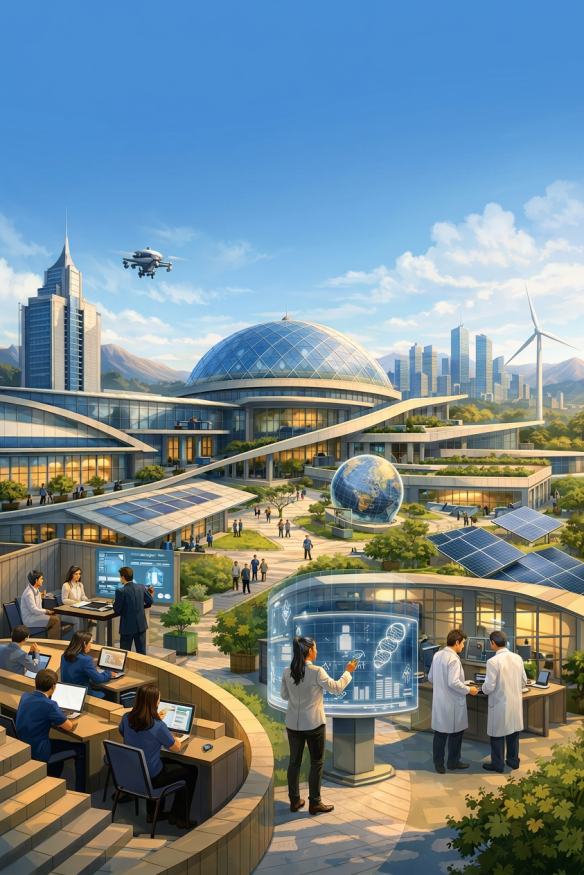
Learning consequently occupies a central place in this project. A Learning Republic is not merely one that produces graduates or accumulates knowledge. It is a society whose people and institutions continuously learn, adapt, remember, and renew themselves across generations.
Perhaps one of the greatest costs societies impose upon themselves is institutional amnesia. Nations rarely fail because they change too frequently. More often, they fail because they repeatedly forget what they have already learned.
Learning itself must therefore become among the Republic’s most important institutions.
The Republic must become a lifelong learner.
Likewise, capability must be distinguished from capacity. Capacity concerns what a nation possesses—its resources, infrastructure, technologies, institutions, and human capital. Capability concerns what a nation can actually accomplish with what it possesses.
Capability emerges when capacities become integrated toward collective purposes.
The Philippines possesses considerable capacities. Our greatest challenge has rarely been their absolute absence. Rather, it has been our inconsistent ability to transform capacity into sustainable national capability.
Capabilities are therefore the true infrastructure of nations.
Roads become economic corridors. Corridors become industries. Industries become capabilities. Capabilities become prosperity. Prosperity, faithfully shared across generations, becomes civilization itself.
Before nations become prosperous, they become capable.
The Republic must therefore become comfortable thinking in generations rather than electoral cycles. Twenty-year problems cannot continue to be addressed through six-year political horizons. Educational reform cannot be completed within a single administration. Climate resilience will not emerge from one presidency. Nation-building itself refuses to recognize electoral calendars.
Civilizations are not constructed according to election cycles.
The Republic must therefore become comfortable with fifty-year ambitions.
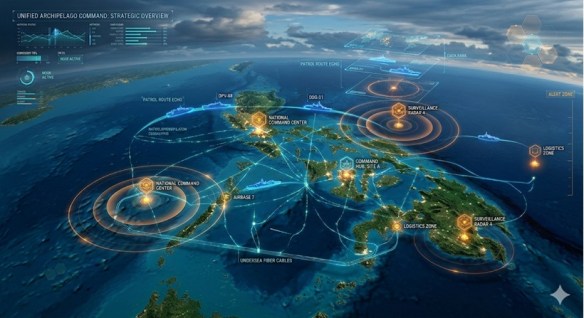
Nor can constitutional governance be meaningfully separated from geography itself. The Philippines is not merely a nation that happens to possess islands. It is an archipelagic civilization whose history has always been inseparable from the sea.
We were maritime before we were modern.
Yet much of our contemporary national imagination remains remarkably land-centric. The sea remains too frequently understood as a boundary rather than a connector—as territory requiring protection rather than a domain capable of generating prosperity, knowledge, resilience, and strategic advantage.
The Philippines must therefore become not merely an archipelago of islands but an archipelago of capabilities.
No province should exist merely to supply labour elsewhere. No island should remain permanently disconnected because of geography. No community should occupy the national periphery indefinitely. The twenty-first century challenges us to move opportunity toward people rather than perpetually requiring people to move toward opportunity.
Unity need not require uniformity. Connection may coexist with plurality. Resilience frequently emerges from adaptability rather than rigidity.
The challenge has never been learning how to become someone else’s nation. The challenge has always been learning how to become fully ourselves.
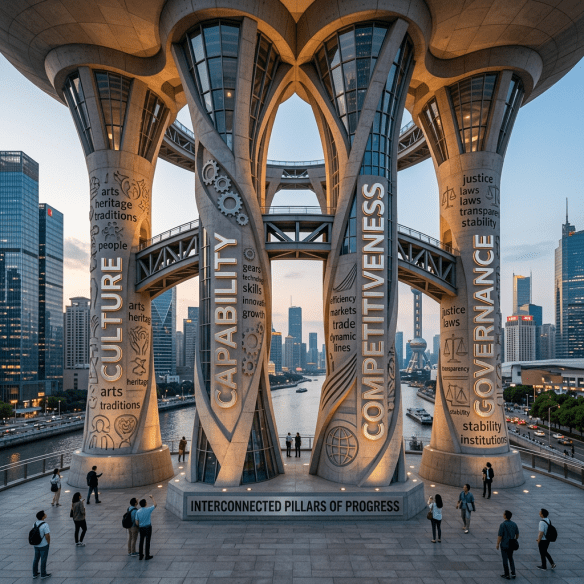
Ultimately, perhaps the Philippines requires fewer competing narratives and more integrating principles.
Learning. Capability. Maritime consciousness. Innovation. Sustainability. Industrialization. Sovereignty. Inclusion. Resilience. Participation. Stewardship.
These are not competing destinations. They are interconnected pillars within a larger architecture of national becoming.
National becoming is neither a slogan nor a programme confined to a single administration. It is the cumulative work of generations—of transforming aspirations into institutions, institutions into capabilities, and capabilities into opportunities that are faithfully transmitted to those who will follow us.
Dreams remain indispensable to national life. Yet dreams alone are insufficient. Dreams require ambition. Ambition requires strategy. Strategy requires institutions. Institutions require competence. Competence requires learning. Learning requires humility.
Institutional humility may be among the most neglected virtues of democratic governance. It requires acknowledging that no administration will solve every national challenge, no legislation will permanently eliminate every institutional weakness, and no generation will ever complete the project of nation-building.
Humility liberates us from the illusion of permanence while strengthening our commitment to progress.
Human beings remain unfinished throughout their lives. Universities remain unfinished. Institutions remain unfinished. Democracies remain unfinished.
The Republic remains unfinished.
This is not evidence of failure. It is evidence that living nations remain necessarily incomplete.
The measure of our success will never be whether we finally declare the Philippines complete. It will be whether future generations inherit institutions more capable of learning, communities more capable of flourishing, and a nation more capable of becoming than the one we ourselves inherited.
We are not called to finish the Republic. No generation ever will.
We are called to strengthen it.
There is, ultimately, only one enduring objective—a better Philippines.
A Philippines that continuously learns. A Philippines that builds rather than merely plans. A Philippines that transforms its strategic geography into strategic advantage. A Philippines that integrates rather than fragments. A Philippines that rewards competence without sacrificing compassion. A Philippines that leaves succeeding generations more capable than preceding generations found it.
Completion belongs to monuments. Becoming belongs to republics.
And becoming is the eternal, unfinished, hopeful, and blessed work of generations—the patient work of building a nation worthy of those who came before us and those who will yet follow after us.
The Philippines remains unfinished because it remains alive—an archipelagic, plural, democratic, and continually renewed conversation between generations.
Its greatest horizon remains before us.
And perhaps that is the greatest dream of all.


Thanks for the essay, Karl…I need another Red Horse! In past essays, you brought up the problem of lack of integration of projects in the Philippines. You bring it up again here in a different word – FRAGMENTATION.
Integrating aka avoiding fragmentation is principally the responsibility of leadership. It is a duty, a responsibility entrusted to them by the people. In the case of the Philippines we can go from local leadership all the way to Marcos, Jr. or whoever sits in Malacañang.
So one can wonder which comes first, an enlightened citizenry that would demand such from their leadership, or an enlightened leadership that will enlighten the citizenry for years to come. I know Joey was of the mindset the citizenry need to be taught because they cannot learn on their own. I hope he isn’t right. But maybe he is.
Thanks CV
Karl, I believe I counted five additional essays within this thread from you. You must have been in a zone…a writing zone!
Random notes.
Fragmentation is a given with 7,000 islands and 100 languages. And hundreds of self-dealing dynasties.
“Capabilities are the true infrastructure of nations.” Brilliant. True.
“Institutional humility” is also a brilliant pinpointing of Philippine weakness, for there is little of the stuff, and a perfect correlation can be witnessed: where humility exists, so does competence.
For me the Philippines is not a failed state. It is an unaware state. Concepts such as institutional humility are not in the primary dialogue, or goals.
Sara Duterte has zero humility.
Excellent viewpoints and insights.
“For me the Philippines is not a failed state. It is an unaware state. “ – JoeAm
Amen to that …but at least we Filipinos are happy, albeit happy fools. Blissful ignorance might be another term for us, eh?
That is why I push for learning and knowledge.
“That is why I push for learning and knowledge.” – Karl G.
A noble pursuit, Karl. I encourage you! May your tribe increase.
It was once said of us that “not all were asleep in the night of our ancestors.” I think relatedly we can say “not all were fools in the land of happy fools.”
Or long suffering ignorance for the destitute, or colonial ignorance for the conquered. Angry ignorance for the frustrated middle class.
Coupled with deception and other ignorance lingerers
OMG, so we’ve gone from “happy” and “blissful” to “long suffering” and “ignorant” and “destitute” to “colonial” and even “deceived.” tsk tsk
That is depressing.
Not if you recognize that “ignorant” is not a criticism (pejorative) but a condition that we all have, and the key is whether we have had the opportunity to do something about it, and have had the discipline to seize the opportunity. The other adjectives reflect historical penalties paid by the innocent.
joeam, you mention long suffering ignorance for the destitute has got me worried. we had celebrated pax silica initiative as new savior of our country, but then, we are suddenly accosted with 184 shipping container vans containing ewaste from united state waiting to be off loaded in subic! if ewaste mining is part of pax silica, we really ought to be told soonest.
AI Overview
Yes, the Pax Silica initiative is connected to concerns about US waste importation, primarily as a potential risk warned by environmental groups rather than an official design of the project. The US-led coalition aims to build a secure supply chain for semiconductors, AI, and critical minerals processing in the Philippines.
Environmental Concerns and “Urban Mining”
Official Scope of Pax Silica
so, sabi ko, if pax silica is not to function as ewaste disposal, what is the 184 shipping containers of ewaste doing here! then again, I was told it is not waste disposal but recovering minerals from waste.
are we sure about that? they already look like waste waste to me! nothing to recover there, ah ewan!
Subic was left as a polluted mess when the US pulled out. If the Philippines does not have rigid waste handling and inspection rights in the Pax Silica agreements, shame on the Philippines. Several nations will be participating. They all should be made to comply under severe penalties for non-compliance.
The Pax Silica argument is essentially between capitalists, who see the huge profit opportunities possible, and socialists who hate foreigners (the US especially) and want the people put first. I’m a realist who thinks the people have a better future if the Philippines is industrialized and managed well. President Marcos also seems to be a realist as well.
“The Pax Silica argument is essentially between capitalists, who see the huge profit opportunities possible, and socialists who hate foreigners (the US especially) and want the people put first.” – JoeAm
Personally I stand with those want the people put first. There are capitalists who can do both – make money and put people first. I vote that the Filipino people deal only with those type of capitalists.
“I’m a realist who thinks the people have a better future if the Philippines is industrialized and managed well. President Marcos also seems to be a realist as well.” – JoeAm
I am a realist too, and the process of thinking tall includes looking at our country years into the future. I don’t want it turned into a toxic wasteland because realists in the 2020s and 2030s chose to make “huge profits” by dumping imported toxic waste into our country. That is a reality that we can avoid by acting today and how to act is detailed comprehensively in Karl Garcia’s essays where he looks decades into the Philippines’ future.
The question facing the Philippines today is “Can we take advantage of Pax Silica without the toxic waste dumping?” I believe the answer is “Yes!” We should take that more realistic route.
Kudos to Philippine watchdog groups that identified things like these 184 containers headed for Subic Bay. Apparently this has been going on for some time. Some action has been taken, but really too little to make a dent in the poisoning process of our “Eden lost.”
My thanks to Kasambahay for bringing up this issue. It is an eye-opener.
Everyone, this illegal e-waste recycling isn’t even a new activity. It’s not part of Pax Silica. Before the activity moved into Freeports it happened in places like the informal communities of Smokey Mountain in Tondo. I saw plenty of that when I used to hang out and do NGO work in Smokey Mountain in the late 1990s and early 2000s even though Smokey Mountain was “officially” shut down in 1995 (the settlers were finally fully moved in the mid-2000s).
I also don’t agree with the Philippine far leftist tendency towards flattening problems in search of simple solutions and clear “enemies.” Nor do I agree with the conversation around “circular economy” and “urban mining,” which by the way is pushed by the Filipino e-waste recycling industry participants who have the most financial gain in the equation. Reductionist explanations feel good since it identifies clear “bad guys,” but it doesn’t solve anything. Reductionism is one of the oldest far leftist tendencies, and it’s intellectually shallow.
Firstly, the common “simple” finger pointing is that the US had not ratified the Basel Convention. The US is an original signatory to the Basel Convention but like any other country the executive signing a treaty means nothing if the legislature had not ratified (agreed to). Despite this basically every US state has some form of state-based Basel Convention law. A lot of e-waste comes from the EU, Japan, South Korea, who are members of the Basel Convention. The treaty itself is voluntary compliance. Too much focus on Basel Convention ignores the fact that the Convention is not the simple panacea or cure-all. Any Filipino group that keeps harping “Basel Convention” doesn’t understand how the Basel Convention even works and is effectively waving around an impressive sounding name as if a magic wand that will fix everything. They are taking advantage of people’s real suffering, because their goal was never to help people, only to fight ideological battles.
We must also understand how the illegal e-waste economy works. We must be aware that the entire illegal activity would not even be possible unless there are brokers, who in the Philippine case are Chinese criminal syndicates working with (shocks) Filipino-American padala operators. On the Philippines side the buyers are also Filipino. The original seller of the e-waste usually sells containers of unsorted e-waste to the lowest bidder then have no control of what happens afterward. The simple far leftist narrative of “the US is dumping e-waste” is simply wrong and anti-US as its goal, and no where do the far leftists even care about stopping illegal e-waste activities because if they did they would push for stronger Philippine law and enforcement. Since the beginning of international far leftism (when it broke off of socialism and anarchism), they have ALWAYS tried to find reductionist narratives to elicit emotionalism to wedge in their real objectives (hint: the objective isn’t about helping people or about the wedge itself, e.g. e-waste dumping).
And the facts are that there have been hundreds of US state cases, EU cases, and so on prosecuting sellers who are based in those countries. The prosecution happens all the time. In fact there was a major prosecution case in California not too long ago. The brokers and buyers are typically not prosecuted in the Philippines. So perhaps solving the problem needs to start there. And focusing on how to help informal workers who feel economically compelled into e-waste recycling work.
Infact I am pushing for landfill ming and ewaste recycling. But we have already have a ateasy atream all we need is to make all landfills and dumps accesible.
ahem, have you seen the denr accredited centers like the one in calamba, laguna and san raphael? they are summat crude and medieval and hand operated, like the ship graveyard in india, where dead ships are scrapped for metals.
ewaste may well have cfc and pfas, or forever chemicals that stay in the environment maybe forever. if we are to poison ourselves, I prefer the government to be upfront and let us know so we can prepare ourselves, and do whatever is necessary to safeguard our health.
ewaste mining is bigger business, if our country if to be the dumpster of the 14nations in the pax silica agreement, I am okay with that. we already have the site and the land allocated, but do we have the technology? if we are to be like india and rely mostly on mano mano with barely any safety gears for workers, I am okay with that too, so long as workers know that work is not automated, and that it may well be back breaking job, so they might as well be compensated well too.
the 184 containers of ewaste is just the beginning, more are coming, whether we are ready or not!
KB, the current vans of e-waste in Subic are not part of Pax Silica. Pax Silica is a manufacturing initiative focused on semiconductors and the associated supply chain. The e-waste issue has been existing in the Philippines ever since the 1990s, which I saw with my own eyes of workers processing e-waste and extracting precious metals with acid baths by hand. The e-waste economy in the Philippines is a function of criminal syndicates, helped by Filipino middlemen, taking advantage of low wage labor in the Philippines. To solve the problem the criminal syndicates, most of which are controlled by Chinese Triads similarly to POGO, must be prosecuted and evicted. The Chinese Triads started off as an anti-Qing dynasty, anti-government organizations and later morphed into criminal enterprises. Today the Triads are co-opted by the Communist Chinese government in the United Front. So if any country is acting in bad faith it is China.
I am also interested in the circular economy and urban mining. However absolutely zero developed countries have figured out a way to do it cheaply enough to replace mining more raw resources. The global resource industry also pushes other initiatives to cover up their extraction activities, e.g. recycling, by pushing the moral responsibility to the many consumers rather than the few producers. For example it is a known fact that only about 5% of “recycled plastics” are actually recycled; the rest end up in landfills. It’s simply cheaper to produce new plastics from petrochemicals. The conversation that makes a difference is reducing the use of non-biodegradable consumables, not recycling.
The global informal e-waste economy, including in the Philippines, operates along the margins in the first place where manual labor is cheap enough that labor can replace part of but not all of the resource extraction and processing chain. So if no developed country has figured it out, I don’t see circular economy and urban mining as viable in the Philippines. It is really a nonstarter.
Two links
Beyond the Dump: What the Philippines Can Learn from Ghana and India on Electronic Waste
Every year, Filipinos buy millions of smartphones, laptops, televisions, appliances, and other electronic devices. They connect us to the digital economy, improve productivity, and enhance our quality of life. Yet every new gadget eventually reaches the end of its useful life. What happens next is becoming one of the fastest-growing environmental and industrial challenges of the twenty-first century: electronic waste, or e-waste.
The Global E-waste Monitor estimates that the world generates tens of millions of metric tons of e-waste annually, and the volume continues to grow faster than recycling capacity. Hidden inside these discarded devices are valuable materials such as gold, silver, copper, palladium, cobalt, nickel, lithium, aluminum, and rare earth elements. In effect, every discarded computer or smartphone is a small urban mine waiting to be tapped.
The question is whether countries will treat e-waste as garbage or as a strategic national resource.
Two countries offer valuable lessons for the Philippines: Ghana and India. One serves as a warning about what happens when regulation lags behind reality. The other demonstrates both the promise and the complexity of building a circular electronics economy.
Ghana became internationally known for Agbogbloshie, once one of the world’s largest informal e-waste processing sites. Thousands of people earned livelihoods by repairing, dismantling, and recycling discarded electronics. The entrepreneurial spirit of these workers should not be underestimated. They recovered valuable metals, repaired equipment that still had useful life, and supplied affordable electronics to many households.
However, the absence of adequate regulation came at a terrible cost. Open-air burning of wires released toxic smoke. Improper acid extraction contaminated soil and waterways. Workers, including children, were exposed to hazardous substances without protective equipment. Communities paid for economic opportunity with their health.
Yet Ghana’s story is not simply one of failure. It also demonstrates that governments can learn and adapt. Ghana has strengthened its legal framework, introduced an e-waste management levy, established formal collection systems, and promoted licensed recycling facilities. The lesson is not to eliminate informal workers but to help them transition into a safer, more productive, and environmentally responsible industry.
India presents a different path.
As one of the world’s largest producers of e-waste, India has embraced Extended Producer Responsibility, requiring manufacturers to participate in collecting and recycling electronic products after consumers discard them. The country has expanded licensed recycling facilities, encouraged technology-driven metal recovery, and maintained a vibrant repair culture that extends the lifespan of electronic products before they become waste.
India’s journey is far from complete. Much of its e-waste still passes through informal channels because informal collectors often offer better prices and greater convenience than formal systems. Enforcement also varies across states. Nevertheless, India demonstrates that e-waste can become part of industrial policy rather than merely environmental policy.
The Philippines has an opportunity to avoid the mistakes of both countries while building on their successes.
First, we should recognize that the country’s existing repair culture is a competitive advantage. Filipino technicians have long demonstrated remarkable ingenuity in repairing appliances, computers, and mobile devices. Instead of encouraging a throwaway culture, policies should support the right to repair, making spare parts, repair information, and diagnostic tools more accessible. Every device repaired is one less device sent prematurely to a landfill.
Second, the Philippines should develop urban mining as a strategic industry. Unlike traditional mining, urban mining extracts valuable materials from discarded electronics already circulating within the economy. Recovering gold, copper, cobalt, lithium, and rare earth elements from e-waste can reduce dependence on imported raw materials while supporting domestic manufacturing.
Third, the country should integrate—not criminalize—the informal sector. Thousands of junk shops, waste collectors, and repair technicians already form an extensive nationwide collection network. Rather than replacing them, government should register, train, certify, and equip them with proper safety standards while linking them to licensed recycling facilities. Their knowledge and reach are valuable assets that should be strengthened, not ignored.
Fourth, the Philippines should establish regional e-waste recycling parks in strategic economic centers such as Metro Manila, Clark, Cebu, Davao, and Batangas. These facilities could combine collection, repair, refurbishment, automated dismantling, battery recycling, precious metal recovery, plastics recycling, and research laboratories. Such hubs would support local employment while strengthening the country’s electronics and semiconductor industries.
Finally, stronger enforcement is essential. The Philippines must prevent illegal imports of obsolete electronics disguised as second-hand goods while fully implementing producer responsibility policies that require manufacturers and importers to finance proper collection and recycling.
E-waste should not be viewed simply as an environmental problem. It is an industrial opportunity. Countries around the world are competing to secure supplies of critical minerals needed for electric vehicles, renewable energy systems, semiconductors, and advanced electronics. The Philippines does not have to rely solely on newly mined resources. Many of these materials are already sitting in homes, offices, warehouses, schools, and junk shops in the form of obsolete electronics.
The country often speaks of becoming a leader in electronics manufacturing and the digital economy. Achieving that vision requires thinking beyond production to the entire lifecycle of electronic products—from design and repair to reuse, recycling, and material recovery.
The lesson from Ghana is clear: never allow poverty and weak regulation to turn e-waste into an environmental disaster. The lesson from India is equally important: with the right policies, innovation, and partnerships, e-waste can become a cornerstone of a circular economy.
The Philippines should aspire to neither a dumping ground nor a nation that merely consumes imported technology. It should become a country that repairs, recovers, remanufactures, and recycles—transforming yesterday’s electronics into tomorrow’s industries. In a resource-constrained world, the richest mines may no longer be beneath our feet, but inside the devices we throw away.
I am just being funny here, india and ewaste? maybe that explains why a bigger country and richer country than us, is at the bottom of the medal tally at the commonwealth games in scotland. malaysia is beating india at medal tally, nigeria too, is beating india.
philippines is not part of the commonwealth and thus able to save her dignity!
The simple explanation here is India doesn’t focus on sporting medals, just as China, Taiwan, Japan, South Korea also don’t do that well in international sporting events. They are focused on building economies, decreasing poverty for their citizens, increasing education outcomes, and real things. So they focus on science, engineering, and industry.
Wait not even in Cricket? The Horse sports? What did the UK do there for centuries, order Garments?
My sentiment is still the same here. What has a higher chance of increasing the material needs of the people, passively watching sports to have pride in a small number of people or the many having a factory job in an industrialized country where they may be proud of their own accomplishments?
In China and India when scientists pass away, like Yuan Longping the “father of hybrid rice” that fed billions of malnourished Chinese or the “father of the Indian space industry” whose contributions to engineering helped enable India’s manufacturing rise, there was a spontaneous outpouring of national grief with tens of thousands of public mourners spilling out into streets. I happened to be there in India on a work trip and witness the reaction to A.P.J. Abdul Kalam’s passing. Sorry if this comes off harsh but in the Philippines two student basketball players died in a tragic incident and the whole country went insane for a week, then totally forgot about it as they moved onto the next collective outrage.
Priorities do matter in national advancement. Notice how countries that place less emphasis on development tend to put more emphasis on sports.
“Sorry if this comes off harsh but in the Philippines two student basketball players died in a tragic incident and the whole country went insane for a week, then totally forgot about it as they moved onto the next collective outrage.” – Joey
Are you comparing the 2 basketball athletes to Yuan Longping and Abdul Kalam? Was the Filipino nation supposed to mourn these two athletes for a longer period of time?
I do not appreciate your habit of disingenuous reframing. You are taking a snippet out and missing the entire point.
Information and news are free. You are welcome to read both to keep yourself informed.
The tragedy of the two boys was cynically driven into the national conversation by pro-Duterte politicians and influencers in order to undermine Marcos Jr. and force a reaction before NBI and DILG could even complete their investigations. Robin Padilla, Bong Go, and Sara Duterte herself. Toss in the Luzon-Mindanao tension between perceived elite Ateneo and one of the student-victims, Rene Baterbonia, being of Mindanao origin (Agusan del Sur) serving as useful proxies.
What do you think was the goal? Since the flood control scandal implicates Marcos Jr. allies who got contracts during the Duterte presidency, and the anti-Philippines Duterte camp has been desperate to run away from Sara Duterte’s own confidential funds scandal, and the basketball camp tragedy followed immediately after the Bato dela Rosa Senate altercation when the pro-Duterte camp looked quite bad in the national light for a sustained period, one may draw their own conclusions based off of facts.
Now that the basketball tragedy is no longer politically useful it has been jettisoned by the pro-Duterte side. So who used the tragedy towards cynical ends to drive national outrage? The fact that the outrage died down and the actors behind pushing it moved on to the next controversy used the dead boys for political gain and threw them in the trash when the “scandal” was no longer useful is disgusting in itself.
All those are facts.
And none of that changes the other fact that countries which focus on development tend not to place so much focus on prestige sports. Because those countries focusing on development are creating systems with active economic participation that raise up the many, not creating systems of passive consumption in sports and entertainment. Manny Pacquiao is an iconic ambassador for decades. How many jobs did Manny create that moved the nation forward?
“Information and news are free.” – Joey N.
And so was your post responding to Karl. I asked two simple questions related to that post. You can’t answer them?
“You are taking a snippet out and missing the entire point.” – Joey N.
Does your snippet have anything to do with your entire point? I don’t see it, which is why I asked for clarification.
That’s all.
“Notice how countries that place less emphasis on development tend to put more emphasis on sports.” – Joey N.
I also found this statement of yours in that post I responded to as odd. In both the Summer and Winter Olympic games, for example, top medal winning countries are overwhelming from countries that have and continue to emphasize economic development.
I have been the most consistently patient with regard to your commenting, giving you good faith treatment despite your penchant for pseudo-Socratic technique. It is tiring. You may figure it out yourself.
No problem, Joey. I just want to alert you that someone in the Society is reading your posts and taking notes, including inconsistencies, and irrelevancies and parts that are not clear at least to me. I welcome you to do the same with mine.
No thanks.
No problem, Joey. Just wanted to let you know that I abide by the Golden Rule.
haha I still cheer for Alex Eala’s win today.. but I do get your point. Starkest example: East Germany versus West Germany. Their athletes were leagues ahead of those of West Germany but the economy in West Germany was far better. Of course countries that are already economically powerful can afford to also promote sports like West Germany did, but that is more of a “side quest” – we already talked about this topic similarly regarding music.
Re the cheering for the father of India’s space program, that reminds me about how some Indonesian farmers viewed the late Dr. Habibie as a “magician”. I wonder if one day Filipinos of the D and E classes will cheer for Dr. Mahar Lagmay because that would be similar.
the usual cycle over there which is why I have mostly tuned out of socmed that is related to the Philippines.
“I wonder if one day Filipinos of the D and E classes will cheer for Dr. Mahar Lagmay because that would be similar.” – Irineo
Or will they consider Dr. Lagmay’s work a “side quest?” Food for thought.
this is food for thought:
“this is food for thought:” – Irineo
I had a chance to browse through the links you shared including the comments. Not very encouraging.
After reading them and some of the comments, I think the D&E classes will not cheer Dr. Lagmay, even in the future. A few Filipino intellectual probably will…but just a few. Not enough to create critical mass.
But thanks for sharing.
One would need to only look at the pattern between developed countries and developing countries with regard to international sporting:
That tells us something about the ability to work together as a unit versus going about things alone because others cannot be trusted that much, and how that relates to the mindset needed to create then execute on economic development.
In developed countries there tends to be non-government organized sporting leagues to create a pipeline, while developing countries favor sending a few extraordinary athletes who receive very little prior government support (until they win). The extraordinary athletes from developing countries tend to be affluent or have their own patrons (e.g. a wealthy benefactor, a corporation, etc.) in order to afford the training required to mold individual talent into competative talent.
East Germany was actually a different sort of case where state-directed sporting was used as an international recognition tool in order to prove that Marxist-Leninism was superior to capitalism — but to distract the population from domestic economic unrest over time as East Germany (which started off roughly equal economically to West Germany) started falling behind. That much we know from the Stasi Files.
Well there is another category that is a bit similar to East Germany without the state-organized aspect: Developing countries that use arbitrary sports patronage in as an attempt to score quick public relations wins; a form of bread and circus. In developing countries with corrupt regimes like Zaire (under Mobutu Sese Seko), Nigeria (under Sani Abacha), Iraq (under Saddam Hussein’s son Uday Hussein), Libya (under Muammar Gaddafi), the arbitrary sports patronage was even more extreme. Bread and circus is a way to compensate for domestic economic failure. Many times the money and effort spent by these countries in international sporting becomes a White Elephant with negligible ROI.
I’m not arguing that the Philippines is an economically failed state, because it isn’t, but in many ways the Philippines is a developmentally stunted state, being stuck in the Middle Income Trap since shortly after EDSA (40ish years). Well last month the Philippines officially graduated to Upper Middle Income status, but how much of those economic gains have reached lower socioeconomic levels which one is made painfully aware of whenever one roams around outside Philippine metro centers.
There has never been a single developing country whose people felt “inspired” by a sporting champion to push for economic development. The academic literature suggests quite the opposite. The nationalist euphoria over wins doesn’t last that long either… “Winning a medal” does not change the reality of structural deficits. Usually countries successfully develop before their national teams start focusing too much on sports since international recognition is a soft power tool to get other countries to buy more stuff from the country who enjoys the spotlight.
Also interesting that most OECD countries, where medal payouts are involved, only Italy is the outlier paying 6-figure medal bonuses. The Philippines has one of the highest medal bonuses (by law, 2015 National Athletes and Coaches Benefits and Incentives Act), comparable to developing nations which also have high medal bonuses and which don’t place that much effort on economic development. And that’s before the private sponsorships and corporate gifts.
I played sports all through school, playing (American) football and basketball for my state championship-winning Catholic school. I was a quite good athlete in those days and am still decent at pickup street basketball at the park, but I knew back then the chance of playing in the professional league was close to zero, so I picked a more realistic course in life. I think all can admire athletes like Manny Pacquiao, Carlos Yulo, and Alex Eala, especially when they persevered through disadvantaged backgrounds, but the emphasis on gaining recognition through sporting to where there’s even a law passed is really a story about a choice of national priorities. Perhaps it’s more enduring to build something where more people can participate in…
I just remembered that Marcos Sr. also had a bread and circuses style arbitrary sports patronage program, which if my memory serves correctly was called Golden Offering that created a whole training pipeline for promising kids picked out of slums. Again like patterns elsewhere the sports chosen were singles/doubles sports rather than team sports. I saw some old television propaganda reels long ago of the hero ceremonies for winning athletes and it was quite OA. The Golden Offering program was used to sportswash Martial Law abroad with national sports champions while distracting Filipinos at home with the deteriorating economy as crony capitalism set in. Well, that program didn’t create a resilient economy either.
Gintong Alay in our lingo
Thanks Karl, that’s the one.
Welcome
Got it.
India had almost the exact same informal e-waste economy as the Philippines has had since the 1990s. I saw it personally when I visited urban slums in India as well during work trips in the IT industry. The difference between India and the Philippines is when India decided it had enough of the negative consequences of e-waste recycling, they enacted laws and enforced the laws. I see this problem similarly to Duterte’s drug war. Many desperate Filipinos who used drugs to self-medicate their pain of poverty were targets of enforcement, yet the Chinese drug kingpins and their Filipino middlemen laughed as the law did not dare touch them. Enforcement against the former has marginal effect compared to enforcement against the latter which is the source of the problem.
Circular Economy and Philippine Industrialization Series
I. The Right to Repair Revolution: Why Repair Is an Industrial Policy
For too long, economic development has been measured by how much we produce and consume. Increasingly, however, competitiveness will also depend upon how effectively nations preserve the value embedded in the products they already possess.
The Philippines has quietly practiced the Right to Repair long before it became a global movement. Across cities and municipalities are thousands of technicians repairing televisions, refrigerators, mobile phones, laptops, printers, air conditioners, and countless household appliances. Filipino ingenuity has transformed repair into both an economic necessity and an entrepreneurial opportunity.
Unfortunately, modern electronics are becoming increasingly difficult to repair. Proprietary software, sealed batteries, specialized tools, and restricted access to replacement parts have shortened product lifespans and accelerated waste generation. Consumers are frequently encouraged to replace products rather than repair them.
The consequences extend beyond consumer inconvenience. They represent a strategic economic loss.
Every discarded laptop prematurely removed from service increases imports. Every irreparable appliance becomes additional waste. Every technician forced to abandon his trade represents lost human capital.
The Right to Repair movement recognizes that repairability is not simply a consumer issue. It is industrial policy. Repair creates jobs that cannot easily be outsourced. It supports local enterprises, reduces waste management costs, and strengthens circular manufacturing systems.
Government should consider policies that encourage repair-friendly product standards, expand technical training programs, support independent repair businesses, and incentivize refurbishment industries. Universities and technical institutions can establish specialized programs in electronics diagnostics and advanced component-level repair.
Repair should become the first stage of the circular economy—not its afterthought.
A nation that learns to repair what it owns ultimately learns to manufacture what it understands.
—
II. Urban Mining: The Philippines’ New Critical Minerals Industry
The twenty-first century will be defined by competition for critical minerals. Lithium powers batteries. Copper enables electrification. Rare earth elements support advanced technologies. Gold, palladium, and specialty metals remain indispensable to electronics manufacturing.
Traditionally, governments have looked beneath mountains and offshore waters when discussing mineral security. Increasingly, however, policymakers are discovering another source: their cities.
Urban mining refers to recovering valuable materials from discarded products already circulating within society. Electronic waste contains substantial quantities of strategic minerals that can be recovered through modern technologies.
The Philippines possesses a unique advantage. It combines a large consumer market, an established electronics manufacturing sector, and growing technical capabilities. Together, these assets create the foundations for an urban mining industry.
Urban mining offers multiple benefits simultaneously. It strengthens supply-chain resilience, supports domestic manufacturing, reduces environmental impacts associated with disposal, and creates highly skilled employment opportunities.
Rather than exporting discarded electronics or sending them to landfills, the country should establish material recovery ecosystems capable of extracting value from obsolete products. Copper recovered from electronic waste can support manufacturing. Precious metals can supply industrial applications. Specialty plastics can re-enter production systems.
Urban mining should therefore become part of the country’s critical minerals strategy alongside responsible conventional mining.
The question is no longer whether discarded electronics possess value. The question is whether the Philippines will recover that value itself or allow others to do so.
—
III. AI, Robotics, and Smart Recycling: Building Tomorrow’s Green Industries
Recycling is undergoing its own technological revolution.
Artificial intelligence can now identify materials more accurately than traditional sorting methods. Robotics can safely dismantle hazardous batteries and complex electronic assemblies. Machine vision systems recognize components in milliseconds. Advanced hydrometallurgical techniques recover valuable metals with increasing precision.
These developments create opportunities extending far beyond waste management.
The Philippines frequently speaks of participating in Industry 4.0. Smart recycling offers precisely such an opportunity. Rather than viewing recycling as a low-technology activity, policymakers should recognize it as a platform for innovation involving artificial intelligence, automation, sensor technologies, data analytics, and advanced materials science.
Future Circular Electronics Parks could incorporate AI-assisted material sorting systems developed by Filipino engineers and researchers. Robotics laboratories could develop automated dismantling technologies specifically designed for regional markets. Startups could commercialize software platforms that improve material traceability and collection logistics.
Smart recycling also creates opportunities for interdisciplinary collaboration among engineers, software developers, environmental scientists, and manufacturing specialists.
The green economy will not be built solely through renewable energy projects. It will also emerge from industries capable of recovering and reusing strategic resources intelligently and efficiently.
Tomorrow’s recycling facilities may increasingly resemble advanced manufacturing plants rather than conventional waste management centers.
Right to repair should remain as a consumer right. Attaching it to industrial policy is a bit far-fetched and exceedingly complicated. Let’s just have a simple and straightforward industrial policy to begin with. It is easier to stick to a straighter path to the destination than to take a bunch of detours down a winding road.
At leaat it still leads you to the door.
All roads lead to the destination, but the trailblazed known path is usually the most efficient. Personally I think the Philippines is better served by adapting (not copying) known strategies to Filipino strengths and political realities. When making decisions for a business unit I hesitate when presented with unproven solutions. That’s in a business that can write off losses as long as it doesn’t bankrupt the company. Decisions on the use of public money should be even more heavily scrutinized. Just my opinion.
Me personally I have been ” summoned” by a former National.Security under secretary asking for my ideas and I was chest thumping inside hehe humble in the outside. Small mercies and simple pleaaures asI said so long as a single person of influence can pick up something from me, new idea, recycled idea or not I am fulfilled.
Thanks great news Karl! Overall I think your contributions are very needed to start a discussion.
Thanks
Yes, that’s how I come down on it. The likely benefits are huge. Waste can be managed, as can resources such as water and energy.
“Waste can be managed, as can resources such as water and energy.” – Joey
Yes…and one way of managing it is dumping it on 3rd world countries which is what the US seems to be trying to do with regard to the Philippines. Note, just as waste can be managed, it can also be mismanaged as can resources such as water and energy.
I agree with this, CV
ah, joeam, president marcos seems like a realist and he is being sorely tested, and rightly so. his order at the recent sona that metro manila workers be given wage increases of 60 to 85 pesos per day is being challenged at court and the president lost. his pay increases: for non agri worker their daily pay be brought up to 780 pesos, for agri worker and workers in smaller firms be up to 743 per day has been vetoed by the court of law! big business are at loggerhead with the president, kasi contracts have priorly been signed and wages have been decided and agreed beforehand. though it would have been easy for big businesses to add codicil to the contract and include the recent pay hike, they prefer instead to show their teeth and show the president how powerful they can be!
so all pay increases are on hold, until further notice, or until someone challenges the tro and file a case vs the big businesses.
A draft I scheduled for later
The Ocean Refinery and Technological Sovereignty
By Karl M. Garcia
Human progress has often been measured not by the discovery of entirely new resources, but by humanity’s capacity to recognise value in what previous generations considered worthless. Coal was once little more than black stone before it powered the Industrial Revolution. Petroleum was once an inconvenient contaminant seeping into water wells before it became the lifeblood of the twentieth century. Silicon was once merely sand before it became the foundation of the digital age.
Perhaps the next great transformation will emerge not from discovering something entirely new, but from rediscovering the value of the things we have spent generations throwing away—and from recognising the strategic value of the resources we have long taken for granted.
Water may prove to be among them.
There is an old lesson in development economics that nations are prisoners neither of their geography nor of their history. They become prisoners only of their imagination. The world’s most prosperous societies are seldom those most generously endowed by nature. Rather, they are those that learn to recognise opportunities hidden within their apparent disadvantages.
Japan transformed geographic constraints into manufacturing excellence. Singapore transformed the absence of natural resources into strategic connectivity. South Korea transformed post-war devastation into technological leadership. More recently, nations such as Vietnam have demonstrated that economic transformation need not follow historical pathways taken elsewhere. Development is neither linear nor predetermined. Countries occasionally leapfrog entire technological stages when imagination, institutions, and political will converge.
The Philippines may now find itself confronting such a moment.
For generations, we have described ourselves primarily as an archipelagic nation—a geographic description that has frequently emphasised our fragmentation rather than our possibilities. Yet perhaps the defining challenge of the twenty-first century is not whether nations possess sufficient resources, but whether they possess sufficient imagination to transform the resources already within their reach.
Nations are not built solely by what they produce. They are equally shaped by what they preserve, what they repair, what they regenerate, and what they choose not to discard.
Throughout history, societies have been distinguished not merely by their capacity to manufacture extraordinary things, but by their ability to steward resources, transmit knowledge across generations, and continuously transform limitations into opportunities. Repair was once neither a political movement nor a lifestyle choice. It was simply how societies functioned.
Today, repair, manufacturing, industrialization, water security, and resource recovery are simultaneously undergoing profound transformations. Products have become more sophisticated yet paradoxically more disposable. Artificial intelligence is democratizing knowledge. Three-dimensional printing is democratizing fabrication. Circular manufacturing is redefining industrial competitiveness. Hydrogen technologies are converging with water security, maritime development, and resource recovery.
These developments are often discussed independently. They should not be.
The future of the Right to Repair cannot be separated from the future of DIY. The future of DIY cannot be separated from distributed manufacturing. Distributed manufacturing cannot be separated from circular industrialization. Circular industrialization cannot be separated from water security and the Blue Circular Economy. The Blue Circular Economy cannot be separated from the Ocean Refinery and the Hydrogen Archipelago. And all of these ultimately converge upon a larger national ambition—Philippine technological sovereignty itself.
They are, in truth, chapters of the same story.Ownership Beyond Possession
Perhaps the greatest paradox of our age is remarkably simple. Human civilization has never possessed greater technological capabilities, yet many of our products have never been more difficult to maintain.
Ownership has increasingly become disconnected from understanding. Consumers encounter permanently bonded batteries, proprietary fasteners, software restrictions preventing independent repairs, and products whose maintenance costs frequently approach replacement costs. Technological sophistication has occasionally come at the expense of practical agency.
Ownership must therefore mean more than possession. It must include the practical freedom to understand, maintain, improve, fabricate, repair, and extend the useful lives of the things entrusted with our labour and resources.
If societies lose the ability to repair what they own, they gradually lose the ability to understand how technologies work. Societies that cannot understand technologies will eventually find themselves dependent upon those that do.
The Right to Repair is therefore considerably more than consumer protection legislation. Properly understood, it is among the first foundations of technological sovereignty.The New DIY Revolution
DIY has evolved from subsistence ingenuity into platform-enabled optionality.
Digital platforms have democratized knowledge. Global supply chains have democratized access to tools and components. Three-dimensional printing has democratized fabrication itself. Artificial intelligence increasingly functions as an interactive mentor capable of assisting with diagnostics, design, and manufacturing.
Repair itself is evolving into distributed manufacturing.
A replacement component no longer necessarily requires transportation through global supply chains if it can instead be designed, downloaded, modified, or fabricated locally. Communities increasingly possess the capabilities to preserve technologies long after commercial support has ended.
A society that can print replacement components gradually becomes a society capable of designing entirely new products.
Perhaps the most important lesson of the maker revolution is remarkably simple—a nation that learns how technologies fail eventually learns how technologies work. A nation that learns how technologies work eventually learns how to build them.
Repair, therefore, becomes the first stage of industrialization itself.The Circular Archipelago
Increasingly, prosperity depends not merely upon what nations produce, but upon how intelligently they preserve, recover, regenerate, and continuously transform the value embedded within the resources already circulating throughout their societies.
Economic resilience is becoming inseparable from resource resilience.
Electronic waste may become strategic mineral reserves. Plastic pollution may become industrial feedstock. Agricultural residues may become manufacturing inputs. Wastewater may become tomorrow’s freshwater supply. Maritime geography may become among our greatest industrial advantages.
Tomorrow’s recycling facilities will increasingly resemble advanced manufacturing plants rather than conventional waste management centers. Artificial intelligence, robotics, advanced material recovery systems, and circular manufacturing technologies will increasingly converge within integrated industrial ecosystems.
The countries that lead the next industrial revolution will not simply manufacture the world’s technologies. They will master their entire lifecycles—from design and production to repair, recovery, regeneration, and reinvention.
Perhaps the Philippines should cease thinking of itself merely as an archipelago of islands and begin imagining itself as a Circular Archipelago—an archipelago of opportunities.Water Security and the Desalination Imperative
For generations, water has been treated as something that simply arrives when we open the tap. It falls from the sky, flows from our rivers, and emerges from reservoirs hidden beyond our cities. Because of this abundance—real or imagined—we have come to regard water as ordinary.
Yet throughout history, civilizations have risen and fallen according to their relationship with water.
The Philippines remains blessed with abundant rainfall and vast marine resources, but these blessings should not lull us into complacency. Climate change has made rainfall increasingly unpredictable. Droughts have become more severe while floods paradoxically coexist with water shortages. Groundwater reserves continue to face overextraction, saltwater intrusion threatens coastal aquifers, and population growth steadily increases demand upon ageing infrastructure.
Every dry season reminds us that being surrounded by water is not the same as having access to safe and reliable freshwater.
It is therefore time to stop thinking desalination is expensive. We need it more than we think.
More importantly, we have been asking the wrong question. Instead of asking whether desalination is expensive, we should ask whether water insecurity is more expensive.
The economic costs of water shortages extend far beyond household inconvenience. Agriculture suffers reduced yields during prolonged droughts. Industries dependent upon reliable water supplies face operational disruptions. Communities become vulnerable to disease when access to clean water becomes limited. Governments spend billions responding to emergencies that could have been mitigated through long-term investments in resilient infrastructure.
Water insecurity carries economic, environmental, and national security consequences that often remain invisible until a crisis emerges.
Water security is therefore not merely environmental policy. It is simultaneously industrial policy, public health policy, climate resilience policy, and national security policy.
No nation can become prosperous if it remains perpetually vulnerable to water shortages.The Hydrogen Archipelago
The twenty-first century is increasingly becoming the century of convergence.
Waste management is converging with hydrogen technologies. Water security is converging with industrial development. Climate resilience is converging with economic competitiveness. Maritime industries are converging with advanced manufacturing and the circular economy.
Paradoxically, the Philippines possesses many of the challenges these emerging technologies seek simultaneously to address. We struggle with plastic pollution, landfill management, water insecurity, underutilised agricultural residues, and some of the highest energy costs in Southeast Asia.
Yet perhaps these challenges are not merely liabilities. Perhaps they are latent assets awaiting integration.
Municipal wastes become valuable inputs for resource recovery systems. Agricultural residues contribute to hydrogen-rich syngas production. Desalination facilities simultaneously provide freshwater, industrial minerals, and chemical feedstocks for coastal industrial estates. Carbon compounds become sustainable construction materials. Excess hydrogen supports manufacturing, transportation, and future maritime applications.
Waste becomes wealth because industries become interconnected rather than isolated.
Water itself becomes part of our industrial ecosystem rather than merely a public utility.The Ocean Refinery
Perhaps the greatest conceptual leap required is to cease thinking about waste management merely as waste management—and water infrastructure merely as water infrastructure.
Plastic waste, seawater, agricultural residues, municipal refuse, wastewater, and even carbon emissions are usually discussed as separate problems demanding separate solutions. Governments establish different agencies for waste management, water resources, energy security, climate resilience, and industrial development. Universities place them within separate disciplines. Industries treat them as distinct sectors with distinct business models.
Nature does not.
Nature wastes remarkably little. One organism’s waste becomes another organism’s nourishment. Entire ecosystems are sustained through cycles of transformation rather than linear consumption.
Human civilization may yet learn to do the same.
Imagine an integrated coastal resource recovery facility—a modern Ocean Refinery.
Municipal solid waste supplies plastic feedstock for hydrogen production. Advanced material recovery facilities separate recyclables before appropriate plastic streams enter hydrogen production systems. Desalination facilities simultaneously provide freshwater for neighbouring communities while recovering commercially valuable minerals from desalination brine and contributing chemical inputs for resource recovery processes. Agricultural biomass undergoes advanced gasification technologies while contaminated municipal wastes benefit from complementary thermal treatment systems. Carbon compounds become valuable inputs for construction materials. Hydrogen supports manufacturing, transportation, and maritime applications.
Nothing leaves the system as waste unless absolutely unavoidable.
This is no longer waste-to-energy. It is waste-to-water-to-hydrogen-to-materials—a circular industrial ecosystem designed around resource recovery rather than resource disposal.
The Ocean Refinery is therefore not a single technology but an organizing principle—a physical manifestation of systems thinking itself.
Its significance extends beyond industrial policy. It represents preventative environmental policy.
A plastic bottle transformed into valuable industrial feedstock never becomes tomorrow’s nanoplastic. Wastewater recycled into freshwater reduces pressure upon natural ecosystems. Desalination powered increasingly by renewable energy strengthens resilience against droughts and climate disruptions before they become humanitarian crises.
Environmental stewardship is often mistakenly understood as the science of cleaning up yesterday’s mistakes. Increasingly, it may become the science of preventing tomorrow’s mistakes from occurring at all.Building Water Sovereignty
The Philippines would do well to welcome expertise wherever it is found. Good ideas have no nationality.
Technological cooperation need not be constrained by geography or ideology when the objectives are human development and environmental sustainability. Scientific knowledge belongs ultimately to humanity’s shared inheritance.
There is likewise no contradiction in learning simultaneously from multiple partners while building indigenous capabilities of our own.
More importantly, our archipelagic geography makes decentralized water infrastructure particularly attractive. Thousands of island communities continue to depend upon groundwater extraction, rainwater collection, or costly water deliveries during periods of drought. Smaller modular desalination facilities powered by renewable energy could provide water security while strengthening climate resilience and reducing logistical vulnerabilities.
Water independence is also disaster resilience.
Desalination should never be viewed as a standalone solution. It must become one component of a comprehensive national water strategy that includes watershed rehabilitation, wastewater recycling, rainwater harvesting, leak reduction programmes, strategic water reserves, smart metering technologies, and improved irrigation practices.
The objective is not to replace existing water sources but to diversify them.
Just as nations diversify their sources of energy, they must also diversify their sources of water.From Technological Capability to Technological Sovereignty
Future competition may revolve not simply around energy technologies, but around resource integration itself.
Nations capable of simultaneously producing clean water, sustainable materials, hydrogen, industrial chemicals, and advanced manufactured products from previously discarded resources may enjoy substantial competitive advantages.
The Philippines need not replicate twentieth-century industrial pathways followed elsewhere. Rather than asking how we might eventually catch up with yesterday’s industrial revolutions, we should ask whether we might instead participate in building tomorrow’s industrial ecosystems.
This will require more than technological innovation. It will require institutional imagination.
Our universities must increasingly encourage interdisciplinary research connecting engineering, environmental science, economics, maritime studies, advanced manufacturing, water sciences, and public policy. Infrastructure planning must increasingly recognise the relationships among ports, industrial estates, fabrication laboratories, water systems, desalination facilities, and integrated resource recovery systems.
Above all, policymakers must increasingly learn to view challenges through systems rather than sectors.
Waste management policy is simultaneously environmental policy, industrial policy, and economic policy. Water security is simultaneously climate resilience policy and manufacturing policy. Maritime policy is simultaneously national security policy and development policy.
The future rarely respects our administrative boundaries.Conclusion: Building the Future We Repair
The transformation from subsistence ingenuity to platform-enabled fabrication is not a story of disappearance but one of evolution.
DIY did not decline—it diversified. Repair has not become obsolete—it has become politically, economically, and technologically significant once again. Circular manufacturing has transformed waste into strategic resources. Water security has become an indispensable pillar of national resilience. The Blue Circular Economy has revealed that maritime geography may become among our greatest industrial advantages. The Ocean Refinery demonstrates that yesterday’s waste may become tomorrow’s prosperity. The Hydrogen Archipelago reveals that the Philippines may not merely participate in the next industrial revolution—it may yet help define portions of it.
Together they describe an emerging philosophy of development centered upon stewardship, resilience, and technological capability.
A society that can repair can build. A society that can build can innovate. A society that can innovate can manufacture. A society that can manufacture can regenerate its resources. A society that can secure its water can secure its future. And a society capable of repairing, designing, fabricating, recovering, integrating, and reinventing its own solutions possesses something increasingly valuable in the twenty-first century—not merely technological capability, but technological sovereignty itself.
The ocean before us is more than a body of water. Properly understood, it may become the world’s next great refinery—not of fossil fuels, but of fresh water, clean energy, sustainable materials, and possibilities yet to be imagined.
For the Philippines, that future may already be waiting upon our shores.
Karl, when using AI tools it is good to have the AI rigorously fact check the output against academic and official government/intergovernmental (e.g. UN) sources. For example, coal was long considered valuable as a fuel by humans going back 5,000 years. In the Industrial Revolution coal just was one of the many types of fuels used to power steam engines, the others being wood/charcoal and later oil.
I was chided privately by Chemrock on AI use..oh well
I don’t think there’s anything wrong with using AI tools to organize what we already know to be true. For what I don’t know I usually defer to experts. All in all it’s useful to apply a critical lens on everything to analyze skeptical arguments against the output. Doing so within an AI tool does use a lot of tokens though, which is why lighter models are preferred by some I suppose. If one instructs the AI, Claude for example, to utilize maximum scrutiny on the highest free tier (Sonnet 5 Max), then one can basically only ask 1-2 prompts every 5 hours which gets annoying for typical conversational usage. One can get around that a bit by setting up prompts in advance and using CLI tools to request the prompt call automatically every 5 hours, but that assumes a structured AI prompt workflow of chained prompts with an end product in mind.
The lighter models don’t have the larger neural network in order to rigorously check against sources at a sufficient level. For me offload to an alternate, supplementary semi-custom LLM which provides the expanded neural network running on quite expensive hardware in my home lab. Enthusiasts can make do with for example a Mac Mini M4 or one of those nVidia or AMD AI mini PC running the same.
Updated draft
From Transit Nation to Transformation Nation: Building a Capability Republic
An Abridged Synthesis
By Karl M. Garcia
For centuries, the Philippines has occupied one of the world’s most strategic maritime crossroads. Yet throughout much of its history, a familiar pattern has persisted: resources, labor, and value have flowed through the archipelago while much of the higher-value processing, manufacturing, financing, and technological development occurred elsewhere. During the Manila–Acapulco Galleon Trade, Manila became an important entrepôt, but much of the value-added production remained overseas. Today, similar patterns endure. Minerals are exported with limited processing, agricultural products leave with little value added, and Filipino talent contributes to economies around the world while many advanced industries remain underdeveloped at home.
The challenge of the twenty-first century is therefore not simply economic growth. It is national transformation. The Philippines must evolve from a Transit Nation into a Transformation Nation—one that continuously converts its natural resources, strategic geography, human talent, and institutions into enduring prosperity, resilience, innovation, and strategic autonomy.
History demonstrates that transformational technologies reshape civilizations when they become part of integrated national systems. During the Industrial Revolution, coal became the dominant energy source for rapidly expanding industry, while increasingly efficient steam engines—particularly those improved by James Watt—powered factories, mines, railways, and steamships. Combined with advances in ironmaking, mechanized manufacturing, transportation, finance, and scientific innovation, these technologies fundamentally transformed productivity and economic organization. The lesson is not that a single invention changed the world, but that nations prosper when they integrate energy, infrastructure, technology, industry, skilled labor, and capable institutions into mutually reinforcing systems.
The same principle applies today.
Prosperity does not emerge from isolated projects but from integrated systems. Energy, water, transport, ports, airports, telecommunications, digital infrastructure, finance, education, manufacturing, environmental management, and governance must function as parts of a coherent national architecture. Reliable and affordable energy powers industry, artificial intelligence, agriculture, desalination, manufacturing, and digital infrastructure. Transport links ports, railways, roads, airports, and logistics hubs into a resilient archipelagic network. Education develops the engineers, scientists, technicians, entrepreneurs, and skilled workers required for future industries. Governance provides the institutional capacity to coordinate these sectors toward long-term national objectives.
Industrialization must likewise emphasize value creation rather than resource extraction. Nations become prosperous by refining, manufacturing, innovating, financing, and managing supply chains rather than exporting raw materials alone. This philosophy is reflected in the concept of the Ocean Refinery—an integrated resource recovery ecosystem that transforms seawater, wastewater, municipal waste, plastics, biomass, and other underutilized resources into freshwater, recycled materials, industrial feedstocks, clean energy, and new products. More broadly, it represents a circular industrial economy where waste becomes resource, environmental challenges become economic opportunities, and fragmented sectors become integrated systems.
Artificial intelligence represents another transformative technology. Like the steam engine in the nineteenth century, AI is not valuable in isolation. It depends upon electricity, fiber-optic networks, data centers, semiconductors, cybersecurity, research institutions, skilled workers, and effective governance. Properly integrated, AI can enhance manufacturing, logistics, healthcare, agriculture, education, environmental management, disaster response, and public administration. Technology succeeds only when supported by capable institutions and complementary infrastructure.
The same systems approach must guide national resilience. In the twenty-first century, security is measured not only by military strength but also by a nation’s ability to continue functioning during armed conflict, natural disasters, cyberattacks, pandemics, and supply-chain disruptions. The Philippines should therefore pursue a National Dual-Use Infrastructure Feasibility Program to identify civilian infrastructure that can also support humanitarian assistance, disaster response, continuity of government, and national defense.
Ports, airports, highways, railways, logistics hubs, warehouses, shipyards, hospitals, universities, power facilities, telecommunications networks, offshore energy platforms, data centers, and even decommissioned ships should be evaluated for their capacity to perform multiple national functions during emergencies. Every peso invested should generate multiple dividends: economic productivity, disaster resilience, humanitarian capability, environmental sustainability, and national security.
The same philosophy should guide future strategic infrastructure, including any proposals for a Quezon Canal or Mindanao Canal. If such projects are ever pursued, feasibility studies should extend beyond engineering and financial viability to include national security, disaster resilience, environmental sustainability, cybersecurity, maritime logistics, and strategic mobility. Great canals have historically reshaped commerce and strategy alike. For an archipelagic republic, infrastructure should not merely shorten distances; it should strengthen national resilience, improve humanitarian response, enhance maritime domain awareness, and increase strategic flexibility.
Many of the Philippines’ greatest obstacles arise not from scarcity but from fragmentation. Ports often lack supporting industries. Agriculture lacks storage and processing. Housing, transport, education, water, industry, and environmental management are frequently planned separately. The future rarely respects bureaucratic boundaries. National development therefore requires systems thinking, institutional coordination, and policies that endure beyond election cycles.
This is the essence of a Capability Republic—a nation where institutions cooperate effectively, infrastructure serves multiple purposes, industries continuously innovate, and citizens possess the knowledge and skills to participate productively. It is also a Republic of Discernment, where evidence, competence, scientific reasoning, and long-term national interests prevail over misinformation, short-term politics, and slogans.
Development must remain centered on people. Land represents homes, livelihoods, culture, and identity as much as economic value. Relocation should restore livelihoods alongside housing. Indigenous Peoples and host communities should become genuine partners through meaningful consultation, Free, Prior and Informed Consent, equitable benefit-sharing, environmental stewardship, and respect for ancestral domains. Prosperity is strongest when those who bear the costs of development also share in its rewards.
Environmental stewardship is not an obstacle to economic growth but one of its foundations. Circular economy principles, renewable energy, watershed protection, wastewater recycling, biodiversity conservation, climate adaptation, resilient infrastructure, and responsible resource management reinforce both ecological integrity and long-term competitiveness.
Human capability remains the Republic’s greatest strategic resource. Future industries will require engineers, scientists, technicians, skilled tradespeople, AI specialists, entrepreneurs, healthcare professionals, and adaptive workers committed to lifelong learning. Industrial policy, education, scientific research, innovation, and workforce development must therefore advance together.
As an Indo-Pacific maritime nation, the Philippines must also recognize that economic security and national security are increasingly inseparable. Maritime trade, ports, logistics corridors, submarine cables, digital infrastructure, and strategic partnerships present both opportunities and vulnerabilities. Strategic autonomy does not require isolation. It requires sufficient domestic capability to engage the world from a position of resilience, confidence, and strength.
Ultimately, the Philippines faces a civilizational choice. It can remain primarily a transit nation through which resources, labor, and value continue to flow outward, or it can become a transformation nation that creates value through knowledge, manufacturing, innovation, resilient infrastructure, capable institutions, and integrated systems.
The task is not simply to build more projects, factories, ports, military bases, power plants, or canals. It is to build better systems—where every strategic investment simultaneously advances economic development, environmental sustainability, disaster preparedness, humanitarian capability, technological progress, and national security.
Coal powered the steam engines that helped drive the Industrial Revolution, but it was the integration of energy, infrastructure, industry, finance, science, and capable institutions that transformed nations. In the twenty-first century, artificial intelligence, clean energy, advanced manufacturing, digital infrastructure, and resilient institutions present the Philippines with a comparable opportunity. The challenge is not merely to adopt new technologies but to organize the Republic so that they reinforce one another.
A refinery transforms raw materials into products of greater value. A Capability Republic transforms human talent, infrastructure, institutions, natural resources, and national purpose into shared prosperity, resilience, technological sovereignty, and enduring national strength. That transformation—from transit to transformation, from fragmentation to integration, and from dependence to capability—may well define the unfinished task of the Philippine century.
Quick iteration
From Fire to the Capability Republic: From Transit Nation to Transformation Nation
Building the Philippine Century
By Karl M. Garcia
Human civilization has always advanced through a simple but profound process: the transformation of nature into capability.
The story did not begin with artificial intelligence, electricity, or even the Industrial Revolution. It began when early humans learned to control fire. Fueled first by wood, fire provided warmth, protection, cooked food, pottery, and eventually metallurgy. It transformed wandering bands into settled communities and allowed humanity not merely to survive nature but to reshape it. Fire became civilization’s first great technology because it unlocked entirely new possibilities.
As civilizations matured, curiosity turned toward understanding the nature of matter itself. The ancient traditions of alchemy sought to transform ordinary substances into extraordinary ones. While many of its ambitions proved unattainable, alchemy developed experimental practices, laboratory techniques, and systematic observation that helped lay important foundations for modern chemistry. During the Scientific Revolution, pioneers such as Robert Boyle and Antoine Lavoisier replaced speculation with evidence, establishing chemistry as a scientific discipline and revealing the principles governing matter and energy.
The Industrial Revolution represented the next great leap. Coal became the dominant fuel of an industrializing world, while increasingly efficient steam engines transformed mining, manufacturing, transportation, and commerce. Combined with advances in ironmaking, mechanization, finance, education, and scientific innovation, these developments fundamentally altered the productive capacity of nations. The lesson of history is not that coal or the steam engine alone changed civilization. Rather, nations prospered because they integrated energy, technology, infrastructure, institutions, and human capability into coherent systems.
Today the world stands at another turning point. Artificial intelligence, biotechnology, robotics, advanced manufacturing, renewable energy, quantum technologies, and digital infrastructure promise transformations comparable to those of previous industrial revolutions. Yet these technologies, like fire and steam before them, are not magic. They require electricity, skilled workers, research institutions, resilient infrastructure, effective governance, and long-term investment. Technology succeeds only when supported by capable institutions.
At the most fundamental level, civilization itself reminds us that all prosperity begins with nature. Carbon, Hydrogen, Oxygen, and Nitrogen—the CHON elements—constitute most of the matter that forms living organisms. Carbon, in particular, occupies a remarkable place in human history. It is the backbone of life itself, yet it has also powered civilization through wood, charcoal, coal, petroleum, natural gas, carbon fibers, polymers, advanced materials, batteries, semiconductors, and countless industrial processes. The history of civilization is, in many respects, the history of humanity learning to transform carbon and other natural resources into increasingly sophisticated forms of value.
This perspective offers an important lesson for the Philippines.
For centuries, the archipelago has occupied one of the world’s most strategic maritime crossroads. Yet a recurring pattern has endured. During the Manila–Acapulco Galleon Trade, Manila served as an important commercial gateway, while much of the manufacturing and higher-value production occurred elsewhere. Today, minerals are still exported with limited processing, agricultural products often leave the country with little value added, and millions of Filipinos contribute their talents to economies abroad while many advanced industries remain underdeveloped at home.
The challenge of the twenty-first century is therefore not merely economic growth. It is transformation.
The Philippines must evolve from a Transit Nation into a Transformation Nation—one that continuously transforms resources into products, knowledge into innovation, infrastructure into resilience, institutions into capability, and human potential into national prosperity.
Prosperity does not arise from isolated projects but from integrated systems. Energy, transport, water, telecommunications, ports, airports, digital infrastructure, finance, education, manufacturing, environmental stewardship, and governance must reinforce one another. Reliable energy powers factories, data centers, hospitals, water systems, and artificial intelligence. Integrated transportation connects ports, railways, highways, airports, and logistics hubs into a resilient archipelagic network. Education prepares engineers, scientists, technicians, entrepreneurs, healthcare professionals, and skilled workers capable of sustaining advanced industries. Governance provides the coordination that transforms separate investments into a coherent national strategy.
Industrialization should likewise focus on value creation rather than resource extraction. Nations become prosperous by refining, manufacturing, innovating, financing, and managing supply chains instead of exporting raw materials alone. This philosophy is embodied by the concept of the Ocean Refinery—an integrated coastal resource recovery ecosystem that transforms seawater, wastewater, municipal waste, plastics, biomass, and other underutilized resources into freshwater, recycled materials, industrial feedstocks, clean energy, and new industries. More broadly, it represents a circular economy in which waste becomes resource and environmental challenges become opportunities for innovation.
Artificial intelligence should become another pillar of national capability. Like the steam engine of the Industrial Revolution, AI is not valuable in isolation. It depends upon electricity, fiber-optic networks, semiconductors, data centers, cybersecurity, scientific research, and highly skilled workers. Properly integrated, AI can improve manufacturing, logistics, agriculture, education, healthcare, environmental management, disaster response, and public administration.
The same systems approach should guide national resilience.
Security in the twenty-first century is measured not only by military strength but also by the ability of society to continue functioning during war, natural disasters, cyberattacks, pandemics, and supply-chain disruptions. The Philippines should therefore pursue a comprehensive National Dual-Use Infrastructure Feasibility Program to identify civilian infrastructure that can also support humanitarian assistance, disaster response, continuity of government, and national defense. Ports, airports, railways, highways, logistics hubs, hospitals, universities, power facilities, telecommunications networks, offshore platforms, data centers, warehouses, and even decommissioned ships should all be evaluated as strategic assets capable of serving multiple national purposes.
The same philosophy should guide future infrastructure proposals, including the Quezon Canal and the Mindanao Canal. Should such projects advance, their feasibility studies should extend beyond engineering and economics to include national security, disaster resilience, environmental sustainability, maritime logistics, cybersecurity, and strategic mobility. Infrastructure should not merely shorten travel times; it should strengthen the Republic itself.
Many of the Philippines’ greatest obstacles arise not from scarcity but from fragmentation. Ports often lack supporting industries. Agriculture lacks storage and processing. Education remains disconnected from future labor demand. Housing, transport, water, energy, industry, and environmental management frequently operate within separate bureaucratic systems. Yet the future rarely respects administrative boundaries. National development requires systems thinking, institutional coordination, and policies that endure beyond election cycles.
This is the essence of a Capability Republic—a nation where institutions cooperate effectively, infrastructure serves multiple purposes, industries innovate continuously, and citizens possess the knowledge, skills, and civic responsibility necessary to sustain long-term development. It is also a Republic of Discernment, where evidence, competence, scientific inquiry, and long-term national interests prevail over misinformation, short-term politics, and empty slogans.
Development must remain centered on people. Land represents homes, livelihoods, culture, and identity as much as economic value. Relocation should restore livelihoods alongside housing. Indigenous Peoples and host communities should become genuine partners through meaningful consultation, Free, Prior and Informed Consent, equitable benefit-sharing, environmental stewardship, and respect for ancestral domains. Prosperity becomes sustainable only when those who bear the costs of development also share in its benefits.
Environmental stewardship is equally indispensable. Circular economy principles, renewable energy, watershed protection, wastewater recycling, biodiversity conservation, climate adaptation, resilient infrastructure, and responsible resource management reinforce both ecological integrity and long-term competitiveness.
As an Indo-Pacific maritime nation, the Philippines must also recognize that economic security and national security have become inseparable. Maritime trade, ports, logistics corridors, submarine cables, digital infrastructure, and strategic partnerships present both opportunities and vulnerabilities. Strategic autonomy does not require isolation. It requires sufficient domestic capability to engage confidently with the world from a position of resilience and strength.
Ultimately, the Philippines faces a civilizational choice. It can remain primarily a transit nation through which resources, labor, and value continue to flow outward. Or it can become a transformation nation that creates value through knowledge, manufacturing, innovation, resilient infrastructure, scientific capability, and effective institutions.
The task before the Republic is not simply to build more factories, ports, power plants, military bases, canals, or data centers. It is to build better systems—systems where every strategic investment strengthens economic development, environmental sustainability, disaster preparedness, humanitarian capability, scientific progress, and national security simultaneously.
From the first campfire fueled by wood to the laboratories of alchemy, from the coal-fired steam engines of the Industrial Revolution to the artificial intelligence systems of the digital age, history teaches the same lesson: civilizations prosper when they learn to transform resources into capability.
A refinery transforms raw materials into products of greater value. A Capability Republic transforms human talent, infrastructure, institutions, science, natural resources, and national purpose into shared prosperity, resilience, technological sovereignty, and enduring national strength.
That transformation—from fire to knowledge, from knowledge to industry, from industry to innovation, and from Transit Nation to Transformation Nation—may well define the unfinished task of the Philippine century.
“There is an old lesson in development economics that nations are prisoners neither of their geography nor of their history. They become prisoners only of their imagination.” – Karl G.
Aww….that means we cannot blame our colonial past for our development economics short comings! It was such a convenient “palusot.”
As the song goes: ” we live for the future and we LEARN from the past.” We must not dwell.
Of course we must not dwell, Karl. But we must not forget the lessons learned….or the lessons that can be learned if we re-visit history.
“Fragmentation is a given with 7,000 islands and 100 languages. And hundreds of self-dealing dynasties.” – JoeAm
So what do you think, Karl? If fragmentation is a given for the Philippines, what does that do to the point of your essay? Is integration a Sisyphean Task, as in Sisyphus rolling that rock up a hill only to have it roll back down before he reaches the top?
It is a given mean it exists, because it is there does not mean you should ignore it, correct?
“It is a given mean it exists, because it is there does not mean you should ignore it, correct? – Karl G.
Correct. I don’t believe that it is a given because we are an archipelago AND we have over 100 languages/dialects. I am with you in pointing out that fragmentation can be dealt with by a people that puts its collective mind to it. Should we happen to succeed in creating integration where fragmentation once dominated, the fact that we are 7,000 islands and have 100 languages/dialects will still be there.
OK