A $500 Million Bet on Bamboo: An Opportunity to Build a New Philippine Industry
By Karl Garcia
The Philippines has no shortage of promising ideas. The greater challenge has often been transforming those ideas into industries that create lasting jobs, strengthen local economies, and compete in global markets.
That is why reports that the government is exploring $300 million to $500 million in financing to develop a Philippine engineered bamboo industry deserve attention. Rather than viewing the proposal with either uncritical enthusiasm or skepticism, it is worth asking a more practical question:
How can this become a successful industry that delivers long-term value for Filipinos?
The opportunity is real.
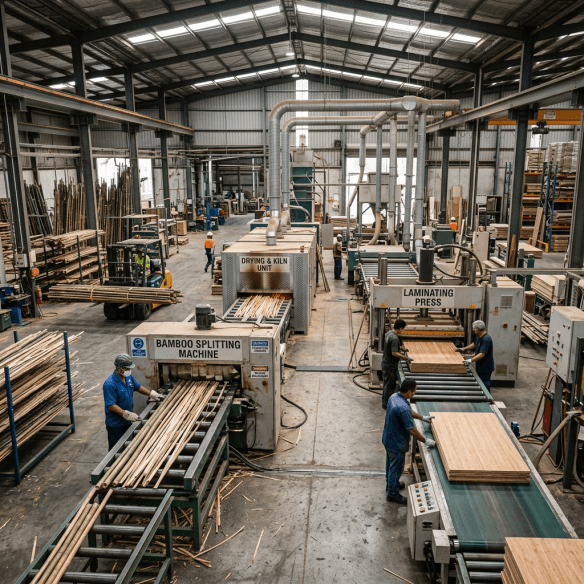
Engineered bamboo is a far cry from the traditional image of bamboo used for fences or rural homes. Through modern treatment, lamination, and fabrication, bamboo can be transformed into high-quality panels, beams, flooring, furniture, and even structural components for construction. As countries search for more sustainable building materials, engineered bamboo is gaining recognition as a renewable and lower-carbon alternative for many applications.
For the Philippines, the potential extends well beyond environmental benefits.
Bamboo grows rapidly, thrives in many parts of the country, and can help rehabilitate degraded land, reduce soil erosion, and stabilize watersheds. More importantly, if processed domestically, it can support an entire value chain—from farmers and cooperatives to manufacturers, designers, builders, exporters, and logistics providers.
Instead of exporting raw materials and importing higher-value finished products, the country has an opportunity to create more value at home.
That makes bamboo not simply an agricultural commodity, but a potential industrial sector.
Of course, successful industries are built through careful planning and consistent execution.
A competitive bamboo industry will require reliable supplies, strong partnerships with growers, modern processing facilities, product quality standards, skilled workers, efficient logistics, and access to domestic and international markets. These are not always the most visible aspects of industrial policy, but they are often the foundations of long-term success.
If financing becomes available, every peso should help strengthen this ecosystem.
Commercially viable bamboo-growing areas should be matched with nearby processing facilities. Farmers should have confidence that there will be dependable buyers for their harvests. Manufacturers should have access to trained technicians and engineers. Builders and consumers should be assured that engineered bamboo products meet recognized safety and performance standards. At the same time, export markets should be developed alongside production capacity so that growth remains sustainable.
Bukidnon has been identified as one possible hub, and it illustrates the broader opportunity. With its agricultural resources, available land, and strategic location in Mindanao, it has many of the ingredients needed to support an industrial cluster. When growers, processors, transport providers, research institutions, financial services, and manufacturers work together, regional economies become more competitive and resilient.
More broadly, the bamboo initiative reflects an encouraging direction for Philippine industrial policy.
This momentum is not occurring in isolation. Across multiple sectors, the Philippines has begun pursuing a common strategy: creating more value from its own resources instead of exporting them in raw form. The coconut industry is expanding beyond copra into higher-value products such as virgin coconut oil, oleochemicals, and specialty food ingredients. New investments in dairy processing—including the Lucio Tan Group’s modern yogurt manufacturing facility—demonstrate how agricultural production can be paired with domestic food processing to capture more value within the country. The cacao and coffee industries are moving toward premium markets, while the seaweed sector continues advancing into carrageenan and other specialty ingredients used globally in food, pharmaceuticals, and cosmetics. Beyond agriculture, policymakers are encouraging downstream processing of critical minerals while supporting growth in semiconductors, electric vehicles, battery supply chains, and data center infrastructure.
Although these industries differ widely, they share the same underlying objective: exporting more finished and specialized products rather than raw commodities, creating better-paying jobs, strengthening domestic manufacturing, and making the Philippine economy more competitive. Engineered bamboo fits naturally within this broader strategy—not simply as another agricultural product, but as a new manufacturing industry capable of generating long-term value.
The country has already established strengths in electronics manufacturing, food processing, business process services, and other export-oriented sectors. Expanding into engineered bamboo would demonstrate that the Philippines can also compete in emerging industries that combine sustainability, innovation, and value-added manufacturing.
Perhaps the greatest significance of this initiative is what it represents.
Industrial development is rarely achieved through a single announcement or investment. It is built through continuity, collaboration, and the steady improvement of capabilities over many years. Governments can provide financing and policy direction, but long-term success depends equally on businesses willing to invest, universities conducting research, financial institutions supporting innovation, and local communities participating in production. Stable policies that endure across administrations are equally important, giving investors and producers the confidence to commit to projects whose returns may take years to realize. When institutions continue moving in the same direction despite changes in political leadership, industries become stronger, more productive, and internationally competitive.
If the engineered bamboo industry succeeds, its impact will extend far beyond a single sector.
It can create quality jobs, strengthen rural livelihoods, support housing and construction, encourage environmental stewardship, and expand Philippine manufacturing into new markets. Just as importantly, it can demonstrate that the country can transform its natural advantages into globally competitive industries.
In the end, this story is about more than bamboo.
It is about building confidence that the Philippines can consistently convert good ideas into productive enterprises, local resources into higher-value products, and strategic investments into broad-based economic growth. Bamboo, coconut, dairy, seaweed, advanced manufacturing, and other emerging industries all point toward the same possibility: a Philippines that exports not merely what it grows or extracts, but what it designs, engineers, processes, and manufactures. If the country can sustain this direction with consistent policies, capable institutions, and long-term investment, its investment in bamboo will become far more than an investment in a single material—it will become an investment in a stronger, more resilient, and more competitive Philippine economy.


 The Society of Honor by Joe America
We have several stands of giant bamboo on our property in Naval. They are awesome plants. You can eat the shoots when they first pop from the ground. They grow several feet a day, and are incredibly useful for building cottages or benches, even as one-man tasks. They can fire the dirty kitchen. Beware the variety that is poisonous, as if poison oak. Itchy. i’ve read of bikes made of bamboo, and houses, of course. Smaller. I hope industrial products do well.
I think I encounteted the itchy ones in my youth, calamine lotion helped.
I also hope this get continous public private support.
here’s a bit of help for those unfortunate few who encountered bamboo itch, and do be careful with those labongs, the good eating bamboo shoots favored by chefs and cooks, sold in the markets. the shoots are naturally encased in thick covering infused with spiky hairs (itchy hairs), the covering best peeled off before the shoots can be sold, making the shoots safe for everyone to handle.
AI Overview
Wash the skin with soap and water. Pat dry. Press duct tape against the itchy area and pull it off to remove microscopic bamboo splinters. Dab 3% hydrogen peroxide on the skin, then apply hydrocortisone cream or an antihistamine to stop the itching.
Bamboo leaves and stalks have tiny, jagged barbs that break the skin. This causes a mechanical rash, similar to fiberglass itch.
Follow these steps for fast relief:
If the rash spreads or turns into a severe allergic reaction known as phytophotodermatitis, seek medical advice.
Thanks, K. We had a clump of those in our yard. It was hell to chop down and remove (for the workers). Once gone my breathing improved.
Many thanks.
when I was little, I was afraid to walk alone among the tall bamboos, and I keep looking over my shoulder. the bamboos creak a lot and sigh with the wind, they seems to talk to one another, scary. we used to go looking for labongs.
Off topic, but consistent with my efforts to promote the positives of Philippine development. The relationship between Japan and the Philippines is getting deeper. Japan wants it. The Philippines wants it.
https://bworldonline.com/top-stories/2026/07/03/760808/japanese-investors-interested-in-mrt-3-ppp-project/
Cebu is different. We think of retail, tourism, and BPOs as important. Well, add logistics. The Philippines is at the center of Asia and Cebu is at the center of the Philippines. Moving goods is big business. Insightful article. Note the optimism in spite of the current doldrums.
https://www.sunstar.com.ph/cebu/logistics-remains-cebus-bright-spot
And Canada, where over 200,000 Filipino OFWs work. Boundless mutual interests. https://www.philstar.com/headlines/2026/07/03/2539555/philippines-canada-seal-agreements-energy-labor-tourism
wonderful! canada maybe far but we are sort of neighbor. and with japan, philippines really is stepping up. our ofws in both countries are helping to spread the good word too, their work ethics are legendary and speaks volumes about us.
Thanks for all the good news.
As far as I am concerned, and as I discern, it is very refreshing.
Of topic here but related to prior discussions. Why the BPO industry is not failing because of AI but is adapting to it.
https://www.pna.gov.ph/articles/1278692?__cf_chl_f_tk=vGXru6yH0rs7uABe81B1rm0zqPUBGO0wysxGV9V4scs-1783216731-1.0.1.1-cAOLYXYZj2xZwvL2OfnmBB0x9yFc1lzm_xVUZPkQI1M
Good News, more training programs less resignations and firings
A bit busy today participating in American Independence Day festivities. While the official Congressionally-mandated America250 celebration has been gutted at the federal level to steal funds for Trump’s Freedom250 celebration of himself, America250 committees are out strong across all American states and local communities. I am enjoying the Biblical-level plagues of heatwaves, thunderstorms, golf ball sized hail, and stinging insects causing a meltdown at the sparsely-attended Freedom250 events in D.C. and Mount Rushmore.
Time is limited today, but if I may throw a “curve ball” at this discussion:
What if rather than pursuing an export market as it appears the Marcos Administration, DA, and DENR appear to be doing — an export market that is not yet established and faces measurable risk due to China owning most of the engineered bamboo products market (with Vietnam taking most of the rest)…
The Philippines can position the engineered bamboo products industry as:
1.) An investment in farmer livelihoods to uplift Class E farmers out of poverty.
2.) Creating a domestic construction lumber-replacement industry to first reduce reliance on foreign-sourced construction lumber and industrial wood products for domestic construction needs.
The Philippines imports $800 million (₱49.2 billion) per year in softwood-derived construction products to serve over 75% of domestic construction needs. The primary softwood construction products import sourcing comes from China (more than 50%), then Canada, then US, followed by significant amounts from Japan, Finland, Malaysia, and Indonesia.
The twin primary goals in national economic planning should be to replace import sources where possible then to saturate the consumption capacity of the domestic market first before export revenue is considered. In other words: to follow the development trajectory of every other successfully developed country. My series on economic development and a theoretical Philippine auto industry focused on exploring this.
Having a domestic market means shifting foreign markets do not have such a drastic effect on the Philippine economy — of which the late 1800s abaca trade is a clear Philippine example of such risks — because it would be a difference between the domestic market’s ability to partially absorb global downturns and complete industry collapse.
More on this later.
Happy Fourth of July to you guys.
Yes, good points per usual.
Great idea on paper, but it might encounter the same problem we have with rice and sugar, i.e. it is cheaper to import than to produce locally.
Chinese bamboo! Good thing the Pandas will eat them…joke
Still celebrating here but I wanted to address this.
I’ve discussed this topic many times in the past but to summarize, ordered by what in my opinion have the highest impact to domestic pricing:
High Impact
Moderate Impact
Systemic Issues
So yes, the government would need to invest in the underlying infrastructure as well, which is applicable to the broader agriculture practice rather than specifically for bamboo, sugar, coffee, rice, etc. This has not really been done at a sufficient scale in past agricultural initiatives. The Philippines just hasn’t yet figured out agronomics at a large scale.
“This has not really been done at a sufficient scale in past agricultural initiatives. The Philippines just hasn’t yet figured out agronomics at a large scale.” – Joey N.
I agree. And that is the tougher challenge – the Philippines figuring out agronomics at a large scale.
this is about farming in the philippines:
AI Overview
Land reform fundamentally contradicts the traditional model of industrialized farming in the Philippines. While land reform prioritizes smallholder ownership and social equity, industrialized farming relies on massive corporate consolidation, economies of scale, and high-capital investments.
The Core Conflicts
The Resulting Issues
How the Philippines Bridges the Gap
Because of these contradictions, the government has created workarounds to allow large-scale production without violating agrarian reform laws:
Cooperatives: The government encourages small agrarian reform beneficiaries (ARBs) to form cooperatives. These co-ops can pool their individual 5-hectare plots together to engage in larger-scale contract farming with major agricultural corporations.:
Agribusiness Venture Agreements (AVAs): Farmer-beneficiaries lease their awarded lands to large corporations. The farmers become stakeholders or employees, and the corporation manages the land as a consolidated, industrial-scale plantation (common in the banana and pineapple industries of Mindanao).
KB, for some reason the AI overview went under moderation and needed manual intervention.
thanks for being dexterous! if AI had its way, it is gonna send me to the neither region, never to be heard, or seen. and thanks again for rescuing my meager attempt at response.
Cooperatives struggle due to poor management and lack of cohesion. Terrible ag results. AVA’s I suspect do better.
Thanks KB. I’m personally in favor of cooperatives from an agency-retention perspective but I’m fine with AVAs too as long as the government has strong watchdogs against conglomerates buying up middlemen and forming a cartel. A problem with cooperatives is it requires more organizing closer to the farmer level, which may not be possible and so needs government-led organizing where farmer-led organization is lacking.
The US uses both the large agribusiness conglomerate and AVA model. However a problem is that due to cartelization of middlemen services AVA participants are often left holding the risks while the agribusiness conglomerate keeps most of the upstream profits. So something to think about.
France, the Netherlands, and Brazil are examples of where the cooperative model works very well, but it requires strong farmer organizing (see French or Dutch farmer “revolts” that happen from time to time).
I know in the Philippines there is the Nucleus Estate Model, mostly for monocrops (e.g. banana, palm, rubber, coconut) in Mindanao but it’s quite small. I read a while back about DA’s push for clustering, but haven’t looked too deeply on the progress of that. Maybe I’ll ask a agriculturalist friend who had left the Philippines and migrated to the US if she has kept current with the progress of the clustering initiative.
ah, joey, you seem to see problems with our fledging effort (!) as regards engineered bamboo. I see problems too, and that brought me to cynthia villar’s remark, baliw kayo sa reseach! coz the $500 million bet on bamboo has yet to enter feasibility study (research, yet again) which should conclude somewhere around 2027.
now, the research or feasibility study should already identify the land where the plant or factory for the engineered bamboo is to take place and my guess, it can only be close to where there is massive bamboo plantation is as in bukidnon province or mindanaw, to save on haulage and transport cost. the plant or factory big enough to house bamboo saw mill and drying shed where split bamboo are dried prior to processing. have we such skillful workers to operate the process, my guess, they would have to learn from the internet how to split bamboo in massive scale, how many days more needed to dry the split bamboo without them catching dreaded mold and fungus which tend to make the bamboo second to useless. to fasten mechanical driers, massive amount of electricity is needed in the drying shed, electricity we are hard pressed to supply as we have browns out often.
water is also needed in the process, this should have already been noted in the study. and if river water is used, the run off could contribute to pollution.
and we have to be mindful of indigents who abhor having their traditional land usurped by large scale manufacturer.
if we can jump the hurdle that ninotchka rosca talked of in her book, philippines, the land of many beginnings, we might just make it!
Birds and snakes love giant bamboo plants. It would be creepy as hell walking through a plantation of the stuff, creaky noises and slithering creatures. Japan has a park of giant bamboo. They trim them back to give the stalks separation but it’s still creepy. A guy with a machete can build a small cottage of bamboo in couple of days, Great for drinking tuba and snoozing during the day. Mosquitoes get in at night. Chickens can too, to leave their deposits.
green tree snakes are quite harmless, though they look lethal. they are quite common in coconut plantation too, up the coconut tree. we rarely see cobra, they are mostly in the paddies where there is abundant of food for them, like frogs.
I’d run first and worry about the color later. I’ve met 3 cobras. One killed my dog. We have frogs because it rains enough. No marsh. Just rice fields over there. I chased a snake, about five feet long, into a bamboo clump. We poked for an hour. Never got it out. It just disappeared in there.
I did immediately see some risks (mostly regarding import-substitution vs export). DA’s comments at the forum were ambiguous, which is probably fine as the proposal is to create a study. So far in my research on engineered bamboo it appears to be quite hard to crack the export market, which China controls. Vietnam which is the #2 country in engineered bamboo uses mostly Chinese-developed processes and Chinese-sourced adhesives — unsurprisingly selling supplies often can earn more money than the actual laborious work done in farming or resource extraction (just look at the origin of Levi’s jeans). Creating a domestic market to replace imported wood construction products might be better as it replaces $800-900 million per year in imports with a domestically manufactured substitute that would later have export potential.
As for the post-harvest processing, yes there is a tendency in the Philippines to prefer manual labor “because it’s cheap.” But mechanization requires machines, which then brings us to “where are the machines sourced from?” In this regard China is way far ahead, going from organically developing the entire engineered bamboo products industry through private small entrepreneurship to developing the machines and binding adhesives required for the modern process.
So all of this would need to be explored further… possibly in the feasibility study.
I think, in china, robots may be doing the actual, repetitive manual work, they work 24/7 and dont need to rest like humans, and dont have to be paid, they also dont join workers union, go on leave, or badmouth the boss.
it can p’haps be done like in the sugarcane industry where farmers with not so big land holding plant sugarcane and then sell them to the cartel or to the sugarboard. maybe bamboo can be same, farmers can plant bamboo in their land, harvest them and sell them to the bamboo cartel too. it could well be feasible if heaps of farmers do same, there would be steady supply for bamboo for commercial purpose, though having bamboo as monocrop to the exclusion of other crops is supposed to be not good for the soil.
I remember back in the 70s, when “Pelota” was the craze in Manila (a game similar to squash, but played with a shorter racket, a larger ball, and 3 walls), I had a racket made of bamboo. I got it because it was pretty and different. A more popular racket was a wooden one made by a company called Mar Craft if I recall correctly. It felt better than my bamboo racket. I don’t think non-wood rackets were out yet, or if they were, they were still rare.
I know of an wealthy family here in the Bay Area that put in bamboo flooring throughout most of their large home. I don’t believe it is a popular form of wood flooring, however. They put it in around 20 years ago. It didn’t come with the original house, so it was clearly a choice by the new owner.
for interior wall cladding, amakan from bamboo is traditionally used in philippine homes. it is cheap and has warmth that looks homely.
While we talk about economic opportunities that the Philippines can take advantage of, I just read this about South Korea in the Finance News:
>>South Korea’s Lee urges speed in launching mega chip projects.
SEOUL, July 6 (Reuters) – South Korean President Lee Jae Myung on Monday ordered officials to move quickly to get to work on major chip and AI projects announced last week.
He warned that delays in permits, land acquisition, and securing power and water supply could undermine the country’s bid to dominate advanced industries.
“In this situation, it appears the outcome will be decided by who moves faster and who secures the lead first,” Lee told a government meeting. “Only speed matters.”<<
The article (from Reuters) gives specifics on what Pres. Lee wants his people to attend to including the areas of infrastructure AND the bureaucratic process of getting permits, clearances, etc. etc.
Just want to point this out to show what the competition is doing and we can compare it with our own government’s abilities.