Finally, We Have a Tennis Star
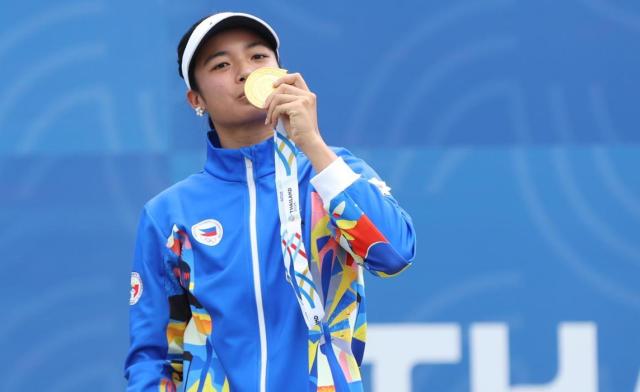
Alexandra Eala and the Arrival of Philippine Tennis on the World Stage
By Karl M. Garcia
For generations, Filipinos have watched tennis from the margins.
We knew the names of global champions. We followed Wimbledon, the US Open, the Australian Open and Roland-Garros. We admired Roger Federer, Rafael Nadal, Novak Djokovic, Serena Williams and many others. We played tennis in subdivisions, schools, clubs and public courts. But there was always a peculiar distance between Philippine tennis and the highest level of the sport.
The Philippines could produce talented players. It could produce juniors, collegiate champions and occasional international competitors. But it had never produced a player who could consistently occupy the global conversation.
That has changed.
Alexandra Eala is not merely a promising Filipino tennis player anymore. She is a genuine international tennis star.
And that distinction matters.
At 21, Eala has already accumulated a sequence of accomplishments that would have been extraordinary for any Filipino tennis player: the 2022 US Open girls’ singles championship, a breakthrough semifinal at the 2025 Miami Open, victories over multiple Grand Slam champions, the first Grand Slam main-draw victory by a Filipino player in the Open Era, a WTA final, a WTA 125 title, and, in 2026, her first WTA Tour championship in Washington, D.C.
She has now reached the world’s top 20 and entered the 2026 US Open as one of the most closely watched players in women’s tennis.
That is no longer a Cinderella story.
It is the emergence of a Philippine sporting institution in human form.
The difference between a good athlete and a star
A country can have excellent athletes without producing sporting stars.
The distinction is important.
A good athlete wins competitions. A star changes the relationship between a country and a sport.
Manny Pacquiao did that for boxing.
Efren Reyes did it for billiards.
Hidilyn Diaz helped do it for weightlifting.
Carlos Yulo has done it for gymnastics.
And Alexandra Eala is beginning to do it for tennis.
This does not mean that she has already achieved the historical stature of those legends. Her career is still young. But the mechanism is the same: she is making an entire population pay attention to a sport in which the Philippines has never been a traditional power.
The response to Eala’s rise has been remarkable. International coverage now routinely describes her not simply as a Filipino tennis prospect but as a global sensation. The US Open itself has described her progression from breakout star to household name.
That transformation is perhaps her greatest significance.
The achievement is no longer only what happens on the court.
It is what happens because Filipinos are watching.
Miami Was the Moment Everything Changed
There are victories in sport.
And then there are moments that change the trajectory of an athlete’s life.
For Eala, Miami in March 2025 was the latter.
She arrived at the Miami Open as a 19-year-old wildcard ranked No. 140 in the world. Before the tournament, she had only two career WTA-level match victories.
Then she defeated Katie Volynets.
Then Jelena Ostapenko.
Then Madison Keys.
Then came Iga Świątek.
The last victory was not simply another upset.
It was a declaration.
Eala defeated the world No. 2 and five-time Grand Slam champion 6–2, 7–5 to become the first player from the Philippines to reach a WTA semifinal.
More remarkably, she had defeated three Grand Slam champions in successive matches: Ostapenko, Keys and Świątek.
That sequence immediately established something that rankings alone cannot establish:
Eala belonged on the court with the best players in the world.
She eventually lost to Jessica Pegula in the semifinal.
But by then the important thing had already happened.
The Philippines had discovered a tennis star.
She Was Not an Overnight Sensation
The phrase “overnight sensation” is tempting.
It is also misleading.
Eala’s Miami breakthrough was sudden.
Her development was not.
She was already a highly regarded junior. She reached No. 2 in the junior world rankings and won the 2022 US Open girls’ singles championship.
That junior championship was particularly symbolic because Eala’s grandparents had met in New York decades earlier.
Her path also took her outside the Philippines.
She trained at the Rafa Nadal Academy in Spain, placing herself inside an elite international development environment rather than relying exclusively on the domestic tennis ecosystem.
That matters because elite tennis is not simply about talent.
It is an industrial system.
Players need world-class coaching, sports science, fitness preparation, competition schedules, recovery systems, travel support, analytics, nutrition, psychological preparation and access to strong opponents.
Eala’s development demonstrates what happens when Filipino talent is connected to that global system.
The lesson should not be that Filipino athletes must leave the Philippines to succeed.
The lesson should be that the Philippines needs to build enough of that system at home.
The Girl Who Won the US Open Is Now Playing the Stars
Eala’s 2022 junior US Open victory now looks almost prophetic.
Four years later, she returned to New York not as a junior champion hoping to break through but as a top-ranked professional.
That distinction is enormous.
The 2025 US Open provided another landmark.
Eala defeated Clara Tauson after coming back from 5–1 down in the third set. That victory became the first Grand Slam main-draw match won by a Filipino player in the Open Era.
The symbolism was difficult to overstate.
For decades, Philippine tennis had been looking for the player who could cross that invisible barrier.
Eala crossed it.
And then she kept going.
From Breakthrough to Consistency
The most important question after Miami was not whether Eala could produce another spectacular upset.
It was whether she could become a consistently elite player.
That is much harder.
Tennis is unforgiving because there is nowhere to hide.
A basketball player can have a bad shooting night while contributing defensively.
A football player can disappear temporarily while teammates compensate.
A tennis player walks onto the court alone.
Every weakness is exposed.
Every tactical mistake comes back across the net.
Every poor serving day becomes a vulnerability.
And every opponent has hours to study your game.
That is why Eala’s subsequent progression is arguably more important than Miami itself.
She reached the Eastbourne final in 2025, becoming the first Filipina to reach a WTA singles final.
She then won the Guadalajara WTA 125 title and finished 2025 ranked No. 50.
In 2026, the progression accelerated.
She won the Birmingham WTA 125 title.
Then came Washington.
There, Eala defeated Leylah Fernandez, Zheng Qinwen, Elina Svitolina, Naomi Osaka and finally Jessica Pegula to win her first WTA Tour title.
The final was especially significant.
Pegula was not an unknown prospect.
She was an established world-class player.
Eala came back from losing the opening set and won 4–6, 6–4, 6–0.
That is not the résumé of a player who merely catches opponents by surprise.
It is the résumé of someone learning how to win.
The Most Important Victory May Have Been Against Świątek at Wimbledon
The Miami victory over Świątek was the introduction.
The 2026 Wimbledon victory showed the maturation.
Eala defeated defending champion Iga Świątek 7–6, 6–2 in the third round.
The significance is different from Miami.
In Miami, Eala was the astonishing underdog.
At Wimbledon, she was already a recognized professional.
The opponent knew who she was.
The tennis world knew who she was.
The pressure was different.
And she still won.
She eventually reached the fourth round, her deepest Grand Slam run to that point.
This is the evolution every elite athlete must make:
from surprise to expectation.
It is relatively easy to be underestimated.
It is much harder to perform when everyone expects you to win.
Eala is now entering that second phase of her career.
The 2026 US Open Shows How Far She Has Come
The latest US Open provides perhaps the clearest snapshot of Eala’s new status.
She arrived in New York ranked around No. 18 in the world.
She was not merely participating.
She was seeded.
She was being profiled by major international publications.
Fans were coming specifically to see her.
And Filipino supporters were transforming her matches into events of their own.
Her first two victories at the 2026 US Open were convincing.
She defeated Mary Stoiana 6–1, 6–2.
Then Oleksandra Oliynykova 6–1, 6–4.
Her third-round match against American Iva Jovic became a three-hour battle at Arthur Ashe Stadium. Eala eventually lost 5–7, 6–3, 5–7.
The loss is disappointing.
But it does not diminish the larger achievement.
Quite the opposite.
Eala was no longer the obscure teenager trying to shock the world.
She was playing a major stadium match as one of the tournament’s attractions.
That is what becoming a star looks like.
Eala’s Tennis Is Distinctly Her Own
There is another reason Eala is exciting.
She does not look like a manufactured clone of another champion.
She is left-handed.
Her game is built around aggressive baseline tennis, a dangerous forehand, movement, variation and the ability to absorb and redirect pace.
Her left-handedness itself creates tactical problems because opponents encounter fewer elite left-handers than right-handers.
But her greatest asset may be something less measurable:
she appears to believe she belongs.
That is crucial.
The psychological transition from prospect to contender is enormous.
A young player can enter a match against a champion thinking:
“I hope I can compete.”
An elite player enters thinking:
“How do I beat her?”
Eala increasingly plays with the second mentality.
She Has Also Learned How to Lose
This may be one of the most important parts of the story.
Great athletes are not defined by avoiding defeat.
They are defined by what defeat does to them.
Eala has experienced the volatility of professional tennis.
She has lost early after breakthrough performances.
She has lost finals.
She has lost matches she was expected to win.
She has suffered disappointing stretches.
And now she has lost a brutal three-set match to Jovic at the US Open.
The danger would be to interpret every loss as a setback.
That is the wrong framework.
A professional tennis career is a long process of converting losses into information.
A weak serve becomes a development target.
A poor return game becomes a tactical problem.
A mental lapse becomes a psychological training opportunity.
A difficult opponent becomes a future study project.
The objective is not perfection.
It is compounding improvement.
And That Is Where Eala Could Become Truly Special
Eala is still only 21.
That is perhaps the most astonishing fact.
She has already reached the top 20.
She has already beaten multiple Grand Slam champions.
She has already won a WTA title.
She has already reached the fourth round of Wimbledon and the US Open.
Yet she is still developing.
That means we should resist the temptation to declare that she must become a Grand Slam champion.
Maybe she will.
Maybe she will not.
No responsible analysis can guarantee that.
Tennis is too competitive.
Injuries happen.
Careers take unexpected turns.
One generation collides with another.
A player can reach No. 5 without winning a major.
Another can win a major unexpectedly.
The correct conclusion is therefore not:
“Alex Eala will win a Grand Slam.”
It is:
“Alex Eala has developed far enough that winning one is no longer an absurd proposition.”
That is a much more meaningful statement.
The Philippines Has Been Waiting for This
There is a deeper national dimension to Eala’s rise.
The Philippines has enormous sporting passion.
But that passion has historically been concentrated.
Basketball dominates.
Boxing has produced international icons.
Weightlifting, gymnastics, athletics, billiards, bowling and other sports have produced champions.
Tennis has never occupied the same cultural space.
Eala could change that.
The potential consequences go beyond television ratings.
Children see someone who looks like them representing the Philippines on the biggest courts in the world.
Parents who never considered tennis seriously may begin asking about tennis academies.
Schools may invest more in courts.
Local clubs may gain members.
Sponsors may become more interested.
Corporate tournaments may grow.
Coaches may find more students.
A larger player base produces more talent.
And eventually, talent produces competition.
That is how sporting ecosystems develop.
The Eala Effect Could Be Bigger Than Eala
This is perhaps the greatest opportunity.
The Philippines should not make the mistake of treating Alexandra Eala as a solitary miracle.
The correct response is to build around her.
Imagine if every major Philippine city had accessible public tennis facilities.
Imagine stronger school tennis programs.
Imagine scholarships for promising juniors.
Imagine systematic scouting outside Metro Manila.
Imagine partnerships between the Philippine Sports Commission, private academies, schools, universities and international tennis institutions.
Imagine sports science becoming normal rather than exceptional.
Imagine promising teenagers being able to train domestically while periodically entering international camps and competitions.
Imagine Filipino coaches receiving regular exposure to international coaching methodologies.
Imagine a national pathway from:
school → junior circuit → national development → ITF → WTA/ATP → Grand Slam.
Eala should not be the end product of Philippine tennis.
She should be evidence that the system can produce one.
And therefore, perhaps, many more.
The Diaspora Is Part of the Story
There is something particularly Filipino about Eala’s popularity.
Filipinos are everywhere.
When she plays in New York, Toronto, California, London or other major international cities, Filipino communities can turn tennis matches into quasi-home games.
The US Open has already seen the extraordinary enthusiasm surrounding her.
International media have noticed Filipino fans arriving with flags, colors and enormous emotional investment.
This gives Eala something unusual.
She does not represent only a country.
She represents a global Filipino community.
That diaspora can become an economic and cultural multiplier.
Filipino communities abroad can support tournaments.
Businesses can sponsor events.
Tennis academies can establish partnerships.
Young Filipino athletes abroad can become part of development networks.
Eala’s identity therefore travels.
But We Should Not Turn Her Into a National Burden
There is also a warning.
Filipinos have a habit of placing enormous expectations on exceptional athletes.
We turn talented young people into national saviors.
Then we become disappointed when they lose.
That would be unfair to Eala.
She is not responsible for fixing Philippine tennis.
She is not responsible for winning every tournament.
She is not responsible for carrying the emotional expectations of more than a hundred million people.
She is an athlete.
Her responsibility is to become the best tennis player she can become.
Our responsibility is to build the ecosystem around her.
That distinction matters.
The healthiest form of national pride is not:
“You must win for us.”
It is:
“We are proud of you. Now let us build the conditions for the next generation.”
From Representation to Excellence
There is an important evolution taking place.
At first, Eala represented possibility.
Then she represented Filipino tennis.
Now she represents something larger:
Filipino excellence can be globally competitive in sports that the Philippines has never traditionally dominated.
That is a powerful psychological shift.
Countries often develop sporting confidence through repeated exposure.
A champion appears.
Then another.
Children grow up seeing success as normal.
Coaches gain experience.
Infrastructure follows.
Investment follows.
Eventually, excellence becomes institutional rather than exceptional.
Eala can be the first major pillar of that process in Philippine tennis.
The Larger Lesson Is Not About Tennis
Ultimately, Alexandra Eala’s story is not just a tennis story.
It is a story about capability.
Talent exists almost everywhere.
What differs is whether a society can identify talent, develop it, protect it, expose it to competition and give it the infrastructure necessary to mature.
Eala’s journey involved exactly those elements.
She had talent.
She received serious development.
She trained internationally.
She entered increasingly difficult competitions.
She learned from defeat.
She found the confidence to challenge the best.
And eventually, the world noticed.
That is a model that can be applied far beyond tennis.
The same principle applies to science.
Engineering.
Music.
Animation.
Artificial intelligence.
Manufacturing.
Medicine.
Sports.
The Philippines does not lack capable people.
The recurring problem is converting individual capability into sustained institutional excellence.
Eala offers a vivid example of what happens when that conversion works.
Finally, We Have a Tennis Star
For a long time, Filipino tennis fans could say:
“Maybe someday.”
Now they can say:
“She’s here.”
Alexandra Eala is already a historic figure in Philippine tennis.
She is the first Filipina to win a WTA Tour singles title.
She is the first Filipino to reach a WTA 1000 semifinal.
She became the first Filipino player in the Open Era to win a Grand Slam main-draw match.
She has beaten multiple Grand Slam champions.
She has reached the world’s top 20.
And she has demonstrated that she can beat established stars not once, but repeatedly.
But perhaps the most important achievement is not any particular ranking or trophy.
It is that a Filipino child can now watch a player from Quezon City walk onto the world’s greatest tennis courts and think:
I could do that too.
That is how sporting history begins.
Not with a medal.
Not with a ranking.
Not even with a championship.
It begins when an entire generation starts believing that something previously considered improbable is now possible.
Alexandra Eala has already done that.
She has made the Philippines visible in a sport where it had rarely been visible at the highest level.
She has given Filipino tennis a face.
She has given Filipino fans a player to follow from tournament to tournament.
And she has given the next generation something even more valuable:
a precedent.
For the first time, the Philippines does not have to ask whether it can produce a world-class tennis player.
We have one.
And she may only be getting started.
(Picture: GMA Network)


I was telling my wife that Alex Eala is a wonderful ambassador for the Philippines. Talented, yes. And oh so poised and intelligent in interviews. What a difference from the less articulate national leaders. Filipinos are learning to be good tennis fans because they want to fit in with the respect (and fame) that Eala demonstrates with such grace, and intelligence.
I hope she carries her fame into politics in ways Pacquiao could not achieve.
By the way, she plays the tennis game like Pacquiao boxed. Confident, determined, always improving, and packing such powerful punches. Her ground game is superb, reading and reacting with a quickness others can’t easily match, and punching with power. Terrific angles. Terrific unpredictability. Terrific skill shots, like drop shots and net play.
She is twice the player today than she was a year ago. I fully expect her to be top 10 within the next year. And women’s tennis will be better for all the fanatics behind her. Of which I am one.
I so much agree on all points.
from DOT: https://x.com/TourismPHL/status/2096816846070812908
https://x.com/iansantos/status/2096850946978689253 this tweet describes that Alex Eala has what I would describe as “Pinoy grit” – the way you might have experienced Pinoys a head shorter than you try to still run past you to shoot the basketball in, or how Filipinos tend look for a way in situations where others might not see a way:
her success shows how far “Pinoy grit” can go if properly trained and supported. I think it also holds lessons for the capability stuff Karl is exploring.
That picture of Eala diving for a low ball on the Wimbledon grass reminds me of Boris Becker in his youth. He played that way. I believe he won his first Wimbledon title at age 17.
Eala’s rise reflects her talent, maturity, enthusiasm, sacrifice, and family support, which ultimately led to international recognition and a full scholarship at Spain’s Rafa Nadal Academy.
If there are any Hispanistas left in the Philippines, they will be happy to know that she is picking up the Spanish language.
Is that good or bad?
Learning another language is generally a good thing.
Ok TY
I saw the Eala vs. Stoiana match last week since it was playing in the background at a cafe I was working out of. A beautiful and talented young woman, for sure.
The cafe was playing 80s hits and ironically as a bunch of older polo-and-slacks-wearing pinoys cheered, Genesis’ 1980 hit Turn It On Again came up on the cafe’s Spotify playlist. For those who might not know, Turn It On Again is a song about a man who watches TV and listens to radio all day, becoming obsessed with the people he watches on the screen; a parasocial relationship.
I have to say, how did intense national pride for Manny Pacquiao since his breakout 2008 bout versus Oscar de la Hoya translate into national development and international prominence? Well since I am around a lot of Fil-Ams going back to my Catholic school days, we were all following Manny Pacquiao since the late 1990s — certainly after his international debut as a last minute replacement then win the International Boxing Federation super-bantamweight title in Las Vegas back a few years later in 2001.
There is already a Philippine archetype of the impoverished youth who fights their way out of poverty to global acclaim. A powerful cultural sedative that romanticizes individual resilience — the burden of success implicitly shifts to the raw grit of a Filipino rather than structural support from the government, education, infrastructure, jobs, or more robust social safety nets. Oh, you failed? Guess you weren’t resilient enough!
Then one must speak to how athletes who make it to the global stage are co-opted into state patronage, oligarchic patronage, and as a piece of spectacle within performative politics. Cash incentives, gifts of cars and condos, intense media coverage, strongly patriotically-worded congressional resolutions all are part of a cycle of illusory national progress. The legitimacy won by the personal dedication and work of the athlete is borrowed to gloss over actual and real development that is broadbased.
As a former athlete myself during my school days, I feel for athletes like Carlos Yulo and Alex Eala. Who would be surprised if 20 years from now once these young athletes’ position as parasocialized substitutes for self-esteem and need for recognition had outlived its national usefulness? Unlike Manny Pacquiao who can still take part in staged and fake exhibition matches at his advanced athletic age, what role then for Yulo or Eala decades from now? How is it fair to put the entire weight of the national expectation on the shoulders of promising young people like Yulo or Eala. Besides, unlike boxing, tennis is definitively an elite sport with elite fans — making elite sports an even more difficult vehicle to broad replication. In the Philippines, athletes who make it to the international spotlight are celebrated as stand-ins for Filipino resilience, where the win is the result of a miraculous anomaly rather than the result of consistent application. Acknowledging an athlete’s years of hard work, instead simplifying wins as a “miracle,” would take away the possibility of diskarte and miracles from the fan who holds heavy expectation.
Athletes like Carlos Yulo and Alex Eala deserve better. The Philippines and Filipinos deserve better.
I don’t know much about Carlos Yulo. Eala comes from a well-to-do family that played tennis and recognized she had talent so sent her to Spain where she has trained for years. She represents her nation with pride and thanks her fans endlessly for the love and support they give her. She has sponsorship deals with Globe, BPI, and Nike and is earning into the millions. I don’t think she deserves better. Obeina (sp?) the pole vaulter does for sure. The weightlifter lady. And the thousands of skilled athletes cut out of the picture deserve better.
The Philippines has so much athletic talent and the organizers of athletics here fail to tap it year after year.
As for fans, each has a story and a need. Let them cheer, and rabidly so.
I nod and agree w/ JoeAm on this one…speaking of the fans. Another Filipina I cheer for in tennis is Leyla Fernandez, although she represents Canada in international tournaments.
Our local Milpitas High School has a Filipina phenom on its Varsity girls’ flag-football team. She is remarkably athletic and has been dominating at quarterback. Defenses must respect her arm, but they also have to worry about her taking off with the ball. When she runs, she reminds me of a mouse escaping a cat—quick, elusive, and very difficult to catch.
She is also an accurate passer. She is shorter than many of her teammates, so I wonder whether that might become a handicap if she moves on to the college level. Then again, in flag football, being shorter may actually be an advantage: she presents a smaller target and may be harder for defenders to reach for the flags.
I’m not suggesting the talent of athletes like Eala or Yulo should be dismissed. Athletes train hard for years whether their sport has masa roots in the street, like boxing or basketball, or is an elite sport like tennis or golf. Nor should one dismiss the real, evocative exuberance of their fans. Cheering for another’s success is a good thing.
What I’m saying, however, is that there’s a rich history of sportswashing in developing nations, usually by those with systemic corruption and widespread poverty, sometimes coupled with state authoritarianism. Sportswashing is where the state appropriates an individual athlete’s success as a substitute for real, broad-based economic development, purporting “proof” of “vitality” and “success” while the collective euphoria and shared belonging fans feel create a halo effect that lets people temporarily forget their government’s real structural failings. Often the country’s media (at times state-captured) and its politicians seize on an athlete’s success, framed as “overcoming great odds,” to conflate individual grit with state success.
During Martial Law, as the economic realities of crony capitalism began breaking the country’s foundations, the Marcos Sr. regime ran an official sportswashing program. There was the famous 1975 “Thrilla in Manila,” a multi-million dollar international PR event meant to assuage global investors who’d started pulling back after the 1969 Balance of Payments Crisis, accelerated by the 1973 Global Oil Crisis. There was the Gintong Alay program, the National Sports Associations, and staged mega-events like the Philippines’ hosting of the 1981 Southeast Asian Games. Makoy himself called Martial Law a “cleansing instrument” for attracting investment, while Imelda dubbed it “martial law with a smile,” a phrase popularized by Marcos critic-turned-apologist Teodoro Valencia.
Of course, once Martial Law ended and the post-EDSA era began, the debt-laden Philippine state could no longer sustain state-sponsored sports patronage. The National Sports Association in the early 1990s was famously plagued with red tape, in-fighting, jockeying, and corruption of public funds, judging from microfilm of old Manila newspapers I’ve read from that era. Domestic conglomerates stepped in as private patrons, shifting basketball and boxing to street-to-national pipelines. The emergence of tennis, an elite sport, may indicate these conglomerates are expanding their patronage networks and sponsorship of Olympic medalists. Whereas countries typically developed first before pursuing international sports as soft power to sell stuff abroad, domestic conglomerates become patrons to sell stuff domestically.
I don’t take particular issue with private sponsorship of remarkably talented athletes. My bone to pick is with the political parasitic opportunism that uses the hard-won success of individual Filipino athletes, who applied real dedication, as a substitute and a cover for political dynasties’ inaction on the hard work of governance.
Olympic gymnast Carlo Yulo had to move to Japan for the training facilities and mentorship that didn’t exist in the Philippines.
Olympic pole vaulter EJ Obiena faced a bitter, unnecessary accounting dispute with his own Philippine Athletics Track and Field Association, which demanded ₱4.8 million back (spent on the Ukrainian coach who mentored his Olympic win) until COA stepped in and cleared him.
Olympic weightlifter Hidilyn Diaz famously had to beg the public on social media for funds just to travel to the Olympics, a major national scandal in 2019.
Yet when these athletes win unexpected victories through their own willpower and their supporters’ sponsorship, politicians and media figures rush to halo-grab. Winners are paraded through the streets for photo ops. “Resolutions of Congratulations” and cash bonuses are quickly drafted and passed. There’s no real political capital spent to glom onto another’s success, capital that could instead address the structural shortcomings driving fans to find hope in these wins in the first place. It’s costless performative politics, congratulating athletes’ “miracle” wins while ignoring that the athletes worked hard for years, because acknowledging that hard work raises the question of why politicians can’t apply the same effort to their own roles. It’s fake accountability, cheaper than actual legislative work or rooting out corruption (since many of the politicians glomming on are part of the corruption problem). No reform of the problematic Philippine Sports Commission (successor to the Marcos Sr. era NSA). No widespread gymnasiums built in the provinces to give kids hope and a positive outlet. No finally solving the chronic malnutrition still stunting the physical potential sports excellence requires, though 4Ps has alleviated childhood malnutrition somewhat.
My problem is with this system of national saints. Filipinos temporarily forget chronic problems like traffic, corruption scandals, red tape, and political gridlock. Raising up a generational, even seemingly miraculous, talent doesn’t require asking hard questions or reforming the system. How often is a saint’s unassailable credibility, amplified by the unifying euphoria of victory, co-opted as a shield to launder a politician’s image? When the wave of euphoria subsides, what’s left of that patriotic pride?
I’m not arguing that there shouldn’t be sports or fans. Both are good and should be supported. But as Karl alludes to before the article’s conclusion: “The Larger Lesson Is Not About Tennis.”
I don’t think the current Marcos government uses star athletes in an untoward manner. Recognize them? Sure. I don’t think Eala will allow herself to be used. She appreciated Marcos’ recognition of her achievements. The Philippine people likely use athletes to put salve on their own wounds. Cure the wounds and they’ll probably still cheer though. The Philippines is a community of strong bonds. I can’t see a problem with that. The only problem is lack of a competent sports authority, and money to spend.
Agree, but that hasn’t been my point since my first reply. Not criticizing Marcos Jr. either as he hasn’t been a big offender in this regard. I’m driving home Karl’s closing argument: the competence and effort of these athletes can be learned from and applied to developing other areas of Philippine capability — ultimately lifting the nation as a whole, not just individual athletes — but that requires politicians to drop the performative halo-grabbing and do real work.
To dream the impossible dream. Yes, Joey that would be the prerequisite.
Yes, and with enough knowledge things that previously seemed impossible start to feel possible then suddenly mundane.
I agree they need to do more and smarter work but it’s not halo grabbing in the way. It’s dynastic privilege that blocks or distracts, and simple lack of accountability or commitment that makes, for instance, jails as life-destroyers rather than life builders. I don’t really see athletes being used much by politicians. Probably because they know it raises the uncomfortable issue of why there aren’t more.
Unrelated OT, but interesting on a couple of points. The PH BPO sector is a unified entity in terms of associations here so are pretty forward looking and aggressive. This explains it part why the sector continues to grow rather than shrink. The initiative explained in this article is aimed at reducing reliance on the US.
https://mb.com.ph/2026/09/08/philippines-bpo-sector-courts-asia-europe-to-curb-us-offshoring-reliance
interesting quote from the article:
so that seems to be the new term for “shared service centers”, I personally/professionally am familiar with accounting shared service centers, specifically the vendor invoice management part, and know that Accenture had or has one in the Philippines.. but yes offering practically entire divisions is something Cloudstaff already does in the Philippines.. so deepening that seems a very strategic move and of course building full capabilities is useful in general.
This is not quite as it seems. GCCs already exist in the Philippine BPO industry, such as for high-value customers such as banking. My bank, JP Morgan Chase for example, routes calls to such a GCC. GCCs are quite small in the Philippines though and I doubt there is enough of a base of qualified workers to expand that much without first building up an educated and well-trained workforce.
The Philippines BPO sector article also reads like a press release, because essentially it is one. Too often I find that Filipino “journalism” consists of re-wording press releases without any deep analysis, or even reproducing press releases in whole. So the article is not actually a good sign of industry growth, but rather is based on a defensive press release.
I’ve had to deal with vendors pitching stuff for my sign-off so I’ll try to break down the article’s “PR Speak” …
Press releases generally must remain factual since there is SEC oversight, but it is not against the law to massage words to put it in a better light.
In the previous July, 2026 IBPAP press release which I had commented on months back somewhere in an earlier article, and where IBPAP released the downgraded outlook numbers, IBPAP stated:
Philippine IT-BPM sector eyes up to $50.5 billion revenue by 2028 in AI shift; July 14, 2026; ABS-CBN
The truth of the matter, however, was that the Philippine BPO sector already showed signs of structural and visible softening before the most recent global crises (e.g. Iran Conflict). The X/Twitter blogpost by user pos2only that Irineo shared and we discussed in detail was written back in February 18, 2026.
The Philippines’ biggest industry has about 3 years left; February 18, 2026; @pos2only via X/Twitter
Here’s the fundamental differences between the Philippines BPO sector and emerging rivals, which IBPAP dismissed as “third-layer” in this article (industry folks will understand this underhanded insult which means essentially “third tier,” where Manila and Cebu are “first tier”).
The lesson here is don’t dismiss “third-layer” competitors 🙂
Something interesting I saw was that apparently IBPAP is now boosting 2 million “AI-enabled” workers by 2028, without a real plan. Agentic AI voice agents are a huge threat that makes “AI-enabled” workers irrelevant. While there are some Philippine GCCs that successfully use what’s called “intelligence arbitrage” (using AI to augment already elite human agents, as I mentioned before GCCs are typically small in relation to general voice services oriented operations. There are claims marketed of agentic AI capability which does not actually exist, something called “shadow implementation,” according to a May, 2026 industry report. Fly-by-night (Philippine owned) operations are deploying cheap or open-source self-hosted LLMs running locally as “wrappers” which have a hallucination rate of up to 25%, further eroding client trust.
When we look at IBPAP as a “Philippine trade group,” and realize that the “Philippine” here is mostly a branding exercise of an association of 100% foreign-owned BPO companies, stuff starts to make sense. The automotive trade group CAMPI is a mostly an association of foreign auto companies where CAMPI exists to help foreign companies sell into the Philippines; IBPAP exists as an association of foreign IT-BPM companies to to operate from the Philippines. IBPAP’s membership is 85-90% foreign-owned companies, while the 10-15% domestic companies mostly cater to the domestic market. So one needs to ask: if it is no longer a cost-saving and thus profit-boosting measure to have outsourced operations in the Philippines, why would these companies stay? The interest of the Philippines economy is secondary to the fiduciary responsibility of these companies. The foreign-owned companies are operating in the Philippines to access cheap voice-based labor, nothing more, nothing less. Once that cheap labor is no longer needed, it no longer worth investing in. The remaining part of the Philippine BPO industry is the actual real estate BPO companies operate out of, banking services to BPO companies, and the like.
The era of cost-arbitrage (exploiting cost differences across borders) is ending. The original proposition of the Philippines as a BPO destination was cheaper labor for the same English fluency and Western (American) cultural affinity. That proposition is no longer enough in a new world that requires the best engineers, coders, and technical resources. And for that an ecosystem of technologically competent, digital native workforce is needed. The Philippines strategy of voice services already occupies some of the lowest parts of the value chain in a world where competitors are rapidly moving up the value chain by bypassing low margin work. To put something into perspective, the Philippines BPO growth rate has dropped down to 5-7% per annum from the hyper-growth era of the last 20 years while new contenders focusing on higher value outsourcing such as Vietnam are breaking through 20% per annum growth. The Philippines is trying to do reforms to address the needs of the future, like the STEM Education Act, Trabaho Para sa Bayan Act, CHED Curriculum Alignment and more, but these mostly exist on paper or are in early implementation. There is a lack of 200,000 STEM professionals and qualified technical educators by 2030 per DOST, and not much time left before then.
ooh, Poland is extremely strong, approaching Germany in terms of capability AND the work ethic is more like the OLD German work ethic – because from Gen X onwards we somewhat became slackers over here, and regarding Gen Z a lot of “Meister” (master craftsmen) are saying it is so hard to get apprentices to become journeymen (Gesellen) because “the young people all want to be influencers”.. plus some GERMAN experts even have moved to Poland due to lower taxes for nearly the same standard of living by now.
Poland was one of the nearshoring destinations for Germany a decade ago. Romania is the nearshoring destination for French and German firms as Romanians usually speak English plus at least one other European language – their language being the closest to old Latin helps and they too are a former (Ottoman) colony so they are flexible/resilient as well..
Vietnam as usual intensely dedicated while the Philippines tends to be overconfident and then back to playing not patintero but catch-up.
A shame if the meister system is waning in Germany. South Korea’s Ministry of Education had launched a meister program specifically for semiconductors and advanced technology, with dozens of high schools participating (a number that’s growing). India has also asked South Korea for help to set up meister schools in India.
https://www.koreajoongangdaily.com/business/with-youth-employment-dropping-students-look-to-semiconductor-specialty-schools-for-guaranteed-work/12213859
Yes, and Poland is currently moving up the value chain into software engineering, advanced technology, defense and so on. A lot of my favorite videogame series are from Polish studios. No longer is Poland exporting the stereotypical Polish plumber or cabbie. No longer is Poland mainly doing German language based work (though they still do).
Interesting here too, which I’ve mentioned before, is that Vietnam had since early in the GenZ generation an English immersion mandate in the early elementary years. That has morphed into a full English as a mandatory language on par with Vietnamese starting in Kindergarten with a third, elective, language mandated a while back. Consequently most Vietnamese GenZ are apparently fluent in Japanese, Chinese, German, Russian, Korean, Malay, etc. along with Vietnamese and English. A friend of mine in Cebu has a GenZ aged sister who has a Vietnamese girlfriend; the Vietnamese girl speaks fully fluent Tagalog and Cebuano, as well as Chinese, while my friend’s sister can only muster a few phrases in Vietnamese. They’re both digital artists. The sister moved to Saigon to work in a Vietnamese animation studio that does animation for Japanese studios (anyone who has watched J-animation in the last 10 plus years has likely noticed that the credits are increasingly filled with Vietnamese names).
That along with the STEM-focus. Btw Vietnam has a lot of conglomerate-owned private schools, similar to Japan (which did it first) and South Korea (which copied Japan), that pipelines STEM students directly into corporate jobs. It seems all the major Vietnamese conglomerates operate their own system of high schools, technical colleges, and research universities. It’s considered very prestigious to get a slot in one of these schools. And all this is beyond what is already mandated in terms of language skills and STEM courses in normal public schools.
This has to mostly do with proactive vs reactive policy. It’s so much easier to just pass a resolution congratulating an athlete’s win than to do the hard work of preparing ahead of time.
not really waning.. in crisis definitely, though where Filipinos tend to glaze Germans tend to see warning signs very quickly.
actually one sees more and more foreign-origin names on the vehicles of new Meister – it is a path up the ladder many immigrants now take.
there is also a bit of a crisis in German engineering, but that is also where immigrants are increasingly filling gaps.
I took my article last year (“Rising Waters in the Philippines”) as a first chalk mark for what the Philippines should be doing about floods.
this year’s article “It’s Raining Again” is the second chalk mark.
even in terms of reacting the Philippines seems to lack a sense of priorities.
I suppose a glass is half full or half empty depending on what you want it to be. I am pretty confident the Philippine BPO/GCC industry is stable and growing in a setting that is unstable and churning, and in which doomscrollers a year or two ago predicted its demise. The industry is not mom and pop stores, it is competent giants of the industry, and they are pressing on, not fleeing. As to the article being PR, experts such as yourself could certainly call it out. Ignoramuses such as myself appreciate knowing what a GCC is, and I am pleased the Philippines has them. The fact that there is an active association is good news for me, and if they are busy polishing their gem rather than grinding it in the mud, we can see that as being in the full part of the glass.
Here is a profile of the Philippine’s digital budget in 2027. It encompasses several important initiatives.
https://www.pna.gov.ph/articles/1283707
Hmm, I think the type of rationalizing by the industry is why the Philippines remains largely reactive rather than proactive. And by industry, I mean 85-90% foreign stakeholders who operate within PEZA zones to access voice labor. Voice labor occupies one of the lowest levels on the value chain — that’s just a fact. One must remember WHY the Philippines BPO exists in the first place: the foreign companies that make up the IBPAP membership offshored American, Canadian, UK, and later Australian voice labor to the Philippines because it’s cheaper to do so in the Philippines. Agentic AI is cheaper than Filipino labor. Agentic AI, which is getting better at a rapid pace, does not have 30-40% turnover, does not have recruiting costs, does not need huge office real estate complexes built to house humans who perform cheap voice labor.
GCCs are nothing new; I’ve helped build more than a few in my time. GCCs are quite small and tailored to very specific high level work, thus only employ equally small numbers of elite agents.
It’s important to differentiate what IBPAP as a trade group representing foreign-owned companies is doing and what the Philippines government is doing. In any case people can conclude what they want. My view in my third decade inside the broader industry, tells me something different. People don’t survive this cutthroat industry by being complacent and reactive.
My point is that the Philippines needs more proactive government involvement, at a large scale, and while the press release you shared shows the government is doing something, it’s not enough. The amount dedicated to the effort is simply not enough. Personally I’d view press releases, like the government PNA and industry IBPAP ones, with a grain of salt. Both are remarkably defensive in nature, if one reads between the lines. I have already laid out the case in detail, and welcome fact checks by any AI.
My sense (from my various readings) is that the statement suggesting BPOs as being “complacent and reactive” is wrong. As for “doing more”, the Philippines needs to do more in many areas and it is good to see the Marcos Government aware that automation is core, versus the Duterte Administration that believed killing people is core. You write to the empty part of the glass. I see the glass filling as being something good.
Yes, Marcos Jr. is trying to do more, but as I’ve said the industry is largely market-driven and isn’t guided strongly by the government. The whole point of the industry moving call centers from California, Texas, Florida, Atlanta to the Philippines in the first place is to access cheap voice labor. If that voice labor is no longer required the Philippines is no longer needed.
We shall agree to disagree on this matter. In a few years I suspect my reading and sense of how the pieces are moving around will likely be closer to what eventually happens.
Could be, for sure. The Philippines certainly maintains it’s labor cost advantage. So if AI upsets the BPO apple cart, maybe there will be manufacturing to replace it. I think the OFW “markets” here are increasingly formal government to government arrangements, and therefore regimented. A number of my wife’s school classmates are OFWs and seem to bounce back and forth as jobs appear or disappear. A sister in law is studying German, aspiring for a nursing job in Germany. The labor costs support that robust “industry”.
Yes, even if agentic AI disrupts the Philippine BPO’s cost arbitrage model on voice services the correct response would be to re-train workers for higher value jobs. I mentioned in my long post that DOST has already provided recommendations to the Congress and OP to narrow the 200,000 high skill worker gap by 2030, and the government is working on it though with not as much robustness as I’d like to see. Marcos Jr. is really limited here in his options as it’s really a job for Congress even though I’m sure DDS will find a way to blame stuff on him ahead of 2028. If you refer to the PNA release you shared, which is directly from Marcos Jr.’s policy shop, he is attempting to use existing funds to re-skill BPO workers ahead of the AI onslaught. The funds dedicated to that effort are quite small because the funds need to come from the OP’s own budget; only Congress can allocate what’s actually needed at scale. In terms of tech stack high skill jobs, it seems like there will be another generational lost since GenZ is too old now, but with Gen Alpha rapidly maturing there is a chance to recalibrate and capture whatever is left by instituting the DOST STEM education recommendations. The Philippines has also risen (slightly) in PISA ranking, which I attribute to the better education of Gen Alpha and perhaps the youngest cohort of GenZ. A Marcos Jr. policy. Industry such as the Pax Silica opportunity and soft skill jobs like nursing or medicine are really the way to go, followed by hard skill jobs like engineering of Pax Silica ends up being a success.
The value chain eliminates the weakest link. That does not mean that while you go up a level you would no longer compete for cost. It is always everybody has a price in more ways than one.
There is a thousand and one ways to escape or avoid getting your hands dirty. Comfort zones
Too much focus on lower value voice services is a weak link. Must remember that early IVR automation attempted to replace voice services in US call contact centers 2 decades ago, before the Philippines BPO industry was even a twinkle in anyone’s eye. IVR failed at the time because it was too rigid. Agentic AI is not that rigid. There is always going to be a place for so-called “elite” human agents, such as those operating from GCCs, but GCCs will never replace the sheer scaling of general voice services that powered Philippine BPO sector and which is now under threat. Increasingly when I call customer service, Filipino human agents are constrained in options while agentic replacements offer easier service. A big flashing warning sign.
Time to share one account without violating NDA.It was Directory Services wherw you locate the listing click and say thank you. What took so long for levelling up that I do not have any idea. That I am sure is already AI ed by now.
Also of interest, how the US and Philippines are working together on defense.
https://news.usni.org/2026/09/08/marines-help-philippine-armed-forces-develop-strike-plans-for-brahmos-anti-ship-missile
This is great actually. I’ve long believed that the AFP has unique strengths in distributed operations and that the over focus of some in the Philippine defense space on expensive weapons like submarines and fighter jets to be misguided. The AFP has excellent roots in distributed operations, proven successfully in the WWII resistance and during the Cold War deployments. As such the US Marines with the Marines’ new Distributed Maritime Operations doctrine and dispersed (rocket) fires matches well.
Joey’s ideas about stardom are interestingly similar to those of Ayn Rand, I don’t remember the exact wording but she said that individuals can’t borrow the achievements of those who just happen to belong to the same nation. That is of course extreme individualism, and at some level it is true – the hilarious version of that in German popular culture is the couch potato bum who drinks loads of beer and watches soccer.
But of course we are not merely individuals, we are part of the collectives that Ayn Rand scorned. Of course sports can be misused by politics for propaganda, but for instance the first German postwar World Cup win in the 1950s, with the famous tabloid headline “Wir Sind Wieder Wer” (we are back, roughly translated) was an important morale boost in the time of postwar reconstruction. And one cheers for people in one’s own nation, own city, own school winning like Greeks cheered for the victors from their towns in the old Olympics.
Carlos Yulo unfortunately got a lot of flak from the fickle Filipino public for his Pinay-Australian girlfriend whom everyone considered rude. Eala will be fine for sure. Of course DOT keeps cheering anyone who wins from the Philippines, whether it is BINI at Coachella, Alex Eala – or SB19 at Lollapalooza, but I wouldn’t compare the kind of promo they are doing now with what Marcos Sr. did with sports and Imelda did with large parts of OPM, that ain’t right we are in a different day and age.
As for fans, Eala fans seem to often be established middle class people from the Philippines as well as the migrant crowds, often the ones more established. The latter cheer for her like they would be happy for their kids achieving something. Of course there are also stage parents who over identify with their kids, just like there are crazy fans.
Best scenario would be if the Philippines keeps growing economically AND cheers its winners, a bit like Germany did in the 1950s.
The best fans for me are those who admire stars for their will to succeed and their work ethic, whether their idols are the likes of Manny Pacquiao or SB19, EJ Obiena or Carlos Yulo, Alex Eala and BINI. I once mentioned how Chino Hills Pinoys flocked around the Wish Bus performances of SB19 and BINI outside an ube cafe (Cafe 86) back in late 2022, Joe you mentioned that the people who live there are far from being losers. Way better in any case than the bitter Pinay titas who bullied young successful Pinays in Switzerland.
Fame is a peculiar beast. And the well-to-do attend concerts as the poor pirate the music. Same with the tennis arena. Eala rocks. Tennis is a snob sport to begin with which is why Filipino cheering excesses drive the stiffed lips crazy. Golf is another snob sport. Baseball in the US covers all classes but the rich have better seats. Success creates a hierarchy. No problem.